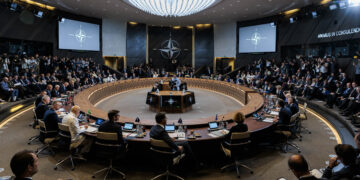
Marco Rubio, the poor man’s Kissinger of our era, drew standing applause in Munich this month—an odd reception for a speech that offered explicit Christian (trans)nationalism. A year before, his colleague and rival J.D. Vance had said similar things, albeit in harsher words. As U.S. missiles pounded Iran this week, German Chancellor Friedrich Merz was muted in his criticism of the latest American military adventure, abjuring any idea of “lecturing our partners.”
After twelve months of both European gestation and American reiteration, in the form of National Security and National Defense Strategies anchored on a pivot to the Western Hemisphere, the dust has started to settle in Europe, even as it rises again in the Middle East. Despite the praise lavished on Rubio by Eurocrats, the continent is finally, fitfully, stumbling towards something like an independent path. Nowhere is that truer than in the land of his German hosts.
As even a casual student of postwar Europe might remember, the Atlantic alliance came into being in 1949 with a triple mission. In the pithy words of its first secretary general, Sir Hastings “Pug” Ismay, NATO was created “to keep the Americans in, the Russians out, and the Germans down.” Three quarters of a century on, all three planks look very wobbly.
Author