Key Points
- The Trump administration’s harsh rhetoric toward NATO allies obscures that the U.S. defense posture in Europe remains mostly unchanged. Rather than reducing the U.S. presence, Trump has leveraged it to bargain for heavier European defense spending.
- Europeans last year pledged to spend 5 percent of GDP on defense and related infrastructure. In return, the United States is keeping its current forces in Europe and remains committed to European defense for the foreseeable future.
- This is a bad deal for Americans, not only because the European pledges are not worth much, but because heavier European defense spending, even if it occurs, does little on its own to benefit the United States.
- Because the Russian threat to Europe beyond Ukraine is limited, the United States need not worry that reducing its force posture will leave European allies dangerously exposed.
- Ironically, keeping so many U.S. troops in Europe undermines the incentive for European states to do more on defense, which means not just meeting spending pledges but reducing their dependence on the United States for military operations.
- Rather than try to get the Europeans to spend more on defense, the United States should start leaving Europe by reducing its force structure on a timetable toward an ultimately full withdrawal.
Trump vs. Europe: more bark than bite
To many observers, President Trump’s recent announcement that he would pull 5,000 troops out of Germany—initiated in response to German Chancellor Friedrich Merz’s criticism of the U.S. war on Iran—demonstrates his desire to radically remake the transatlantic relationship by forcing a genuine burden-shift within NATO and ultimately reducing the U.S. military presence on the continent.1Natasha Bertrand and Kit Maher, “Trump Threatens More Cuts After US Announced Withdrawal of 5,000 Troops from Germany,” CNN, May 2, 2026, https://www.cnn.com/2026/05/01/politics/us-troop-withdrawal-germany-trump-merz; Julian E. Barnes, Helene Cooper, and Megan Mineiro, “U.S. to Withdraw 5,000 Troops from Germany, Pentagon Says,” New York Times, May 1, 2026, https://www.nytimes.com/2026/05/01/us/politics/us-troops-germany.html. The Pentagon subsequently stated that they were going from four brigade combat teams in Europe to three.
Even before taking office for the second time, Trump unnerved European allies with his enthusiasm for peace talks with Russia over Ukraine, his failure to hold Ukraine in the same high regard as most transatlantic leaders, and his tendency to occasionally blast NATO allies as free-riders.2Benjamin Friedman, “Make America’s Allies Sweat,” Defense Priorities, January 23, 2025, https://www.defensepriorities.org/symposia/realistic-recommendations-for-trump-ii/#benjamin-friedman. As early as March 2016, he complained, “We are getting ripped off by every country in NATO, where they pay virtually nothing. …And we’re paying the majority of the costs.”3Glenn Kessler, “Trump’s Claim that the U.S. Pays the ‘Lion’s Share’ for NATO,” Washington Post, March 30, 2016, https://www.washingtonpost.com/news/fact-checker/wp/2016/03/30/trumps-claim-that-the-u-s-pays-the-lions-share-for-nato/. Since then, he has repeatedly struck a similar chord, lamenting that “[w]e’re providing all they want, and… they’re not doing anything toward helping us monetarily,” adding, “It’s disgraceful” and “I don’t like being taken advantage of.”4Donald Trump, “President Trump: ‘I Want Europe to Pay’,” Atlantic Council, January 2, 2019, https://www.atlanticcouncil.org/blogs/natosource/president-trump-i-want-europe-to-pay/.
Upon Trump’s return to office, his secretary of defense Pete Hegseth similarly attacked European defense efforts while suggesting the United States would no longer be “primarily focused on the security of Europe.” Vice President J.D. Vance at the Munich Security Conference criticized many European states on cultural grounds.5Pete Hegseth, “Opening Remarks by Secretary of Defense Pete Hegseth at Ukraine Defense Contact Group (as Delivered),” U.S. Department of War, February 12, 2025, https://www.war.gov/News/Speeches/Speech/article/4064113/opening-remarks-by-secretary-of-defense-pete-hegseth-at-ukraine-defense-contact/; “Remarks by the Vice President at the Munich Security Conference,” U.S. Embassy Romania, https://ro.usembassy.gov/remarks-by-the-vice-president-at-the-munich-security-conference/?utm_source=chatgpt.com. After something of a lull for the rest of 2025, the president once again ignited European furor by insistently talking about buying or maybe even seizing Greenland, a Danish territory.6Paul Adams, “US Allies Won’t Forget Trump Greenland Crisis,” BBC, January 21, 2026, https://www.bbc.com/news/articles/cj3vv1kv1rdo.
Most recently, Trump has threatened to pull out of NATO as punishment for the allies’ lack of support for his attack on Iran, and then threatened to punish states that he deemed insufficiently supportive of his war in the Middle East.7Jack Detsch and Connor O’Brien, “Trump Has Threatened to Leave NATO over Iran. There Are Few Signs That’s Happening,” Politico, April 1, 2026, https://www.politico.com/news/2026/04/01/trump-nato-no-plans-withdrawal-00854455; Annie Linskey and Robbie Gramer, “Trump Team Explores Punishment for NATO Countries That Didn’t Support Iran War,” Wall Street Journal, April 8, 2026, https://www.wsj.com/world/europe/trump-weighs-punishing-certain-nato-countries-over-lack-of-iran-war-support-a2361995; Phil Stewart, “Exclusive: Pentagon Email Floats Suspending Spain from NATO, Other Steps over Iran Rift, Source Says,” Reuters, April 24, 2026, https://www.reuters.com/world/pentagon-email-floats-suspending-spain-nato-other-steps-over-iran-rift-source-2026-04-24/; David E. Sanger, “Trump Threatens to Pull Troops from Germany as He Lashes Out at Chancellor,” New York Times, April 29, 2026, https://www.nytimes.com/2026/04/29/us/politics/trump-germany-us-troops.html. The administration then announced plans remove troops from Germany, cancelled the deployment of an army “Multi-Domain Task Force” there—a unit that exists to fire various medium- or long-range missiles—and stated that U.S. troop levels in Europe were returning to 2021 levels.8Rafael Loss, “Striking Reversal: How Europeans Should React to Trump’s Missile Cancellation,” European Council on Foreign Relations, May 4, 2026, https://ecfr.eu/article/striking-reversal-how-europeans-should-react-to-trumps-missile-cancellation/; John Vandiver, “Pentagon Offers Details on Troop Reduction Plan Amid Confusion in Europe,” Stars and Stripes, May 20, 2026, https://www.stripes.com/theaters/europe/2026-05-20/pentagon-europe-force-posture-changes-21727163.html. These actions fit within the larger pattern that defines Trump’s dealings with U.S. allies in Europe.
In many ways, however, appearances are deceiving. Beneath the surface of the increasingly harsh rhetoric, the Trump administration has done little to substantively change U.S. policy towards Europe. Neither the most recent National Security Strategy nor the National Defense Strategy, let alone the defense budget itself, suggest any reductions to U.S. force posture on the continent.9“National Security Strategy of the United States of America,” White House, November 2025, https://www.whitehouse.gov/wp-content/uploads/2025/12/2025-National-Security-Strategy.pdf; “2026 National Defense Strategy,” U.S. Department of War, January 23, 2026, https://media.defense.gov/2026/Jan/23/2003864773/-1/-1/0/2026-NATIONAL-DEFENSE-STRATEGY.PDF. It also remains doubtful whether the announced troop withdrawals from Germany will actually take place. If they do, odds are the troops will not come home but instead move to a neighboring country.10Jennifer Kavanagh, “Trump’s Right to Take Troops out of Germany. Now See Where They Go,” Responsible Statecraft, May 6, 2026, https://responsiblestatecraft.org/trump-troops-germany/. And given that the proposed retrenchment from Germany seems largely to be the result of presidential pique, there is little reason to believe it is indicative of a coming strategic shift.
To be sure, even without actual policy changes, the rhetorical attacks the Trump administration has launched against NATO and the allies are consequential. By U.S. design, Article 5 of the NATO treaty does not legally commit states to fight for others to honor the alliance’s mutual defense commitment.11Marc Trachtenberg, “Is There Life After NATO?” Policy Analysis no. 982, Cato Institute, October 22, 2024, https://www.cato.org/sites/cato.org/files/2024-10/policy-analysis-982.pdf. The idea that the United States would fight a war and risk nuclear annihilation for its allies is not a legal requirement but simply a transatlantic political consensus among leaders. That makes it ethereal—and subject to damage by rhetoric, especially from a U.S. president.12Benjamin Friedman and Justin Logan, “Threatening NATO over Iran is Stupid, but Potentially Useful,” American Conservative, April 12, 2026, https://www.theamericanconservative.com/threatening-nato-over-iran-is-stupid-but-potentially-useful/.
Yet even these political effects are limited because the Trump administration has given Europeans every reason to hope that they can maintain the United States as Europe’s primary security provider as long as they pledge to rearm and avoid criticizing U.S. foreign policy in the process. In essence, U.S. officials have offered their European counterparts an implicit bargain: as long as they promise to finally start rearming, the United States will abstain from reducing its troop presence in Europe and commitment to European security.
From the White House’s perspective, this strategy has already proven effective. In what was widely applauded as a landmark decision, at the 2025 Hague Summit, the European NATO allies pledged to spend 3.5 percent of gross domestic product on defense plus another 1.5 percent on related infrastructure.13“The Hague Summit Declaration,” NATO, June 25, 2025, https://www.nato.int/en/about-us/official-texts-and-resources/official-texts/2025/06/25/the-hague-summit-declaration. In return for this official commitment, the Europeans appear to have secured sufficient goodwill from the Trump administration to prevent any plan to meaningfully reduce the U.S. military role in Europe from being implemented.
The problem is that this quasi-bargain does little to promote U.S. strategic interests. For one thing, the defense spending pledges Trump extracted from U.S. allies are virtually meaningless. The Europeans are buying off Trump with mostly future spending promises they are likely to renege on.
Getting the Europeans to spend more on defense is the wrong goal in the first place. A narrow focus on defense spending betrays a fundamental misunderstanding of Europe’s current geopolitical circumstances. As we discuss in more detail below, the Russian threat to the rest of Europe is quite limited: the balance of power favors U.S. allies, especially if they can pool capabilities more effectively. This means that European states ramping up defense spending need not be a precondition for drastic reductions in U.S. forces, which can safely begin withdrawing from the continent.
In fact, without a significant U.S. retrenchment from Europe, it is unlikely that Europeans will ever implement the policy changes needed to substantially increase their military capabilities. Only when they feel more exposed to external threats will they turn pledges and white papers into real burden-shifting. Even a large U.S. withdrawal might not be enough to incentivize such changes, given Russian weakness. But one thing is clear: continuing to reassure allies of U.S. commitments, as the standard Washington playbook calls for, is counterproductive to putting American interests first.
Boosting allied defense spending is the wrong goal
The first Trump administration did little to change defense policy in Europe. A late push to trim force levels in Germany came to naught, while slight increases to the U.S. presence in Poland went forward and NATO continued expanding.14Moritz Graefrath, “The End of Transatlanticism,” The Critic, July 24, 2025, https://thecritic.co.uk/the-end-of-transatlanticism/; Ryan Browne and Zachary Cohen, “US to Withdraw Nearly 12,000 Troops from Germany in Move That Will Cost Billions and Take Years,” CNN, July 29, 2020, https://www.cnn.com/2020/07/29/politics/us-withdraw-troops-germany; “Statement by the President Regarding the Enhanced Defense Cooperation Agreement with the Republic of Poland,” White House, August 15, 2020, https://trumpwhitehouse.archives.gov/briefings-statements/statement-president-regarding-enhanced-defense-cooperation-agreement-republic-poland/?utm_source=chatgpt.com; “Trump Approves Montenegro’s NATO Membership,” RadioFreeEurope/RadioLiberty, April 11, 2017, https://www.rferl.org/a/montenegro-nato-us-trump-approves/28423936.html. But Trump’s flirtation with making Article 5 commitments contingent on European defense spending and rejection of the ally worship that had become standard in Washington certainly ruffled feathers.
Many analysts believed that his second term would reveal the true Trump, the one who would unleash his instinct to bring the troops home and make nice with Russia. This fear motivated Europeans leaders to take on a greater burden of their defense, or to at least make a show of doing so.
By now it has become clear, however, that Trump II is following the pattern established during his first term. Trump continues to issue verbal attacks against European allies in public and private—the intensity with which he does so has certainly amplified—but seems content to abstain from implementing big policy shifts as long as the allies behave in accordance with his expectations.
Despite the president’s dramatic rhetoric on first Greenland and now Iran, his administration’s overall message on European defense has remained remarkably consistent: “do more, or we’ll do less.”15Gram Slattery and Humeyra Pamuk, “Exclusive: US Sets 2027 Deadline for Europe-led NATO Defense, Officials Say,” Reuters, December 6, 2025, https://www.reuters.com/business/aerospace-defense/us-sets-2027-deadline-europe-led-nato-defense-officials-say-2025-12-05/. Implicit in this stance is a promise of encouragement: do more, and we will continue being there for you. Even Hegseth’s confrontational speech in early 2025 posited that if the Europeans were to take “primary responsibility” for their continent’s defense, they would find that the “the American military and the American people stand beside you, as we have in NATO.”16“Secretary of Defense Pete Hegseth Press Conference Following NATO Ministers Defense Meeting in Brussels, Belgium,” U.S. Department of War, February 13, 2025, https://www.war.gov/News/Transcripts/Transcript/Article/4066734/secretary-of-defense-pete-hegseth-press-conference-following-nato-ministers-of/.
In general terms, this position is not revolutionary: U.S. presidents and secretaries of defense have complained about European defense efforts for decades.17Moritz S. Graefrath, “Eisenhower’s Vision of European Security,” Engelsberg Ideas, May 20, 2025, https://engelsbergideas.com/notebook/eisenhowers-vision-of-european-security/. But past presidents have also shied away from any signals that might be read as a break with the transatlantic alliance and instead reliably extolled the virtues of defending allies through NATO.18Campbell Craig, Benjamin H. Friedman, Brendan Rittenhouse Green, Justin Logan, Stephen G. Brooks, G. John Ikenberry, and William C. Wohlforth, “Debating American Engagement: The Future of U.S. Grand Strategy,” International Security 38, no. 2 (2013): 181–199. Trump is genuinely different. Because his threats to pull troops from Europe—and potentially even leave NATO—are perceived as more credible, he has been more successful at provoking energetic responses.
Yet while Trump has made a break from feckless U.S. efforts to jawbone Europeans into spending more, he is hardly a radical seeking to dismantle U.S. hegemony abroad. Instead, he has revealed himself as an instinctual proponent of what has been dubbed “illiberal hegemony.”19Barry R. Posen, “The Rise of Illiberal Hegemony: Trump’s Surprising Grand Strategy,” Foreign Affairs 97, no. 2 (March/April 2018): 20–27. He seems to want to extract higher rents for U.S. hegemony, not end it. In practice, this means that as long as heavier European defense spending is forthcoming, the president is more than content to maintain the status quo and keep the current U.S. force posture intact. Eliciting higher European defense spending is the ultimate goal, not an intermediate step on the way to a reduced U.S. military presence and thus a reduction in U.S. costs.
Defense spending in NATO countries (2025)
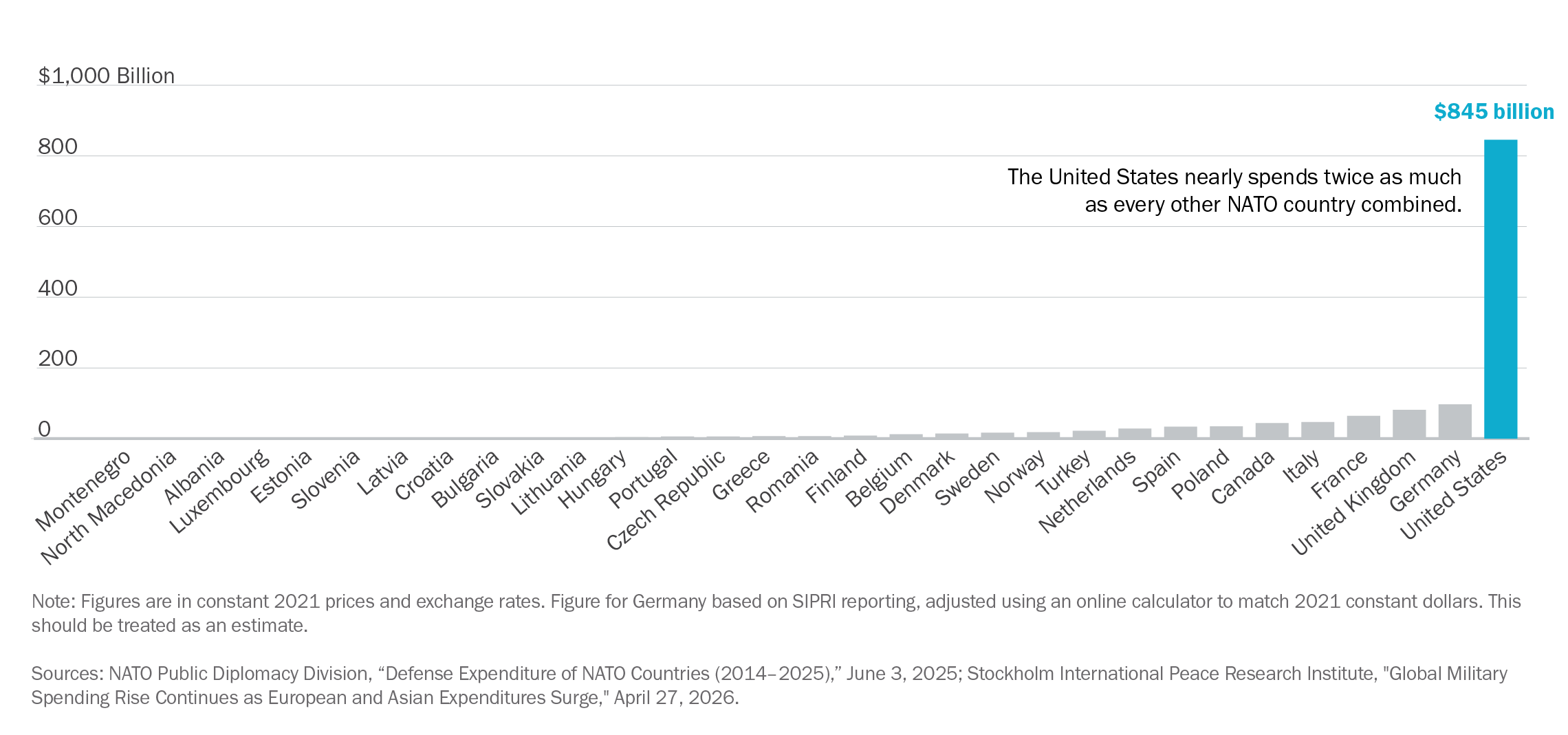
European officials grasped this proclivity easily enough and, early in this Trump administration, sought to mollify Washington to avoid a drawdown of U.S. forces from Europe. At the Hague NATO summit, they seem to have achieved just that by committing to investing at least 5 percent of their gross domestic product in defense and related infrastructure by 2035. In addition, various European countries also seem to have assured U.S. officials that they would comply with their demands to buy more American defense products with their rearmament efforts.20Marco Rubio, “Trump Defense Deal with NATO is a Big, Beautiful Win for America,” USA Today, July 9, 2025, https://www.usatoday.com/story/opinion/2025/07/09/trump-nato-defense-spending-rubio/84503719007/; Gram Slattery, John Irish, and Daphne Psaledakis, “U.S. Officials Object to European Push to Buy Weapons Locally,” Reuters, April 2, 2025, https://www.reuters.com/world/us-officials-object-european-push-buy-weapons-locally-2025-04-02/.
By pledging to spend more, and spend American, the Europeans gave the Americans a public relations victory. In President Trump’s eyes, the Hague summit delivered “a monumental win” for the United States. After decades of failure, he proclaimed to have achieved what none of his predecessors could: to convince Europe to shoulder more of its defense burden.21Danny Aeberhard, “Threat Posed by Russia Fuels Quantum Leap in NATO Defence Spending,” BBC, June 25, 2025, https://www.bbc.com/news/live/cm2ld0e0rzkt?post=asset%3Ad9cbf621-e221-4c80-bedb-337823676127#post.
While the United States did not offer anything formal in exchange for these commitments, European leaders seem to think they have bought themselves a reprieve from, if not an utter cancelation of, any U.S. plans to disentangle from continental security affairs.22Nicholas Vinocur, Laura Kayali, Paul McLeary, and Victor Jack, “Europe Managed to Keep Trump in NATO. Now What?” Politico Pro, June 26, 2025, https://subscriber.politicopro.com/article/2025/06/europe-managed-to-keep-trump-in-nato-now-what-00426846. In fact, U.S. leaders have taken care to assure several of their allies that they need not fear a withdrawal of U.S. troops now that they have been forthcoming with their spending pledges.23Piotr Skolimowski and Maciej Martewicz, “Trump Vows to Shield Poland in Any Troop Withdrawal from Europe,” Bloomberg, September 3, 2025, https://www.bloomberg.com/news/articles/2025-09-03/trump-vows-to-shield-poland-in-any-troop-withdrawal-from-europe?embedded-checkout=true.
This overarching approach of essentially trading spending pledges for a continued U.S. presence in Europe permeates the current National Security Strategy and National Defense Strategy. Both documents celebrate the fact that the administration has induced the Europeans to do more on defense—without saying that the United States can therefore do less.
The same idea also underlies the administration’s careful framing of any moves that might be interpreted as a prelude to a diminished U.S. role in European defense. For instance, when the Trump administration announced it would end the Baltic Security Initiative, which has given $200 million annually to Baltic states for training and equipment since 2018, it was quick to clarify that the move “will not have an impact on the U.S. troop presence in the region.”24“U.S. to Cut Military Aid for Baltic States,” Euractiv, September 6, 2025, https://www.euractiv.com/news/us-to-cut-military-aid-for-baltic-states/. Similarly, the Pentagon’s 2025 announcement that 800 soldiers who had rotated into Romania would be withdrawn from Europe were accompanied by U.S. assurances that this was not a sign of a fundamental shift in military posture in Europe.25Alice Tidey, “Let’s Not Make ‘Too Much’ of US Troop Withdrawal, Rutte Says on Romania Visit,” Euronews, November 5, 2025, https://ca.news.yahoo.com/lets-not-too-much-us-154644185.html?guccounter=1. Indeed, Trump immediately assured the press that the move constituted nothing but a simple repositioning.
Europe outmaneuvered Trump
While the president has touted Europe’s pledges as a landmark achievement that will ensure U.S. allies produce significant military capabilities and thus help decrease the burden on the United States, upon closer inspection there is little for Americans to celebrate here. The significance of Europe’s defense spending pledges has been vastly overstated: they ultimately mean little, and they certainly do not guarantee that Europe will decrease its military dependence on the United States.
For one thing, as is the case with all paper promises in international relations, no one can prevent states from reneging on them. In fact, there are good reasons to believe that European leaders will do just that, as they face overwhelming incentives to avoid a significant increase in defense expenditure.
In part, this is due to domestic resistance against the rearmament agenda publicly embraced by Brussels.26“Briefing: ReArm Europe Plan/Readiness 2030,” European Parliament, April 2025, https://www.europarl.europa.eu/RegData/etudes/BRIE/2025/769566/EPRS_BRI(2025)769566_EN.pdf. Across the continent, leaders are grappling with the fact that the anticipated spikes in defense expenditures might turn out to be deeply unpopular with their electorates.27Nikolaj Nielsen, “Poll Suggests French and Germans Oppose Defence Spending Hike,” EU Observer, March 3, 2025, https://euobserver.com/eu-political/ard2dc30b6. When then-Chancellor-elect Friedrich Merz pushed to disable Germany’s constitutional “debt brake” to pave the way for unlimited defense spending, this did not sit well with much of his conservative base which is known for its fiscal restraint.28Molly O’Neal, “German Leaders Miscalculated Popular Will for War Spending,” Responsible Statecraft, April 1, 2025, https://responsiblestatecraft.org/germany-defense-increase/. Confronting the risk of further hemorrhaging votes to the populist Alternative for Germany, Merz is unlikely to remain as resolutely committed to rearmament as he appeared immediately following his election victory.29Moritz Graefrath, “The German Election and the Future of U.S.-European Relations,” Lawfare, February 27, 2025, https://www.lawfaremedia.org/article/the-german-election-and-the-future-of-u.s.-european-relations.
France seems likely to face similar implementation troubles. The struggle to improve his country’s fiscal situation led to the collapse of Prime Minister François Bayrou’s government following a no-confidence vote in early September 2025.30“Experts React: The French Government Has Collapsed Again. What Does this Mean for France, the EU, and Macron?” Atlantic Council, September 8, 2025, https://www.atlanticcouncil.org/blogs/new-atlanticist/experts-react/experts-react-the-french-government-has-collapsed-again-what-does-this-mean-for-france-the-eu-and-macron/. It is doubtful whether President Emmanual Macron and Bayrou’s successor, Sébastien Lecornu, will be able to reconcile their ambitious spending goals with the need to address France’s looming debt crisis. After all, the French public is unlikely to finance the purchase of guns if it requires them giving up their butter.31Francois Valentin, “France’s Budget Crisis Won’t Be Solved by Rearmament,” UnHerd, July 17, 2025, https://unherd.com/newsroom/frances-budget-crisis-wont-be-solved-by-rearmament/?lang=us. A recent public opinion survey found that only 40 percent of French respondents supported increased military investments.32Jonathan Guyer, Lucas Robinson, Eloise Cassier, and Ransom Miller, “Ruptures and New Realities: The Transatlantic Relationship After Trump,” Institute for Global Affairs at Eurasia Group, June 2025, https://instituteforglobalaffairs.org/wp-content/uploads/2025/06/2025-06-11-Ruptures-and-new-realities_INTERACTIVE.pdf. With the 2027 presidential election already looming large, it is likely that candidates will reflect this lukewarm view on militarization.33Mujtaba Rahman, “Macron’s Succession Problem,” Politico, July 2, 2025, https://www.politico.eu/article/emmanuel-macron-presidential-race-2027-succession-france-eu/. Smaller Europeans states will likely face similar constraints, especially those in Western Europe where concerns about Russia are more muted than in the continent’s east.
Even if these political obstacles were absent, European leaders would likely find reneging on their promises tempting.34Justin Logan, “Trump Shouldn’t Settle for European Spending Pledges,” Foreign Policy, July 25, 2025, https://foreignpolicy.com/2025/07/25/trump-nato-europe-ukraine-budget-troops/. Trump is prone to declare victory prematurely and move on without much attention to detail. And even if he were to stay focused on European defense spending, he will only be president for a few more years. After that, the threat of a U.S. withdrawal will likely diminish. Why not go back to free riding off American protection?35Noah Keate, “Germany’s Merz Admits Europe Has Been a ‘Free-Rider’ on US Defense,” Politico, July 18, 2025, https://www.politico.eu/article/europe-free-rider-us-defense-germany-friedrich-merz-donald-trump-nato/. On how buck-passing to the United States undermines Germany’s Zeitenwende, see Rafał Ulatowski, “The Illusion of Germany’s Zeitenwende,” Washington Quarterly 47, no. 3 (Fall 2024): 59–76. Why not continue to brush off concerns over hard power, grand strategy, and geopolitics and avoid politically treacherous guns versus butter tradeoffs?36Ulrike Franke, “A Millennial Considers the New German Problem After 30 Years of Peace,” War on the Rocks, May 19, 2021, https://warontherocks.com/2021/05/a-millennial-considers-the-new-german-problem-after-30-years-of-peace/.
Of course, it is tempting to believe that recent months, and especially the Greenland and Iran episodes, have created a genuine tipping point in transatlantic relations and led to a geopolitical awakening in Europe. But the habit that has prevailed in Berlin, Paris, and other European capitals for decades is hard to break.37Moritz S. Graefrath and Gesine Weber, “Breaking Europe’s Trans-Atlantic Habit: The End of the Senior Partner Myth,” War on the Rocks, February 24, 2026, https://warontherocks.com/2026/02/breaking-europes-transatlantic-habit-the-end-of-the-senior-partner-myth/. Having made their careers in the warmth of the transatlantic embrace, European officials are prone to bet that things will return to “normal” once Trump is gone and forego meaningful change.
While it is certainly possible that European states will simply decide to not meet their professed spending targets, it is more likely that they will expand their conceptualization of what counts toward defense expenditure so they can formally declare fulfillment of their pledges. Even under NATO’s current definition of defense spending, various budget lines that do little to increase military capabilities in the short to medium terms—such as pension payments to military retirees—count toward the 5 percent goal.38“Defence Expenditures and NATO’s 5% Commitment,” NATO, August 27, 2025, https://www.nato.int/cps/en/natohq/topics_49198.htm.
The Hague Summit Declaration itself paved the way for further accounting gymnastics by demanding that only 3.5 percent of GDP be spent on defense investments proper, while the remaining 1.5 percent can go toward defense-related expenditures broadly conceived.39“The Hague Summit Declaration,” NATO, June 25, 2025, https://www.nato.int/cps/en/natohq/official_texts_236705.htm. The latter could include, for instance, infrastructure projects primarily aimed at civilian use.40John R. Deni and Ryan Arick, “What Counts as ‘Defense’ in NATO’s Potential 5 Percent Spending Goal?” Atlantic Council, June 20, 2025, https://www.atlanticcouncil.org/blogs/new-atlanticist/what-counts-as-defense-in-natos-potential-5-percent-spending-goal/. Foreshadowing what is to come, Italy recently considered passing off the construction of a $16 billion bridge from Sicily to the Italian mainland as the kind of strategic investment that would count toward the 5 percent goal.41Tom Kingston, “Italy Disavows Plan to Count Massive Sicily Bridge as NATO Spending,” Defense News, September 3, 2025, https://www.defensenews.com/global/europe/2025/09/03/italy-disavows-plan-to-count-massive-sicily-bridge-as-nato-spending/. The pledges made to date effectively invite states to massage their numbers until they match expectations.
As long as some combination of distant pledges, half measures, and focused flattery keeps the United States committed, the Europeans have little incentive to take steps toward meaningful rearmament. Their incentive, to be blunt, is to fake it until the public pressure from Washington subsides.
Finally, even if European states were to keep their spending promises and invest in military assets, the effective gains in Europe’s ability to defend itself independently are likely to be limited for two reasons. First, defense investments will do relatively little to lessen Europe’s dependence on the United States if the administration keeps pushing the continent to buy American weapons systems.42Gram Slattery, John Irish, and Daphne Psaledakis, “U.S. Officials Object to European Push to Buy Weapons Locally,” Reuters, April 2, 2025, https://www.reuters.com/world/us-officials-object-european-push-buy-weapons-locally-2025-04-02/. In this case, greater European defense spending would enshrine the United States’ role as the continent’s protector. Dependence on U.S. defense contractors will also preclude the development of a stronger military spending lobby in Europe, making the increased effort harder to sustain.43Ann Markusen, Peter Hall, Scott Campbell, and Sabina Deitrick, The Rise of the Gunbelt: The Military Remapping of Industrial America (New York: Oxford University Press, 1991).
Second, spending as a portion of GDP is a poor proxy for military capability.44Jennifer Kavanagh and Daniel DePetris, “The U.S. Needs a Different Approach for Rebalancing NATO,” World Politics Review, January 16, 2025, https://www.worldpoliticsreview.com/us-military-europe-trump/. Unless European militaries achieve greater unity in military matters, the newly available defense funds will split into dozens of pieces, most of which are too small to matter. Unsurprisingly, given the number of states involved, there is so far little consensus about what the increased military spending should buy, beyond general balancing against Russia. This means that spending increases, if real, are likely to dissipate in service of disparate agendas.
To illustrate the point, one concrete objective that Europeans might unite their investments around would be to enhance their ability, absent U.S. help, to quickly move ground forces east to defend against a potential Russian move against a bordering state.45Barry R. Posen, “European Military Autonomy: What Comes First?” Survival 67, no. 5 (October–November 2025): 7–28. This approach would require heavy investment in keeping forces ready to deploy, transport to move forces quickly, the required infrastructure to enable deployments, and increasing military manpower, which is especially expensive in Western Europe.
Rather than taking such meaningful steps, Europe’s defense pledges are likely to follow standard patterns to fund expensive and overlapping procurement. For example, Germany’s €100 billion special fund for defense, the purported centerpiece of the Zeitenwende spurred by Russia’s invasion of Ukraine, has gone to the procurement of a broad suite of equipment, including buying pricey U.S. F-35s, as opposed to a more focused push to build a readier force.46Benjamin Tallis, “The End of the Zeitenwende: Reflections After Two Years of Action Group Zeitenwende,’” German Council on Foreign Relations, August 30, 2024, https://dgap.org/en/research/publications/end-zeitenwende. Similarly, while infrastructure investments in integrated road and rail projects in Germany, Poland, and the Baltic states would meaningfully alter the military balance, independent national efforts to separately improve military infrastructure will be of little significance in the grand scheme of things.
Viewed in this light, it becomes clear that the Europeans have been outmaneuvering Trump and gotten much more out of the quasi-bargain than the president might think. In return for spending pledges of dubious strategic value, they seem to have achieved their central goal: fending off any actual U.S. disentanglement from the continent for the foreseeable future.47Matthew Mpoke Bigg, “Seven European Leaders Rush to Join Zelensky at the White House,” New York Times, August 18, 2025, https://www.nytimes.com/2025/08/18/us/european-allies-zelensky-white-house.html; Sophia Cai and Eli Stokols, “NATO Chief Calls Trump ‘Daddy,’” Politico, June 25, 2025, https://www.politico.com/news/2025/06/25/nato-chief-calls-trump-daddy-00423485.
Just start leaving
All this being said, the Trump administration has not yet committed itself officially to upholding the status quo in Europe. This means there is still a genuine opportunity to change course.
One option for the United States would be to focus on making sure the Europeans enact their pledged defense spending, push to have that increase used efficiently to prepare to defend against Russia, and then start pulling U.S. forces. This would be the classic “as they stand up, we stand down” approach, which echoes the early Cold War view that the U.S. military presence was a temporary stopgap that could be removed once Europeans had the ability to balance Soviet power on their own.48Max Bergmann, Colin Wall, Sean Monaghan, and Pierre Morcos, “Transforming European Defense,” Center for Strategic and International Studies, August 18, 2022, https://www.csis.org/analysis/transforming-european-defense; Brendan Rittenhouse Green, “Two Concepts of Liberty: U.S. Cold War Grand Strategies and the Liberal Tradition,” International Security 37, no. 2 (Fall 2012): 9–43.
This approach would be a meaningful improvement over one that keeps U.S. force levels in Europe at status quo levels either because it is what we owe our allies (the classic Washington/Biden administration view) or because it is a reward for increased effort (the Trump view to date). Still, it makes a similar error in effectively letting European moves dictate U.S. policy.
U.S. forces in Europe (2026)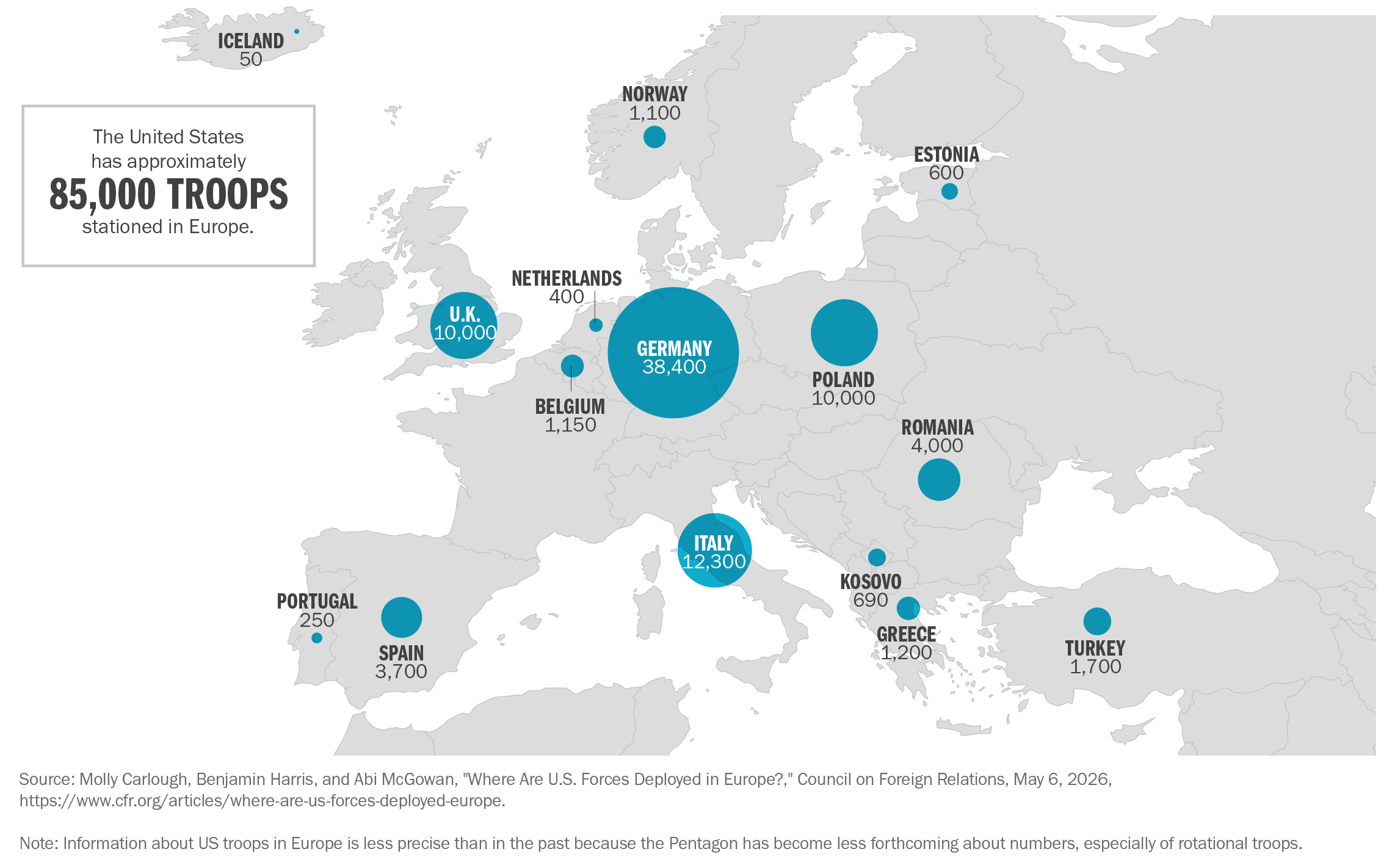
If the United States wants a sustained European defense effort, then the best way to get it is to take the first step and force the Europeans to balance Russian power on their own, though even that might prove insufficient. U.S. forces in Europe today dull the limited threat Russia poses beyond Ukraine and other borderlands. Without a more pungent whiff of danger, it is hard to see European defense reforms going from the showy and temporary to the real and permanent.
The other fundamental problem with the idea that U.S. retrenchment should await greater European capability development is its assumption that current NATO defense efforts are necessary to keep Russia at bay and thus protect U.S. interests. In other words, it assumes that, while the burden of containing Russia can be shifted around, defense efforts need to remain as large and intense as they are to avoid a strategic catastrophe. This view badly inflates the Russian threat, as discussed below.
The best U.S. option for European defense is to simply start leaving.49A good first step in a such process is outlined here: Jennifer Kavanagh and Dan Caldwell, “Aligning Global Military Posture with U.S. Interests,” Defense Priorities, July 9, 2025, https://www.defensepriorities.org/explainers/aligning-global-military-posture-with-us-interests. Ideally Washington would present its allies with a plan for a phased withdrawal of U.S. forces from Europe, especially ground forces. This will give them time to adjust as they see fit, either collectively via the European Union or other regional groupings, or on an individual basis.
This option need not involve a painful fight about withdrawing from NATO. The U.S. could keep the treaty commitment while reducing the force levels it commits—relying on the example of the Rio Treaty that officially commits U.S. forces to defend much of Latin America but has largely become a dead letter. In addition, the president could simply state that the United States plans to take Article 5 literally, which entails supporting allies under attack but not necessary fighting for them. This political step, combined with the removal of U.S. forces, would likely energize Europe’s collective defense efforts and reduce dependence on the United States.
Such an ideal path should also include dropping any insistence that Europeans “buy American.” Letting European countries build bigger defense industries will create more powerful domestic political interests that support heavier arms trading going forward.
A less ideal but perhaps more realistic alternative is making a withdrawal a fait accompli and simply letting the facts on the ground do the communicating. While such a course of action would be more disquieting for European leaders, U.S. officials can rest assured that it would not endanger American security.
The limits of the Russian threat
The United States does not need to worry about whether Europeans step up defensively before withdrawing forces from Europe because Russia has neither the evident intention for further revisionism beyond Ukraine nor the capabilities to do so.
Because intentions are changeable and notoriously hard to pin down, they are less important in measuring threat than capabilities. But it is important to note that there is little basis for the widespread view that Russia’s invasion of Ukraine demonstrates a broader agenda of territorial aggrandizement. Russia’s motivation for the war seems largely to have been to keep Ukraine out of the Western sphere, especially with regard to NATO forces being deployed there, whether as part of the alliance or informally.50Christopher McCallion, “Assessing Realist and Liberal Explanations for the Russo-Ukrainian War,” Defense Priorities, June 7, 2023, https://www.defensepriorities.org/explainers/assessing-realist-and-liberal-explanations-for-the-russo-ukrainian-war/; Barry R. Posen, “Putin’s Preventive War: The 2022 Invasion of Ukraine,” International Security 49, no. 3 (2025): 7–49. Whether one sees this as imperialistic or a response to Western policies that threatened Russian security interests, the point is that it does not entail any desire for further expansion beyond Ukraine.
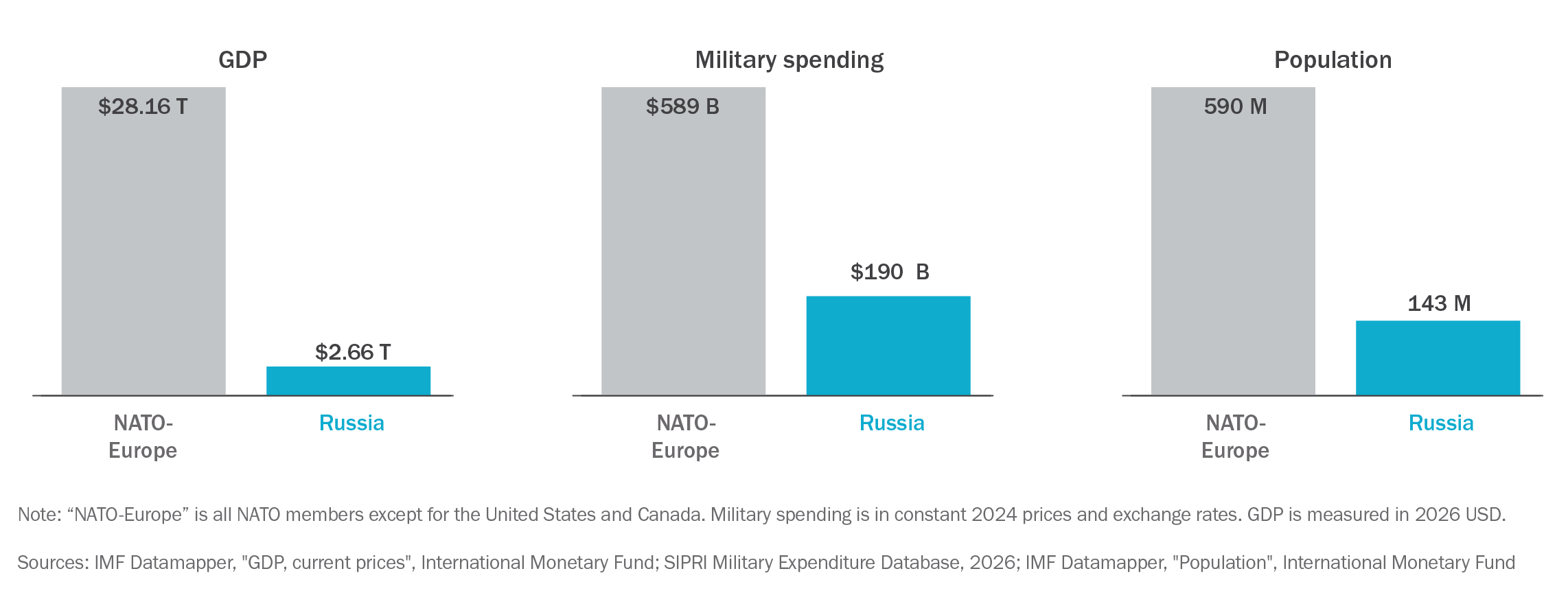
In any event, Russia’s military capability makes it a limited threat to NATO states, irrespective of what its real intentions are. This is not simply because it has been seriously degraded by the war in Ukraine.51Michelle Grisé, et al, “How Will Russia Reconstitute Its Military After the Ukraine Conflict?” RAND, March 27, 2025, https://www.rand.org/pubs/research_briefs/RBA2713-2.html. Rather, it is the lasting result of a balance of power that highly favors the Europeans, both in the short and long terms. In 2025, total non-U.S. NATO military spending was about $600 billion.52These calculations include all NATO states, minus the U.S., which means European allies plus Canada. “Defence Expenditure of NATO Countries (2014-2025),” NATO, August 28, 2025, https://www.nato.int/content/dam/nato/webready/documents/finance/def-exp-2025-en.pdf?utm_source=chatgpt.com. Russia, with its ramped-up war spending, has a defense budget of perhaps $462 billion, adjusting for purchasing power.53Fenella McGerty and Karl Dewey, “Global Defence Spending Soars to New High,” Military Balance Blog, International Institute for Strategic Studies, February 12, 2025, https://www.iiss.org/online-analysis/military-balance/2025/02/global-defence-spending-soars-to-new-high/. Non-U.S. NATO has 2.1 million active-duty troops to Russia’s 1.5 million. The $22 trillion in GDP that NATO has when excluding the United States is 10 times Russia’s economic output. Of course, political divisions make these European figures hard to compare directly to Russia’s, but they show the massive amount of potential capability the continent possesses and could tap into amid a direct Russian threat to a NATO member.
NATO-Europe vs. Russia
Russia’s battlefield performance in Ukraine is a more direct measure of its capability and constitutes good news for Europe’s security. While Russia has improved its performance after a disastrous start in Ukraine, its forces still suffer from questionable morale, logistical deficiencies, and difficulty with combined arms warfare.54Kirill Shamiev, “Brass Tacks: Why Russia’s Military Fails to Reform,” European Council on Foreign Relations, May 15, 2024, https://ecfr.eu/publication/brass-tacks-why-russias-military-fails-to-reform/. They have suffered upwards of half a million casualties and lost vast stores of vehicles.55Andrew S. Bowen, “Russian Military Performance and Outlook,” Congressional Research Service, May 28, 2025, https://www.congress.gov/crs-product/IF12606. Despite recent gains, Russian forces remain largely stuck east of the Dnipro River, a far cry from an army likely to come sweeping toward Poland.
The Ukraine war demonstrates why states increasingly avoid invading capable rivals. Defense, as Clausewitz tells us, has major political advantages.56Carl von Clausewitz, On War, ed. and trans. Michael Howard and Peter Paret (Princeton: Princeton University Press, 1976), bk. VI, chap. 1. When countries are attacked and defend their territory, they tend to excite nationalism, which motivates their people to fight on despite heavy sacrifices. Defenders also tend to attract outside support because they are victims of aggression. The invasion of Ukraine elicited a furious outpouring of Western support, which has been crucial to Ukraine’s cause.
These political advantages of defense are complemented by technological ones.57David Johnson, “Ending the Ideology of the Offense, Part II,” War on the Rocks, August 25, 2022, https://warontherocks.com/2022/08/ending-the-ideology-of-the-offense-part-ii/. Surveillance systems, with drones playing a leading role, now allow defending forces to see enemy forces attempting advances with newfound clarity. This can be translated quickly into targeting information for artillery fire, missiles, and attack drones, allowing a smaller footprint of military personnel to protect the front lines. Advanced air defense systems and man-portable air-defense systems make it difficult for aircraft to offer advancing forces close air support or do much else.58Justin Bronk, Nick Reynolds, and Jack Watling, “The Russian Air War and Ukrainian Requirements for Air Defence,” RUSI Special Report, November 7, 2022, https://static.rusi.org/SR-Russian-Air-War-Ukraine-web-final.pdf. Massing forces to achieve breakthroughs across defensive lines has thus become costlier. Since any Russian attack on a NATO state would occur under similarly adverse circumstances, these shifts in warfare suggest that even the most vulnerable European states, like Estonia, would be able to mount a credible defense against Russia, inflicting enough damage to make the prospect of aggression quite unappealing.59Jennifer Kavanagh and Jeremy Shapiro, “The Bear in the Baltics: Reassessing the Russian Threat in Estonia,” European Council on Foreign Relations, December 18, 2025, https://ecfr.eu/publication/the-bear-in-the-baltics-reassessing-the-russian-threat-in-estonia/.
The fact that any such war could well go nuclear provides additional reassurance that it is unlikely to occur.60Benjamin H. Friedman, “A New NATO Agenda: Less U.S., Less Dependency,” Defense Priorities, July 8, 2024, https://www.defensepriorities.org/explainers/a-new-nato-agenda/. The war in Ukraine has done nothing to undermine extended nuclear deterrence. It remains as doubtful as ever whether Russia would be willing to run the nuclear risks associated with a direct attack on a NATO member state. While the drone incursions into NATO airspace that took place in recent months signal that Russia is willing to run the limited escalation risks such gray zone tactics entail, they are orders of magnitude lower than those associated with a ground offensive.61Daniel DePetris, “NATO Rose to the Challenge and Passed Russia’s Test in Poland,” Chicago Tribune, September 16, 2025, https://www.chicagotribune.com/2025/09/16/column-russian-drones-poland-nato-depetris/. Despite common assertions to the contrary, there is no reason to doubt that Putin is rational enough to heavily weigh the existential dangers of a nuclear war.62John Mearsheimer and Sebastian Rosato, “The Russian Invasion Was a Rational Act: It is in the West’s Interest to Take Putin Seriously,” UnHerd, September 14, 2023, https://unherd.com/2023/09/the-russian-invasion-was-a-rational-act/.
Retrenchment is safe
As a fallback position, critics of a U.S. retrenchment from Europe willing to admit that the Russian threat is limited typically point out that a troop withdrawal would either invite an influx of Chinese influence or badly hurt the credibility of U.S. commitments elsewhere.63Michael Beckley, “Delusions of Détente: Why America and China Will Be Enduring Rivals,” Foreign Affairs, August 22, 2023, https://www.foreignaffairs.com/united-states/china-delusions-detente-rivals. Neither of these claims is particularly convincing.64Moritz S. Graefrath, “The False Peril of Great Power Retrenchment: Types of Strategic Withdrawals and their Consequences,” European Journal of International Security, vol. 10, no. 3 (2025), 331–349, https://doi.org/10.1017/eis.2024.43.
First, some fear that a U.S. withdrawal would open the continent’s doors to Chinese influence. In this narrative, it is Beijing, not Moscow, that exploits the “vacuum” left behind by departing U.S. forces.65Olivier Schmitt, “Why a Rapid U.S. Withdrawal from Europe Will Reinforce China,” Strategic Europe, December 17, 2024, https://carnegieendowment.org/europe/strategic-europe/2024/12/why-a-rapid-us-withdrawal-from-europe-will-reinforce-china?lang=en. China itself has stoked these fears, pitching itself as a new potential partner for Europe following a transatlantic breakup.66Finbarr Bermingham, “Your Best Friend Has Abandoned You: Inside China’s Latest EU Charm Offensive,” South China Morning Post, February 28, 2025, https://www.scmp.com/news/china/diplomacy/article/3300453/your-best-friends-have-abandoned-you-inside-chinas-latest-eu-charm-offensive; “China Seeks Closer Europe Ties to Counter the US in a ‘Volatile’ World,” FRANCE 24, June 30, 2025, https://www.france24.com/en/live-news/20250630-china-s-top-diplomat-visits-europe-pitching-closer-ties-in-volatile-world.
But while a limited rapprochement between Europe and China is possible, Washington need not fear that the continent will fundamentally shift its alignment away from the United States.67Moritz S. Graefrath, “U.S. Troop Withdrawals from Europe Won’t Benefit Its Rivals,” War on the Rocks, September 30, 2024, https://warontherocks.com/2024/09/u-s-troop-withdrawals-from-europe-wont-benefit-its-rivals/. For one thing, China’s limited support of Russia in its war against Ukraine has become a salient source of disagreement that continues to draw frequent public censure from European officials.68Finbarr Bermingham, “Von der Leyen Deepens Gloom over China-EU Summit with Attack on Beijing’s Russia Stance,” South China Morning Post, July 8, 2025, https://www.scmp.com/news/china/diplomacy/article/3317442/von-der-leyen-deepens-gloom-over-china-eu-summit-attack-beijings-russia-stance. Furthermore, economic tensions between the EU and China appear even more intractable as trade disputes multiply.69Antonia Zimmermann and Koen Verhelst, “EU-China Ties Buckle Under Trump’s Trade Pressure,” Politico, July 22, 2025, https://www.politico.eu/article/eu-china-beijing-summit-trade-donald-trump-tariffs/. Most importantly, cultural and economic ties between the United States and Europe are historically rooted, institutionalized, and not easily undone.
Second, critics of a prospective U.S. retrenchment have argued that such a move would irreparably damage the United States’ reputation globally, signal American weakness, and cast doubt on the credibility of its other commitments around the world. While this line of reasoning is intuitively appealing, such concerns over reputational costs are misplaced. Ample research on international politics has debunked the idea that allies and adversaries assess the credibility of a state’s threats based on its historical track record.70Jonathan Mercer, “Bad Reputation: The Folly of Going to War for ‘Credibility,’” Foreign Affairs, August 28, 2013, https://www.foreignaffairs.com/articles/syria/2013-08-28/bad-reputation. Interests and capability are what make threats credible. The idea that retrenchment in Europe would undermine U.S. commitments globally and thus empower rivals is flatly wrong.
Embracing the exit
The time is ripe for the United States to start withdrawing its troops from Europe and hand the burden of continental defense to its allies. The Trump administration should save its breath, quit lambasting the Europeans, and place their security in their hands.
Perhaps counterintuitively, by revealing Russia’s weakness, the war in Ukraine has shown that the right time for an exit from the continent is now. The European allies possess the means to defend themselves, but to date continue to lack sufficient incentive to turn their massive latent power into capabilities. As long as Uncle Sam is there to bail them out, this will not change. To be sure, following a U.S. withdrawal, Europe will need some time to adjust. But given the limits of the Russian threat, they will be able to come to terms with a post-American European security landscape. Whatever intent the Kremlin might harbor, it simply lacks the capability to begin an extensive campaign of aggression beyond Ukraine for the foreseeable future.
In short, it is safe for the United States to reduce its burden in Europe. It can reap the rewards of a strategic withdrawal while resting assured that such a move will not lead to Europe being overrun. To the contrary, it will reveal that the allies have long been fine on their own.
Endnotes
- 1Natasha Bertrand and Kit Maher, “Trump Threatens More Cuts After US Announced Withdrawal of 5,000 Troops from Germany,” CNN, May 2, 2026, https://www.cnn.com/2026/05/01/politics/us-troop-withdrawal-germany-trump-merz; Julian E. Barnes, Helene Cooper, and Megan Mineiro, “U.S. to Withdraw 5,000 Troops from Germany, Pentagon Says,” New York Times, May 1, 2026, https://www.nytimes.com/2026/05/01/us/politics/us-troops-germany.html. The Pentagon subsequently stated that they were going from four brigade combat teams in Europe to three. ↩︎
- 2Benjamin Friedman, “Make America’s Allies Sweat,” Defense Priorities, January 23, 2025, https://www.defensepriorities.org/symposia/realistic-recommendations-for-trump-ii/#benjamin-friedman. ↩︎
- 3Glenn Kessler, “Trump’s Claim that the U.S. Pays the ‘Lion’s Share’ for NATO,” Washington Post, March 30, 2016, https://www.washingtonpost.com/news/fact-checker/wp/2016/03/30/trumps-claim-that-the-u-s-pays-the-lions-share-for-nato/. ↩︎
- 4Donald Trump, “President Trump: ‘I Want Europe to Pay’,” Atlantic Council, January 2, 2019, https://www.atlanticcouncil.org/blogs/natosource/president-trump-i-want-europe-to-pay/. ↩︎
- 5Pete Hegseth, “Opening Remarks by Secretary of Defense Pete Hegseth at Ukraine Defense Contact Group (as Delivered),” U.S. Department of War, February 12, 2025, https://www.war.gov/News/Speeches/Speech/article/4064113/opening-remarks-by-secretary-of-defense-pete-hegseth-at-ukraine-defense-contact/; “Remarks by the Vice President at the Munich Security Conference,” U.S. Embassy Romania, https://ro.usembassy.gov/remarks-by-the-vice-president-at-the-munich-security-conference/?utm_source=chatgpt.com. ↩︎
- 6Paul Adams, “US Allies Won’t Forget Trump Greenland Crisis,” BBC, January 21, 2026, https://www.bbc.com/news/articles/cj3vv1kv1rdo. ↩︎
- 7Jack Detsch and Connor O’Brien, “Trump Has Threatened to Leave NATO over Iran. There Are Few Signs That’s Happening,” Politico, April 1, 2026, https://www.politico.com/news/2026/04/01/trump-nato-no-plans-withdrawal-00854455; Annie Linskey and Robbie Gramer, “Trump Team Explores Punishment for NATO Countries That Didn’t Support Iran War,” Wall Street Journal, April 8, 2026, https://www.wsj.com/world/europe/trump-weighs-punishing-certain-nato-countries-over-lack-of-iran-war-support-a2361995; Phil Stewart, “Exclusive: Pentagon Email Floats Suspending Spain from NATO, Other Steps over Iran Rift, Source Says,” Reuters, April 24, 2026, https://www.reuters.com/world/pentagon-email-floats-suspending-spain-nato-other-steps-over-iran-rift-source-2026-04-24/; David E. Sanger, “Trump Threatens to Pull Troops from Germany as He Lashes Out at Chancellor,” New York Times, April 29, 2026, https://www.nytimes.com/2026/04/29/us/politics/trump-germany-us-troops.html. ↩︎
- 8Rafael Loss, “Striking Reversal: How Europeans Should React to Trump’s Missile Cancellation,” European Council on Foreign Relations, May 4, 2026, https://ecfr.eu/article/striking-reversal-how-europeans-should-react-to-trumps-missile-cancellation/; John Vandiver, “Pentagon Offers Details on Troop Reduction Plan Amid Confusion in Europe,” Stars and Stripes, May 20, 2026, https://www.stripes.com/theaters/europe/2026-05-20/pentagon-europe-force-posture-changes-21727163.html. ↩︎
- 9“National Security Strategy of the United States of America,” White House, November 2025, https://www.whitehouse.gov/wp-content/uploads/2025/12/2025-National-Security-Strategy.pdf; “2026 National Defense Strategy,” U.S. Department of War, January 23, 2026, https://media.defense.gov/2026/Jan/23/2003864773/-1/-1/0/2026-NATIONAL-DEFENSE-STRATEGY.PDF. ↩︎
- 10Jennifer Kavanagh, “Trump’s Right to Take Troops out of Germany. Now See Where They Go,” Responsible Statecraft, May 6, 2026, https://responsiblestatecraft.org/trump-troops-germany/. ↩︎
- 11Marc Trachtenberg, “Is There Life After NATO?” Policy Analysis no. 982, Cato Institute, October 22, 2024, https://www.cato.org/sites/cato.org/files/2024-10/policy-analysis-982.pdf. ↩︎
- 12Benjamin Friedman and Justin Logan, “Threatening NATO over Iran is Stupid, but Potentially Useful,” American Conservative, April 12, 2026, https://www.theamericanconservative.com/threatening-nato-over-iran-is-stupid-but-potentially-useful/. ↩︎
- 13“The Hague Summit Declaration,” NATO, June 25, 2025, https://www.nato.int/en/about-us/official-texts-and-resources/official-texts/2025/06/25/the-hague-summit-declaration. ↩︎
- 14Moritz Graefrath, “The End of Transatlanticism,” The Critic, July 24, 2025, https://thecritic.co.uk/the-end-of-transatlanticism/; Ryan Browne and Zachary Cohen, “US to Withdraw Nearly 12,000 Troops from Germany in Move That Will Cost Billions and Take Years,” CNN, July 29, 2020, https://www.cnn.com/2020/07/29/politics/us-withdraw-troops-germany; “Statement by the President Regarding the Enhanced Defense Cooperation Agreement with the Republic of Poland,” White House, August 15, 2020, https://trumpwhitehouse.archives.gov/briefings-statements/statement-president-regarding-enhanced-defense-cooperation-agreement-republic-poland/?utm_source=chatgpt.com; “Trump Approves Montenegro’s NATO Membership,” RadioFreeEurope/RadioLiberty, April 11, 2017, https://www.rferl.org/a/montenegro-nato-us-trump-approves/28423936.html. ↩︎
- 15Gram Slattery and Humeyra Pamuk, “Exclusive: US Sets 2027 Deadline for Europe-led NATO Defense, Officials Say,” Reuters, December 6, 2025, https://www.reuters.com/business/aerospace-defense/us-sets-2027-deadline-europe-led-nato-defense-officials-say-2025-12-05/. ↩︎
- 16“Secretary of Defense Pete Hegseth Press Conference Following NATO Ministers Defense Meeting in Brussels, Belgium,” U.S. Department of War, February 13, 2025, https://www.war.gov/News/Transcripts/Transcript/Article/4066734/secretary-of-defense-pete-hegseth-press-conference-following-nato-ministers-of/. ↩︎
- 17Moritz S. Graefrath, “Eisenhower’s Vision of European Security,” Engelsberg Ideas, May 20, 2025, https://engelsbergideas.com/notebook/eisenhowers-vision-of-european-security/. ↩︎
- 18Campbell Craig, Benjamin H. Friedman, Brendan Rittenhouse Green, Justin Logan, Stephen G. Brooks, G. John Ikenberry, and William C. Wohlforth, “Debating American Engagement: The Future of U.S. Grand Strategy,” International Security 38, no. 2 (2013): 181–199. ↩︎
- 19Barry R. Posen, “The Rise of Illiberal Hegemony: Trump’s Surprising Grand Strategy,” Foreign Affairs 97, no. 2 (March/April 2018): 20–27. ↩︎
- 20Marco Rubio, “Trump Defense Deal with NATO is a Big, Beautiful Win for America,” USA Today, July 9, 2025, https://www.usatoday.com/story/opinion/2025/07/09/trump-nato-defense-spending-rubio/84503719007/; Gram Slattery, John Irish, and Daphne Psaledakis, “U.S. Officials Object to European Push to Buy Weapons Locally,” Reuters, April 2, 2025, https://www.reuters.com/world/us-officials-object-european-push-buy-weapons-locally-2025-04-02/. ↩︎
- 21Danny Aeberhard, “Threat Posed by Russia Fuels Quantum Leap in NATO Defence Spending,” BBC, June 25, 2025, https://www.bbc.com/news/live/cm2ld0e0rzkt?post=asset%3Ad9cbf621-e221-4c80-bedb-337823676127#post. ↩︎
- 22Nicholas Vinocur, Laura Kayali, Paul McLeary, and Victor Jack, “Europe Managed to Keep Trump in NATO. Now What?” Politico Pro, June 26, 2025, https://subscriber.politicopro.com/article/2025/06/europe-managed-to-keep-trump-in-nato-now-what-00426846. ↩︎
- 23Piotr Skolimowski and Maciej Martewicz, “Trump Vows to Shield Poland in Any Troop Withdrawal from Europe,” Bloomberg, September 3, 2025, https://www.bloomberg.com/news/articles/2025-09-03/trump-vows-to-shield-poland-in-any-troop-withdrawal-from-europe?embedded-checkout=true. ↩︎
- 24“U.S. to Cut Military Aid for Baltic States,” Euractiv, September 6, 2025, https://www.euractiv.com/news/us-to-cut-military-aid-for-baltic-states/. ↩︎
- 25Alice Tidey, “Let’s Not Make ‘Too Much’ of US Troop Withdrawal, Rutte Says on Romania Visit,” Euronews, November 5, 2025, https://ca.news.yahoo.com/lets-not-too-much-us-154644185.html?guccounter=1. ↩︎
- 26“Briefing: ReArm Europe Plan/Readiness 2030,” European Parliament, April 2025, https://www.europarl.europa.eu/RegData/etudes/BRIE/2025/769566/EPRS_BRI(2025)769566_EN.pdf. ↩︎
- 27Nikolaj Nielsen, “Poll Suggests French and Germans Oppose Defence Spending Hike,” EU Observer, March 3, 2025, https://euobserver.com/eu-political/ard2dc30b6. ↩︎
- 28Molly O’Neal, “German Leaders Miscalculated Popular Will for War Spending,” Responsible Statecraft, April 1, 2025, https://responsiblestatecraft.org/germany-defense-increase/. ↩︎
- 29Moritz Graefrath, “The German Election and the Future of U.S.-European Relations,” Lawfare, February 27, 2025, https://www.lawfaremedia.org/article/the-german-election-and-the-future-of-u.s.-european-relations. ↩︎
- 30“Experts React: The French Government Has Collapsed Again. What Does this Mean for France, the EU, and Macron?” Atlantic Council, September 8, 2025, https://www.atlanticcouncil.org/blogs/new-atlanticist/experts-react/experts-react-the-french-government-has-collapsed-again-what-does-this-mean-for-france-the-eu-and-macron/. ↩︎
- 31Francois Valentin, “France’s Budget Crisis Won’t Be Solved by Rearmament,” UnHerd, July 17, 2025, https://unherd.com/newsroom/frances-budget-crisis-wont-be-solved-by-rearmament/?lang=us. ↩︎
- 32Jonathan Guyer, Lucas Robinson, Eloise Cassier, and Ransom Miller, “Ruptures and New Realities: The Transatlantic Relationship After Trump,” Institute for Global Affairs at Eurasia Group, June 2025, https://instituteforglobalaffairs.org/wp-content/uploads/2025/06/2025-06-11-Ruptures-and-new-realities_INTERACTIVE.pdf. ↩︎
- 33Mujtaba Rahman, “Macron’s Succession Problem,” Politico, July 2, 2025, https://www.politico.eu/article/emmanuel-macron-presidential-race-2027-succession-france-eu/. ↩︎
- 34Justin Logan, “Trump Shouldn’t Settle for European Spending Pledges,” Foreign Policy, July 25, 2025, https://foreignpolicy.com/2025/07/25/trump-nato-europe-ukraine-budget-troops/. ↩︎
- 35Noah Keate, “Germany’s Merz Admits Europe Has Been a ‘Free-Rider’ on US Defense,” Politico, July 18, 2025, https://www.politico.eu/article/europe-free-rider-us-defense-germany-friedrich-merz-donald-trump-nato/. On how buck-passing to the United States undermines Germany’s Zeitenwende, see Rafał Ulatowski, “The Illusion of Germany’s Zeitenwende,” Washington Quarterly 47, no. 3 (Fall 2024): 59–76. ↩︎
- 36Ulrike Franke, “A Millennial Considers the New German Problem After 30 Years of Peace,” War on the Rocks, May 19, 2021, https://warontherocks.com/2021/05/a-millennial-considers-the-new-german-problem-after-30-years-of-peace/. ↩︎
- 37Moritz S. Graefrath and Gesine Weber, “Breaking Europe’s Trans-Atlantic Habit: The End of the Senior Partner Myth,” War on the Rocks, February 24, 2026, https://warontherocks.com/2026/02/breaking-europes-transatlantic-habit-the-end-of-the-senior-partner-myth/. ↩︎
- 38“Defence Expenditures and NATO’s 5% Commitment,” NATO, August 27, 2025, https://www.nato.int/cps/en/natohq/topics_49198.htm. ↩︎
- 39“The Hague Summit Declaration,” NATO, June 25, 2025, https://www.nato.int/cps/en/natohq/official_texts_236705.htm. ↩︎
- 40John R. Deni and Ryan Arick, “What Counts as ‘Defense’ in NATO’s Potential 5 Percent Spending Goal?” Atlantic Council, June 20, 2025, https://www.atlanticcouncil.org/blogs/new-atlanticist/what-counts-as-defense-in-natos-potential-5-percent-spending-goal/. ↩︎
- 41Tom Kingston, “Italy Disavows Plan to Count Massive Sicily Bridge as NATO Spending,” Defense News, September 3, 2025, https://www.defensenews.com/global/europe/2025/09/03/italy-disavows-plan-to-count-massive-sicily-bridge-as-nato-spending/. ↩︎
- 42Gram Slattery, John Irish, and Daphne Psaledakis, “U.S. Officials Object to European Push to Buy Weapons Locally,” Reuters, April 2, 2025, https://www.reuters.com/world/us-officials-object-european-push-buy-weapons-locally-2025-04-02/. ↩︎
- 43Ann Markusen, Peter Hall, Scott Campbell, and Sabina Deitrick, The Rise of the Gunbelt: The Military Remapping of Industrial America (New York: Oxford University Press, 1991). ↩︎
- 44Jennifer Kavanagh and Daniel DePetris, “The U.S. Needs a Different Approach for Rebalancing NATO,” World Politics Review, January 16, 2025, https://www.worldpoliticsreview.com/us-military-europe-trump/. ↩︎
- 45Barry R. Posen, “European Military Autonomy: What Comes First?” Survival 67, no. 5 (October–November 2025): 7–28. ↩︎
- 46Benjamin Tallis, “The End of the Zeitenwende: Reflections After Two Years of Action Group Zeitenwende,’” German Council on Foreign Relations, August 30, 2024, https://dgap.org/en/research/publications/end-zeitenwende. ↩︎
- 47Matthew Mpoke Bigg, “Seven European Leaders Rush to Join Zelensky at the White House,” New York Times, August 18, 2025, https://www.nytimes.com/2025/08/18/us/european-allies-zelensky-white-house.html; Sophia Cai and Eli Stokols, “NATO Chief Calls Trump ‘Daddy,’” Politico, June 25, 2025, https://www.politico.com/news/2025/06/25/nato-chief-calls-trump-daddy-00423485. ↩︎
- 48Max Bergmann, Colin Wall, Sean Monaghan, and Pierre Morcos, “Transforming European Defense,” Center for Strategic and International Studies, August 18, 2022, https://www.csis.org/analysis/transforming-european-defense; Brendan Rittenhouse Green, “Two Concepts of Liberty: U.S. Cold War Grand Strategies and the Liberal Tradition,” International Security 37, no. 2 (Fall 2012): 9–43. ↩︎
- 49A good first step in a such process is outlined here: Jennifer Kavanagh and Dan Caldwell, “Aligning Global Military Posture with U.S. Interests,” Defense Priorities, July 9, 2025, https://www.defensepriorities.org/explainers/aligning-global-military-posture-with-us-interests. ↩︎
- 50Christopher McCallion, “Assessing Realist and Liberal Explanations for the Russo-Ukrainian War,” Defense Priorities, June 7, 2023, https://www.defensepriorities.org/explainers/assessing-realist-and-liberal-explanations-for-the-russo-ukrainian-war/; Barry R. Posen, “Putin’s Preventive War: The 2022 Invasion of Ukraine,” International Security 49, no. 3 (2025): 7–49. ↩︎
- 51Michelle Grisé, et al, “How Will Russia Reconstitute Its Military After the Ukraine Conflict?” RAND, March 27, 2025, https://www.rand.org/pubs/research_briefs/RBA2713-2.html. ↩︎
- 52These calculations include all NATO states, minus the U.S., which means European allies plus Canada. “Defence Expenditure of NATO Countries (2014-2025),” NATO, August 28, 2025, https://www.nato.int/content/dam/nato/webready/documents/finance/def-exp-2025-en.pdf?utm_source=chatgpt.com. ↩︎
- 53Fenella McGerty and Karl Dewey, “Global Defence Spending Soars to New High,” Military Balance Blog, International Institute for Strategic Studies, February 12, 2025, https://www.iiss.org/online-analysis/military-balance/2025/02/global-defence-spending-soars-to-new-high/. ↩︎
- 54Kirill Shamiev, “Brass Tacks: Why Russia’s Military Fails to Reform,” European Council on Foreign Relations, May 15, 2024, https://ecfr.eu/publication/brass-tacks-why-russias-military-fails-to-reform/. ↩︎
- 55Andrew S. Bowen, “Russian Military Performance and Outlook,” Congressional Research Service, May 28, 2025, https://www.congress.gov/crs-product/IF12606. ↩︎
- 56Carl von Clausewitz, On War, ed. and trans. Michael Howard and Peter Paret (Princeton: Princeton University Press, 1976), bk. VI, chap. 1. ↩︎
- 57David Johnson, “Ending the Ideology of the Offense, Part II,” War on the Rocks, August 25, 2022, https://warontherocks.com/2022/08/ending-the-ideology-of-the-offense-part-ii/. ↩︎
- 58Justin Bronk, Nick Reynolds, and Jack Watling, “The Russian Air War and Ukrainian Requirements for Air Defence,” RUSI Special Report, November 7, 2022, https://static.rusi.org/SR-Russian-Air-War-Ukraine-web-final.pdf. ↩︎
- 59Jennifer Kavanagh and Jeremy Shapiro, “The Bear in the Baltics: Reassessing the Russian Threat in Estonia,” European Council on Foreign Relations, December 18, 2025, https://ecfr.eu/publication/the-bear-in-the-baltics-reassessing-the-russian-threat-in-estonia/. ↩︎
- 60Benjamin H. Friedman, “A New NATO Agenda: Less U.S., Less Dependency,” Defense Priorities, July 8, 2024, https://www.defensepriorities.org/explainers/a-new-nato-agenda/. ↩︎
- 61Daniel DePetris, “NATO Rose to the Challenge and Passed Russia’s Test in Poland,” Chicago Tribune, September 16, 2025, https://www.chicagotribune.com/2025/09/16/column-russian-drones-poland-nato-depetris/. ↩︎
- 62John Mearsheimer and Sebastian Rosato, “The Russian Invasion Was a Rational Act: It is in the West’s Interest to Take Putin Seriously,” UnHerd, September 14, 2023, https://unherd.com/2023/09/the-russian-invasion-was-a-rational-act/. ↩︎
- 63Michael Beckley, “Delusions of Détente: Why America and China Will Be Enduring Rivals,” Foreign Affairs, August 22, 2023, https://www.foreignaffairs.com/united-states/china-delusions-detente-rivals. ↩︎
- 64Moritz S. Graefrath, “The False Peril of Great Power Retrenchment: Types of Strategic Withdrawals and their Consequences,” European Journal of International Security, vol. 10, no. 3 (2025), 331–349, https://doi.org/10.1017/eis.2024.43. ↩︎
- 65Olivier Schmitt, “Why a Rapid U.S. Withdrawal from Europe Will Reinforce China,” Strategic Europe, December 17, 2024, https://carnegieendowment.org/europe/strategic-europe/2024/12/why-a-rapid-us-withdrawal-from-europe-will-reinforce-china?lang=en. ↩︎
- 66Finbarr Bermingham, “Your Best Friend Has Abandoned You: Inside China’s Latest EU Charm Offensive,” South China Morning Post, February 28, 2025, https://www.scmp.com/news/china/diplomacy/article/3300453/your-best-friends-have-abandoned-you-inside-chinas-latest-eu-charm-offensive; “China Seeks Closer Europe Ties to Counter the US in a ‘Volatile’ World,” FRANCE 24, June 30, 2025, https://www.france24.com/en/live-news/20250630-china-s-top-diplomat-visits-europe-pitching-closer-ties-in-volatile-world. ↩︎
- 67Moritz S. Graefrath, “U.S. Troop Withdrawals from Europe Won’t Benefit Its Rivals,” War on the Rocks, September 30, 2024, https://warontherocks.com/2024/09/u-s-troop-withdrawals-from-europe-wont-benefit-its-rivals/. ↩︎
- 68Finbarr Bermingham, “Von der Leyen Deepens Gloom over China-EU Summit with Attack on Beijing’s Russia Stance,” South China Morning Post, July 8, 2025, https://www.scmp.com/news/china/diplomacy/article/3317442/von-der-leyen-deepens-gloom-over-china-eu-summit-attack-beijings-russia-stance. ↩︎
- 69Antonia Zimmermann and Koen Verhelst, “EU-China Ties Buckle Under Trump’s Trade Pressure,” Politico, July 22, 2025, https://www.politico.eu/article/eu-china-beijing-summit-trade-donald-trump-tariffs/. ↩︎
- 70Jonathan Mercer, “Bad Reputation: The Folly of Going to War for ‘Credibility,’” Foreign Affairs, August 28, 2013, https://www.foreignaffairs.com/articles/syria/2013-08-28/bad-reputation. ↩︎
Authors


More on Europe


Events on Burden sharing