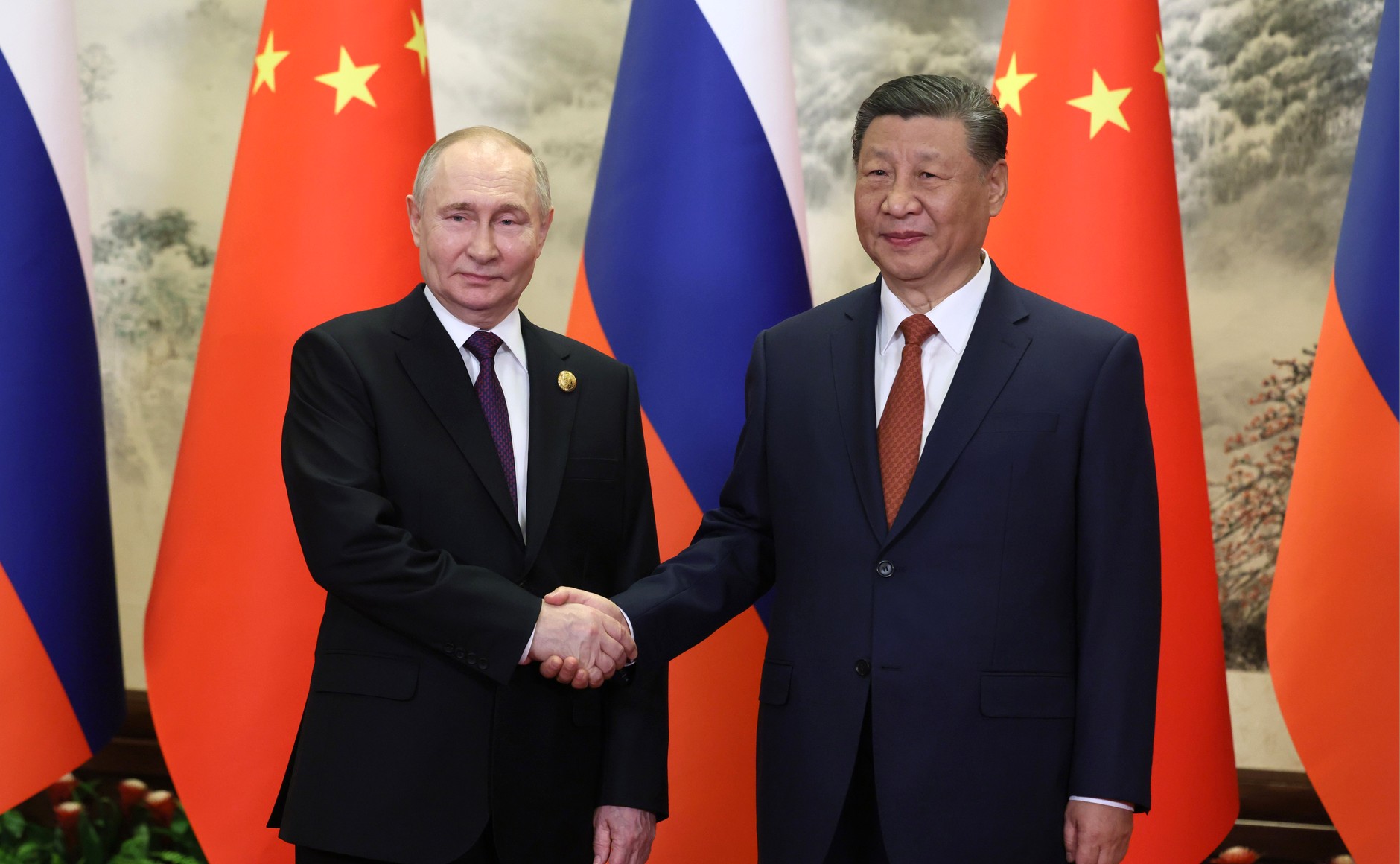
China and Russia’s growing partnership has become a concern for U.S. policymakers. But these worries often ignore the limits of the China-Russia relationship and how U.S. foreign policy drives their cooperation.
In this DEFP Q&A, Asia Program Director Lyle Goldstein discusses his new explainer on the China-Russia quasi-alliance and how to improve relations with both countries. (This interview has been lightly edited for clarity. Watch the full interview here.)
What constraints prevent the China-Russia partnership from becoming a more formal alliance?
Goldstein: The bilateral relationship between these two Eurasian giants is both broad and deep—it’s not just a marriage of convenience. But there are limits that constrain their ties from developing into a full alliance that would keep us up at night.
First, there is the historical memory. Back in the 1950s, China and Russia had a really strong bilateral alliance that blew up in their faces. There are many reasons why, and after a couple of decades of vitriolic insults, they were literally on the verge of war. Part of the problem was that Moscow and Beijing were too closely intertwined and interdependent. Fast forward to today, both powers are conscious of avoiding that and are focused on self-reliance.
Second, they have fundamentally different interests. China is obsessed with Taiwan and the South China Sea, and Russia has really no interest in either. China has no major interest in Ukraine or the Baltic Sea while Russia does. They do have sympathy for one another, but it doesn’t really go beyond that—and this rules out the worst-case scenario, which is that they would cooperate in a war.
Both countries clearly want to avoid antagonizing the United States. China has been clearest in saying that it is not forming an alliance or an anti-Western bloc, which would be very contrary to its long-term interests. Beijing wants to avoid a new cold war, and it knows that forming an alliance with Russia is not conducive to that end.
Even though both China and Russia are concerned about the United States and see it as threatening, they also know that, given their strong nuclear forces, it is not necessary, for now, to build a full alliance.
How has U.S. foreign policy pushed China and Russia together?
Goldstein: While I just made the case that we don’t have to worry too much, there are still things to be concerned about in regard to the China-Russia relationship. For example, it’s unlikely but possible that the two countries could form a tighter relationship around military technology cooperation, which would be troubling for the U.S. One way we can prevent that is to stop driving them together.
Washington has challenged both Moscow and Beijing on their core interests for over 30 years. Since the 1996 Taiwan Strait crisis, for example, Beijing has been actively preparing for a Taiwan contingency. For Russia, the wars in the former Yugoslavia, the bombing of Belgrade, and NATO expansion have created enormous strains in U.S.-Russia relations. As a result, the logic of world politics has brought the two together and fostered a dynamic relationship.
Over three decades, China and Russia have built something rather substantive. Still, both have shown restraint, particularly Beijing, because they know that a formal alliance would be destabilizing. If Washington continues to take steps that antagonize both countries, then they have their contingency plan for that unfortunate development. We need to try very hard to avoid that.
What would a better U.S. approach to China and Russia look like?
Goldstein: When President Trump returned to office and met with Russian President Vladimir Putin in Alaska, there was a lot of talk about a so-called “reverse Kissinger.” Back in the early 1970s, Henry Kissinger paved the way for a new relationship with China, which was quite helpful in ending the Cold War on favorable terms by isolating the Soviet Union. Many have trumpeted it as a great strategy that could be used in reverse, meaning that instead of softening relations with China against Russia, we would soften relations with Russia to turn them against China.
I’m skeptical of this for many reasons, not least that, if you look at the actual history of what Kissinger did, he was trying to simultaneously improve relations with both countries, and he succeeded for several years. There was a significant easing of tensions with the Soviets during the détente period.
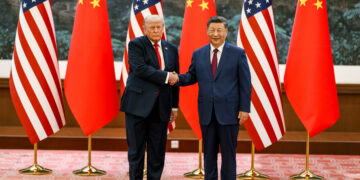
In my new explainer, I advocate for a “double Kissinger,” meaning improving relations with both Moscow and Beijing. In some ways, the Trump administration seems to be coming around to this policy. It’s probably not part of some grand strategy, but more about pragmatism. It’s important for the U.S. to maintain a working relationship with both countries, as they have significant influence worldwide. A good relationship with Moscow and Beijing is key to lowering tensions in many places around the world, including the Arctic, Latin America, and the Middle East.
Of course, there is also the nuclear peril. The U.S., Russia, and China have the world’s biggest nuclear arsenals. The best way to reduce the risk of catastrophic conflict is for the U.S. to improve its relationships with China and Russia. I am modestly pleased with how diplomacy with both Beijing and Moscow is developing under the Trump administration, but I’d like to see a more energetic push on both fronts.
The biggest challenges are the Ukraine war, on the one hand, and Taiwan, on the other. I argue in the paper that we should focus on these two issues rather than put them aside. We need to address them up front and use skillful diplomacy to remove these major obstacles to greater cooperation and improved relations.
Author

More on Asia




Events on Asia