Key points
- It’s in America’s interests to avoid a Eurasian hegemon, so forestalling a deeper alliance between China and Russia should be a major goal of U.S. strategy.
- China and Russia’s present relationship is best described as a “quasi-alliance.” It bears some features of a military partnership, but it still falls short of a full alliance as seen with the cooperation between the U.S. and its allies.
- U.S. foreign policy has been the main driver behind the China-Russia quasi-alliance, though various factors still constrain the relationship, including the security provided by nuclear weapons and mutual wariness of worsened tensions with the U.S.
- Chinese and Russian cooperation remains primarily commercial, and even that aspect of the relationship has its complications, but overly confrontational U.S. policies could still push the two powers closer together.
- Rather than confront both powers at once, or engage with Russia to drive a wedge between the two (a so-called “reverse Kissinger”), a better approach is to improve relations with both China and Russia at the same time (a so-called “double Kissinger”).
Threat inflation and a Eurasian hegemon
The strategic cooperation between China and Russia increasingly forms an organizing principle in U.S. defense strategy.1This is a major facet of the “great power competition” concept enshrined in the “National Security Strategy of the United States of America,” White House, December 2017, https://trumpwhitehouse.archives.gov/wp-content/uploads/2017/12/NSS-Final-12-18-2017-0905.pdf. Russia’s role in American strategic thinking assumed new prominence after the invasion of Ukraine, but the Biden administration’s policy was still to view China as the greater threat. Either way, there exists a decades-old consensus that a conjoining of Chinese and Russian military efforts would represent a new level of threat to the United States.2See, for example, Zbigniew Brzezinski, The Grand Chessboard (New York: Basic Books, 1998); James Ballacqua (ed.), The Future of China-Russia Relations (Lexington: University of Kentucky Press, 2010); and Douglas Schoen and Melik Kaylan, The Russia-China Axis: The New Cold War and America’s Crisis of Leadership (New York: Encounter Books, 2014).
This line of thinking seems to resonate with the second Trump administration. In early 2025, according to one press report, Secretary of State Marco Rubio “warned that closer ties between China and Russia would pose a problem for the US, if Moscow became the ‘permanent junior partner’ to Beijing….”3“Rubio Says US Can’t Let Russia Become China’s ‘Junior Partner,” Bloomberg News, February 27, 2025, https://www.yahoo.com/news/rubio-says-us-t-let-040848373.html.
The concern with a Eurasian hegemon forms a relatively stable line of American strategic reasoning going back to Sir Halford Mackinder and Nicholas Spykman.4Halford Mackinder, “The Geographical Pivot of History,” Geographical Journal 23, no. 4 (April 1904): 421–437; Nicholas J. Spykman, The Geography of the Peace (New York: Harcourt, Brace & Co., 1944). These theorists observed that joining the resources of the Eurasian supercontinent could pose a threat to the leading maritime states, namely the U.S. and the UK. Mackinder was most concerned with a possible alliance marrying Russia’s geography and resources to Germany’s manufacturing prowess.5Mackinder, 436. Today, the more obvious pairing is of Russia, with its large nuclear arsenal, and China, a country now firmly holding the position of “workshop of the world.”
It is therefore conceivable that, if it works in league with Russia, China could achieve an extraordinary level of power in Eurasia. As one leading American expert put it, “The crux of the problem, in short, is regional hegemony in Asia….”6Stephen Walt, “Hedging on Hegemony: The Realist Debate over How to Respond to China” International Security 49 (spring 2025), 37. A prospective China-Russia alliance could present a viable path toward this future. This is perceived as a threat by the U.S. for two major reasons. First, the accumulated resources of Eurasia could constitute a rival power that might threaten the United States or at least its trade interests. Second, there is the tendency of regional hegemons to “roam,” or take aggressive action on the world stage.7On the tendency of regional hegemons to roam, see John J. Mearsheimer, “Can China Rise Peacefully?” National Interest, April 8, 2014, https://nationalinterest.org/feature/can-china-rise-peacefully-10204; Emma Ashford, First Among Equals: US Foreign Policy in a Multipolar World (New Haven: Yale University Press, 2025), 173; Walt, “Hedging on Hegemony…” 38.
This concern, rooted in realpolitik thinking, provides a foundation for more alarmist thinking that sees a Russia and China leading a global league of autocratic states. A good example is the 2018 book Axis of Authoritarians. As one of the leaders of this research effort writes, “The two leading dissatisfied powers are once again authoritarian… and covet, as they have for centuries, different parts of the globe. Russia covets Europe, while China covets Asia (and beyond).”8Richard J. Ellings, “The Strategic Context of China-Russia Relations” in eds. Richard J. Ellings and Robert Sutter, Axis of Authoritarians: Implications of China-Russia Cooperation (Washington: National Bureau of Asian Research, 2018), 8. This is plainly an exaggeration, or at least a worst-case scenario, but such assessments are more and more the norm among the U.S. foreign policy elite.9Robert D. Blackwill and Richard Fontaine, “No Limits? The China-Russia Relationship and U.S. Foreign Policy,” Council on Foreign Relations, December 2024, https://www.cfr.org/reports/no-limits-china-russia-relationship-and-us-foreign-policy?gad_source=1&gad_campaignid=23585471037&gbraid=0AAAAAD-idA3KvrbaNUW3u8VPEn8Pfjtzl&gclid=CjwKCAjwpcTNBhA5EiwAdO1S9sm2EXmY7ZH4s17somjaBnJeOlMhhuteEin5PJavjVoAgrUn04omZhoCmt8QAvD_BwE.
In this explainer, I argue that while constraints on Chinese-Russian cooperation mean the United States has little to fear from the relationship, it is worth shifting U.S. policy to stop driving the two powers together. The best way to achieve this is not simply courting Russia but gradually improving ties with both countries. This would not only ensure the two Eurasian giants do not upgrade their partnership into an alliance that could genuinely threaten U.S. national security, but also reduce the real risk that Russia and China individually present to the United States.
This explainer begins with a brief historical discussion about China and Russia’s historically stable and improving relationship. A second section discusses factors that limit the two powers’ cooperation. A third section discusses the Chinese-Russian quasi-alliance in both military and commercial domains. A fourth section explains how the U.S. inclination toward “excessive balancing” could lead to a tighter and more formalized China-Russia alliance with negative outcomes for U.S. national security. A fifth section explains how to avoid this dark outcome by pursuing détente with both Moscow and Beijing simultaneously.
From the golden age to the Sino-Soviet conflict to growing ties
The China-Russia bilateral relationship carries its share of historical baggage, but this is often exaggerated.10Bobo Lo, A Wary Embrace: What the China-Russia Relationship Means for the World (Melbourne: Penguin Books Australia, 2017), 3–4. There have been tensions over the roughly five centuries of China-Russia contact in the Modern Era, to be sure. Yet these tensions never came close to approximating the cataclysmic bloodletting that has afflicted other neighboring powers, whether between Russia and Germany or China and Japan. China and Russia have never been involved in a large-scale war against one another.11On one of the more serious of the various Sino-Russian skirmishes at Albazin in 1685, see, for example, Mark Mancall, Russia and China: Their Diplomatic Relations through 1728 (Cambridge, MA: Harvard University Press, 1971), 131–140.
True, Russia played a considerable role in China’s century of humiliation, roughly 1839–1945, when the European powers, together with Japan and to a lesser extent the U.S., fought numerous wars on Chinese territory and generally contested for zones of interest. The Kremlin took advantage of China’s weakness to secure its favored borders along the Amur River and extending to the Pacific coastline.12Andrew Higgins, “On Russia-China Border, Selective Memory of Massacre Works for Both Sides,” New York Times, March 26, 2020, https://www.nytimes.com/2020/03/26/world/ussia/ussia-china-border.html. The Chinese still occasionally brace at the subject of Mongolian statehood or whether the city of Vladivostok was originally a Manchu settlement.13Jan Kallberg, “Goodbye Vladivostok, Hello Haishenwai,” Center for European Policy Analysis, July 2022, https://cepa.org/article/goodbye-vladivostok-hello-haishenwai/.
But generally China is more concerned to emphasize that the Russians rendered vital assistance in Chinese struggles with Japan and later against the U.S. in Korea.14Yuri Tavrovsky [Юрий Тавровский], “The Unending War: China Does Not Accept the Results of the Second World War” [Незавершенная Война. Пекин Не Устраивают Итоги Второй Мировой], Nezavismaya Gazeta [Независмая Газета], February 18, 2020, https://www.ng.ru/ideas/2020-02-17/7_7796_war.html. It was the Korean War that crystalized the high point of China-Russia cooperation. As one recent history of this period relates regarding combat in the Korean War, “Soviet fighters would come to rescue Chinese and [North] Korean pilots… in extremely dangerous situations,” adding, “The Soviet air force played a very important role during the Korean War.”15Zhihua Shen and Yafeng Xia, Mao and Sino-Soviet Partnership, 1945–59: A New History (Lanham, MD: Lexington Books, 2015), 87. A similar account is offered in Dai Kuixian [戴逵贤], The US-China Fight to the Finish in the Skies above North Korea [朝鲜上空的中美对决] (Beijing: Aviation Industry Press, 2018), 181.
This cooperation dissolved with high drama when all Soviet advisors in China were ordered home in 1960. Ideological differences, historical grievances, and, most fundamentally, internal political machinations gave rise to the Sino-Soviet split that brought the Eurasian giants to the brink of war in March 1969.16On the Ussuri clash, see Lyle Goldstein, “A Forgotten Battle: Fifty Years Ago, Russia and China Slugged it Out on Damansky Island,” National Interest, March 17, 2019, https://nationalinterest.org/feature/forgotten-battle-fifty-years-ago-russia-and-china-slugged-it-out-damansky-island-47677. On the Sino-Soviet split, see Lorenz M. Luthi, The Sino-Soviet Split: Cold War in the Communist World (Princeton, NJ: Princeton University Press, 2008). The Kremlin undertook a massive military buildup to contend with the Chinese threat and even threatened to undertake strikes against Beijing’s nascent nuclear arsenal.17On these nuclear threats, see Lyle Goldstein, “Do Nascent WMD Arsenals Deter? The Sino-Soviet Crisis of 1969,” Political Science Quarterly 118, no. 1 (spring 2003), 53–79, https://www.psqonline.org/article.cfm?IDArticle=14854.
Sino-Soviet geopolitical rivalry spread throughout the world, including notably into Africa, and played a role in triggering a major war between China and Vietnam in 1979.18Nguyen Minh Quang, “The Bitter Legacy of the 1979 China-Vietnam War,” Diplomat, February 23, 2017, https://thediplomat.com/2017/02/the-bitter-legacy-of-the-1979-china-vietnam-war/. The fact that a captured Soviet T-62 tank remains on very prominent display at Beijing’s newly renovated military museum suggests that the Sino-Soviet conflict has not been forgotten, and this seems true on the Russian side as well.19Goldstein, “A Forgotten Battle.”
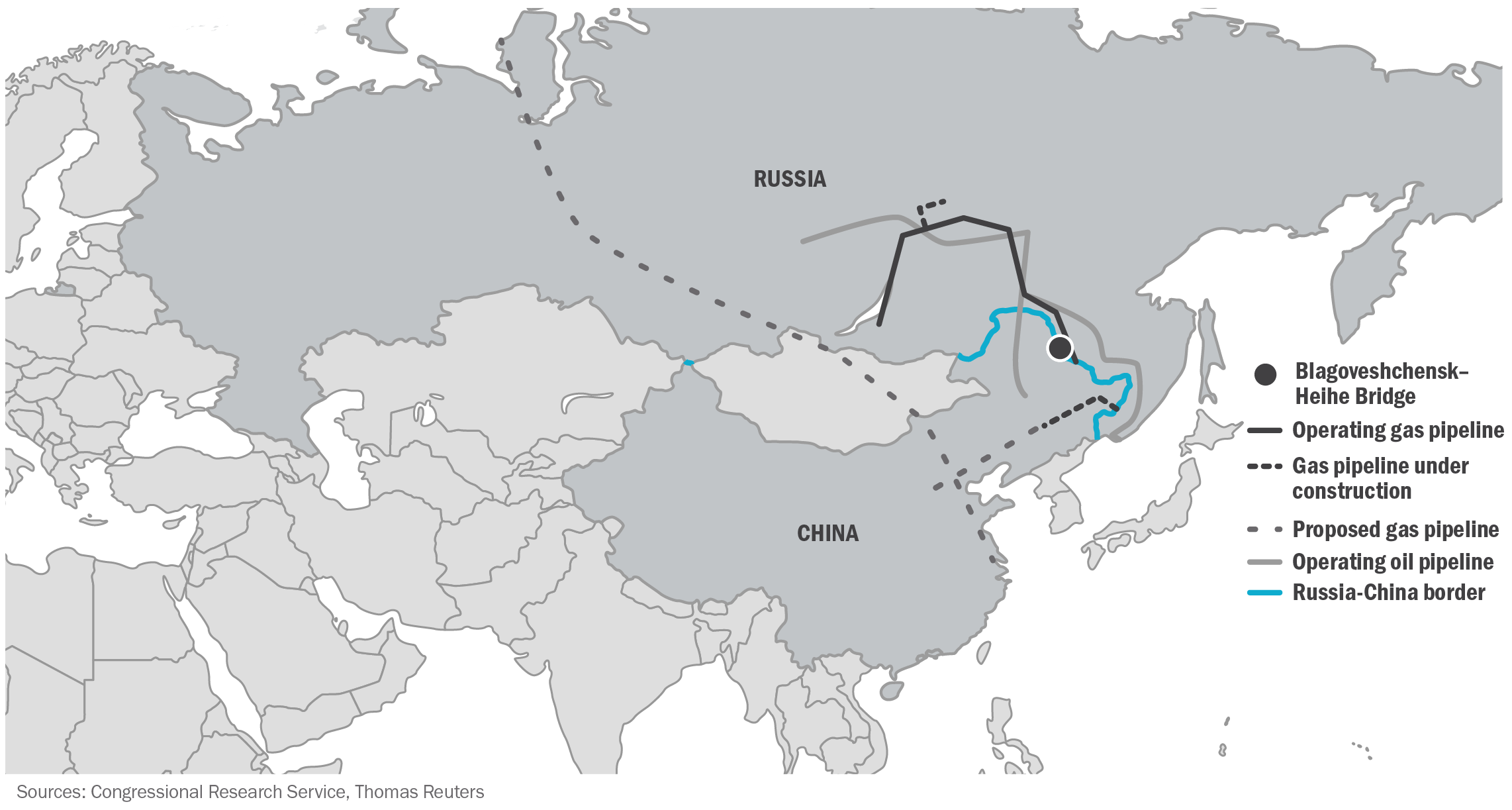
Less than two decades later, the bilateral China-Russia relationship began to warm again under the guidance of two reformist leaders, Deng Xiaoping and Mikhail Gorbachev. The relationship has since progressed through several stages, from normalization to comprehensive partnership. Some of the significant milestones in this warming trend came thanks to external threats, such as the sense of mutual vulnerability following the NATO campaign against Serbia in 1999.20See, for example, Tom Fox, “Bombs over Belgrade: An Underrated Sino-American Anniversary,” War on the Rocks, May 7, 2019, https://warontherocks.com/2019/05/bombs-over-belgrade-an-underrated-sino-american-anniversary/. Starting in the mid-1990s, China began to import large quantities of Russian weapons, ranging from fighter aircraft and air transports to destroyers and diesel submarines.21Lyle Goldstein and Vitaly Kozyrev, “China-Russia Military Cooperation and the Emergent U.S.-China Rivalry: Implications and Recommendations for U.S. National Security,” Journal of Peace and War Studies, October 2020, 27–32. In 2005, China and Russia organized their first joint military exercise.22Vicky O’Hara, “China, Russia Hold Joint Military Exercises,” NPR, August 18, 2005, https://www.npr.org/2005/08/18/4804897/china-russia-hold-joint-military-exercises. A smaller multilateral exercise was held under the auspices of the Shanghai Cooperation Organization (SCO) in 2003. In 2011, oil began to flow through a China-Russia oil pipeline.23“Russia-China Oil Pipeline Opens,” BBC, January 2, 2011, https://www.bbc.com/news/world-asia-pacific-12103865.
China and Russia’s energy ties
Throughout the contemporary period, growing tensions with the U.S. and its allies, both in Eastern Europe and in the western Pacific, spurred closer ties between the Eurasian giants. Russia’s threat perceptions increased when NATO began so-called “out-of-area” operations, starting in the Balkans during the late 1990s. The U.S. withdrawal from the ABM Treaty (2002) and the second Iraq war (2003) both added to the U.S.-Russia estrangement, since the ABM Treaty had long been regarded as a cornerstone of nuclear disarmament and Iraq had formerly been a Soviet client state.
The continuing process of NATO expansion during the 2000s also played a major role in triggering Russian threat perceptions. Russia’s invasion of Georgia in 2008 was likely a response to NATO’s expansion into the Caucasus region, a former Soviet area traditionally in Russia’s sphere of influence. U.S. interventions in Libya and Syria (2011 and 2013, respectively), both partners to Russia, further inflamed the Kremlin’s ire. But it was the boiling of the Ukraine crisis, from the Orange Revolution (2004) to the Maidan protests (2013) to Russia’s annexation of Crimea (2014), that finally led to Russia’s complete break with the West and its 2022 full-scale invasion of Ukraine.
This succession of perceived wounds made Moscow eager to work with Beijing in order to contest U.S. global power. Meanwhile, a parallel process was unfolding in the Asia-Pacific due to obvious U.S. efforts to contain China. The Pacific rivalry was set in motion during the 1995–96 Taiwan crisis when Washington deployed two aircraft carriers to the vicinity of the island in order to deter Beijing. Maritime incidents, including dangerous maneuvering both in the EP-3 aircraft collision (2001) and the so-called USNS Impeccable incident (2009) as well as the crisis at Scarborough Shoal (2012) convinced Chinese strategists that the U.S. was determined to maintain military predominance in areas proximate to China. They viewed this outcome as unacceptable.
Growing friction in Chinese-Japanese relations in the East China Sea (2010) contributed to a bubbling cauldron alongside other tensions in the South China Sea and Korean Peninsula. The resulting American “pivot” to the Asia-Pacific in 2012 became another step in the deepening Sino-American estrangement that is now so evident.24For a critique of the Obama administration’s pivot, see Robert Ross, “The Problem with the Pivot,” Foreign Affairs, November/December 2012, https://www.foreignaffairs.com/articles/asia/2012-11-01/problem-pivot. While apprehensions in the South China Sea reached a new apex in 2015 with the completion of China’s reef bases there, Taiwan tensions would increase dangerously again that following year when Tsai Ing-wen was elected the island’s president.
But it was when the first Trump administration declared a new U.S. strategy of great power competition, which overtly saw China as a primary adversary, that U.S.-China strains became fully evident. That policy was continued and even strengthened under President Joe Biden, who declared no fewer than four times that the U.S. was prepared to fight to defend Taiwan, partially overturning the decades-long policy of “strategic ambiguity.” China viewed all this as hostile and dangerous, making Beijing more receptive and enthusiastic to working with Russia.
The impact of the 2022 Russia-Ukraine War in solidifying the China-Russia relationship has been especially dramatic. That tendency was apparent more than a decade ago after the Maidan protests and the Crimea annexation. The China-Russia relationship grew substantially closer in 2015, as illustrated by President Xi Jinping’s controversial visit to Moscow after the West imposed sanctions on Russia for annexing Crimea in 2014.25Matt Schiavenza, “China and Russia Grow Even Closer,” Atlantic, May 10, 2015, https://www.theatlantic.com/international/archive/2015/05/china-and-russia-grow-even-closer/392882/.
In a foretaste of China’s eventual position on the Russia-Ukraine War, Beijing adopted a mixed position, refusing to endorse or formally recognize the Kremlin’s actions in Crimea but not condemning Moscow or slowing China-Russia cooperation.26Zhang Lihua, “Explaining China’s Position on the Crimea Referendum,” Carnegie Endowment for International Peace, April 1, 2015, https://carnegieendowment.org/research/2015/04/explaining-chinas-position-on-the-crimea-referendum?lang=en. Chinese leaders would later evidence similar inhibitions, steadfastly refusing to give Russia finished armaments or munitions to support the Kremlin’s war. But China’s neutrality in the conflict has been notably pro-Russian, entailing diplomatic, economic, and indirect military support.
The China-Russia quasi-alliance
In the process of building broad-based bilateral cooperation, Russia and China formed what might be called a quasi-alliance starting in the late 1990s, both as a response to perceived American threats and as a result of pragmatic efforts to fill major security and defense gaps. Major Chinese shortfalls in defense capabilities during this period, such as submarines, and Beijing’s isolation from the West drove China closer to Russia, as did lingering instability in Central Asia.27On common concerns in Central Asia, see, for example, Jeanne L. Wilson “Coloured Revolutions: the View from Moscow and Beijing,” Journal of Communist Studies and Transition Politics 25 (2009), https://www.tandfonline.com/doi/abs/10.1080/13523270902861061. Chinese and Russian military institutions, including research institutes and production centers, made initial exchanges as the two armed forces initiated regular exchanges and exercises.28Alexander Lukin, Russia and China: the New Rapprochement (Medford, MA: Polity Press, 2018), 136.
The China-Russia relationship is currently growing closer, including in the commercial, scientific, and cultural domains, but it is still far from a genuine military alliance.29Alexander Korolev, China-Russia Strategic Alignment in World Politics (Amsterdam: Amsterdam University Press, 2022), 191. Alliances vary significantly across a range of commitments and activities, but an actual military alliance would entail some mutual defense obligations or, by looser definitions, some formalized set of strategic obligations.30For a definition of an alliance as including mutual defense obligations and a discussion of a looser alternative, see Natalie Armbruster and Benjamin Friedman, “Who is an Ally and Why Does it Matter?” Defense Priorities, October 12, 2022, https://www.defensepriorities.org/explainers/who-is-an-ally-and-why-does-it-matter/. As much as U.S. antagonism has spurred China-Russia cooperation, the relationship still seems unlikely to reach the level of military alliance.31For a skeptical perspective on China-Russia relations, see Odd Arne Westad, “The Next Sino-Russian Split: Beijing Will Ultimately Come to Regret Its Support of Moscow,” Foreign Affairs, April 5, 2022, https://www.foreignaffairs.com/articles/east-asia/2022-04-05/next-sino-russian-split. For a view of the China-Russia partnership as deeper and more durable, see Marcin Kaczmarski, Russia-China Relations in the Post-Crisis International Order (London: Routledge, 2015), or, more recently Korolev, China-Russia Strategic Alignment in World Politics.
I adopt the term “quasi-alliance” because the relationship does have features of an alliance, such as institutionalized military cooperation in the form of educational exchanges and joint exercises repeated on an annual basis. Yet it lacks other aspects of a full military alliance, at least relative to how American alliances tend to look, including shared bases, an integrated and standing command structure, and mutual defense commitments. Comparing China-Russia military cooperation to the much more robust relationships that the U.S. has with NATO or its major East Asian allies yields the conclusion that the military partnership between Beijing and Moscow is far less developed.
The limits of China-Russia cooperation
Before turning to the substance of China and Russia’s strategic cooperation, it is useful to frame its limits. Four key factors have prevented the quasi-alliance from becoming an alliance.
First, there is the memory of past enmity resulting from the reality that the two states still share a border and can threaten each other. Second, differing geopolitical circumstances limit an overlap in interests and the two powers remain divided on key issues. Third, Beijing and Moscow worry that a tight, militarized alliance would not serve their respective interests or a stable world order. This is partly a result of a fourth key factor, which is that the threat that drives Russia and China together—the United States—is not as threatening as it might be. This is especially true given that both countries have large nuclear deterrents that diminish the likelihood of a direct war with other nuclear powers and make the prospect of being invaded hard to credit.
There is not only a lingering memory of hostile relations between China and Russia during the second half of the Cold War (1960–1990) but the extant, if minor, possibility that the two Eurasian giants could threaten one another in the future. Inhibitions on the Russian side are more acute, since Russia is the weaker of the two parties. There are plentiful hints of Russian anxieties regarding the growth of Chinese influence in Russia, including apparently within the Kremlin’s intelligence apparatus.32Jacob Judah, Paul Sonne, and Anton Troianovski, “Secret Russian Intelligence Document Shows Deep Suspicion of China,” New York Times, June 7, 2025, https://www.nytimes.com/2025/06/07/world/europe/china-russia-spies-documents-putin-war.html. Some Russians have articulated the fear that China’s demographic and military superiority could pose an inherent threat to their resource-rich but sparsely populated Far Eastern territories.33Mikhail Vovk [Михаил Вовк], “Alexander Khramchikhin: The US Is Not a Threat to Us, but We Should Be Wary of a Chinese Attack” [Александр Храмчихин: США нам не грозят, а вот удара Китая опасаться следует], Arguments and Facts [Аргументы и Факты], February 22, 2011, https://aif.ru/politics/world/23637. Likewise, a few Chinese experts emphasize that the two nations have been bitter rivals historically with “nothing in common,” and that the Chinese have often considered the Russians “threatening.”34Professor Lanxin Xiang, “China and Russia: An Unlikely Brotherhood,” posted by Watson School of International and Public Affairs, November 7, 2023, YouTube, https://www.youtube.com/watch?v=9VBJtOCVc1g. Such negative sentiments are mostly dormant in both countries as pragmatic cooperation prevails, but they still surface occasionally and likely limit the relationship.
A related issue is Russia’s wariness of being exploited as China’s junior partner. The asymmetry of power that characterizes the relationship, where China is a global trading juggernaut with nearly nine times the GDP of Russia, makes Russia wary of becoming overly dependent on China.35Philipp Ivanov, “Together and Apart: The Conundrum of the China-Russia Partnership,” Asia Society, October 11, 2023, https://asiasociety.org/policy-institute/together-and-apart-conundrum-china-russia-partnership. The gap is significantly narrower if Purchasing Power Parity (PPP) measurements are used. PPP estimates for 2025 by the IMF are available at “GDP (PPP) by Country (2025) – IMF,” Worldometers, https://www.worldometers.info/gdp/gdp-by-country/?source=imf&year=2025&metric=ppp®ion=worldwide.
A second major constraint on bilateral relations is divergent interests. This strategic divergence is a result of several factors: geography, trade competition, and historic experiences with sovereignty.
With respect to geography, Russia has core interests in the Baltic Sea, for instance, but China has hardly any interests there at all. The same is true in reverse concerning the South China Sea. These inherent asymmetries mean China and Russia may have a similar outlook and sympathies toward each other, but there is little inclination to contemplate war over the same issues. This should put to rest that most feared scenario of China and Russia acting in concert in a war against the West—a fear that has been expressed by wantonly slinging around the emotive term “axis.”
China and Russia have long disagreed about the South China Sea dispute, as the Kremlin was initially reluctant to go along with China’s controversial claims to the so-called nine-dash line that encompasses much of the South China’s Sea’s area and critical sea lanes.36Svetlana Dorofeeva [Светлана Дорофеева], “Sea of Discord. What Should Russia Do in the Conflict Around the South China Sea?” [Море раздора. Что делать России в конфликте вокруг Южно-Китайского моря?], Arguments and Facts [Аргументы и Факты], May 11, 2018, https://aif.ru/politics/world/more_razdora_chto_delat_rossii_v_konflikte_vokrug_yuzhno-kitayskogo_morya?ysclid=lqr3ubkhrq613607753. This was especially seen with regard to Vietnam. Russia supported Vietnam’s own extensive territorial claims and associated reef-building efforts in the South China Sea even though this was antagonistic to China, not least because Russian firms were active in exploring for hydrocarbons off of Vietnam’s coast.37Despite some recent improvement in the China-Vietnam relationship, these tensions persist. See, for example, Tommy Walker, “China-Vietnam Tensions Flare up over South China Sea,” DW, June 18, 2024, https://www.dw.com/en/china-vietnam-tensions-flare-up-over-south-china-sea/a-69398016. This placed Moscow, at least for a time, in league with Washington, which also opposed Beijing’s expansive claims in the South China Sea. China-Russia tensions over this issue likely peaked during a 2014 crisis involving China’s provocative placement of a major drill rig in waters claimed by Vietnam.38Michael Green, Kathleen Hicks, Zach Cooper, John Schaus, and Jake Douglas, “China Counter-coercion Series: China-Vietnam Oil Rig Standoff,” Center for Strategic and International Relations Asia Maritime Transparency Initiative, June 12, 2017, https://amti.csis.org/counter-co-oil-rig-standoff/. Those tensions have receded since, but the issue of Vietnam—a country that China fought a war with in 1979—and particularly Russia’s long commitment to arming Hanoi with billions of dollars in advanced weaponry, has long been a thorn in the side of the China-Russia quasi-alliance.39While China has reservations about Russia-Vietnam cooperation, it is plausible that it prefers this to closer U.S.-Vietnam cooperation.
India poses a similarly sensitive problem. China is reasonably understanding of the “special bond” that unites Russia and India, but looks askance at certain key defense programs, such as the BrahMos anti-ship missile that has heightened Indian capabilities, since it has supersonic speed and thus likely a high ability to penetrate defenses.40Petr Topychkanov, “The BrahMos Is Just Beginning,” Carnegie Endowment for International Peace, July 3, 2015, https://carnegieendowment.org/posts/2015/07/the-brahmos-is-just-beginning?lang=en. This is a symptom of a larger issue: competition between Beijing and Moscow for defense exports in developing markets remains intense, with some residual bad feelings that Chinese weapons are often copies of Russian systems.41See, for example, Alexandre Sheldon Duplaix, “Russia-China Naval Partnership and Its Significance” in Sarah Kirchberger, Svenja Sinjen, and Nils Wormer (eds.), Russia-China Relations: Emerging Alliance or Eternal Rivals (Cham, Switzerland: Springer, 2022), 107.
The Ukraine war also reveals the limits of cooperation. By refusing to sell Russia finished weapons systems, China has offended the Russian foreign policy elite. The Russians are aware that China has the military-industrial heft to impact the war’s outcome if Beijing were so inclined, and there is little doubt Russia would benefit substantially from Chinese armored vehicles, artillery, and infantry arms, not to mention munitions. Yet Beijing has refrained from providing this equipment.42“China Snaps Back at U.S. Claims It Might Supply Russia with Weapons,” Newsweek, February 20, 2023, https://www.newsweek.com/china-america-russia-ukraine-lethal-weapons-supply-1782320.
At the same time, China’s unique historical experience—both as a colonized power and its perception of Taiwan as a renegade province—makes its leaders more consistent guardians of state sovereignty than Russia, which seems to regard sovereignty issues left over from the collapse of the USSR as open to revision. Chinese foreign policy elites have harshly criticized Russia’s policies, especially its attempt to shift borders by force.43“Russia Is Sure to Lose in Ukraine, Reckons a Chinese Expert on Russia,” Economist, April 11, 2024, https://www.economist.com/by-invitation/2024/04/11/russia-is-sure-to-lose-in-ukraine-reckons-a-chinese-expert-on-russia.
Eurasia expert Zhao Long writes: “Across successive crises—from the Kosovo War to the Russia-Georgia conflict to Crimea—China has consistently refused to recognize any unilateral changes to territorial status….”44Zhao Long, “Why China Is Not Interested in Great Power Carve-ups,” Diplomat, May 30, 2025, https://thediplomat.com/2025/05/why-china-is-not-interested-in-great-power-carve-ups/. He concludes, “China’s commitment to Ukraine’s sovereignty and territorial integrity has not changed—and there is little reason to believe it will in the future.”45Long, “Why China Is Not Interested in Great Power Carve-ups.” This disagreement over sovereignty has not been a huge stumbling block to China-Russia cooperation, but it is emblematic of deeper philosophical differences and seems to act as a limiting factor on Chinese aid to Russia’s war in Ukraine.
The third key factor limiting cooperation is a desire to avoid deepening antagonism with the United States. Chinese and Russian leaders are aware that as bad as relations are with U.S., they could always be worse. This is why official statements on the bilateral relationship, going back even to the 1990s, point out that they are not directed against a third party.46Vanora Bennett, “Russia, China Sign Declaration of Unity,” Los Angeles Times, April 24, 1997, https://www.latimes.com/archives/la-xpm-1997-04-24-mn-51910-story.html; “Joint Statement Signed by the Chinese and Russian Heads of States,” Chinese Ministry of Foreign Affairs, July 24, 2001, https://www.mfa.gov.cn/eng/zy/gb/202405/t20240531_11367099.html. Both countries are wary of going too far and, in so doing, provoking a counterreaction from the U.S. and its allies. China and Russia are wary of American power, having paid dearly for blundering into wars and undertaking rivalries against America. Such costly blunders could be said to include both the Korean War and the Soviet war in Afghanistan. In short, they are not eager to embrace a new cold war, and they seem to have an awareness that formalizing and invigorating the quasi-alliance would be detrimental in this respect.47Larry Elliott, “Xi Jinping warns of ‘new cold war’ if US keeps up protectionism,” Guardian, January 25, 2021, https://www.theguardian.com/world/2021/jan/25/china-xi-jinping-warns-of-new-cold-war-us-protectionist-policies; Lyle Goldstein and Vitaly Kozyrev, The New Cold War at Sea: Maritime Implications of the China-Russia Quasi-Alliance (Annapolis, MD: Naval Institute Press, 2026), 49–52.
The fourth and related factor undermining Chinese-Russian cooperation is the limits of the U.S. threat. While the military establishments in both China and Russia are focused on the United States, they are aware that the U.S. is not trying to directly attack or overthrow their respective regimes, despite occasional rhetoric to the contrary.48See, for example, Deep Shivaram and Avie Schneider, “Biden Says of Putin: ‘For God’s Sake, This Man Cannot Remain in Power,’” NPR, March 26, 2022, https://www.npr.org/2022/03/26/1089014039/biden-says-of-putin-for-gods-sake-this-man-cannot-remain-in-power.
This security partly derives from nuclear weapons. Russia leaned hard on its nuclear arsenal to deter against U.S. and European military intervention in Ukraine. Meanwhile, China has embarked on a major buildup of its own nuclear forces.49Jonas Olsson, “China’s Nuclear Arsenal Surges 20% in One Year, Reaching over 600 Warheads: SIPRI,” Breaking Defense, June 15, 2025, https://breakingdefense.com/2025/06/chinas-nuclear-arsenal-surges-20-in-one-year-reaching-over-600-warheads-sipri/. It is logical that nuclear weapons would play some role in reducing both nations’ insecurity vis-à-vis the United States. China and Russia have both felt an increased level of threat from the U.S. in recent decades, but their respective nuclear arsenals mean there is no need to take extreme measures, such as significantly upgrading their quasi-alliance.50Robert Jervis, The Meaning of the Nuclear Revolution: Statecraft and the Meaning of Armageddon (Ithaca, NY: Cornell University Press, 1989).
The U.S. cements the China-Russia quasi-alliance
Despite these sources of restraint, China and Russia have good reasons to cooperate. Moscow and Beijing have fundamental common interests: promoting internal development, expanding trade, maintaining political stability, and aggressively countering separatism and terrorism. These provide substantial ballast to bilateral relations, but it’s the United States that is the major factor in cementing the contemporary China-Russia quasi-alliance. To a considerable degree, the quasi-alliance is a classic example of a state balancing against a threatening power.51Stephen Walt, The Origin of Alliances (Ithaca, Cornell University Press, 1987).
The outlines of the contemporary China-Russia quasi-alliance are evident in the two countries’ joint statement of April 1997 that warned against “hegemony… conflict and confrontation,” and advocated for “a trend towards a multipolar world.” The statement also condemned the “Cold War mentality and bloc politics,” declaring that China and Russia seek to forge “a new type of long-term inter-State relations that are not directed against third countries.”52This paragraph is drawn from “Russian-Chinese Joint Declaration on a Multipolar World and the Establishment of a New International Order, adopted in Moscow on 23 April 1997,” full text available at United Nations Digital Library, https://digitallibrary.un.org/record/234074?ln=en&v=pdf. By that point, both Beijing and Moscow had quite clearly seen enough of the “unipolar moment,” including U.S. military interventions in Iraq, Somalia, and Bosnia with concurrent threats applied to the Taiwan Strait and the ever-volatile Korean Peninsula. Both nations had begun to contemplate alternate systems of global order.
A quarter century later, the same suspicions of American global predominance remain a major impetus for solidifying the relationship. The May 2024 China-Russia joint statement, which runs to about 8,000 words, states that it is not directed against a third party but also warns against “hegemony and power politics” and advocates for “building a multipolar world”—clear jabs at the global role played by the U.S.53Ben Norton, “China-Russia joint statement marking ‘new era’ on 75th anniversary of relations (full text),” Geopolitical Economy, May 24, 2024, https://geopoliticaleconomy.com/2024/05/24/china-russia-joint-statement-new-era-75th-anniversary/.
These U.S. policies involved encroachment on the vital national security interests of both China and Russia over a period extending back into the Cold War. For Russia, major concerns revolved around NATO expansion and political volatility in Ukraine, but also other issues like arms control and the Middle East. For China, the main driver of tensions was U.S. actions related to Taiwan—such Nancy Pelosi’s visit to the island in August 2022—which Beijing believes are aimed both at containing China and making Taiwan’s separation permanent. Other U.S. strategic initiatives, including in the East China Sea, the South China Sea, and on the Korean Peninsula, have likewise reinforced Chinese anxieties and created a strong impetus for China and Russia to work together.
While the China-Russia quasi-alliance has seen the two nations cooperate on military matters, the two countries also collaborate in other ways, including in developing strategic trade relations and conducting ad hoc initiatives in various global flashpoints. The 2024 statement is remarkable in its breadth, covering regional areas from Afghanistan to Africa to the Arctic, as well as functional issues like joint lunar exploration and even “digital green transformation,” as well as a bilateral “pop music festival.”54Norton, “China-Russia Joint Statement…” Chinese and Russian leaders meet very regularly and issue joint statements on a roughly annual basis. The 2025 joint statement is considerably briefer but covers familiar themes.55“Joint Declaration of the People’s Republic of China and the Russian Federation on Further Strengthening Cooperation to Uphold the Authority of International Law,” China Ministry of Foreign Affairs, May 9, 2025, https://www.mfa.gov.cn/eng/zy/jj/xjpdelsjxgsfwcxjnslwgzzslqd/202505/t20250509_11617838.html.
Military exercises
The core of any budding alliance is, of course, military cooperation, and this has formed a central plank of the developing Chinese-Russian relationship. Both countries’ militaries have been jointly exercising regularly since 2005. These exercises have gradually come to encompass all their armed services (including their coast guards), as well as advanced doctrinal concepts like anti-submarine and amphibious warfare.56Ma Ning and Zhang Hailong [马宁, 张海龙], “Brothers Join Hands, the Ocean Soldiers Guard the Peace” [兄弟携手, 大洋砺兵卫和平], Navy Today [当代海军], August 2023, 11. The exercises have also expanded to new and sensitive areas, such as the Black and South China seas.57Xuan Ya [悬崖], “Bright ‘Warships’ in the Mediterranean: the Chinese-Russian ‘Joint Sea 2015’ Military Drill” [亮‘舰’地中海中俄‘海上联合-2015’军事演习], Shipborne Weapons [舰载武器], July 2015, 10–15.
Not all China-Russia military exercises are potentially threatening—for example, ground forces exercises held in interior Asia. But other joint military exercises are more troubling. Consider the joint strategic aviation exercises that began in 2019. Both countries fielded nuclear-capable bombers. Notably, a Chinese-language account observes that the U.S. has been undertaking similar strategic bomber patrols around China’s flanks.58Pan Shi [磐石], “Brandishing of the Enormous Wing: A Discussion” [挥动巨人的翅膀: 谈中俄罗斯空军第二次联合战略巡航], Shipborne Weapons [舰载武器], January 2021, 32, 40. The mid-2024 iteration of the China-Russia strategic aviation exercise took place close to Alaska and witnessed, for the first time, Chinese bombers staging out of a Russian airbase, which theoretically could enable greater reach for Chinese bombers in a hypothetical U.S.-China conflict.59Heather Williams, Kari Bingen, and Lachlan MacKenzie, “Why Did China and Russia Stage a Joint Bomber Exercise Near Alaska?” Center for Strategic and International Studies, July 30, 2024, https://www.csis.org/analysis/why-did-china-and-russia-stage-joint-bomber-exercise-near-alaska. The regular China-Russia joint strategic aviation patrol once again took wing in December 2025, as a new China-Japan diplomatic crisis continued to escalate.60Jason Douglas, “Russian and Chinese Bombers Fly Joint Patrol Close to Japan,” Wall Street Journal, December 9, 2025, https://www.wsj.com/world/asia/russian-and-chinese-bombers-fly-joint-patrol-close-to-japan-2ae912e4?gaa_at=eafs&gaa_n=AWEtsqeks-NIM5HyCgCzl9WL9Ok7S4cAuLiXiuPIKb-oXLWzV6KMoN_j_dy7uLSj740%3D&gaa_ts=6940208a&gaa_sig=G0DrAD6XaaJZxrpWlbRWUg6pbp8_nQN3JhGWnPwGqSa0AncZNKp74iiCBor7RW9u1RrFpI5gupAOIDeg1SEIaQ%3D%3D. Since regular exercises of nuclear-capable bombers along rival powers’ flanks is becoming more common, such behaviors may deepen great power threat perceptions and should be limited or curtailed by the exercise of reciprocal restraint if possible.
The military exercises that China and Russia have undertaken since 2005 help reveal the limits of cooperation. These exercises are frequent and increasingly sophisticated, but still limited in scale. They are smaller than those undertaken either by NATO or the U.S. and its allies in East Asia. The largest China-Russia naval exercise involved 15 warships, while large U.S.-led multilateral exercises in both Europe and East Asia routinely gather 40 to 50 warships and sometimes even more.61Lyle J. Goldstein and Vitaly A. Kozyev, The New Cold War at Sea: Maritime Implications of the China-Russia Quasi-Alliance (Annapolis: U.S. Naval Institute Press, 2026), 50; “Steadfast Defender draws to a close for thousands of personnel across all of Nato,” BFBS Forces News, May 31, 2024, https://www.forcesnews.com/nato/steadfast-defender-draws-close-thousands-personnel-across-all-nato; “RIMPAC 2024: Departure for the World’s Largest Naval Exercise,” Bundeswehr, October 7, 2024, https://www.bundeswehr.de/en/organization/navy/news/rimpac-2024-departure-world-s-largest-naval-exercise-5816742. Since China and Russia rank as the second and third largest fleets, they could quite easily match or exceed these numbers, but they choose not to.62“Global Naval Powers Ranking (2026),” WDMMW, https://www.wdmmw.org/ranking.php. That indicates that Beijing and Moscow are exercising moderation in their quasi-alliance.
Weapons and technology cooperation
A more worrisome trend that stretches back over three decades concerns the aid that the two sides have rendered to one another in military-technical development. That tendency is hardly hidden, since most of China’s front-line fighter aircraft and bombers are derivative of Soviet designs. The same is true when it comes to surface combatants, conventional submarines, as well as crucial air-defense, air-to-air, and anti-ship missiles, not to mention sensors.63Goldstein and Kozyrev, “China-Russia Military Cooperation…” 27–32.
Russian assistance in the development of Chinese weaponry has occurred in two major waves, the first during the 1950s and the second during the 1990s and 2000s.64Russian arms sales to China did continue into the 2010s, but the quantity of those sales has diminished over time as China’s indigenous weapons production has strongly improved. See, for example, “Russia Completes Sale to China of Su-35 Jets for $2.5 Bln,” Moscow Times, April 17, 2019, https://www.themoscowtimes.com/2019/04/17/russia-completes-delivery-of-su-35-fighter-jets-to-china-for-25bln-a65271. While this military-technical assistance has generally declined over the last decade, long-term cooperation remains likely, including in critical areas such as submarine development. That is because both militaries see opportunities to improve and both remain isolated from advanced Western technology. Undersea warfare should be a focus of concern to U.S. defense analysts given that the PLA Navy can still benefit substantially from Russia’s extensive experience, particularly in developing nuclear submarines to counter the U.S. Navy.65On non-nuclear submarine cooperation, see Sergei Guneev [Сергей Гунеев], “Russia and China Are Designing a New Generation Non-nuclear Submarine” [Россия и Китай проектируют неатомную подводную лодку нового поколения], RIA Novosti [РИА Новости], August 25, 2020, https://ria.ru/20200825/bezopasnost-1576269235.html. On the quality of contemporary Russian nuclear submarines, see Admiral James Foggo (USN), quoted in “Tracking the Russian ‘Severodvinsk’ Submarine: ‘It’s Very Capable and It’s Very Quiet,’” posted by 60 Minutes, April 28, 2019, YouTube, https://www.youtube.com/watch?v=hhAaFXyy9rU. On Chinese interest in Russian nuclear submarine design, see, for example, Shi Zheng [施征], “Return to the Throne: A Brief Analysis of Russia’s Sixth Generation Strategic Nuclear Submarine” [重回王座: 浅析俄罗斯第六代战略核潜艇], Ordnance Science and Technology [兵工科技], no. 20 (2022): 44.
With respect to undersea warfare, a Russian report in mid-2025 suggested that Russian torpedo development could benefit from Chinese advances in artificial intelligence.66Kiril Ryabov [Кирилл Рябов], “Artificial Intelligence for Chinese Torpedoes” [Искусственный интеллект для китайских торпед], Military Review [Военное Обозрение], June 6, 2025, https://topwar.ru/265814-iskusstvennyj-intellekt-dlja-kitajskih-torped.html. This Russian admiration for Chinese military engineering is relatively new and reverses decades of one-way transfers of military-technical expertise. While various Chinese military sectors can still benefit from Russian military achievements, it’s interesting to imagine that Russia’s future navy might well be partially designed and built in China.67This is a possibility that is quite actively discussed in both the Chinese and Russian military press. See, for example, Ilya Kramnik [Илья Крамник], “Chinese Help: Why Russia Should Buy Warships from the PRC” [Китайская помощь: Зачем России покупать боевые корабли у КНР], Izvestiya [Известия], January 10, 2018, https://iz.ru/693302/ilia-kramnik/kitaiskaia-pomoshch; “Rising Sun in Winter: Looking at the Prospects of Russian Naval Equipment Cooperation from the Current Status of Russia’s Surface Forces” [冬日旭阳: 从俄罗斯水面力量现状看中俄罗斯海军装备合作前景], Shipborne Weapons [舰载武器], December 2022, 58. In a worst-case scenario for the U.S., China’s industrial heft might be combined with Russia’s strategic and military design prowess, potentially enabling a much more powerful Chinese military. In such a future, the U.S. might no longer be the world’s most powerful armed forces. While that development would not be devastating for U.S. national security, it could be concerning nonetheless.
Likewise, their joint lunar project involves close cooperation between the two space establishments.68“China’s Ties with Russia Are Growing More Solid,” Economist, April 25, 2024, https://www.economist.com/china/2024/04/25/chinas-ties-with-russia-are-growing-more-solid. Space cooperation could form a leading indicator for both countries’ scientific establishments more generally.
Ad hoc cooperation in wars and hotspots
Russia and China also support one another in more ad hoc ways, as illustrated by the Russia-Ukraine War. While withholding direct military aid and finished weapons, China has provided widespread economic and diplomatic support.69Simon McCarthy, “As War Breaks Out in Europe, China Blames the U.S.,” CNN, February 25, 2022, https://edition.cnn.com/2022/02/25/china/china-reaction-ukraine-russia-intl-hnk-mic. China has also apparently furnished key inputs into Russian military production, including nitrocellulose for munitions and the co-production of drones, while even provisioning Russia with vital satellite imagery support.70Michael R. Gordon, Warren P. Strobel, and Alan Cullison, “China Has Helped Russia Boost Arms Production, U.S. Says,” Wall Street Journal, April 12, 2024, https://www.reuters.com/world/china/us-demands-clarity-allies-their-role-potential-war-over-taiwan-ft-reports-2025-07-12/.
It is likely that the Chinese military is receiving reports on how to counter advanced U.S. weaponry from Russia.71“Russia Is Starting to Make Its Superiority in Electronic Warfare Count,” Economist, November 23, 2023, https://www.economist.com/europe/2023/11/23/russia-is-starting-to-make-its-superiority-in-electronic-warfare-count. For Chinese study of Russian counter-HIMARS operations, see Lyle Goldstein and Nathan Waechter, “China Considers Countermeasures to US HIMARS Missile System,” Diplomat, June 22, 2023, https://thediplomat.com/2023/06/china-considers-countermeasures-to-us-himars-missile-system/. Thus a military partnership between Beijing and Moscow that grows out of the current relationship could indeed pose major challenges for Washington.
Russia’s deployment of North Korean troops into the Russia-Ukraine War, moreover, has raised concerns about a “trilateral axis” emergent in Northeast Asia, but there is little evidence of this beyond photos from a 2025 military parade in Beijing attended by both Vladimir Putin and Kim Jong-un.72Elizabeth Wishnick, “Russia-China-North Korea Relations: Obstacles to a Trilateral Axis,” Foreign Policy Research Institute, March 15, 2025, https://www.fpri.org/wp-content/uploads/2025/03/russia-china-north-korea-obstacles-to-trilateral-axis.pdf. In interviews with the author undertaken in Shanghai in late 2025, Chinese experts were at pains to emphasize that no alliance joining China, Russia, and North Korea is under consideration.73Author interviews in Shanghai, November 24, 2025.
China and Russia have also cooperated in a more ad hoc manner in various other hotspots. For example, since the U.S. pullout from Afghanistan in 2021, Beijing and Moscow have made plans to help stabilize the volatile situation there, focusing on refugees, drug flows, and risks related to terrorism.74Ella Corbett and Lyle Goldstein, “Washington Shouldn’t Fear Russia and China Seeking Influence in Afghanistan,” Real Clear World, August 2025, https://www.realclearworld.com/articles/2025/08/09/washington_shouldnt_fear_russia_and_china_seeking_influence_in_afghanistan_1127826.html. In the Middle East, China and Russia have undertaken trilateral naval exercises with Iran.75For a Chinese perspective on these exercises, see “China-Iran-Russia Joint Exercise Is Not a Threat, but a Security Bond” [中伊俄联演不是威胁,是安全纽带北晚在线], Global Times [环球时报], March 13, 2024, https://baijiahao.baidu.com/s?id=1793365772940617103&wfr=spider&for=pc. During the 2026 U.S.-Israeli war against Iran, both Russia and China have notably declined to become directly involved, even as they’ve offered some limited diplomatic, economic, and intelligence support.76Noah Robertson, Ellen Nakashima, and Warren Strobel, “Russia is providing Iran intelligence to target U.S. forces, officials say,” Washington Post, March 6, 2026, https://www.washingtonpost.com/national-security/2026/03/06/russia-iran-intelligence-us-targets/. Other trilateral naval exercises have occurred in cooperation with South Africa.77Andrei Dikarev [Андрей Дикарев], “Russia and China in Africa: Rivalry or Cooperation” [Россия и Китай в Африске: Соперничество или Сотрудничество?], World Economy and International Relations [Мировая Экономика и Международные Отношения] 64, no. 4 (2020), 62.
Even the commercial relationship is complicated
Strategic cooperation in military affairs is the issue of most concern for U.S. observers, but it is worth emphasizing that economics and development remain the beating heart of China-Russia cooperation, whether or not one considers this part of their quasi-alliance. China-Russia commercial interactions are, by and large, the natural outcome of market dynamics among the two large neighbors and not part of any alliance formation scheme.
The economic structures of the two Eurasian powers are quite complementary. China badly needs the natural resources, especially energy, that Russia has in abundance. Russia benefits from access to China’s enormous manufacturing base as well as its wide experience in global trade and in penetrating markets across the world.
The two countries’ trade and investment relationship grew steadily over the last couple of decades (until last year), with impressive gains even in non-energy sectors, such as agriculture and high technology.78Korolev, China-Russia Strategic Alignment in International Politics, 146–147. In part, this reflects the successive rounds of Western sanctions that were slapped on Russia and that significantly intensified in 2022. China has used a variety of mechanisms to evade these sanctions, including creating shell companies, using specialized banks, and taking advantage of transshipment points.79Reid Standish, “How Might China Respond to US Sanctions on Russia’s Biggest Oil Companies?” Radio Free Europe/Radio Liberty, October 24, 2025, https://www.rferl.org/a/china-russia-oil-sanctions-lukoil-rosneft-evasion-ukraine-trump/33569580.html.
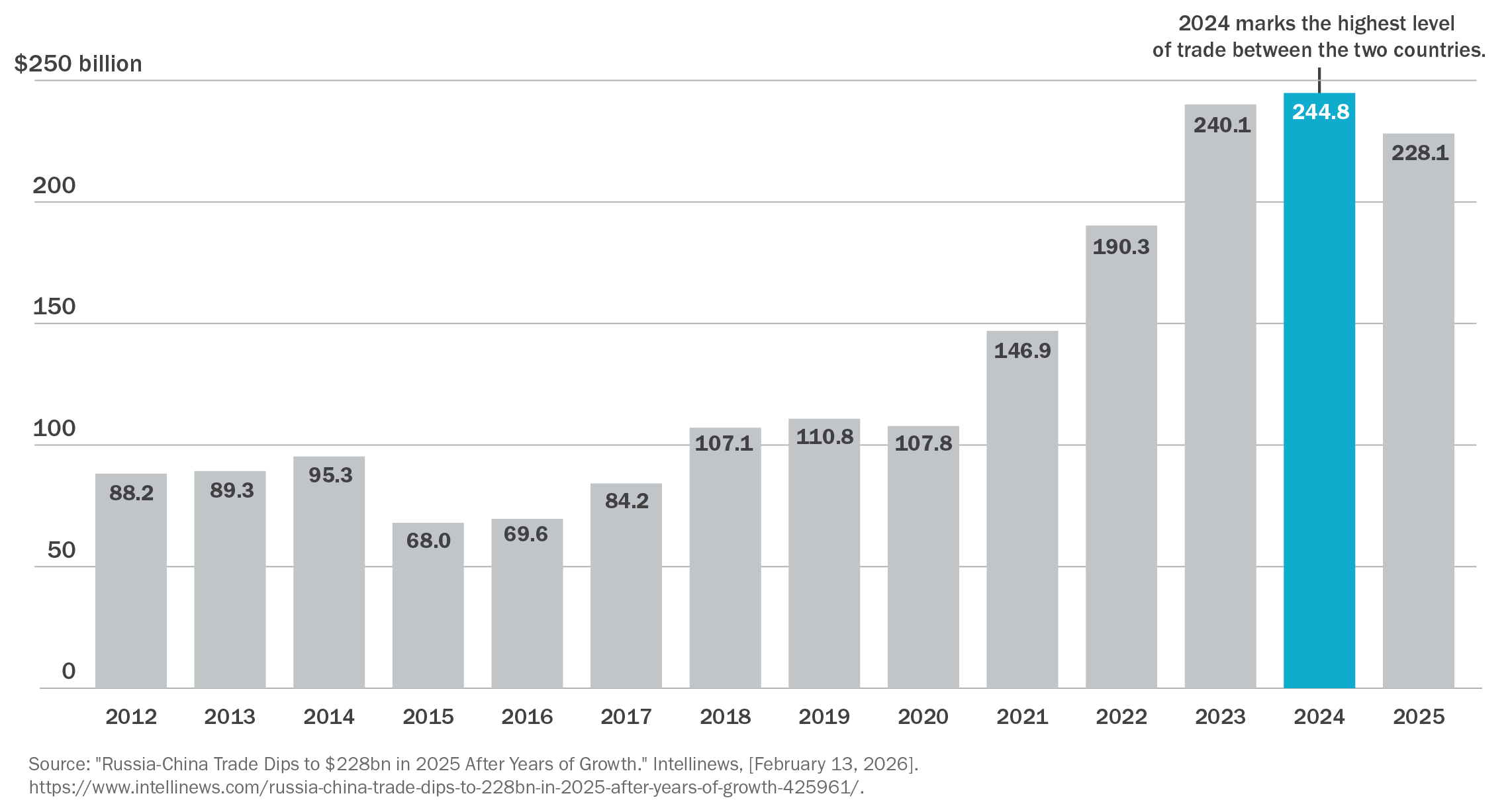
Trade volume between Russia and China grew at a torrid pace during 2022 and 2023, by an average of 30 percent per annum, likely reflecting major adjustments such as import substitution due to the Ukraine war.80“China, Russia Trade Soared In 2023 As Commerce with US Sank,” VOA News, January 12, 2024, https://www.voanews.com/a/china-russia-trade-soared-in-2023-as-commerce-with-us-sank-/7437001.html. However, trade grew by only about 2 percent in 2024, and there was a decline in China-Russia trade volume in 2025 in part because of slumping energy prices and market saturation during that period.81“Russia-China Trade & Investment Trends Shifting: Latest Development Updates,” Russia’s Pivot to Asia, November 2025, https://russiaspivottoasia.com/russia-china-trade-investment-trends-shifting-latest-development-updates/.
China-Russia trade volume (2012–2025)
China-Russia trade growth also reflects the reality that the trade ties between the two nations remain underdeveloped. For example, the first highway bridge linking the two countries over the Amur River was only completed in 2019 and did not open until 2022.82“Construction of First Highway Bridge Linking Russia, China Completed,” Radio Free Europe/Radio Liberty, November 30, 2019, https://www.rferl.org/a/amur-highway-bridge-connecting-russia-china-construction/30300119.html. And despite all of China’s frenetic high-speed rail building, there is still no linkage to Russian cities despite this being planned for many years.83Xu Wei, “Russia, China Look to Build Harbin-Vladivostok High Speed Rail Link,” Yicai Global, December 20, 2017, https://www.rferl.org/a/amur-highway-bridge-connecting-russia-china-construction/30300119.html.
The Russians have long bemoaned the structure of China-Russia trade in which natural resource commodities (e.g. fossil fuels) are often exchanged for finished, manufactured goods.84Korolev, China-Russia Strategic Alignment, 136. This reflects a mentality in Russia that they should not just be a “gas station” for other countries but should themselves engage in high-tech manufacturing. In the context of the China-Russia relationship, this sensitivity is heightened since during the last period of intensive China-Russia interaction (1950–1960), the roles were reversed, with relatively advanced finished products going from Russia to China rather than in the other direction.85On economic aspects of the “golden age” in the Sino-Soviet relationship, see Lorenz M. Luthi, The Sino-Soviet Split: Cold War in the Communist World (Princeton, NJ: Princeton University Press, 2008), 37–38.
Related tensions have occasionally flared regarding environmental despoilation precipitated by voracious Chinese demand for Russian resources, particularly timber in Siberia. In 2019, protests reportedly erupted in many Russian cities over Chinese logging practices in Siberia.86Steven Lee Meyer, “China’s Voracious Appetite for Timber Stokes Fury in Russia and Beyond,” New York Times, April 9, 2019, https://www.nytimes.com/2019/04/09/world/asia/chinas-voracious-appetite-for-timber-stokes-fury-in-russia-and-beyond.html. And while Russians are no doubt thankful that Chinese goods are filling crucial consumption gaps caused by Ukraine-related economic sanctions, they remain concerned that Chinese firms have gained monopolies in Russian markets.87“China Has Become a Monopolist – And Started to Raise Prices: Autos Are Becoming a Luxury Good” [Китай стал монополистом — и начал поднимать цены: авто становится роскошью], Zen [Дзен], July 8, 2025, https://dzen.ru/a/aES6dOgekVWmcJPS.
Western pressure has created some specific instances of strategic partnering in the commercial realm. The combination of the alleged Kremlin-directed cyber-attacks on U.S. elections in 2016 with the first Trump administration’s assault on the Chinese digital communications company Huawei during 2018–19 led Huawei to undertake a major expansion in Russia that may have included hiring as many as 1,000 new research scientists.88“China’s Huawei Shifts Investment from U.S. to Russia,” Moscow Times, September 1, 2020, https://www.themoscowtimes.com/2020/09/01/chinas-huawei-shifts-investment-from-us-russia-a71303. If both Russia and China were to be squeezed out entirely of Western information and communications networks, then it was logical they would seek synergies in this domain.89“Commerce Department Prohibits Russian Kaspersky Software for U.S. Customers,” June 20, 2024, U.S. Department of Commerce, https://www.bis.gov/press-release/commerce-department-prohibits-russian-kaspersky-software-u.s.-customers. The following year, Huawei in collaboration with Russian partners reported record data transfer speeds in Russian communication networks that could have national security implications, according to some Western analysts.90Roman Kolodii, Giangiuseppe Pili, and Jack Crawford, “Hi-Tech, High Risk? Russo-Chinese Cooperation on Emerging Technologies,” RUSI, March 1, 2024, https://www.rusi.org/explore-our-research/publications/commentary/hi-tech-high-risk-russo-chinese-cooperation-emerging-technologies.
In any case, China and Russia remain far behind the world’s most active bilateral trading relationships, such as between the U.S. and its major economic partners, including China.91Kari Crane, “Top U.S. Trading Partners by Trade Volume,” Passages, https://shippingsolutionssoftware.com/blog/top-u.s.-trading-partners. This illustrates that U.S. bilateral trade with five partners all exceed the aggregate of China-Russia trade at about $230 billion in 2025. That is another reason not to exaggerate the strategic importance of China-Russia relations. On the whole, this trading relationship should be considered normal and not part of an alliance or excessively related to security issues.
To summarize these elements of cooperation, the quasi-alliance remains far below the level of a formal, highly developed alliance. There are very regular China-Russia military drills, but their size and scope are relatively limited. The exercises do not suggest that the Kremlin would take on the risks of direct involvement in a war with the U.S., including allowing Chinese staging from Russian bases, or that China would do so for Russia. The two countries’ national defense establishments have close ties, including in education and research, but the list of actual joint military development projects remains quite small. The two Eurasian powers do not permanently base one another’s military formations on each other’s territory, as is common in U.S. alliance arrangements. Increased trade ties add glue to their strategic cooperation, but this is only partly a strategic choice driven by Western pressure and is mostly due to more fundamental economic factors.
U.S. policies could still drive China and Russia closer together
Wiser policies in Washington that embrace restraint, particularly by avoiding deploying military forces proximate to both China and Russia, can avert a more dangerous future in which Beijing and Moscow consider elevating their security partnership to something like a formalized alliance. Such an alliance could entail large-scale military exercises in new domains around the world, further integration of China’s and Russia’s military-educational and military-industrial complexes, and setting up for combined warfare by integrating command structures and permanent basing forces on one another’s territory.
Both Beijing and Moscow have long objected to what they see as inappropriate interference by Washington in their nearby domains. China is concerned about U.S. deployments to the Korean Peninsula and in the South China Sea, but it’s very clear that Taiwan is viewed as “the core of China’s core interests.”92“Taiwan Question at the Core of China’s Core Interests, Says Taiwan Affairs Office Spokesperson after Chinese, US Leaders’ Phone Talk,” Global Times, February 5, 2026, https://www.globaltimes.cn/page/202602/1354842.shtml. According to Kremlin pronouncements going back over a decade, Russian leaders view U.S. military activities in the former USSR with similar fear and loathing.93Barry Posen, “Putin’s Preventive War: The 2022 Invasion of Ukraine,” International Security 49 (winter 2025), https://doi.org/10.1162/isec_a_00501: 7–49.
If sufficiently antagonized on core security interests, China could conceivably alter its policy to start directly arming Russian forces in Ukraine. Another far-fetched but unpleasant future would be if Chinese submarines armed with nuclear weapons began to operate from Russia’s Arctic ports—a launch point significantly closer to the U.S. homeland than China’s very distant submarine bases. This strategic option has been floated in the Russian press.94Alexander Shirokorod [Александр Широкорад], “The Struggle for the Arctic is Growing: Why China Needs New Operational Patrol Areas for its Nuclear Missile Submarines” [Борьба за Арктику нарастает: Зачем Китаю необходимы новые районы боевого патрулирования подводных ракетоносцев], Nezavisimaya Gazeta [Независимая Газета], May 17, 2019, http://nvo.ng.ru/realty/2019-05-17/1_1044_struggle.html. Such a militarization of the Arctic would undoubtedly be negative for U.S. national security, not least as it would drive an enormous and expensive set of countermeasures.
Such escalatory steps will hopefully remain far-fetched, but understanding the U.S. role in the China-Russia quasi-alliance could help us prevent this dark and dangerous future. As Gilbert Rozman explained a decade ago, “The lesson of the Sino-Soviet dispute and the failure to resolve it until 1989 [for Beijing and Moscow] is that any distractions from confronting U.S. power are dangerous.”95Gilbert Rozman, The Sino-Russian Challenge to the World Order: National Identities, Bilateral Relations, and East Versus West in the 2010s (Stanford, CA: Stanford University Press, 2014), 237. Rozman noted that the relationship is built on a deeply shared identity that “reject[s] the old idea… that the West is superior to the East.”96Rozman, 259. He concluded that Beijing and Moscow “define ‘core national interests’ in similar ways…. In both cases, these are defined in opposition to U.S. interests.”97Rozman, 275.
Both Russia and China have flirted with stepping up their quasi-alliance. Putin stated explicitly that a China-Russia alliance is a possibility.98“Russia-China Military Alliance ‘Quite Possible,’ Putin Says,” Moscow Times, October 23, 2020, https://www.themoscowtimes.com/2020/10/23/russia-china-military-allisance-quite-possible-putin-says-a71834. And while officially Beijing has not wavered from its principled stance of non-alignment [不结盟], some leading scholars in China have publicly advocated for a much tighter bond with Russia.99Zheng Yu, “China and Russia: Alliance or No Alliance,” China-US Focus, July 29, 2016, https://www.chinausfocus.com/foreign-policy/china-and-russia-alliance-or-no-alliance; Xu Jin [徐进], “Why Does China Dislike Alliances?” [当代中国拒斥同盟心理的由来], Chinese Foreign Policy [中国外交], December 2015, 3–10.
How would such a development affect U.S. national security interests? On one hand, it might not, given the depths of deterrence provided by mutually assured destruction. On the other hand, China could become a much more formidable nuclear weapons power under Russian tutelage, given Russia’s vast experience in this area, a point that has been made by Chinese nuclear strategy experts.100Men Honghua [门洪华], “Strategic Stability in International Relations: Process, Assessment, and China’s Role” [国际关系中的战略稳定: 进程, 评估, 与中国担当], Chinese Foreign Policy [中国外交], November 2023, 16–37.
Such moves, plausible in theory, could prove destabilizing, since both undersea operations and nuclear forces are widely viewed as critical to great powers. It is noteworthy that Chinese and Russian strategists may be more attuned to the dangers of triggering the “security dilemma” (where defensive acts are perceived by adversaries as offensive, triggering deeper insecurity) than their Western counterparts.101Mu Chunshan, “No, China Is Not Leading an Anti-Western Bloc,” Diplomat, September 5, 2025, https://thediplomat.com/2025/09/no-chinas-isnt-leading-an-anti-west-bloc/. Since 2022, such deliberations have been muted in both capitals. Russia, now in circumstances of greater isolation, might wish for a closer bond with China, but China is more reluctant, wishing not to be dragged into Putin’s costly, unending war against Ukraine. And though Kremlin pundits may wish for a Taiwan war to divert Western pressure, there is little to no hint that Russia will get directly involved in such a conflict. In other words, both powers wish to avoid entrapment in the other’s risky gambits.
‘Reverse Kissinger’ or ‘double Kissinger’?
The second Trump administration has brought a new approach to foreign policy that seems in certain respects a departure from the strategy developed in Trump’s first term. In particular, the effort to improve relations with Russia has sought to make good on Trump’s campaign promise to end the tragic Russia-Ukraine War. Many foreign policy experts have read into this an additional goal of wooing the Kremlin away from China’s embrace.102David Ignatius, “Trump Bets on a ‘Reverse Kissinger,’” Washington Post, April 3, 2025, https://www.washingtonpost.com/opinions/2025/04/03/trump-foreign-policy-reverse-kissinger-china-russia-gamble/; Jianli Yang, “The Myth of a ‘Reverse Kissinger’: Why Aligning With Russia to Counter China Is a Strategic Illusion,” Diplomat, February 21, 2025, https://thediplomat.com/2025/02/the-myth-of-a-reverse-kissinger-why-aligning-with-russia-to-counter-china-is-a-strategic-illusion/; and Glenn Chafitz, “The US Dividing Russia from China? Forget about It,” ASPI Strategist, March 12, 2025, https://www.aspistrategist.org.au/the-us-dividing-russia-from-china-forget-about-it/.
In February 2025, Secretary of State Rubio said the new administration was very concerned that “two nuclear powers [are] aligned against the U.S” and explicitly suggested that new U.S. policies were aimed at “peeling [Russia]… off a relationship with the Chinese.”103“Secretary of State Marco Rubio With Matthew Boyle for Breitbart News Network,” U.S. Department of State, February 24, 2025, https://www.state.gov/secretary-of-state-marco-rubio-with-matthew-boyle-for-breitbart-news-network/. U.S. efforts to focus on the more dangerous of the two Eurasian powers have a definite historical echo and have been widely characterized as a “reverse Kissinger”—mimicking National Security Advisor Henry Kissinger’s successful efforts to more closely align China with the U.S. against the USSR.
Starting in 1969, the Nixon administration began to reappraise U.S. strategy toward China after violent clashes on the Ussuri River border between China and Russia convinced American leaders that the Sino-Soviet split was genuine and deep. President Richard Nixon had earlier expressed an interest in engaging with China, but these dramatic events crystalized Washington’s determination to exploit the fracture for American advantage. It took almost three years to accomplish the breakthrough with Nixon’s visit to Beijing, and a full decade to normalize U.S.-China relations, but this maneuver is often regarded by strategists as masterful, raising American prestige around the world and even playing some role in bringing the Cold War to a peaceful denouement.104The U.S.-China rapprochement likely helped to end the Cold War favorably for the U.S. by sapping Soviet resources, since the Kremlin was forced to expend major funds on weaponry, fortifications, and infrastructure along the entire length of its border with China—an enormous undertaking. See, for example, James von Geldern, “BAM,” Seventeen Moments in Soviet History, https://soviethistory.msu.edu/1980-2/bam/.
Nixon’s diplomatic maneuver yielded handsome results across the board, not least by resetting the global balance of power and easing the trauma of American defeat in Vietnam. After Nixon’s visit to Beijing, America was not only reestablished as the world’s preeminent peacemaker but once again stood tall in Asia too.
Yet few remember now that Kissinger made a simultaneous effort to improve the U.S. relationship with Moscow. The goal was to enhance relations with both Eurasian powers and leverage improved ties with China toward diplomatic gains with the Kremlin.105Henry Kissinger, On China (New York: Penguin, 2011), 274. That is exactly what happened as Nixon achieved several historic breakthroughs with Moscow the same year he went to Beijing. These agreements, namely the Strategic Arms Limitation Talks (SALT) and Anti-Ballistic Missile (ABM) system treaties, became not only the cornerstones of nuclear arms control but ushered in an era of détente, lowering tensions worldwide.
The Trump administration could conclude that driving a wedge between Beijing and Moscow is impossible given the breadth and depth of the quasi-alliance. It is notable how the first Trump administration sought to use the abrogation of the INF (Intermediate Nuclear Forces) Treaty to foster tensions between Moscow and Beijing, hoping that Russia would blame China for the treaty’s downfall since the U.S. maintained that China’s missile buildup made the treaty impossible to adhere to.106Igor Subbotin [Игорь Субботин], “John Bolton Arrived in Moscow with a Message for China,” [Джон Болтон приехал в Москву с посланием для Китая], Nezavismaya Gazeta [Независимая Газета], October 22, 2018, https://www.ng.ru/world/2018-10-22/7_7337_bolton.html. But as Brian Carlson notes, in the wake of the treaty’s demise, “Russia… took steps to alleviate China’s concerns. Putin vowed that Russia would deploy no missiles previously forbidden by the treaty in any regional theater unless the U.S. were to deploy them in that theater first.”107Brian G. Carlson, “China-Russia Cooperation in Nuclear Deterrence” in Sarah Kirchberger, Svenja Sinjen, and Nils Wormer (eds.), Russia-China Relations: Emerging Alliance or Eternal Rivals (Cham, Switzerland: Springer, 2022), 154.
Carlson notes that the Kremlin steadfastly refused to put pressure on Beijing to join strategic arms control negotiations. In fact, one reason such wedge strategies are unlikely to succeed is that both Russian and Chinese strategists are particularly attuned to this possibility.108Lyle Goldstein, “Does China Think America is Using a ‘Wedge Strategy’?” National Interest, July 28, 2016, https://nationalinterest.org/feature/does-china-think-america-using-wedge-strategy-17152.
A so-called “double Kissinger” is a better approach. Such a policy would reflect that China-Russia relations in and of themselves are not the central problem for U.S. national security. Rather, it is the extant danger of escalation with either one that could prove catastrophic.
A policy to defuse those dangers would focus on circumscribing U.S. involvement in both Ukraine and Taiwan. In each case, Washington has encroached on the spheres of influence of other great powers. Limitations in U.S. support—and avoiding any more formal commitments to defend Ukraine or Taiwan—would reduce both Russia’s and China’s incentives to advance their quasi-alliance.
With respect to Russia, a “double Kissinger” effort would include removing many sanctions while seeking economic and diplomatic engagement, for example in the Arctic and with respect to nuclear arms control. Of course, the biggest single factor in lowering U.S.-Russia tensions would be to settle the conflict in Ukraine and even address the Kremlin’s laser-like focus on the “root causes” of the conflict. To its credit, the current administration has taken steps in these directions, but so far without significantly positive results.
The other side of this dual approach could be harder for the current administration, but it might also be less fraught since thankfully there is no war in the western Pacific. Progress could be made to lower tensions with China, whether on the Korean Peninsula or in the South China Sea. On the former, a quadrilateral framework (China, North Korea, South Korea, and the U.S.) could be used pursue a peace treaty. On the latter, the U.S. could agree not to build up in the Luzon Strait (proximate to Taiwan) in return for Chinese restraint in and around flashpoints, such as Scarborough Shoal.
As always, Beijing will measure Washington’s intentions on Taiwan policy most carefully. Here too there are relatively simple steps that can be taken, such as removing U.S. troops from the island, decreasing U.S. Navy warship transits of the Taiwan Strait, upholding the One China policy, and exercising restraint in force deployments to proximate areas, such as in the Ryukyu Islands. The Trump administration has taken some steps to lower tensions in the Asia-Pacific, for example returning to “strategic ambiguity” and backing away from “strategic clarity,” but much more can be done.
A “double Kissinger” approach will not only lower that all too real danger of great power war, but attenuate the China-Russia quasi-alliance, since American pressure has always been a fundamental factor behind the relationship. This would help stabilize the current global situation and support U.S. national security interests by creating the strongest possible foundation for future peace and prosperity.
Adapting U.S. national security to a multipolar world
This explainer has assessed the China-Russia quasi-alliance and concludes that it does not pose a major threat to U.S. national security interests. Of course, there are genuinely substantive concerns about the China-Russia military relationship, whether over future submarine or space development or in sharing insights from the Russia-Ukraine War.109“China’s ties with Russia are growing more solid: Our columnist visits a future Russian outpost in China’s most advanced spaceport,” Economist, April 25, 2024, https://www.economist.com/china/2024/04/25/chinas-ties-with-russia-are-growing-more-solid. These domains bear close watching, but the overall course of the partnership is unlikely to evolve into a full-blown alliance of threatening proportions. This is because Moscow and Beijing continue to have many real disagreements.
Moreover, both Moscow and particularly Beijing recognize that a tight, militarized China-Russia alliance would destabilize the world order. This has been consistently revealed in both Russian and Chinese statements and actions, and it deserves careful reflection by American strategists.110“Military Parade Not a Demonstration of Bloc Politics,” China Daily, September 4, 2025, https://www.chinadaily.com.cn/a/202509/06/WS68bb8225a3108622abc9f2f5.html. A Chinese appraisal of China-Russia relations from late 2025 explains that the countries are aiming to develop “a new paradigm of cooperation that transcends bloc confrontation.”111Zhang Hong [张弘], “China-Russia Strategic Alignment Enhances Global Security” [中俄战略对表提升全球安全], Global Times [环球时报], December 4, 2025, https://opinion.huanqiu.com/article/4PPVnC7ShhJ.
Yet it’s also true that the U.S. has been a main force behind the China-Russia quasi-alliance. This includes a U.S. tendency toward excessive balancing, exerting continuous geopolitical pressure especially over both Ukraine and Taiwan. This has contributed in no small part to pushing Russia and China together, fueling deeper insecurity in the U.S. and an increased risk of war.
One way the U.S. can defuse tensions is to set aside threat inflation concerning the China-Russia quasi-alliance in favor of a more pragmatic and realistic approach to national security. Decreasing threat inflation will require stepped-up diplomatic and people-to-people engagement with an attendant focus on abjuring damaging language like the term “adversary” when discussing both China and Russia. Another suggestion is for national security officials to avoid conjoining China and Russia as a single problem to be solved. The two countries are extremely different as are their respective positions in the world order. Treating them as a single issue only supports the exaggeration of threats and ultimately harms U.S. national security.
Simultaneous overtures toward both Russia and China in the form of “double Kissinger” diplomacy will go a long way to lower global tensions and prompt both Beijing and Moscow to adopt more independent approaches to national security given a less threatening overall strategic situation. This approach could move world politics away from a messianic struggle between good and evil, or democracy and authoritarianism, and toward a more stable coexistence among the great powers.
Endnotes
- 1This is a major facet of the “great power competition” concept enshrined in the “National Security Strategy of the United States of America,” White House, December 2017, https://trumpwhitehouse.archives.gov/wp-content/uploads/2017/12/NSS-Final-12-18-2017-0905.pdf. ↩︎
- 2See, for example, Zbigniew Brzezinski, The Grand Chessboard (New York: Basic Books, 1998); James Ballacqua (ed.), The Future of China-Russia Relations (Lexington: University of Kentucky Press, 2010); and Douglas Schoen and Melik Kaylan, The Russia-China Axis: The New Cold War and America’s Crisis of Leadership (New York: Encounter Books, 2014). ↩︎
- 3“Rubio Says US Can’t Let Russia Become China’s ‘Junior Partner,” Bloomberg News, February 27, 2025, https://www.yahoo.com/news/rubio-says-us-t-let-040848373.html. ↩︎
- 4Halford Mackinder, “The Geographical Pivot of History,” Geographical Journal 23, no. 4 (April 1904): 421–437; Nicholas J. Spykman, The Geography of the Peace (New York: Harcourt, Brace & Co., 1944). ↩︎
- 5Mackinder, 436. ↩︎
- 6Stephen Walt, “Hedging on Hegemony: The Realist Debate over How to Respond to China” International Security 49 (spring 2025), 37. ↩︎
- 7On the tendency of regional hegemons to roam, see John J. Mearsheimer, “Can China Rise Peacefully?” National Interest, April 8, 2014, https://nationalinterest.org/feature/can-china-rise-peacefully-10204; Emma Ashford, First Among Equals: US Foreign Policy in a Multipolar World (New Haven: Yale University Press, 2025), 173; Walt, “Hedging on Hegemony…” 38. ↩︎
- 8Richard J. Ellings, “The Strategic Context of China-Russia Relations” in eds. Richard J. Ellings and Robert Sutter, Axis of Authoritarians: Implications of China-Russia Cooperation (Washington: National Bureau of Asian Research, 2018), 8. ↩︎
- 9Robert D. Blackwill and Richard Fontaine, “No Limits? The China-Russia Relationship and U.S. Foreign Policy,” Council on Foreign Relations, December 2024, https://www.cfr.org/reports/no-limits-china-russia-relationship-and-us-foreign-policy?gad_source=1&gad_campaignid=23585471037&gbraid=0AAAAAD-idA3KvrbaNUW3u8VPEn8Pfjtzl&gclid=CjwKCAjwpcTNBhA5EiwAdO1S9sm2EXmY7ZH4s17somjaBnJeOlMhhuteEin5PJavjVoAgrUn04omZhoCmt8QAvD_BwE. ↩︎
- 10Bobo Lo, A Wary Embrace: What the China-Russia Relationship Means for the World (Melbourne: Penguin Books Australia, 2017), 3–4. ↩︎
- 11On one of the more serious of the various Sino-Russian skirmishes at Albazin in 1685, see, for example, Mark Mancall, Russia and China: Their Diplomatic Relations through 1728 (Cambridge, MA: Harvard University Press, 1971), 131–140. ↩︎
- 12Andrew Higgins, “On Russia-China Border, Selective Memory of Massacre Works for Both Sides,” New York Times, March 26, 2020, https://www.nytimes.com/2020/03/26/world/ussia/ussia-china-border.html. ↩︎
- 13Jan Kallberg, “Goodbye Vladivostok, Hello Haishenwai,” Center for European Policy Analysis, July 2022, https://cepa.org/article/goodbye-vladivostok-hello-haishenwai/. ↩︎
- 14Yuri Tavrovsky [Юрий Тавровский], “The Unending War: China Does Not Accept the Results of the Second World War” [Незавершенная Война. Пекин Не Устраивают Итоги Второй Мировой], Nezavismaya Gazeta [Независмая Газета], February 18, 2020, https://www.ng.ru/ideas/2020-02-17/7_7796_war.html. ↩︎
- 15Zhihua Shen and Yafeng Xia, Mao and Sino-Soviet Partnership, 1945–59: A New History (Lanham, MD: Lexington Books, 2015), 87. A similar account is offered in Dai Kuixian [戴逵贤], The US-China Fight to the Finish in the Skies above North Korea [朝鲜上空的中美对决] (Beijing: Aviation Industry Press, 2018), 181. ↩︎
- 16On the Ussuri clash, see Lyle Goldstein, “A Forgotten Battle: Fifty Years Ago, Russia and China Slugged it Out on Damansky Island,” National Interest, March 17, 2019, https://nationalinterest.org/feature/forgotten-battle-fifty-years-ago-russia-and-china-slugged-it-out-damansky-island-47677. On the Sino-Soviet split, see Lorenz M. Luthi, The Sino-Soviet Split: Cold War in the Communist World (Princeton, NJ: Princeton University Press, 2008). ↩︎
- 17On these nuclear threats, see Lyle Goldstein, “Do Nascent WMD Arsenals Deter? The Sino-Soviet Crisis of 1969,” Political Science Quarterly 118, no. 1 (spring 2003), 53–79, https://www.psqonline.org/article.cfm?IDArticle=14854. ↩︎
- 18Nguyen Minh Quang, “The Bitter Legacy of the 1979 China-Vietnam War,” Diplomat, February 23, 2017, https://thediplomat.com/2017/02/the-bitter-legacy-of-the-1979-china-vietnam-war/. ↩︎
- 19Goldstein, “A Forgotten Battle.” ↩︎
- 20See, for example, Tom Fox, “Bombs over Belgrade: An Underrated Sino-American Anniversary,” War on the Rocks, May 7, 2019, https://warontherocks.com/2019/05/bombs-over-belgrade-an-underrated-sino-american-anniversary/. ↩︎
- 21Lyle Goldstein and Vitaly Kozyrev, “China-Russia Military Cooperation and the Emergent U.S.-China Rivalry: Implications and Recommendations for U.S. National Security,” Journal of Peace and War Studies, October 2020, 27–32. ↩︎
- 22Vicky O’Hara, “China, Russia Hold Joint Military Exercises,” NPR, August 18, 2005, https://www.npr.org/2005/08/18/4804897/china-russia-hold-joint-military-exercises. A smaller multilateral exercise was held under the auspices of the Shanghai Cooperation Organization (SCO) in 2003. ↩︎
- 23“Russia-China Oil Pipeline Opens,” BBC, January 2, 2011, https://www.bbc.com/news/world-asia-pacific-12103865. ↩︎
- 24For a critique of the Obama administration’s pivot, see Robert Ross, “The Problem with the Pivot,” Foreign Affairs, November/December 2012, https://www.foreignaffairs.com/articles/asia/2012-11-01/problem-pivot. ↩︎
- 25Matt Schiavenza, “China and Russia Grow Even Closer,” Atlantic, May 10, 2015, https://www.theatlantic.com/international/archive/2015/05/china-and-russia-grow-even-closer/392882/. ↩︎
- 26Zhang Lihua, “Explaining China’s Position on the Crimea Referendum,” Carnegie Endowment for International Peace, April 1, 2015, https://carnegieendowment.org/research/2015/04/explaining-chinas-position-on-the-crimea-referendum?lang=en. ↩︎
- 27On common concerns in Central Asia, see, for example, Jeanne L. Wilson “Coloured Revolutions: the View from Moscow and Beijing,” Journal of Communist Studies and Transition Politics 25 (2009), https://www.tandfonline.com/doi/abs/10.1080/13523270902861061. ↩︎
- 28Alexander Lukin, Russia and China: the New Rapprochement (Medford, MA: Polity Press, 2018), 136. ↩︎
- 29Alexander Korolev, China-Russia Strategic Alignment in World Politics (Amsterdam: Amsterdam University Press, 2022), 191. ↩︎
- 30For a definition of an alliance as including mutual defense obligations and a discussion of a looser alternative, see Natalie Armbruster and Benjamin Friedman, “Who is an Ally and Why Does it Matter?” Defense Priorities, October 12, 2022, https://www.defensepriorities.org/explainers/who-is-an-ally-and-why-does-it-matter/. ↩︎
- 31For a skeptical perspective on China-Russia relations, see Odd Arne Westad, “The Next Sino-Russian Split: Beijing Will Ultimately Come to Regret Its Support of Moscow,” Foreign Affairs, April 5, 2022, https://www.foreignaffairs.com/articles/east-asia/2022-04-05/next-sino-russian-split. For a view of the China-Russia partnership as deeper and more durable, see Marcin Kaczmarski, Russia-China Relations in the Post-Crisis International Order (London: Routledge, 2015), or, more recently Korolev, China-Russia Strategic Alignment in World Politics. ↩︎
- 32Jacob Judah, Paul Sonne, and Anton Troianovski, “Secret Russian Intelligence Document Shows Deep Suspicion of China,” New York Times, June 7, 2025, https://www.nytimes.com/2025/06/07/world/europe/china-russia-spies-documents-putin-war.html. ↩︎
- 33Mikhail Vovk [Михаил Вовк], “Alexander Khramchikhin: The US Is Not a Threat to Us, but We Should Be Wary of a Chinese Attack” [Александр Храмчихин: США нам не грозят, а вот удара Китая опасаться следует], Arguments and Facts [Аргументы и Факты], February 22, 2011, https://aif.ru/politics/world/23637. ↩︎
- 34Professor Lanxin Xiang, “China and Russia: An Unlikely Brotherhood,” posted by Watson School of International and Public Affairs, November 7, 2023, YouTube, https://www.youtube.com/watch?v=9VBJtOCVc1g. ↩︎
- 35Philipp Ivanov, “Together and Apart: The Conundrum of the China-Russia Partnership,” Asia Society, October 11, 2023, https://asiasociety.org/policy-institute/together-and-apart-conundrum-china-russia-partnership. The gap is significantly narrower if Purchasing Power Parity (PPP) measurements are used. PPP estimates for 2025 by the IMF are available at “GDP (PPP) by Country (2025) – IMF,” Worldometers, https://www.worldometers.info/gdp/gdp-by-country/?source=imf&year=2025&metric=ppp®ion=worldwide. ↩︎
- 36Svetlana Dorofeeva [Светлана Дорофеева], “Sea of Discord. What Should Russia Do in the Conflict Around the South China Sea?” [Море раздора. Что делать России в конфликте вокруг Южно-Китайского моря?], Arguments and Facts [Аргументы и Факты], May 11, 2018, https://aif.ru/politics/world/more_razdora_chto_delat_rossii_v_konflikte_vokrug_yuzhno-kitayskogo_morya?ysclid=lqr3ubkhrq613607753. ↩︎
- 37Despite some recent improvement in the China-Vietnam relationship, these tensions persist. See, for example, Tommy Walker, “China-Vietnam Tensions Flare up over South China Sea,” DW, June 18, 2024, https://www.dw.com/en/china-vietnam-tensions-flare-up-over-south-china-sea/a-69398016. ↩︎
- 38Michael Green, Kathleen Hicks, Zach Cooper, John Schaus, and Jake Douglas, “China Counter-coercion Series: China-Vietnam Oil Rig Standoff,” Center for Strategic and International Relations Asia Maritime Transparency Initiative, June 12, 2017, https://amti.csis.org/counter-co-oil-rig-standoff/. ↩︎
- 39While China has reservations about Russia-Vietnam cooperation, it is plausible that it prefers this to closer U.S.-Vietnam cooperation. ↩︎
- 40Petr Topychkanov, “The BrahMos Is Just Beginning,” Carnegie Endowment for International Peace, July 3, 2015, https://carnegieendowment.org/posts/2015/07/the-brahmos-is-just-beginning?lang=en. ↩︎
- 41See, for example, Alexandre Sheldon Duplaix, “Russia-China Naval Partnership and Its Significance” in Sarah Kirchberger, Svenja Sinjen, and Nils Wormer (eds.), Russia-China Relations: Emerging Alliance or Eternal Rivals (Cham, Switzerland: Springer, 2022), 107. ↩︎
- 42“China Snaps Back at U.S. Claims It Might Supply Russia with Weapons,” Newsweek, February 20, 2023, https://www.newsweek.com/china-america-russia-ukraine-lethal-weapons-supply-1782320. ↩︎
- 43“Russia Is Sure to Lose in Ukraine, Reckons a Chinese Expert on Russia,” Economist, April 11, 2024, https://www.economist.com/by-invitation/2024/04/11/russia-is-sure-to-lose-in-ukraine-reckons-a-chinese-expert-on-russia. ↩︎
- 44Zhao Long, “Why China Is Not Interested in Great Power Carve-ups,” Diplomat, May 30, 2025, https://thediplomat.com/2025/05/why-china-is-not-interested-in-great-power-carve-ups/. ↩︎
- 45Long, “Why China Is Not Interested in Great Power Carve-ups.” ↩︎
- 46Vanora Bennett, “Russia, China Sign Declaration of Unity,” Los Angeles Times, April 24, 1997, https://www.latimes.com/archives/la-xpm-1997-04-24-mn-51910-story.html; “Joint Statement Signed by the Chinese and Russian Heads of States,” Chinese Ministry of Foreign Affairs, July 24, 2001, https://www.mfa.gov.cn/eng/zy/gb/202405/t20240531_11367099.html. ↩︎
- 47Larry Elliott, “Xi Jinping warns of ‘new cold war’ if US keeps up protectionism,” Guardian, January 25, 2021, https://www.theguardian.com/world/2021/jan/25/china-xi-jinping-warns-of-new-cold-war-us-protectionist-policies; Lyle Goldstein and Vitaly Kozyrev, The New Cold War at Sea: Maritime Implications of the China-Russia Quasi-Alliance (Annapolis, MD: Naval Institute Press, 2026), 49–52. ↩︎
- 48See, for example, Deep Shivaram and Avie Schneider, “Biden Says of Putin: ‘For God’s Sake, This Man Cannot Remain in Power,’” NPR, March 26, 2022, https://www.npr.org/2022/03/26/1089014039/biden-says-of-putin-for-gods-sake-this-man-cannot-remain-in-power. ↩︎
- 49Jonas Olsson, “China’s Nuclear Arsenal Surges 20% in One Year, Reaching over 600 Warheads: SIPRI,” Breaking Defense, June 15, 2025, https://breakingdefense.com/2025/06/chinas-nuclear-arsenal-surges-20-in-one-year-reaching-over-600-warheads-sipri/. ↩︎
- 50Robert Jervis, The Meaning of the Nuclear Revolution: Statecraft and the Meaning of Armageddon (Ithaca, NY: Cornell University Press, 1989). ↩︎
- 51Stephen Walt, The Origin of Alliances (Ithaca, Cornell University Press, 1987). ↩︎
- 52This paragraph is drawn from “Russian-Chinese Joint Declaration on a Multipolar World and the Establishment of a New International Order, adopted in Moscow on 23 April 1997,” full text available at United Nations Digital Library, https://digitallibrary.un.org/record/234074?ln=en&v=pdf. ↩︎
- 53Ben Norton, “China-Russia joint statement marking ‘new era’ on 75th anniversary of relations (full text),” Geopolitical Economy, May 24, 2024, https://geopoliticaleconomy.com/2024/05/24/china-russia-joint-statement-new-era-75th-anniversary/. ↩︎
- 54Norton, “China-Russia Joint Statement…” ↩︎
- 55“Joint Declaration of the People’s Republic of China and the Russian Federation on Further Strengthening Cooperation to Uphold the Authority of International Law,” China Ministry of Foreign Affairs, May 9, 2025, https://www.mfa.gov.cn/eng/zy/jj/xjpdelsjxgsfwcxjnslwgzzslqd/202505/t20250509_11617838.html. ↩︎
- 56Ma Ning and Zhang Hailong [马宁, 张海龙], “Brothers Join Hands, the Ocean Soldiers Guard the Peace” [兄弟携手, 大洋砺兵卫和平], Navy Today [当代海军], August 2023, 11. ↩︎
- 57Xuan Ya [悬崖], “Bright ‘Warships’ in the Mediterranean: the Chinese-Russian ‘Joint Sea 2015’ Military Drill” [亮‘舰’地中海中俄‘海上联合-2015’军事演习], Shipborne Weapons [舰载武器], July 2015, 10–15. ↩︎
- 58Pan Shi [磐石], “Brandishing of the Enormous Wing: A Discussion” [挥动巨人的翅膀: 谈中俄罗斯空军第二次联合战略巡航], Shipborne Weapons [舰载武器], January 2021, 32, 40. ↩︎
- 59Heather Williams, Kari Bingen, and Lachlan MacKenzie, “Why Did China and Russia Stage a Joint Bomber Exercise Near Alaska?” Center for Strategic and International Studies, July 30, 2024, https://www.csis.org/analysis/why-did-china-and-russia-stage-joint-bomber-exercise-near-alaska. ↩︎
- 60Jason Douglas, “Russian and Chinese Bombers Fly Joint Patrol Close to Japan,” Wall Street Journal, December 9, 2025, https://www.wsj.com/world/asia/russian-and-chinese-bombers-fly-joint-patrol-close-to-japan-2ae912e4?gaa_at=eafs&gaa_n=AWEtsqeks-NIM5HyCgCzl9WL9Ok7S4cAuLiXiuPIKb-oXLWzV6KMoN_j_dy7uLSj740%3D&gaa_ts=6940208a&gaa_sig=G0DrAD6XaaJZxrpWlbRWUg6pbp8_nQN3JhGWnPwGqSa0AncZNKp74iiCBor7RW9u1RrFpI5gupAOIDeg1SEIaQ%3D%3D. ↩︎
- 61Lyle J. Goldstein and Vitaly A. Kozyev, The New Cold War at Sea: Maritime Implications of the China-Russia Quasi-Alliance (Annapolis: U.S. Naval Institute Press, 2026), 50; “Steadfast Defender draws to a close for thousands of personnel across all of Nato,” BFBS Forces News, May 31, 2024, https://www.forcesnews.com/nato/steadfast-defender-draws-close-thousands-personnel-across-all-nato; “RIMPAC 2024: Departure for the World’s Largest Naval Exercise,” Bundeswehr, October 7, 2024, https://www.bundeswehr.de/en/organization/navy/news/rimpac-2024-departure-world-s-largest-naval-exercise-5816742. ↩︎
- 62“Global Naval Powers Ranking (2026),” WDMMW, https://www.wdmmw.org/ranking.php. ↩︎
- 63Goldstein and Kozyrev, “China-Russia Military Cooperation…” 27–32. ↩︎
- 64Russian arms sales to China did continue into the 2010s, but the quantity of those sales has diminished over time as China’s indigenous weapons production has strongly improved. See, for example, “Russia Completes Sale to China of Su-35 Jets for $2.5 Bln,” Moscow Times, April 17, 2019, https://www.themoscowtimes.com/2019/04/17/russia-completes-delivery-of-su-35-fighter-jets-to-china-for-25bln-a65271. ↩︎
- 65On non-nuclear submarine cooperation, see Sergei Guneev [Сергей Гунеев], “Russia and China Are Designing a New Generation Non-nuclear Submarine” [Россия и Китай проектируют неатомную подводную лодку нового поколения], RIA Novosti [РИА Новости], August 25, 2020, https://ria.ru/20200825/bezopasnost-1576269235.html. On the quality of contemporary Russian nuclear submarines, see Admiral James Foggo (USN), quoted in “Tracking the Russian ‘Severodvinsk’ Submarine: ‘It’s Very Capable and It’s Very Quiet,’” posted by 60 Minutes, April 28, 2019, YouTube, https://www.youtube.com/watch?v=hhAaFXyy9rU. On Chinese interest in Russian nuclear submarine design, see, for example, Shi Zheng [施征], “Return to the Throne: A Brief Analysis of Russia’s Sixth Generation Strategic Nuclear Submarine” [重回王座: 浅析俄罗斯第六代战略核潜艇], Ordnance Science and Technology [兵工科技], no. 20 (2022): 44. ↩︎
- 66Kiril Ryabov [Кирилл Рябов], “Artificial Intelligence for Chinese Torpedoes” [Искусственный интеллект для китайских торпед], Military Review [Военное Обозрение], June 6, 2025, https://topwar.ru/265814-iskusstvennyj-intellekt-dlja-kitajskih-torped.html. ↩︎
- 67This is a possibility that is quite actively discussed in both the Chinese and Russian military press. See, for example, Ilya Kramnik [Илья Крамник], “Chinese Help: Why Russia Should Buy Warships from the PRC” [Китайская помощь: Зачем России покупать боевые корабли у КНР], Izvestiya [Известия], January 10, 2018, https://iz.ru/693302/ilia-kramnik/kitaiskaia-pomoshch; “Rising Sun in Winter: Looking at the Prospects of Russian Naval Equipment Cooperation from the Current Status of Russia’s Surface Forces” [冬日旭阳: 从俄罗斯水面力量现状看中俄罗斯海军装备合作前景], Shipborne Weapons [舰载武器], December 2022, 58. ↩︎
- 68“China’s Ties with Russia Are Growing More Solid,” Economist, April 25, 2024, https://www.economist.com/china/2024/04/25/chinas-ties-with-russia-are-growing-more-solid. ↩︎
- 69Simon McCarthy, “As War Breaks Out in Europe, China Blames the U.S.,” CNN, February 25, 2022, https://edition.cnn.com/2022/02/25/china/china-reaction-ukraine-russia-intl-hnk-mic. ↩︎
- 70Michael R. Gordon, Warren P. Strobel, and Alan Cullison, “China Has Helped Russia Boost Arms Production, U.S. Says,” Wall Street Journal, April 12, 2024, https://www.reuters.com/world/china/us-demands-clarity-allies-their-role-potential-war-over-taiwan-ft-reports-2025-07-12/. ↩︎
- 71“Russia Is Starting to Make Its Superiority in Electronic Warfare Count,” Economist, November 23, 2023, https://www.economist.com/europe/2023/11/23/russia-is-starting-to-make-its-superiority-in-electronic-warfare-count. For Chinese study of Russian counter-HIMARS operations, see Lyle Goldstein and Nathan Waechter, “China Considers Countermeasures to US HIMARS Missile System,” Diplomat, June 22, 2023, https://thediplomat.com/2023/06/china-considers-countermeasures-to-us-himars-missile-system/. ↩︎
- 72Elizabeth Wishnick, “Russia-China-North Korea Relations: Obstacles to a Trilateral Axis,” Foreign Policy Research Institute, March 15, 2025, https://www.fpri.org/wp-content/uploads/2025/03/russia-china-north-korea-obstacles-to-trilateral-axis.pdf. ↩︎
- 73Author interviews in Shanghai, November 24, 2025. ↩︎
- 74Ella Corbett and Lyle Goldstein, “Washington Shouldn’t Fear Russia and China Seeking Influence in Afghanistan,” Real Clear World, August 2025, https://www.realclearworld.com/articles/2025/08/09/washington_shouldnt_fear_russia_and_china_seeking_influence_in_afghanistan_1127826.html. ↩︎
- 75For a Chinese perspective on these exercises, see “China-Iran-Russia Joint Exercise Is Not a Threat, but a Security Bond” [中伊俄联演不是威胁,是安全纽带北晚在线], Global Times [环球时报], March 13, 2024, https://baijiahao.baidu.com/s?id=1793365772940617103&wfr=spider&for=pc. ↩︎
- 76Noah Robertson, Ellen Nakashima, and Warren Strobel, “Russia is providing Iran intelligence to target U.S. forces, officials say,” Washington Post, March 6, 2026, https://www.washingtonpost.com/national-security/2026/03/06/russia-iran-intelligence-us-targets/. ↩︎
- 77Andrei Dikarev [Андрей Дикарев], “Russia and China in Africa: Rivalry or Cooperation” [Россия и Китай в Африске: Соперничество или Сотрудничество?], World Economy and International Relations [Мировая Экономика и Международные Отношения] 64, no. 4 (2020), 62. ↩︎
- 78Korolev, China-Russia Strategic Alignment in International Politics, 146–147. ↩︎
- 79Reid Standish, “How Might China Respond to US Sanctions on Russia’s Biggest Oil Companies?” Radio Free Europe/Radio Liberty, October 24, 2025, https://www.rferl.org/a/china-russia-oil-sanctions-lukoil-rosneft-evasion-ukraine-trump/33569580.html. ↩︎
- 80“China, Russia Trade Soared In 2023 As Commerce with US Sank,” VOA News, January 12, 2024, https://www.voanews.com/a/china-russia-trade-soared-in-2023-as-commerce-with-us-sank-/7437001.html. ↩︎
- 81“Russia-China Trade & Investment Trends Shifting: Latest Development Updates,” Russia’s Pivot to Asia, November 2025, https://russiaspivottoasia.com/russia-china-trade-investment-trends-shifting-latest-development-updates/. ↩︎
- 82“Construction of First Highway Bridge Linking Russia, China Completed,” Radio Free Europe/Radio Liberty, November 30, 2019, https://www.rferl.org/a/amur-highway-bridge-connecting-russia-china-construction/30300119.html. ↩︎
- 83Xu Wei, “Russia, China Look to Build Harbin-Vladivostok High Speed Rail Link,” Yicai Global, December 20, 2017, https://www.rferl.org/a/amur-highway-bridge-connecting-russia-china-construction/30300119.html. ↩︎
- 84Korolev, China-Russia Strategic Alignment, 136. ↩︎
- 85On economic aspects of the “golden age” in the Sino-Soviet relationship, see Lorenz M. Luthi, The Sino-Soviet Split: Cold War in the Communist World (Princeton, NJ: Princeton University Press, 2008), 37–38. ↩︎
- 86Steven Lee Meyer, “China’s Voracious Appetite for Timber Stokes Fury in Russia and Beyond,” New York Times, April 9, 2019, https://www.nytimes.com/2019/04/09/world/asia/chinas-voracious-appetite-for-timber-stokes-fury-in-russia-and-beyond.html. ↩︎
- 87“China Has Become a Monopolist – And Started to Raise Prices: Autos Are Becoming a Luxury Good” [Китай стал монополистом — и начал поднимать цены: авто становится роскошью], Zen [Дзен], July 8, 2025, https://dzen.ru/a/aES6dOgekVWmcJPS. ↩︎
- 88“China’s Huawei Shifts Investment from U.S. to Russia,” Moscow Times, September 1, 2020, https://www.themoscowtimes.com/2020/09/01/chinas-huawei-shifts-investment-from-us-russia-a71303. ↩︎
- 89“Commerce Department Prohibits Russian Kaspersky Software for U.S. Customers,” June 20, 2024, U.S. Department of Commerce, https://www.bis.gov/press-release/commerce-department-prohibits-russian-kaspersky-software-u.s.-customers. ↩︎
- 90Roman Kolodii, Giangiuseppe Pili, and Jack Crawford, “Hi-Tech, High Risk? Russo-Chinese Cooperation on Emerging Technologies,” RUSI, March 1, 2024, https://www.rusi.org/explore-our-research/publications/commentary/hi-tech-high-risk-russo-chinese-cooperation-emerging-technologies. ↩︎
- 91Kari Crane, “Top U.S. Trading Partners by Trade Volume,” Passages, https://shippingsolutionssoftware.com/blog/top-u.s.-trading-partners. This illustrates that U.S. bilateral trade with five partners all exceed the aggregate of China-Russia trade at about $230 billion in 2025. ↩︎
- 92“Taiwan Question at the Core of China’s Core Interests, Says Taiwan Affairs Office Spokesperson after Chinese, US Leaders’ Phone Talk,” Global Times, February 5, 2026, https://www.globaltimes.cn/page/202602/1354842.shtml. ↩︎
- 93Barry Posen, “Putin’s Preventive War: The 2022 Invasion of Ukraine,” International Security 49 (winter 2025), https://doi.org/10.1162/isec_a_00501: 7–49. ↩︎
- 94Alexander Shirokorod [Александр Широкорад], “The Struggle for the Arctic is Growing: Why China Needs New Operational Patrol Areas for its Nuclear Missile Submarines” [Борьба за Арктику нарастает: Зачем Китаю необходимы новые районы боевого патрулирования подводных ракетоносцев], Nezavisimaya Gazeta [Независимая Газета], May 17, 2019, http://nvo.ng.ru/realty/2019-05-17/1_1044_struggle.html. ↩︎
- 95Gilbert Rozman, The Sino-Russian Challenge to the World Order: National Identities, Bilateral Relations, and East Versus West in the 2010s (Stanford, CA: Stanford University Press, 2014), 237. ↩︎
- 96Rozman, 259. ↩︎
- 97Rozman, 275. ↩︎
- 98“Russia-China Military Alliance ‘Quite Possible,’ Putin Says,” Moscow Times, October 23, 2020, https://www.themoscowtimes.com/2020/10/23/russia-china-military-allisance-quite-possible-putin-says-a71834. ↩︎
- 99Zheng Yu, “China and Russia: Alliance or No Alliance,” China-US Focus, July 29, 2016, https://www.chinausfocus.com/foreign-policy/china-and-russia-alliance-or-no-alliance; Xu Jin [徐进], “Why Does China Dislike Alliances?” [当代中国拒斥同盟心理的由来], Chinese Foreign Policy [中国外交], December 2015, 3–10. ↩︎
- 100Men Honghua [门洪华], “Strategic Stability in International Relations: Process, Assessment, and China’s Role” [国际关系中的战略稳定: 进程, 评估, 与中国担当], Chinese Foreign Policy [中国外交], November 2023, 16–37. ↩︎
- 101Mu Chunshan, “No, China Is Not Leading an Anti-Western Bloc,” Diplomat, September 5, 2025, https://thediplomat.com/2025/09/no-chinas-isnt-leading-an-anti-west-bloc/. ↩︎
- 102David Ignatius, “Trump Bets on a ‘Reverse Kissinger,’” Washington Post, April 3, 2025, https://www.washingtonpost.com/opinions/2025/04/03/trump-foreign-policy-reverse-kissinger-china-russia-gamble/; Jianli Yang, “The Myth of a ‘Reverse Kissinger’: Why Aligning With Russia to Counter China Is a Strategic Illusion,” Diplomat, February 21, 2025, https://thediplomat.com/2025/02/the-myth-of-a-reverse-kissinger-why-aligning-with-russia-to-counter-china-is-a-strategic-illusion/; and Glenn Chafitz, “The US Dividing Russia from China? Forget about It,” ASPI Strategist, March 12, 2025, https://www.aspistrategist.org.au/the-us-dividing-russia-from-china-forget-about-it/. ↩︎
- 103“Secretary of State Marco Rubio With Matthew Boyle for Breitbart News Network,” U.S. Department of State, February 24, 2025, https://www.state.gov/secretary-of-state-marco-rubio-with-matthew-boyle-for-breitbart-news-network/. ↩︎
- 104The U.S.-China rapprochement likely helped to end the Cold War favorably for the U.S. by sapping Soviet resources, since the Kremlin was forced to expend major funds on weaponry, fortifications, and infrastructure along the entire length of its border with China—an enormous undertaking. See, for example, James von Geldern, “BAM,” Seventeen Moments in Soviet History, https://soviethistory.msu.edu/1980-2/bam/. ↩︎
- 105Henry Kissinger, On China (New York: Penguin, 2011), 274. ↩︎
- 106Igor Subbotin [Игорь Субботин], “John Bolton Arrived in Moscow with a Message for China,” [Джон Болтон приехал в Москву с посланием для Китая], Nezavismaya Gazeta [Независимая Газета], October 22, 2018, https://www.ng.ru/world/2018-10-22/7_7337_bolton.html. ↩︎
- 107Brian G. Carlson, “China-Russia Cooperation in Nuclear Deterrence” in Sarah Kirchberger, Svenja Sinjen, and Nils Wormer (eds.), Russia-China Relations: Emerging Alliance or Eternal Rivals (Cham, Switzerland: Springer, 2022), 154. ↩︎
- 108Lyle Goldstein, “Does China Think America is Using a ‘Wedge Strategy’?” National Interest, July 28, 2016, https://nationalinterest.org/feature/does-china-think-america-using-wedge-strategy-17152. ↩︎
- 109“China’s ties with Russia are growing more solid: Our columnist visits a future Russian outpost in China’s most advanced spaceport,” Economist, April 25, 2024, https://www.economist.com/china/2024/04/25/chinas-ties-with-russia-are-growing-more-solid. ↩︎
- 110“Military Parade Not a Demonstration of Bloc Politics,” China Daily, September 4, 2025, https://www.chinadaily.com.cn/a/202509/06/WS68bb8225a3108622abc9f2f5.html. ↩︎
- 111Zhang Hong [张弘], “China-Russia Strategic Alignment Enhances Global Security” [中俄战略对表提升全球安全], Global Times [环球时报], December 4, 2025, https://opinion.huanqiu.com/article/4PPVnC7ShhJ. ↩︎
Author

More on Asia