Key points
- The U.S.-Israeli war in Iran has shattered the longstanding Washington assumption that the U.S. military presence in the Persian Gulf guarantees the security of the United States’ Gulf Arab partners.
- The war raises fundamental questions in the Gulf about the deterrent value of U.S. military bases and exacerbates fears about the reliability of U.S. security commitments.
- The United States should redefine the basis of its Gulf partnerships for the benefit of all parties by significantly reducing its footprint and Gulf reliance on U.S. support while encouraging greater Gulf defense cooperation.
- Fears in Washington about the risks of drawing down U.S. forces in the Gulf are overblown. The United States can move to a largely offshore posture without sacrificing its key interests in the region or abandoning its Gulf partners.
- Resetting the partnership—and the U.S. military presence—can unlock a host of benefits ranging from accelerating social and economic reform in the Gulf to making elusive progress in negotiations with Iran over the fate of its nuclear program.
The U.S. has a robust military presence in the Middle East. Proponents of maintaining this presence often cite the need to defend the United States’ regional allies, especially Saudi Arabia and the other Gulf Arab monarchies that form the Gulf Cooperation Council (GCC).1For one recent example, see Reuel Marc Gerecht and Ray Takeyh, “The U.S. Needs Its Mideast Bases,” Wall Street Journal, June 4, 2026, https://www.wsj.com/opinion/the-u-s-needs-its-mideast-bases-bde1bcdc. U.S. national defense strategy documents and rationales for the U.S. military’s regional posture routinely mention the security of the Gulf States and deterring Iranian attacks against them.2U.S. Department of War, 2026 National Defense Strategy (2026), https://media.defense.gov/2026/Jan/23/2003864773/-1/-1/0/2026-national-defense-strategy.pdf; U.S. Department of Defense, 2022 National Defense Strategy of the United States of America (2022), https://media.defense.gov/2022/Oct/27/2003103845/-1/-1/1/2022-NATIONAL-DEFENSE-STRATEGY-NPR-MDR.pdf; Brad Cooper, “Posture Statement of U.S. Central Command,” U.S. Central Command, May 19, 2026, https://www.centcom.mil/ABOUT-US/POSTURE-STATEMENT/.
Absent the permanent presence of U.S. troops in the Gulf, proponents argue, the Gulf States would be attacked, destabilized, extorted, or seduced by China. The result could be a global energy crisis, an emboldened Iran, or a foreign hegemon in control of the Gulf’s vast hydrocarbon resources.
While these fears have long been overstated, proponents of deep engagement in the region have clung to them in the face of growing calls for the United States to pivot or rebalance the focus of its national security strategy to Asia.
The war in Iran, however, has shattered whatever remained of the assumption that the U.S. presence in the Gulf is required for the Gulf States’ security. Despite the U.S. military’s expansive network of bases across the region, conventional deterrence failed to ward off attacks on the Gulf’s energy and civilian infrastructure. Iran and its proxies’ ability to launch thousands of missile and drone attacks on countries hosting 50,000 U.S. troops served as a stark demonstration to Gulf leaders that the U.S. military presence is as much a liability as it is an asset.3Noah Robertson et al., “Pentagon Weighing Smaller U.S. Military Presence in Gulf Once Iran War Ends,” Washington Post, August 18, 2026, https://www.washingtonpost.com/national-security/2026/08/18/pentagon-evaluating-smaller-us-military-presence-persian-gulf-after-iran-war/; Dan Lamothe, “Pentagon Prepares for Potential Surge of Naval Forces in Middle East,” Washington Post, October 1, 2026, https://www.washingtonpost.com/national-security/2026/10/01/pentagon-prepares-potential-surge-naval-forces-middle-east/; Abdulkhaleq Abdulla (@Abdulkhaleq_UAE), “Emirati scholar and former government advisor on UAE approach to US bases,” X, April 19, 2026, https://x.com/Abdulkhaleq_UAE/status/2045915711508480099.
Even before the war, Gulf leaders were concerned about the reliability of the U.S. security commitment and the deterrence value of U.S. bases. The war in Iran has profoundly deepened these concerns, exposing the Gulf States to probably the greatest threat to their security since Iraq’s 1990 invasion of Kuwait.
This presents an opportunity for the United States and the Gulf States to redefine the foundations of their security partnership. The basis of that partnership should be a reappraisal of U.S. interests in the region. As the U.S. scramble to respond to Iran’s entirely predictable efforts to shutter the Strait of Hormuz has shown, the United States retains a strong interest in ensuring the free flow of hydrocarbons out of the region, if not as a matter of national security then of economic prosperity.4For one of many open-source examples predicting an Iranian effort to close the Strait of Hormuz, see Caitlin Talmadge, “Closing Time: Assessing the Iranian Threat to the Strait of Hormuz,” International Security 33, no. 1 (2008): 82–117. The Carter Doctrine, first articulated in January 1980, suggested that the United States would use military force to prevent an outside power, then the Soviet Union, from gaining control of the Persian Gulf because access to the region’s oil resources was viewed as key to U.S. and NATO war plans. Developments in energy markets since then, including the diversification of global energy supplies, hydraulic fracturing, and the development of other energy sources, have reduced the importance of Persian Gulf oil exports for U.S. warmaking even as they remain relevant for maintaining stability in global energy prices, inflation, and other macroeconomic conditions.
Defending this interest will require mitigating risks of a regional war, major cross-strait missile and drone attacks on Gulf energy infrastructure, and a sustained maritime harassment campaign that could severely disrupt the region’s energy exports. This interest is likely to endure at least until the Gulf States establish more robust alternatives to their dependence on the strait or the global economy further reduces its reliance on hydrocarbons.
Mitigating these risks will require a new approach. The U.S. and the Gulf States should aim for a much smaller U.S. military footprint, less Gulf reliance on U.S. support, and greater GCC defense cooperation. This will be key to increasing the U.S.-Gulf partnership’s resilience and reducing its vulnerability to Iranian attack. It would also diminish one of Iran’s primary motivations for lashing out against the Gulf—what it perceives as U.S. threats to the survival of the Iranian regime.
This paper examines the consequences of the war in Iran for the Gulf States and provides a brief overview of Gulf leaders’ growing concerns about the U.S. military presence. It then outlines a framework for U.S.-Gulf relations after the war and concludes that a U.S. drawdown from the region will not only better serve U.S. interests but those of its Gulf Arab partners.
U.S. bases failed to protect the Gulf
The Gulf States were on the front lines of the U.S.-Israeli war on Iran. Iranian missile and drone strikes caused extensive damage to the Gulf’s military, civilian, and energy infrastructure. Although only a small portion of the more than 6,000 missile and drone strikes that Iran launched during the first two months of the war hit their targets, the attacks damaged at least 20 military installations hosting U.S. troops across the six Gulf monarchies, Iraq, and Jordan, according to commercial satellite imagery. This caused an estimated $4 billion–$9.4 billion in damage to base infrastructure alone.5Andrew England and Nicolas Parasie, “The UAE’s Bold Gambit on Iran,” Financial Times, July 28, 2026, https://www.ft.com/content/6d2d0b89-0d26-4e49-8e52-a53bdc178974; Merlyn Thomas, Alex Murray, and Matt Murphy, “Iran Attacks Damage 20 U.S. Military Sites since Start of War, Satellite Images Show,” BBC, June 1, 2026, https://www.bbc.com/news/articles/c2l2yl7r8r2o; Mark F. Cancian and Chris H. Park, “The War May Be Ending. What Did Epic Fury Cost?,” Center for Strategic and International Studies, June 23, 2026, https://www.csis.org/analysis/war-may-be-ending-what-did-epic-fury-cost. Many of the bases were rendered all but uninhabitable.6Helene Cooper and Eric Schmitt, “Iran’s Attacks Force U.S. Troops to Work Remotely,” New York Times, March 25, 2026, https://www.nytimes.com/2026/03/25/us/politics/iran-us-bases.html; Anika Arora Seth et al., “How Iran Devastated an American Naval Base—and Caused a U.S. Recalculation,” Wall Street Journal, June 26, 2026, https://www.wsj.com/world/middle-east/iran-us-naval-base-bahrain-e87bbca3.
Iran’s efforts to target power plants, refineries, oil fields, desalination plants, hotels, international airports, ports, and other civilian and energy infrastructure shattered the Gulf’s reputation as a haven for finance, tourism, and trade. By the time Washington announced a short-lived ceasefire in April, one industry estimate suggested that Iranian attacks on energy-linked infrastructure in the Gulf had caused as much as $39 billion in damage. The International Energy Agency estimated that 80 or more oil and gas facilities had been damaged in the war.7Karan Satwani and Audun Martinsen, “Gulf War Leaves $58 Billion Repair Bill and a Global Equipment Crunch,” Rystad Energy, April 14, 2026, https://www.rystadenergy.com/insights/gulf-war-repair-bill-supply-chain-equipment-crunch. Rystad Energy’s $58 billion headline damage estimate includes an estimated $19 billion of damage to infrastructure in Iran. Valerie Volcovici, “IEA Ready to Further Tap Global Oil Reserves If Needed, Chief Says,” Reuters, April 13, 2026, https://www.reuters.com/business/energy/iea-stands-ready-tap-global-oil-reserves-if-needed-chief-says-2026-04-13/. Iran’s attacks on the Ras Laffan gas complex knocked out 17 percent of Qatar’s liquefied natural gas export capacity for up to five years, which will cost a projected $20 billion in annual revenue.8Maha El Dahan et al., “Iran Attacks Wipe Out 17% of Qatar’s LNG Capacity for up to Five Years, QatarEnergy CEO Says,” Reuters, March 19, 2026, https://www.reuters.com/business/energy/iran-attack-damage-wipes-out-17-qatars-lng-capacity-three-five-years-qatarenergy-2026-03-19/.
Iran’s attacks also forced some of the Gulf’s major energy producers, responsible for more than a quarter of the world’s crude oil exports and roughly 14 percent of natural gas exports before the war, to shut down portions of their energy infrastructure.9“Annual Statistical Bulletin,” Organization of the Petroleum Exporting Countries, 2026, https://publications.opec.org/asb; Yousef Saba et al., “Qatar LNG, Saudi Refinery, Israeli Oil, Gas Fields Down Due to Mideast Strikes,” Reuters, March 2, 2026, https://www.reuters.com/business/energy/saudi-aramco-shuts-ras-tanura-refinery-after-drone-strike-source-says-2026-03-02/. At the same time, Iran’s ability to use mines, missiles, and drones to severely curtail tanker traffic in the Strait of Hormuz, through which roughly one-fifth of the global oil supply passed before the war, further depressed Gulf energy exports and wreaked havoc on the global economy. While some of the region’s energy exporters such as Saudi Arabia and Oman ended up benefiting from the corresponding rise in prices, those with little ability to bypass the strait, such as Iraq, Kuwait, and Qatar, suffered substantial revenue losses.10Ahmad Ghaddar et al., “Hormuz Closure Divides the Fortunes of Middle Eastern Oil States,” Reuters, April 6, 2026, https://www.reuters.com/business/energy/hormuz-closure-divides-fortunes-middle-eastern-oil-states-2026-04-06/.
GCC states’ liquid fuels production 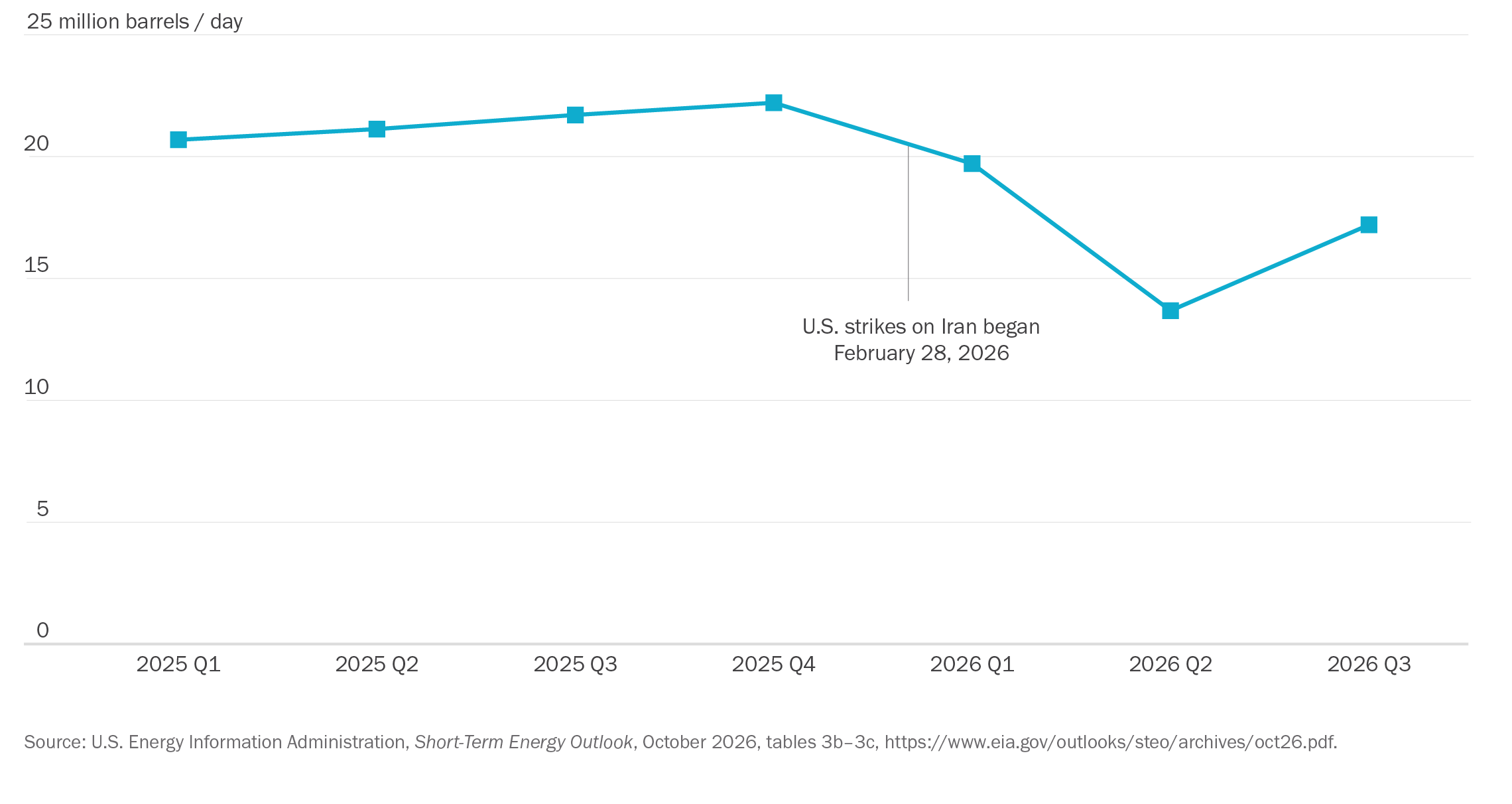
GCC liquid fuels production fell nearly 40 percent between late 2025 and mid-2026 as Iran choked exports through the Strait of Hormuz and damaged energy infrastructure.
The Iran-backed Houthis reignited their conflict with Saudi Arabia in July, posing additional threats to oil exports. From their strategic position along Yemen’s Red Sea coast, the Houthis have harassed Saudi tankers attempting to transit the Bab al-Mandab Strait, the region’s second key chokepoint, and launched drone strikes that have damaged the kingdom’s energy facilities.11Qasim Nauman and Vivian Nereim, “Saudi Arabia and Yemen’s Houthis Edge Back to the Brink of War,” New York Times, September 8, 2026, https://www.nytimes.com/2026/09/08/world/middleeast/saudi-arabia-yemen-houthis-energy-attack.html. In early September, a drone attack originating from Iraq on the kingdom’s East-West pipeline, responsible for roughly 4 percent of the global oil supply, further constricted Saudi exports.12Tiffanie Turnbull, “Saudi Arabia Shuts Key Oil Pipeline after Drone Attack Launched from Iraq,” BBC, September 12, 2026, https://www.bbc.com/news/articles/c62m933465eo; Lisa Friedman, “Global Oil Prices Could Hit Highest Levels in Months after Saudi Pipeline Attacks,” New York Times, September 16, 2026, https://www.nytimes.com/2026/09/16/business/saudi-pipeline-houthi-attacks.html
Damage to the Gulf States’ economies extended far beyond the energy sector. The region’s tourism and hospitality industries suffered major shocks after air traffic essentially collapsed in the early weeks of the war and hotels and airports came under attack. According to one industry estimate, the Middle East stood to lose $34 billion–$56 billion in visitor spending from the disruptions, with GCC countries taking the bulk of the losses. Regional airline carriers are expected to suffer a net loss of $4.3 billion this year.13“Tourism Impacts in Middle East from Iran War,” Tourism Economics, March 4, 2026, https://www.tourismeconomics.com/research/tourism-and-iran-war/; “Middle East Disruptions and High Fuel Prices Halve Airline Industry Profitability,” International Air Transport Association, June 7, 2026, https://www.iata.org/en/pressroom/2026-releases/06-07-middle-east-disruptions-high-fuel-prices-halve-airline-industry-profitability/.
Other commodity exports, such as aluminum, fertilizer, and refined fuels, were also disrupted by Iran’s attacks on the strait, pushing up global prices.14Rebecca Geldard, “Beyond Oil: 9 Commodities Impacted by the Strait of Hormuz Crisis,” World Economic Forum, April 1, 2026, https://www.weforum.org/stories/supply-chains-and-transportation/beyond-oil-lng-commodities-impacted-closure-hormuz-strait/. Real estate and financial markets in the Gulf took a hit, exacerbating the economic strain. Overall, GCC economies are expected to contract by 4.3–4.8 percent this year, with contractions ranging from about 1.6 percent (the United Arab Emirates) to nearly 21 percent (Qatar), according to the World Bank and International Monetary Fund.15Oman is an exception. Unlike other GCC economies, Oman’s economy will grow by 3.1 percent this year, according to the World Bank. “From Divide to Opportunity: AI, Jobs, and Growth. Middle East, North Africa, Afghanistan, and Pakistan Economic Update,” World Bank Group, October 2026, https://doi.org/10.1596/978-1-4648-2364-0; “Regional Economic Outlook Update, Middle East and Central Asia, October 2026: Steering Through Uncertainty: Strengthening Resilience in Challenging Times,” International Monetary Fund, October 2026, https://www.imf.org/-/media/files/publications/reo/mcd-cca/2026/october/english/text.pdf. This is on par with the region’s contraction during the COVID-19 pandemic.
Iranian attacks by state targeted (Feb 28–Nov 10, 2026)
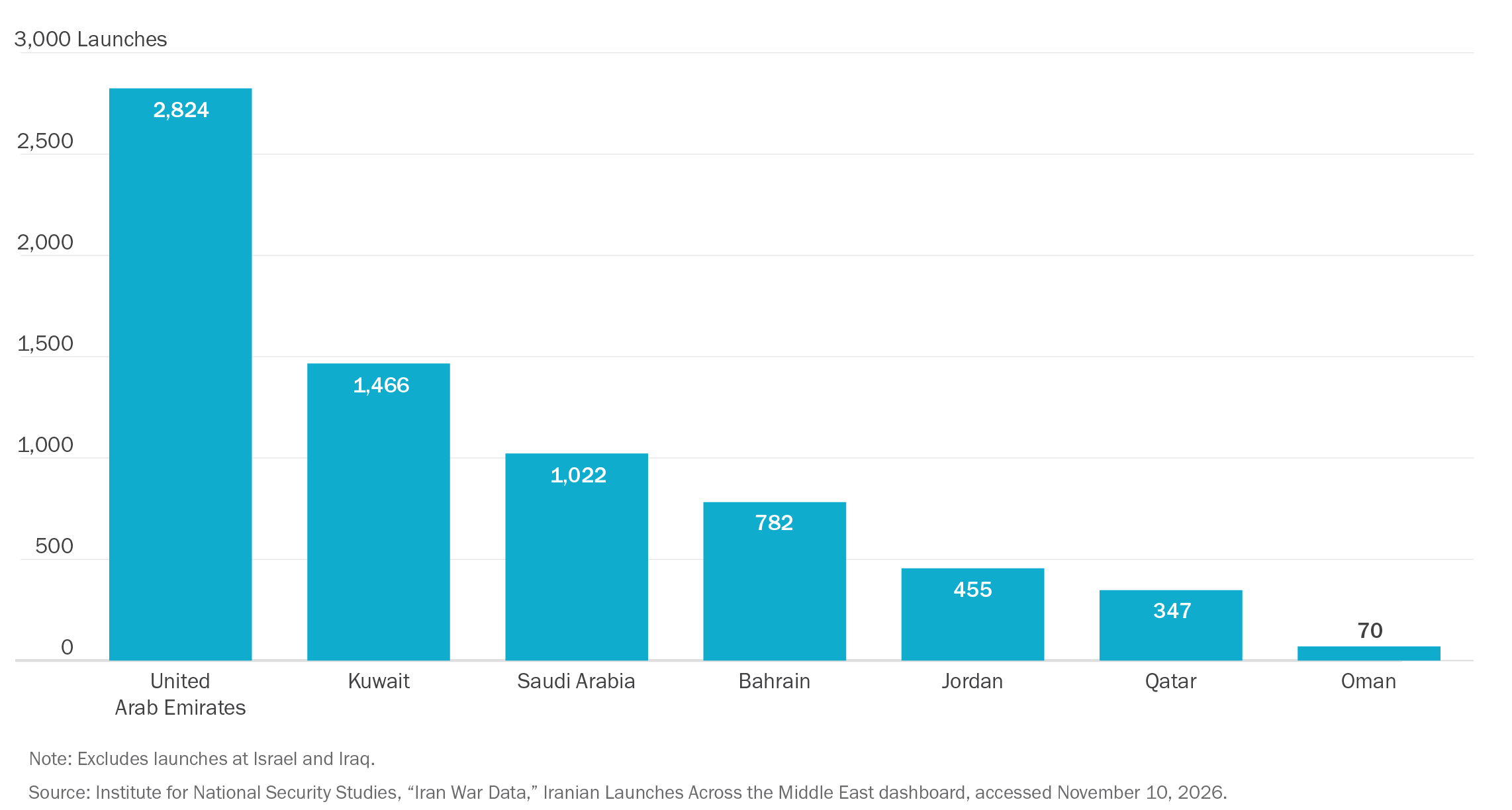
Despite hosting 50,000 or more U.S. troops, the Gulf States and Jordan faced thousands of Iranian missile and drone strikes during the war, which damaged their infrastructure and economies.
The extent of the damage underscores how little Gulf interests were taken into account in the U.S.-Israeli decision to fight. Despite being forced to bear the brunt of Iran’s retaliation—and playing host to tens of thousands of U.S. troops—the Gulf States had little influence over whether the war was launched and how it was conducted, with many Gulf leaders complaining that they were not meaningfully consulted.16Vivian Nereim, “Trump’s Gulf Allies Do Not Want Him to Bomb Iran,” New York Times, January 14, 2026, https://www.nytimes.com/2026/01/14/world/middleeast/gulf-trump-iran.html; David S. Cloud et al., “The U.S. Liberated Kuwait but Now Struggles to Protect It from Iran,” Wall Street Journal, July 31, 2026, https://www.wsj.com/world/middle-east/the-u-s-liberated-kuwait-but-now-struggles-to-protect-it-from-iran-acb68e94 Their U.S. partnership meant the Gulf States were chain-ganged into the conflict.
Tehran’s rhetoric notwithstanding, Iran did not retaliate against the Gulf States simply because they host U.S. troops and bases. Tehran wanted to increase the costs of the war to U.S. security partners in an effort to coerce the U.S. and Israel into ceasing hostilities. At the same time, the war demonstrated to the Gulf States that hosting U.S. troops on their soil did not provide the deterrent effect or protection they had long hoped for.
Gulf state doubts about the U.S. commitment
The war accelerated long-term trends in the Gulf that had already called into question the value of U.S. military bases and the reliability of U.S. security commitments. While the peacetime forward presence of thousands of U.S. troops was once perceived as guaranteeing the Arab monarchies’ security during the Gulf War in 1990–91 and its aftermath, the threats they could deter have all but vanished.
Since the fall of Saddam Hussein in Iraq in 2003, no country in the region has posed a credible threat of conquest to the Gulf States.17Eugene Gholz and Daryl G. Press, “Protecting ‘The Prize’: Oil and the U.S. National Interest,” Security Studies 19, no. 3 (2010): 453–85. Despite its population of more than 90 million, Iran has a weak economy hamstrung by decades of international sanctions. It has little money to spend on its armed forces, which are poorly trained and equipped and largely incapable of launching a serious offensive.18“World Bank Open Data,” World Bank, accessed September 17, 2026, https://data.worldbank.org; Anthony H. Cordesman, “The Changing Trends in Gulf Military and Security Forces: A Net Assessment,” Center for Strategic and International Studies, November 21, 2023, https://www.csis.org/analysis/changing-trends-gulf-military-and-security-forces-net-assessment. Instead, Iran prioritized investments in asymmetric strategies—such as terrorism, irregular warfare, and proxy warfare—designed to challenge and erode the conventional deterrence that thousands of U.S. troops in the region were presumed to provide.
Even before the Iran war, Gulf Arab leaders had become increasingly concerned about the deterrent value of the U.S. forward presence for countering Iran’s and its proxies’ asymmetric strategies, especially drone and missile attacks on Gulf energy and civilian infrastructure and efforts to harass maritime traffic around the Strait of Hormuz.
Gulf leaders suffered a strategic shock in 2019 when the United States did not retaliate against Iran for its suspected role in mining Saudi and Emirati oil tankers in the Gulf of Oman and cruise missile and drone attacks on two major Saudi oil installations.19David D. Kirkpatrick and Ben Hubbard, “Attack on Saudi Oil Facilities Tests U.S. Guarantee to Defend Gulf,” New York Times, September 19, 2019, https://www.nytimes.com/2019/09/19/world/middleeast/saudi-iran-attack-oil.html. Emirati leaders were similarly disappointed by what they perceived as an insufficient U.S. response to Houthi attacks on Abu Dhabi in 2022.20Vivian Nereim, “An Oil-Rich Ally Tests Its Relationship with the U.S.,” New York Times, August 8, 2023, https://www.nytimes.com/2023/08/08/world/middleeast/uae-russia-china-us.html.
Iran’s strikes on an Iraqi base hosting U.S. troops in 2020 and Al Udeid Air Base in Qatar in 2025 provided further evidence that the U.S. presence was insufficient to deter the growing Iranian missile and drone threat.21Joseph Trevithick, “Everything New We Just Learned about the 2020 Iranian Missile Attack on U.S. Forces in Iraq,” TWZ, March 1, 2021, https://www.twz.com/39527/everything-new-we-just-learned-about-the-iranian-missile-attack-on-al-asad-air-base; Taylor Luck, “Iran Crisis: Why Gulf Arabs Increasingly See U.S. as a Liability,” Christian Science Monitor, January 8, 2020, https://www.csmonitor.com/World/Middle-East/2020/0108/Iran-crisis-Why-Gulf-Arabs-increasingly-see-US-as-a-liability; Dina Esfandiary, “How a Single Strike Rattled the Gulf’s Illusion of Stability,” TIME, July 1, 2025, https://time.com/7299042/strike-rattled-gulfs-illusion-stability/. These attacks suggest that the U.S. network of bases in the Gulf had already become a prime target for Iranian retaliation, rather than a deterrent.22For a comprehensive discussion of the precision revolution’s effects on Iran’s capabilities, see Benjamin Friedman, “The Proliferation of Accuracy and Vulnerability of Military Bases,” Defense Priorities, September 24, 2026, https://www.defensepriorities.org/explainers/the-proliferation-of-accuracy-and-vulnerability-of-military-bases/.
But in the run-up to the U.S.-Israeli war on Iran, it was Israel, not Iran, that prompted Gulf leaders to raise fundamental questions about the nature of their security relationship with the United States. When Israel launched airstrikes in September 2025 targeting Hamas leaders in Qatar, home to Al Udeid, the largest U.S. military installation in the region, Gulf leaders were outraged.23Adam Rasgon, “Trump Promises to Defend Qatar, a Reassurance after Israel’s Strike,” New York Times, October 1, 2025, https://www.nytimes.com/2025/10/01/world/middleeast/qatar-trump-executive-order.html. A member of the U.S.-backed GCC, regional mediator, and major non-NATO ally had been attacked, and the United States had failed to prevent it.
To be clear, even as Gulf leaders’ worries about the benefits of U.S. bases have grown, most have still sought legally binding security guarantees and a continued U.S. troop presence on their territories to increase the likelihood of U.S. aid in the event of an attack.24“Gulf Countries Accept Redeployment of U.S. Forces to Deter Iran,” Asharq al-Awsat, May 18, 2019, https://english.aawsat.com/home/article/1727961/gulf-countries-accept-redeployment-us-forces-deter-iran; “UAE Official Calls for ‘Unambivalent’ U.S. Security Commitment,” Reuters, November 14, 2022, https://www.reuters.com/world/middle-east/uae-official-calls-unambivalent-us-security-commitment-2022-11-14/; Dion Nissenbaum et al., “Saudi Arabia Seeks U.S. Security Pledges, Nuclear Help for Peace with Israel,” Wall Street Journal, March 9, 2023, https://www.wsj.com/articles/saudi-arabia-seeks-u-s-security-pledges-nuclear-help-for-peace-with-israel-cd47baaf. Hosting U.S. troops has served as a kind of next-best insurance policy and costly signal of U.S. commitment, since any attack on the Gulf would presumably draw in the United States. But in seeking to couple U.S. forces to their defense, Gulf leaders took on a risk that, prior to the war in Iran, was largely theoretical. This risk—entrapment—became reality with the outbreak of the war. Banking on a tripwire, Gulf leaders instead ended up on a chain gang as the United States and Israel dragged them into a conflict they had long sought to avoid.25For further discussion of entrapment in alliance politics, see Thomas J. Christensen and Jack Snyder, “Chain Gangs and Passed Bucks: Predicting Alliance Patterns in Multipolarity,” International Organization 44, no. 2 (Spring 1990): 137–68, https://www.jstor.org/stable/2706792.
The Gulf reassesses the value of U.S. bases
After months of war, some Gulf States are now questioning the basis of the partnership—including the deterrent value of U.S. bases—and hedging against the unreliability of U.S. commitments by further diversifying security ties.26Vivian Nereim, “In Qatar, Trapped Between the U.S. and Iran, War Forced a Reckoning,” New York Times, April 19, 2026, https://www.nytimes.com/2026/04/19/world/middleeast/qatar-iran-us-war.html; Samia Nakhoul, “Gulf Recalibrates as Iran Emerges Intact from War,” Reuters, June 15, 2026, https://www.reuters.com/world/middle-east/gulf-recalibrates-iran-emerges-intact-war-2026-06-15/. While the Gulf States are unlikely to distance themselves from the United States given a lack of viable alternatives, they are similarly unlikely to view U.S. bases in the region as the source of their security. This presents an opportunity for the United States and the GCC to redefine the foundations of their partnership.
Gulf Arab officials are frustrated with the U.S. approach to Iran.27Vivian Nereim, “How Three Months of War Changed the Gulf Forever,” New York Times, June 26, 2026, https://www.nytimes.com/2026/06/26/world/middleeast/gulf-changed-forever-iran-war.html; Susannah George, “Frustration with Trump Grows among U.S.’s Persian Gulf Allies, Officials Say,” Washington Post, August 15, 2026, https://www.washingtonpost.com/world/2026/08/15/frustration-with-trump-grows-among-us-persian-gulf-allies-officials-say/. Some have begun to question the value of hosting U.S. bases.28Sune Engel Rasmussen and Summer Said, “Muted U.S. Response to Iranian Attacks Deepens Gulf Fears about Cease-Fire,” Wall Street Journal, May 9, 2026, https://www.wsj.com/world/middle-east/iran-us-ceasefire-deal-gulf-countries-9402cac4; Badr Al-Boussaïdi, “La guerre contre l’Iran a révélé à quel point la politique d’endiguement était un mythe,” Le Monde, July 13, 2026, https://www.lemonde.fr/idees/article/2026/07/13/badr-al-boussaidi-ministre-des-affaires-etrangeres-d-oman-la-guerre-contre-l-iran-a-revele-a-quel-point-la-politique-d-endiguement-etait-un-mythe_6723040_3232.html; George, “Frustration with Trump Grows.” They are further worried about their ability to influence U.S. military actions and the U.S. failure to address core threats to their security, especially Iran’s ballistic missile program and regional proxy network.29Adam Rasgon, “Gulf States Are Frustrated by Failure to Tackle Iran’s Missiles, Analysts Say,” New York Times, June 18, 2026, https://www.nytimes.com/2026/06/18/world/middleeast/gulf-states-us-iran-deal.html; Nereim, “How Three Months”; Rasmussen and Said, “Muted U.S. Response.” Even Qatar has reportedly been questioning its policy of hosting U.S. troops.30Rasmussen and Said, “Muted U.S. Response.” At the outset of the war, Gulf officials’ confidence in the United States was shattered by its inability to dislodge the Iranian regime, and as the war dragged on, by the U.S. failure to pry open the Strait of Hormuz.31George, “Frustration with Trump Grows.” Gulf officials are also wary of the closeness of the U.S.-Israel relationship and concerned about the threat of Israeli regional dominance after the war.32Rasmussen and Said, “Muted U.S. Response.”
U.S. bases hit by Iran
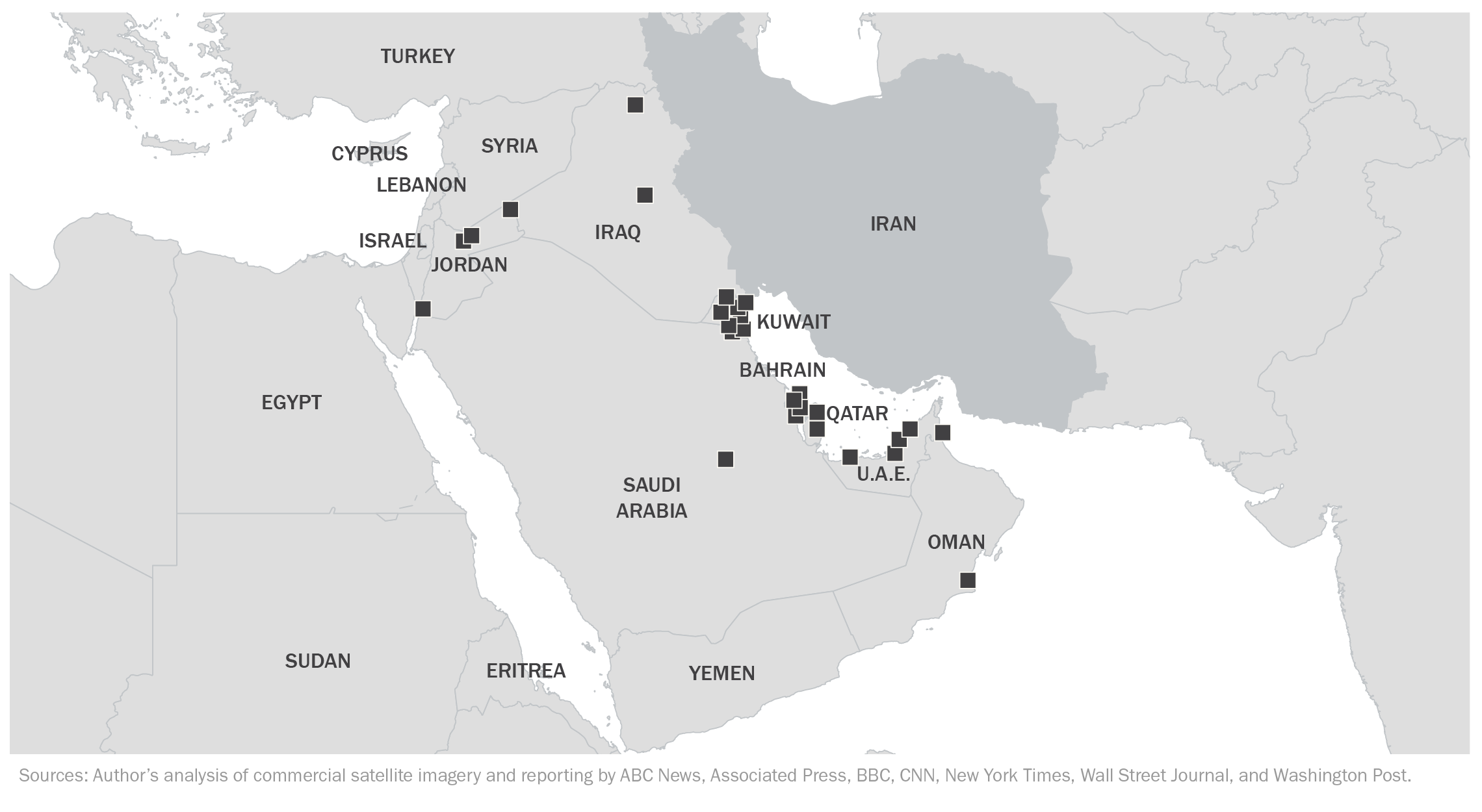
Iranian strikes have damaged more than two dozen facilities hosting U.S. troops or U.S. military equipment in eight countries during the war, suggesting the bases were as much a liability for the Gulf States as they were an asset.
Despite their frustrations, the Gulf States are unlikely to pivot to an alternative security provider in the near term. Their military equipment, arms, maintenance, and training are deeply intertwined with the United States, and U.S. military efforts to integrate Gulf air defenses were mostly successful in intercepting thousands of Iranian missiles and drones. China lacks the ambition and power projection capabilities to replace the U.S. as security guarantor. Russia has struggled to maintain its toehold in Syria.33“Syria and Russia Reach Deal on Future of Tartous and Hmeimim Bases after 18 Months of Talks,” Reuters, August 9, 2026, https://www.reuters.com/world/middle-east/syria-russia-reach-deal-future-tartous-hmeimim-bases-after-18-months-talks-2026-08-09/. European countries, while helpful at bolstering Gulf militaries on the margins, are similarly ill-positioned to take on the responsibility.34“12 Squadron Deploy to the Gulf,” Royal Air Force, January 23, 2026, https://www.raf.mod.uk/news/articles/12-squadron-deploy-to-the-gulf/; “France Deploys Fighter Jets over UAE to Protect Its Military Bases,” France 24, March 3, 2026, https://www.france24.com/en/middle-east/20260303-france-deploys-fighter-jets-over-uae-to-protect-its-military-bases.
Instead of replacing the United States, the Gulf States are likely to accelerate efforts to diversify their security ties in an effort to complement U.S. support and hedge against the dual risks of U.S. entanglement and abandonment. In August, Saudi Arabia signed a joint defense agreement, known as the Mecca Pact, with Pakistan and Turkey, which describes an attack on any of the signatories as an attack on all.35Ben Hubbard, “Saudi Arabia, Turkey and Pakistan Sign Joint Defense Pact,” New York Times, August 7, 2026, https://www.nytimes.com/2026/08/07/world/middleeast/saudi-turkey-pakistan-joint-defense-pact.html. Although the pact’s collective defense language is largely hollow, it could serve as a useful mechanism for joint defense industry projects and counterterrorism cooperation. The pact builds on Riyadh’s efforts in July to organize a multinational coalition to counter Houthi attacks on commercial shipping in the Red Sea, which could reinforce the European Union’s existing freedom of navigation mission in the region.36“EUNAVFOR Operation ASPIDES,” European External Action Service, accessed September 21, 2026, https://www.eeas.europa.eu/eunavfor-aspides_en.
Meanwhile, the United Arab Emirates (UAE) is doubling down on its security partnership with Israel, even as it affirms the value of U.S. Patriot missile interceptors. The Emiratis are particularly indebted to the Israelis for deploying advanced air defense systems to the UAE in the early months of the war, an unprecedented level of wartime collaboration between Israel and an Arab state.37England and Parasie, “The UAE’s Bold Gambit on Iran.” Kuwait, which suffered one of the deadliest attacks of the war when six U.S. service members were killed in an Iranian drone strike in March, signed an expanded joint defense agreement with Pakistan in August.38Lara Seligman, “U.S. Troops Killed in Kuwait Had No Warning of Deadly Drone Attack,” Wall Street Journal, March 3, 2026, https://www.wsj.com/world/middle-east/u-s-troops-killed-in-kuwait-had-no-warning-of-deadly-drone-attack-b0ef6bce; “Kuwait, Pakistan Sign Joint Defense, Military Cooperation Agreement,” Kuwait Times, August 27, 2026, https://kuwaittimes.com/article/48802/kuwait/kuwait-pakistan-sign-joint-defense-military-cooperation-agreement/. Gulf governments have looked to diverse suppliers such as Australia, Italy, and Ukraine for counter-drone and anti-aircraft systems.39Vivian Nereim, “Sucked Into War, Gulf Countries Face the Limits of U.S. Security Guarantees,” New York Times, March 17, 2026, https://www.nytimes.com/2026/03/17/world/middleeast/iran-war-gulf-saudi-arabia-qatar-emirates.html.
A new framework for U.S.-Gulf relations
Defending U.S. interests in the Persian Gulf after the war will require a new security relationship with the United States’ Gulf Arab partners, one that involves reducing its vulnerability and increasing its resilience to Iranian attack. As the war has shown, the security of Gulf Arab energy producers remains key for the free flow of hydrocarbons out of the Gulf. This is the closest thing to a vital interest that the United States has in the region, and one the Trump administration inadvertently compromised in waging a war for regime change in Tehran.
Securing this interest should serve as the cornerstone of the partnership, not only for the United States’ benefit but so the Gulf States can reclaim their status as a haven for finance, trade, and investment and modernize their hydrocarbon-dependent economies.
The partnership should be restructured on the basis of a much smaller U.S. military footprint, less reliance on U.S. support, and greater defense cooperation among the Gulf States. Doing so will put the partnership on much firmer footing for years to come. Future Gulf State efforts to bypass the Strait of Hormuz, or global reductions in dependence on hydrocarbons, can provide opportunities to once again rebalance the relationship.
A smaller U.S. footprint
Shrinking the U.S. military footprint in the Gulf will be key to reducing the vulnerability of the United States and its Gulf Arab partners to the threat of Iranian missile and drone attacks. The Pentagon is reportedly already discussing changes to the U.S. force posture in the Gulf, including the potential to close or downsize some bases.40Seth et al., “How Iran Devastated an American Naval Base”; Robertson et al., “Pentagon Weighing Smaller U.S. Military Presence.” The basis for such changes, however, must go beyond merely calculating the outer limits of Iranian missile ranges or the cost to harden or repair significantly damaged installations. It must be rooted in a reappraisal of the purpose and missions of the U.S. military in the region after the war winds down.
Given the primacy of the U.S. interest in the free flow of energy exports out of the Gulf, these missions should largely focus on intercepting attacks on Gulf energy infrastructure and maintaining freedom of navigation through the Strait of Hormuz. Any counterproliferation mission aiming to prevent the outbreak of a nuclear weapons capability in the region would continue to rely on assets deployed elsewhere, such as B-2 bombers based in the United States or at the U.S.-UK base at Diego Garcia, while Iran and its regional proxy network would be countered insofar as they threatened Gulf energy infrastructure and maritime traffic. Some mix of U.S. military and State Department-led efforts to continue training and advising Gulf partners on counterterrorism may also be warranted.
The Pentagon could then downsize or close the majority of bases hosting a permanent U.S. military presence in the Gulf. Not only could U.S. regional missions be accomplished with a smaller, more dispersed force largely stationed offshore, but base closures would diminish one of Iran’s primary motivations for lashing out against the Gulf and maritime traffic—what it perceives as U.S. threats to the survival of its regime.41Kenneth Katzman, “Iran’s Foreign and Defense Policies,” Congressional Research Service, CRS no. R44017, January 11, 2021, https://www.congress.gov/crs-product/R44017.
Those facilities primarily hosting large numbers of ground forces, such as in Kuwait, would be prime candidates for closure given their increasing irrelevance to the current threat environment.42Cloud et al., “The U.S. Liberated Kuwait.” To the extent the U.S. Army retained a forward presence in the region, it would be largely for air and missile defense at sites with a residual U.S. presence.
U.S. Central Command could reduce the U.S. Navy presence to a single carrier strike group based outside the Gulf and downsize or close the Navy’s heavily damaged Fifth Fleet headquarters in Bahrain.43Seth et al., “How Iran Devastated an American Naval Base.” While specialized vessels like those for mine clearance could be maintained inside the Gulf to facilitate freedom of navigation, the Navy would otherwise rely on flexible access agreements for a dispersed network of ports in the Arabian Sea and Red Sea, along with sea-based platforms for sustainment.44For further discussion of options for maintaining a forward naval presence from outside the Gulf, see Mark Gunzinger and Chris Dougherty, “Outside-In: Operating from Range to Defeat Iran’s Anti-Access and Area-Denial Threats,” Center for Strategic and Budgetary Assessments, January 18, 2012, https://csbaonline.org/resource/outside-in-operating-from-range-to-defeat-irans-anti-access-and-area-denial-threats/. In any retaliation for Iranian attacks, carrier-based strike aircraft would provide the bulk of the forces for immediate strikes against anti-ship missile launchers, ballistic missile launch sites, coastal radar installations, storage depots, ground control stations, and other targets.
Central Command could also redeploy the vast majority of ground-based strike aircraft outside the region while maintaining flexible access agreements to surge back in a crisis.45For another proposal to scale back the U.S. military footprint in the region but retain flexible access, see Jennifer Kavanagh, “An Access-Only Posture for the Middle East,” Defense Priorities, October 26, 2026, https://www.defensepriorities.org/explainers/an-access-only-posture-for-the-middle-east/. It could relocate command components at Al Udeid to the continental United States, leaving residual assets in locations such as Qatar or Jordan focused on intelligence, surveillance, and reconnaissance.46Michael R. Gordon and Marcus Weisgerber, “Years before Prince Sultan Attack, U.S. Officials Sounded Alarm about Gulf Bases,” Wall Street Journal, April 1, 2026, https://www.wsj.com/world/middle-east/iran-saudi-arabia-prince-sultan-air-base-bffed59d. It could also leave other enablers, such as refueling tankers and airborne command and control assets, to provide a logistics and command infrastructure for flowing forces back to the region in a crisis. With these changes, the Pentagon could plausibly reduce the U.S. military presence in the region by two-thirds or more.
The Pentagon should reject proposals to relocate U.S. military forces to Israel in the hope of reducing their vulnerability to Iranian drone and missile attacks.47Shirit Avitan Cohen, “U.S. Base Relocation to Israel Considered after Iranian Strikes in Gulf,” Israel Hayom, July 8, 2026, https://www.israelhayom.com/2026/07/08/us-base-relocation-to-israel-considered-after-iranian-strikes-in-gulf/. Doing so would carry risks that far outweigh any benefits. Iran has a demonstrated ability to strike Israel with medium-range ballistic missiles, such as its solid-propellant Kheibar Shekan, and is working to develop longer-range missiles and drones with still greater precision.48David S. Cloud and Shelby Holliday, “Cheap, Accurate and Lethal: Iran’s Best Missile Is Getting More Dangerous,” Wall Street Journal, July 25, 2026, https://www.wsj.com/world/middle-east/iran-kheibar-shekan-missile-5776a6e4. U.S. troops in Israel would almost certainly remain vulnerable to Iranian strikes while becoming a prime target for attacks by Iranian proxies Hezbollah and Hamas.
Even if Israel imposed comparatively few restrictions on access, basing, and overflight, the presence of U.S. forces would inevitably entangle Washington in unwanted future conflicts, whether against Iran or in Israel’s border disputes with Lebanon and Syria. Israel would have little incentive for restraint, believing that any retaliatory attack would drag in its American guests, leaving the United States even more deeply enmeshed in the region’s conflicts.
Decreased reliance on U.S. support
The Gulf States have learned that excessive dependence on a single security provider breeds risk and vulnerability, with their own interests inevitably coming second to the provider’s. Even so, they will likely remain dependent on the United States in the years ahead for key capabilities, such as reinforcing their air and missile defense, intelligence, logistics, and command and control. This is because their militaries are closely intertwined with U.S. technology and training.
To meet the Iranian threat to their energy and civilian infrastructure, the Gulf States will need access to cheaper and more plentiful air and missile defense systems, which the United States has struggled to provide, alongside other weapons and equipment tailored to defeat Iran’s evolving capabilities.49“Operation Epic Fury, Report to Congress, April 1, 2026–June 30, 2026,” Lead Inspector General, September 9, 2026, https://media.defense.gov/2026/Sep/09/2003993626/-1/-1/1/OEF_Q3_JUN2026_FINAL_508%20SECURE.PDF; Alistair MacDonald and Summer Said, “Gulf Allies Turn Away from U.S. for Fresh Ammo,” Wall Street Journal, April 12, 2026, https://www.wsj.com/world/gulf-allies-turn-away-from-u-s-for-fresh-ammo-9960be73. This will require investing in alternative providers and indigenous capacity building.
The Gulf States’ efforts to further diversify their arms suppliers will aid in developing the layered, integrated air and missile defenses they need to fill structural gaps exposed by Iran’s attacks. The United States may continue to provide Patriot and Terminal High Altitude Area Defense systems and missiles and even engage in the joint production of anti-missile and counter-drone technologies.50“Operation Epic Fury, Report to Congress, April 1, 2026–June 30, 2026,” Lead Inspector General, September 9, 2026, https://media.defense.gov/2026/Sep/09/2003993626/-1/-1/1/OEF_Q3_JUN2026_FINAL_508%20SECURE.PDF; Alistair MacDonald and Summer Said, “Gulf Allies Turn Away from U.S. for Fresh Ammo,” Wall Street Journal, April 12, 2026, https://www.wsj.com/world/gulf-allies-turn-away-from-u-s-for-fresh-ammo-9960be73. But the Gulf would benefit from complementing legacy U.S. systems with lower-cost interceptors, mobile systems, and counter-drone technologies from a more diverse set of suppliers. The Gulf States may increasingly look to South Korea for medium-range air and missile defense systems to bolster the layer between their strategic defenses and point protection. They could turn to Japan and others as alternative suppliers for Patriot missiles.51MacDonald and Said, “Gulf Allies Turn Away.”
The Gulf States will also need to rely on countries with direct experience in drone warfare. Saudi Arabia, the UAE, and Qatar have already signed defense cooperation deals with Ukraine for weapons production and experience sharing, as Ukraine has hard-earned expertise fending off Russian drones modeled on Iran’s.52Anastasiia Malenko, “Ukraine Agrees to 10-Year Defense Cooperation with Gulf Countries,” Wall Street Journal, March 28, 2026, https://www.wsj.com/livecoverage/iran-war-middle-east-news-updates/card/ukraine-agrees-to-10-year-defense-cooperation-with-gulf-countries-IETFUeY4WMDrqEA935jY. The Gulf States would further benefit from Ukraine’s interceptor drones and electronic warfare equipment, and potentially from emerging suppliers such as a UK startup looking to export counter-drone missiles.53MacDonald and Said, “Gulf Allies Turn Away.” Turkey is becoming an increasingly attractive partner for low-cost drone exports and is positioned to expand joint defense industry production with the Mecca Pact. Even China could continue supplying drones and light attack aircraft to Gulf buyers.54Paul Iddon, “Turkey’s Homegrown Armed Drones Are Now Ubiquitous in the Arab World,” Forbes, August 29, 2026, https://www.forbes.com/sites/pauliddon/2026/08/29/turkeys-homegrown-armed-drones-are-now-ubiquitous-in–the-arab-world/; Nereim, “An Oil-Rich Ally.”
At the same time, the Gulf States can further develop their indigenous defense industries. Saudi Arabia remains focused on achieving objectives set out in its Vision 2030 plan, an ambitious effort to reduce its reliance on oil exports and strengthen non-oil sectors of its economy. Riyadh has set a goal of localizing 50 percent of its defense spending by the end of the decade, up from about 4 percent in 2018.55Glen Carey, “Saudis Want to Make Their Own Weapons. Russia Is Eager to Help,” Bloomberg, March 2, 2018, https://www.bloomberg.com/politics/articles/2018-03-02/saudis-want-to-make-their-own-weapons-russia-is-eager-to-help; Agnes Helou, “Saudi Arabia Reveals Strides in Local Defense Production as It Races Towards Ambitious 2030 Goal,” Breaking Defense, November 25, 2024, https://breakingdefense.com/2024/11/saudi-arabia-reveals-strides-in-local-defense-production-as-it-races-towards-ambitious-2030-goal/. While it has made some progress in areas such as maintenance, repair, and component assembly, it remains fundamentally dependent on imports of foreign-manufactured arms.56Mohammed al-Kinani, “Saudi Arabia’s Drive to Build a Defense Powerhouse,” Arab News, August 9, 2025, https://www.arabnews.com/business/saudi-arabias-drive-to-build-a-defense-powerhouse-2611276; Zain Hussain and Alaa Tartir, “Recent Trends in International Arms Transfers in the Middle East and North Africa,” Stockholm International Peace Research Institute, April 10, 2025, https://www.sipri.org/commentary/topical-backgrounder/2025/recent-trends-international-arms-transfers-middle-east-and-north-africa.
The UAE has also made strides toward indigenization through partnerships with international firms, including producing armored vehicles, small arms, and precision-guided munitions.57Zoltan Barany, “Indigenous Defense Industries in the Gulf,” Center for Strategic and International Studies, April 24, 2020, https://www.csis.org/analysis/indigenous-defense-industries-gulf. But similar to Riyadh, Abu Dhabi continues to rely on foreign partners for a significant share of its technological inputs and intellectual property, and it lacks a critical mass of expertise for homegrown research and development.58Leonardo Jacopo Maria Mazzucco, “UAE Defense Industry Ambitions,” Arab Gulf States Institute, July 22, 2025, https://agsi.org/analysis/uae-defense-industry-ambitions/. The Gulf States will have to overcome Western defense firms’ concerns about intellectual property and technology transfer, a shortage of STEM workers, supply chain density, and other major hurdles to make meaningful progress in the coming years. A drawdown of U.S. forces in the region will give them an even greater incentive to invest in these efforts.
Increased Gulf Arab defense cooperation
The Gulf States have tried for decades to foster greater defense integration, with little progress. Efforts to integrate Gulf militaries under the aegis of the Gulf Cooperation Council, as with the Peninsula Shield Force in the early 1980s or the GCC’s joint military command in 2013, have failed to yield a capable collective defense that can counter the Iranian threat.59P. K. Abdul Ghafour, “Joint Military Command to Bolster GCC Defense,” Arab News, December 12, 2013, https://www.arabnews.com/middle-east/joint-military-command-to-bolster-gcc-defense-491416. Internal rivalries, exemplified by the blockade of Qatar by Saudi Arabia, the UAE, and Bahrain (along with Egypt) in 2017 and the Saudi-Emirati strategic rivalry that has only worsened in recent months, have been partly to blame.
An even greater impediment, however, has been the U.S. military’s forward presence and GCC states’ separate bilateral security relationships with the United States. The security umbrella that Gulf leaders had perceived in the U.S. presence has almost certainly impeded integration by inducing moral hazard. Gulf leaders have been unwilling to resolve internal political disagreements and territorial disputes, pool resources, and integrate their military capabilities, believing that the United States will come to their aid in a crisis.
Drawing down U.S. forces from the region after the war would incentivize the Gulf States to pursue closer coordination and integration. Such efforts would be in line with U.S. aspirations since at least the U.S.-GCC Camp David Summit in 2015, when Washington sought to transition from providing bilateral security guarantees to enhancing regional security cooperation.60“Annex to U.S.-Gulf Cooperation Council Camp David Joint Statement,” White House, May 14, 2015, https://obamawhitehouse.archives.gov/the-press-office/2015/05/14/annex-us-gulf-cooperation-council-camp-david-joint-statement. While full integration and interoperability likely remain far off, a U.S. drawdown could increase multilateral coordination in key domains.
Given the nature of the Iranian threat, the Gulf States’ priority should be joint, layered air and missile defenses, including further developing an early warning system for Iranian ballistic missile attacks, and maritime awareness and security.61“Statement of the Extraordinary Session of the Joint Defense Council,” Gulf Cooperation Council, September 18, 2025, https://www.gcc-sg.org/en/MediaCenter/News/Pages/news2025-9-18-5.aspx. The United States can help foster greater intelligence sharing with the goal of developing a multilateral intelligence fusion center; strengthening cybersecurity; conducting GCC joint exercises, including for the defense of energy infrastructure; developing counter-drone tactics; and better coordinating procurement to overcome the persistent differences in hardware and software that have impeded greater interoperability.62Brahim Saidy, “Building an Integrated Missile Defense Architecture for Gulf States: Perceptions, Capabilities and Challenges,” in The Arms Trade, Military Services and the Security Market in the Gulf States: Trends and Implications, ed. Dania Thafer and David B. Des Roches (Gerlach Press, 2016). While the United States can help foster this cooperation, it should not lead it. Security agreements must be Gulf-owned and Gulf-led to avoid endemic dependence on U.S. help.
Overcoming fears of a U.S. drawdown
While critics warn that a U.S. drawdown would destabilize the Gulf, the presumed risks are overstated and readily managed by capable Gulf partners backstopped by U.S. forces stationed offshore. Rather than increase the risks to the Gulf States, a smaller, more dispersed U.S. footprint, in combination with diversified Gulf security ties and greater defense cooperation, would undermine Iran’s ability to threaten the Gulf and disrupt energy exports flowing out of the region.
An emboldened Iran
Some fear that a U.S. drawdown would leave the GCC states exposed to new forms of Iranian coercion, including efforts to extort tanker traffic through the strait.63See, for example, Gerecht and Takeyh, “The U.S. Needs Its Mideast Bases.” The nature of the Iranian threat and the capabilities of U.S. forces postured offshore suggest this concern is overblown. As the war in Iran has shown, the most effective defense against Iranian missile and drone attacks is not a large-scale bombing campaign designed to raise the costs for Tehran and punish it into submission. It is deterrence by denial: degrading Iran’s ability to successfully—and consistently—strike its targets.
Even on a wartime footing, the U.S. military has been unable to prevent every Iranian attack on Gulf targets. It has, however, intercepted the overwhelming majority of strikes with a combination of the GCC’s world-class air and missile defense systems and U.S. naval assets patrolling outside the Gulf.
A smaller U.S. presence primarily stationed offshore would retain these capabilities and deny any sustained Iranian harassment campaign, which requires consistent pressure to be effective.64For further discussion of this point, see Gholz and Press, “Protecting ‘The Prize.’” Moreover, the United States has a demonstrated ability to rapidly flow forces into theater in the event of a crisis. Iran would still be capable of inflicting transient economic pain, curtailing exports and raising prices. But as U.S. efforts to guide and protect tanker traffic through the strait since the spring of 2026 have shown, Iran would struggle to deter a resilient tanker fleet indefinitely.65Benoit Faucon et al., “More Oil Is Now Coming Out of the Persian Gulf Than Before the Iran War,” Wall Street Journal, October 21, 2026, https://www.wsj.com/world/middle-east/more-oil-is-now-coming-out-of-the-persian-gulf-than-before-the-iran-war-6a6d1670.
Should Iran attempt to levy a fee on commercial traffic for safe passage, as Tehran has repeatedly suggested, its success is unlikely to hinge on the U.S. military posture in the region after the war. Iran’s ability to toll the strait will depend far more on how negotiations over control of the strait, U.S. sanctions, its own frozen funds, and the fate of its nuclear program play out. And even if Iran establishes a tolling regime, the benefits are likely to be short-lived. GCC efforts to establish alternative export routes to bypass Hormuz, bury pipelines, and make greater use of overseas storage facilities will severely undermine Iran’s ability to coerce Gulf energy exporters.66England and Parasie, “The UAE’s Bold Gambit on Iran.”
Gulf appeasement
Others are concerned that a reduced U.S. footprint would mean a reduced U.S. commitment to the GCC’s defense, leading the Gulf States to accommodate Iran more than they otherwise would.67Cloud et al., “The U.S. Liberated Kuwait”; Dario Sabaghi, “What Is the Future of U.S. Military Bases in the Gulf?,” New Arab, August 26, 2026, https://www.newarab.com/analysis/what-future-us-military-bases-gulf. Gulf governments, however, are already nervous about the reliability of U.S. defense commitments—even with the U.S. military on a wartime footing with 50,000 or more troops in the region.68Ismaeel Naar, “Trump Meets Middle East Leaders as Regional Wars Widen,” New York Times, September 22, 2026, https://www.nytimes.com/2026/09/22/world/middleeast/trump-persian-gulf-leaders-meeting.html. As evidenced by the U.S. failure to retaliate after the 2019 attacks on Saudi oil infrastructure and Saudi and Emirati tankers—and its decline of Saudi Arabia’s requests to strike the Houthis after drone attacks in September—the presence of U.S. troops in the region is far from a guarantee that the United States will come to the Gulf States’ defense even with standing pledges of support.69Helene Cooper et al., “Trump Gets Caught in a Dilemma over a Saudi Plea for Military Help,” New York Times, September 20, 2026, https://www.nytimes.com/2026/09/20/us/politics/trump-yemen-houthis-red-sea-iran.html. Yet the Gulf almost certainly can rely on the United States to counter any sustained campaign to prevent the free flow of hydrocarbons. Washington has a demonstrated record of employing military force in defense of this key interest, from U.S. operations to defend Saudi Arabia and liberate Kuwait in 1990–91 to contemporary efforts to counter Iran in the Strait of Hormuz.
The answer is not to pair any U.S. drawdown with enhanced security guarantees to reassure Gulf partners. Far more diagnostic than U.S. security agreements, executive orders, non-NATO ally status—or even the presence of U.S. troops in the region—is that the United States is likely to come to the aid of the Gulf States if and when its own key interest comes under threat.
After the war concludes—regardless of the U.S. force posture—Gulf Arab governments will need to reach a new modus vivendi with Iran that recognizes its dominant position in the Gulf. Iran will retain the ability to launch the occasional ballistic missile and drone attack in and across the strait even if there is a negotiated end to the war. No forward U.S. troop presence could prevent it from doing so.
The Gulf governments are already moving to accommodate Iran, just as Saudi Arabia pursued rapprochement in the years after the Iran-backed attacks in 2019, culminating in the 2023 normalization agreement.70Vivian Nereim, “Gulf Arabs Seek Options after U.S. Bases Did Not Deter Iran,” New York Times, September 15, 2026, https://www.nytimes.com/2026/09/15/world/middleeast/gulf-us-iran-uae-bahrain-saudi-arabia.html; England and Parasie, “The UAE’s Bold Gambit on Iran”; Parisa Hafezi et al., “Iran and Saudi Arabia Agree to Resume Ties in Talks Brokered by China,” Reuters, March 10, 2023, https://www.reuters.com/world/middle-east/iran-saudi-arabia-agree-resume-ties-re-open-embassies-iranian-state-media-2023-03-10/. Given the changed balance of power, these efforts will be a necessary part of the new stabilizing equilibrium for the region after the war.
Security spirals and nuclear proliferation
Critics might contend that U.S. retrenchment from the Gulf would ignite a regional arms race, including toward indigenous nuclear enrichment. The Gulf States could do this to balance each other and Iran. As Kenneth Pollack has argued, “One of the dirty little secrets of the Persian Gulf is that GCC unity is a fiction: the Qataris want American military bases not to shield them from Iran or Iraq but to deter Saudi Arabia. Likewise, Bahrain wants powerful missiles not to make it an effective member of the Peninsula Shield Force but so that it can strike Qatar if it ever feels the need.”71Kenneth M. Pollack, “Securing the Gulf,” Foreign Affairs, July 1, 2003, https://www.foreignaffairs.com/articles/middle-east/2003-07-01/securing-gulf.
The U.S. forward presence in the Gulf has done little to tamp down intra-Gulf rivalries and may exacerbate them. In 2017, despite U.S. concerns about the need to present a united front against Iran—and thousands of U.S. troops based at Al Udeid—Saudi Arabia, its GCC allies, and Egypt blockaded Qatar in protest of what they perceived as its destabilizing policies in the region. In another case of moral hazard, it was the U.S. troop presence that helped give Doha the confidence to pursue the activist foreign policy that Saudi Arabia and others found so threatening.72Mehran Kamrava, Qatar: Small State, Big Politics (Cornell University Press, 2013).
More recently, the strategic rivalry between Saudi Arabia and the UAE has unfolded against the backdrop of a robust U.S. troop presence in both countries. The U.S. role in the region is one reason for the intensification of the rivalry.73Vivian Nereim, “A Trump Call Ignited Saudi-U.A.E. Feud,” New York Times, February 27, 2026, https://www.nytimes.com/2026/02/27/world/middleeast/saudi-arabia-united-arab-emirates-feud-trump-call.html. Despite these persistent intra-Gulf divisions, however, the risk of outright aggression is low, even in the absence of a robust U.S. military footprint. A reduced U.S. presence would also mitigate the moral hazard that has undermined greater GCC integration, spurring efforts to overcome the political hurdles to greater defense cooperation.
The record is mixed as to whether U.S. bases and security guarantees serve as effective tools of counterproliferation.74Scott D. Sagan, “The Causes of Nuclear Weapons Proliferation,” Annual Review of Political Science 14, no. 1 (2011): 225–44. U.S. allies such as France, the United Kingdom, and Israel maintain nuclear weapons programs, while Japan and South Korea have eschewed or abandoned them. The Trump administration’s recent deal with Saudi Arabia to establish a civilian nuclear program that leaves open the prospect of domestic enrichment suggests that Washington is willing to tolerate some degree of proliferation in the Gulf even as it maintains thousands of troops in the region.75Michael R. Gordon and Laurence Norman, “Saudi Nuclear Agreement Could Open a Path to 20% Enrichment,” Wall Street Journal, September 2, 2026, https://www.wsj.com/world/middle-east/saudi-nuclear-agreement-could-open-a-path-to-20-enrichment-21806868.
Should the United States draw down in the Gulf, it would still retain substantial economic and diplomatic leverage to curb further proliferation. Meanwhile, the Gulf States would continue to face the many hurdles that have so far deterred them from establishing weapons programs, including the expense, technical challenges, lack of expertise, difficulty maintaining secrecy, and risks of international backlash. Even if an Arab Gulf state were to acquire nuclear material from abroad, it would still need to design and test a device and engineer a delivery vehicle.76Alexander H. Montgomery, “Ringing in Proliferation: How to Dismantle an Atomic Bomb Network,” International Security 30, no. 2 (2005): 153–87. While nuclear alarmists have long warned that the region is ripe for proliferation, these and other challenges stand in the way of such fears coming to pass.
Power vacuums and China
Other critics contend that a U.S. drawdown would create a vacuum and see China increase its influence over the Gulf States.77Dov Zakheim, “When America Creates a Vacuum, Others Fill It,” Jerusalem Strategic Tribune, July 27, 2021, https://jstribune.com/dov-zakheim-us-russia-china-middle-east-policy/. They point to China’s expanding trade in the region; growing Chinese investments in infrastructure, energy, and technology; arms sales and joint military exercises; increased diplomatic heft as a regional mediator; and even reported efforts to construct dual-use port facilities that could one day support a Chinese naval presence in the region.78Alexandra Stevenson and Murphy Zhao, “For China, Billions of Dollars Are at Risk from a Widening War,” New York Times, March 9, 2026, https://www.nytimes.com/2026/03/09/business/china-trade-persian-gulf-iran.html; Peter Singer, “How China Is Winning the Middle East,” Defense One, January 19, 2024, https://www.defenseone.com/ideas/2024/01/how-china-winning-middle-east/393483/; Gordon Lubold and Warren P. Strobel, “Secret Chinese Port Project in Persian Gulf Rattles U.S. Relations with U.A.E.,” Wall Street Journal, November 19, 2021, https://www.wsj.com/politics/national-security/us-china-uae-military-11637274224.
The implication is that China would become a major regional actor if the U.S. military draws down, potentially weaponizing Gulf energy resources and even seeking regional hegemony.79Michael Doran and Peter Rough, “China’s Emerging Middle Eastern Kingdom,” Tablet, August 3, 2020, https://www.tabletmag.com/sections/israel-middle-east/articles/china-middle-eastern-kingdom.
China, however, lacks the will and capabilities to fill the role of security guarantor in the Gulf, let alone exercise hegemonic control.80Rosemary Kelanic, “China Can’t Dominate the Middle East,” Defense Priorities, May 5, 2025, https://www.defensepriorities.org/explainers/china-cant-dominate-the-middle-east/; Yun Sun, “China Wants to Weaken, Not Replace, the U.S. in the Middle East,” Foreign Policy, February 29, 2024, https://foreignpolicy.com/2024/02/29/china-middle-east-united-states-regional-hegemon-war/; Andrew Scobell and Alireza Nader, “China in the Middle East: The Wary Dragon,” RAND, December 5, 2016, https://www.rand.org/content/dam/rand/pubs/research_reports/RR1200/RR1229/RAND_RR1229.pdf. Instead, China has sought to free-ride off U.S. efforts to maintain the free flow of energy exports and expand economic and investment relationships while carefully avoiding taking sides in regional conflicts.81Yuan Zhang, “Two Pillars, One Gulf: China’s High-Stakes Balancing Act between Iran and the GCC,” Gulf Research Center, December 3, 2025, https://www.grc.net/single-commentary/338. Beijing remains far more focused on domestic stability and the security dynamics of its immediate neighborhood than on projecting power in the Middle East.82Andrew Scobell, “China’s Minimalist Global Military Posture: Great Power Lite?,” Asian Security 19, no. 1 (2023): 1–25.
China’s military is growing stronger and more capable.83Michael A. McDevitt, China as a Twenty-First Century Naval Power: Theory, Practice, and Implications (Naval Institute Press, 2020). But China lacks the blue-water power projection capabilities and overseas logistics infrastructure to replace the U.S. Navy in the Persian Gulf.84Mike Sweeney, “Challenges to Chinese Blue-Water Operations,” Defense Priorities, April 30, 2024, https://www.defensepriorities.org/explainers/challenges-to-chinese-blue-water-operations/; Andrew Scobell, “What China Wants in the Middle East,” United States Institute of Peace, November 1, 2023, https://web.archive.org/web/20231206054554/https://www.usip.org/publications/2023/11/what-china-wants-middle-east; Felix K. Chang, “Sustaining the Chinese Navy’s Operations at Sea: Bigger Fists, Growing Legs,” Foreign Policy Research Institute, May 3, 2023, https://www.fpri.org/article/2023/05/sustaining-the-chinese-navys-operations-at-sea-bigger-fists-growing-legs/. Protecting Gulf energy exports against drone and missile threats in the Strait of Hormuz requires expeditionary logistics, command structures, and strike capabilities that the People’s Liberation Army Navy cannot credibly sustain thousands of miles from the First Island Chain. The Chinese military is far better tailored to conducting operations across the Taiwan Strait than to projecting power into the far reaches of the Indian Ocean.
Rather than attempt to persuade Beijing to replace the U.S. onshore presence, the Gulf States are more likely to see China as another opportunity to diversify their defense ties and economies. Saudi Arabia and the UAE may continue looking to China for particular capabilities, such as drones, missiles, and light aircraft.85Agnes Helou, “Chinese and Saudi Firms Create Joint Venture to Make Military Drones in the Kingdom,” Defense News, March 9, 2022, https://www.defensenews.com/unmanned/2022/03/09/chinese-and-saudi-firms-create-joint-venture-to-make-military-drones-in-the-kingdom/; Zachary Cohen, “U.S. Intel and Satellite Images Show Saudi Arabia Is Now Building Its Own Ballistic Missiles with Help of China,” CNN, December 23, 2021, https://edition.cnn.com/2021/12/23/politics/saudi-ballistic-missiles-china/index.html; Agnes Helou, “UAE to Buy a Dozen Chinese L-15 Trainer Aircraft,” Defense News, February 25, 2022, https://www.defensenews.com/air/2022/02/25/uae-to-buy-a-dozen-chinese-l-15-trainer-aircraft/. GCC states will seek increased investment in non-hydrocarbon sectors such as AI and other advanced technologies, clean energy, tourism, finance, and infrastructure.86Joanna Lahham and Alexandre Raffoul, “Why GCC-China Ties Matter beyond the Gulf,” World Economic Forum, June 17, 2026, https://www.weforum.org/stories/all/gcc-china-ties-matter-beyond-gulf/. To the extent that China’s influence in the region continues to rise, the Gulf States will see it as an opportunity to play Beijing off Washington to their own advantage.
The benefits of a new framework
A postwar environment where the United States abandons most of its fixed bases in favor of a largely offshore military presence would better serve both American and Gulf Arab interests. Washington would still be able to ensure the free flow of hydrocarbons out of the Gulf while reducing U.S. and Gulf vulnerabilities to Iran’s missile and drone attacks. At the same time, Iran would have less motive to lash out, decreasing the likelihood of another U.S.-led war in the region.
But the benefits of a new U.S.-Gulf framework extend further. The drawdown of U.S. troops would reduce longstanding domestic opposition in the Gulf States to the U.S. military, which some Gulf Arab publics have long perceived as propping up their autocratic governments, eroding their leaders’ domestic legitimacy, and impeding domestic reforms.87Geoffrey F. Gresh, Gulf Security and the U.S. Military: Regime Survival and the Politics of Basing (Stanford University Press, 2015). It would also diminish a key motivation for jihadi terrorists who view the U.S. military presence on the soil of Muslim countries—particularly Saudi Arabia, the home of two of Islam’s holiest sites—as a profound religious desecration.88Daniel Benjamin and Steven Simon, The Age of Sacred Terror: Radical Islam’s War Against America (Random House, 2002). In general, drawing down in the region would significantly reduce force protection risks for the U.S. military.
The Gulf States would also have an opportunity to more credibly practice the neutrality they have sought to maintain in the U.S.-Israeli conflict with Iran. Despite public disavowals of allowing the United States to launch attacks from their soil, the expansive presence of U.S. troops across the region has made Gulf leaders’ claims of neutrality untenable. Credible neutrality will be key to allowing the Gulf States to restore their hard-earned reputation as safe havens for investment in technology, finance, tourism, and other industries.
Shifting the basis of the U.S.-Gulf partnership away from one where the U.S. is security guarantor toward one based on mutual investment, trade, and defense benefits will accelerate progress toward the Gulf’s economic transformation goals.
Reenvisioning the U.S.-Gulf security partnership may also be key for diplomatic progress with Iran over its nuclear program. Although often overlooked, a key provision of the memorandum of understanding that the U.S. and Iran signed in June suggests that any final deal between the two countries would include the United States removing its forces “from the proximity” of Iran within 30 days.89“Read the Full Text of Trump’s Preliminary U.S.-Iran Agreement to End the War,” NPR, June 18, 2026, https://www.npr.org/2026/06/18/nx-s1-5863027/us-iran-trump-memorandum-of-understanding-full-text. While the memorandum’s vague and careless language is likely a key reason it fell apart, including a reference to removing U.S. forces from around the Gulf suggests the U.S. military presence remains a major bargaining chip in negotiations.
Any deal with Iran to suspend or eliminate its nuclear program will almost certainly require addressing Tehran’s fear of further U.S. and Israeli attacks. Being prepared to draw down the U.S. military presence in the Gulf will thus prove key to finalizing a deal. Not only will this better position the U.S. to establish a new framework with the Gulf States, but it will begin to resolve decades of fear, mistrust, and insecurity at the root of Iran’s quest for a nuclear deterrent.90For further discussion of the U.S.-Iran security dilemma, see Rosemary Kelanic, “A Security Dilemma Made Worse: How War with Iran Backfired,” Defense Priorities, August 5, 2026, https://www.defensepriorities.org/explainers/a-security-dilemma-made-worse-how-war-with-iran-backfired/.
All statements of fact, opinion, or analysis expressed are those of the author and do not reflect the official positions or views of the U.S. Government. Nothing in the contents should be construed as asserting or implying U.S. Government authentication of information or endorsement of the author’s views.
Endnotes
- 1For one recent example, see Reuel Marc Gerecht and Ray Takeyh, “The U.S. Needs Its Mideast Bases,” Wall Street Journal, June 4, 2026, https://www.wsj.com/opinion/the-u-s-needs-its-mideast-bases-bde1bcdc. ↩︎
- 2U.S. Department of War, 2026 National Defense Strategy (2026), https://media.defense.gov/2026/Jan/23/2003864773/-1/-1/0/2026-national-defense-strategy.pdf; U.S. Department of Defense, 2022 National Defense Strategy of the United States of America (2022), https://media.defense.gov/2022/Oct/27/2003103845/-1/-1/1/2022-NATIONAL-DEFENSE-STRATEGY-NPR-MDR.pdf; Brad Cooper, “Posture Statement of U.S. Central Command,” U.S. Central Command, May 19, 2026, https://www.centcom.mil/ABOUT-US/POSTURE-STATEMENT/. ↩︎
- 3Noah Robertson et al., “Pentagon Weighing Smaller U.S. Military Presence in Gulf Once Iran War Ends,” Washington Post, August 18, 2026, https://www.washingtonpost.com/national-security/2026/08/18/pentagon-evaluating-smaller-us-military-presence-persian-gulf-after-iran-war/; Dan Lamothe, “Pentagon Prepares for Potential Surge of Naval Forces in Middle East,” Washington Post, October 1, 2026, https://www.washingtonpost.com/national-security/2026/10/01/pentagon-prepares-potential-surge-naval-forces-middle-east/; Abdulkhaleq Abdulla (@Abdulkhaleq_UAE), “Emirati scholar and former government advisor on UAE approach to US bases,” X, April 19, 2026, https://x.com/Abdulkhaleq_UAE/status/2045915711508480099. ↩︎
- 4For one of many open-source examples predicting an Iranian effort to close the Strait of Hormuz, see Caitlin Talmadge, “Closing Time: Assessing the Iranian Threat to the Strait of Hormuz,” International Security 33, no. 1 (2008): 82–117. The Carter Doctrine, first articulated in January 1980, suggested that the United States would use military force to prevent an outside power, then the Soviet Union, from gaining control of the Persian Gulf because access to the region’s oil resources was viewed as key to U.S. and NATO war plans. Developments in energy markets since then, including the diversification of global energy supplies, hydraulic fracturing, and the development of other energy sources, have reduced the importance of Persian Gulf oil exports for U.S. warmaking even as they remain relevant for maintaining stability in global energy prices, inflation, and other macroeconomic conditions. ↩︎
- 5Andrew England and Nicolas Parasie, “The UAE’s Bold Gambit on Iran,” Financial Times, July 28, 2026, https://www.ft.com/content/6d2d0b89-0d26-4e49-8e52-a53bdc178974; Merlyn Thomas, Alex Murray, and Matt Murphy, “Iran Attacks Damage 20 U.S. Military Sites since Start of War, Satellite Images Show,” BBC, June 1, 2026, https://www.bbc.com/news/articles/c2l2yl7r8r2o; Mark F. Cancian and Chris H. Park, “The War May Be Ending. What Did Epic Fury Cost?,” Center for Strategic and International Studies, June 23, 2026, https://www.csis.org/analysis/war-may-be-ending-what-did-epic-fury-cost. ↩︎
- 6Helene Cooper and Eric Schmitt, “Iran’s Attacks Force U.S. Troops to Work Remotely,” New York Times, March 25, 2026, https://www.nytimes.com/2026/03/25/us/politics/iran-us-bases.html; Anika Arora Seth et al., “How Iran Devastated an American Naval Base—and Caused a U.S. Recalculation,” Wall Street Journal, June 26, 2026, https://www.wsj.com/world/middle-east/iran-us-naval-base-bahrain-e87bbca3. ↩︎
- 7Karan Satwani and Audun Martinsen, “Gulf War Leaves $58 Billion Repair Bill and a Global Equipment Crunch,” Rystad Energy, April 14, 2026, https://www.rystadenergy.com/insights/gulf-war-repair-bill-supply-chain-equipment-crunch. Rystad Energy’s $58 billion headline damage estimate includes an estimated $19 billion of damage to infrastructure in Iran. Valerie Volcovici, “IEA Ready to Further Tap Global Oil Reserves If Needed, Chief Says,” Reuters, April 13, 2026, https://www.reuters.com/business/energy/iea-stands-ready-tap-global-oil-reserves-if-needed-chief-says-2026-04-13/. ↩︎
- 8Maha El Dahan et al., “Iran Attacks Wipe Out 17% of Qatar’s LNG Capacity for up to Five Years, QatarEnergy CEO Says,” Reuters, March 19, 2026, https://www.reuters.com/business/energy/iran-attack-damage-wipes-out-17-qatars-lng-capacity-three-five-years-qatarenergy-2026-03-19/. ↩︎
- 9“Annual Statistical Bulletin,” Organization of the Petroleum Exporting Countries, 2026, https://publications.opec.org/asb; Yousef Saba et al., “Qatar LNG, Saudi Refinery, Israeli Oil, Gas Fields Down Due to Mideast Strikes,” Reuters, March 2, 2026, https://www.reuters.com/business/energy/saudi-aramco-shuts-ras-tanura-refinery-after-drone-strike-source-says-2026-03-02/. ↩︎
- 10Ahmad Ghaddar et al., “Hormuz Closure Divides the Fortunes of Middle Eastern Oil States,” Reuters, April 6, 2026, https://www.reuters.com/business/energy/hormuz-closure-divides-fortunes-middle-eastern-oil-states-2026-04-06/. ↩︎
- 11Qasim Nauman and Vivian Nereim, “Saudi Arabia and Yemen’s Houthis Edge Back to the Brink of War,” New York Times, September 8, 2026, https://www.nytimes.com/2026/09/08/world/middleeast/saudi-arabia-yemen-houthis-energy-attack.html. ↩︎
- 12Tiffanie Turnbull, “Saudi Arabia Shuts Key Oil Pipeline after Drone Attack Launched from Iraq,” BBC, September 12, 2026, https://www.bbc.com/news/articles/c62m933465eo; Lisa Friedman, “Global Oil Prices Could Hit Highest Levels in Months after Saudi Pipeline Attacks,” New York Times, September 16, 2026, https://www.nytimes.com/2026/09/16/business/saudi-pipeline-houthi-attacks.html ↩︎
- 13“Tourism Impacts in Middle East from Iran War,” Tourism Economics, March 4, 2026, https://www.tourismeconomics.com/research/tourism-and-iran-war/; “Middle East Disruptions and High Fuel Prices Halve Airline Industry Profitability,” International Air Transport Association, June 7, 2026, https://www.iata.org/en/pressroom/2026-releases/06-07-middle-east-disruptions-high-fuel-prices-halve-airline-industry-profitability/. ↩︎
- 14Rebecca Geldard, “Beyond Oil: 9 Commodities Impacted by the Strait of Hormuz Crisis,” World Economic Forum, April 1, 2026, https://www.weforum.org/stories/supply-chains-and-transportation/beyond-oil-lng-commodities-impacted-closure-hormuz-strait/. ↩︎
- 15Oman is an exception. Unlike other GCC economies, Oman’s economy will grow by 3.1 percent this year, according to the World Bank. “From Divide to Opportunity: AI, Jobs, and Growth. Middle East, North Africa, Afghanistan, and Pakistan Economic Update,” World Bank Group, October 2026, https://doi.org/10.1596/978-1-4648-2364-0; “Regional Economic Outlook Update, Middle East and Central Asia, October 2026: Steering Through Uncertainty: Strengthening Resilience in Challenging Times,” International Monetary Fund, October 2026, https://www.imf.org/-/media/files/publications/reo/mcd-cca/2026/october/english/text.pdf. ↩︎
- 16Vivian Nereim, “Trump’s Gulf Allies Do Not Want Him to Bomb Iran,” New York Times, January 14, 2026, https://www.nytimes.com/2026/01/14/world/middleeast/gulf-trump-iran.html; David S. Cloud et al., “The U.S. Liberated Kuwait but Now Struggles to Protect It from Iran,” Wall Street Journal, July 31, 2026, https://www.wsj.com/world/middle-east/the-u-s-liberated-kuwait-but-now-struggles-to-protect-it-from-iran-acb68e94 ↩︎
- 17Eugene Gholz and Daryl G. Press, “Protecting ‘The Prize’: Oil and the U.S. National Interest,” Security Studies 19, no. 3 (2010): 453–85. ↩︎
- 18“World Bank Open Data,” World Bank, accessed September 17, 2026, https://data.worldbank.org; Anthony H. Cordesman, “The Changing Trends in Gulf Military and Security Forces: A Net Assessment,” Center for Strategic and International Studies, November 21, 2023, https://www.csis.org/analysis/changing-trends-gulf-military-and-security-forces-net-assessment. ↩︎
- 19David D. Kirkpatrick and Ben Hubbard, “Attack on Saudi Oil Facilities Tests U.S. Guarantee to Defend Gulf,” New York Times, September 19, 2019, https://www.nytimes.com/2019/09/19/world/middleeast/saudi-iran-attack-oil.html. ↩︎
- 20Vivian Nereim, “An Oil-Rich Ally Tests Its Relationship with the U.S.,” New York Times, August 8, 2023, https://www.nytimes.com/2023/08/08/world/middleeast/uae-russia-china-us.html. ↩︎
- 21Joseph Trevithick, “Everything New We Just Learned about the 2020 Iranian Missile Attack on U.S. Forces in Iraq,” TWZ, March 1, 2021, https://www.twz.com/39527/everything-new-we-just-learned-about-the-iranian-missile-attack-on-al-asad-air-base; Taylor Luck, “Iran Crisis: Why Gulf Arabs Increasingly See U.S. as a Liability,” Christian Science Monitor, January 8, 2020, https://www.csmonitor.com/World/Middle-East/2020/0108/Iran-crisis-Why-Gulf-Arabs-increasingly-see-US-as-a-liability; Dina Esfandiary, “How a Single Strike Rattled the Gulf’s Illusion of Stability,” TIME, July 1, 2025, https://time.com/7299042/strike-rattled-gulfs-illusion-stability/. ↩︎
- 22For a comprehensive discussion of the precision revolution’s effects on Iran’s capabilities, see Benjamin Friedman, “The Proliferation of Accuracy and Vulnerability of Military Bases,” Defense Priorities, September 24, 2026, https://www.defensepriorities.org/explainers/the-proliferation-of-accuracy-and-vulnerability-of-military-bases/. ↩︎
- 23Adam Rasgon, “Trump Promises to Defend Qatar, a Reassurance after Israel’s Strike,” New York Times, October 1, 2025, https://www.nytimes.com/2025/10/01/world/middleeast/qatar-trump-executive-order.html. ↩︎
- 24“Gulf Countries Accept Redeployment of U.S. Forces to Deter Iran,” Asharq al-Awsat, May 18, 2019, https://english.aawsat.com/home/article/1727961/gulf-countries-accept-redeployment-us-forces-deter-iran; “UAE Official Calls for ‘Unambivalent’ U.S. Security Commitment,” Reuters, November 14, 2022, https://www.reuters.com/world/middle-east/uae-official-calls-unambivalent-us-security-commitment-2022-11-14/; Dion Nissenbaum et al., “Saudi Arabia Seeks U.S. Security Pledges, Nuclear Help for Peace with Israel,” Wall Street Journal, March 9, 2023, https://www.wsj.com/articles/saudi-arabia-seeks-u-s-security-pledges-nuclear-help-for-peace-with-israel-cd47baaf. ↩︎
- 25For further discussion of entrapment in alliance politics, see Thomas J. Christensen and Jack Snyder, “Chain Gangs and Passed Bucks: Predicting Alliance Patterns in Multipolarity,” International Organization 44, no. 2 (Spring 1990): 137–68, https://www.jstor.org/stable/2706792. ↩︎
- 26Vivian Nereim, “In Qatar, Trapped Between the U.S. and Iran, War Forced a Reckoning,” New York Times, April 19, 2026, https://www.nytimes.com/2026/04/19/world/middleeast/qatar-iran-us-war.html; Samia Nakhoul, “Gulf Recalibrates as Iran Emerges Intact from War,” Reuters, June 15, 2026, https://www.reuters.com/world/middle-east/gulf-recalibrates-iran-emerges-intact-war-2026-06-15/. ↩︎
- 27Vivian Nereim, “How Three Months of War Changed the Gulf Forever,” New York Times, June 26, 2026, https://www.nytimes.com/2026/06/26/world/middleeast/gulf-changed-forever-iran-war.html; Susannah George, “Frustration with Trump Grows among U.S.’s Persian Gulf Allies, Officials Say,” Washington Post, August 15, 2026, https://www.washingtonpost.com/world/2026/08/15/frustration-with-trump-grows-among-us-persian-gulf-allies-officials-say/. ↩︎
- 28Sune Engel Rasmussen and Summer Said, “Muted U.S. Response to Iranian Attacks Deepens Gulf Fears about Cease-Fire,” Wall Street Journal, May 9, 2026, https://www.wsj.com/world/middle-east/iran-us-ceasefire-deal-gulf-countries-9402cac4; Badr Al-Boussaïdi, “La guerre contre l’Iran a révélé à quel point la politique d’endiguement était un mythe,” Le Monde, July 13, 2026, https://www.lemonde.fr/idees/article/2026/07/13/badr-al-boussaidi-ministre-des-affaires-etrangeres-d-oman-la-guerre-contre-l-iran-a-revele-a-quel-point-la-politique-d-endiguement-etait-un-mythe_6723040_3232.html; George, “Frustration with Trump Grows.” ↩︎
- 29Adam Rasgon, “Gulf States Are Frustrated by Failure to Tackle Iran’s Missiles, Analysts Say,” New York Times, June 18, 2026, https://www.nytimes.com/2026/06/18/world/middleeast/gulf-states-us-iran-deal.html; Nereim, “How Three Months”; Rasmussen and Said, “Muted U.S. Response.” ↩︎
- 30Rasmussen and Said, “Muted U.S. Response.” ↩︎
- 31George, “Frustration with Trump Grows.” ↩︎
- 32Rasmussen and Said, “Muted U.S. Response.” ↩︎
- 33“Syria and Russia Reach Deal on Future of Tartous and Hmeimim Bases after 18 Months of Talks,” Reuters, August 9, 2026, https://www.reuters.com/world/middle-east/syria-russia-reach-deal-future-tartous-hmeimim-bases-after-18-months-talks-2026-08-09/. ↩︎
- 34“12 Squadron Deploy to the Gulf,” Royal Air Force, January 23, 2026, https://www.raf.mod.uk/news/articles/12-squadron-deploy-to-the-gulf/; “France Deploys Fighter Jets over UAE to Protect Its Military Bases,” France 24, March 3, 2026, https://www.france24.com/en/middle-east/20260303-france-deploys-fighter-jets-over-uae-to-protect-its-military-bases. ↩︎
- 35Ben Hubbard, “Saudi Arabia, Turkey and Pakistan Sign Joint Defense Pact,” New York Times, August 7, 2026, https://www.nytimes.com/2026/08/07/world/middleeast/saudi-turkey-pakistan-joint-defense-pact.html. ↩︎
- 36“EUNAVFOR Operation ASPIDES,” European External Action Service, accessed September 21, 2026, https://www.eeas.europa.eu/eunavfor-aspides_en. ↩︎
- 37England and Parasie, “The UAE’s Bold Gambit on Iran.” ↩︎
- 38Lara Seligman, “U.S. Troops Killed in Kuwait Had No Warning of Deadly Drone Attack,” Wall Street Journal, March 3, 2026, https://www.wsj.com/world/middle-east/u-s-troops-killed-in-kuwait-had-no-warning-of-deadly-drone-attack-b0ef6bce; “Kuwait, Pakistan Sign Joint Defense, Military Cooperation Agreement,” Kuwait Times, August 27, 2026, https://kuwaittimes.com/article/48802/kuwait/kuwait-pakistan-sign-joint-defense-military-cooperation-agreement/. ↩︎
- 39Vivian Nereim, “Sucked Into War, Gulf Countries Face the Limits of U.S. Security Guarantees,” New York Times, March 17, 2026, https://www.nytimes.com/2026/03/17/world/middleeast/iran-war-gulf-saudi-arabia-qatar-emirates.html. ↩︎
- 40Seth et al., “How Iran Devastated an American Naval Base”; Robertson et al., “Pentagon Weighing Smaller U.S. Military Presence.” ↩︎
- 41Kenneth Katzman, “Iran’s Foreign and Defense Policies,” Congressional Research Service, CRS no. R44017, January 11, 2021, https://www.congress.gov/crs-product/R44017. ↩︎
- 42Cloud et al., “The U.S. Liberated Kuwait.” ↩︎
- 43Seth et al., “How Iran Devastated an American Naval Base.” ↩︎
- 44For further discussion of options for maintaining a forward naval presence from outside the Gulf, see Mark Gunzinger and Chris Dougherty, “Outside-In: Operating from Range to Defeat Iran’s Anti-Access and Area-Denial Threats,” Center for Strategic and Budgetary Assessments, January 18, 2012, https://csbaonline.org/resource/outside-in-operating-from-range-to-defeat-irans-anti-access-and-area-denial-threats/. ↩︎
- 45For another proposal to scale back the U.S. military footprint in the region but retain flexible access, see Jennifer Kavanagh, “An Access-Only Posture for the Middle East,” Defense Priorities, October 26, 2026, https://www.defensepriorities.org/explainers/an-access-only-posture-for-the-middle-east/. ↩︎
- 46Michael R. Gordon and Marcus Weisgerber, “Years before Prince Sultan Attack, U.S. Officials Sounded Alarm about Gulf Bases,” Wall Street Journal, April 1, 2026, https://www.wsj.com/world/middle-east/iran-saudi-arabia-prince-sultan-air-base-bffed59d. ↩︎
- 47Shirit Avitan Cohen, “U.S. Base Relocation to Israel Considered after Iranian Strikes in Gulf,” Israel Hayom, July 8, 2026, https://www.israelhayom.com/2026/07/08/us-base-relocation-to-israel-considered-after-iranian-strikes-in-gulf/. ↩︎
- 48David S. Cloud and Shelby Holliday, “Cheap, Accurate and Lethal: Iran’s Best Missile Is Getting More Dangerous,” Wall Street Journal, July 25, 2026, https://www.wsj.com/world/middle-east/iran-kheibar-shekan-missile-5776a6e4. ↩︎
- 49“Operation Epic Fury, Report to Congress, April 1, 2026–June 30, 2026,” Lead Inspector General, September 9, 2026, https://media.defense.gov/2026/Sep/09/2003993626/-1/-1/1/OEF_Q3_JUN2026_FINAL_508%20SECURE.PDF; Alistair MacDonald and Summer Said, “Gulf Allies Turn Away from U.S. for Fresh Ammo,” Wall Street Journal, April 12, 2026, https://www.wsj.com/world/gulf-allies-turn-away-from-u-s-for-fresh-ammo-9960be73. ↩︎
- 50“Operation Epic Fury, Report to Congress, April 1, 2026–June 30, 2026,” Lead Inspector General, September 9, 2026, https://media.defense.gov/2026/Sep/09/2003993626/-1/-1/1/OEF_Q3_JUN2026_FINAL_508%20SECURE.PDF; Alistair MacDonald and Summer Said, “Gulf Allies Turn Away from U.S. for Fresh Ammo,” Wall Street Journal, April 12, 2026, https://www.wsj.com/world/gulf-allies-turn-away-from-u-s-for-fresh-ammo-9960be73. ↩︎
- 51MacDonald and Said, “Gulf Allies Turn Away.” ↩︎
- 52Anastasiia Malenko, “Ukraine Agrees to 10-Year Defense Cooperation with Gulf Countries,” Wall Street Journal, March 28, 2026, https://www.wsj.com/livecoverage/iran-war-middle-east-news-updates/card/ukraine-agrees-to-10-year-defense-cooperation-with-gulf-countries-IETFUeY4WMDrqEA935jY. ↩︎
- 53MacDonald and Said, “Gulf Allies Turn Away.” ↩︎
- 54Paul Iddon, “Turkey’s Homegrown Armed Drones Are Now Ubiquitous in the Arab World,” Forbes, August 29, 2026, https://www.forbes.com/sites/pauliddon/2026/08/29/turkeys-homegrown-armed-drones-are-now-ubiquitous-in–the-arab-world/; Nereim, “An Oil-Rich Ally.” ↩︎
- 55Glen Carey, “Saudis Want to Make Their Own Weapons. Russia Is Eager to Help,” Bloomberg, March 2, 2018, https://www.bloomberg.com/politics/articles/2018-03-02/saudis-want-to-make-their-own-weapons-russia-is-eager-to-help; Agnes Helou, “Saudi Arabia Reveals Strides in Local Defense Production as It Races Towards Ambitious 2030 Goal,” Breaking Defense, November 25, 2024, https://breakingdefense.com/2024/11/saudi-arabia-reveals-strides-in-local-defense-production-as-it-races-towards-ambitious-2030-goal/. ↩︎
- 56Mohammed al-Kinani, “Saudi Arabia’s Drive to Build a Defense Powerhouse,” Arab News, August 9, 2025, https://www.arabnews.com/business/saudi-arabias-drive-to-build-a-defense-powerhouse-2611276; Zain Hussain and Alaa Tartir, “Recent Trends in International Arms Transfers in the Middle East and North Africa,” Stockholm International Peace Research Institute, April 10, 2025, https://www.sipri.org/commentary/topical-backgrounder/2025/recent-trends-international-arms-transfers-middle-east-and-north-africa. ↩︎
- 57Zoltan Barany, “Indigenous Defense Industries in the Gulf,” Center for Strategic and International Studies, April 24, 2020, https://www.csis.org/analysis/indigenous-defense-industries-gulf. ↩︎
- 58Leonardo Jacopo Maria Mazzucco, “UAE Defense Industry Ambitions,” Arab Gulf States Institute, July 22, 2025, https://agsi.org/analysis/uae-defense-industry-ambitions/. ↩︎
- 59P. K. Abdul Ghafour, “Joint Military Command to Bolster GCC Defense,” Arab News, December 12, 2013, https://www.arabnews.com/middle-east/joint-military-command-to-bolster-gcc-defense-491416. ↩︎
- 60“Annex to U.S.-Gulf Cooperation Council Camp David Joint Statement,” White House, May 14, 2015, https://obamawhitehouse.archives.gov/the-press-office/2015/05/14/annex-us-gulf-cooperation-council-camp-david-joint-statement. ↩︎
- 61“Statement of the Extraordinary Session of the Joint Defense Council,” Gulf Cooperation Council, September 18, 2025, https://www.gcc-sg.org/en/MediaCenter/News/Pages/news2025-9-18-5.aspx. ↩︎
- 62Brahim Saidy, “Building an Integrated Missile Defense Architecture for Gulf States: Perceptions, Capabilities and Challenges,” in The Arms Trade, Military Services and the Security Market in the Gulf States: Trends and Implications, ed. Dania Thafer and David B. Des Roches (Gerlach Press, 2016). ↩︎
- 63See, for example, Gerecht and Takeyh, “The U.S. Needs Its Mideast Bases.” ↩︎
- 64For further discussion of this point, see Gholz and Press, “Protecting ‘The Prize.’” ↩︎
- 65Benoit Faucon et al., “More Oil Is Now Coming Out of the Persian Gulf Than Before the Iran War,” Wall Street Journal, October 21, 2026, https://www.wsj.com/world/middle-east/more-oil-is-now-coming-out-of-the-persian-gulf-than-before-the-iran-war-6a6d1670. ↩︎
- 66England and Parasie, “The UAE’s Bold Gambit on Iran.” ↩︎
- 67Cloud et al., “The U.S. Liberated Kuwait”; Dario Sabaghi, “What Is the Future of U.S. Military Bases in the Gulf?,” New Arab, August 26, 2026, https://www.newarab.com/analysis/what-future-us-military-bases-gulf. ↩︎
- 68Ismaeel Naar, “Trump Meets Middle East Leaders as Regional Wars Widen,” New York Times, September 22, 2026, https://www.nytimes.com/2026/09/22/world/middleeast/trump-persian-gulf-leaders-meeting.html. ↩︎
- 69Helene Cooper et al., “Trump Gets Caught in a Dilemma over a Saudi Plea for Military Help,” New York Times, September 20, 2026, https://www.nytimes.com/2026/09/20/us/politics/trump-yemen-houthis-red-sea-iran.html. ↩︎
- 70Vivian Nereim, “Gulf Arabs Seek Options after U.S. Bases Did Not Deter Iran,” New York Times, September 15, 2026, https://www.nytimes.com/2026/09/15/world/middleeast/gulf-us-iran-uae-bahrain-saudi-arabia.html; England and Parasie, “The UAE’s Bold Gambit on Iran”; Parisa Hafezi et al., “Iran and Saudi Arabia Agree to Resume Ties in Talks Brokered by China,” Reuters, March 10, 2023, https://www.reuters.com/world/middle-east/iran-saudi-arabia-agree-resume-ties-re-open-embassies-iranian-state-media-2023-03-10/. ↩︎
- 71Kenneth M. Pollack, “Securing the Gulf,” Foreign Affairs, July 1, 2003, https://www.foreignaffairs.com/articles/middle-east/2003-07-01/securing-gulf. ↩︎
- 72Mehran Kamrava, Qatar: Small State, Big Politics (Cornell University Press, 2013). ↩︎
- 73Vivian Nereim, “A Trump Call Ignited Saudi-U.A.E. Feud,” New York Times, February 27, 2026, https://www.nytimes.com/2026/02/27/world/middleeast/saudi-arabia-united-arab-emirates-feud-trump-call.html. ↩︎
- 74Scott D. Sagan, “The Causes of Nuclear Weapons Proliferation,” Annual Review of Political Science 14, no. 1 (2011): 225–44. ↩︎
- 75Michael R. Gordon and Laurence Norman, “Saudi Nuclear Agreement Could Open a Path to 20% Enrichment,” Wall Street Journal, September 2, 2026, https://www.wsj.com/world/middle-east/saudi-nuclear-agreement-could-open-a-path-to-20-enrichment-21806868. ↩︎
- 76Alexander H. Montgomery, “Ringing in Proliferation: How to Dismantle an Atomic Bomb Network,” International Security 30, no. 2 (2005): 153–87. ↩︎
- 77Dov Zakheim, “When America Creates a Vacuum, Others Fill It,” Jerusalem Strategic Tribune, July 27, 2021, https://jstribune.com/dov-zakheim-us-russia-china-middle-east-policy/. ↩︎
- 78Alexandra Stevenson and Murphy Zhao, “For China, Billions of Dollars Are at Risk from a Widening War,” New York Times, March 9, 2026, https://www.nytimes.com/2026/03/09/business/china-trade-persian-gulf-iran.html; Peter Singer, “How China Is Winning the Middle East,” Defense One, January 19, 2024, https://www.defenseone.com/ideas/2024/01/how-china-winning-middle-east/393483/; Gordon Lubold and Warren P. Strobel, “Secret Chinese Port Project in Persian Gulf Rattles U.S. Relations with U.A.E.,” Wall Street Journal, November 19, 2021, https://www.wsj.com/politics/national-security/us-china-uae-military-11637274224. ↩︎
- 79Michael Doran and Peter Rough, “China’s Emerging Middle Eastern Kingdom,” Tablet, August 3, 2020, https://www.tabletmag.com/sections/israel-middle-east/articles/china-middle-eastern-kingdom. ↩︎
- 80Rosemary Kelanic, “China Can’t Dominate the Middle East,” Defense Priorities, May 5, 2025, https://www.defensepriorities.org/explainers/china-cant-dominate-the-middle-east/; Yun Sun, “China Wants to Weaken, Not Replace, the U.S. in the Middle East,” Foreign Policy, February 29, 2024, https://foreignpolicy.com/2024/02/29/china-middle-east-united-states-regional-hegemon-war/; Andrew Scobell and Alireza Nader, “China in the Middle East: The Wary Dragon,” RAND, December 5, 2016, https://www.rand.org/content/dam/rand/pubs/research_reports/RR1200/RR1229/RAND_RR1229.pdf. ↩︎
- 81Yuan Zhang, “Two Pillars, One Gulf: China’s High-Stakes Balancing Act between Iran and the GCC,” Gulf Research Center, December 3, 2025, https://www.grc.net/single-commentary/338. ↩︎
- 82Andrew Scobell, “China’s Minimalist Global Military Posture: Great Power Lite?,” Asian Security 19, no. 1 (2023): 1–25. ↩︎
- 83Michael A. McDevitt, China as a Twenty-First Century Naval Power: Theory, Practice, and Implications (Naval Institute Press, 2020). ↩︎
- 84Mike Sweeney, “Challenges to Chinese Blue-Water Operations,” Defense Priorities, April 30, 2024, https://www.defensepriorities.org/explainers/challenges-to-chinese-blue-water-operations/; Andrew Scobell, “What China Wants in the Middle East,” United States Institute of Peace, November 1, 2023, https://web.archive.org/web/20231206054554/https://www.usip.org/publications/2023/11/what-china-wants-middle-east; Felix K. Chang, “Sustaining the Chinese Navy’s Operations at Sea: Bigger Fists, Growing Legs,” Foreign Policy Research Institute, May 3, 2023, https://www.fpri.org/article/2023/05/sustaining-the-chinese-navys-operations-at-sea-bigger-fists-growing-legs/. ↩︎
- 85Agnes Helou, “Chinese and Saudi Firms Create Joint Venture to Make Military Drones in the Kingdom,” Defense News, March 9, 2022, https://www.defensenews.com/unmanned/2022/03/09/chinese-and-saudi-firms-create-joint-venture-to-make-military-drones-in-the-kingdom/; Zachary Cohen, “U.S. Intel and Satellite Images Show Saudi Arabia Is Now Building Its Own Ballistic Missiles with Help of China,” CNN, December 23, 2021, https://edition.cnn.com/2021/12/23/politics/saudi-ballistic-missiles-china/index.html; Agnes Helou, “UAE to Buy a Dozen Chinese L-15 Trainer Aircraft,” Defense News, February 25, 2022, https://www.defensenews.com/air/2022/02/25/uae-to-buy-a-dozen-chinese-l-15-trainer-aircraft/. ↩︎
- 86Joanna Lahham and Alexandre Raffoul, “Why GCC-China Ties Matter beyond the Gulf,” World Economic Forum, June 17, 2026, https://www.weforum.org/stories/all/gcc-china-ties-matter-beyond-gulf/. ↩︎
- 87Geoffrey F. Gresh, Gulf Security and the U.S. Military: Regime Survival and the Politics of Basing (Stanford University Press, 2015). ↩︎
- 88Daniel Benjamin and Steven Simon, The Age of Sacred Terror: Radical Islam’s War Against America (Random House, 2002). ↩︎
- 89“Read the Full Text of Trump’s Preliminary U.S.-Iran Agreement to End the War,” NPR, June 18, 2026, https://www.npr.org/2026/06/18/nx-s1-5863027/us-iran-trump-memorandum-of-understanding-full-text. ↩︎
- 90For further discussion of the U.S.-Iran security dilemma, see Rosemary Kelanic, “A Security Dilemma Made Worse: How War with Iran Backfired,” Defense Priorities, August 5, 2026, https://www.defensepriorities.org/explainers/a-security-dilemma-made-worse-how-war-with-iran-backfired/. ↩︎
Author

More on Middle East
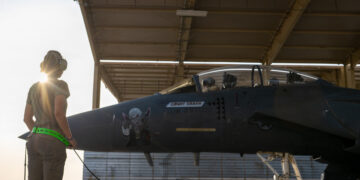
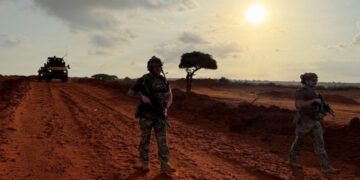

Events on Middle East