Key points
- The pledge made by NATO members to spend 5 percent of their GDP on defense by 2035 is an opportunity for the U.S. to steer its European allies toward greater security responsibilities.
- Europe still faces internal divisions and must overcome decades of dependence on the U.S. However, given its central role in the region, Washington is well-positioned to help unlock Europe’s considerable defense potential.
- To do so, American leaders will need to find the right combination of pressures and incentives to nudge their European allies toward greater responsibility. This will mean, among other things, consolidating Europe’s strategic autonomy through NATO and the EU.
- Instead of envisioning Europe as a captive market and limiting its commercial and investment opportunities in the U.S., Washington should allow its allies to protect their defense sectors and consolidate their defense companies.
- Washington should also decrease its operational presence in Europe in order to incentivize European leaders to take responsibility for their own defense.
The promise and pitfalls of NATO’s 5 percent budget pledge
Since Donald Trump returned to the White House in January 2025, U.S. officials have indicated they would “no longer tolerate an imbalanced [trans-Atlantic ] relationship which encourages dependency” and have occasionally expressed hostility toward Europe.1Defense Secretary Pete Hegseth, cited in Camille Grand, “The End of the ‘Imperial Republic’ and the Future of the Transatlantic Alliance,” Brookings Institution, June 23, 2025, https://www.brookings.edu/articles/the-end-of-the-imperial-republic-and-the-future-of-the-transatlantic-alliance/. Washington may not be able or even willing to scrap its involvement in the region, but there is strong merit to the claim that Joe Biden was America’s “last truly trans-Atlanticist president.”2Max Bergmann and Sophia Besch, “Why European Defense Still Depends on America,” Foreign Affairs, March 7, 2023, https://www.foreignaffairs.com/ukraine/why-european-defense-still-depends-america.
At the NATO summit in June 2025, the members of the trans-Atlantic alliance pledged to spend 3.5 percent of their GDP on “core” defense and 1.5 percent on associated domains such as innovation, cybersecurity, and critical infrastructure by 2035.3Lorne Cook, Mike Corder, and Molly Quell, “NATO Leaders Are Set to Agree on a Historic Defense Spending Pledge, but the Hike Won’t Apply to All,” Associated Press, June 23, 2025, https://www.ap.org/news-highlights/spotlights/2025/nato-leaders-are-set-to-agree-on-a-historic-defense-spending-pledge-but-the-hike-wont-apply-to-all/. This 5 percent pledge is no panacea and could bring new challenges. Still, it is a positive step toward strengthening Europe’s military power and guiding the trans-Atlantic relationship on a more sustainable course.
To ensure that its NATO allies build a truly combat-ready European force, the U.S. should abandon its regional hegemonic strategy and take further steps toward retrenchment. This will incentivize European leaders to address the strategic, industrial-military, and operational obstacles that have long impeded their ability to defend themselves.4Hegemony can be defined “as the ability of an actor with overwhelming capability to shape the international system through both coercive and non-coercive means”; Carla Norloff, Oxford Bibliographies (online), September 2015, https://www.oxfordbibliographies.com/display/document/obo-9780199743292/obo-9780199743292-0122.xml. Those adjustments won’t be easy, but Washington has sufficient leverage to steer Europe toward a more independent future.
A timely promise
NATO’s 5 percent budget pledge represents an acknowledgment that the trans-Atlantic relationship must become more equal. Although often strident, the Trump administration’s complaints about Europe’s free-riding reflect a structural evolution in America’s geostrategic priorities.5Maciej Bukowsi, “Europe After the U.S. Decoupling: Change or Be Damned,” CEPA, December 15, 2025, https://cepa.org/article/europe-after-the-us-decoupling-change-or-be-damned/.
NATO-Europe defense spending (2025)
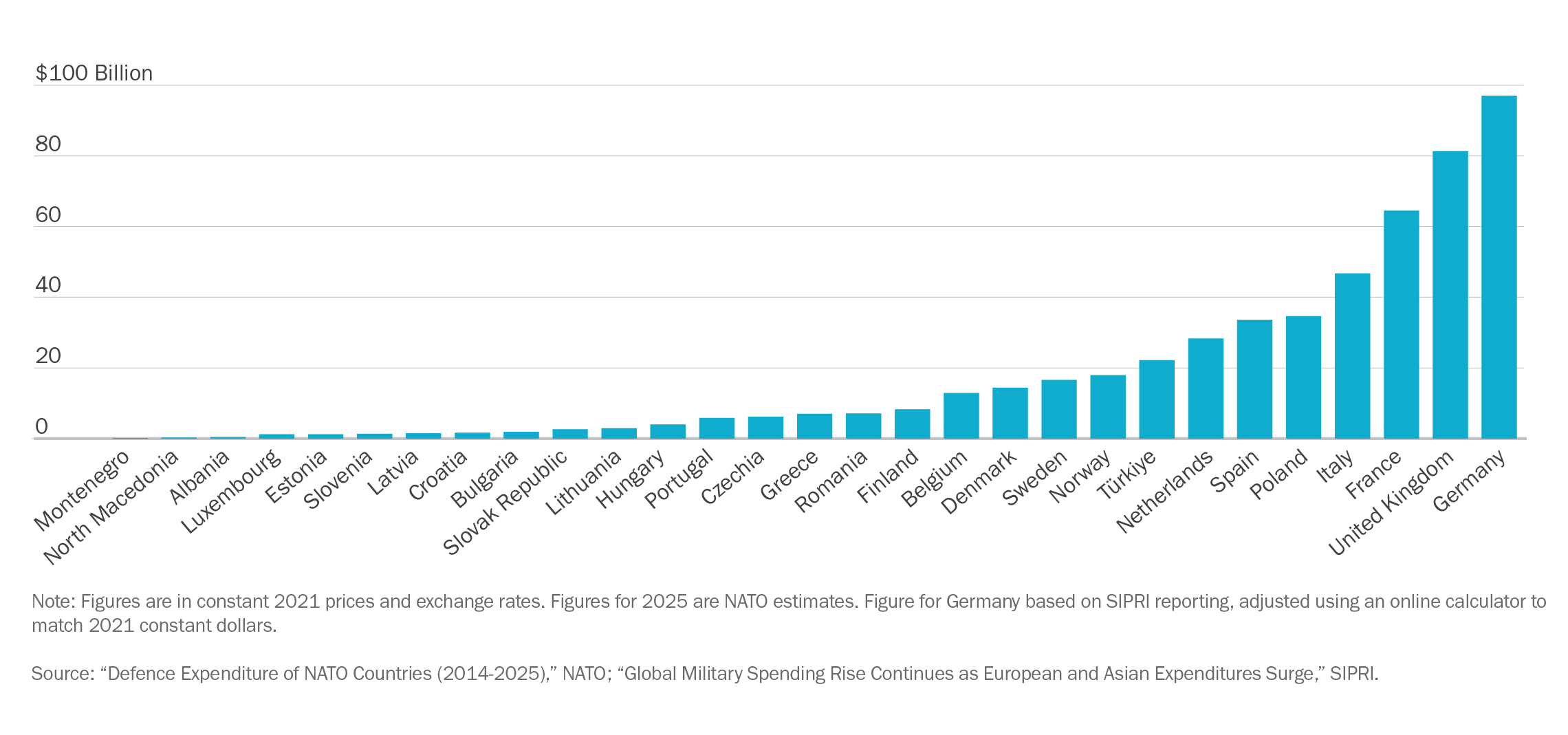
Defense spending by European nations varies widely based on size, population, geographic vulnerability, and other factors.
Washington has contributed an average of 68 percent of NATO member states’ combined defense budgets from 1960 to 2024, even though the threat of a local power dominating Europe has nearly disappeared since the break-up of the Soviet Union.6Benjamin David Giltner, “Their Own Two Feet: How Europeans Can Lead on Conventional Deterrence in Europe,” Cato Institute, October 23, 2025, 2, https://www.cato.org/sites/cato.org/files/2025-10/policy-analysis-1006-update.pdf. Europe’s share of world GDP fell from about one-third to 14 percent between 1960 and 2024.7Giltner, “Their Own Two Feet,” 2. Europe’s value as a launch pad for power projection has declined as the U.S. scaled back its armed interventions in neighboring regions.8Jennifer Kavanagh and Dan Caldwell, “Aligning Global Military Posture with U.S. Interests,” Defense Priorities, July 9, 2025, 8, https://www.defensepriorities.org/explainers/aligning-global-military-posture-with-us-interests/. Likewise, with new data-driven technologies such as AI making national power less tangible, the advantages of maintaining a heavy local presence have diminished.9Bukowski, “Europe After the U.S. Decoupling.”
This reevaluation comes amid other transformations. In recent years, growing segments of the U.S. national security community have acknowledged the costs of foreign interventionism and the need for Washington to reduce its commitments abroad as its relative power declines.10Stephen M. Walt, “It’s Not Too Late for Restrained U.S. Foreign Policy,” Foreign Policy, March 14, 2024, https://foreignpolicy.com/2024/03/14/united-states-realism-restraint-great-power-strategy/. A significant faction of the Republican Party shifted on this issue following President Trump’s “America First” slogan, but many Democrats have signaled similar inclinations.11Camille Grand, “Defending Europe with Less America,” European Council on Foreign Relations, July 2024, 5, https://ecfr.eu/wp-content/uploads/2024/07/Defending-Europe-with-less-America-v1.pdf. The Cold Warriors who remain deeply attached to Europe are being replaced by a new generation of American leaders.12Leonard Schütte, “America First, Europe Fourth,” War on the Rocks, December 4, 2025, https://warontherocks.com/2025/ 12/america-first-europe-fourth/. Domestic backing for extensive NATO commitments can thus no longer be taken for granted.13“‘Dim, If Not Dismal Future’: Gates Blasts NATO,” Associated Press, June 10, 2011, https://www.nbcnews.com/id/wbna43351604. Regardless of who replaces President Trump in January 2029, America’s involvement in European security will remain much more uncertain than it was in the pre-Trump II era.
Reducing U.S. troop levels in Europe could save up to $80 billion annually.14Barry R. Posen, “A New Transatlantic Division of Labor Could Save Billions Every Year!,” Bulletin of the Atomic Scientists, September 7, 2021, https://thebulletin.org/premium/2021-09/a-new-transatlantic-division-of-labor-could-save-billions-every-year/. Those funds could be reallocated to other security priorities—the U.S. border, the Western Hemisphere, or the Indo-Pacific—or other functions of government.15Schütte, “America First, Europe Fourth.” Such a shift could result in a smaller force structure, helping to allay the U.S. military’s growing recruitment difficulties.16Jack Detsch, “NATO Doesn’t Have Enough Troops,” Foreign Policy, April 10, 2024, https://foreignpolicy.com/2024/04/10/nato-troop-numbers-russia-ukraine-war/. Europe’s buildup would also ease the resentment Washington has long expressed toward the region’s leaders, possibly improving cooperation across the Atlantic.17On Washington’s complaints, see Peter Huessy, “The Long History of U.S. Irritation at European NATO’s Freeloading,” CEPA, February 21, 2024, https://cepa.org/article/the-long-history-of-us-irritation-at-european-natos-freeloading/; on a healthier trans-Atlantic relationship, see Benjamin Friedman, “A New NATO Agenda: Less U.S., Less Dependency,” Defense Priorities, July 8, 2024, 6, https://www.defensepriorities.org/wp-content/uploads/2024/07/DEFP_A_new_NATO_agenda.pdf.
An expanding European defense-industrial base could bring additional investment and sales opportunities for U.S. companies, helping them achieve economies of scale and mitigating Washington’s commercial deficit.18On investment opportunities, see Dalibor Rohac, “Why Europe Needs Its Defense Industry – and How the United States Can Help,” American Enterprise Institute, November 21, 2025, 10, https://www.aei.org/research-products/report/why-europe-needs-its-defense-industry-and-how-the-united-states-can-help/; on sales opportunities, see Aaron Mehta and Valerie Insinna, “Europe is Pouring Money into Defense. Can U.S. Firms Reap the Reward Amid Trans-Atlantic Tension?” Breaking Defense, June 25, 2025, https://breakingdefense.com/2025/06/europe-is-pouring-money-into-defense-can-us-firms-reap-the-reward-amid-trans-atlantic-tension/; on economies of scale and the reduction of the U.S. deficit, see Sean Monaghan, “Europe’s Trillion Dollar Opportunity to Save Ukraine. and the Free World,” Center for Strategic and International Studies, March 5, 2025, 9, https://www.csis.org/analysis/europes-trillion-dollar-opportunity-save-ukraine-and-free-world. It could offset the supply chain vulnerabilities and workforce shortages that plague the U.S. defense industrial base.19On cyber threats, see Kathryn Levantovscaia, “Pax Americana vs. Autonomy: How the U.S. and EU Defense Industrial Strategies Diverge,” Atlantic Council, April 17, 2024, https://www.atlanticcouncil.org/blogs/new-atlanticist/pax-americana-vs-autonomy-how-the-us-and-eu-defense-industrial-strategies-diverge/; on other issues, see Sophia Besch, Erik Brown, and Rafaela Uzan, “Rebalancing the Transatlantic Defense-Industrial Relationship: Regional Pragmatism in Northeastern Europe,” Carnegie Endowment for International Peace, December 2025, 2–3, https://carnegieendowment.org/research/2025/12/rebalancing-the-transatlantic-defense-industrial-relationship-regional-pragmatism-in-northeastern-europe. It might also close some trans-Atlantic technology and interoperability gaps.20Sophia Besch, “Rebooting the U.S.-EU Defense Relationship,” American-German Institute, December 22, 2021, https://americangerman.institute/publication/rebooting-the-u-s-eu-defense-relationship/. Such improvements, even if limited, could strengthen America’s and Europe’s competitiveness, resilience, and deterrence.21On competitiveness and resilience, see Kurt M. Campbell and Rush Doshi, “Underestimating China: Why America Needs a New Strategy of Allied Scale to Offset Beijing’s Enduring Advantages,” Foreign Affairs, May–June 2025, https://www.foreignaffairs.com/china/underestimating-china; “A New Transatlantic Bargain: The Case for Building a Strong European Pillar,” Harvard Kennedy School, Belfer Center, February 2025, 9, https://www.belfercenter.org/transatlantic-bargain; Paul Soler, “Defence Industry Warns EU to ‘Urgently’ Curb Dependence on Key Raw Materials,” Euronews, October 14, 2025, https://www.euronews.com/my-europe/2025/10/14/defence-industry-warns-eu-to-urgently-curb-dependence-on-key-raw-materials; on the consequences of deterrence, see Balazs Marko, “Deterrence and Industrial Wars of Attrition,” SSRN Papers, July 22, 2025, 1–33, https://papers.ssrn.com/sol3/papers.cfm?abstract_id=5361410.
Can Europe’s NATO members meet the 5 percent threshold?
There is no guarantee that European leaders will fulfill their new budget commitments. The 3.5+1.5 percent threshold is a significant step up from the 2 percent that NATO’s members committed to after Russia’s annexation of Crimea in 2014.22“Defence Expenditures and NATO’s 5% Commitment,” NATO, updated December 18, 2025, https://www.nato.int/en/what-we-do/introduction-to-nato/defence-expenditures-and-natos-5-commitment/. It is also higher than the 3 percent they maintained on average during the Cold War.23Giltner, “Their Own Two Feet,” 2. It’s a high bar even for the United States, as President Trump himself acknowledged.24Paul McLeary, “Trump Says U.S. Doesn’t Have to Meet NATO Spending Goal,” Politico, June 20, 2025, https://www.politico.com/news/2025/06/20/trump-says-the-us-doesnt-have-to-meet-nato-spending-goal-00416154.
Europe faces serious domestic challenges, which might hamper large hikes in defense spending. Its GDP growth has nearly stagnated since the 2008 financial crisis.25Jared Cohen, “The Future of European Defense,” Goldman Sachs, June 30, 2025, 3, https://www.goldmansachs.com/insights/articles/the-future-of-european-defense. Having built its competitiveness on free trade and multilateralism, the EU has suffered from the decline of multilateralism over the past decade.26Leonard Schuette and Hylke Dijkstra, “The Show Must Go On: The EU’s Quest to Sustain Multilateral Institutions Since 2016,” Journal of Common Market Studies, vol. 61, issue 5 (2023): 1319, https://doi.org/10.1111/jcms.13466. Its industrial productivity and innovation are falling behind the U.S. and China.27Nick Smith, “Rearming Europe: Political Legitimacy Through War,” Phenomenal World, July 10, 2025, https://www.phenomenalworld.org/analysis/rearming-europe/. In 2024, the average national public debt across the eurozone was 88 percent.28Rohac, “Why Europe Needs Its Defense Industry,” 6. Pressure on local welfare systems has intensified, largely due to austerity policies, a rapidly aging population, the COVID-19 pandemic, and the Russia-Ukraine war.29On austerity, see Smith, “Rearming Europe”; on demographic aging, see Luigi Scazzieri, “Towards an EU ‘Defence Union,’” Center for European Reform, January 2025, 12, https://www.cer.eu/sites/default/files/pb_LS_defence_union_29.1.25.pdf; on other factors, see Elizabeth Krecké, “Competing Models for the Future of Welfare in Europe,” Geopolitical Intelligence Services, January 15, 2026, https://www.gisreportsonline.com/r/future-of-welfare-europe/
The situation may worsen if European states double down on their military buildup. Although some studies suggest that increased defense spending can boost economic growth, most research shows it yields weaker positive externalities than other investments (i.e., healthcare and education).30Smith, “Rearming Europe”; Dimitri Zurstrasse, “Military Unification: A Critical Juncture for European Defense Policy,” Phenomenal World, July 30, 2025, https://www.phenomenalworld.org/analysis/military-unification/. It may even undermine those investments and raise national debt.31On the decline of public investments, see Damian Tobin, “NATO Leaders Pledge Increased Defense Spending – Is This Really the Price for Peace and Prosperity?,” The Conversation, June 30, 2025, https://theconversation.com/nato-leaders-pledge-increased-defence-spending-is-this-really-the-price-for-peace-and-prosperity-255989; on national debt, see Smith, “Rearming Europe.”
Rising defense spending remains relatively unpopular when it comes at the expense of health and education budgets.32Ivan Krastev and Mark Leonard, “The Meaning of Sovereignty: Ukrainian and European Views of Russia’s War on Ukraine,” European Council on Foreign Relations, July 2024, 29, https://ecfr.eu/wp-content/uploads/2024/07/The-meaning-of-sovereignty-Ukrainian-and-European-views-of-Russias-war-on-Ukraine-v2.pdf. Europe’s economic struggles and austerity measures could thus weaken public support for a defense buildup, especially since European citizens were not consulted about NATO’s 5 percent pledge.33Mihail Evans, “Is Russia Really a Threat to Europe? Debunking Rutte’s Claims,” Center for International Relations and Sustainable Development, 2025, https://www.cirsd.org/en/horizons/horizons-summer-2025–issue-no-31/is-russia-really-a-threat-to-europe.
European leaders also have a history of underdelivering. For example, in 2024, only 21 of Europe’s 30 NATO members met the 2 percent defense spending threshold pledged a decade earlier. That number would have been much lower had Russia not invaded Ukraine.34Cooke, Corder, and Quell, “NATO Leaders Are Set to Agree on a Historic Defense Pledge.” EU states still devoted only 1.9 percent of their GDP to defense on average in 2024.35Rohac, “Why Europe Needs Its Defense Industry,” 4. Additionally, many of Europe’s leading powers were just above the target (e.g., the UK and France), right below it (e.g., Germany), or far below it (e.g., Italy and Spain).36an Tian, Lorenzo Scarazzato, and Jade Guiberteau Ricard, “NATO’s New Spending Target: Challenges and Risks Associated with a Political Signal,” SIPRI, June 27, 2025, https://www.sipri.org/commentary/essay/2025/natos-new-spending-target-challenges-and-risks-associated-political-signal.
NATO’s 5 percent budget target could reflect political deceit. The pledge, introduced by Secretary-General Mark Rutte to appease Washington, allowed President Trump to claim “a monumental win” and Europe to keep the U.S. engaged with little near-term accountability.37On Rutte’s input, see Vu Lam, “NATO’s 5% Pledge and the Quiet Drift from the Indo-Pacific,” Lowy Institute, July 2, 2025, https://www.lowyinstitute.org/the-interpreter/nato-s-5-pledge-quiet-drift-indo-pacific; on Trump’s claim, see Victor Jack, Chris Lunday, and Laura Kayali, “NATO Clinches Defense Spending Deal in Big Win for Trump,” Politico, June 25, 2025, https://www.politico.eu/article/nato-defense-spending-deal-win-us-donald-trump/; on European leaders, see Mark John, “Europe Placates Trump with NATO Pledges It Can Ill Afford,” Reuters, June 25, 2025, https://www.reuters.com/business/aerospace-defense/europe-placates-trump-with-nato-pledges-it-can-ill-afford-2025-06-25/. NATO’s 2025 summit statement did not specify that the 5 percent pledge would apply to “all allies.”38Lam, “NATO’s 5% Pledge.” Equally intriguing, the 2029 progress review falls just after the end of Trump’s second term, potentially leaving the door open for renegotiation.39Kristen Taylor, “How NATO Nations Need to Sell the 5 Percent Spending Hike to Their Own People,” Breaking Defense, August 13, 2025, https://breakingdefense.com/2025/08/how-nato-nations-need-to-sell-the-5-%-spending-hike-to-their-own-people/.
How much is 5 percent really worth?
The impact of NATO’s budget pledge might still be limited, even if members fulfill it. The 5 percent threshold could be misleading from a financial standpoint. The 1.5 percent allocated to other security areas cannot bolster Europe’s capabilities as much as the 3.5 percent allocated to “core” defense. Additionally, given the loopholes that pervade the process, some countries may resort to “creative accounting” to meet their spending requirements.40Justina Budginaite-Froehly, LeAnne Noelani Howard, and Timo S. Koster, “NATO’s Spending Pledge is no Invitation for Creative Accounting,” Atlantic Council, November 21, 2025, https://www.atlanticcouncil.org/commentary/op-ed/natos-spending-pledge-is-no-invitation-for-creative-accounting/. More fundamentally, a state’s defense budget, measured as a share of GDP, may be heavily distorted by variations in that state’s economic output. Stagnant military expenditures can look deceptively strong in relative terms during periods of recession—and vice versa.41Friedman, “A New NATO Agenda,” 6.
Even if European defense budgets rise significantly in both absolute and relative terms, the region still has a long way to go. Its historical prioritization of healthcare, pensions, and education led to an overall shortfall of approximately €1.1 trillion relative to NATO’s 2 percent threshold from 2006 to 2020.42Scazzieri, “Towards an EU ‘Defence Union,’” 4. Even after accounting for its post-Ukraine war buildup, Europe’s combined defense spending increased by only 50 percent from 2000 to 2023, whereas China, Russia, and (from a much larger base) the U.S. implemented increases of 596 percent, 360 percent, and 60 percent, respectively.43Grand, “Defending Europe with Less America,” 8. Thus, NATO’s 5 percent target is unlikely to bridge the gap between the two sides of the Atlantic.44Kristi Raik, Marcin Terlikowski, and Mario Baumann, “Beyond Burden Sharing: Conceptualizing the European Pillar of NATO,” German Council on Foreign Relations, June 17, 2025, 6–7, https://dgap.org/en/research/publications/beyond-burden-sharing-conceptualizing-european-pillar-nato. This will be especially true if President Trump’s envisioned 66 percent increase in the U.S. defense budget for next year is enacted, even in part.45rin D. Dumbacher and Michael C. Horowitz, “Trump’s $1.5 Trillion Defense Budget Should Not Come as a Surprise,” Council on Foreign Relations, January 9, 2026, https://www.cfr.org/expert-brief/trumps-15-trillion-defense-budget-should-not-come-surprise?utm_medium=social_owned&utm_source=li.
Europe’s combat capability limitations could persist even if it closes the spending gap durably. The region’s legacy of underspending is compounded by the fact that, until recently, its defense investments prioritized humanitarian interventions, counterinsurgency, and counterterrorism over traditional military capabilities.46Bergmann and Besch, “Why European Defense Still Depends on America.” Moreover, European states could fail to correct their ineffective defense spending patterns, leading to additional delays, waste, and poor decisions.47On their ineffectiveness, see Max Bergmann, “NATO’s ‘Brain Death’ in The Hague,” Center for Strategic and International Studies, June 25, 2025, https://www.csis.org/analysis/natos-brain-death-hague; on the consequences of their ineffectiveness, see Alex Burilkov et al., “Fit for War By 2030? European Rearmament Efforts vis-a-vis Russia,” Kiel Institute and Bruegel, June 2025, 13, https://www.kielinstitut.de/fileadmin/Dateiverwaltung/IfW-Publications/fis-import/eef51261-68bf-4883-b1e9-ed0fb74a92ed-Kiel_Report_no3.pdf. More fundamentally, focusing on share-of-GDP ratios risks diverting attention from a rigorous evaluation of each country’s defense needs.48Friedman, “A New NATO Agenda,” 6. Those ratios do not address intra-European differences either. As such, because NATO’s 5 percent pledge applies to a group of states, their respective investments might lack coherence at the regional level, especially since each European alliance member has a distinct set of strategic, industrial-military, and operational preferences.49On the question of coherence, see Max Bergmann and Otto Svendsen, “How Europe Can Defend Itself with Less America,” Center for Strategic and International Studies, October 2025, 21, https://csis-website-prod.s3.amazonaws.com/s3fs-public/2025-10/251008_Bergmann_Europe_America.pdf?VersionId=gU.6G8PzLlwKppQ7OW6zqIzXdGXYiQ.f; on intra-European differences, see Hugo Meijer and Stephen G. Brooks, “Illusions of Autonomy: Why Europe Cannot Provide for Its Security if the United States Pulls Back,” International Security, vol. 45, no. 4 (Spring 2021): 15–23, https://doi.org/10.1162/isec_a_00405.
An encouraging starting point
Although the 5 percent budget pledge is full of ambiguities, it can still significantly improve European combat capabilities. Since the first Trump presidency and Russia’s invasion of Ukraine, European leaders have increasingly discussed strategic autonomy.50Antoine Cibirski, “Has Europe’s Hour Come?” Fondation Robert Schuman, March 20, 2022, https://www.robert-schuman.eu/en/european-issues/0625-has-europe-s-hour-come. These discussions have gained momentum as questions about the reliability of the U.S. conventional and nuclear deterrents have intensified.51On conventional aspects, see Sophia Besch and Erik Brown, “Who’s Going to Unite Europe on Defense?,” Carnegie Endowment for International Peace, March 21, 2025, https://carnegieendowment.org/emissary/2025/03/europe-defense-plan-ukraine-white-paper-rearm?lang=en; on nuclear issues, see Zuzanna Gwadera, “U.S. Allies Question Extended Deterrence Guarantees, But Have Few Options,” International Institute for Security Studies, March 20, 2025, https://www.iiss.org/online-analysis/military-balance/2025/03/us-allies-question-extended-deterrence-guarantees-but-have-few-options/. European leaders have increasingly worried that Washington could try to coerce them by halting intelligence-sharing or withholding spare parts, maintenance services, software updates, or data transfers necessary to operate American weapon systems.52Ellen Francis, Missy Ryan, and Michael Birnbaum, “Trump Turbulence Leads Allies to Rethink Reliance on U.S. Weapons,” Washington Post, March 23, 2025, https://www.washingtonpost.com/world/2025/03/23/europe-us-weapons-dependence-trump/.
Admittedly, the concept of strategic autonomy remains debated.53Paola Tamma, “Europe Wants ‘Strategic Autonomy’—It Just Has to Decide What That Means,” Politico, October 15, 2020, https://www.politico.eu/article/europe-trade-wants-strategic-autonomy-decide-what-means/. While some define it as taking on greater responsibilities in support of the West, others interpret it as a hedge against a potential U.S. withdrawal from Europe, or as a first step toward fulfilling the EU’s “potential as a global power.”54Daniel Fiott, “Strategic Autonomy: Towards ‘European Sovereignty’ in Defence?” European Union Institute for Security Studies, November 2018, 1–8, https://www.iss.europa.eu/sites/default/files/EUISSFiles/Brief%2012__Strategic%20Autonomy.pdf. However, all these definitions share a common horizon aligned with NATO’s 5 percent budget pledge: equipping Europe with the tools necessary to reduce its dependence on America.
Many European leaders now acknowledge that defending the region is their responsibility.55“Speech by President Von Der Leyen at the European Parliament Plenary Debate on the Conclusions of the European Council Meeting,” July 8, 2025, https://ec.europa.eu/commission/presscorner/detail/es/speech_25_1777. European leaders have committed to becoming Ukraine’s primary providers of military aid.56“Europe Remains Dangerously Reliant on American Arms,” The Economist, January 24, 2026, https://www.economist.com/europe/2026/01/24/europe-remains-dangerously-reliant-on-american-arms. The EU’s March 2022 Strategic Compass was its first ever “shared assessment of geopolitical threats.”57Paul Alvarez-Couceiro Fernandez, “Europe at a Strategic Disadvantage: A Fragmented Defense Industry,” War on the Rocks, April 18, 2023, https://warontherocks.com/2023/04/europe-at-a-strategic-disadvantage-a-fragmented-defense-industry/. Despite ongoing rivalry, mistrust, and legal and political barriers, NATO and the EU have deepened their collaboration at both the staff and senior levels.58Grand, “Defending Europe with Less America,” 14. More broadly, the fact that the European construction process has always been “forged in crisis” suggests that the region’s governments and militaries could make more breakthroughs in integration if push came to shove.59Jean Monnet, cited in Emma Ashford and MacKenna Rawlins, “American Roulette: Scenarios for U.S. Retrenchment and the Future of European Defense,” Stimson Center, July 8, 2024, https://www.stimson.org/2024/american-roulette-scenarios-for-us-retrenchment-and-the-future-of-european-defense/.
This commitment has begun to take shape. Defense spending by European NATO members rose to $516 billion in 2025, up significantly over the previous year.60“Defence Expenditure of NATO Countries (2014-2025),” NATO, https://www.nato.int/content/dam/nato/webready/documents/finance/def-exp-2025-en.pdf. In March 2025, the EU launched the ReArm Europe Plan/Readiness 2030 program to boost combined defense spending by $800 billion through measures such as easing the bloc’s 3 percent deficit rule and 60 percent debt-to-GDP rule.61Smith, “Rearming Europe.” The EU’s SAFE initiative, released that same month, includes a €150 billion loans-for-joint-procurement mechanism.62Guntram B. Wolff, Armin Steinbach, and Jeromin Zettelmeyer, “The Governance and Funding of European Rearmament,” Bruegel, April 7, 2025, 10–11, https://www.bruegel.org/policy-brief/governance-and-funding-european-rearmament. This effort echoes the March 2024 European Defense Industrial Strategy, which aims for intra-regional trade to constitute at least 35 percent of the bloc’s defense market by 2030.63“First Ever Defence Industrial Strategy and a New Defence Industry Programme to Enhance Europe’s Readiness and Security,” European Commission, March 4, 2024, https://ec.europa.eu/commission/presscorner/detail/en/ip_24_1321.
NATO-Europe’s defense spending in aggregate (2024–2025)
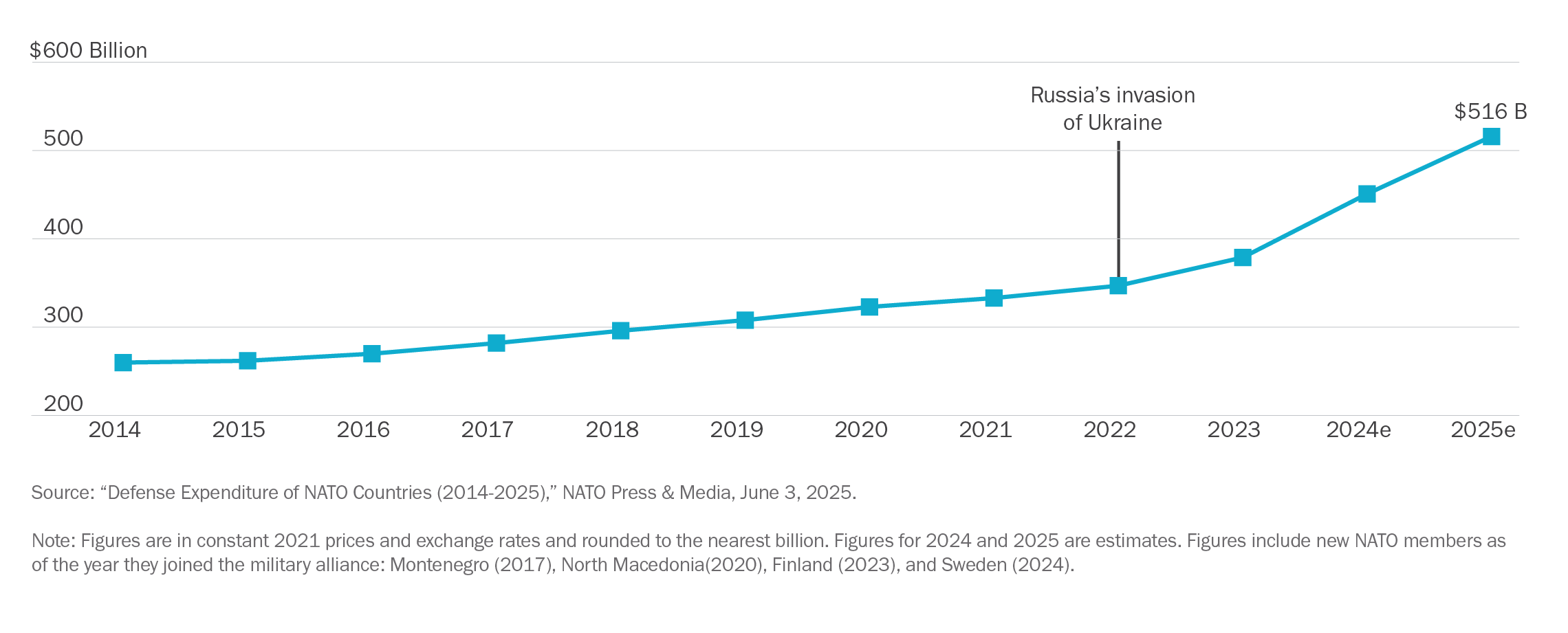
Though stagnant for years amid reliance on the U.S., Europe’s defense budgets have significantly increased since the war in Ukraine began.
Europe has the potential to deliver. With a GDP of about $19 trillion in 2024 (compared to Russia’s $2 trillion) and a population of 449 million people (compared to Russia’s 145 million), the European Union remains an economic and demographic giant capable of sustaining a military buildup.64Agnia Grigas, “Europe Has the Resources to Defend Itself and Back Ukraine against Russia,” Atlantic Council, March 4, 2025, https://www.atlanticcouncil.org/blogs/ukrainealert/europe-has-the-resources-to-defend-itself-and-back-ukraine-against-russia/. Including the UK, Turkey, Ukraine, and Norway, Europe has 28 companies among the top 100 defense firms by revenue worldwide (17 are in the EU).65Jan Joel Andersson and Malena Britz, “The European Union’s role in European Defence Industry Policy,” Defence Studies, vol. 25, issue 2 (2025): 325, https://doi.org/10.1080/14702436.2025.2472694. Its output quality surpasses that of the U.S. in niche areas such as main battle tanks and conventional submarines.66“The Future of European Competitiveness: Part A: A Competitiveness Strategy for Europe,” European Commission, September 2024, 59, https://commission.europa.eu/document/download/97e481fd-2dc3-412d-be4c-f152a8232961_en. Even if European states do not ultimately meet NATO’s 5 percent threshold or fully optimize their defense spending, making a serious effort to do so would strengthen European defense.67Alexander Panetta, “‘Shock and Awe’: Trump Moves Faster Than Last Time to Impose Agenda,” CBC News, January 29, 2025, https://www.cbc.ca/news/world/trump-early-orders-analysis-1.7444144.
America’s role in Europe’s strategic dependence
To succeed, NATO’s 5 percent efforts must be based on a clear understanding of the factors that have hampered Europe’s defense. While those challenges originate in the European construction process, U.S. leaders have consistently leveraged their central role in the region to perpetuate Europe’s dependence on Washington.
Internal obstacles to a European defense renaissance
Building on the trauma of World War II, European leaders have long envisioned international politics as “an ever-extending process of peaceful discussion, production and exchange” where the use of force would become illegitimate and irrelevant.68Alexis Carré, “Europeans Have Weapons but Aren’t Warriors,” Foreign Policy, December 4, 2022, https://foreignpolicy.com/2022/12/04/europeans-have-weapons-but-arent-warriors/. At the same time, concerns about national sovereignty, a desire for “democratic accountability,” and fear of supranational overreach have incentivized European states to limit the EU’s defense powers.69On sovereignty and democracy, see Zurstrassen, “Military Unification”; on fear of supranationalism, see Scazzieri, “Towards an EU ‘Defence Union,’” 2.
National divisions compound those challenges. European countries exhibit a wide variety of “leadership styles, degrees of risk tolerance, and approaches to governance.”70Rob Murray, “Europe and the United States Need to Revolutionize Their Defense Industrial Bases—and How They Cooperate,” Atlantic Council, December 10, 2024, https://www.atlanticcouncil.org/in-depth-research-reports/report/europe-and-the-united-states-need-to-revolutionize-their-defense-industrial-bases-and-how-they-cooperate/. Each military is guided by unique strategic, bureaucratic, and corporate interests.71Barry R. Posen, “Europe Can Defend Itself,” Survival, vol. 62, no. 6 (January 2021): 10, https://doi.org/10.1080/00396338.2020.1851080. And while most EU states are NATO members, the bloc includes a few neutral countries.72Scazzieri, “Towards an EU ‘Defence Union.’” 11.
European leaders often struggle to unite, as shown by their recurrent debates over how to prioritize threats like Russia, terrorism, and illegal immigration, and by their failure to reach consensus on China.73Meijer and Brooks, “Illusions of Autonomy,” 15–23; Duncan Bartlett, “European Countries Struggle to Align on China,” China Project, May 1, 2023, https://thechinaproject.com/2023/05/01/european-countries-struggle-to-align-on-china/. Although the Ukraine war has heightened concerns about Moscow, divisions remain, as illustrated by the persistent contrast between Eastern European states that spend heavily on defense to compensate for their proximity to Russia, and the region’s major powers that benefit from greater distance (i.e., Germany and France) and, in some cases, protective mountain ranges (e.g., Italy and Spain).74 On Eastern European states, see Bergmann and Svendsen, “How Europe Can Defend Itself with Less America,” 16; on Germany and France, see Hanna Duggal and Reuters, “NATO Countries’ Budgets Compared: Defence vs Healthcare and Education,” Al Jazeera, June 25, 2025, https://www.aljazeera.com/news/2025/6/25/nato-countries-budgets-compared-defence-vs-healthcare-and-education; on Italy and Spain, see Mike Sweeney, “How Would Europe Defend Itself?” Defense Priorities, April 11, 2023, 9–10, https://www.defensepriorities.org/wp-content/uploads/2024/02/DEFP_How_would_Europe_defend_itself.pdf.
Rivalries exacerbate the problem. European states are reluctant to share sensitive information with one another.75Besch and Brown, “Who’s Going to Unite Europe on Defense?” Their support for the EU depends on how much they can gain from collective defense relative to other members.76Besch and Brown, “Who’s Going to Unite Europe on Defense?” France’s efforts to promote strategic autonomy have often been perceived by other nations as an attempt to use European resources to boost Paris’s influence.77Anchal Vohra, “‘Strategic Autonomy’ is a French Pipe Dream,” Foreign Policy, July 3, 2023, https://foreignpolicy.com/2023/07/03/strategic-autonomy-is-a-french-pipe-dream/. Rivalries also exist within EU institutions, as illustrated by disputes over bureaucratic appointments and clashes between the European Commission and European Council.78On appointments, see Gregorio Sorgi, Giovanna Coli, and Lucia MacKenzie, “A Viking Funeral? Dwindling Nordics in Brussels Blame the EU,” Politico, August 23, 2023, https://www.politico.eu/article/european-union-staff-national-representation-nordic-scandinavia-sweden-finland-denmark-quotas-blue-book-traineeship/; on the European Commission and the European Council, see Suzanne Lynch, “Europe’s Odd Couple: The Dysfunctional Relationship at the Heart of the EU,” Politico, November 10, 2022, https://www.politico.eu/article/ursula-von-der-leyen-charles-michel-europe-eu-g20-summit-european-council-commission/.
These fractures have generated considerable strategic incoherence. In most areas of foreign policy and defense, there is no such thing as a true European policy but a patchwork of national policies.79Jordy Geerlings, “Why Europe Never Seems to Speak with One Voice on the World Stage,” Substack, January 20, 2024, https://jordygeerlings.substack.com/p/why-europe-never-seems-to-speak-with?utm_campaign=post&utm_medium=web. These divisions often lead to contradictions, redundancies, missed opportunities, and wasted resources. This has enabled Russia and China to use divide-and-rule tactics that have further weakened Europe’s defense.80On China, see Abishur Prakash, “How Xi’s Visit Exposed the Split in Europe over China,” South China Morning Post, May 15, 2024, https://www.scmp.com/opinion/world-opinion/article/3262540/how-xis-visit-exposed-split-europe-over-china; on Russia, see Sijbren de Jong, “Confuse, Divide and Rule: How Russia Drives Europe Apart,” Institute for European Studies, March 18, 2016, https://hcss.nl/news/confuse-divide-and-rule-how-russia-drives-europe-apart/.
NATO-Europe defense spending increases (2021–2025)
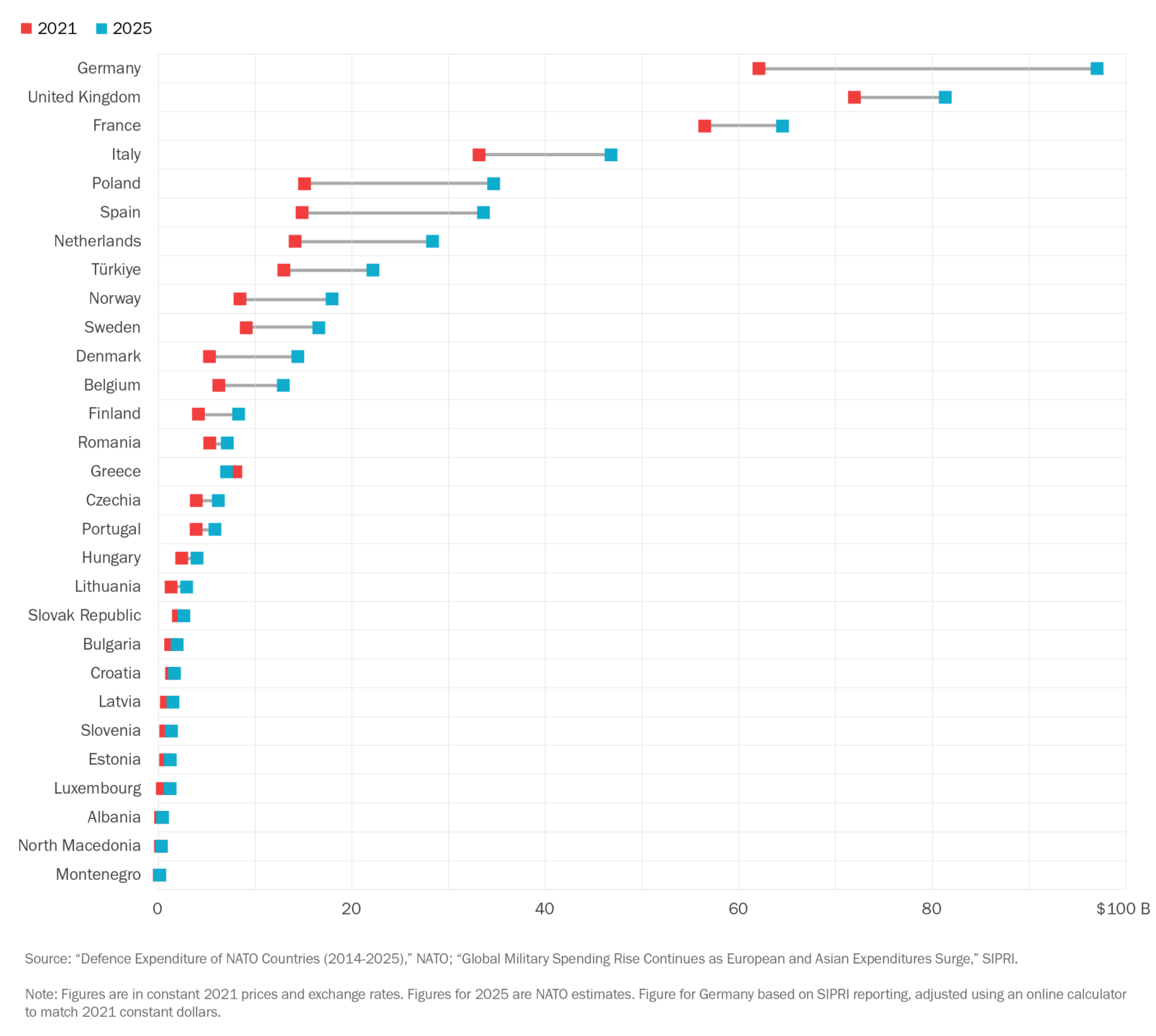
The war in Ukraine has significantly catalyzed defense spending in European countries, though some have increased their budgets more than others.
America’s misguided ambition to use NATO to control Europe
The U.S. isn’t the root cause of Europe’s defense issues, but it has long leveraged NATO to maintain control over the region and prevent challenges to its authority. American leaders initially sought to reduce their post-World War II military presence and even supported the creation of a European army in the mid-1950s.81Joshua Byun, “Stuck Onshore: Why the United States Failed to Retrench from Europe During the Early Cold War,” Texas National Security Review, vol. 7, issue 4 (Fall 2024): 11, https://doi.org/10.26153/tsw/56030. However, after this project fell apart, amid the Soviet threat and Europe’s divisions, Washington gradually realized that underwriting the region’s security gave it significant leverage.82On the failure of the European Army, see Byun, “Stuck Onshore,” especially 28–33; on America’s strategic reorientation, see John M. Schuessler and Joshua R. Shifrinson, “The Shadow of Exit from NATO,” Strategic Studies Quarterly (Fall 2019), 44, https://www.airuniversity.af.edu/Portals/10/SSQ/documents/Volume-13_Issue-3/Schuessler.pdf. Despite frequent complaints about allied free-riding, it kept a large troop presence in Europe and undermined any supranational European initiative.83Christopher Layne, The Peace of Illusions: American Grand Strategy from 1940 to Present (Ithaca, NY: Cornell University Press, 2006), 71–117.
After the Cold War, American leaders committed to precluding “any hostile power from dominating [the] region.”84William Burr, “Prevent the Reemergence of a New Rival: The Making of the Cheney Regional Defense Strategy, 1991–1992,” National Security Archives, February 26, 2008, https://nsarchive2.gwu.edu/nukevault/ebb245/. Perpetuating Europe’s dependence would help prevent any local challenge to U.S. leadership, secure new markets, and project American military power into neighboring regions.85On U.S. perceptions of the EU as a potential rival, see “Excerpts from the Pentagon’s Plan: ‘Prevent the Reemergence of a New Rival,’” New York Times, March 8, 1992, https://www.nytimes.com/1992/03/08/world/excerpts-from-pentagon-s-plan-prevent-the-re-emergence-of-a-new-rival.html; see also Friedman, “A New NATO Agenda,” 2; on the benefits for U.S. companies, see Rajan Menon and William Ruger, “NATO Enlargement and U.S. Grand Strategy: A Net Assessment,” International Politics, vol. 57, issue 3 (2020): 372, https://doi.org/10.1057/s41311-020-00235-7; on the projection of U.S. military power, see Raik, Terlikowski, and Bauman, “Beyond Burden Sharing,” 3. These factors motivated Washington’s push for NATO’s expansion and opposition to European-led diplomatic and security structures.86Joshua R. Itzkowitz Shifrinson, “Deal or No Deal? The End of the Cold War and the U.S. Offer to Limit NATO Expansion,” International Security, vol. 40, no. 4 (Spring 2016): 37–40, doi:10.1162/ISEC_a_00236; James M. Goldgeier, Not Whether but When: The U.S. Decision to Enlarge NATO (Washington, D.C.: Brookings Institution Press, 1999), 135–136. They also explain its insistence that the EU focus on economics and that Brussels’ nascent defense initiatives not lead to “decoupling, duplication, and discrimination” within NATO.87On the EU’s economic focus, see Juan Garcia-Nieto, “With Friends Like These: How the United States Can Foster the European Union’s Strategic Autonomy,” John Quincy Adams Society, Fall 2022, 4–5, https://jqas.org/wp-content/uploads/2023/03/Garcia-Analysis.pdf; on U.S. pressures, see Max Bergmann et al., “Transforming European Defense,” Center for Strategic and International Studies, August 2022, 6–7, https://www.csis.org/analysis/transforming-european-defense. As in the past, those policies heavily relied on political interference and divide-and-rule tactics.88Hajnalka Vincze, “Right Assessment, Wrong Tactics: Europe in the New National Security Strategy,” Foreign Policy Research Institute, December 17, 2025, https://www.fpri.org/article/2025/12/right-assessment-wrong-tactics-europe-in-the-new-national-security-strategy/; Max Bergmann et al., “Transforming European Defense,” 6.
Although Donald Trump questioned Washington’s role in European security and threatened to leave NATO during his first presidential term, his administration was generally consistent in supporting U.S. activities within the Western alliance.89On Trump’s NATO threats, see Veronica Stracqualursi and Jim Acosta, “New York Times: Trump Raised Withdrawing the U.S. from NATO Several Times in 2018,” CNN, January 16, 2019, https://edition.cnn.com/2019/01/15/politics/trump-nato-us-withdraw; on the first Trump administration’s actual policies, see James Sperling and Mark Webber, “Trump’s Foreign Policy and NATO: Exit and Voice,” Review of International Studies, vol. 45, issue 3 (2019): 523–525, https://doi.org/10.1017/S0260210519000123. Trump treated NATO as a network of “bilateral security commitments” to maximize leverage over each European state.90Linde Desmaele, Europe’s Evolving Role in U.S. Grand Strategy: Indispensable or Insufferable (New York: Routledge, 2024), 136. He opposed the EU’s efforts at defense integration even more fiercely than his predecessors.91Desmaele, Europe’s Evolving Role in U.S. Grand Strategy, 132–133.
Though it adopted a friendlier approach, the Biden administration leveraged Russia’s invasion of Ukraine to reaffirm the U.S. preponderance in Europe. This involved renewed investment in NATO, support for Finland’s and Sweden’s NATO entries, massive military aid to Kyiv, skyrocketing arms sales to European states, and a growing troop presence near Russia.92Bergmann and Besch, “Why European Defense Still Depends on America.” Meanwhile, despite occasional expressions of support, it remained ambivalent about EU strategic autonomy and sought to protect Washington’s status as the region’s key security guarantor.93On Washington’s ambivalence, see Max Bergmann, “Europe on Its Own: Why the United States Should Want a Better-Armed EU,” Foreign Affairs, August 22, 2022, https://www.foreignaffairs.com/europe/europe-its-own; on Washington’s concrete measures, see Max Bergmann, “Trump Needs a Plan to Get Europeans to Step Up on Defense,” Center for Strategic and International Studies, January 31, 2025, https://www.csis.org/analysis/trump-needs-plan-get-europeans-step-defense.
European leaders, despite much rhetoric to the contrary, never seriously sought to alter this arrangement, which allowed them to shift costs and advance regional integration while maintaining access to Congress and the White House.94On the security and economic benefits for Europe, see Michael John Williams, “No Exit: Why U.S. Policy on Europe is Counterproductive and What to Do About It,” International Politics, vol. 62 (2025): 1112–1113, https://doi.org/10.1057/s41311-025-00719-4; on access to U.S. leaders, see G. John Ikenberry, Liberal Leviathan: The Origins, Crisis, and Transformation of the American World Order (Princeton: Princeton University Press, 2011). Despite occasional tensions, renewed U.S. gestures often sufficed to revive their “complacency.”95Bergmann, “Trump Needs a Plan.” This pattern has persisted in recent years. Indeed, despite the boost from Russia’s invasion of Ukraine, European strategic autonomy again lost momentum after February 2022.96Bergmann and Besch, “Why European Defense Still Depends on America.”
Roots of Europe’s industrial-military struggles
Flawed government policies have long hindered Europe’s defense-industrial potential. Chronic underinvestment has severely harmed local production capacity.97Cohen, “The Future of European Defense,” 2. Despite its buildup after the Ukraine war, Europe’s defense sector still faces uncertain long-term demand.98Marco Centrone and Meenakshi Fernandes, “Improving the Quality of European Defence Spending,” European Parliamentary Research Service, November 2024, 2, https://www.europarl.europa.eu/RegData/etudes/STUD/2024/762855/EPRS_STU(2024)762855_EN.pdf. Similarly, intra-EU public R&D investments in defense remain insufficient, amounting to only €11 billion in 2023.99“Defence Data 2023-2024,” European Defence Agency, 2024, 3, https://eda.europa.eu/docs/default-source/brochures/1eda—defence-data-23-24—web—v3.pdf.
A lack of private funding has prevented European companies from bridging the gap between basic research and industrial innovation, rewarding risk-taking, mitigating the unpredictability of public contract allocations, and rapidly scaling up production.100On the gap between basic research and prototyping, see William D. Bonvillian, Pioneering Progress: American Science, Technology, and Innovation Policy (Cambridge, MA: MIT University Press, 2024), 81–97; on scaling and financial resilience, see Fraser Clark and Ieva Miyares, “Private Capital in European Defence: From Peripheral Sector to Strategic Imperative,” Deloitte UK, November 11, 2025, https://www.deloitte.com/uk/en/Industries/defense-security-justice/perspectives/private-capital-in-european-defence.html. Banks, which provide most funding to European companies, are risk-averse.101On their risk aversion, see Rohac, “Why Europe Needs Its Defense Industry,” 7; on their lack of interest in the security sector, see Besch, Brown, and Uzan, “Rebalancing the Transatlantic Defense-Industrial Relationship,” 5. Europe’s financial markets, which are far less developed than in the U.S., lack “depth and liquidity.”102Cohen, “The Future of European Defense,” 3. Strict Environmental, Social, and Governance (ESG) standards and a widespread belief that supporting the defense sector is “unethical” have also taken a toll.103Scazzieri, “Towards an EU ‘Defence Union,’” 14 This shortage of European financial capital has enabled U.S. companies to attract European talent.104Cohen, “The Future of European Defense,” 3. It has also helped U.S. investors dominate FDI inflows into EU tech sectors.105Alina Polyakova and Matthew Eitel, “On Tech, the EU Doesn’t Speak for Europe,” Politico, May 29, 2023, https://www.politico.eu/article/on-tech-the-eu-doesnt-speak-for-europe/; see also Daniel Michaels, “Military Tech Companies, Long Snubbed in Europe, Are Having a Moment,” Wall Street Journal, October 23, 2025, https://www.wsj.com/business/entrepreneurship/military-tech-companies-long-snubbed-in-europe-are-having-a-moment-0ffb2cf0?mod=author_content_page_1_pos_31.
Intra-regional fragmentation remains pervasive. European states have maintained separate regulations, export controls, and IP restrictions.106For examples, see Oleksandr V. Danylyuk and Jack Watling, “Winning the Industrial War: Comparing Russia, Europe and Ukraine, 2022-2024,” RUSI, April 2025, 37–39, https://static.rusi.org/winning-the-industrial-war-comparing-russia-europe-ukraine-2022-24.pdf. They have frequently opposed transnational mergers due to concerns about job losses and the loss of industrial assets.107Sylvia Pfeifer et al., “European Defence Industry’s Search for Scale,” Financial Times, February 13, 2025, https://www.ft.com/content/f2d9046e-670a-45b2-bb06-6ca9feb4b809. National firms have closely aligned their output capacity with their country’s security priorities while leveraging their connections with the government to minimize foreign competition.108On adaptation to the state’s priorities, see Sebastian Clapp, “Reinforcing the EU’s Defence Industry,” European Parliamentary Research Service, November 2024, 3, https://www.europarl.europa.eu/RegData/etudes/BRIE/2023/749805/EPRS_BRI(2023)749805_EN.pdf; on lobbying, see Zurstrassen, “Military Unification?”
Although the EU has attempted to address these issues, its influence is limited by its small budget (1 percent of the bloc’s GDP), lack of fiscal powers, and inability to impose binding decisions.109On the EU’s limited budget, see Zurstrassen, “Military Unification?”; on the EU’s limited fiscal powers and influence over security issues, see Besch, Brown, and Uzan, “Rebalancing the Transatlantic Defense-Industrial Relationship,” 6–8. The bloc’s financial incentives remain inadequate to transform its members’ defense spending.110Wolff, Steinbach and Zettelmeyer, “The Governance and Funding of European Rearmament,” 11; see also Besch and Brown, “Who’s Going to Unite Europe on Defense?” Discussions about defense bonds, collective borrowing, a rearmament bank, and new taxes seem unlikely to materialize in the foreseeable future, given intra-EU divisions and the technical complexities involved.111On new taxes, see Astrid Chevreuil and Federico Steinberg, “Strengthening European Defense in an Era of U.S. Retrenchment: Insights from the Draghi Report,” Georgetown Journal of International Affairs, April 9, 2025, https://gjia.georgetown.edu/2025/04/09/strengthening-european-defense-in-an-era-of-us-retrenchment-insights-from-the-draghi-report/; on the other options, see Cohen, “The Future of European Defense,” 6. Meanwhile, national rivalries and resistance to supranationalism have left the EU’s joint procurement, R&D, and capability development efforts “under-resourced and disconnected.”112Besch and Brown, “Who’s Going to Unite Europe on Defense?” In fact, the more support states receive from Brussels, the less they collaborate with each other.113Besch, Brown, and Uzan, “Rebalancing the Transatlantic Defense-Industrial Relationship,” 6.
The European defense industry has suffered as a result. Underspending has sped up the aging of local “production lines” and constrained “surge capacity.”114Besch, Brown, and Uzan, “Rebalancing the Transatlantic Defense-Industrial Relationship,” 5. Fragmentation has led to wasted investments, higher production costs, the loss of economies of scale, strained supply chains, and increased vulnerability to inflation and shortages of materials, technologies, and workforce.115On wasted investments and higher production costs, see Centrone and Fernandes, “Improving the Quality of European Defence Spending,” I, 11; Wolff, Steinbach, and Zettelmeyer, “The Governance and Funding of European Rearmament,” 6; on the other issues, see Laura Kayali, Lili Bayer, and Joshua Posaner, “Europe’s Military Buildup: More Talk Than Action,” Politico, June 14, 2023, https://www.politico.eu/article/europe-military-industry-defense-buildup-war/. More broadly, European defense companies are too small to compete globally.116Wolff, Steinbach, and Zettelmeyer, “The Governance and Funding of European Rearmament,” 4.
These issues have prevented Europe from producing certain types of equipment.117Wolff, Steinbach, and Zettelmeyer, “The Governance and Funding of European Rearmament,” 4. They have also duplicated capabilities, reduced interoperability, weakened incentives for regional strategic planning, and limited opportunities to customize and integrate hardware.118On capabilities, interoperability, and planning, see Clapp, “Reinforcing Europe’s Defence industry,” 2–3; on customization and integration, see “The Cost of Non-Europe in Defence Procurement,” Umbraco ASD, 3–4, https://umbraco.asd-europe.org/media/ajilx1n4/the-cost-of-non-europe-in-defence-procurement_updated-28-april-2025_.pdf?rmode=pad&v=1dbc4b2b21e8910.
America’s contribution to Europe’s industrial-military shortfalls
The U.S. has long used NATO to penetrate European markets, export American technological standards, and spread American military doctrines across the Atlantic. This, in turn, has enabled Washington to consolidate its defense industry, improve its commercial balance, and create jobs at home.119On market shares and standards, see Zurstrassen, “Military Unification?”; on doctrines and concepts, see Luis Simón, “Understanding U.S. Retrenchment in Europe,” Survival, vol. 57, Issue 2 (2015): 161, https://doi.org/10.1080/00396338.2015.1026093; on job creation, see Alvarez-Couceiro Fernandez, “Europe at A Strategic Disadvantage.”
Meanwhile, European defense firms have missed out on domestic growth opportunities and remained vulnerable to acquisitions.120Daniel Fiott, “The Poison Pill: EU Defence on U.S. Terms?”, European Union Institute for Security Studies, June 2019, 6–7, https://www.iss.europa.eu/sites/default/files/EUISSFiles/7%20US-EU%20defence%20industries.pdf. They’ve had significantly less access to the American procurement market.121Andrew Rettman, “EU Urges U.S. to Back Off on Arms Firms Sanctions,” EU Observer, May 15, 2019, https://euobserver.com/36002/eu-urges-us-to-back-off-on-arms-firms-sanctions/. Even when they do gain entry, they face much higher demands, especially regarding technology transfers.122Lucas F. Hellemeier, “The Implications of a Second Trump Presidency for Europe’s Defense-Industrial Efforts,” War on the Rocks, November 26, 2024, https://warontherocks.com/2024/11/the-implications-of-a-second-trump-presidency-for-europes-defense-industrial-efforts/. Trans-Atlantic industrial collaboration has often involved “subcontracting, licensing, or participation” in U.S.-led initiatives.123Besch, Brown, and Uzan, “Rebalancing the Transatlantic Defense-Industrial Relationship,” 4.
American officials have systematically opposed Europe’s efforts to integrate its defense industries. For instance, when Brussels revived those ambitions after Brexit and the 2016 U.S. presidential election, the Trump administration condemned “a dramatic reversal of the last three decades of increased integration of the trans-Atlantic defense sector” and urged the EU to open its “paltry” European Defense Fund to U.S. companies.124On Washington’s condemnation of Brussels’ ambitions, see Hellemeier, “The Implications of a Second Trump Presidency”; on the European Defense Fund, see Bergmann and Besch, “Why European Defense Still Depends on America.” It also lobbied against the bloc’s technological ambitions because it wanted to preserve the dominance of American tech firms in European markets.125On Washington’s strategy toward Europe, see Linde Desmaele, “European Strategic Autonomy as a Double-Edged Sword? U.S. Perspectives in an Era of Sino-American Competition,” Journal of European Integration, vol. 47, issue 6 (2025): 851–852, https://doi.org/10.1080/07036337.2025.2537368; on the relevance of big tech for America’s primacy, see Roberto J. González, “How Big Tech and Silicon Valley Are Transforming the Military-Industrial Complex,” Watson Institute, Costs of War Project, April 17, 2024, 1–26, https://costsofwar.watson.brown.edu/sites/default/files/papers/Silicon-Valley-MIC.pdf.
The Biden administration failed to encourage the EU’s hesitant discussions on defense integration.126Bergmann, “Trump Needs a Plan.” Instead, it urged its allies to purchase American weapon systems, depriving European companies of vital domestic opportunities.127Bergmann and Besch, “Why European Defense Still Depends on America.” It promoted legislation such as the Inflation Reduction Act and the CHIPS and Science Act, which provided U.S. companies with massive subsidies, thereby weakening Europe’s industrial and technological competitiveness.128Jana Puglierin and Jeremy Shapiro, “The Art of Vassalisation: How Russia’s War on Ukraine Has Transformed Transatlantic Relations,” European Council on Foreign Relations, April 2023, 14, https://ecfr.eu/wp-content/uploads/2023/04/The-art-of-vassalisation-How-Russias-war-on-Ukraine-has-transformed-transatlantic-relations.pdf; Marwan Bishara, “How Joe Biden Suckered Europe,” Al Jazeera, November 29, 2022, https://www.aljazeera.com/opinions/2022/11/29/how-joe-biden-suckered-europe. It continued to blunt Brussels’ efforts to push back against the dominance of tech giants such as Google, Amazon, and Microsoft.129Javier Espinoza and Kiran Stacey, “U.S. Officials Lobby European Powerbroker on Big Tech Regulations,” Financial Times, February 8, 2022, https://www.ft.com/content/c7a0d74c-9a10-4f5c-a381-2e60d3ea5a1f.
European leaders remained ambivalent about shifting away from Washington’s weapon supply systems, which offer greater availability, quality, and maintenance support.130“The Cost of Non-Europe in Defence Procurement,” 2. Some NATO allies were still eager to buy American weapons to keep or attract U.S. troops.131Hellemeier, “The Implications of a Second Trump Presidency.” Likewise, Sweden, the Netherlands, Poland, and others remained disinclined to endorse the EU’s “buy European” proposals because their defense industries were too closely linked with America’s.132Sophia Besch and Martin Quencez, “The Importance of Being Protectionist: A Long View of the European Defense Fund,” War on the Rocks, June 13, 2019, https://warontherocks.com/2019/06/the-importance-of-being-protectionist-a-long-view-of-the-european-defense-fund/.
Thus, Europe’s dependence on U.S. military hardware increased further. One leading study found that America’s share of weapons imports among local NATO members rose from 52 percent in 2015–2019 to 64 percent in 2020–2024. Although other studies reported lower figures, many overlooked less direct forms of reliance, such as equipment sourced from external suppliers (i.e., Israel and South Korea) relying heavily on American inputs.133Smith, “Rearming Europe”; Ben Schreer, “Europe’s Defence Procurement Since 2022: A Reassessment,” International Institute for Strategic Studies, October 23, 2024, https://www.iiss.org/online-analysis/military-balance/2024/10/europes-defence-procurement-since-2022-a-reassessment/; on third parties, see Jonathan D. Caverley, “The U.S. Should Head an Arms Cartel,” Wall Street Journal, March 2, 2023, https://www.wsj.com/articles/the-u-s-should-head-an-arms-cartel-american-weapons-sales-biden-f-16-south-korea-india-defense-geopolitical-strategy-e0d33902. Europe’s dependence is particularly pronounced in advanced capabilities such as air defense, missiles, and fighter aircraft.134Juan Mejino-López and Guntram B. Wolff, “Europe’s Dependence on U.S. Foreign Military Sales: Evidence for Policy Makers from a New Database,” Defense and Peace Economics, March 30, 2026, https://doi.org/10.1080/10242694.2026.2647243. Moreover, new generations of European military hardware (e.g., precision guidance systems) seem poised to rely heavily on U.S. technologies as the region falls behind in key sectors such as AI and quantum computing.135Henrik Larsen, “European Defense Depends on Tech,” CEPA, March 17, 2025, https://cepa.org/article/european-defense-depends-on-tech/.
These patterns reinforce Europe’s strategic dependence on Washington. On the one hand, by preventing the emergence of a strong, integrated defense industry, they curtail Europe’s production capacity and deprive the region of a strong advocate for strategic autonomy.136On the need to accept the waste that inherently comes with the military-industrial complex, see Dwight R. Lee, “Public Goods, Politics, and Two Cheers for the Military-Industrial Complex,” in ed. Robert Higgs, Arms, Politics, and the Economy: Historical and Contemporary Perspectives (New York: Holmes & Meier, 1990), 22–36. On the other hand, they constantly incentivize European leaders to meet or anticipate U.S. demands across a wide range of domains rather than cultivate an independent voice.137Mejino-López and Wolff, “Europe’s Dependence on Foreign Military Sales.”
Operational outcome: A weak European combat capability
Inherent European weaknesses and U.S. efforts to keep the region dependent largely explain Europe’s insufficient combat capability and low readiness levels.138Grand, “Defending Europe with Less America,” 7–13. As of 2025, the 23 countries that were both NATO and EU members fielded about 1.28 million active-duty military personnel, not to mention other European alliance members such as the UK (150,000) and Norway (24,000), compared to Russia’s 1.26 million.139“The Size of NATO and non-NATO Military Forces in Europe,” New Union Post, May 7, 2026; https://newunionpost.eu/2026/04/17/size-nato-armies-europe-infographic/. Yet European armies remain deficient in terms of talent, leadership, and even raw numbers.140Paula Soler, “Why Europe Isn’t Ready for a Return to Compulsory Military Service,” Parliament Magazine, December 18, 2025, https://www.theparliamentmagazine.eu/news/article/why-europe-isnt-ready-for-a-return-to-compulsory-military-service.
Although the region’s aggregated capabilities seem respectable at first glance, many of those assets are obsolete in key domains such as battle tanks, infantry vehicles, and artillery units. National disparities remain enormous, as illustrated by the number of European states that have no tanks (12) or fighter aircraft (14).141Grand, “Defending Europe with less America,” 10–12. European armies have low munition stocks, particularly for “smart systems.”142Sweeney, “How Would Europe Defend Itself,” 13–14. They also lack a unified command structure.143Alexandr Burilkov and Guntram B. Wolff, “Defending Europe Without the U.S.: First Estimates of What is Needed,” Bruegel, February 21, 2025, 3, https://www.bruegel.org/analysis/defending-europe-without-us-first-estimates-what-needed.
Europe’s logistics system is ill-suited to military transport and hampered by national bureaucratic procedures.144Martina Sapio, “The U.S. Cavalry Isn’t Coming: How Europe Moves Its Armies Without American Assistance,” Politico, April 23, 2025, https://www.politico.eu/article/us-military-support-nato-europe-armies-without-american-assistance-donald-trump/; Centrone and Fernandes, “Improving the Quality of European Defence Spending,” 8. Its west-to-east orientation, designed for U.S. reinforcements, overlooks other needs.145Sapio, “The U.S. Cavalry Isn’t Coming.” The region also lacks fuel facilities, repair assets, and ammunition stockpiles.146Centrone and Fernandes, “Improving the Quality of European Defence Spending,” 18.
Because of these weaknesses, Europe would struggle to defend itself without U.S. forces.147Bergmann and Svendsen, “How Europe Can Defend Itself with Less America,” 15. Likewise, it could not operate effectively without America’s command-and-control systems as well as its Intelligence, Surveillance, and Reconnaissance (ISR) assets, air- and missile-defense systems, and other critical enablers.148On command-and-control systems, see Burilkov and Wolff, “Defending Europe Without the U.S.,” 3; on critical enablers, see Grand, “The End of the ‘Imperial Republic.’”
NATO-Europe militaries by personnel size (2024)
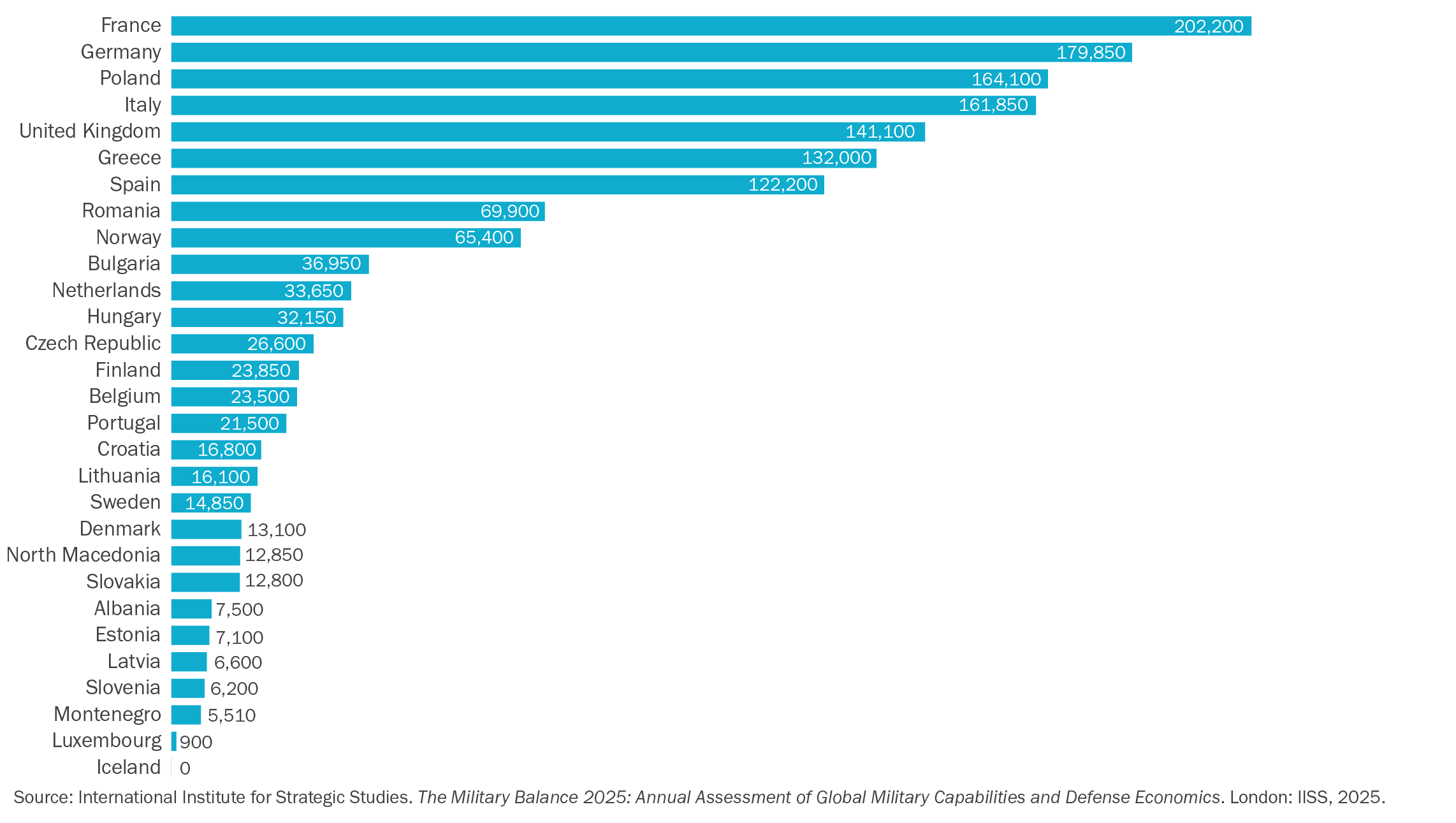
On paper, Europe has a significant number of active-duty military personnel, yet European armies remain deficient in other ways such as expertise and leadership.
Similarly, America’s nuclear arsenal and counterforce doctrine continue to underpin European deterrence. France and (to a lesser extent) the UK might be able to deter Russia in the future, especially if other European nations bolster their capabilities.149On France and the UK, see Paul van Hooft, “Nuclear Deterrence: Can Britain and France Take on America’s Role in Defending Europe Against Russian Aggression?” RAND, March 19, 2025, https://www.rand.org/pubs/commentary/2025/03/nuclear-deterrence-can-britain-and-france-take-on-americas.html; on other European contributions, Grégoire Roos, “Macron’s Nuclear Weapons Offer to Europe: Gaullist Policy, Updated for a More Unstable World,” Chatham House, March 2026, https://www.chathamhouse.org/2026/03/macrons-nuclear-weapons-offer-europe-gaullist-policy-updated-more-unstable-world. However, because of their far more modest capabilities and nuclear doctrines as well as persistent intra-European divisions, they cannot offer a credible alternative to the U.S. nuclear umbrella at this point.150Astrid Chevreuil, “European Deterrence at a Crossroads: French and British Nuclear Options,” Washington Quarterly, vol. 48, issue 2 (2025): 123–125, https://doi.org/10.1080/0163660X.2025.2514975. This is especially true for London, which has faced significant operational issues and cannot sustain its deterrent without American support.151On the UK’s limitations, see Alexander Sorg, “Force de l’Europe: How Realistic is a French Nuclear Umbrella?” War on the Rocks, March 24, 2025, https://warontherocks.com/2025/03/force-de-leurope-how-realistic-is-a-french-nuclear-umbrella/.
How the Trump II administration compromises NATO’s 5 percent pledge
The second Trump administration has rightly promoted NATO’s 5 percent budget pledge as a corrective to Europe’s dependence. However, its persistent desire to dominate Europe risks compounding some of the region’s problems.
Washington’s ambiguities toward retrenchment
In some respects, the Trump II administration has paved the way for a stronger Europe. It has begun phasing out certain local U.S. regiments.152“What Does the U.S. Drawdown in Romania Mean for European Defense?,” Atlantic Council, October 30, 2025, https://www.atlanticcouncil.org/blogs/new-atlanticist/experts-react/what-does-the-us-drawdown-in-romania-mean-for-european-defense/. It has downgraded the status of the U.S. regional Air Force Command and NATO’s Air Command.153Leoni Habedank, Rafael Loss, and Katrine Westgaard, “Look What You Made Us Do: How to Realize a Europe-Led NATO,” European Council on Foreign Relations, October 30, 2025, https://ecfr.eu/article/look-what-you-made-us-do-how-to-realise-a-european-led-nato/. Washington has sought to transfer leadership of the Allied Joint Force Commands in Norfolk, Virginia, and Naples, Italy, to European generals and to cut some of its NATO command-and-planning positions.154On allied force commands, see Sara Bjerg Moller, “Trump’s NATO Dilemma: America Can’t Disengage from the Alliance and Also Lead It,” Foreign Affairs, February 12, 2026, https://www.foreignaffairs.com/united-states/trumps-nato-dilemma; on the other positions, see Graham Slattery, Jonathan Landay, and Humeyra Pamuk, “U.S. To Cut Roughly 200 NATO Positions, Sources Say,” Reuters, January 20, 2026, https://www.reuters.com/world/us-cut-roughly-200-nato-positions-sources-say-2026-01-20/. It plans to reduce its involvement in the alliance’s “force-generation” and “defense-planning” by 2027.155Moller, “Trump’s NATO Dilemma.”
The Trump administration has signaled that America’s support should not be taken for granted. For instance, in early 2025, it temporarily halted military assistance and intelligence sharing with Ukraine.156On Trump’s moves, see Aamer Madhani, “Trump’s Transactional Approach to Diplomacy is a Driving Force on the World Stage,” Associated Press, March 9, 2025, https://apnews.com/article/trump-transactional-diplomacy-tariffs-russia-ukraine-canada-e70f0e800b1c7891a0fa4f21a28c67af; on Ukraine’s relevance to European security, see Oleksiy Goncharenko, “Ukraine is Now an Indispensable Security Partner for the U.S. and Europe,” Atlantic Council, July 24, 2025, https://www.atlanticcouncil.org/blogs/ukrainealert/ukraine-is-now-an-indispensable-security-partner-for-the-us-and-europe/. Washington has begun phasing out its military aid to Eastern European countries.157Schütte, “America First, Europe Fourth.” President Trump has suggested that Article 5 of NATO’s charter might not apply to states that underinvest in their defense.158Miranda Priebe, Zachary Burdette, and Scott Behmer, “How Might NATO Allies Respond if the United States Retrenches from Europe?” RAND, October 8, 2025, 29, https://www.rand.org/pubs/research_reports/RRA2807-2.html. He has warned that the U.S. might no longer export its top weapon systems to certain countries because “someday maybe they [will not be America’s] allies.”159Francis, Ryan, and Birnbaum, “Trump Turbulence Leads Allies to Rethink Reliance on U.S. Weapons.”
Washington’s January 2026 National Defense Strategy confirmed this “sharp shift… in approach, focus, and tone.”160“2026 NDS: National Defense Strategy: Restoring Peace Through Strength for a New Golden Age of America,” Department of War, January 2026, 6, https://media.defense.gov/2026/Jan/23/2003864773/-1/-1/0/2026-NATIONAL-DEFENSE-STRATEGY.PDF. The U.S. aims to “incentivize and enable” fulfillment of the 5 percent pledge.161“2026 NDS: National Defense Strategy,” 4. It will provide “more limited” support and adjust its “force posture” to Europe’s actual capabilities and the actual challenge posed by Russia, which it considers a “manageable threat.” In summary, it expects its allies to “take primary responsibility for [their] conventional defense.”162“2026 NDS: National Defense Strategy,” 10, 11.
However, the U.S. commitment to retrenchment remains in question. President Trump’s sharp critique of NATO allies is neither new nor surprising, given that he views statecraft as a continuous pursuit of leverage.163Aamer Madhani, “Trump’s Transactional Approach to Diplomacy,” Associated Press, May 15, 2025, https://www.realclearpolicy.com/2025/05/15/trumps_transactional_approach_to_diplomacy_1110405.html. His “America First” coalition includes factions that oppose restraint and even support primacy.164On restraint see “The Meaning of ‘America First’ is in Flux,” The Economist, January 19, 2026, https://www.economist.com/united-states/2026/01/19/the-meaning-of-america-first-is-in-flux; on primacy, see Majda Ruge and Jeremy Shapiro, “Polarized Power: The Three Republican ‘Tribes’ That Could Define America’s Relationship with the World,” European Council on Foreign Relations, November 17, 2022, https://ecfr.eu/article/polarised-power-the-three-republican-tribes-that-could-define-americas-relationship-with-the-world/. Moreover, despite his criticisms of America’s endless wars, Trump has shown increased interventionist impulses, culminating in the recent U.S. war in Iran.165Jonathan Taplin, “The Terrifying New Era of American Imperialism,” Rolling Stone, March 5, 2026, https://www.rollingstone.com/politics/political-commentary/trump-america-military-industrial-iran-war-1235524970/.
In fact, the Trump administration’s trans-Atlantic policies have not fundamentally departed from those of its predecessors. Defense Secretary Pete Hegseth said he “expects” NATO to “be sustained for generations to come.”166Sumantra Maitra, “Europe, the Rationale of Burden Shifting, and the Promise of Germany,” in eds. Emma Ashford and Nevada Joan Lee, “New Visions for Grand Strategy,” Stimson Center, September 2025, 31, https://www.stimson.org/wp-content/uploads/2025/09/New-Visions-Full-Report.pdf. In the same vein, America’s latest National Security Strategy has described Europe as “strategically and culturally vital to the United States.”167“National Security Strategy of the United States of America,” White House, November 2025, 26, https://www.whitehouse.gov/wp-content/uploads/2025/12/2025-National-Security-Strategy.pdf.
To be sure, Washington has been extremely assertive in recent months. In January 2026, President Trump reiterated long-standing claims to Denmark’s Greenland, arguing that U.S. “ownership and control [were] an absolute necessity” and refusing for days to rule out hostile economic or military actions.168On Trump’s position, see Alexandra Hutzler, “Trump Again Suggests U.S. Should Own and Control Greenland,” ABC News, December 23, 2024, https://abcnews.go.com/Politics/trump-suggests-us-control-greenland/story?id=117057427; on Trump’s threats, see Joshua Keating, “The Real Danger of Trump’s Greenland Gambit,” Vox, January 11, 2025, https://www.vox.com/world-politics/394464/trump-greenland-purchase. In April, he declared that the U.S. would withdraw 5,000 troops from Germany within a year, at least partly in response to Berlin’s criticisms of his war in Iran, and even suggested additional reductions.169On the announcement, see Noah Robertson, Michael Birnbaum, and Adam Taylor, “Pentagon to Pull 5,000 Troops from Germany, Alarming Republican Lawmakers,” Washington Post, updated May 2, 2026, https://www.washingtonpost.com/national-security/2026/05/01/us-troops-germany-trump-merz/; on the possibility of further cuts, see Natasha Bertrand and Kit Maher, “Trump Threatens More Cuts After U.S. Announces Withdrawal of 5,000 Troops from Germany,” CNN, May 2, 2026, https://www.cnn.com/2026/05/01/politics/us-troop-withdrawal-germany-trump-merz. Trump has also repeatedly insulted NATO allies and individual European leaders.170On Trump’s attacks against NATO, see Milena Wälde, “‘COWARDS’: Trump Blasts NATO Allies over Hormuz,” Politico, March 20, 2026, https://www.politico.eu/article/donald-trump-nato-allies-cowards-hormuz-tensions/; on his attacks against individual European leaders, see Nandita Bose, Trevor Hunnicutt, and Kate Holton, “Trump Says UK’s Starmer is No Winston Churchill After Rift over Iran Strikes,” Reuters, March 3, 2026, https://www.reuters.com/world/europe/trump-says-sad-see-us-uk-relationship-is-not-what-it-was-2026-03-03/.
Yet far from being a sign of disinterest, these moves reflect a desire to preserve U.S. dominance on harsher terms than before.171Stephen M. Walt, “The Predatory Hegemon: How Trump Wields American Power,” Foreign Affairs, March/April 2006, https://www.foreignaffairs.com/united-states/predatory-hegemon-walt; see also Barry R. Posen, “The Rise of Illiberal Hegemony: Trump’s Surprising Grand Strategy,” Foreign Affairs, March/April 2018, https://www.foreignaffairs.com/united-states/rise-illiberal-hegemony. They stem from a perception of European helplessness and a belief that, although not always successful, America’s threats may eventually compel its allies to submit.172Panetta, “‘Shock and Awe.’”
Washington has occasionally softened its rhetoric when it realized it was generating too much resistance. For instance, after the Greenland controversy, it called European states America’s “cherished allies and oldest friends.”173On the transatlantic friendship, see Natasha Lindstaedt, “In His Munich Speech, Marco Rubio Balanced Loyalty to Trump with Reassurance to Europe,” The Conversation, February 16, 2026, https://theconversation.com/in-his-munich-speech-marco-rubio-balanced-loyalty-to-trump-with-reassurances-to-europe-275983; on collective security, see Steven Erlanger and David E. Sanger, “Three American Speeches in Munich, and Plenty of Confusion,” New York Times, February 15, 2026, https://www.nytimes.com/2026/02/15/world/europe/three-american-speeches-at-munich-and-plenty-of-confusion.html; on being stronger together, see Sarah Davis, “U.S. Ambassador to NATO: ‘We Need Strong Allies, Not Dependents,’” The Hill, February 14, 2026, https://thehill.com/policy/international/5739099-us-ambassador-nato-allies/. True to a long-standing American tradition, this show of warmth was intended to keep European leaders “divided and off-balance” to better maintain U.S. hegemony.174Stephen M. Walt, “Trump Is Playing Good Cop/Bad Cop with Europe,” Foreign Policy, February 17, 2026, https://foreignpolicy.com/2026/02/17/trump-europe-munich-vance-rubio-good-bad-cop/.
Compounding Europe’s military dependence
The limits of the Trump II administration’s drawdown from Europe risk perpetuating the region’s reliance on Washington.
As of early 2026, the U.S. local footprint still hovered around 80,000 troops.175Slattery, Landay, and Pamuk, “U.S. To Cut Roughly 200 NATO Positions, Sources Say.” This was consistent with the Biden administration’s post-Ukraine-war levels and well above pre-war figures.176Molly Carlough, Abi McGowan, and Benjamin Harris, “Where are U.S. Forces Deployed in Europe?”, Council on Foreign Relations, February 27, 2025, https://www.cfr.org/articles/where-are-us-forces-deployed-europe.
The Trump administration has confirmed that an American general will serve as supreme allied commander Europe (SACEUR), continuing the tradition since 1951 of American leadership over European forces.177Phil Stewart et al., “America’s Next Top General in Europe Will Also Lead NATO Forces, Officials Say,” Reuters, May 30, 2025, https://www.reuters.com/world/us/americas-next-top-general-europe-will-also-lead-nato-officials-say-2025-05-30/. It has reinforced its control over NATO’s Marine, Air, and Land Commands, which are critical for supporting alliance operations, improving trans-Atlantic interoperability, and “provid[ing] wartime component command headquarters.”178On Washington’s move, see Katja Bego, “What Should a More European NATO Look Like? The U.S. and Europe Disagree,” Chatham House, February 13, 2026, https://www.chathamhouse.org/2026/02/what-should-more-european-nato-look-us-and-europe-disagree; on the relevance of those commands, see Richard D. Hooker Jr., “A New NATO Command Structure,” Atlantic Council, June 5, 2024, 5, https://www.atlanticcouncil.org/wp-content/uploads/2024/05/A-New-NATO-Command-Structure.pdf. President Trump has also shown willingness to offer security guarantees to Ukraine, including intelligence support, “battlefield oversight,” and participation in a European-led air defense system.179Henry Foy, Christopher Miller, and Steff Chávez, “U.S. Offers Air and Intelligence Support to Postwar Force in Ukraine,” Financial Times, August 26, 2025, https://www.ft.com/content/66ec25a0-4af8-467f-9fbe-cf42de890a7e?syn-25a6b1a6=1.
Despite Europe’s growing pushback against the war in Iran, Trump’s demands clearly indicate that Washington still views its European bases and NATO’s support as critical to any U.S. intervention in the Middle East or Africa.180On U.S. calls to NATO, see Efrat Lachter, “Trump Presses NATO Partners on Support as Hegseth Blasts Hesitation,” Fox News, March 2026, https://www.foxnews.com/world/trump-presses-nato-partners-support-hegseth-blasts-hesitation; on the geopolitical value of Europe’s bases, see Julian E. Barnes, Helen Cooper, and Megan Mineiro, “U.S. To Withdraw 5,000 Troops from Germany, Pentagon Says,” New York Times, May 1, 2026, https://www.nytimes.com/2026/05/01/us/politics/us-troops-germany.html. Although Trump has issued new threats to leave NATO since then, his administration favors punishing or rewarding allies based on their level of support.181Annie Linskey and Robbie Grammer, “Trump Team Explores Punishment for NATO Countries That Didn’t Support Iran War,” Wall Street Journal, April 8, 2026, https://www.wsj.com/world/europe/trump-weighs-punishing-certain-nato-countries-over-lack-of-iran-war-support-a2361995; Jack Detsch and Paul McLeary, “Trump Weighs Consequences for NATO Allies on ‘Naughty’ List,” Politico, April 22, 2026, https://www.politico.com/news/2026/04/22/trump-nato-allies-consequences-list-00883619. Likewise, the forthcoming U.S. troop withdrawal from Germany represents only a small share of America’s regional footprint; it will not compromise European security and some of these troops might be redeployed to other parts of Europe.182Jennifer Kavanagh, “Trump’s Right to Take Troops Out of Germany. Now Let’s See Where They Go,” Responsible Statecraft, May 6, 2026, https://responsiblestatecraft.org/trump-troops-germany/. In late May, President Trump announced that the U.S. would deploy an additional 5,000 troops to Poland.183Lex Harvey, Kit Maher, and Haley Britzky, “Trump Says He’s Sending 5,000 Troops to Poland, Deepening Confusion over U.S. Military Deployments to Europe,” CNN, May 22, 2026, https://edition.cnn.com/2026/05/22/politics/trump-poland-troops-nato-ukraine-hnk.
The Trump administration has tacitly indicated its intention to uphold the U.S. nuclear umbrella over Europe.184Kacper Kremiec, “What Does the U.S. National Defense Strategy Mean for Europe?”, Defence24.com, January 25, 2026, https://defence24.com/geopolitics/what-does-the-us-national-defense-strategy-mean-for-europe. In fact, Washington intends to upgrade its atomic arsenal in the region and has reportedly begun deploying nuclear weapons in the UK for the first time since 2008.185Karl-Heinz Kamp, “What If the USA Closes Its Nuclear Umbrella over Europe?” German Council on Foreign Relations, 2–3, https://dgap.org/en/research/publications/what-if-usa-closes-its-nuclear-umbrella-over-europe; Dmytro Basmat, “U.S. Likely Moved Nuclear Weapons to UK for First Time since 2008 Amid Russian Threats,” Kyiv Independent, July 29, 2025, https://kyivindependent.com/us-likely-moved-nuclear-weapons-to-uk-for-first-time-since-2008-amid-russian-threats-media-reports/. The U.S. is also considering deploying nuclear warheads and nuclear-capable aircraft in other European countries, a prospect that Eastern European states strongly encourage.186Henry Foy and Amy McKinnon, “U.S. in Talks to Expand Nuclear Capable Deployments in Europe,” Financial Times, June 2, 2026, https://www.ft.com/content/1a32ad0f-c8b3-4b91-a931-5dc053c6c214?syn-25a6b1a6=1.
The U.S. government’s modest efforts toward retrenchment have faced sharp congressional condemnations.187John Deni, “The Economic Argument for Keeping U.S. Forces in Europe,” Breaking Defense, August 15, 2025, https://breakingdefense.com/2025/08/the-economic-argument-for-keeping-us-forces-in-europe/. Congress has passed legislation that could prevent the executive branch from reducing the U.S. presence in Europe to fewer than 76,000 personnel for more than 45 days without consulting European allies and proving that such cuts benefit U.S. national security.188Stavroula Pabst, “Congress Wants to Stop Trump Troop Withdrawal from Europe,” Responsible Statecraft, December 8, 2025, https://responsiblestatecraft.org/ndaa-europe/. It is also worth remembering that President Trump cannot withdraw from NATO without congressional authorization (a highly unlikely event).189Paul Whiteley, “Three Reasons Donald Trump Won’t Pull the US out of NATO,” The Conversation, April 9, 2026, https://theconversation.com/three-reasons-donald-trump-wont-pull-the-us-out-of-nato-280224.
U.S. military leaders have likewise tried to resist retrenchment.190Noah Robertson et al., “Military Leaders Voice Concern over Hegseth’s New Pentagon Strategy,” Washington Post, updated September 29, 2025, https://www.washingtonpost.com/national-security/2025/09/29/hegseth-national-defense-strategy-trump-dissent/. Frustration seems especially strong in the Army, which sees Europe’s predominantly land-based theater as crucial to offset its marginal role in the Indo-Pacific.191Christopher S. Chivvis, “How U.S. Forces Should Leave Europe.” Foreign Affairs, July 23, 2025, https://www.foreignaffairs.com/united-states/how-us-forces-should-leave-europe. The Trump administration also faces a powerful military-industrial complex with a vested interest in perpetuating America’s allies’ dependence on Washington.192Benjamin H. Friedman, “Alarums and Excursions: Explaining Threat Inflation in U.S. Foreign Policy,” Cato Institute, June 17, 2020, https://www.cato.org/publications/alarums-excursions-explaining-threat-inflation-us-foreign-policy.
Meanwhile, European leaders have stuck to a familiar response. Despite their dismay at Trump’s re-election, they initially tried to placate him.193Francis, Ryan, and Birnbaum, “Trump Turbulence Leads Allies to Rethink Reliance on U.S. Weapons.” As shown by their desperate attempts to keep the U.S. involved in Ukraine, they “consistently adopted a posture of submission.”194On the war in Ukraine, see Ashok Swain, “Europe Kneels Before Trump in Washington,” Euronews, August 22, 2025, https://www.euronews.com/2025/08/22/europe-kneels-before-trump-in-washington; on Europe’s submission, see Matthias Matthijs and Nathalie Tocci, “How Europe Lost: Can the Continent Escape Its Trump Trap?” Foreign Affairs, January/February 2026, https://www.foreignaffairs.com/united-states/how-europe-lost-matthijs-tocci. Although partly successful (for now), their pushback on Greenland was “disorganized” and “hesitant.”195On Europe’s partial victory, see Nathalie Tocci, “Trump’s Greenland U-Turn Was Spectacular. The Lesson for Europe: Strongmen Understand Only Strength,” The Guardian, January 23, 2026, 2–26, https://www.theguardian.com/commentisfree/2026/jan/23/europe-trump-climbdown-genuflecting-tacos-greenland; on Europe’s persistent weakness, see Georgios Samaras, “Trump Is Testing Europe—and the Clock is Ticking,” The Conversation, January 21, 2026, https://theconversation.com/trump-is-testing-europe-and-the-clock-is-ticking-273990; Henry Foy and Barbara Moens, “Trump Assault Opens EU Rift as Leaders Split on U.S. Strategy,” Financial Times, December 15, 2025, https://www.ft.com/content/294c24e6-0647-4ebb-ab08-278061e8fe19. Moreover, Washington’s subsequent tactical softening immediately reignited their desire for “normalcy.”196Moritz S. Graefrath and Gesine Weber, “Breaking Europe’s Transatlantic Habits: The End of the Senior Partner Myth,” War on the Rocks, February 24, 2026, https://warontherocks.com/2026/02/breaking-europes-transatlantic-habit-the-end-of-the-senior-partner-myth/. This led most European leaders to quietly support the U.S. and Israel during the early stages of the war against Iran.197Nathalie Tocci, “Europe Abandons Integrity and Influence on Iran,” Foreign Policy, March 3, 2026, https://foreignpolicy.com/2026/03/03/europe-france-germany-britain-trump-iran-israel-war/.
Admittedly, European leaders have since criticized the war, reduced their support for U.S. operations, and declined Trump’s request for direct European involvement.198Nathalie Tocci, “Iran is a Turning Point for Europe’s Liberation—From Donald Trump,” The Guardian, April 9, 2026, https://www.theguardian.com/commentisfree/2026/apr/09/iran-is-a-turning-point-for-europes-liberation-from-donald-trump. The conflict has also prompted them to accelerate their efforts to ensure continuity of NATO’s activities in the event of an American withdrawal.199Bojan Pancevski and Daniel Michaels, “Europe Is Accelerating a NATO Fallback Plan in Case Trump Pulls Out,” Wall Street Journal, April 14, 2026, https://www.wsj.com/world/europe/europe-nato-trump-plans-3a423233. Yet their resistance remains limited and ambiguous.200Detsch and McLeary “Trump Weighs Consequences for NATO Allies on ‘Naughty’ List.” For instance, while many European nations are ready to join a multilateral mission to help stabilize the Strait of Hormuz after the war, Germany has sought to walk back some of its recent criticisms, declaring that Washington remains its most critical NATO ally.201John Vandiver, “Allies Preparing for Possible Help Role in Strait of Hormuz, NATO’s Top Leader Says,” Stars and Stripes, May 4, 2026, https://www.stripes.com/theaters/europe/2026-05-04/rutte-nato-trump-germany-21570969.html. More broadly, European leaders are striving to demonstrate their strategic value to the Trump administration ahead of NATO’s July 2026 annual summit.202Philippe Jacqué, “Europe Seeks to Defuse Trump Criticism Ahead of NATO Summit in Ankara,” Le Monde, May 23, 2026, https://www.lemonde.fr/en/international/article/2026/05/23/europe-seeks-to-defuse-trump-criticism-ahead-of-nato-summit-in-ankara_6753752_4.html.
In that context, the Trump administration’s persistent ambiguities could discourage European leaders from making the domestic sacrifices and intra-regional compromises necessary to develop their defense capacity. They could also motivate them to continue damage control while advocating more passionately for their cause in Washington, especially after a new administration takes office in January 2029.203Priebe, Burdette, and Behmer, “How Might NATO Allies Respond,” 44–45. Yet their persistent desire to limit tensions at all costs may encourage the Trump administration to make new demands that could further delay the emergence of Europe’s strategic autonomy.204On the risk of new U.S. demands, see Paul Taylor, “The EU Has Capitulated to Trump. But Even This Doesn’t Buy an End to the Transatlantic Trade War,” The Guardian, July 28, 2025, https://www.theguardian.com/commentisfree/2025/jul/28/eu-capitulated-donald-trump-transatlantic-trade-war.
Compromising the economic foundations of Europe’s defense buildup
The Trump administration’s policies may weaken the economic vitality necessary for Europe’s defense buildup.
Washington’s hostile trans-Atlantic policies have hurt European economies. For example, the July 2025 U.S.-EU trade deal framework, which the bloc accepted largely out of fear, included a 15 percent tariff on European exports (with some exemptions).205Alberto Alemanno, “Europe’s Economic Surrender,” Project Syndicate, July 30, 2025, https://www.project-syndicate.org/commentary/high-cost-of-eu-capitulation-to-trump-tariff-threats-by-alberto-alemanno-2025-07; on U.S. tariffs, see Priebe, Burdette, and Behmer, “How Might NATO Allies Respond,” 47. Brussels may not honor all these commitments, but the Trump administration has renewed its offensive to ensure the deal’s full implementation, threatening further retribution.206Jennifer Kavanagh and Peter Slezkine, “The Fatal Flaw in the Transatlantic Alliance,” Foreign Affairs, September 30, 2025, https://www.foreignaffairs.com/united-states/fatal-flaw-transatlantic-alliance; Daphne Psaledakis and David Lawder, “Trump Sets July 4 Deadline for EU to Comply with Trade Deal or Face ‘Much Higher’ Tariffs,” Reuters, May 7, 2026, https://www.reuters.com/world/trump-says-giving-eu-until-july-4-fulfill-trade-deal-or-will-raise-tariffs-2026-05-07/. Even if they’re only partially carried out, these tariffs and other forms of economic coercion could erode Europe’s capacity to rearm.207Priebe, Burdette, and Behmer, “How Might NATO Allies Respond,” 54. Moreover, as they exacerbate the strain on the region’s struggling welfare systems, U.S. policies could trigger a “radical rejection of the rearmament drive” among European citizens.208On the backlash against a European buildup, see Olivier Brochet and Joe Orchard, cited in Rudy Ruitenberg, “European Arms Industry Growth to Beat 10% a Year, Redburn Forecasts,” Defense News, October 6, 2025, https://www.defensenews.com/global/europe/2025/10/06/european-arms-industry-growth-to-beat-10-a-year-redburn-forecasts/; on the pressure of rearmament on European welfare systems, see Smith, “Rearming Europe.”
Beyond tariffs, Washington has worked to deepen Europe’s economic dependence on the U.S. For instance, the July 2025 U.S.-EU trade deal framework required the bloc to purchase $750 billion in American energy annually.209Zurstrassen, “Military Unification?” If the deal is fully implemented, the U.S. share of the EU’s liquefied natural gas imports, currently at 57 percent, could rise to 75–80 percent by the end of the decade.210Sarah Shamim, “Can Europe Break with Trump? A Tale of Energy, Defence, Economic Dependence,” Al Jazeera, January 21, 2026, https://www.aljazeera.com/economy/2026/1/21/can-europe-break-with-trump-a-tale-of-energy-defence-economic-dependence. Likewise, the Trump administration has offered massive financial and regulatory support for the U.S. tech industry and lobbied aggressively against the EU’s attempts to limit its dominance in defense-relevant domains such as AI, cloud computing, and cybersecurity.211On U.S. tech policies, see Steve Wamhoff and Matthew Gardner, “How Four Big Pro-Trump Tech Companies Avoided Taxes,” Institute on Taxation and Economic Policy, March 17, 2026, https://itep.org/amazon-alphabet-meta-tesla-pro-trump-tech-companies-avoided-taxes/; Blake Montgomery and Nick Robins-Early, “How the Tech Industry’s Embrace of Trump May Be Paying Dividends,” The Guardian, December 16, 2025, https://www.theguardian.com/global/2025/dec/15/ai-trump-openai-google-data-centers; on the consequences for Europe, see Bukowski, “Europe After the U.S. Decoupling.” Its hostile economic policies may compound Europe’s dependency on America’s market, investment, and payment systems.212Jacob Kirkegaard, “Europe Is Stuck with America,” Foreign Affairs, April 6, 2026, https://www.foreignaffairs.com/united-states/europe-stuck-america.
The Trump administration has exerted political pressure to ensure that Europe’s defense buildup would result in a “supercharging” of America’s defense industrial base rather than tapping into the region’s potential.213See Hélène Masson, “The U.S. Defense Industry in Europe in the Age of America First,” Fondation pour la Recherche Stratégique, March 31, 2026, 19, https://www.frstrategie.org/web/documents/publications/defense-et-industries/2026/US_Europe_HMasson_FRS_02_2026.pdf. In this regard, the “buy American” requirements in the July 2025 U.S.-EU preliminary deal are bound to hurt European military companies both at home and abroad.214On the vulnerability of European defense firms, see Hellemeier, “The Implications of a Second Trump Presidency.” Despite occasional overtures, the Trump administration has consistently lobbied to prevent the EU from integrating its defense industries and restricting the dominance of U.S. military corporations.215Besch, Brown, and Uzan, “Rebalancing the Transatlantic Defense-Industrial Relationship,” 2. This has helped keep Europe dependent on American defense technologies.216Sam Schechner, Berber Jin, and Kim Mackrael, “Europe Prepares for a Nightmare Scenario: The U.S. Blocking Access to Tech,” Wall Street Journal, January 23, 2026, https://www.wsj.com/tech/europe-prepares-for-a-nightmare-scenario-the-u-s-blocking-access-to-tech-1967b39b?mod=author_content_page_1_pos_5.
Eroding the political foundations of a European buildup
Europe’s defense prospects could also suffer from the Trump II administration’s proclaimed desire to interfere in the region’s local politics.217Vincze, “Right Assessment, Wrong Tactics.”
The U.S. wants to bolster European leaders with whom it shares ideological affinities.218Astrid Benölken, “Will Trump ‘Pull’ Italy, Austria, Poland, Hungary from EU?” DW, December 12, 2025, https://www.dw.com/en/will-trump-pull-italy-austria-poland-hungary-from-eu/a-75134777. But “cultivating resistance to Europe’s current trajectory” also signals a much more ambitious agenda.219“National Security Strategy,” 27.
Europe’s far-right groups remain divided.220Rosa Balfour, Stefan Lehne, and Elena Ventura, “The European Radical Right in the Age of Trump 2.0,” Carnegie Endowment for International Peace, September 22, 2025, https://carnegieendowment.org/research/2025/09/the-european-radical-right-in-the-age-of-trump-20. They have reservations about President Trump’s style and haven’t welcomed his attacks on European sovereignty.221Hanne Cokelaere, “Trump Is Unpopular in Europe – Even Among Right-Wing Populist Supporters, POLITICO Poll Shows,” Politico, December 29, 2025, https://www.politico.eu/article/politico-poll-international-populism-donald-trump/; Alice Hanock et al., “Europe’s Rightwing Parties Squirm as Trump Threatens Tariffs,” Financial Times, January 19, 2026, https://www.ft.com/content/d41c5eb5-4ec7-431d-ab16-bdc8ac9cc67c. These movements also know that Trump is deeply unpopular with European voters.222Jeanna Smialek, Koba Ryckewaert, and Catherine Porter, “How Trump Became a Liability for Europe’s Far Right,” New York Times, January 27, 2026, https://www.nytimes.com/2026/01/27/world/europe/trump-liability-europe-far-right-populists.html. Many observers have interpreted the recent fall of Hungarian Prime Minister Viktor Orbán, the EU’s main internal spoiler and most pro-Trump leader, as a clear rejection of the U.S. and harbinger of greater European strategic autonomy.223Simon Nixon, “Hungary Has Defended Europe Against Civilizational Erasure,” Euractiv, April 15, 2026, https://www.euractiv.com/opinion/make-now-mistake-obans-overthrow-is-a-watershed-moment-for-europe/.
Yet Trump still has significant support in many of Europe’s far-right parties.224Laura Pitel et al., “Europe’s Far-Right Questions Merits of Trump Ties After Orbán Defeat,” Financial Times, April 13, 2026, https://www.ft.com/content/19335eb8-3c7a-456d-a959-0214e7fe5244?syn-25a6b1a6=1. The U.S. government could help those movements fund their activities and spread disinformation.225On funding, see Anchal Vohra, “How Trump’s Outreach to Europe Far Right Aims to Split EU,” DW, December 10, 2025, https://www.dw.com/en/how-trumps-outreach-to-europes-far-right-fits-into-his-national-security-strategy/a-75092824; on disinformation, see Mario Solletty and Océane Herrero, “French Diplomats Are Taking On MAGA—One Meme At a Time,” Politico, January 29, 2026, https://www.politico.eu/article/france-diplomats-memes-fight-maga-era-information-wars-emmanuel-macron/; see also Balfour, Lehne, and Ventura, “The European Radical Right in the Age of Trump 2.0.” Moreover, the pressure that its economic policies have created on European welfare systems might boost the far right’s popularity.226On the far-right’s appeal, see Giovanni Grevi, “The Political Test of European Defence,” Italian Institute for International Political Studies, March 24, 2025, https://www.ispionline.it/en/publication/the-political-test-of-european-defence-203797; on the discredit of traditional elites, see Ricardo Duque Gabriel, Mathias Klein, and Ana Sofia Pessoa, “The Political Costs of Austerity,” Review of Economics and Statistics, vol. 108, issue 1 (2026): 145–161, https://doi.org/10.1162/rest_a_01373. The same is true of other American initiatives that disregard the region’s economic interests, such as the war in Iran.227Katrin Bennhold, “The Iran War and Angry Voters,” New York Times, May 6, 2026, https://www.nytimes.com/2026/05/06/world/britain-elections-far-right-europe-iran-deal.html. President Trump could further discredit the mainstream parties in power by repeatedly forcing them to bend the knee.228Samaras, “Trump Is Testing Europe—and the Clock Is Ticking.”
Most of the region’s far-right movements oppose a European-led NATO or an EU-led defense.229Jeremy Cliffe et al., “Rise to the Challengers: Europe’s Populist Parties and its Foreign Policy Future,” European Council on Foreign Relations, June 12, 2025, https://ecfr.eu/publication/rise-to-the-challengers-europes-populist-parties-and-its-foreign-policy-future/#challenger-foreign-policy. Their continued rise would fuel societal fractures across Europe and alter the makeup of EU institutions.230On those movements’ rise, see Balfour, Lehne, and Ventura, “The European Radical Right in the Age of Trump 2.0”; on the consequences for European defense, see Liana Fix and Sophia Winograd, “How Far-Right Election Gains Are Changing Europe,” Council on Foreign Relations, October 15, 2024, https://www.cfr.org/articles/how-far-right-election-gains-are-changing-europe. Although Washington’s interference may trigger a nationalist pushback, this momentum could exacerbate intra-EU divisions rather than generate regional unity in areas such as trade, technology, and space.231Nathalie Tocci, “As Trump Enters the Fray, the Danger is That a Nationalist Europe Will Fragment, Not Stick Together,” The Guardian, January 13, 2025, https://www.theguardian.com/commentisfree/2025/jan/13/trump-nationalist-europe-meloni-orban-rightwing.
Policy recommendations
The Trump II administration should leverage NATO’s 5 percent budget pledge to rebalance the trans-Atlantic relationship across the strategic, defense-industrial, and operational levels.
Strategic
The emergence of a truly capable European defense will require Washington to end its longstanding efforts to maintain dominance over Europe’s military, economic, technological, and political spheres. Instead, the U.S. should support its allies in strengthening their national power, overcoming their divisions, and asserting their strategic voice.
This reorientation entails letting Europe take a leadership role within NATO. The shared standards, common strategic planning, and “highly integrated structures” that the Western alliance has developed over decades give Europe an ideal instrument for safeguarding collective security.232Justina Budginaite-Froehly, “The EU Must Become a Strategic Player in Defense—Alongside NATO,” Atlantic Council, March 5, 2025, https://www.atlanticcouncil.org/in-depth-research-reports/issue-brief/the-eu-must-become-a-strategic-player-in-defense-alongside-nato/. Furthermore, NATO can enable a smooth transition from U.S. domination to European responsibility.233Sweeney, “How Would Europe Defend Itself,” 1–2.
Washington should also provide rhetorical support for a stronger EU endowed with substantial security powers. It should encourage European leaders to overcome their divisions and end its opposition to the bloc’s defense initiatives.234Bergmann, “Trump Needs a Plan to Get Europeans to Step Up on Defense”; Bergmann and Svendsen, “How Europe Can Defend Itself with Less America,” 34. The EU can excel in nontraditional security areas, such as sanctions, cybersecurity, and critical infrastructure protection.235On sanctions, see “Interview: French Chief of Defence, Gen. Thierry Burkhard: Ukraine War Confirms Need to Define a Long-Term Strategy to Ensure the Defence of Europe,” European Defence Agency, https://eda.europa.eu/webzine/issue23/interview; on the other aspects, see Scazzieri, “Towards an EU ‘Defence Union,’” 6–8. It also has genuine potential for capability development.236Scazzieri, “Towards an EU ‘Defence Union,’” 7.
The U.S. should tone down its antagonism toward Europe, including President Trump’s baseless claims about Greenland, his insults toward NATO allies, and his personal attacks on European leaders.237On the pointlessness of his claims over Greenland, see Stefanie Dazio, River Zhang, and Emma Burrows, “FACT FOCUS: Trump Repeats False Claims When Discussing Greenland’s Security in the Arctic,” Associated Press, January 13, 2026, https://apnews.com/article/fact-check-greenland-denmark-trump-arctic-security-russia-china-6346aa8e86be594e467e8cc18f98357b. This aggressiveness could divide European states and lead them to prioritize expediency over strategic vision, thereby exacerbating local capability gaps.238Priebe, Burdette, and Behmer, “How Might NATO Allies Respond,” VII. In a worst-case scenario, it could prompt Russia to test NATO’s cohesion.239Raik, Terlikowski, and Baumann, “Beyond Burden Sharing,” 3.
To be sure, Washington’s adjustments alone will not suffice; Europe must ultimately step up. However, these adjustments can help European leaders recognize that the United States will not stand in the way of European strategic autonomy and that expanding their combat capabilities will only help stabilize the trans-Atlantic relationship.
Defense-industrial level
In the defense-industrial sphere, Washington should end its threats and lobbying to force “buy American” deals and other harmful economic measures on European leaders. It should halt its efforts to prevent the EU from consolidating its military industries and supporting local defense start-ups. Instead, it should encourage Brussels to “integrate, coordinate, and supplement” European defense spending, joint procurement, and R&D efforts at the necessary scale.240Bergmann and Besch, “Why European Defense Still Depends on America.”
In parallel, Washington should remove the commercial barriers and export controls that constrain access to the U.S. defense market and ease requirements for local private European investments.241“A New Transatlantic Bargain,” 16. Efforts to make U.S. security and foreign disclosure regulations less opaque and more predictable would be welcomed.242James Hursch and Kristen Taylor, “To Meet NATO’s 5 Percent Benchmark, Allies Need More Industrial Capacity. Here’s How They Can Build It,” Atlantic Council, July 23, 2025, https://www.atlanticcouncil.org/blogs/new-atlanticist/to-meet-natos-5-percent-benchmark-allies-need-more-industrial-capacity/.
A larger European defense industry will have greater political capital to bolster support for European defense within EU institutions. Likewise, allowing Europeans to build their own defense industries may generate the domestic political coalitions that will sustain defense spending over time.243On this topic, see Lee, “Public Goods, Politics, and Two Cheers for the Military-Industrial Complex.”
Washington should increase its political and financial support for closer trans-Atlantic coordination on economic security, including supply chain resilience and access to critical minerals. Greater involvement in initiatives such as the U.S.-EU dialogue on security and defense would enable trans-Atlantic partners to reduce their vulnerabilities to China.244Bergmann et al., “Transforming European Defence,” 5.
European leaders should build on those foundations to integrate their national procurement processes either regionally or through subregional coalitions based on industrial complementarities or shared threat perceptions, and to focus on the right capabilities.245On subregional coalitions, see Besch, Brown, and Uzan, “Rebalancing the Transatlantic Defense-Industrial Relationship,” 8. For instance, they should significantly increase production capacity for all types of munitions (e.g., artillery, long-range missiles, and interceptors), especially precision-guided.246Bergmann and Svendsen, “How Europe Can Defend Itself with Less America,” 22–24; on precision-guided munitions, see Sweeney, “How Would Europe Defend Itself,” 13–14. They should bolster long-range strike capabilities to threaten Russia’s territory to ensure credible deterrence. They should leverage their industrial advantages and Ukraine’s expertise to boost drone production. Missile defense systems and interceptors should also be prioritized. And despite their growing vulnerability, armored vehicles remain an indispensable investment for any future conflict against Moscow.247Bergmann and Svendsen, “How Europe Can Defend Itself with Less America,” 24-26.
Although they already have capabilities in these areas, European leaders need to dramatically expand their production of strategic enablers to reduce their dependence on the U.S., including in strategic airlift, air refueling, ISR, and missile defense.248Barry R. Posen, “How Europe Can Deter Russia: Deploying Troops to Ukraine Is Not the Answer,” Foreign Affairs, April 21, 2025, https://www.foreignaffairs.com/north-america/how-europe-can-deter-russia. For instance, given the distances involved in any potential fight against Russia, air refueling assets may enable European aircraft to loiter over targets and reach operational theaters otherwise beyond reach.249Bergmann and Svendsen, “How Europe Can Defend Itself with Less America,” 27.28.
Operational
In the operational domain, the U.S. should steadily decrease its military presence in Europe. Reducing to about 30,000 troops by the end of the decade, along with a 50 percent cut in U.S. air and naval assets, seems like a reasonable goal.250Kavanagh and Caldwell, “Aligning Global Military Posture with U.S. Interests,” 7. European defense ambitions have repeatedly stalled when Washington has signaled continued commitment. This historical pattern suggests that Europeans are unlikely to meet the 5 percent spending pledge unless America initiates retrenchment first. A steady, credible reduction in U.S. forces may incentivize them to bolster European combat capability.
In the meantime, Washington should encourage the creation of a “permanent standing pan-European reaction force” of about 100,000 troops under NATO or EU responsibility within a decade.251Bergmann and Svendsen, “How Europe Can Defend Itself with Less America,” 4, 17-18. It should transfer NATO’s key command positions while maintaining staff involvement “at every level.”252Raik, Terlikowski, and Baumann, “Beyond Burden Sharing: Conceptualizing the European Pillar of NATO.” 7. It could also promote “double-hatted” NATO-EU positions and smaller European command-and-control coalitions based on geographic or functional priorities.253On “double-hatted” positions, see Bergmann and Svendsen, “How Europe Can Defend Itself with Less America,” 31-32; on subregional coalitions, see Sweeney, “How Would Europe Defend Itself,” 15-16, 20-21; see also Bergmann and Svendsen, “How Europe Can Defend Itself with Less America,” 30-31. As long as the U.S. maintains its leadership in the alliance’s key positions, it will discourage European leaders from assuming greater responsibility. A reduction in U.S. staffing in leadership roles can incentivize Europe to ensure their own defense.
To make the most of this transition, U.S. allies should conceive their standing force as a lethal “mass of maneuver” that could be quickly dispatched and concentrated in any European theater.254Posen, “How Europe Can Deter Russia.” Poland is key in this regard. Given its size, terrain, and location, the country is both Eastern Europe’s defense stronghold and an ideal launching pad for defending the Baltic states.255Posen, “How Europe Can Deter Russia.” However, European leaders could also deploy light assets to the Baltics to slow any Russian offensive while reinforcements arrive.256Benjamin Giltner, “What Will It Take for Europe to Defend Itself?,” Cato Institute, November 18, 2025, https://www.cato.org/commentary/what-will-it-take-europe-defend-itself.
To bolster readiness levels, European leaders should significantly improve Europe’s infrastructure (e.g., bridges), integrate the region’s railways, and optimize port traffic.257Posen, “How Europe Can Deter Russia.” European armies should improve their troops’ training and invest far more in maintenance and spare parts.258On training, see Giltner, “What Will It Take for Europe to Defend Itself”; on maintenance and spare parts, see Posen, “How Europe Can Deter Russia.” They should also integrate their C4ISR capabilities to better coordinate their movements and respond to the enemy.259C4ISR means “Command, Control, Communication, Computers, Intelligence, Surveillance, and Reconnaissance”; Sweeney, “How Would Europe Defend Itself,” 2, 18.
A balanced trans-Atlantic relationship
The adjustments required of Europe’s NATO members to meet the 5 percent budget pledge they made in July 2025 and assume responsibility for their own defense are likely to disrupt well-entrenched habits, upset powerful vested interests, and generate strategic anxiety.
Yet rebalancing the U.S.-Europe partnership is the best way forward. Given its key role in the region’s geopolitics and its immense national power, Washington is uniquely positioned to help Europe overcome its weaknesses and become a truly autonomous partner. This will be achieved not by managing Europe’s transition but by credibly stepping back to incentivize Europe to step up. Provided it sheds its hegemonic impulses and maintains a constructive approach toward its NATO allies, the U.S. can steer the trans-Atlantic relationship toward a more sustainable path that benefits all.
Endnotes
- 1Defense Secretary Pete Hegseth, cited in Camille Grand, “The End of the ‘Imperial Republic’ and the Future of the Transatlantic Alliance,” Brookings Institution, June 23, 2025, https://www.brookings.edu/articles/the-end-of-the-imperial-republic-and-the-future-of-the-transatlantic-alliance/. ↩︎
- 2Max Bergmann and Sophia Besch, “Why European Defense Still Depends on America,” Foreign Affairs, March 7, 2023, https://www.foreignaffairs.com/ukraine/why-european-defense-still-depends-america. ↩︎
- 3Lorne Cook, Mike Corder, and Molly Quell, “NATO Leaders Are Set to Agree on a Historic Defense Spending Pledge, but the Hike Won’t Apply to All,” Associated Press, June 23, 2025, https://www.ap.org/news-highlights/spotlights/2025/nato-leaders-are-set-to-agree-on-a-historic-defense-spending-pledge-but-the-hike-wont-apply-to-all/. ↩︎
- 4Hegemony can be defined “as the ability of an actor with overwhelming capability to shape the international system through both coercive and non-coercive means”; Carla Norloff, Oxford Bibliographies (online), September 2015, https://www.oxfordbibliographies.com/display/document/obo-9780199743292/obo-9780199743292-0122.xml. ↩︎
- 5Maciej Bukowsi, “Europe After the U.S. Decoupling: Change or Be Damned,” CEPA, December 15, 2025, https://cepa.org/article/europe-after-the-us-decoupling-change-or-be-damned/. ↩︎
- 6Benjamin David Giltner, “Their Own Two Feet: How Europeans Can Lead on Conventional Deterrence in Europe,” Cato Institute, October 23, 2025, 2, https://www.cato.org/sites/cato.org/files/2025-10/policy-analysis-1006-update.pdf. ↩︎
- 7Giltner, “Their Own Two Feet,” 2. ↩︎
- 8Jennifer Kavanagh and Dan Caldwell, “Aligning Global Military Posture with U.S. Interests,” Defense Priorities, July 9, 2025, 8, https://www.defensepriorities.org/explainers/aligning-global-military-posture-with-us-interests/. ↩︎
- 9Bukowski, “Europe After the U.S. Decoupling.” ↩︎
- 10Stephen M. Walt, “It’s Not Too Late for Restrained U.S. Foreign Policy,” Foreign Policy, March 14, 2024, https://foreignpolicy.com/2024/03/14/united-states-realism-restraint-great-power-strategy/. ↩︎
- 11Camille Grand, “Defending Europe with Less America,” European Council on Foreign Relations, July 2024, 5, https://ecfr.eu/wp-content/uploads/2024/07/Defending-Europe-with-less-America-v1.pdf. ↩︎
- 12Leonard Schütte, “America First, Europe Fourth,” War on the Rocks, December 4, 2025, https://warontherocks.com/2025/ 12/america-first-europe-fourth/. ↩︎
- 13“‘Dim, If Not Dismal Future’: Gates Blasts NATO,” Associated Press, June 10, 2011, https://www.nbcnews.com/id/wbna43351604. ↩︎
- 14Barry R. Posen, “A New Transatlantic Division of Labor Could Save Billions Every Year!,” Bulletin of the Atomic Scientists, September 7, 2021, https://thebulletin.org/premium/2021-09/a-new-transatlantic-division-of-labor-could-save-billions-every-year/. ↩︎
- 15Schütte, “America First, Europe Fourth.” ↩︎
- 16Jack Detsch, “NATO Doesn’t Have Enough Troops,” Foreign Policy, April 10, 2024, https://foreignpolicy.com/2024/04/10/nato-troop-numbers-russia-ukraine-war/. ↩︎
- 17On Washington’s complaints, see Peter Huessy, “The Long History of U.S. Irritation at European NATO’s Freeloading,” CEPA, February 21, 2024, https://cepa.org/article/the-long-history-of-us-irritation-at-european-natos-freeloading/; on a healthier trans-Atlantic relationship, see Benjamin Friedman, “A New NATO Agenda: Less U.S., Less Dependency,” Defense Priorities, July 8, 2024, 6, https://www.defensepriorities.org/wp-content/uploads/2024/07/DEFP_A_new_NATO_agenda.pdf. ↩︎
- 18On investment opportunities, see Dalibor Rohac, “Why Europe Needs Its Defense Industry – and How the United States Can Help,” American Enterprise Institute, November 21, 2025, 10, https://www.aei.org/research-products/report/why-europe-needs-its-defense-industry-and-how-the-united-states-can-help/; on sales opportunities, see Aaron Mehta and Valerie Insinna, “Europe is Pouring Money into Defense. Can U.S. Firms Reap the Reward Amid Trans-Atlantic Tension?” Breaking Defense, June 25, 2025, https://breakingdefense.com/2025/06/europe-is-pouring-money-into-defense-can-us-firms-reap-the-reward-amid-trans-atlantic-tension/; on economies of scale and the reduction of the U.S. deficit, see Sean Monaghan, “Europe’s Trillion Dollar Opportunity to Save Ukraine. and the Free World,” Center for Strategic and International Studies, March 5, 2025, 9, https://www.csis.org/analysis/europes-trillion-dollar-opportunity-save-ukraine-and-free-world. ↩︎
- 19On cyber threats, see Kathryn Levantovscaia, “Pax Americana vs. Autonomy: How the U.S. and EU Defense Industrial Strategies Diverge,” Atlantic Council, April 17, 2024, https://www.atlanticcouncil.org/blogs/new-atlanticist/pax-americana-vs-autonomy-how-the-us-and-eu-defense-industrial-strategies-diverge/; on other issues, see Sophia Besch, Erik Brown, and Rafaela Uzan, “Rebalancing the Transatlantic Defense-Industrial Relationship: Regional Pragmatism in Northeastern Europe,” Carnegie Endowment for International Peace, December 2025, 2–3, https://carnegieendowment.org/research/2025/12/rebalancing-the-transatlantic-defense-industrial-relationship-regional-pragmatism-in-northeastern-europe. ↩︎
- 20Sophia Besch, “Rebooting the U.S.-EU Defense Relationship,” American-German Institute, December 22, 2021, https://americangerman.institute/publication/rebooting-the-u-s-eu-defense-relationship/. ↩︎
- 21On competitiveness and resilience, see Kurt M. Campbell and Rush Doshi, “Underestimating China: Why America Needs a New Strategy of Allied Scale to Offset Beijing’s Enduring Advantages,” Foreign Affairs, May–June 2025, https://www.foreignaffairs.com/china/underestimating-china; “A New Transatlantic Bargain: The Case for Building a Strong European Pillar,” Harvard Kennedy School, Belfer Center, February 2025, 9, https://www.belfercenter.org/transatlantic-bargain; Paul Soler, “Defence Industry Warns EU to ‘Urgently’ Curb Dependence on Key Raw Materials,” Euronews, October 14, 2025, https://www.euronews.com/my-europe/2025/10/14/defence-industry-warns-eu-to-urgently-curb-dependence-on-key-raw-materials; on the consequences of deterrence, see Balazs Marko, “Deterrence and Industrial Wars of Attrition,” SSRN Papers, July 22, 2025, 1–33, https://papers.ssrn.com/sol3/papers.cfm?abstract_id=5361410. ↩︎
- 22“Defence Expenditures and NATO’s 5% Commitment,” NATO, updated December 18, 2025, https://www.nato.int/en/what-we-do/introduction-to-nato/defence-expenditures-and-natos-5-commitment/. ↩︎
- 23Giltner, “Their Own Two Feet,” 2. ↩︎
- 24Paul McLeary, “Trump Says U.S. Doesn’t Have to Meet NATO Spending Goal,” Politico, June 20, 2025, https://www.politico.com/news/2025/06/20/trump-says-the-us-doesnt-have-to-meet-nato-spending-goal-00416154. ↩︎
- 25Jared Cohen, “The Future of European Defense,” Goldman Sachs, June 30, 2025, 3, https://www.goldmansachs.com/insights/articles/the-future-of-european-defense. ↩︎
- 26Leonard Schuette and Hylke Dijkstra, “The Show Must Go On: The EU’s Quest to Sustain Multilateral Institutions Since 2016,” Journal of Common Market Studies, vol. 61, issue 5 (2023): 1319, https://doi.org/10.1111/jcms.13466. ↩︎
- 27Nick Smith, “Rearming Europe: Political Legitimacy Through War,” Phenomenal World, July 10, 2025, https://www.phenomenalworld.org/analysis/rearming-europe/. ↩︎
- 28Rohac, “Why Europe Needs Its Defense Industry,” 6. ↩︎
- 29On austerity, see Smith, “Rearming Europe”; on demographic aging, see Luigi Scazzieri, “Towards an EU ‘Defence Union,’” Center for European Reform, January 2025, 12, https://www.cer.eu/sites/default/files/pb_LS_defence_union_29.1.25.pdf; on other factors, see Elizabeth Krecké, “Competing Models for the Future of Welfare in Europe,” Geopolitical Intelligence Services, January 15, 2026, https://www.gisreportsonline.com/r/future-of-welfare-europe/ ↩︎
- 30Smith, “Rearming Europe”; Dimitri Zurstrasse, “Military Unification: A Critical Juncture for European Defense Policy,” Phenomenal World, July 30, 2025, https://www.phenomenalworld.org/analysis/military-unification/. ↩︎
- 31On the decline of public investments, see Damian Tobin, “NATO Leaders Pledge Increased Defense Spending – Is This Really the Price for Peace and Prosperity?,” The Conversation, June 30, 2025, https://theconversation.com/nato-leaders-pledge-increased-defence-spending-is-this-really-the-price-for-peace-and-prosperity-255989; on national debt, see Smith, “Rearming Europe.” ↩︎
- 32Ivan Krastev and Mark Leonard, “The Meaning of Sovereignty: Ukrainian and European Views of Russia’s War on Ukraine,” European Council on Foreign Relations, July 2024, 29, https://ecfr.eu/wp-content/uploads/2024/07/The-meaning-of-sovereignty-Ukrainian-and-European-views-of-Russias-war-on-Ukraine-v2.pdf. ↩︎
- 33Mihail Evans, “Is Russia Really a Threat to Europe? Debunking Rutte’s Claims,” Center for International Relations and Sustainable Development, 2025, https://www.cirsd.org/en/horizons/horizons-summer-2025–issue-no-31/is-russia-really-a-threat-to-europe. ↩︎
- 34Cooke, Corder, and Quell, “NATO Leaders Are Set to Agree on a Historic Defense Pledge.” ↩︎
- 35Rohac, “Why Europe Needs Its Defense Industry,” 4. ↩︎
- 36an Tian, Lorenzo Scarazzato, and Jade Guiberteau Ricard, “NATO’s New Spending Target: Challenges and Risks Associated with a Political Signal,” SIPRI, June 27, 2025, https://www.sipri.org/commentary/essay/2025/natos-new-spending-target-challenges-and-risks-associated-political-signal. ↩︎
- 37On Rutte’s input, see Vu Lam, “NATO’s 5% Pledge and the Quiet Drift from the Indo-Pacific,” Lowy Institute, July 2, 2025, https://www.lowyinstitute.org/the-interpreter/nato-s-5-pledge-quiet-drift-indo-pacific; on Trump’s claim, see Victor Jack, Chris Lunday, and Laura Kayali, “NATO Clinches Defense Spending Deal in Big Win for Trump,” Politico, June 25, 2025, https://www.politico.eu/article/nato-defense-spending-deal-win-us-donald-trump/; on European leaders, see Mark John, “Europe Placates Trump with NATO Pledges It Can Ill Afford,” Reuters, June 25, 2025, https://www.reuters.com/business/aerospace-defense/europe-placates-trump-with-nato-pledges-it-can-ill-afford-2025-06-25/. ↩︎
- 38Lam, “NATO’s 5% Pledge.” ↩︎
- 39Kristen Taylor, “How NATO Nations Need to Sell the 5 Percent Spending Hike to Their Own People,” Breaking Defense, August 13, 2025, https://breakingdefense.com/2025/08/how-nato-nations-need-to-sell-the-5-%-spending-hike-to-their-own-people/. ↩︎
- 40Justina Budginaite-Froehly, LeAnne Noelani Howard, and Timo S. Koster, “NATO’s Spending Pledge is no Invitation for Creative Accounting,” Atlantic Council, November 21, 2025, https://www.atlanticcouncil.org/commentary/op-ed/natos-spending-pledge-is-no-invitation-for-creative-accounting/. ↩︎
- 41Friedman, “A New NATO Agenda,” 6. ↩︎
- 42Scazzieri, “Towards an EU ‘Defence Union,’” 4. ↩︎
- 43Grand, “Defending Europe with Less America,” 8. ↩︎
- 44Kristi Raik, Marcin Terlikowski, and Mario Baumann, “Beyond Burden Sharing: Conceptualizing the European Pillar of NATO,” German Council on Foreign Relations, June 17, 2025, 6–7, https://dgap.org/en/research/publications/beyond-burden-sharing-conceptualizing-european-pillar-nato. ↩︎
- 45rin D. Dumbacher and Michael C. Horowitz, “Trump’s $1.5 Trillion Defense Budget Should Not Come as a Surprise,” Council on Foreign Relations, January 9, 2026, https://www.cfr.org/expert-brief/trumps-15-trillion-defense-budget-should-not-come-surprise?utm_medium=social_owned&utm_source=li. ↩︎
- 46Bergmann and Besch, “Why European Defense Still Depends on America.” ↩︎
- 47On their ineffectiveness, see Max Bergmann, “NATO’s ‘Brain Death’ in The Hague,” Center for Strategic and International Studies, June 25, 2025, https://www.csis.org/analysis/natos-brain-death-hague; on the consequences of their ineffectiveness, see Alex Burilkov et al., “Fit for War By 2030? European Rearmament Efforts vis-a-vis Russia,” Kiel Institute and Bruegel, June 2025, 13, https://www.kielinstitut.de/fileadmin/Dateiverwaltung/IfW-Publications/fis-import/eef51261-68bf-4883-b1e9-ed0fb74a92ed-Kiel_Report_no3.pdf. ↩︎
- 48Friedman, “A New NATO Agenda,” 6. ↩︎
- 49On the question of coherence, see Max Bergmann and Otto Svendsen, “How Europe Can Defend Itself with Less America,” Center for Strategic and International Studies, October 2025, 21, https://csis-website-prod.s3.amazonaws.com/s3fs-public/2025-10/251008_Bergmann_Europe_America.pdf?VersionId=gU.6G8PzLlwKppQ7OW6zqIzXdGXYiQ.f; on intra-European differences, see Hugo Meijer and Stephen G. Brooks, “Illusions of Autonomy: Why Europe Cannot Provide for Its Security if the United States Pulls Back,” International Security, vol. 45, no. 4 (Spring 2021): 15–23, https://doi.org/10.1162/isec_a_00405. ↩︎
- 50Antoine Cibirski, “Has Europe’s Hour Come?” Fondation Robert Schuman, March 20, 2022, https://www.robert-schuman.eu/en/european-issues/0625-has-europe-s-hour-come. ↩︎
- 51On conventional aspects, see Sophia Besch and Erik Brown, “Who’s Going to Unite Europe on Defense?,” Carnegie Endowment for International Peace, March 21, 2025, https://carnegieendowment.org/emissary/2025/03/europe-defense-plan-ukraine-white-paper-rearm?lang=en; on nuclear issues, see Zuzanna Gwadera, “U.S. Allies Question Extended Deterrence Guarantees, But Have Few Options,” International Institute for Security Studies, March 20, 2025, https://www.iiss.org/online-analysis/military-balance/2025/03/us-allies-question-extended-deterrence-guarantees-but-have-few-options/. ↩︎
- 52Ellen Francis, Missy Ryan, and Michael Birnbaum, “Trump Turbulence Leads Allies to Rethink Reliance on U.S. Weapons,” Washington Post, March 23, 2025, https://www.washingtonpost.com/world/2025/03/23/europe-us-weapons-dependence-trump/. ↩︎
- 53Paola Tamma, “Europe Wants ‘Strategic Autonomy’—It Just Has to Decide What That Means,” Politico, October 15, 2020, https://www.politico.eu/article/europe-trade-wants-strategic-autonomy-decide-what-means/. ↩︎
- 54Daniel Fiott, “Strategic Autonomy: Towards ‘European Sovereignty’ in Defence?” European Union Institute for Security Studies, November 2018, 1–8, https://www.iss.europa.eu/sites/default/files/EUISSFiles/Brief%2012__Strategic%20Autonomy.pdf. ↩︎
- 55“Speech by President Von Der Leyen at the European Parliament Plenary Debate on the Conclusions of the European Council Meeting,” July 8, 2025, https://ec.europa.eu/commission/presscorner/detail/es/speech_25_1777. ↩︎
- 56“Europe Remains Dangerously Reliant on American Arms,” The Economist, January 24, 2026, https://www.economist.com/europe/2026/01/24/europe-remains-dangerously-reliant-on-american-arms. ↩︎
- 57Paul Alvarez-Couceiro Fernandez, “Europe at a Strategic Disadvantage: A Fragmented Defense Industry,” War on the Rocks, April 18, 2023, https://warontherocks.com/2023/04/europe-at-a-strategic-disadvantage-a-fragmented-defense-industry/. ↩︎
- 58Grand, “Defending Europe with Less America,” 14. ↩︎
- 59Jean Monnet, cited in Emma Ashford and MacKenna Rawlins, “American Roulette: Scenarios for U.S. Retrenchment and the Future of European Defense,” Stimson Center, July 8, 2024, https://www.stimson.org/2024/american-roulette-scenarios-for-us-retrenchment-and-the-future-of-european-defense/. ↩︎
- 60“Defence Expenditure of NATO Countries (2014-2025),” NATO, https://www.nato.int/content/dam/nato/webready/documents/finance/def-exp-2025-en.pdf. ↩︎
- 61Smith, “Rearming Europe.” ↩︎
- 62Guntram B. Wolff, Armin Steinbach, and Jeromin Zettelmeyer, “The Governance and Funding of European Rearmament,” Bruegel, April 7, 2025, 10–11, https://www.bruegel.org/policy-brief/governance-and-funding-european-rearmament. ↩︎
- 63“First Ever Defence Industrial Strategy and a New Defence Industry Programme to Enhance Europe’s Readiness and Security,” European Commission, March 4, 2024, https://ec.europa.eu/commission/presscorner/detail/en/ip_24_1321. ↩︎
- 64Agnia Grigas, “Europe Has the Resources to Defend Itself and Back Ukraine against Russia,” Atlantic Council, March 4, 2025, https://www.atlanticcouncil.org/blogs/ukrainealert/europe-has-the-resources-to-defend-itself-and-back-ukraine-against-russia/. ↩︎
- 65Jan Joel Andersson and Malena Britz, “The European Union’s role in European Defence Industry Policy,” Defence Studies, vol. 25, issue 2 (2025): 325, https://doi.org/10.1080/14702436.2025.2472694. ↩︎
- 66“The Future of European Competitiveness: Part A: A Competitiveness Strategy for Europe,” European Commission, September 2024, 59, https://commission.europa.eu/document/download/97e481fd-2dc3-412d-be4c-f152a8232961_en. ↩︎
- 67Alexander Panetta, “‘Shock and Awe’: Trump Moves Faster Than Last Time to Impose Agenda,” CBC News, January 29, 2025, https://www.cbc.ca/news/world/trump-early-orders-analysis-1.7444144. ↩︎
- 68Alexis Carré, “Europeans Have Weapons but Aren’t Warriors,” Foreign Policy, December 4, 2022, https://foreignpolicy.com/2022/12/04/europeans-have-weapons-but-arent-warriors/. ↩︎
- 69On sovereignty and democracy, see Zurstrassen, “Military Unification”; on fear of supranationalism, see Scazzieri, “Towards an EU ‘Defence Union,’” 2. ↩︎
- 70Rob Murray, “Europe and the United States Need to Revolutionize Their Defense Industrial Bases—and How They Cooperate,” Atlantic Council, December 10, 2024, https://www.atlanticcouncil.org/in-depth-research-reports/report/europe-and-the-united-states-need-to-revolutionize-their-defense-industrial-bases-and-how-they-cooperate/. ↩︎
- 71Barry R. Posen, “Europe Can Defend Itself,” Survival, vol. 62, no. 6 (January 2021): 10, https://doi.org/10.1080/00396338.2020.1851080. ↩︎
- 72Scazzieri, “Towards an EU ‘Defence Union.’” 11. ↩︎
- 73Meijer and Brooks, “Illusions of Autonomy,” 15–23; Duncan Bartlett, “European Countries Struggle to Align on China,” China Project, May 1, 2023, https://thechinaproject.com/2023/05/01/european-countries-struggle-to-align-on-china/. ↩︎
- 74On Eastern European states, see Bergmann and Svendsen, “How Europe Can Defend Itself with Less America,” 16; on Germany and France, see Hanna Duggal and Reuters, “NATO Countries’ Budgets Compared: Defence vs Healthcare and Education,” Al Jazeera, June 25, 2025, https://www.aljazeera.com/news/2025/6/25/nato-countries-budgets-compared-defence-vs-healthcare-and-education; on Italy and Spain, see Mike Sweeney, “How Would Europe Defend Itself?” Defense Priorities, April 11, 2023, 9–10, https://www.defensepriorities.org/wp-content/uploads/2024/02/DEFP_How_would_Europe_defend_itself.pdf. ↩︎
- 75Besch and Brown, “Who’s Going to Unite Europe on Defense?” ↩︎
- 76Besch and Brown, “Who’s Going to Unite Europe on Defense?” ↩︎
- 77Anchal Vohra, “‘Strategic Autonomy’ is a French Pipe Dream,” Foreign Policy, July 3, 2023, https://foreignpolicy.com/2023/07/03/strategic-autonomy-is-a-french-pipe-dream/. ↩︎
- 78On appointments, see Gregorio Sorgi, Giovanna Coli, and Lucia MacKenzie, “A Viking Funeral? Dwindling Nordics in Brussels Blame the EU,” Politico, August 23, 2023, https://www.politico.eu/article/european-union-staff-national-representation-nordic-scandinavia-sweden-finland-denmark-quotas-blue-book-traineeship/; on the European Commission and the European Council, see Suzanne Lynch, “Europe’s Odd Couple: The Dysfunctional Relationship at the Heart of the EU,” Politico, November 10, 2022, https://www.politico.eu/article/ursula-von-der-leyen-charles-michel-europe-eu-g20-summit-european-council-commission/. ↩︎
- 79Jordy Geerlings, “Why Europe Never Seems to Speak with One Voice on the World Stage,” Substack, January 20, 2024, https://jordygeerlings.substack.com/p/why-europe-never-seems-to-speak-with?utm_campaign=post&utm_medium=web. ↩︎
- 80On China, see Abishur Prakash, “How Xi’s Visit Exposed the Split in Europe over China,” South China Morning Post, May 15, 2024, https://www.scmp.com/opinion/world-opinion/article/3262540/how-xis-visit-exposed-split-europe-over-china; on Russia, see Sijbren de Jong, “Confuse, Divide and Rule: How Russia Drives Europe Apart,” Institute for European Studies, March 18, 2016, https://hcss.nl/news/confuse-divide-and-rule-how-russia-drives-europe-apart/. ↩︎
- 81Joshua Byun, “Stuck Onshore: Why the United States Failed to Retrench from Europe During the Early Cold War,” Texas National Security Review, vol. 7, issue 4 (Fall 2024): 11, https://doi.org/10.26153/tsw/56030. ↩︎
- 82On the failure of the European Army, see Byun, “Stuck Onshore,” especially 28–33; on America’s strategic reorientation, see John M. Schuessler and Joshua R. Shifrinson, “The Shadow of Exit from NATO,” Strategic Studies Quarterly (Fall 2019), 44, https://www.airuniversity.af.edu/Portals/10/SSQ/documents/Volume-13_Issue-3/Schuessler.pdf. ↩︎
- 83Christopher Layne, The Peace of Illusions: American Grand Strategy from 1940 to Present (Ithaca, NY: Cornell University Press, 2006), 71–117. ↩︎
- 84William Burr, “Prevent the Reemergence of a New Rival: The Making of the Cheney Regional Defense Strategy, 1991–1992,” National Security Archives, February 26, 2008, https://nsarchive2.gwu.edu/nukevault/ebb245/. ↩︎
- 85On U.S. perceptions of the EU as a potential rival, see “Excerpts from the Pentagon’s Plan: ‘Prevent the Reemergence of a New Rival,’” New York Times, March 8, 1992, https://www.nytimes.com/1992/03/08/world/excerpts-from-pentagon-s-plan-prevent-the-re-emergence-of-a-new-rival.html; see also Friedman, “A New NATO Agenda,” 2; on the benefits for U.S. companies, see Rajan Menon and William Ruger, “NATO Enlargement and U.S. Grand Strategy: A Net Assessment,” International Politics, vol. 57, issue 3 (2020): 372, https://doi.org/10.1057/s41311-020-00235-7; on the projection of U.S. military power, see Raik, Terlikowski, and Bauman, “Beyond Burden Sharing,” 3. ↩︎
- 86Joshua R. Itzkowitz Shifrinson, “Deal or No Deal? The End of the Cold War and the U.S. Offer to Limit NATO Expansion,” International Security, vol. 40, no. 4 (Spring 2016): 37–40, doi:10.1162/ISEC_a_00236; James M. Goldgeier, Not Whether but When: The U.S. Decision to Enlarge NATO (Washington, D.C.: Brookings Institution Press, 1999), 135–136. ↩︎
- 87On the EU’s economic focus, see Juan Garcia-Nieto, “With Friends Like These: How the United States Can Foster the European Union’s Strategic Autonomy,” John Quincy Adams Society, Fall 2022, 4–5, https://jqas.org/wp-content/uploads/2023/03/Garcia-Analysis.pdf; on U.S. pressures, see Max Bergmann et al., “Transforming European Defense,” Center for Strategic and International Studies, August 2022, 6–7, https://www.csis.org/analysis/transforming-european-defense. ↩︎
- 88Hajnalka Vincze, “Right Assessment, Wrong Tactics: Europe in the New National Security Strategy,” Foreign Policy Research Institute, December 17, 2025, https://www.fpri.org/article/2025/12/right-assessment-wrong-tactics-europe-in-the-new-national-security-strategy/; Max Bergmann et al., “Transforming European Defense,” 6. ↩︎
- 89On Trump’s NATO threats, see Veronica Stracqualursi and Jim Acosta, “New York Times: Trump Raised Withdrawing the U.S. from NATO Several Times in 2018,” CNN, January 16, 2019, https://edition.cnn.com/2019/01/15/politics/trump-nato-us-withdraw; on the first Trump administration’s actual policies, see James Sperling and Mark Webber, “Trump’s Foreign Policy and NATO: Exit and Voice,” Review of International Studies, vol. 45, issue 3 (2019): 523–525, https://doi.org/10.1017/S0260210519000123. ↩︎
- 90Linde Desmaele, Europe’s Evolving Role in U.S. Grand Strategy: Indispensable or Insufferable (New York: Routledge, 2024), 136. ↩︎
- 91Desmaele, Europe’s Evolving Role in U.S. Grand Strategy, 132–133. ↩︎
- 92Bergmann and Besch, “Why European Defense Still Depends on America.” ↩︎
- 93On Washington’s ambivalence, see Max Bergmann, “Europe on Its Own: Why the United States Should Want a Better-Armed EU,” Foreign Affairs, August 22, 2022, https://www.foreignaffairs.com/europe/europe-its-own; on Washington’s concrete measures, see Max Bergmann, “Trump Needs a Plan to Get Europeans to Step Up on Defense,” Center for Strategic and International Studies, January 31, 2025, https://www.csis.org/analysis/trump-needs-plan-get-europeans-step-defense. ↩︎
- 94On the security and economic benefits for Europe, see Michael John Williams, “No Exit: Why U.S. Policy on Europe is Counterproductive and What to Do About It,” International Politics, vol. 62 (2025): 1112–1113, https://doi.org/10.1057/s41311-025-00719-4; on access to U.S. leaders, see G. John Ikenberry, Liberal Leviathan: The Origins, Crisis, and Transformation of the American World Order (Princeton: Princeton University Press, 2011). ↩︎
- 95Bergmann, “Trump Needs a Plan.” ↩︎
- 96Bergmann and Besch, “Why European Defense Still Depends on America.” ↩︎
- 97Cohen, “The Future of European Defense,” 2. ↩︎
- 98Marco Centrone and Meenakshi Fernandes, “Improving the Quality of European Defence Spending,” European Parliamentary Research Service, November 2024, 2, https://www.europarl.europa.eu/RegData/etudes/STUD/2024/762855/EPRS_STU(2024)762855_EN.pdf. ↩︎
- 99“Defence Data 2023-2024,” European Defence Agency, 2024, 3, https://eda.europa.eu/docs/default-source/brochures/1eda—defence-data-23-24—web—v3.pdf. ↩︎
- 100On the gap between basic research and prototyping, see William D. Bonvillian, Pioneering Progress: American Science, Technology, and Innovation Policy (Cambridge, MA: MIT University Press, 2024), 81–97; on scaling and financial resilience, see Fraser Clark and Ieva Miyares, “Private Capital in European Defence: From Peripheral Sector to Strategic Imperative,” Deloitte UK, November 11, 2025, https://www.deloitte.com/uk/en/Industries/defense-security-justice/perspectives/private-capital-in-european-defence.html. ↩︎
- 101On their risk aversion, see Rohac, “Why Europe Needs Its Defense Industry,” 7; on their lack of interest in the security sector, see Besch, Brown, and Uzan, “Rebalancing the Transatlantic Defense-Industrial Relationship,” 5. ↩︎
- 102Cohen, “The Future of European Defense,” 3. ↩︎
- 103Scazzieri, “Towards an EU ‘Defence Union,’” 14 ↩︎
- 104Cohen, “The Future of European Defense,” 3. ↩︎
- 105Alina Polyakova and Matthew Eitel, “On Tech, the EU Doesn’t Speak for Europe,” Politico, May 29, 2023, https://www.politico.eu/article/on-tech-the-eu-doesnt-speak-for-europe/; see also Daniel Michaels, “Military Tech Companies, Long Snubbed in Europe, Are Having a Moment,” Wall Street Journal, October 23, 2025, https://www.wsj.com/business/entrepreneurship/military-tech-companies-long-snubbed-in-europe-are-having-a-moment-0ffb2cf0?mod=author_content_page_1_pos_31. ↩︎
- 106For examples, see Oleksandr V. Danylyuk and Jack Watling, “Winning the Industrial War: Comparing Russia, Europe and Ukraine, 2022-2024,” RUSI, April 2025, 37–39, https://static.rusi.org/winning-the-industrial-war-comparing-russia-europe-ukraine-2022-24.pdf. ↩︎
- 107Sylvia Pfeifer et al., “European Defence Industry’s Search for Scale,” Financial Times, February 13, 2025, https://www.ft.com/content/f2d9046e-670a-45b2-bb06-6ca9feb4b809. ↩︎
- 108On adaptation to the state’s priorities, see Sebastian Clapp, “Reinforcing the EU’s Defence Industry,” European Parliamentary Research Service, November 2024, 3, https://www.europarl.europa.eu/RegData/etudes/BRIE/2023/749805/EPRS_BRI(2023)749805_EN.pdf; on lobbying, see Zurstrassen, “Military Unification?” ↩︎
- 109On the EU’s limited budget, see Zurstrassen, “Military Unification?”; on the EU’s limited fiscal powers and influence over security issues, see Besch, Brown, and Uzan, “Rebalancing the Transatlantic Defense-Industrial Relationship,” 6–8. ↩︎
- 110Wolff, Steinbach and Zettelmeyer, “The Governance and Funding of European Rearmament,” 11; see also Besch and Brown, “Who’s Going to Unite Europe on Defense?” ↩︎
- 111On new taxes, see Astrid Chevreuil and Federico Steinberg, “Strengthening European Defense in an Era of U.S. Retrenchment: Insights from the Draghi Report,” Georgetown Journal of International Affairs, April 9, 2025, https://gjia.georgetown.edu/2025/04/09/strengthening-european-defense-in-an-era-of-us-retrenchment-insights-from-the-draghi-report/; on the other options, see Cohen, “The Future of European Defense,” 6. ↩︎
- 112Besch and Brown, “Who’s Going to Unite Europe on Defense?” ↩︎
- 113Besch, Brown, and Uzan, “Rebalancing the Transatlantic Defense-Industrial Relationship,” 6. ↩︎
- 114Besch, Brown, and Uzan, “Rebalancing the Transatlantic Defense-Industrial Relationship,” 5. ↩︎
- 115On wasted investments and higher production costs, see Centrone and Fernandes, “Improving the Quality of European Defence Spending,” I, 11; Wolff, Steinbach, and Zettelmeyer, “The Governance and Funding of European Rearmament,” 6; on the other issues, see Laura Kayali, Lili Bayer, and Joshua Posaner, “Europe’s Military Buildup: More Talk Than Action,” Politico, June 14, 2023, https://www.politico.eu/article/europe-military-industry-defense-buildup-war/. ↩︎
- 116Wolff, Steinbach, and Zettelmeyer, “The Governance and Funding of European Rearmament,” 4. ↩︎
- 117Wolff, Steinbach, and Zettelmeyer, “The Governance and Funding of European Rearmament,” 4. ↩︎
- 118On capabilities, interoperability, and planning, see Clapp, “Reinforcing Europe’s Defence industry,” 2–3; on customization and integration, see “The Cost of Non-Europe in Defence Procurement,” Umbraco ASD, 3–4, https://umbraco.asd-europe.org/media/ajilx1n4/the-cost-of-non-europe-in-defence-procurement_updated-28-april-2025_.pdf?rmode=pad&v=1dbc4b2b21e8910. ↩︎
- 119On market shares and standards, see Zurstrassen, “Military Unification?”; on doctrines and concepts, see Luis Simón, “Understanding U.S. Retrenchment in Europe,” Survival, vol. 57, Issue 2 (2015): 161, https://doi.org/10.1080/00396338.2015.1026093; on job creation, see Alvarez-Couceiro Fernandez, “Europe at A Strategic Disadvantage.” ↩︎
- 120Daniel Fiott, “The Poison Pill: EU Defence on U.S. Terms?”, European Union Institute for Security Studies, June 2019, 6–7, https://www.iss.europa.eu/sites/default/files/EUISSFiles/7%20US-EU%20defence%20industries.pdf. ↩︎
- 121Andrew Rettman, “EU Urges U.S. to Back Off on Arms Firms Sanctions,” EU Observer, May 15, 2019, https://euobserver.com/36002/eu-urges-us-to-back-off-on-arms-firms-sanctions/. ↩︎
- 122Lucas F. Hellemeier, “The Implications of a Second Trump Presidency for Europe’s Defense-Industrial Efforts,” War on the Rocks, November 26, 2024, https://warontherocks.com/2024/11/the-implications-of-a-second-trump-presidency-for-europes-defense-industrial-efforts/. ↩︎
- 123Besch, Brown, and Uzan, “Rebalancing the Transatlantic Defense-Industrial Relationship,” 4. ↩︎
- 124On Washington’s condemnation of Brussels’ ambitions, see Hellemeier, “The Implications of a Second Trump Presidency”; on the European Defense Fund, see Bergmann and Besch, “Why European Defense Still Depends on America.” ↩︎
- 125On Washington’s strategy toward Europe, see Linde Desmaele, “European Strategic Autonomy as a Double-Edged Sword? U.S. Perspectives in an Era of Sino-American Competition,” Journal of European Integration, vol. 47, issue 6 (2025): 851–852, https://doi.org/10.1080/07036337.2025.2537368; on the relevance of big tech for America’s primacy, see Roberto J. González, “How Big Tech and Silicon Valley Are Transforming the Military-Industrial Complex,” Watson Institute, Costs of War Project, April 17, 2024, 1–26, https://costsofwar.watson.brown.edu/sites/default/files/papers/Silicon-Valley-MIC.pdf. ↩︎
- 126Bergmann, “Trump Needs a Plan.” ↩︎
- 127Bergmann and Besch, “Why European Defense Still Depends on America.” ↩︎
- 128Jana Puglierin and Jeremy Shapiro, “The Art of Vassalisation: How Russia’s War on Ukraine Has Transformed Transatlantic Relations,” European Council on Foreign Relations, April 2023, 14, https://ecfr.eu/wp-content/uploads/2023/04/The-art-of-vassalisation-How-Russias-war-on-Ukraine-has-transformed-transatlantic-relations.pdf; Marwan Bishara, “How Joe Biden Suckered Europe,” Al Jazeera, November 29, 2022, https://www.aljazeera.com/opinions/2022/11/29/how-joe-biden-suckered-europe. ↩︎
- 129Javier Espinoza and Kiran Stacey, “U.S. Officials Lobby European Powerbroker on Big Tech Regulations,” Financial Times, February 8, 2022, https://www.ft.com/content/c7a0d74c-9a10-4f5c-a381-2e60d3ea5a1f. ↩︎
- 130“The Cost of Non-Europe in Defence Procurement,” 2. ↩︎
- 131Hellemeier, “The Implications of a Second Trump Presidency.” ↩︎
- 132Sophia Besch and Martin Quencez, “The Importance of Being Protectionist: A Long View of the European Defense Fund,” War on the Rocks, June 13, 2019, https://warontherocks.com/2019/06/the-importance-of-being-protectionist-a-long-view-of-the-european-defense-fund/. ↩︎
- 133Smith, “Rearming Europe”; Ben Schreer, “Europe’s Defence Procurement Since 2022: A Reassessment,” International Institute for Strategic Studies, October 23, 2024, https://www.iiss.org/online-analysis/military-balance/2024/10/europes-defence-procurement-since-2022-a-reassessment/; on third parties, see Jonathan D. Caverley, “The U.S. Should Head an Arms Cartel,” Wall Street Journal, March 2, 2023, https://www.wsj.com/articles/the-u-s-should-head-an-arms-cartel-american-weapons-sales-biden-f-16-south-korea-india-defense-geopolitical-strategy-e0d33902. ↩︎
- 134Juan Mejino-López and Guntram B. Wolff, “Europe’s Dependence on U.S. Foreign Military Sales: Evidence for Policy Makers from a New Database,” Defense and Peace Economics, March 30, 2026, https://doi.org/10.1080/10242694.2026.2647243. ↩︎
- 135Henrik Larsen, “European Defense Depends on Tech,” CEPA, March 17, 2025, https://cepa.org/article/european-defense-depends-on-tech/. ↩︎
- 136On the need to accept the waste that inherently comes with the military-industrial complex, see Dwight R. Lee, “Public Goods, Politics, and Two Cheers for the Military-Industrial Complex,” in ed. Robert Higgs, Arms, Politics, and the Economy: Historical and Contemporary Perspectives (New York: Holmes & Meier, 1990), 22–36. ↩︎
- 137Mejino-López and Wolff, “Europe’s Dependence on Foreign Military Sales.” ↩︎
- 138
- 139“The Size of NATO and non-NATO Military Forces in Europe,” New Union Post, May 7, 2026; https://newunionpost.eu/2026/04/17/size-nato-armies-europe-infographic/. ↩︎
- 140Paula Soler, “Why Europe Isn’t Ready for a Return to Compulsory Military Service,” Parliament Magazine, December 18, 2025, https://www.theparliamentmagazine.eu/news/article/why-europe-isnt-ready-for-a-return-to-compulsory-military-service. ↩︎
- 141
- 142Sweeney, “How Would Europe Defend Itself,” 13–14. ↩︎
- 143Alexandr Burilkov and Guntram B. Wolff, “Defending Europe Without the U.S.: First Estimates of What is Needed,” Bruegel, February 21, 2025, 3, https://www.bruegel.org/analysis/defending-europe-without-us-first-estimates-what-needed. ↩︎
- 144Martina Sapio, “The U.S. Cavalry Isn’t Coming: How Europe Moves Its Armies Without American Assistance,” Politico, April 23, 2025, https://www.politico.eu/article/us-military-support-nato-europe-armies-without-american-assistance-donald-trump/; Centrone and Fernandes, “Improving the Quality of European Defence Spending,” 8. ↩︎
- 145Sapio, “The U.S. Cavalry Isn’t Coming.” ↩︎
- 146Centrone and Fernandes, “Improving the Quality of European Defence Spending,” 18. ↩︎
- 147Bergmann and Svendsen, “How Europe Can Defend Itself with Less America,” 15. ↩︎
- 148On command-and-control systems, see Burilkov and Wolff, “Defending Europe Without the U.S.,” 3; on critical enablers, see Grand, “The End of the ‘Imperial Republic.’” ↩︎
- 149On France and the UK, see Paul van Hooft, “Nuclear Deterrence: Can Britain and France Take on America’s Role in Defending Europe Against Russian Aggression?” RAND, March 19, 2025, https://www.rand.org/pubs/commentary/2025/03/nuclear-deterrence-can-britain-and-france-take-on-americas.html; on other European contributions, Grégoire Roos, “Macron’s Nuclear Weapons Offer to Europe: Gaullist Policy, Updated for a More Unstable World,” Chatham House, March 2026, https://www.chathamhouse.org/2026/03/macrons-nuclear-weapons-offer-europe-gaullist-policy-updated-more-unstable-world. ↩︎
- 150Astrid Chevreuil, “European Deterrence at a Crossroads: French and British Nuclear Options,” Washington Quarterly, vol. 48, issue 2 (2025): 123–125, https://doi.org/10.1080/0163660X.2025.2514975. ↩︎
- 151On the UK’s limitations, see Alexander Sorg, “Force de l’Europe: How Realistic is a French Nuclear Umbrella?” War on the Rocks, March 24, 2025, https://warontherocks.com/2025/03/force-de-leurope-how-realistic-is-a-french-nuclear-umbrella/. ↩︎
- 152“What Does the U.S. Drawdown in Romania Mean for European Defense?,” Atlantic Council, October 30, 2025, https://www.atlanticcouncil.org/blogs/new-atlanticist/experts-react/what-does-the-us-drawdown-in-romania-mean-for-european-defense/. ↩︎
- 153Leoni Habedank, Rafael Loss, and Katrine Westgaard, “Look What You Made Us Do: How to Realize a Europe-Led NATO,” European Council on Foreign Relations, October 30, 2025, https://ecfr.eu/article/look-what-you-made-us-do-how-to-realise-a-european-led-nato/. ↩︎
- 154On allied force commands, see Sara Bjerg Moller, “Trump’s NATO Dilemma: America Can’t Disengage from the Alliance and Also Lead It,” Foreign Affairs, February 12, 2026, https://www.foreignaffairs.com/united-states/trumps-nato-dilemma; on the other positions, see Graham Slattery, Jonathan Landay, and Humeyra Pamuk, “U.S. To Cut Roughly 200 NATO Positions, Sources Say,” Reuters, January 20, 2026, https://www.reuters.com/world/us-cut-roughly-200-nato-positions-sources-say-2026-01-20/. ↩︎
- 155Moller, “Trump’s NATO Dilemma.” ↩︎
- 156On Trump’s moves, see Aamer Madhani, “Trump’s Transactional Approach to Diplomacy is a Driving Force on the World Stage,” Associated Press, March 9, 2025, https://apnews.com/article/trump-transactional-diplomacy-tariffs-russia-ukraine-canada-e70f0e800b1c7891a0fa4f21a28c67af; on Ukraine’s relevance to European security, see Oleksiy Goncharenko, “Ukraine is Now an Indispensable Security Partner for the U.S. and Europe,” Atlantic Council, July 24, 2025, https://www.atlanticcouncil.org/blogs/ukrainealert/ukraine-is-now-an-indispensable-security-partner-for-the-us-and-europe/. ↩︎
- 157Schütte, “America First, Europe Fourth.” ↩︎
- 158Miranda Priebe, Zachary Burdette, and Scott Behmer, “How Might NATO Allies Respond if the United States Retrenches from Europe?” RAND, October 8, 2025, 29, https://www.rand.org/pubs/research_reports/RRA2807-2.html. ↩︎
- 159Francis, Ryan, and Birnbaum, “Trump Turbulence Leads Allies to Rethink Reliance on U.S. Weapons.” ↩︎
- 160“2026 NDS: National Defense Strategy: Restoring Peace Through Strength for a New Golden Age of America,” Department of War, January 2026, 6, https://media.defense.gov/2026/Jan/23/2003864773/-1/-1/0/2026-NATIONAL-DEFENSE-STRATEGY.PDF. ↩︎
- 161“2026 NDS: National Defense Strategy,” 4. ↩︎
- 162“2026 NDS: National Defense Strategy,” 10, 11. ↩︎
- 163Aamer Madhani, “Trump’s Transactional Approach to Diplomacy,” Associated Press, May 15, 2025, https://www.realclearpolicy.com/2025/05/15/trumps_transactional_approach_to_diplomacy_1110405.html. ↩︎
- 164On restraint see “The Meaning of ‘America First’ is in Flux,” The Economist, January 19, 2026, https://www.economist.com/united-states/2026/01/19/the-meaning-of-america-first-is-in-flux; on primacy, see Majda Ruge and Jeremy Shapiro, “Polarized Power: The Three Republican ‘Tribes’ That Could Define America’s Relationship with the World,” European Council on Foreign Relations, November 17, 2022, https://ecfr.eu/article/polarised-power-the-three-republican-tribes-that-could-define-americas-relationship-with-the-world/. ↩︎
- 165Jonathan Taplin, “The Terrifying New Era of American Imperialism,” Rolling Stone, March 5, 2026, https://www.rollingstone.com/politics/political-commentary/trump-america-military-industrial-iran-war-1235524970/. ↩︎
- 166Sumantra Maitra, “Europe, the Rationale of Burden Shifting, and the Promise of Germany,” in eds. Emma Ashford and Nevada Joan Lee, “New Visions for Grand Strategy,” Stimson Center, September 2025, 31, https://www.stimson.org/wp-content/uploads/2025/09/New-Visions-Full-Report.pdf. ↩︎
- 167“National Security Strategy of the United States of America,” White House, November 2025, 26, https://www.whitehouse.gov/wp-content/uploads/2025/12/2025-National-Security-Strategy.pdf. ↩︎
- 168On Trump’s position, see Alexandra Hutzler, “Trump Again Suggests U.S. Should Own and Control Greenland,” ABC News, December 23, 2024, https://abcnews.go.com/Politics/trump-suggests-us-control-greenland/story?id=117057427; on Trump’s threats, see Joshua Keating, “The Real Danger of Trump’s Greenland Gambit,” Vox, January 11, 2025, https://www.vox.com/world-politics/394464/trump-greenland-purchase. ↩︎
- 169On the announcement, see Noah Robertson, Michael Birnbaum, and Adam Taylor, “Pentagon to Pull 5,000 Troops from Germany, Alarming Republican Lawmakers,” Washington Post, updated May 2, 2026, https://www.washingtonpost.com/national-security/2026/05/01/us-troops-germany-trump-merz/; on the possibility of further cuts, see Natasha Bertrand and Kit Maher, “Trump Threatens More Cuts After U.S. Announces Withdrawal of 5,000 Troops from Germany,” CNN, May 2, 2026, https://www.cnn.com/2026/05/01/politics/us-troop-withdrawal-germany-trump-merz. ↩︎
- 170On Trump’s attacks against NATO, see Milena Wälde, “‘COWARDS’: Trump Blasts NATO Allies over Hormuz,” Politico, March 20, 2026, https://www.politico.eu/article/donald-trump-nato-allies-cowards-hormuz-tensions/; on his attacks against individual European leaders, see Nandita Bose, Trevor Hunnicutt, and Kate Holton, “Trump Says UK’s Starmer is No Winston Churchill After Rift over Iran Strikes,” Reuters, March 3, 2026, https://www.reuters.com/world/europe/trump-says-sad-see-us-uk-relationship-is-not-what-it-was-2026-03-03/. ↩︎
- 171Stephen M. Walt, “The Predatory Hegemon: How Trump Wields American Power,” Foreign Affairs, March/April 2006, https://www.foreignaffairs.com/united-states/predatory-hegemon-walt; see also Barry R. Posen, “The Rise of Illiberal Hegemony: Trump’s Surprising Grand Strategy,” Foreign Affairs, March/April 2018, https://www.foreignaffairs.com/united-states/rise-illiberal-hegemony. ↩︎
- 172Panetta, “‘Shock and Awe.’” ↩︎
- 173On the transatlantic friendship, see Natasha Lindstaedt, “In His Munich Speech, Marco Rubio Balanced Loyalty to Trump with Reassurance to Europe,” The Conversation, February 16, 2026, https://theconversation.com/in-his-munich-speech-marco-rubio-balanced-loyalty-to-trump-with-reassurances-to-europe-275983; on collective security, see Steven Erlanger and David E. Sanger, “Three American Speeches in Munich, and Plenty of Confusion,” New York Times, February 15, 2026, https://www.nytimes.com/2026/02/15/world/europe/three-american-speeches-at-munich-and-plenty-of-confusion.html; on being stronger together, see Sarah Davis, “U.S. Ambassador to NATO: ‘We Need Strong Allies, Not Dependents,’” The Hill, February 14, 2026, https://thehill.com/policy/international/5739099-us-ambassador-nato-allies/. ↩︎
- 174Stephen M. Walt, “Trump Is Playing Good Cop/Bad Cop with Europe,” Foreign Policy, February 17, 2026, https://foreignpolicy.com/2026/02/17/trump-europe-munich-vance-rubio-good-bad-cop/. ↩︎
- 175Slattery, Landay, and Pamuk, “U.S. To Cut Roughly 200 NATO Positions, Sources Say.” ↩︎
- 176Molly Carlough, Abi McGowan, and Benjamin Harris, “Where are U.S. Forces Deployed in Europe?”, Council on Foreign Relations, February 27, 2025, https://www.cfr.org/articles/where-are-us-forces-deployed-europe. ↩︎
- 177Phil Stewart et al., “America’s Next Top General in Europe Will Also Lead NATO Forces, Officials Say,” Reuters, May 30, 2025, https://www.reuters.com/world/us/americas-next-top-general-europe-will-also-lead-nato-officials-say-2025-05-30/. ↩︎
- 178On Washington’s move, see Katja Bego, “What Should a More European NATO Look Like? The U.S. and Europe Disagree,” Chatham House, February 13, 2026, https://www.chathamhouse.org/2026/02/what-should-more-european-nato-look-us-and-europe-disagree; on the relevance of those commands, see Richard D. Hooker Jr., “A New NATO Command Structure,” Atlantic Council, June 5, 2024, 5, https://www.atlanticcouncil.org/wp-content/uploads/2024/05/A-New-NATO-Command-Structure.pdf. ↩︎
- 179Henry Foy, Christopher Miller, and Steff Chávez, “U.S. Offers Air and Intelligence Support to Postwar Force in Ukraine,” Financial Times, August 26, 2025, https://www.ft.com/content/66ec25a0-4af8-467f-9fbe-cf42de890a7e?syn-25a6b1a6=1. ↩︎
- 180On U.S. calls to NATO, see Efrat Lachter, “Trump Presses NATO Partners on Support as Hegseth Blasts Hesitation,” Fox News, March 2026, https://www.foxnews.com/world/trump-presses-nato-partners-support-hegseth-blasts-hesitation; on the geopolitical value of Europe’s bases, see Julian E. Barnes, Helen Cooper, and Megan Mineiro, “U.S. To Withdraw 5,000 Troops from Germany, Pentagon Says,” New York Times, May 1, 2026, https://www.nytimes.com/2026/05/01/us/politics/us-troops-germany.html. ↩︎
- 181Annie Linskey and Robbie Grammer, “Trump Team Explores Punishment for NATO Countries That Didn’t Support Iran War,” Wall Street Journal, April 8, 2026, https://www.wsj.com/world/europe/trump-weighs-punishing-certain-nato-countries-over-lack-of-iran-war-support-a2361995; Jack Detsch and Paul McLeary, “Trump Weighs Consequences for NATO Allies on ‘Naughty’ List,” Politico, April 22, 2026, https://www.politico.com/news/2026/04/22/trump-nato-allies-consequences-list-00883619. ↩︎
- 182Jennifer Kavanagh, “Trump’s Right to Take Troops Out of Germany. Now Let’s See Where They Go,” Responsible Statecraft, May 6, 2026, https://responsiblestatecraft.org/trump-troops-germany/. ↩︎
- 183Lex Harvey, Kit Maher, and Haley Britzky, “Trump Says He’s Sending 5,000 Troops to Poland, Deepening Confusion over U.S. Military Deployments to Europe,” CNN, May 22, 2026, https://edition.cnn.com/2026/05/22/politics/trump-poland-troops-nato-ukraine-hnk. ↩︎
- 184Kacper Kremiec, “What Does the U.S. National Defense Strategy Mean for Europe?”, Defence24.com, January 25, 2026, https://defence24.com/geopolitics/what-does-the-us-national-defense-strategy-mean-for-europe. ↩︎
- 185Karl-Heinz Kamp, “What If the USA Closes Its Nuclear Umbrella over Europe?” German Council on Foreign Relations, 2–3, https://dgap.org/en/research/publications/what-if-usa-closes-its-nuclear-umbrella-over-europe; Dmytro Basmat, “U.S. Likely Moved Nuclear Weapons to UK for First Time since 2008 Amid Russian Threats,” Kyiv Independent, July 29, 2025, https://kyivindependent.com/us-likely-moved-nuclear-weapons-to-uk-for-first-time-since-2008-amid-russian-threats-media-reports/. ↩︎
- 186Henry Foy and Amy McKinnon, “U.S. in Talks to Expand Nuclear Capable Deployments in Europe,” Financial Times, June 2, 2026, https://www.ft.com/content/1a32ad0f-c8b3-4b91-a931-5dc053c6c214?syn-25a6b1a6=1. ↩︎
- 187John Deni, “The Economic Argument for Keeping U.S. Forces in Europe,” Breaking Defense, August 15, 2025, https://breakingdefense.com/2025/08/the-economic-argument-for-keeping-us-forces-in-europe/. ↩︎
- 188Stavroula Pabst, “Congress Wants to Stop Trump Troop Withdrawal from Europe,” Responsible Statecraft, December 8, 2025, https://responsiblestatecraft.org/ndaa-europe/. ↩︎
- 189Paul Whiteley, “Three Reasons Donald Trump Won’t Pull the US out of NATO,” The Conversation, April 9, 2026, https://theconversation.com/three-reasons-donald-trump-wont-pull-the-us-out-of-nato-280224. ↩︎
- 190Noah Robertson et al., “Military Leaders Voice Concern over Hegseth’s New Pentagon Strategy,” Washington Post, updated September 29, 2025, https://www.washingtonpost.com/national-security/2025/09/29/hegseth-national-defense-strategy-trump-dissent/. ↩︎
- 191Christopher S. Chivvis, “How U.S. Forces Should Leave Europe.” Foreign Affairs, July 23, 2025, https://www.foreignaffairs.com/united-states/how-us-forces-should-leave-europe. ↩︎
- 192Benjamin H. Friedman, “Alarums and Excursions: Explaining Threat Inflation in U.S. Foreign Policy,” Cato Institute, June 17, 2020, https://www.cato.org/publications/alarums-excursions-explaining-threat-inflation-us-foreign-policy. ↩︎
- 193Francis, Ryan, and Birnbaum, “Trump Turbulence Leads Allies to Rethink Reliance on U.S. Weapons.” ↩︎
- 194On the war in Ukraine, see Ashok Swain, “Europe Kneels Before Trump in Washington,” Euronews, August 22, 2025, https://www.euronews.com/2025/08/22/europe-kneels-before-trump-in-washington; on Europe’s submission, see Matthias Matthijs and Nathalie Tocci, “How Europe Lost: Can the Continent Escape Its Trump Trap?” Foreign Affairs, January/February 2026, https://www.foreignaffairs.com/united-states/how-europe-lost-matthijs-tocci. ↩︎
- 195On Europe’s partial victory, see Nathalie Tocci, “Trump’s Greenland U-Turn Was Spectacular. The Lesson for Europe: Strongmen Understand Only Strength,” The Guardian, January 23, 2026, 2–26, https://www.theguardian.com/commentisfree/2026/jan/23/europe-trump-climbdown-genuflecting-tacos-greenland; on Europe’s persistent weakness, see Georgios Samaras, “Trump Is Testing Europe—and the Clock is Ticking,” The Conversation, January 21, 2026, https://theconversation.com/trump-is-testing-europe-and-the-clock-is-ticking-273990; Henry Foy and Barbara Moens, “Trump Assault Opens EU Rift as Leaders Split on U.S. Strategy,” Financial Times, December 15, 2025, https://www.ft.com/content/294c24e6-0647-4ebb-ab08-278061e8fe19. ↩︎
- 196Moritz S. Graefrath and Gesine Weber, “Breaking Europe’s Transatlantic Habits: The End of the Senior Partner Myth,” War on the Rocks, February 24, 2026, https://warontherocks.com/2026/02/breaking-europes-transatlantic-habit-the-end-of-the-senior-partner-myth/. ↩︎
- 197Nathalie Tocci, “Europe Abandons Integrity and Influence on Iran,” Foreign Policy, March 3, 2026, https://foreignpolicy.com/2026/03/03/europe-france-germany-britain-trump-iran-israel-war/. ↩︎
- 198Nathalie Tocci, “Iran is a Turning Point for Europe’s Liberation—From Donald Trump,” The Guardian, April 9, 2026, https://www.theguardian.com/commentisfree/2026/apr/09/iran-is-a-turning-point-for-europes-liberation-from-donald-trump. ↩︎
- 199Bojan Pancevski and Daniel Michaels, “Europe Is Accelerating a NATO Fallback Plan in Case Trump Pulls Out,” Wall Street Journal, April 14, 2026, https://www.wsj.com/world/europe/europe-nato-trump-plans-3a423233. ↩︎
- 200Detsch and McLeary “Trump Weighs Consequences for NATO Allies on ‘Naughty’ List.” ↩︎
- 201John Vandiver, “Allies Preparing for Possible Help Role in Strait of Hormuz, NATO’s Top Leader Says,” Stars and Stripes, May 4, 2026, https://www.stripes.com/theaters/europe/2026-05-04/rutte-nato-trump-germany-21570969.html. ↩︎
- 202Philippe Jacqué, “Europe Seeks to Defuse Trump Criticism Ahead of NATO Summit in Ankara,” Le Monde, May 23, 2026, https://www.lemonde.fr/en/international/article/2026/05/23/europe-seeks-to-defuse-trump-criticism-ahead-of-nato-summit-in-ankara_6753752_4.html. ↩︎
- 203Priebe, Burdette, and Behmer, “How Might NATO Allies Respond,” 44–45. ↩︎
- 204On the risk of new U.S. demands, see Paul Taylor, “The EU Has Capitulated to Trump. But Even This Doesn’t Buy an End to the Transatlantic Trade War,” The Guardian, July 28, 2025, https://www.theguardian.com/commentisfree/2025/jul/28/eu-capitulated-donald-trump-transatlantic-trade-war. ↩︎
- 205Alberto Alemanno, “Europe’s Economic Surrender,” Project Syndicate, July 30, 2025, https://www.project-syndicate.org/commentary/high-cost-of-eu-capitulation-to-trump-tariff-threats-by-alberto-alemanno-2025-07; on U.S. tariffs, see Priebe, Burdette, and Behmer, “How Might NATO Allies Respond,” 47. ↩︎
- 206Jennifer Kavanagh and Peter Slezkine, “The Fatal Flaw in the Transatlantic Alliance,” Foreign Affairs, September 30, 2025, https://www.foreignaffairs.com/united-states/fatal-flaw-transatlantic-alliance; Daphne Psaledakis and David Lawder, “Trump Sets July 4 Deadline for EU to Comply with Trade Deal or Face ‘Much Higher’ Tariffs,” Reuters, May 7, 2026, https://www.reuters.com/world/trump-says-giving-eu-until-july-4-fulfill-trade-deal-or-will-raise-tariffs-2026-05-07/. ↩︎
- 207Priebe, Burdette, and Behmer, “How Might NATO Allies Respond,” 54. ↩︎
- 208On the backlash against a European buildup, see Olivier Brochet and Joe Orchard, cited in Rudy Ruitenberg, “European Arms Industry Growth to Beat 10% a Year, Redburn Forecasts,” Defense News, October 6, 2025, https://www.defensenews.com/global/europe/2025/10/06/european-arms-industry-growth-to-beat-10-a-year-redburn-forecasts/; on the pressure of rearmament on European welfare systems, see Smith, “Rearming Europe.” ↩︎
- 209Zurstrassen, “Military Unification?” ↩︎
- 210Sarah Shamim, “Can Europe Break with Trump? A Tale of Energy, Defence, Economic Dependence,” Al Jazeera, January 21, 2026, https://www.aljazeera.com/economy/2026/1/21/can-europe-break-with-trump-a-tale-of-energy-defence-economic-dependence. ↩︎
- 211On U.S. tech policies, see Steve Wamhoff and Matthew Gardner, “How Four Big Pro-Trump Tech Companies Avoided Taxes,” Institute on Taxation and Economic Policy, March 17, 2026, https://itep.org/amazon-alphabet-meta-tesla-pro-trump-tech-companies-avoided-taxes/; Blake Montgomery and Nick Robins-Early, “How the Tech Industry’s Embrace of Trump May Be Paying Dividends,” The Guardian, December 16, 2025, https://www.theguardian.com/global/2025/dec/15/ai-trump-openai-google-data-centers; on the consequences for Europe, see Bukowski, “Europe After the U.S. Decoupling.” ↩︎
- 212Jacob Kirkegaard, “Europe Is Stuck with America,” Foreign Affairs, April 6, 2026, https://www.foreignaffairs.com/united-states/europe-stuck-america. ↩︎
- 213See Hélène Masson, “The U.S. Defense Industry in Europe in the Age of America First,” Fondation pour la Recherche Stratégique, March 31, 2026, 19, https://www.frstrategie.org/web/documents/publications/defense-et-industries/2026/US_Europe_HMasson_FRS_02_2026.pdf. ↩︎
- 214On the vulnerability of European defense firms, see Hellemeier, “The Implications of a Second Trump Presidency.” ↩︎
- 215Besch, Brown, and Uzan, “Rebalancing the Transatlantic Defense-Industrial Relationship,” 2. ↩︎
- 216Sam Schechner, Berber Jin, and Kim Mackrael, “Europe Prepares for a Nightmare Scenario: The U.S. Blocking Access to Tech,” Wall Street Journal, January 23, 2026, https://www.wsj.com/tech/europe-prepares-for-a-nightmare-scenario-the-u-s-blocking-access-to-tech-1967b39b?mod=author_content_page_1_pos_5. ↩︎
- 217Vincze, “Right Assessment, Wrong Tactics.” ↩︎
- 218Astrid Benölken, “Will Trump ‘Pull’ Italy, Austria, Poland, Hungary from EU?” DW, December 12, 2025, https://www.dw.com/en/will-trump-pull-italy-austria-poland-hungary-from-eu/a-75134777. ↩︎
- 219“National Security Strategy,” 27. ↩︎
- 220Rosa Balfour, Stefan Lehne, and Elena Ventura, “The European Radical Right in the Age of Trump 2.0,” Carnegie Endowment for International Peace, September 22, 2025, https://carnegieendowment.org/research/2025/09/the-european-radical-right-in-the-age-of-trump-20. ↩︎
- 221Hanne Cokelaere, “Trump Is Unpopular in Europe – Even Among Right-Wing Populist Supporters, POLITICO Poll Shows,” Politico, December 29, 2025, https://www.politico.eu/article/politico-poll-international-populism-donald-trump/; Alice Hanock et al., “Europe’s Rightwing Parties Squirm as Trump Threatens Tariffs,” Financial Times, January 19, 2026, https://www.ft.com/content/d41c5eb5-4ec7-431d-ab16-bdc8ac9cc67c. ↩︎
- 222Jeanna Smialek, Koba Ryckewaert, and Catherine Porter, “How Trump Became a Liability for Europe’s Far Right,” New York Times, January 27, 2026, https://www.nytimes.com/2026/01/27/world/europe/trump-liability-europe-far-right-populists.html. ↩︎
- 223Simon Nixon, “Hungary Has Defended Europe Against Civilizational Erasure,” Euractiv, April 15, 2026, https://www.euractiv.com/opinion/make-now-mistake-obans-overthrow-is-a-watershed-moment-for-europe/. ↩︎
- 224Laura Pitel et al., “Europe’s Far-Right Questions Merits of Trump Ties After Orbán Defeat,” Financial Times, April 13, 2026, https://www.ft.com/content/19335eb8-3c7a-456d-a959-0214e7fe5244?syn-25a6b1a6=1. ↩︎
- 225On funding, see Anchal Vohra, “How Trump’s Outreach to Europe Far Right Aims to Split EU,” DW, December 10, 2025, https://www.dw.com/en/how-trumps-outreach-to-europes-far-right-fits-into-his-national-security-strategy/a-75092824; on disinformation, see Mario Solletty and Océane Herrero, “French Diplomats Are Taking On MAGA—One Meme At a Time,” Politico, January 29, 2026, https://www.politico.eu/article/france-diplomats-memes-fight-maga-era-information-wars-emmanuel-macron/; see also Balfour, Lehne, and Ventura, “The European Radical Right in the Age of Trump 2.0.” ↩︎
- 226On the far-right’s appeal, see Giovanni Grevi, “The Political Test of European Defence,” Italian Institute for International Political Studies, March 24, 2025, https://www.ispionline.it/en/publication/the-political-test-of-european-defence-203797; on the discredit of traditional elites, see Ricardo Duque Gabriel, Mathias Klein, and Ana Sofia Pessoa, “The Political Costs of Austerity,” Review of Economics and Statistics, vol. 108, issue 1 (2026): 145–161, https://doi.org/10.1162/rest_a_01373. ↩︎
- 227Katrin Bennhold, “The Iran War and Angry Voters,” New York Times, May 6, 2026, https://www.nytimes.com/2026/05/06/world/britain-elections-far-right-europe-iran-deal.html. ↩︎
- 228Samaras, “Trump Is Testing Europe—and the Clock Is Ticking.” ↩︎
- 229Jeremy Cliffe et al., “Rise to the Challengers: Europe’s Populist Parties and its Foreign Policy Future,” European Council on Foreign Relations, June 12, 2025, https://ecfr.eu/publication/rise-to-the-challengers-europes-populist-parties-and-its-foreign-policy-future/#challenger-foreign-policy. ↩︎
- 230On those movements’ rise, see Balfour, Lehne, and Ventura, “The European Radical Right in the Age of Trump 2.0”; on the consequences for European defense, see Liana Fix and Sophia Winograd, “How Far-Right Election Gains Are Changing Europe,” Council on Foreign Relations, October 15, 2024, https://www.cfr.org/articles/how-far-right-election-gains-are-changing-europe. ↩︎
- 231Nathalie Tocci, “As Trump Enters the Fray, the Danger is That a Nationalist Europe Will Fragment, Not Stick Together,” The Guardian, January 13, 2025, https://www.theguardian.com/commentisfree/2025/jan/13/trump-nationalist-europe-meloni-orban-rightwing. ↩︎
- 232Justina Budginaite-Froehly, “The EU Must Become a Strategic Player in Defense—Alongside NATO,” Atlantic Council, March 5, 2025, https://www.atlanticcouncil.org/in-depth-research-reports/issue-brief/the-eu-must-become-a-strategic-player-in-defense-alongside-nato/. ↩︎
- 233Sweeney, “How Would Europe Defend Itself,” 1–2. ↩︎
- 234Bergmann, “Trump Needs a Plan to Get Europeans to Step Up on Defense”; Bergmann and Svendsen, “How Europe Can Defend Itself with Less America,” 34. ↩︎
- 235On sanctions, see “Interview: French Chief of Defence, Gen. Thierry Burkhard: Ukraine War Confirms Need to Define a Long-Term Strategy to Ensure the Defence of Europe,” European Defence Agency, https://eda.europa.eu/webzine/issue23/interview; on the other aspects, see Scazzieri, “Towards an EU ‘Defence Union,’” 6–8. ↩︎
- 236Scazzieri, “Towards an EU ‘Defence Union,’” 7. ↩︎
- 237On the pointlessness of his claims over Greenland, see Stefanie Dazio, River Zhang, and Emma Burrows, “FACT FOCUS: Trump Repeats False Claims When Discussing Greenland’s Security in the Arctic,” Associated Press, January 13, 2026, https://apnews.com/article/fact-check-greenland-denmark-trump-arctic-security-russia-china-6346aa8e86be594e467e8cc18f98357b. ↩︎
- 238Priebe, Burdette, and Behmer, “How Might NATO Allies Respond,” VII. ↩︎
- 239Raik, Terlikowski, and Baumann, “Beyond Burden Sharing,” 3. ↩︎
- 240Bergmann and Besch, “Why European Defense Still Depends on America.” ↩︎
- 241“A New Transatlantic Bargain,” 16. ↩︎
- 242James Hursch and Kristen Taylor, “To Meet NATO’s 5 Percent Benchmark, Allies Need More Industrial Capacity. Here’s How They Can Build It,” Atlantic Council, July 23, 2025, https://www.atlanticcouncil.org/blogs/new-atlanticist/to-meet-natos-5-percent-benchmark-allies-need-more-industrial-capacity/. ↩︎
- 243On this topic, see Lee, “Public Goods, Politics, and Two Cheers for the Military-Industrial Complex.” ↩︎
- 244
- 245On subregional coalitions, see Besch, Brown, and Uzan, “Rebalancing the Transatlantic Defense-Industrial Relationship,” 8. ↩︎
- 246Bergmann and Svendsen, “How Europe Can Defend Itself with Less America,” 22–24; on precision-guided munitions, see Sweeney, “How Would Europe Defend Itself,” 13–14. ↩︎
- 247Bergmann and Svendsen, “How Europe Can Defend Itself with Less America,” 24-26. ↩︎
- 248Barry R. Posen, “How Europe Can Deter Russia: Deploying Troops to Ukraine Is Not the Answer,” Foreign Affairs, April 21, 2025, https://www.foreignaffairs.com/north-america/how-europe-can-deter-russia. ↩︎
- 249Bergmann and Svendsen, “How Europe Can Defend Itself with Less America,” 27.28. ↩︎
- 250Kavanagh and Caldwell, “Aligning Global Military Posture with U.S. Interests,” 7. ↩︎
- 251Bergmann and Svendsen, “How Europe Can Defend Itself with Less America,” 4, 17-18. ↩︎
- 252Raik, Terlikowski, and Baumann, “Beyond Burden Sharing: Conceptualizing the European Pillar of NATO.” 7. ↩︎
- 253On “double-hatted” positions, see Bergmann and Svendsen, “How Europe Can Defend Itself with Less America,” 31-32; on subregional coalitions, see Sweeney, “How Would Europe Defend Itself,” 15-16, 20-21; see also Bergmann and Svendsen, “How Europe Can Defend Itself with Less America,” 30-31. ↩︎
- 254Posen, “How Europe Can Deter Russia.” ↩︎
- 255Posen, “How Europe Can Deter Russia.” ↩︎
- 256Benjamin Giltner, “What Will It Take for Europe to Defend Itself?,” Cato Institute, November 18, 2025, https://www.cato.org/commentary/what-will-it-take-europe-defend-itself. ↩︎
- 257Posen, “How Europe Can Deter Russia.” ↩︎
- 258On training, see Giltner, “What Will It Take for Europe to Defend Itself”; on maintenance and spare parts, see Posen, “How Europe Can Deter Russia.” ↩︎
- 259C4ISR means “Command, Control, Communication, Computers, Intelligence, Surveillance, and Reconnaissance”; Sweeney, “How Would Europe Defend Itself,” 2, 18. ↩︎
Author