Summary
Determining arrangements for Ukraine’s postwar security will be a critically important element of a negotiated end to the Russia-Ukraine war. A lasting peace will require an agreement that addresses both Kyiv’s fears about future Russian aggression and Moscow’s security concerns, including those focused specifically on Ukraine and those related to Europe’s security architecture more broadly.
The prewar status quo will not be acceptable to either combatant. In talks that have occurred since 2022, Moscow has consistently demanded that, in any war settlement, Kyiv accept territorial concessions and commit to permanent neutrality that would end Ukraine’s bid for membership in the North Atlantic Treaty Organization (NATO), limit its security ties with the alliance, and eliminate the prospect of NATO forces being based inside Ukraine.1Charap and Radchenko, “The Talks That Could Have Ended the War in Ukraine.” Moscow has also indicated that an acceptable deal would impose restrictions on Ukraine’s military capabilities to forestall the emergence of Ukrainian armed forces that are able to threaten Russian territory or Russian-occupied territory in Ukraine with long-range missiles and other capabilities. Ukraine has suggested that it will not accept a settlement that leaves it both without security guarantees or military partnerships and demilitarized so that it is unable to defend itself. To last, any agreement to end the war will need to leave Ukraine confident that it can, at the very least, deter aggression and defend itself if attacked.
In this report, I explore a possible model for Ukraine’s postwar security arrangements that might satisfy these competing security concerns and demands—a version of armed nonalignment that excludes membership in military alliances, such as NATO, but would provide Ukraine the military capabilities it needs to deter future attacks and defend itself if deterrence fails, without direct Western military intervention. Such a Ukrainian military force would serve as Kyiv’s primary assurance against future war, but it would lack capabilities to pose a real threat to Russia, thus addressing Moscow’s most serious concerns. For peace to take hold and endure, both sides will need to feel that a settlement sufficiently addresses their security concerns; Ukraine’s armed nonalignment offers a way to do so.
The purpose of this report is to examine how armed nonalignment could work in Ukraine, first by comparing it with potential alternative arrangements for Ukraine’s postwar security and then looking at the mechanics of such a model, including how Ukraine could establish its nonalignment and what would be required to defend the country sufficiently. With Western assistance focused on artillery ammunition, artillery rockets, and air defense, along with investments in Ukraine’s own defense production, Kyiv would need about five years after the settlement of the war to establish a strong and credible defensive posture that is sufficient to protect the territory under its control and hold off any future aggression.
Scope
In this report, I focus on one possible model for Ukraine’s postwar security arrangements, which will be one of several key elements of a negotiated end to the war. Any negotiated settlement will have to address a range of other issues, including territorial control, sanctions, humanitarian issues, and commitments from Russia to address insecurity created by its invasion of Ukraine. All of these issues will be as essential to a final settlement as Ukraine’s postwar security arrangements, but are beyond the scope of this report.
Security arrangements for Ukraine
Conversations about Ukraine’s future security tend to revolve around three dimensions: security guarantees, military alignment, and the size and capabilities of Ukraine’s military force.
Security guarantees and commitments are arrangements in which one country or group of countries promises another country military protection or assistance to support its national defense during peacetime or in the event of external aggression. The term security guarantee is sometimes used broadly to cover a variety of different types of support, but its literal definition is much narrower. In the context of U.S. military and diplomatic parlance and documents, a security guarantee is a binding commitment to support another country’s self-defense in the event of an attack, implicitly suggesting direct involvement of U.S. military forces in that contingency. NATO’s Article 5 and similar provisions in U.S. security agreements with Japan and South Korea are security guarantees under this definition, but other commitments (for example, providing military aid) are not.
Ukraine has long sought security guarantees that would ensure direct Western military intervention if it were attacked again in the future, such as the commitment in Article 5. Such aspirations are understandable but not realistic and could prove a challenge for negotiating a lasting settlement. The United States proved unwilling to offer such a commitment to Ukraine in the past, and the same is true of most of Europe. Russia has suggested that it will continue fighting rather than accept such an outcome as part of a settlement. Security commitments that fall short of Article 5 are more likely. These could include promises of peacetime military support to build Ukraine’s defensive capabilities or additional U.S. or European military aid, intelligence-sharing, and sanctions and economic pressure should Russia invade Ukraine in the future.
A country’s military alignment primarily consists of its membership in military alliances. Countries that choose to be neutral commit to avoiding alliances and other security partnerships that would force them to take sides should hostilities commence. For Ukraine, formal alignment with the United States or Europe would most likely occur through NATO membership or some other bilateral or multilateral military alliance. Such an outcome may be out of reach for Ukraine, given limited willingness of the United States and most key states in Europe to enter a formal alliance with Ukraine. Furthermore, Russia has long rejected the possibility of U.S. or European military forces in Ukraine.
Under neutrality, Ukraine would give up the possibility of NATO membership and eschew participation in other mutual defense treaties and organizations while agreeing to bar foreign forces from Ukrainian territory and limit military cooperation with foreign partners that might force Ukraine to take sides in a future conflict. Nonalignment does not have a formal legal definition and so is a flexible concept. Nonaligned states do not join formal military alliances, but they often have a range of different types of security partnerships that fall below that level. In practice, nonaligned states also aim to maintain a degree of military independence, which can mean limiting the basing of foreign forces or avoiding arrangements that include deep military integration with a partner.
The final area for consideration is the size and capabilities of Ukraine’s military. Ukraine’s military has grown in size, skill, and capabilities since Russia’s full-scale invasion began in February 2022. On the one hand, Russia has demanded Ukraine’s demilitarization as a condition for a settlement, calling for the country’s military to be capped in size and capabilities. On the other hand, Ukraine would like a large military force that is capable of maintaining a forward defense posture and is armed with extensive offensive and defensive capabilities, including long-range strike. There are, of course, a variety of options between these two stances, some of which involve voluntary limits on Ukraine’s military force and others that impose mutual restrictions on both Ukraine and Russia (for example, geographic commitments regarding the basing of forces or capabilities). As with Ukraine’s alignment, these options will ultimately be negotiated between the war’s stakeholders.
Ukraine’s postwar security arrangements will likely be the outcome of the negotiations that end the war. As argued in this report, arrangements that include military alignment with the United States or security guarantees that promise intervention by U.S. and other NATO military forces lack credibility; Western countries have refused to make these commitments in the past. These arrangements also face political challenges in the United States, Russia, and Ukraine. Therefore, the most likely outcome seems to be one in which Ukraine would be either neutral or nonaligned, with the exact parameters to be decided on during negotiations, and armed through a mix of indigenous production and Western security assistance that gives Ukraine capabilities to secure its territory.
Parameters of Ukraine’s nonalignment
Ukraine’s postwar security arrangement is likely to be bespoke, designed to bridge its security concerns, as well as those of Russia, as best possible. Although the terms of Ukraine’s nonalignment will be subject to negotiation, it is possible to sketch out a set of conditions that might satisfy (at least minimally) both sides and key third parties.
Some of the likely parameters are obvious. For example, under any interpretation of nonalignment, Ukraine will have to agree to forgo NATO membership and membership in other mutual defense organizations and military alliances, including with the United States and European countries. Russia could also insist that Ukraine further agree to limit direct forms of military cooperation with NATO. Moscow will probably push for restrictions on foreign forces located inside Ukraine, including on a permanent or rotational basis.
Nonalignment should not preclude all defense cooperation between Ukraine and European states or the United States, however, nor would it leave Ukraine unprepared for its own defense. Training activities conducted outside Ukraine, including in Europe and the United States, on a bilateral or multilateral basis (outside of NATO), would likely continue. Ukraine’s nonalignment need not exclude all military assistance either. For example, defense-oriented military aid from the United States and other NATO allies and economic investment in Ukraine’s defense industrial base should proceed. Ukraine’s nonalignment would also not preclude European Union (EU) membership. Ukraine might adopt a protocol limiting its involvement in some of the EU’s defense and security mechanisms, as other neutral EU states have done.
In peacetime, under nonalignment, intelligence-sharing arrangements between Ukraine and Western partners would differ from the wartime status quo. Intelligence and warning intended to allow Ukraine to protect its civilians and critical infrastructure from external aggression or internal terrorism should continue. However, the targeting data and the satellite imagery mapping Russian military movements and activities that Ukraine has relied on during the war to launch offensives and conduct strikes would not be necessary and could be curtailed during peacetime. These mechanisms could be renewed if Russia seemed ready to invade Ukraine again.
Beyond defining the terms of a peace deal, Ukraine, its Western partners, and Russia will need to find a credible and enduring way to establish Ukraine’s nonalignment that is also feasible given Ukraine’s domestic political constraints. Russia will likely demand formal and binding commitments from Ukraine and its Western partners to implement and guarantee Ukraine’s nonalignment. Verbal promises or informal commitments will likely not be credible or sufficient for Russia because Ukraine’s NATO aspirations are codified in its constitution and affirmed in NATO policy.
Ukraine’s nonalignment—at least as it pertains to NATO—could be established by the United States and its NATO allies agreeing to formally close NATO’s open door, committing not to add any new alliance members beyond the current 32 members, or at least close membership to Ukraine. NATO members are unlikely to agree to such a step, given that they have long refused to allow outside powers—namely Russia—to have a veto over alliance membership. Similar resistance would likely impede efforts to revise NATO’s 2024 commitment on Ukraine’s “irreversible” path to joining the alliance or revoke the 2008 promise that Ukraine would become a NATO member.2NATO, “Statement of the NATO-Ukraine Council.”
An alternative would be for Ukraine to formally adopt nonalignment, either for an indefinite period or permanently. This could be accomplished in two main ways—constitutional change or United Nations (UN) Security Council resolution. First, Ukraine could amend its constitution to formally adopt nonaligned status and rule out NATO membership or military alliances of any kind. Ukraine has maintained a version of nonalignment in the past, but the experience of the war with Russia since 2022 would likely make a constitutional change prohibitively difficult.
A different and, perhaps more feasible, approach would be for Ukraine’s nonalignment to be established in a binding UN Security Council resolution, as was outlined in the draft of the Istanbul Communiqué negotiated in 2022. A UN Security Council (UNSC) resolution supported by its members and possibly affirmed by other states (such as the those in NATO) would give Ukraine’s neutral status an international imprimatur and some longevity because any change would have to be approved by all UNSC members, including Russia. It would also give the rest of NATO a way to affirm their own commitment to honoring Ukraine’s nonaligned status.
One challenge to this approach is that a UNSC resolution on Ukraine’s nonalignment would conflict with the country’s constitution. This might not be a deal-breaker, especially if used as an interim solution. The language in Ukraine’s constitution on the country’s commitment to pursue NATO membership is broad and does not include a timeline or specific commitments by the president. If nonalignment leads to a durable peace and an end to Russian aggression, a change to Ukraine’s constitution may be more possible.
Arming a nonaligned Ukraine
A nonaligned Ukraine would be responsible for its own defense. Ukraine’s best strategy would be a defensive one focused on territorial denial, sometimes called a porcupine defense. The approach would aim to deter Russia by giving Kyiv the defensive capabilities needed to make any future attempt by Russia to take additional slices of Ukraine’s territory prohibitively costly. In case of deterrence failure, Ukraine would have the capabilities to deny an aggressor its objectives through attrition.
This rule of thumb, used widely in campaign analyses such as this one, suggests that for every one defender, the aggressor needs three soldiers to mount a successful offensive (a 3:1 offense-to-defense ratio).3O’Hanlon, The Future of Land Warfare; Posen, “Europe Can Defend Itself”; Davis, Aggregation, Disaggregation, and the 3:1 Rule in Ground Combat; Zumbrun, “How a Simple Ratio Came to Influence Military Strategy.” Applying this to the Ukraine case would suggest that if Russia attacks with around 500,000 troops along the country’s 1,000-km eastern front line—the typical size of the Russian force on Ukraine’s eastern front over the course of the war—Ukraine would need about 170,000 troops on defense. A more conservative ratio of 2:1 would put that requirement at 250,000. This would allow for about 250 personnel per kilometer, which would match recommendations from U.S. military doctrine which continue to be used by U.S. military planners.4Department of the Army, Commander and Staff Organization and Operations. Ukraine can likely get by with a smaller total number of frontline forces if needed because of the role of drones and passive defenses in the war, which have replaced personnel to some extent.
Along the rest of Ukraine’s line of contact (an additional 1,000 km), Kyiv can likely rely on half this number of forces, given the more-limited fighting in this zone. The border with Belarus can likely be protected during peacetime with border guards—Russia has not attacked through this region since the very beginning of the war, and the terrain is inhospitable to invaders—and with surge forces during wartime. Ukraine will also need about 100,000 personnel to man this surge force and, based on its anticipated holdings of air defense systems, about 15,000 personnel dedicated to air and missile defense. Its current 50,000 personnel devoted to air and naval operations are likely sufficient. Finally, it will need an institutional component to deal with training, acquisition, recruiting, and other similar tasks. These personnel would be divided into active-duty forces and a high-readiness reserve that could be called up in 24 to 48 hours, as shown in Table S.1.
Table S.1: Total forces required for Ukraine’s self-defense
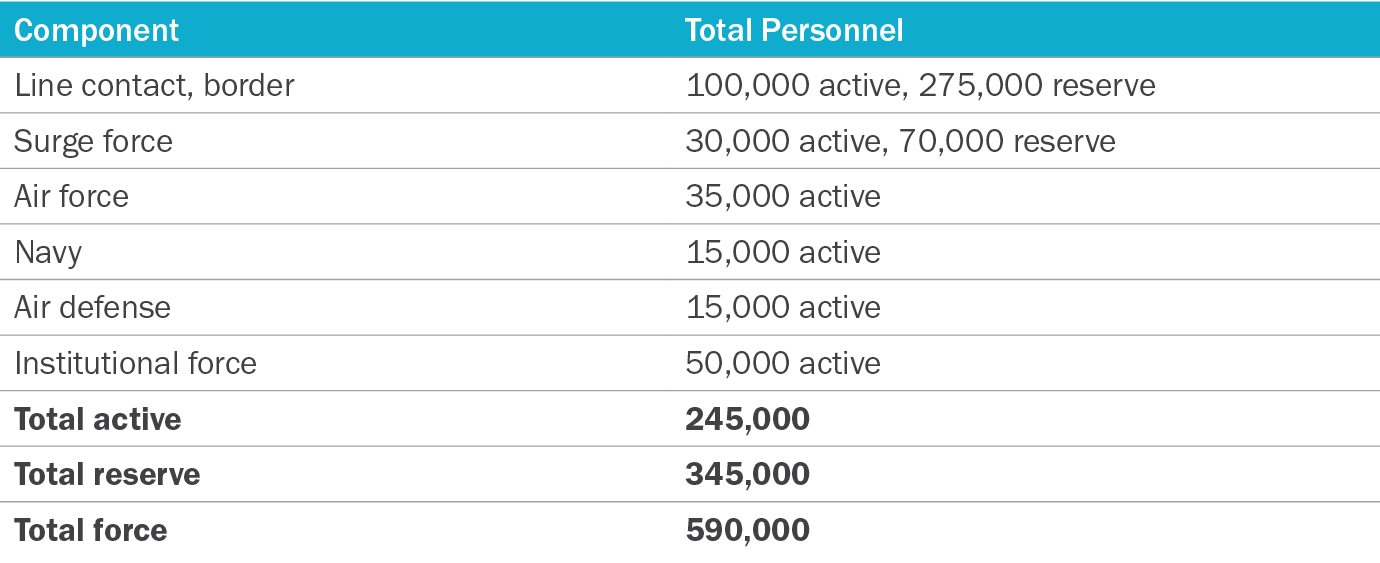
A military of this size would not pose a threat to Russia, which has been able to maintain over 500,000 personnel in Ukraine since the early months of the war. Moscow should, therefore, be willing to accept a Ukrainian military with these general dimensions. Given demographic and resource constraints, a military of this size would be on the upper edge of what Ukraine can sustain and afford, so it should not be necessary to negotiate caps as part of the settlement, which would be politically difficult in Kyiv.
Turning to military capabilities, a defensive denial strategy would rely on a narrow set of military weapons and systems, including anti-tank and anti-personnel mines, cheap attritable drones, short-range artillery and ammunition of many kinds, and the construction equipment, cement, and other materials needed to build barricades, fortifications, and trenches. Ukraine should not need more tanks, however, as they have served limited purpose in the current war. Along its coasts, Ukraine would need naval mines, antiship missiles, and surface and subsurface sea drones. To protect its skies, Ukraine would rely on air defense of many types and ranges, as well as counterdrone and electronic jamming supplemented by aircraft, including the F-16s that it has already received and its remaining Soviet-era fleet.
Ukraine would benefit from a small stockpile of precision missiles—mostly short-range (less than 80 km) rockets and some extended range systems. Long-range missiles with a reach of 500 km or more can support Ukraine’s defense of its civilian infrastructure and strategic targets by giving Kyiv the capability to strike and destroy (also known as the ability to hold at risk) a larger number of Russia’s drone and missile launch platforms. However, the benefits of a long-range strike capability should not be overestimated. Russia will always have the ability to reposition its launch platforms farther away and continue attacks. It also has a larger number of missiles and launchers that give significant resilience to Ukrainian deep strikes. Relying on long-range missiles is also costly and inefficient as a means of defense and deterrence, given Ukraine’s limited resources. Ukraine may derive some deterrent value and some tactical gains from a small stockpile of indigenously produced long-range missiles, but these missiles need not be a centerpiece of Ukraine’s porcupine strategy.
Experience from the Russia-Ukraine war since 2022 can offer guidelines for determining what and how much Ukraine will need to stockpile. It seems reasonable that Ukraine would want to stockpile about a year’s worth of munitions and drones. Doing so would give Kyiv and its partners (if needed and available) time to ramp up production of key systems to supply Ukraine’s military for a longer war. Other metrics may offer better benchmarks for other capabilities. For artillery systems, infantry fighting vehicles, and tanks, for example, it makes more sense to figure out how many of these would be needed to equip a force of the size required for a defensive denial strategy (Table S.2). For air defense, the relevant metric is the number of missiles and drones fired by Russia at Ukrainian cities over the course of the war. Some systems, such as long-range strike, are not strictly required for a defensive strategy. Ukraine’s requirements are listed in Table S.2.
Although many have expressed doubts that Ukraine can build a military capable of deterring Russia over the long term, Ukraine can indeed meet the requirements for a robust defensive military capability in a period of about five years. It can meet these targets largely by relying on indigenous production and Western assistance for only munitions, air defense systems, and interceptor missiles. The hardest area to meet Ukraine’s likely requirements is air defense; Kyiv will need to rely on a mix of systems and likely continue to invest in interceptor missiles beyond the five-year timeline considered here. The required Western assistance is also summarized in Table S.2 and comes with a price tag of $41.5 billion over five years.
Table S.2: Capabilities required for Ukraine’s self-defense

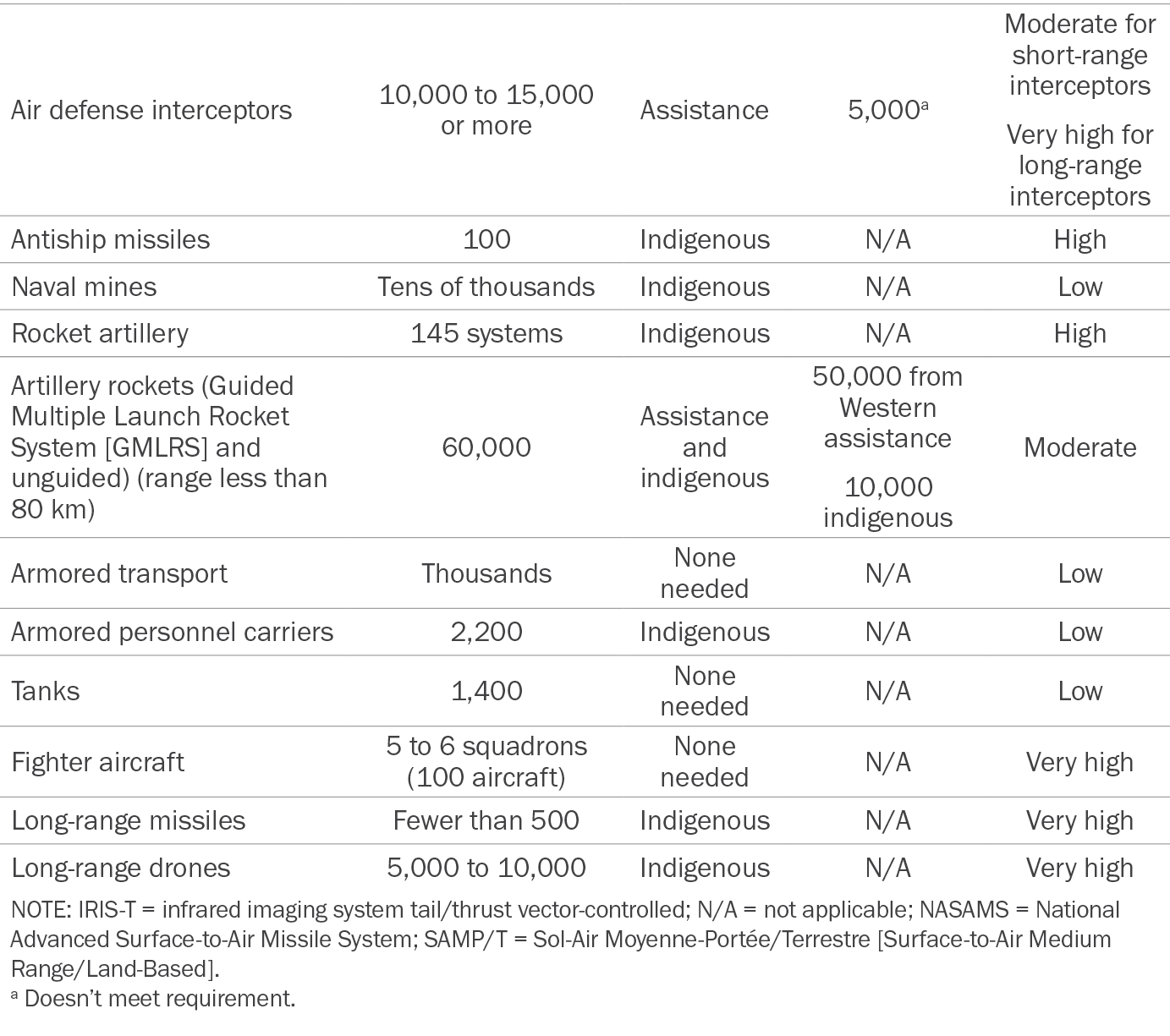
For the most part, the armed Ukraine envisioned in this analysis should not elicit Russian concerns. Of the Western assistance recommended by this analysis, the only sensitive area would be long-range air defense and interceptor missiles, especially longer-range PAC-2 missiles, which Ukraine has used for offensive strikes. Such systems as combat and early warning aircraft and long-range missiles would likely be concerns for Russia if they were included in Western assistance.
Russia’s possible objections to Ukraine’s military holdings will likely be similar. Long-range missiles, long-range air defense, and combat and early warning aircraft will be of primary concern because of their ability to collect data on and strike targets deep inside Russian territory. U.S. High Mobility Artillery Rocket Systems (HIMARS) could trigger Russian objections because they can fire much longer-range missiles than the ATACMS that Ukraine has a small stockpile of, including the Precision Strike Missile (PrSM). Russian sensitivities about Ukraine’s indigenous rocket artillery and most types of ammunition are also likely to be on the low side, with the possible exception of Ukraine’s antiship missiles because of the threat that they could pose to Russia’s Black Sea fleet.
Russia has expressed more concerns about Ukraine’s indigenous production of long-range missiles, of which it now has several variants with ranges longer than 500 km and up to 3,000 km. Ukraine should be allowed to continue this domestic production. Rates of production of these missiles are too low to contribute to large stockpiles, but Ukraine’s ability to produce these missiles in large numbers could grow. This is one of several areas in which negotiators might be able to orchestrate trades, extracting Russian concessions for compromises from Ukraine on areas of concern for Moscow. One approach for long-range missiles might be to allow Ukraine to stockpile some number of cruise and ballistic missiles domestically, maybe in the low hundreds, and then store anything beyond this outside the country, in strategic stockpiles that would be released if Ukraine were attacked again.
Geographic limitations and mutual assurances
Ensuring that any settlement endures will require arrangements to further reduce both sides’ threat perceptions. This might be accomplished by instituting a set of self-imposed geographic restrictions on the deployment of certain military capabilities and forces equipped with certain types of weapons. Such geographic limitations would be adopted on a mutual basis: Russia and Ukraine would agree to reciprocal conditions even if they are not symmetrical in nature. For Ukraine, such measures would reduce the threat of a surprise attack. Given the reduced threat that Ukraine would pose as a nonaligned, defensively postured state, Russia should be willing to take steps to reassure Kyiv that it would not take action if Ukraine does not continue to push for NATO membership. Indeed, such Russian concessions would be another advantage of armed nonalignment for Ukraine.
As a starting point, a settlement should establish a demilitarized zone (DMZ), in which all military personnel and equipment would be prohibited. Ideally this DMZ would be quite wide, up to 10 or 15 km, and stretch across both sides of the line of contact between the two parties. The DMZ would not be the same width across the 2,000-km border, nor would it be symmetrical on the two sides, as it would need to account for the geography, demography, and other features that will vary on the Ukrainian and Russian sides.
Beyond the DMZ, a settlement between Russia and Ukraine could benefit from a series of additional geographic restrictions aimed at creating a larger buffer between the two sides. Verification and monitoring will be difficult and require buy-in from both combatants, as well as an enforcement mechanism. In the current context, one approach might be to establish four security zones on each side of any DMZ. In the first, passive defenses, drones, and light ground personnel (perhaps up to 50,000 troops) would be allowed to operate. At a distance of around 50 km would be a second zone, with short-range artillery, anti-tank guns, and armored vehicles with some heavy forces. The third zone would include Multiple Launch Rocket Systems (MLRS) and rocket artillery at a distance of 100 km, as well as tanks and fighting vehicles. The final zone would apply to long-range missiles and aircraft and might start at a distance of 200 km from the line of contact. As a secondary safeguard, missiles and launchers could be stored separately.
Finally, there is the question of air defense. Limits on short-range air defense and interceptors should not be needed, but some accommodation might be required for longer-range air defense and interceptors. At the very least, more-advanced air defense systems, such Patriots and their Russian equivalents, could be placed at least 50 km from the line of contact with exceptions negotiated for major cities. Other assurances might include transparency between the two sides when it comes to the locations of long-range air defense radars or arrangements that store interceptor missiles and air defense systems separately.
Key findings
The following key findings arise from this research:
- Armed nonalignment is the most feasible approach to Ukraine’s postwar security because it can ensure Ukraine’s ability to defend itself and deter aggression while addressing Russia’s security concerns and accounting for political and resource constraints in the United States and Europe.
- Comparisons to other countries’ security models are instructive, but Ukraine’s nonaligned status will be bespoke. Ukraine will need to formalize this status in some way to make the commitment credible.
- Russia will likely insist on no North Atlantic Treaty Organization (NATO) membership and no hosting of foreign forces. However, Ukraine would continue military exercises with Western partners outside of Ukraine and defense industrial integration with those partners, outside of a formal alliance structure.
- Ukraine will need about 245,000 active-duty forces and a reserve force of at least 345,000 to meet its security and deterrence needs. This will be close to the maximum force size that Ukraine can feasibly recruit and fiscally sustain.
- Using a combination of indigenous production and Western assistance, Ukraine can build a robust military deterrent, including a year’s supply of all types of ammunition and a six-months supply of air defense interceptors, in about five years after the end of the war.
- Ukraine can rely on its own defense production to meets its postwar needs for drones, artillery systems, and armored vehicles. It should not require more tanks and aircraft and can rely on limited domestic production for long-range missiles.
- Ukraine will need Western-provided short-range munitions, air defense systems, and interceptors. This aid could be structured as formal security assurances to Ukraine.
Next steps for implementation
Although it would not be Kyiv’s ideal outcome, armed nonalignment offers Ukraine the surest path to a secure future. It is Ukraine’s most credible security arrangement because it leaves the country’s future defenses in the hands of its own military. It is also the most likely scenario to support an enduring settlement that avoids a return to war, and it is the most feasible outcome, given the constraints on each relevant stakeholder.
Still, implementing Ukraine’s armed nonalignment will come with challenges. There are sure to be disagreements between Ukraine and Russia over some of the details of commitments on each side and what the postwar Ukrainian military will look like. Whatever the final terms, the commitments and requirements of every party (i.e., Russia and Ukraine, but also the United States and European states) should be clearly and transparently defined. Working-level dialogues in the United States, Ukraine, and Russia can begin to sketch out these conditions even as fighting continues in anticipation of an end in the medium term.
Chapter 1: Introduction
Determining arrangements for Ukraine’s postwar security will be a critically important element of a negotiated end to the Russia-Ukraine war. A lasting peace will require an agreement that addresses both Kyiv’s fears about future Russian aggression and Moscow’s security concerns, including those focused specifically on Ukraine and those related to Europe’s security architecture more broadly. The prewar status quo will not be acceptable to either combatant.
In the talks that have occurred since 2022, Moscow has consistently demanded that, in any war settlement, Ukraine commit to permanent neutrality that would prevent Ukraine’s membership in the North Atlantic Treaty Organization (NATO), limit its security ties with the alliance, and rule out the presence of foreign forces inside Ukraine.5Charap and Radchenko, “The Talks That Could Have Ended the War in Ukraine.” Moscow has also insisted on limits to Ukraine’s military capabilities, presumably to minimize threats to Russian territory or Russian-occupied territory in Ukraine.6Faulconbridge, “Putin, Ascendant in Ukraine, Eyes Contours of a Trump Peace Deal”; Soldatkin and Antonov, “Putin Says Any Ukraine Peace Deal Must Ensure Russia’s Security, Vows No Retreat.” Because, at the time of this writing, Russia has the advantage on the battlefield and can afford to keep fighting, Moscow has considerable leverage to push for terms that meet these requirements.
Ukraine will not agree to a war settlement that leaves it both without external security guarantees and demilitarized so that it is unable to defend itself.7Government of Ukraine, “What Is Zelenskyy’s 10-Point Peace Plan?” Kyiv could probably be forced into an unfavorable settlement if conditions on the battlefield worsen or the United States cuts off military aid, but an imposed surrender of this kind is unlikely to last. Instead, an insecure Ukraine that fears renewed Russian aggression would have the incentive (and probably the will and capabilities) to undermine a ceasefire on these terms, either by resuming hostilities outright or by using irregular warfare to impose costs on Russia. To last, a war settlement will need to leave Ukraine confident that it can, at the very least, deter future aggression and defend itself if attacked.
Given these daunting requirements, the most feasible option for Ukraine’s postwar security—and likely the only one able to minimally satisfy requirements for both sides—is a version of armed nonalignment.8For more on the concept of nonalignment, see Rothstein, “Alignment, Nonalignment, and Small Powers: 1945–1965”; Vital, The Survival of Small States; Radoman, Military Neutrality and Nonalignment as Security Strategies of Small States; Ørvik, The Decline of Neutrality 1914–1941; and Flanagan and Osler Hampson, Securing Europe’s Future; and Ørvik, Semi-Aligned Security. Under armed nonalignment, Ukraine would be outside the NATO and other collective defense organizations, but it would not be left defenseless. Instead, it would be armed with defensive military weapons—provided through agreements with the United States and European states—sufficient to deter a renewed Russian invasion and to defend the territory under its control in case deterrence fails. To reduce both sides’ concerns about the risk of new attacks, negotiations could dictate geographic constraints on the deployment of long-range missiles and drones, tanks, and other offensive capabilities. Such provisions should not be unilateral. Instead, if Ukraine agrees to self-limitations on the geographic locations of certain military capabilities or military forces and exercises, Russia should adopt a similar set of self-imposed restrictions.
Ukraine’s armed nonalignment would thus have benefits for both combatants and give them assurances to address their mutual distrust.9Kavanagh, Safeguarding U.S. Interests in a Ukraine War Settlement; Kavanagh and McCallion, “Armed Neutrality for Ukraine Is NATO’s Least Poor Option.” Relying on its own military forces for security will ensure that Ukraine is not left relying on foreign promises that could turn out to be hollow. It is also a means by which Ukraine can get Russia to accept some constraints on its own military capabilities, effectively providing another layer of security for Ukraine. At the same time, armed nonalignment goes the furthest of any settlement options toward addressing Russia’s security concerns with respect to Ukraine’s NATO membership, Western alignment, and military capabilities.
Despite these benefits, however, armed nonalignment has its critics. There are those who argue that armed nonalignment will not work to make or keep peace. These skeptics expect that such an arrangement would leave Ukraine with military capabilities too weak to defend its territory and do little more than set the stage for another Russian invasion.10Ash et al., How To End Russia’s War on Ukraine. If armed nonalignment were to come with onerous caps on Ukraine’s offensive and defensive military capabilities, this might be true. But such caps are not a required component of the armed nonalignment model. Even a final arrangement that limited certain offensive capabilities would still leave the country with the capabilities to protect the territory under its control as long as sufficient defensive weapons and systems were permitted.11Kavanagh and McCallion, “Armed Neutrality for Ukraine Is NATO’s Least Poor Option.” Ukrainian decisionmakers, including President Volodymyr Zelenskyy, increasingly acknowledge that Ukraine’s own military force will act as the central guarantee of the country’s security. After a March 2025 meeting of Europe’s leaders, Zelenskyy said, “[i]t’s obvious that the strength and size of the Ukrainian army will always be a key guarantee of our security.”12As quoted in Irish and Pineau, “Europeans Back Strong Ukraine Army, Differ on Future ‘Reassurance Force.’” This is the essence of armed nonalignment.
Voices on the Russian side criticize armed nonalignment for the opposite reason. Although they welcome that the approach would prevent Ukraine from entering NATO or other military alliances with the West, these critics are concerned that armed nonalignment will allow for a Ukrainian army that is large and well equipped enough to launch successful offensive operations against Russian territory or Russian-occupied territory in Ukraine.13Dickinson, “Putin’s Dream of Demilitarizing Ukraine Has Turned into His Worst Nightmare”; Posen, “Putin’s Preventive War.” This group of critics warns that Moscow will continue to fight (or resume fighting) rather than accept the risk of one of these undesirable outcomes.14Mefford, “The Finlandization Fallacy.”
No postwar arrangement will leave either Ukraine or Russia feeling totally secure.15I thank Eric Ciaramella for his comments on this point. Ukraine will always fear that Russia will resume its aggression. Russia will have to accept that Ukraine is likely to be better prepared militarily than it was before the war and a determined enemy to Russia for decades to come. Still, armed nonalignment is the most plausible model for Ukraine’s postwar security and the one that meets both sides’ minimum requirements for national security. It can also provide a stable equilibrium of capabilities and mutual deterrence after the war that will be conducive to a lasting settlement.
Agreeing on the details of such an arrangement will be difficult. Several sets of issues will need to be addressed. For example, Ukraine will need a way to establish its nonaligned status that is credible to Russia but also feasible, given its legal and constitutional requirements. Even trickier, there will need to be at least a tacit mutual understanding on what a future armed Ukraine might look like, including the size and capabilities of Ukraine’s military.
Beyond agreement between Ukraine and Russia, a plan for Ukraine’s armed nonalignment will need to determine which types of Western military assistance will be used to arm Ukraine and where this assistance will come from. These are not insignificant questions, given constraints on available defense production in the United States and Europe. In fact, the success of armed nonalignment will depend heavily on the ability of the United States, Europe, and Ukraine to build up Ukraine’s defensive military capabilities so that the country can preserve its remaining territory and deter future Russian aggression. Doing so will take time, but Ukraine’s military need not be built in a month or even a year. Russia will need time to rest its soldiers and refit its military forces, affording Kyiv and its Western partners five to ten years after a settlement to strengthen Ukraine’s defenses.16Grisé et al., Russia’s Military After Ukraine. Timing will be important; Ukraine will want to build the core of its defensive barriers quickly and work to fill in other capabilities over time, but U.S. and European defense production constraints may limit the speed of any buildup.
Scope
Ukraine’s postwar security arrangements will be one of several key elements of a negotiated end to the war. This negotiated outcome will also address a variety of other issues, including control of territory, phased relief of sanctions, humanitarian issues, and, importantly, commitments from Russia to address the insecurity its aggression has created in Ukraine and Europe. These issues will be essential to a lasting settlement and are no less important than the specific arrangements required for Ukraine’s postwar security, but they are beyond the scope of this report.
Methodology and structure
In this report, I consider the feasibility of implementing armed nonalignment as Ukraine’s postwar security model. I will first consider the full variety of security arrangements that might be available to Ukraine and their advantages and disadvantages, including the extent to which these arrangements can support a lasting settlement and which are most politically feasible, given considerations of credibility and the concerns of key stakeholders. I will then examine the different ways that armed nonalignment could be implemented, including legal mechanisms to establish Ukraine’s nonaligned status, what an armed Ukraine might look like, and how Ukraine would get access to necessary weapons to support its self-defense in the short or long term. To do so, I combine a variety of methodologies, including a historical review of similar cases, extensive analysis of Ukrainian military campaign analysis to evaluate requirements, and an assessment of the defense production capacities of Ukraine, European states, and the United States. These methodologies are supplemented with findings from unstructured discussions conducted with Russian and Ukrainian military experts over the course of 2025.
The key takeaway is that it appears possible to build an armed and nonaligned Ukraine capable of defending itself within about five years after the war, given some limited U.S. and European support, while still addressing Russia’s security concerns. Should this approach be adopted as part of a future settlement, this report can offer a roadmap for policymakers to move toward implementation.
Chapter 2: Alternative security arrangements for Ukraine
The following are likely to be the three dimensions of Ukraine’s postwar security model:
- Security guarantees and commitments are arrangements in which one country or a group of countries promises another country military protection or assistance to support its national defense during peacetime or in the event of external aggression.17Walter, “The Critical Barrier to Civil War Settlement”; Fortna, Peace Time. The term security guarantee is sometimes used broadly to cover a wide variety of different types of support, but in the context of U.S. military and diplomatic parlance and documents, a security guarantee typically refers only to binding commitments to support another country’s self-defense in the event of an attack, including by sending U.S. military forces. NATO’s Article 5 and similar provisions in U.S. security agreements with Japan and South Korea are security guarantees under this definition. Other commitments—for example, the promise of military aid—are not.18Bilefsky, “Ukraine Has Asked for ‘Security Guarantees’ to Make Peace with Russia. What Does That Mean?”; Charap and Shapiro, “Elements of an Eventual Russia-Ukraine Armistice and the Prospect for Regional Stability in Europe.” Israel does not have a formal security guarantee from the United States, for instance, but does have a codified security commitment that includes military aid and promises from Washington to take remedial action if Israel is attacked (by Egypt).19Charap and Shapiro, “Elements of an Eventual Russia-Ukraine Armistice and the Prospect for Regional Stability in Europe.” For Ukraine, postwar arrangements could vary and include binding guarantees of direct military support in the event of a future attack or more-limited commitments of peacetime or wartime military aid. It is also possible, however, that Ukraine would be without security guarantees and commitments of any kind.
- Military alignment is determined primarily by a country’s alliances and formal security partnerships, especially those that determine which side it might take in a conflict.20Charap and Shapiro, “Elements of an Eventual Russia-Ukraine Armistice and the Prospect for Regional Stability in Europe”; Soldatenko, “Exploring Ukraine’s Armed Neutrality or Nonalignment”; Ørvik, Semi-Aligned Security; Mueller, “Alignment Balancing and Stability in Eastern Europe.” For Ukraine, formal alignment with the United States or Europe would occur most likely through NATO membership or some other bi- or multilateral military alliance. Under neutrality, Ukraine would give up seeking NATO membership and eschew participation in other mutual defense treaties and organizations; it would also agree to bar foreign forces from Ukrainian territory and limit military cooperation with foreign partners that might force Ukraine to take sides in a future conflict.21Soldatenko, “Exploring Ukraine’s Armed Neutrality or Nonalignment.” Nonalignment does not have a formal legal definition and is a more flexible concept. Nonaligned states do not join formal military alliances but often have a variety of different types of security partnerships that fall below that level. In practice, nonaligned states also aim to maintain military independence, which can mean limiting the basing of foreign forces or arrangements that include deep military integration with a partner. Ukraine’s postwar security arrangement will be bespoke and could include some mix of these formal and informal categories.
- The size and capabilities of Ukraine’s military have grown since Russia’s full-scale invasion of Ukraine.22Kuzan, “Ukraine’s Growing Military Strength Is an Underrated Factor in Peace Talks”; Sanders, “Ukraine’s Third Wave of Military Reform 2016–2022.” On the one hand, Russia has demanded Ukraine’s “demilitarization” as a condition for a settlement, hoping to see the country’s military capped in size and capabilities.23Graham, “Russia’s Peace Demands on Ukraine Have Not Budged.” On the other hand, Ukraine would like a large military force that can maintain a forward defense posture armed with extensive offensive and defensive capabilities, including long-range strike.24Irish and Pineau, “Europeans Back Strong Ukraine Army, Differ on Future ‘Reassurance Force.’” There are, of course, a variety of options in between, some involving voluntary limits on Ukraine’s military force and others using mutual restrictions on Ukraine and Russia (e.g., geographic commitments regarding the basing of forces or capabilities). As with Ukraine’s alignment, this will ultimately be negotiated between the war’s stakeholders.
Choices made across these three dimensions could result in a variety of different security models for Ukraine, some of which have historical precedents or present-day manifestations, which will be discussed in this chapter. Ukraine’s final security arrangement will not look exactly like any of those examples; it will be unique based on Ukraine’s specific circumstances, how the war ends, and what happens at the negotiating table. But these cases, their advantages and disadvantages, and the conditions under which they endured or collapsed can help map out the option space for Ukraine. Likewise, an examination of the feasibility of these historical models, focused on credibility and political concerns, can identify which security parameters may be most within reach for Ukraine.
Exploring alternative security arrangements
Table 2.1 shows a variety of models that vary based on the security guarantees and commitments, military alignment, and military capabilities. Ukraine’s ultimate postwar security arrangement will not be an exact replica of any one of the cases presented here but may be some mix of parameters taken from these examples and designed specifically for Ukraine.
Table 2.1: Security models

Alliances and quasi-alliances
NATO and other U.S. mutual defense relationships
The most desirable approach from Ukraine’s perspective would be one that combines credible security guarantees with clear Western alignment and no caps on its military forces. The best multilateral example of this security arrangement is NATO. Members of NATO receive binding security guarantees under Article 5, which states that an attack on one member state will be viewed as an attack on all member states. NATO member states also have their own militaries of varying sizes and capabilities.25NATO, Handbook, 2006. Some NATO members have modified arrangements to fit their specific needs or to address sensitivities and geographic considerations. Norway is a member of NATO but does not permit the permanent deployment of allied forces on its territory or host U.S. nuclear weapons. Denmark has a similar set of limitations on foreign deployments during peacetime, including a stipulation that foreign forces cannot deploy on Danish territory unless invited.26Ørvik, Semi-Alignment and Western Security. These countries are still integrated into NATO institutions, however, and are covered by the Article 5 guarantee.27Westfall and Ilyushina, “Here’s What Russia and Ukraine Have Demanded to End the War.”
At the bilateral level, the United States has similar mutual defense relationships with such countries as Japan and South Korea. These countries enjoy U.S. security guarantees that promise American military support in the event of external aggression, including, if necessary, direct participation by U.S. military forces. As a part of both the NATO alliance and these bilateral mutual defense commitments, the United States has historically based large numbers of U.S. military personnel in Europe, Japan, and South Korea.28Japan-U.S. Security Treaty; Mutual Defense Treaty Between the United States and the Republic of Korea.
Feasibility for Ukraine
These models are likely not feasible for Ukraine. The most significant reason for this lack of feasibility has to do with credibility. The United States and other NATO allies have twice in the recent past (2014 and 2022) refused to send military forces to directly support Ukraine following Russian invasion and continue to refuse to send military personnel to Ukraine. Having already revealed their lack of political will to fight for Ukraine, and in the absence of some major political or strategic shift, offering Ukraine an alliance commitment or NATO membership that would entail a binding promise to do what has already been refused would seem hollow.29Goldberg, “The Obama Doctrine”; Wolf, “Here’s What Biden Has Said About Sending US Troops to Ukraine.” Notably, the NATO-lite options adopted by Norway and Denmark would suffer from these same basic limitations.
Critics of this line of reasoning could argue that it is Ukraine’s lack of alliance membership that explains why NATO members stayed on the sidelines in 2014 and 2022.30Centre for Eastern Studies “If Ukraine Was in NATO, Would Russia Have Attacked?” It is impossible to evaluate this counterfactual with any certainty, but the history of U.S. military operations makes clear that the United States does not need a formal treaty commitment to send military forces to intervene in conflicts in which Washington sees U.S. interests at stake.31Kavanagh et al., Characteristics of Successful U.S. Military Interventions. The decisions made by U.S. Presidents Barack Obama, Joseph Biden, and Donald Trump not to intervene offer strong evidence that U.S. policymakers do not see vital U.S. interests on the line in Ukraine.32Kavanagh and McCallion, “Armed Neutrality for Ukraine Is NATO’s Least Poor Option.”
Accepting Ukraine as a NATO member would create new political pressures for U.S. military action if Ukraine were attacked again and raise the stakes for U.S. credibility, but these pressures and stakes are still no guarantee that the United States or other NATO members would respond by sending military forces into Ukraine.33Kavanagh and McCallion, “Armed Neutrality for Ukraine Is NATO’s Least Poor Option”; Friedman, “Neutrality not NATO: Assessing security options for Ukraine”; Logan and Shifrinson, “Don’t Let Ukraine Join NATO.” Article 5 of the North Atlantic Treaty specifies that, in the event of an attack on a member state, other members “will assist the Party or Parties so attacked by taking forthwith, individually and in concert with the other Parties, such action as it deems necessary.”34NATO, “Collective Defence and Article 5.” Military action is one possible response, but it is by no means promised or required.35Rumer, “Neutrality.” But there is no assurance that the politics would work in Ukraine’s favor, and much would depend on the United States’ decision, because the rest of Europe has shown limited ability or appetite for military action in Ukraine without U.S. backing.36Fornusek, “‘Coalition of the Willing’ for Ukraine Stalls over Lack of US Backstop, Bloomberg Reports.”
There are other reasons why Ukraine is unlikely to receive NATO membership or a bilateral alliance with the United States. First, especially under the Trump administration, Washington has made clear that Ukraine will not receive NATO membership as an outcome of this war, in part because there is a growing reluctance in Washington to take on additional security responsibilities in Europe and especially in Ukraine. This position is not unique to Trump, however. Presidents Biden and Obama also assessed that Ukraine’s strategic importance to the United States did not warrant NATO membership or direct U.S. military intervention against Russia’s invasions.37Bose and Singh, “Trump: Not Practical for Ukraine to Join NATO, Get Back All Land.”
Even if the United States was willing to offer Kyiv this type of deal, Russia is almost certain to reject a settlement that leaves Ukraine allied with the United States inside or outside NATO. Moscow has made its insistence on Ukraine’s nonalignment a core demand; Russia will likely prefer continued war over such an outcome.38Menkiszak and Rodkiewicz, “Meeting in Istanbul.” Ukraine’s NATO membership is thus not a realistic condition for an armistice.
Israel model
Beyond the formal alliance model, the United States has several quasi-allies with which it does not have treaty commitments but does have unique military relationships and semi-alignment. As one example, the United States first extended a limited security commitment to Israel in the 1973 treaty that ended the war with Egypt. As a part of this settlement, the United States promised to take “remedial action” if Egypt were to violate the ceasefire, though what this entailed was never specified.39Charap and Shapiro, “Elements of an Eventual Russia-Ukraine Armistice and the Prospect for Regional Stability in Europe”; Ciarmella, Envisioning a Long-Term Security Arrangement for Ukraine; Lewis, “The United States and Israel.” The relationship was further formalized in a 1975 memorandum of agreement between Israel and the United States that committed Washington “to be fully responsive, within the limits of its resources and Congressional authorization and appropriation, on an on-going and long-term basis to Israel’s military equipment and other defense requirements, to its energy requirements and to its economic needs.”40Memorandum of Agreement Between the Governments of Israel and the United States. The United States committed to providing Israel military aid each year, including money that could be invested in Israel’s defense industrial base. Since 1981, this aid has been guided by the concept of the qualitative military edge that the United States aims to provide Israel in terms of its military technology compared with its regional neighbors. The concept has no formal definition but often includes access to the most-advanced U.S. systems and intelligence before other countries in the region.41Haig, statement for the record submitted in response to question from Clarence Long.
Israel enjoys wide latitude when it comes to the types of military assistance it can receive from the United States—very little is off-limits—and it has built a large and capable military. The original memorandum of agreement has been extended in ten-year increments since 1975; Israel now receives close to $4 billion in military assistance per year.42“Rubio Signs Declaration to Expedite Delivery of $4 Billion in Military Aid to Israel”; U.S. Department of State, “U.S. Cooperation with Israel”; Masters and Merrow, “U.S. Aid to Israel in Four Charts.” Israel also benefits from other types of U.S. military support that fall just short of a full security guarantee. The United States frequently surges military power into the Middle East whenever Israel seems to face a heightened threat from abroad and has even acted as a backstop of sorts, offering air defense support when Israel has faced kinetic attacks. In 2024 and 2025, for instance, the United States supported Israel’s efforts to shoot down Iranian drones and missiles aimed at Israeli targets and eventually joined Israel’s war against Iran, conducting airstrikes on Iranian nuclear targets.43Clayton and Zanotti, “Israel-Iran Conflict, U.S. Strikes, and Ceasefire.”
Feasibility for Ukraine
Many have suggested that the Israel model would be a good one for Ukraine—including Kyiv itself. However, this model is most likely not replicable, at least not as a package. As with the alliance models described above, there are credibility considerations. The United States provides Israel a level of support that it is has not been willing to provide Ukraine in terms of types of direct military aid and security assistance (e.g., weapons). Although the United States assisted Israel in shooting down missiles launched toward its territory by Iran, Washington has explicitly refused to do the same for Ukraine.44Melkozerova, Gramer, and McLeary, “Ukraine Bridles at No-Holds-Barred US Support for Israel.” The United States also sells Israel advanced missiles, aircraft, and other defense systems that it has not been willing to send to Ukraine. An offer to Ukraine of an Israel-style commitment in the future, when the United States has demonstrated a willingness to do so thus far, would not be credible.
There are also political limitations and constraints that Ukraine would face that Israel does not. Military support to Israel is bolstered by historically bipartisan U.S. political support that Ukraine does not enjoy. In fact, there is political resistance to long-term commitments of military aid to Ukraine, especially from some in the U.S. Republican Party.45Riccardi, “How Stalled U.S. Aid for Ukraine Exemplifies GOP’s Softening Stance on Russia.” This resistance would be a possible barrier to any potential application of the Israel model to Ukraine.
Although the Israel model is unlikely to work for Ukraine in full, some aspects of this model could be useful (for example, the remedial action commitment made by the United States in 1973). In Ukraine’s case, the United States or other NATO allies might promise to provide additional military assistance, expand intelligence-sharing, or impose new economic costs on Russia if Moscow were to invade Ukraine again.
Taiwan model
Taiwan also has a special security relationship with the United States.46Ciarmella, Envisioning a Long-Term Security Arrangement for Ukraine. The United States had a mutual defense agreement with Taiwan up until 1979, when the United States shifted its diplomatic recognition to China. In response to this move, the U.S. Congress then passed the Taiwan Relations Act. This act commits the United States to continue to augment Taiwan’s defenses with defensive military assistance and “to maintain the capacity of the United States to resist any resort to force or other forms of coercion that would jeopardize the security, or the social or economic system, of the people on Taiwan.”47Public Law 96-8, Taiwan Relations Act. The legislation does not specify which types of aid or measures would be required, which gives the U.S. President some discretion. Taiwan is therefore not formally a U.S. ally, nor does it have a U.S. security guarantee. But, in practice, its relationship with the United States is deeper than the average security partner, in a sort of semi-alignment.
U.S. policy toward Taiwan has long been one of strategic ambiguity, in which Washington neither commits to defend Taiwan nor definitively declines to do so, in hopes of simultaneously deterring China from using coercion against the island and Taiwan from declaring independence.48Glaser, Bush, and Green, Toward a Stronger U.S. Taiwan Relationship. The United States continues to send weapons to Taiwan and reportedly has military trainers on the island, despite Beijing’s protestations.49Ciaramella, Envisioning a Long-Term Security Arrangement for Ukraine; Green and Glaser, “What Is the One China Policy and Why Does It Matter?” The U.S.-China bargain over Taiwan has worked so far, preventing a war in the Taiwan Strait. But the equilibrium is under threat, and Taiwan remains the flashpoint that is most likely to drag the United States and China into a war.
Feasibility for Ukraine
As with the Israel model, some parts of the Taiwan model are replicable for Ukraine, but others are very clearly not. The United States could make a formal, codified commitment to supply Ukraine arms to support its defense, as it did for Taiwan.50Public Law 96-8, Taiwan Relations Act; Gordon, “A Security Guarantee for Ukraine?” In fact, something similar already exists, signed under President Biden as an executive agreement.51Bilateral Security Agreement Between the United States of America and Ukraine, June 13, 2024. The U.S.-Ukraine bilateral security agreement was signed in 2024 as a ten-year arrangement that committed the United States to “build and maintain Ukraine’s credible defense and deterrence capability.”52Soldatenko, “The U.S.-Ukraine Security Agreement Is What the Parties Will Make of It.” As with the Israel model, it is not clear that there is the same political appetite for an indefinite and open-ended commitment to Ukraine as there is for Taiwan, but some form and duration of U.S. military assistance after a settlement seems within reach.
It would be much harder, however, for the United States to credibly promise to “maintain the capacity of the United States to resist any resort to force or other forms of coercion that would jeopardize the security, or social or economic system, of the people” of Ukraine, when it has very clearly not done so in the past.53Public Law 96-8, Taiwan Relations Act. Moreover, the United States has long defined Taiwan as a crucial linchpin of American power. Ukraine has never held this level of importance for the United States, and it is unrealistic to assume that it would do so in the future.54Sentner, “Trump Gives His ‘Assurance’ for No US Boots on the Ground in Ukraine.” It is unlikely, then, that the United States would ever make such an expansive commitment to Ukraine as it did to Taiwan in 1979.
Neutral states
The models considered so far include only aligned states or states with de facto U.S. military alignments. There are also models for fully neutral and nonaligned states. As noted previously, neutral states stay outside military alliances and commit to avoid partnerships and commitments that would make it hard to avoid taking sides in a future conflict. Neutral states can have their own militaries and security guarantees, so long as those guarantees are not mutual defense commitments of any kind. There are several examples of this type of arrangement.
Belgium, Malta, and the Istanbul communiqué
Belgium from 1839 to 1914 is an example of a state that combined neutrality with binding multilateral security guarantees. By the terms of the Treaty of London of 1839, Belgium was made an independent state but accepted neutrality. This neutrality was guaranteed by the United Kingdom, Austria, Russia, France, and Prussia.55Treaty of London of 1839. Belgium had its own military force under this model, though it was small. This arrangement endured successfully for 75 years but collapsed in 1914 when German forces invaded Belgium on the way to France. In accordance with its obligations, the United Kingdom entered the war.56Treaty of London of 1839; Charap, “Ukraine’s Best Chance for Peace.” That the United Kingdom felt compelled to enter the war is evidence that its guarantees were quite credible.
A more recent but similar example is the case of Malta. After British forces left Malta in 1979, the country declared its neutrality and positioned itself with the Cold War nonaligned movement. Given Malta’s strategic location, however, NATO member states were concerned that they would lose their foothold on the island and the Soviet Union would seize the opportunity to expand its footprint. In 1980, Italy agreed to offer a security guarantee of Malta’s neutrality in case it faced external aggression.57Galea, “Malta and Neutrality”; U.S. Department of State, “U.S. Policy Toward Malta.” In 1981, Malta signed a parallel agreement with the Soviet Union under which Moscow agreed to support the island’s neutrality as well.58Galea, “Malta and Neutrality”; U.S. Department of State, “U.S. Policy Toward Malta.” Technically, as a successor to the Soviet Union, Russia has a commitment to recognize Malta’s neutrality. Malta is not without its own military, though it is small. It is also a member of the European Union (EU). If the Malta model were applied to Ukraine, a neutral Ukraine could receive a guarantee of its neutrality from the United States and sign an agreement with Russia to support this neutral status.59Soldatenko, “Exploring Ukraine’s Armed Neutrality or Nonalignment.”
A third variant of this model was included in the Istanbul communiqué, a draft proposal developed by Russia and Ukraine early in the war that set out the terms of a possible deal between the two countries. Although negotiations collapsed and the agreement was never signed, the framework is still referenced as a possible starting point for resumed settlement talks. Under the terms proposed in the communiqué, Ukraine would accept permanent neutrality, and, if the country were attacked again, the guarantors would be treaty bound to hold urgent and immediate consultations (which shall be held within no more than three days) among them, in the exercise of the right to individual or collective self-defense… will provide (in response to and on the basis of an official request from Ukraine) assistance to Ukraine, as a permanently neutral state under attack, by immediately taking such individual or joint action as may be necessary… using armed force in order to restore and subsequently maintain the security of Ukraine as a permanently neutral state.60As quoted in Soldatenko, “Exploring Ukraine’s Armed Neutrality or Nonalignment.”
The wording of the proposed guarantees was even more far-reaching than Article 5 in the demands it placed on guarantors. Russia later attempted to include a stipulation that would require any intervention to be agreed to by all guarantor states, giving Russia a veto over any military assistance offered to Ukraine. Ukraine objected to this provision, but it is unclear whether some agreement might have been reached if negotiations had endured.61Troianovski, Entous and Schwirtz, “Ukraine-Russia Peace Is as Elusive as Ever”; Soldatenko, “Exploring Ukraine’s Armed Neutrality or Nonalignment.”
Feasibility for Ukraine
Although the arrangement proposed in the Istanbul communiqué might have been acceptable to both Russia and Ukraine in 2022, implementing this model, the one used by Belgium in 1939, or the one used in Malta in 1981 would face challenges, in terms of both credibility and political will. Most importantly, any model that requires the United States or European countries to commit to send military forces to defend Ukraine (or, more precisely, its neutrality) in case of external aggression would not be credible because these countries have refused to do so in the past. The United States specifically could not credibly commit to offer Ukraine a guarantee like the one that Italy has provided Malta, because it has already proven that it is not willing to directly intervene to defend Ukraine. The Trump administration in particular has rejected any commitment that would include the possibility of U.S. forces on the ground participating in Ukraine’s defense.62Hegseth, “Opening Remarks by Secretary of Defense Pete Hegseth at Ukraine Defense Contact Group (As Delivered).”
Beyond credibility, there are other political considerations that would interfere with the adoption of a model similar to that proposed in the Istanbul communiqué or used for Belgium in 1939. Russia has indicated that it is still open to an arrangement like the one outlined in Istanbul. However, for Ukraine, after four years of war, having Russia as one of its security guarantors is a nonstarter.63“Russia’s Lavrov Outlines Terms for Ukraine Peace: Big Power Security Guarantee.” Russia, meanwhile, has indicated that it will not accept an arrangement that includes security guarantees in which Moscow is not included as one of the guarantors. Combined with credibility concerns, political constraints seem to rule out the Istanbul or Belgium approach for Ukraine.
Finland during the Cold War
Neutrality does not always come with security guarantees, however. Finland’s situation during the Cold War is a case of a country that was forced to accept neutrality, had no security guarantees, and had caps placed on its military forces as a condition of the Treaty of Peace with the Soviet Union that was signed in 1947.64Treaty of Peace with Finland; Aunesluoma and Rainio-Niemi, “Neutrality as Identity?” In subsequent agreements with Moscow, Helsinki also accepted constraints on its foreign and defense policy and agreed to orient its military force away from its eastern border with Russia.65Agreement of Friendship, Cooperation, and Mutual Assistance between the Union of Soviet Socialist Republics and the Republic of Finland.
Known as Finlandization, Finland’s Cold War model for foreign policy is generally described in negative terms and as an undesirable outcome for Ukraine or any other state, largely because of Finland’s forfeited control over its own military and defense decisions and the caps placed on its military development. But critics of Finlandization tend to ignore the successes of Finland’s Cold War approach to self-defense. Although its active-duty force was capped in size, no limits were placed on its reserve force, which Finland grew to consist of several hundred thousand high-readiness forces that could be mobilized and deployed quickly.66Arter, “From Finlandisation and Post-Finlandisation to the End of Finlandisation?”; Häkkinen and Kaarkoski, “Willingness to Defend and Foreign Policy in Sweden and Finland from the Early Cold War Period to the 2010s.” In addition, Finland’s total defense concept ensured that, beyond the active duty and reserve force, the country’s population was both resilient and ready to serve in civil defense roles as necessary.67Visuri, “Evolution of the Finnish Military Doctrine, 1945–1985.” Defense functions were localized, to an extent, and arms depots and command structures were decentralized to encourage rapid response and flexibility.68Visuri, “Evolution of the Finnish Military Doctrine, 1945–1985.”
Finland faced restrictions on military capabilities, including on air-to-air missiles (which it did not have until 1980) and modernized fighter aircraft (which it received in 1962). It was not until the late 1950s that Finland was even able to update its artillery systems. (Each of these changes was negotiated with the Soviet Union.69Visuri, “Evolution of the Finnish Military Doctrine, 1945–1985.”) To ensure its self-defense despite these constraints, Finland adopted a territorial defense strategy and invested heavily in its production of defensive military equipment not limited under the Paris Treaty, turning itself into a hard-to-attack porcupine.70Vital, The Survival of Small States; Tomas Ries, Cold Will. This territorial defense strategy relied on a variety of more-defensive capabilities—artillery and anti-tank mines, for instance—and exploited passive defenses, including physical barriers, hardening of infrastructure, and border surveillance, to respond quickly to border violations. The strategy also exploited Finland’s geography to support its self-defense, making use of its forests, rivers, and vast territory to create obstacles that would impede, entrap, and wear out any attackers.71Ålander, “Defense Capability—the Secret of Finnish Happiness?”; Wither, “Back to the Future?”; Ries, Cold Will. In terms of procurement, Finland focused on mobility and firepower to maximize the combat capability of its lean fighting force.72Visuri, “Evolution of the Finnish Military Doctrine, 1945–1985.”
It’s true that Finland’s post–World War II defense strategy was never tested by Moscow, but military analysts generally offer favorable assessments of Finland’s defensive strengths. Most importantly, the approach allowed Finland to preserve its sovereignty and maintain a stable relationship with its much bigger and better-armed neighbor.73Ries, Cold Will; Vital, The Survival of Small States. Moscow was satisfied with the arrangement. It did not control Finland, but it still benefited from a stable border on its northwestern flank.74Ålander, “Defense Capability—the Secret of Finnish Happiness?”; Ries, Cold Will; Vital, The Survival of Small States.
Feasibility for Ukraine
The Finlandization model is not one Ukraine will find ideal, but it is not necessarily a bad one, and it is more feasible and realistic than many of the other models discussed in this chapter.75Sweeney, “Saying ‘no’ to NATO—options for Ukrainian neutrality”; Van Evera, “To prevent war and secure Ukraine, make Ukraine neutral”; Friedman, “Neutrality not NATO: Assessing security options for Ukraine”; Kavanagh, “Safeguarding U.S. interests in a Ukraine war settlement.” Neutrality, or some form of nonalignment, would keep Ukraine out of NATO, addressing a core Russian redline. Meanwhile, Ukraine could replicate the defense strategy and procurement approach used by Finland to build strong defenses that are capable of deterring future aggression. On this score, Ukraine already has some advantages: Its military balance is more favorable compared with Russia than was true with Finland and the Soviet Union, and its defense industrial base is much stronger than Finland’s was.
There are some differences between Finland’s World War II experience and Ukraine, however. First, Russia does not have the same historical relationship with Finland that it does with Ukraine, and therefore lacks the same imperial ambitions toward Finland as it has in Ukraine. As a result, it might have been more lenient with Finland than it wants to be with Ukraine when it comes to imposing caps on military capabilities. However, Ukraine also has more leverage than Finland did at the end of World War II and can likely avoid the most-severe restrictions that Russia might try to impose. Second, Russia benefited from Finland’s militarization to a degree, because it formed a physical buffer between Russia and the rest of Europe that offered it protection.76Vital, The Survival of Small States; Menon and Snyder, “Buffer Zones”; Lieven, “Restraining NATO.” This also may have worked in Finland’s favor in a way that is unlikely to help Ukraine. Ukraine can only serve a buffer for Russia if Moscow controls Kyiv’s political leadership, which is not the case as of this writing.
Overall, Finland’s Cold War experience offers Ukraine a model that is feasible and would ensure its long-term security, even if it would require that Kyiv accepts a neutral status.
Nonaligned states
As with neutral states, nonaligned states remain outside of formal alliances. But because nonalignment is a policy concept and not a legal status, they have more flexibility in their choices about which types of military activities to pursue. In this sense, it is best to think of nonalignment as operating on a spectrum. States can be nonaligned and have very few security partnerships, or they can be nonaligned and have many types of partnerships and relationships that vary from limited in nature to extensive, including hosting of military forces and participation in military exercises.77Soldatenko, “Exploring Ukraine’s Armed Neutrality or Nonalignment”; Ørvik, Semi-Aligned Security; Mueller, “Alignment Balancing and Stability in Eastern Europe.” If Ukraine adopts a form of nonalignment, its terms are likely to be specific to its circumstance and negotiated jointly with Moscow and U.S. and European partners, so it may not follow any of these models exactly. Still, it is useful to consider what lessons might be offered form the experiences of nonaligned countries.
Vietnam and post-Cold War Finland and Sweden
Some nonaligned states are without alliances or security guarantees. Vietnam, for instance, adopted its nonaligned status willingly, seeing it as the best way to avoid being dragged unwilling into major power wars, especially after the Vietnam War involving the United States and its 1979 war with China.78Yaacob, “Vietnam’s Flexible Nonalignment.” The country’s “four no’s” policy prevents it from taking sides in international conflicts, joining military alliances, hosting foreign forces, or establishing foreign military bases inside Vietnam, and it urges against the use or even threat of force in dealing with other countries.79Shidore, “What the US Can Learn from Vietnam’s Four No’s”; Tuan, “Vietnam Continues ‘Four Nos’ Defense Policy.” Vietnam’s policy does not prohibit military relationships for training or intelligence-sharing with other countries, which Vietnam engages in quite extensively.80Shidore, “What the US Can Learn from Vietnam’s Four No’s”; International Trade Administration, “Vietnam Country Commercial Guide: Defense and Security Sector.” Vietnam has pursued balance, however, forging partnerships with many nations. In 2024, it was the only country to host visits from Chinese President Xi Jinping, Russian President Vladimir Putin, and President Biden.81Le Thu, “Hanoi’s American Hedge”; Schaufelbuehl et al., “Non-Alignment, the Third Force, or Fence-Sitting.” At the same time, without security guarantees or any assistance, Vietnam has built a strong military force and an effective maritime militia to defend its coastal territories from Chinese encroachment.82Parameswaran, “What’s Next for Vietnam’s Maritime Militia?”
Between the end of the Cold War and their entrance into NATO in 2023 and 2024, Finland and Sweden were also formally nonaligned countries: They avoided binding military alliances but they still established a deep connection with NATO and other NATO member states while Vietnam has not aligned with any one security bloc.83Chatterjee, “How Sweden and Finland Went from Neutral to NATO”; Kjellström Elgin and Lanoszka, “Sweden, Finland, and the Meaning of Alliance Membership.” For example, both countries became NATO partners, participated in NATO missions abroad (including Sweden’s participation in NATO operations in Libya), and Sweden agreed to host NATO training exercises.84Chatterjee, “How Sweden and Finland Went from Neutral to NATO”; Kjellström, Elgin, and Lanoszka, “Sweden, Finland, and the Meaning of Alliance Membership”; Egnell, “The Swedish Experience.” As a result, even before NATO membership, these countries had deeply integrated their militaries with NATO. They remained formally nonaligned but benefited in many ways from their position just on the edge of the NATO alliance. Neither Finland nor Sweden would have benefited automatically from Article 5 protection or the assured provision of military or economic assistance had these countries been attacked prior to 2023, but both had at least some expectation of NATO protection because their close integration with NATO members. They would, however, have been covered by the EU’s mutual assistance provision—Article 42.7 of the Lisbon treaty.
Feasibility for Ukraine
A security arrangement similar those that Finland and Sweden had after the Cold War or Vietnam had after 1976 is a model that Ukraine might strive for and one that is likely feasible, to an extent. The approach would leave Ukraine outside major alliances, but allow it to develop the military capabilities needed to defend itself and build significant military partnerships and cooperation with U.S. and European partners.
From the perspective of the United States and other NATO allies, this model would likely be acceptable. Most European partners have indicated that they hope to maintain a close military partnership in Ukraine, even if it is not a NATO member, through military sales, defense industrial cooperation, and military training.85See for example, European Council, “EU Military Support for Ukraine”; and Grand, Kobzova, and Popescu, “Preventing the Next War.”
Past statements from Moscow indicate that Russia would likely have concerns about some parts of the Finnish and Swedish experience in the post-Cold War period—specifically the hosting of NATO training exercises—especially those aimed at increasing interoperability with NATO, and the deep integration between the two Nordic states and NATO militarily. But Russia is unlikely to be able to stop all forms of cooperation between Ukraine and NATO members if Ukraine were to be nonaligned. Defense industrial cooperation, for example, and training activities outside Ukraine are things Russia would likely agree to, especially on a bilateral basis or outside of NATO. Much defense industrial integration has already occurred and will be hard to unwind.
Importantly, this model comes with no guarantees or commitments, something that Ukraine has insisted is necessary for an enduring armistice. This could be a political barrier on the Ukrainian side if the arrangement is seen as insufficient to ensure the country’s future rearmament.
Egypt
Vietnam after 1976 and Finland and Sweden during the Cold War are examples of nonaligned states with no security guarantees or formal codified security commitments. Egypt offers an example of a nonaligned state that lacks formal security guarantees but does have a codified commitment of military aid from the United States.86Public Law 96-35, Special International Security Assistance Act of 1979; U.S. Department of State, “Foreign Assistance by Country: Egypt”; Singh, “Egyptian Nonalignment.” Although in the early 1970s Egypt was a close partner of the Soviet Union, it resumed diplomatic ties with the United States in 1974. As part of the Camp David Accords signed in 1978, the United States committed to provide Egypt with yearly military and economic aid. Egypt remained a nonaligned state, but did allow U.S. military forces access, basing, and overflight rights. Today, Egypt is still nonaligned, participates in partnerships with many different countries (including China), and receives billions of dollars in military aid yearly from the United States (under statute).87Singh, “Egyptian Nonalignment”; Wahba and Burnham, “Egypt’s Embrace of China Warrants a Harder U.S. Line on Military Aid”; Brobst and Wahba, “US Policymakers Beware.” Egypt does not have caps on its military forces, but there are restrictions on which capabilities it can deploy in the Sinai, especially close to the border with Israel.88Sharp, “Egypt.” In general, Egypt’s military is less capable than Ukraine’s, but it does have advanced military capabilities, such as F-16s.
Feasibility for Ukraine
Of all the approaches outlined so far, the Egypt model might be the most achievable for Ukraine, although Ukraine would need significantly greater defense capabilities than Egypt has. Ukraine would still be outside of major alliances if the Egypt approach were applied, but it would receive some codified commitment of security assistance from the United States and other NATO allies. Political limitations in the United States might mean that Washington’s commitment to Ukraine is smaller and shorter in duration than what Egypt has received, but some promise of military aid for a certain period is certainly within reach.89Debusmann, “Why Are Some Republicans Opposing More Aid for Ukraine?”; Galston and Muchnick, “What Americans Believe About Ending the War in Ukraine.” Russia, too, might find this type of approach acceptable because it would keep Ukraine out of NATO. Specific terms would need to be worked out at the bargaining table, especially when it comes to which types of assistance would be included or explicitly excluded. On its face, this approach would not seem to cross any redlines, and, because it is broadly consistent with what the United States has been willing to do in the past, it also does not face serious credibility challenges.
Implications for Ukraine
Ukraine’s postwar security arrangement is likely to look somewhat different from the examples already described previously. Each of the models already discussed emerged in response to specific circumstances and constraints, as will Ukraine’s. However, the advantages and shortcomings of the different models, credibility concerns, and the possible reactions of key stakeholders to similar provisions applied to the Ukraine case can help map out the most-feasible parameters of Ukraine’s security future.
On the question of alignment, it seems likely that a formal military alliance between Ukraine and the United States, inside or outside NATO, is out of reach for Kyiv. The biggest barrier to these types of arrangements is the issue of credibility. The United States and much of Europe has refused twice in the recent past to commit military forces to defend Ukraine when it was attacked. As a result, future commitments to do so are simply not credible. Beyond this, the Trump administration has stated clearly that it is not willing to send U.S. forces to defend Ukraine.
Quasi-alignment like that enjoyed by Israel and Taiwan can be ruled out on similar grounds. Both models would require the United States to make commitments to take actions it has refused in the past, including, in Israel model, the provision of direct military support and nearly unlimited military assistance. For the Taiwan model, the United States cannot hope to maintain a position of strategic ambiguity after not defending Ukraine twice in the past.
This leaves only nonalignment and neutrality as feasible security models for Ukraine. It is likely that some version of institutionalized nonalignment would meet both Ukraine’s desire to maintain its ties with the West and Russia’s interest in keeping Ukraine out of NATO or other formal alliances with the United States and European states. The details of this status would be negotiated with Russia and Ukraine’s Western partners, however, and likely could include some forms of cooperation with the United States and Europe that are similar to those enjoyed by such countries as Vietnam, Egypt, or Finland during the Cold War. How this might be accomplished and what Ukraine’s nonalignment might look like is discussed in Chapter 3.
It also seems unlikely that a nonaligned Ukraine will end up with security guarantees as defined in this report, including promises to deploy military forces to defend Ukraine in the event of an attack. Once again, the primary issue is one of credibility. Neither the United States nor European countries can credibly commit to intervene directly to defend Ukraine, given that they have not done so in the recent past. There are also political considerations, in particular from Ukraine and Russia and including for models that would offer security guarantees of Ukraine’s neutrality. Russia has indicated that, if Ukraine receives security guarantees of this type, Russia must be included as a guarantor and has also indicated that it will keep fighting if this is not the case. Ukraine has suggested that having Russia as a guarantor of its future security is not something it will consider at this point. This dynamic will make reaching an agreement on security guarantees impossible.
However, other types of security commitments from the United States and other NATO allies do seem feasible for Ukraine. Peacetime security commitments that promise Ukraine certain types of military aid to build its defenses and separate agreements that cover what Ukraine might receive in terms of additional military support in the event of a recurrence of war are both possible. These arrangements would need to be negotiated between Ukraine and its Western partners. These commitments may be codified in some cases, but at least in the United States, the political support necessary to do so is not assured.90Ciaramella, “The Case for a Binding Security Agreement with Ukraine.”
Finally, there is the question of Ukraine’s own military capabilities. In the cases considered here, only a few countries have military caps that are externally imposed. Finland during the Cold War is one. Egypt faces geographic limits on its deployments but not its holdings or capabilities. Caps on military capabilities have been used to punish aggressors, such as Germany after World War I and Japan after World War II. But even these caps have been lifted over time. Though Ukraine has the weaker position on the battlefield, it is unlikely to be so weakened and its sovereignty in such existential danger that it has no bargaining leverage when real negotiations start. Russia is unlikely, in other words, to fully defeat Ukraine in the way that Germany was defeated. It seems more likely than not that Ukraine’s postwar security arrangement will not include restrictive caps on its military capabilities, for the most part. Much will depend, however, on when and how the war ends.
The question of what Ukraine might need for its defense and where it might resource those needs will be discussed in Chapter 4.
Overall, Ukraine’s future security arrangement is most likely to be some kind of armed nonalignment with the specific parameters to be determined. This is the most feasible outcome, given credibility concerns and the positions of key stakeholders, but it is also an outcome likely to meet the minimum requirements of the two combatants. Russia would get its core demands—Ukraine would be outside of NATO and without U.S. or European forces inside Ukraine. Ukraine would get what it cares about most: a military force that is capable of deterring aggression and defending its territory.
Even if it is the most feasible outcome, however, it will not be easy to define or implement the terms of Ukraine’s nonalignment. As noted, there is no arrangement that will leave both sides feeling entirely secure. Ukraine will always fear a new Russian invasion, and Russia may distrust even a Ukraine that is armed only for the defense. Still, armed nonalignment may be the best option available, given the current state of the war and both sides’ demands. The rest of this report is dedicated to describing what Ukraine’s armed nonalignment requires and how it could be implemented.
Chapter 3: Options for establishing Ukrainian nonalignment
Designing and implementing Ukraine’s nonalignment will be challenging, given the ferocity with which Ukraine has fought to deepen its alignment with the West, its own domestic politics and constitutional requirements, and Russia’s equal determination to keep Ukraine from being integrated militarily with the United States and Europe. In legal terms, a state that opts for permanent neutrality commits to not taking sides between belligerents in future wars or joining organizations or partnerships that would require it to do so.91Soldatenko, “Exploring Ukraine’s Armed Neutrality or Nonalignment”; Vital, The Survival of Small States; Radoman, Military Neutrality and Nonalignment as Security Strategies of Small States; Ørvik, The Decline of Neutrality 1914–1941; Flanagan and Hampson, Securing Europe’s Future; Ørvik, Semi-Aligned Security. For example, most permanently neutral states cannot enter into agreements that would require them to offer direct military assistance to foreign states involved in conflicts or to facilitate another state’s war effort by hosting foreign troops or bases and providing weapons or other types of support.92Soldatenko, “Exploring Ukraine’s Armed Neutrality or Nonalignment”; Radoman, Military Neutrality and Nonalignment as Security Strategies of Small States; Ørvik, The Decline of Neutrality 1914–1941; Flanagan and Hampson, Securing Europe’s Future. Restrictions can extend to peacetime activities, such as intelligence-sharing and training, if those activities are understood to be preparation for future wars or they somehow make it impossible for the neutral state to remain on the sidelines if a war begins.93Soldatenko, “Exploring Ukraine’s Armed Neutrality or Nonalignment.”
Beyond this, however, international law does not spell out precisely what is or is not allowed for a permanently neutral state, which creates some flexibility. For instance, a neutral state might be permitted to host certain types of military exercises or participate in intelligence-sharing arrangements that support self-defense. Neutral states can also receive military and other types of assistance from external powers in peacetime and when they are victims of aggression, in the name of defending their neutral status.94Soldatenko, “Exploring Ukraine’s Armed Neutrality or Nonalignment.”
Nonalignment and neutrality are sometimes used interchangeably, but the two concepts are distinct. There is no formal legal definition for nonalignment because it is a policy concept rather than a legal status. Nonaligned states are those that remain outside of alliances and binding military partnerships. To support this status, nonaligned states may also avoid hosting foreign military forces and bases and self-impose limits on other types of defense cooperation, including some kinds of military training, intelligence-sharing, and defense integration with other states. However, nonaligned states do have greater discretion in determining which types of activities are permitted and excluded.95Soldatenko, “Exploring Ukraine’s Armed Neutrality or Nonalignment.” This means that two nonaligned states can end up looking very different in practice. For example, Vietnam’s nonaligned status looks very different than that of Finland and Sweden in the post–Cold War period.
Ultimately, the specific terminology used—neutrality or nonalignment—will be less important than the details of Ukraine’s status (i.e., the exact terms Russia and Ukraine agree to at the end of the war). Ukraine’s postwar arrangement will be bespoke.96Greminger and Rickli, “Neutrality After the Russian Invasion of Ukraine,.” The requirements of this status will need to be negotiated and codified. More-explicit terms will provide assurances for both sides and reduce the risk that misunderstandings trigger a return to conflict.97Fortna, Peace Time. For example, such issues as Ukraine’s participation in or hosting of multilateral military exercises and training and defense cooperation with the United States and European states should be discussed and agreed on.
Regardless of the specific terms agreed, the fact of mutual consent will make the settlement more likely to last. Russia might insist on some kind of binding legal codification of Ukraine’s neutral or nonaligned status. Accepting such a condition would be in Ukraine’s interest because formalizing a nonaligned status should reduce Russian security concerns and, therefore, the risk of future invasion. Ukraine would give up some of the benefits of being a NATO candidate country, including training and interoperability-related activities. If nonalignment were accepted permanently, Ukraine would also give up future chances of joining NATO. But formalizing its nonalignment also comes with benefits for Ukraine. It would make Ukraine’s commitment to staying outside NATO credible and increase the chances that any armistice would endure by addressing one to the core motivations for the current war: Ukraine’s possible integration with the West. Russia might even be willing to lessen its demands in other areas in exchange for Ukraine’s indefinite nonaligned status.
Formally codifying Ukraine’s nonalignment would make its case unique; most nonaligned states do not have legally binding conditions. In the end, Ukraine’s status may be somewhere between permanent neutrality and the flexible nonalignment self-imposed by such countries as India.
This report uses the term nonalignment when discussing Ukraine’s future status because it would offer Ukraine the most flexibility to shape its own security arrangements and pursue defense cooperation especially with European states. Subsequent sections will describe what that might include and how the status could be implemented to be credible to Russia and politically feasible in Ukraine.
What could Ukraine’s nonalignment look like?
Starting positions
Russia’s demands when it comes to Ukraine’s alignment have been consistent but parsimonious. Putin has repeated many times that Ukraine must give up its bid for NATO membership and that current NATO members must similarly abandon their efforts to bring Ukraine into NATO in the future. Moscow has also stated that it will not accept an arrangement that has European or U.S. military forces based in Ukraine on a permanent or temporary basis.98Kirby, “Putin Rejects Western Security in Ukraine, Warning Troops Would Be Target.”
Other details of what Russia might demand are more ambiguous. In memos offered to the Ukrainian delegation at Istanbul in 2025, Russia articulated some other possible stipulations, including an end to Western military assistance.99Menkiszak and Rodkiewicz, “Meeting in Istanbul.” However, there is likely some flexibility on this point and on Ukraine’s future defense cooperation with the West. There are some indications that Russia would not object to Ukraine’s defense industrial integration with Europe and that some forms of military training conducted outside Ukraine, some U.S. maintenance and logistical support to Ukraine’s holdings of U.S.-provided military equipment, and continued military assistance on defensive capabilities (that excludes long-range missiles) would all be acceptable. Russia may ask for more-extensive limits on peacetime intelligence-sharing, although there is no historical precedent for the United States agreeing to such a condition.100Russian military experts, interviews with the author, May–June 2025; Slezkine, “Dmitry Suslov: Russia’s Take on Alaska Talks.”
Ukraine’s leadership seems to have accepted that NATO membership is not on the table in the short term, but some continue to insist on security guarantees from the United States and European states, up to and including “Article 5-like” commitments.101Rasmussen, “A European Deterrence Force Is a Prerequisite for Peace in Ukraine.” These arrangements would not be credible, as outlined in the previous chapter.102Wilkins, “‘Alignment’, Not ‘Alliance’—The Shifting Paradigm of International Security Cooperation; Mueller, “Alignment Balancing and Stability in Eastern Europe.” Other political and military leaders in Ukraine seem more willing to accept some form of nonalignment as inevitable and even acceptable, but insist that such activities as intelligence-sharing, large amounts of Western military aid, and other forms of defense cooperation with the United States and European states should continue.103Méheut, “Ukraine Pursues a Weapons Buildup More Potent Than Any Security Guarantee.”
Some of Ukraine’s European backers similarly hope to offer Ukraine security commitments and assurances after the war ends. This includes a plan for a reassurance force that would be based in western Ukraine to offer military training and serve as a deterrent (whether this force would deter Russia is an open question and outside the scope of this report), as well as promises of long-term military aid and investment in Ukraine’s defense industrial base through joint ventures and other forms of integration. European leaders hope that the United States will join this effort, although the Trump administration has made no commitments at the time of this writing.104Foy, “Europe Has ‘Pretty Precise’ Plan to Send Troops to Ukraine, von der Leyen Says.”; Mazarr et al., What Deters and Why.
The Trump administration has been clear that it does not see Ukraine’s NATO membership as an outcome of this war and that the United States will not shoulder the burden of Ukraine’s long-term security.105Hegseth, “Opening Remarks by Secretary of Defense Pete Hegseth at Ukraine Defense Contact Group (As Delivered).” Trump and his national security team have suggested that they intend for Europe to play the leading role in arming Ukraine for the future, but have been willing to sell weapons to Ukraine and its European supporters in pursuit of this objective.106Singh, “Vance Says Europe Will Have to Take ‘Lion’s Share’ of Burden for Ukrainian Security.” Although it has not been said specifically, what is known of the proposals that the Trump administration has made to Russia suggests that the administration has no intention of leaving Ukraine unable to defend itself in the future.107Davies, “Russia and Ukraine ‘Very Close to a Deal’, Says Trump”; Eckel, “Witkoff and Putin Hold Talks as Trump Says Crimea ‘Will Stay With Russia.’” This means that it will likely push back on the most-extreme Russian demands for demilitarization and be supportive of Ukraine’s desire to pursue continued defense cooperation with the West.
Possible parameters
Although the terms of Ukraine’s nonalignment will be subject to negotiation, it is possible to sketch out a set of conditions that might satisfy (at least minimally) all relevant parties.
Some of the likely parameters are obvious. For example, under any interpretation of nonalignment, Ukraine will have to agree to forgo NATO membership and membership in other mutual defense organizations and military alliances, including with the United States and European countries.108Soldatenko, “Exploring Ukraine’s Armed Neutrality or Nonalignment.” This has been set as a redline by Russia and, in any case, there is limited support among NATO members for Ukraine’s entrance into the alliance at this point. Although Ukraine has expressed no interest in joining Russian-led collective defense groupings—such as the Collective Security Treaty Organization, an organization of former Soviet states that includes a mutual defense commitment—as a nonaligned state, Ukraine would also be outside these organizations. Ukraine’s nonalignment would not necessarily preclude EU membership. The EU has several members that have adopted military neutrality and protect that status inside the EU by signing a protocol as part of their accession process.109Soldatenko, “Exploring Ukraine’s Armed Neutrality or Nonalignment”; Kavanagh and McCallion, “Armed Neutrality for Ukraine Is NATO’s Least Poor Option.” Moreover, Russia has not objected to Ukraine’s EU membership in past negotiations.110Troianovski, Entous, and Schwirtz, “Ukraine-Russia Peace Is as Elusive as Ever.”
Russia will also likely insist that Ukraine further agree to limit direct forms of military cooperation with NATO and its members and other foreign militaries. This will include a prohibition of foreign forces located inside Ukraine, including on a permanent or rotational basis, for most reasons, including combat support operations.111Weller, “Ukraine Settlement Options”; Russian military experts, interviews with the author, May–June 2025. Such restrictions would extend across domains. Foreign forces would not have a presence on the ground in Ukraine, at its ports on the Black Sea, or in Ukraine’s airspace for surveillance, air defense, or training purposes.
Other forms of direct Ukraine-NATO cooperation premised on preparing Ukraine for membership or integrating Ukraine into NATO—including the NATO-Ukraine Council, the NATO Liaison and Integration Office in Kyiv, and the NATO Security Assistance and Training for Ukraine Command—would also end. Ukraine would not have to withdraw from Partnership for Peace, however, given that even formal allies of Russia, such as Armenia, participate in the program.
It would be untenable for Russia to insist on ruling out all forms of defense cooperation between Ukraine and Europe or the United States, however, as long as that cooperation occurred outside of the NATO context. Training activities conducted outside of Ukraine, including those in Europe and the United States, on a bilateral or multilateral basis (outside of NATO), would continue. For instance, some training of Ukraine’s military forces for F-16 fighter pilots and tank crew operators who might use Western systems would be necessary. U.S. or European maintenance support for Ukraine’s existing stock of Western systems will also be needed.112Soldatenko, “Exploring Ukraine’s Armed Neutrality or Nonalignment.” Ukraine’s nonalignment need not exclude all military assistance. Indeed, some military aid from the United States and Europe and economic investment in Ukraine’s defense industrial base will be necessary for the country’s self-defense, particularly in the first years after a ceasefire.113Soldatenko, “Exploring Ukraine’s Armed Neutrality or Nonalignment.”
Arrangements for nonalignment would also likely need to address the issue of intelligence-sharing. During the war, Ukraine has relied heavily on NATO- and, especially, U.S.-provided intelligence for targeting of long-range strikes and defensive warning.114Najibullah and Dobrynin, “How Important Is US Intelligence for Ukraine’s War Effort?” Limitations on Ukraine’s intelligence integration with the United States and Europe is something that Russian interlocutors consistently identify as one of their fundamental conditions for any ceasefire.115Ravid, “Russia Submits ‘Usual’ Demands for Peace in Ukraine Talks.”
In peacetime and under nonalignment, intelligence-sharing arrangements can and should be revised from wartime practices. Intelligence and warning intended to allow Ukraine to protect its civilians and critical infrastructure from external aggression or internal terrorism could continue. After all, the United States shares this type of information widely, even with Russia and other U.S. competitors. However, targeting data and the satellite imagery that maps Russian military movements and activities, which Ukraine has relied on during the war to launch long-range strikes, can be curtailed during peacetime because they will be unnecessary.116Hockenos, “Ukraine’s Narrow Path to Victory Without Trump.” More generally, however, the boundaries of what is acceptable or unacceptable when it comes to intelligence-sharing will be fluid, hard to codify, and hard for Russia to verify.
Regardless of the specific activities and types of cooperation and engagement permitted and barred under Ukraine’s nonalignment, both Moscow and Kyiv will benefit from an explicit accounting of the agreed-on terms and requirements. This accounting will reduce the risk of misunderstandings and give each side assurances that its basic security concerns are being addressed.
To further institutionalize Ukraine’s nonalignment and build confidence between the two sides, Moscow and Kyiv might also adopt a series of mutual assurances. Most importantly, Ukraine’s willingness to voluntarily accept the limits of nonalignment should be directly linked to reciprocal commitments made by Russia. For example, Russia might also commit to limit the deployment of foreign forces on Russian territory or at least near Ukraine, and the two sides might jointly agree not to hold (or at least restrict) military exercises within a certain distance of the line of contact.117Charap et al., A New Approach to Conventional Arms Control in Europe; Fortna, Peace Time. They might limit the size, frequency, or type of exercises permitted in sensitive areas.118Charap et al., A New Approach to Conventional Arms Control in Europe; Fortna, Peace Time. They might similarly place limits on permanent military infrastructure and installations located in sensitive areas, including within a certain distance of the line of contact.119Charap et al., A New Approach to Conventional Arms Control in Europe; Fortna, Peace Time. A joint non-use-of-force commitment could also be valuable. These commitments, whichever Ukraine and Russia decide to adopt, should be formalized in an agreement between the two sides. The military effect of such mutual assurances may be only modest, but their psychological value, should the two sides adhere to them, could be substantial in representing a first step in what will be a long process of rebuilding some level of trust between the two sides. Chapters 4 and 5 include additional thoughts on mutual assurances worth considering.
Finally, agreements on Ukraine’s nonaligned status should specify how this arrangement might change if Ukraine were to be attacked again. Some U.S. and European officials have suggested that, if Russia invades again, Ukraine’s nonaligned status should be permanently lifted, and Ukraine should be allowed to immediately join NATO.120Gould, “Top Republican Senator.” This makes little sense because the current obstacles to Ukraine’s NATO membership would still be applicable. However, it does make sense that, in the case Ukraine is attacked again, any limits imposed on intelligence-sharing, security assistance, and types or amount of training conducted outside Ukraine as part of its nonaligned status should be void for the duration of any fighting.
These parameters are summarized in Table 3.1.
Table 3.1: Potential parameters for Ukraine’s nonalignment
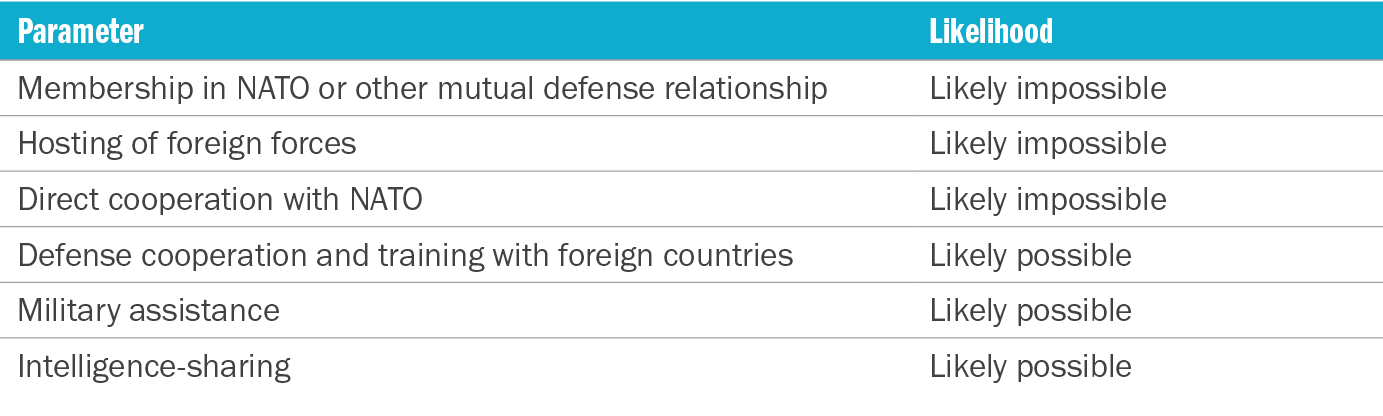
Implications for EU membership
Nonalignment would not preclude Ukraine’s membership in the EU. During the Istanbul talks in 2022, Russia was open to Ukraine’s EU membership.121Troianovski, Entous, and Schwirtz, “Ukraine-Russia Peace Is as Elusive as Ever.” Putin confirmed as much at the Shanghai Cooperation Organization meeting in September 2025.122Antonov, “Putin Says Russia Doesn’t Oppose Ukraine Joining the EU”; Yıldız, “The European Union–Russia–Ukraine Triangle.”
The EU’s mutual assistance clause, Article 42.7 of the Lisbon Treaty, could complicate Ukraine’s EU membership after it takes a position of nonalignment, however. Article 42.7 commits EU member states to offer assistance to other members that face armed aggression by “all means in their power.”123EU, Treaty of Lisbon; Boddens Hosang and Ducheine, Implementing Article 42.7 of the Treaty on European Union. Article 42.7 commits member states to much less than NATO’s Article 5 does. Although Article 5 commits NATO members to view an attack on one as an attack on all, Article 42.7 demands that EU members offer only assistance to a fellow member that is facing aggression. Moreover—while NATO is backed up by real military plans, forward deployed forces, and training exercises—the EU does not have the institutional capacity or mandate for the military defense of its members.124EU, Treaty of Lisbon. That Russia has not objected more strenuously to Ukraine’s push for EU membership despite this mutual assistance provision likely reflects the traditional weakness of EU cooperative defense mechanisms and the distinctions between NATO and the EU in terms of both membership and activities. The reality is that Ukraine’s path to EU membership will be long one; there is no shortcut for the reforms that Ukraine will need to make.
Should it eventually meet all the accession criteria, there are ways for Ukraine to join the EU without affecting its military nonalignment. Notably, the EU already has members that have adopted positions of military neutrality—Ireland, Austria, and Malta (which has been discussed previously).125Cramer and Franke, “Ambiguous Alliance.” Each of these states has adopted a slightly different approach to squaring its neutrality with EU membership and participation in EU common security and defense mechanisms.
In the case of Ireland, the 2013 Protocol on the Concerns of the Irish People on the Lisbon Treaty notes that “[t]he Treaty of Lisbon does not affect or prejudice Ireland’s traditional policy of military neutrality.”126EU, Treaty of Lisbon; Mulqueen, “Generating More Heat Than Light?”; EU, “Protocol on the Concerns of the Irish People on the Treaty of Lisbon.” It continues, [i]t will be for Member States—including Ireland, acting in a spirit of solidarity and without prejudice to its traditional policy of military neutrality—to determine the nature of aid or assistance to be provided to a Member State which is the object of a terrorist attack or the victim of armed aggression on its territory.127EU, “Protocol on the Concerns of the Irish People on the Treaty of Lisbon.”
Ireland is still part of the EU’s Common Security and Defense Policy (CSDP) and has contributed to the European Defense Fund and other defense-oriented initiatives. But its protocol ensures that Ireland will not have to send military forces or engage in foreign wars that compromise its long-standing military neutrality. The participation of Irish military personnel in CSDP operations for peacekeeping and in conflict zones is highly constrained. Any deployment of more than 12 military personnel requires approval from the UN, the Dáil (Ireland’s lower house of parliament), and the Irish government.128Cramer and Franke, “Ambiguous Alliance.” On the other hand, although there is little talk in Ireland of ever invoking Article 42.7 for its own defense, it likely could accept foreign assistance if it were to face external aggression, especially if that assistance did not include the deployment of foreign forces.129Cramer and Franke, “Ambiguous Alliance.”
Austria’s situation is similar but unique. Austria defines its neutrality to exclude participation in foreign wars, membership in foreign alliances, and hosting of foreign troops on its soil. Its protocol to the EU protects this neutrality, but Austria also participates in the CSDP and has sent military and civilian personnel to EU peacekeeping missions. Its military force is quite small, however, so its contributions to mutual assistance missions under Article 42.7 would therefore be quite limited.130Cramer and Franke, “Ambiguous Alliance.”
Ukraine might not need to make a special arrangement to safeguard its nonalignment on entry into the EU. Finland and Sweden, for instance, were able to join the EU as nonaligned states without such a protocol. But if Russia were to insist and Ukraine to agree to place conditions on its EU membership, Kyiv could follow the Irish example and adopt a protocol relating to Article 42.7. Ukraine’s protocol would be specific to its circumstances and the ultimate form of its nonalignment, determined at the bargaining table with Russia and Ukraine’s Western partners. Some limits on the deployment of foreign forces in Ukraine might be adopted, but Ukraine would still be able to participate in Europe’s defense industrial initiatives and integrate economically with Europe.
Mechanisms for implementing nonalignment
Beyond defining the terms of nonalignment, Ukraine and Russia will need to find a way to establish Ukraine’s nonalignment that is credible and enduring but also feasible, given Ukraine’s domestic political constraints. Russia will likely demand formal and binding commitments by Ukraine and current NATO members to implement and guarantee Ukraine’s nonalignment on a permanent or indefinite basis.131Weller, “Ukraine Settlement Options”; Kavanagh and McCallion, “Armed Neutrality for Ukraine Is NATO’s Least Poor Option.” Moscow has made it clear that verbal promises or soft commitments will not be credible or sufficient for Russia.
Ukraine’s past commitments to nonalignment in various forms have been narrow in scope and limited in practical effect. Even when the country maintained a policy of nonalignment (called non-bloc status under Ukrainian law) from 2010 to 2014, it worked simultaneously to deepen military integration and cooperation with NATO.132Roininen, “Myths & Pretexts.” Furthermore, past commitments have lacked endurance and been easy to change during leadership transitions.133Roininen, “Myths & Pretexts.” To be credible in the future, then, Ukraine’s commitment to nonalignment will need to be formal, lasting, and clearly tied to its military behavior and partnerships.
Ukraine’s nonalignment—at least as it pertains to NATO—could be established by the United States and its NATO allies agreeing to formally close NATO’s open door and committing to not adding new NATO members beyond the current 32 nations.134Graham, “The Precarious Future of NATO’s Open Door Policy”; Weller, “Ukraine Settlement Options”; Kavanagh and McCallion, “Armed Neutrality for Ukraine Is NATO’s Least Poor Option.” NATO members are unlikely to agree to such a step, given that they have long maintained the alliance’s right to add members and refused to allow outside powers—namely Russia—to have a veto over alliance membership.135NATO, “Enlargement and Article 10.” It is possible that if the Trump administration supported such a position it could convince a few European members to take this stance, but unanimity is unlikely. Even then, it would be difficult to find a legal vehicle, short of a treaty ratified in each country’s legislature or even complementary constitutional amendments, that would also be binding on future leaders.136Graham, “Precarious Future.”
Similar resistance would likely impede efforts to revise NATO’s 2024 commitment on Ukraine’s “irreversible” path to joining the alliance or to revoke the 2008 promise that Ukraine “will become” a NATO member.137Kupchan, “Close NATO’s Door to Ukraine”; Weller, “Ukraine Settlement Options”; Kavanagh and McCallion, “Armed Neutrality for Ukraine Is NATO’s Least Poor Option.” Such a change is not impossible, if the United States pushed for it, but even then, it is not guaranteed such an initiative would achieve success. Although the Trump administration has ruled out NATO membership for Ukraine as an outcome of the current war, Putin is unlikely to accept a simple verbal commitment from the United States as sufficient to ensure Ukraine’s nonalignment. Not only would such a commitment not be binding on a future president, as noted, but U.S. policy on Ukraine’s NATO membership has changed in the past.138Bigg, Chutel, and Troianovski, “Why Isn’t Ukraine in NATO?”; Graham, “The Precarious Future of NATO’s Open Door Policy”; Weller, “Ukraine Settlement Options”; Kavanagh and McCallion, “Armed Neutrality for Ukraine Is NATO’s Least Poor Option.” Moreover, even though this approach would address Ukraine’s NATO membership, it would not fully establish Ukraine’s nonaligned status.
An alternative would be for Ukraine to formally adopt nonalignment on its own, either for an indefinite period or permanently. This could be accomplished in two main ways: constitutional change or United Nations Security Council (UNSC) resolution.
Given this history and the political context, a change to Ukraine’s constitution to remove the goal of NATO membership and formally adopt nonalignment is likely impossible in the near term because it would require two-thirds approval of the Ukrainian parliament and other demanding legislative procedures.139Soldatenko, “Exploring Ukraine’s Armed Neutrality or Nonalignment.” Notably, any formal treaty would require constitutional change to have legal effect in Ukraine and would therefore face this same challenge.140Soldatenko, “Exploring Ukraine’s Armed Neutrality or Nonalignment.”
Some analysts have suggested that such an amendment might be possible if the United States or some combination of European countries offered Ukraine a bi- or multilateral deal that exchanged Ukraine’s nonalignment for robust Western-backed security guarantees. The problem with that path, however, is that the most-generous security guarantees (and the ones that Kyiv wants most) are likely off the table, given resistance from key stakeholders.141Soldatenko, “Exploring Ukraine’s Armed Neutrality or Nonalignment.” It is not impossible that promises of military assistance over a period of around five to ten years, along with some commitment to remedial actions if Ukraine were to be attacked again (e.g., increased military aid, snapback sanctions on Russia) might be sufficient in the context of a larger agreement to win support for a constitutional amendment on nonalignment in Ukraine’s parliament. Still, this path seems difficult at the time of this writing.
A different, and perhaps more feasible, approach would be for Ukraine’s nonaligned status to be established in a binding UNSC resolution, as was outlined in the draft of the Istanbul Communiqué negotiated in 2022.142Troianovski, Entous, and Schwirtz, “Ukraine-Russia Peace Is as Elusive as Ever.” This approach, which both Ukraine and Russia seemed open to in 2022, would give Ukraine’s nonaligned status an international imprimatur and some longevity; any change would have to be approved by all UNSC members, including Russia. UNSC endorsement would strengthen Kyiv’s legal commitment and formalize U.S. and European recognition of Kyiv’s status.143Weller, “Ukraine Settlement Options.”
However, this approach comes with challenges. A UNSC resolution is not as binding as a treaty or formal change to Ukraine’s constitution.144Amado, “Binding or Not?” There are numerous cases of UNSC resolutions that fall apart prematurely or fail to have the intended effect—the Joint Comprehensive Plan of Action negotiated with Iran during the Obama administration is just one example.145White House, “President Donald J. Trump Is Ending United States Participation in an Unacceptable Iran Deal”; Center for Arms Control and Non-Proliferation, “The Iran Deal, Then and Now.” To work, a UNSC resolution on Ukraine’s nonalignment would have to come with consequences for violations by Ukraine, Russia, or any other party. Sanctions would be the most likely punitive tool, although, for Ukraine, a cut-off of military aid or intelligence-sharing would also be possible. The other challenge is that, if Ukraine’s nonalignment is adopted in a UNSC resolution without a change to Ukraine’s constitution, it would leave the two in conflict, and Ukraine’s constitution, which continues to hold NATO membership as a goal, would take precedence.146Soldatenko, “Exploring Ukraine’s Armed Neutrality or Nonalignment.” To get around this issue, the Istanbul Communiqué in 2022 included both constitutional change and a UNSC resolution.147Soldatenko, “Exploring Ukraine’s Armed Neutrality or Nonalignment.”
However, relying on only a UNSC resolution might be a sufficient interim solution. The wording in Ukraine’s constitution that commits the country to pursue NATO membership is general and open-ended, stating that the country is on a “strategic course towards full membership” in NATO and the EU and that the president is the “guarantor” of Ukraine’s path to NATO.148Panasyuk, “Some Questions About Ukrainian ‘Way to NATO’ Constitutionality: Some Legal Aspects Which May Become the Stumbling Blocks for Ukrainian Future NATO Membership.” There is no timeline specified for this process, however, and no set of actions that Ukraine or its president is constitutionally required to take to meet this requirement. This stipulation might not be incompatible with an open-ended commitment to nonalignment adopted in a political agreement and the basic parameters outlined in this chapter. Moreover, at some point in the future, a change to Ukraine’s constitution may not be impossible, especially if peace endures and Ukraine’s new status is seen as beneficial.
Regardless of how Ukraine adopts and guarantees its nonaligned status, Russia will likely demand an equally binding commitment by the United States and other NATO members to recognize and respect Ukraine’s permanent or semipermanent nonalignment.149Weller, “Ukraine Settlement Options.” This recognition could occur through an endorsed UNSC resolution on Ukraine’s nonaligned status or UNSC endorsement of a peace treaty with a nonalignment provision, as described previously.150Weller, “Ukraine Settlement Options.” Russia’s recognition of Ukraine’s nonalignment could occur through this vehicle, as well, or as a separate commitment made to Ukraine.
If Kyiv adopted another approach to formally accept nonalignment, NATO members could commit to honor Ukraine’s status with a separate legally binding agreement that would acknowledge officially that Ukraine will not join NATO or other collective defense mechanisms. The agreement might even be one that Russia and NATO countries jointly sign, which would also restrain Russia from pressing Ukraine to align more closely with Moscow and other Russian partners and offer Ukraine some assurances if it came with consequences for violation.151Weller, “Ukraine Settlement Options.” As noted previously, in exchange for these commitments by Ukraine, the United States, and other NATO allies, Russia might also offer a set of codified assurances, specifically to Ukraine, regarding its military posture near territory controlled by Ukraine.
Summary
Ukraine’s nonalignment would likely require some mix of legally binding commitments that are signed and approved credibly by the Ukrainian government, international organizations, and the United States and Europe. A binding UNSC resolution seems the most politically feasible mechanism and one that Russia has seemed open to.
Ukraine’s nonalignment would have terms specific to its situation and be the product of a negotiation. Some likely parameters of Ukraine’s nonalignment are fairly clear. Ukraine would give up pursuit of NATO membership (at least temporarily and probably permanently) and membership in any other group with collective defense provisions. Ukraine would likely have to agree to exclude the basing or training of foreign military forces inside Ukraine. Beyond these conditions, there is some room for flexibility. Ukraine might be able to participate in military training outside of Ukraine and could still receive some military assistance from the United States, other countries, and European states. Intelligence-sharing would extend only to what is deemed necessary for Ukraine’s self-defense during peacetime, although this and other restrictions on Ukraine’s military cooperation with the United States and Europe would be lifted in the case of renewed Russian aggression. Mutual assurances between Ukraine and Russia might help institutionalize Ukraine’s nonalignment while reducing Ukraine’s own security concerns. Finally, even under nonalignment, Ukraine could still join the EU once it meets the bloc’s political and economic requirements, likely with a protocol that preserves its military nonalignment.
Establishing Ukraine’s nonalignment will be challenging to work out legally and perhaps institutionally, but no more so than the subsequent task of defining what an armed Ukraine will look like, including the size and capabilities of its military forces and where those capabilities come from.
Chapter 4: Arming Ukraine for its self-defense
A nonaligned Ukraine would be responsible for its own defense, even if the final security arrangement for Ukraine includes security commitments that offer military assistance in the short term or promise additional external military aid if Ukraine is attacked again. As evidenced over the course of the war, what the United States and Europe can and are willing to provide Ukraine in the event of a future attack may not be enough to ensure the country’s self-defense.152Dickinson, “New US Aid Package Is Not Enough to Prevent Russian Victory in Ukraine”; Yermak, “Western Aid Not Enough to Equip ‘Even 4 Out of 14’ Underarmed Brigades Needed on the Front, Zelensky Says.” Ukraine must, therefore, have the means to credibly protect itself from future aggression without depending on wartime aid.
Russia has indicated a desire for Ukraine to be demilitarized as part of any settlement, or at least for its military force to be capped in terms of size and capabilities. Ukraine wants no limits on its military forces and has a long list of military systems and weapons that it says are needed for its self-defense, from more air defense systems to advanced fighter jets and long-range missiles.153Graham, “Russia’s Peace Demands on Ukraine Have Not Budged”; Bollfrass, “Are Nuclear Weapons an Option for Ukraine?” A durable settlement to the war will need to find a middle ground between these two positions.
An outcome acceptable to both sides could be centered on two principles. First, Ukraine should be armed primarily with systems that are useful for defending the territory it controls but that cannot facilitate an offensive campaign to retake Russian-occupied areas or enable Ukrainian long-range strikes into Russia. These systems would include air defenses, mines, drones, and short-range artillery.154Kavanagh, “A Defensive Approach to Ukraine Military Aid”; Ashford and Grieco, “How Ukraine Can Win Through Defense.” Other passive defenses, such as nets to catch drones, radars and jamming equipment, razor wire, and cement, will also be important.155Walsh et al., “Ukraine’s Fishing Net Defense Against High-Tech Threat Shows the Challenges for Kyiv to Respond to Russia’s Summer Offensive.” Western aid packages would exclude tanks, aircraft, and long-range strike weapons. Aid in these areas should not be required for Ukraine’s defense (although, as of this writing, Ukraine has plans to build its own long-range strike capability).156Kavanagh, “A Defensive Approach to Ukraine Military Aid.” Ukraine’s military force would similarly need to be large enough to enable effective defensive operations but not so large as to enable major offensives to retake Russian occupied areas. Second, reciprocal geographic restrictions on the locations of certain military capabilities should be included in any final arrangement, especially because adopting unilateral numerical caps on military capabilities may not be politically feasible for Ukraine.157Charap and Priebe, Avoiding a Long War. Reciprocal self-imposed restrictions on the locations or numbers of certain types of systems (e.g., limiting the placement of long-range strike weapons within a given distance from shared border areas or the ceasefire line) could ease concerns on both sides.
For Russia, limits on Ukraine’s deployment of certain types of capabilities in the manner just described combined with Kyiv’s acceptance of nonaligned status should reduce fears of future threats coming from Ukraine, whether because of NATO deployments there or Ukraine’s military. Moscow should, therefore, be willing to accept reciprocal restrictions of its own and implement them (which it did not do following agreements that ended the 2014 war in Ukraine), in recognition of its improved security situation.158Trilateral Contact Group, “Package of Measures for the Implementation of the Minsk Agreements.” For Ukraine, geographic limits may be more acceptable than hard numerical caps. Ukraine would also likely hope that Russia will adopt self-imposed restrictions on the deployment locations of certain systems or capabilities near its territory. Such compromises should leave Kyiv feeling more secure and confident in its self-defense and ease the urgency and burden of its own military buildup. The details of such geographic restrictions will be discussed in Chapter 5.
Ukraine’s best strategy: A porcupine defense
The goal of the United States and its European allies should be to prepare Ukraine to carry out a porcupine defense, which would deter would-be aggressors by giving Ukraine the defensive capabilities needed to make any future Russian attempt to take additional slices of Ukraine’s territory prohibitively difficult and costly.159Kavanagh, “A Defensive Approach to Ukraine Military Aid”; Ashford and Grieco, “How Ukraine Can Win Through Defense.” By building up its defenses, Kyiv would hope to convince Moscow that any future campaign to seize Ukrainian territory using military force would be expensive, bloody, and unlikely to succeed, thereby dissuading Moscow from considering repeat invasions. In case of a deterrence failure, these same capabilities would enable Ukraine to defend itself and deny Russia territorial gains of any consequence (and reclaim territory lost in land grabs quickly) but not make additional offensive advances.160Ashford and Grieco, “How Ukraine Can Win Through Defense”; Friedman and McCallion, “Make Ukraine a porcupine rather than a protectorate.”
In effect, this strategy would amount to the land-warfare version of the defensive denial approach that many analysts have recommended for Taiwan.161Timbie and Ellis, “A Large Number of Small Things.” It is also similar to the strategy that Finland has employed since the Cold War. Compared with both of those cases, Ukraine has a more favorable military balance; it has a larger military and arsenal of military equipment.162Mahadzir, “Pacific Military Balance Tilting in China’s Favor, Says New Defense of Japan Report”; International Institute for Strategic Studies, The Military Balance 2025; Kavanagh and McCallion, “Armed Neutrality for Ukraine Is NATO’s Least Poor Option.” However, Ukraine has a less favorable geographic situation compared with Taiwan and Finland, with fewer natural barriers to protect its borders, but it is not without rivers, forests, and other topographic characteristics that it can exploit to create challenges for Russia.163Charap et al., Guidelines for Designing a Ceasefire in the Russia-Ukraine War; Levy, “The Offensive/Defensive Balance of Military Technology.”
The force requirements of a defensive denial strategy like the one proposed for Ukraine will be lower than those associated with a forward defense approach, which would aim to defeat an aggressor right at the line of contact rather than drawing it into a longer, drawn out war that denies its objectives.164Stares and O’Hanlon, “Defending Ukraine in the Absence of NATO Security Guarantees.” But Ukraine will still need enough forces to guard its territory, including the entire line of contact with Russia in the east and its uncontested border to the north. It will also need sufficient surge and reserve forces to defend the country in case of aggression.165Stares and O’Hanlon, “Defending Ukraine in the Absence of NATO Security Guarantees.” Even conservative estimates may be higher than what Russia would prefer, but a reasonably sized Ukrainian army that is capable of fully defending the country’s territory is unlikely to be large enough to pose an offensive threat to Russia or Russian-occupied areas of Ukraine.166Snyder, The Ideology of the Offensive.
With a porcupine strategy, defensive capabilities—such as anti-tank and anti-personnel mines, cheap drones, and short-range artillery—will be of primary importance, as will the construction equipment, cement and other building materials, and armored vehicles needed to build barricades, fortifications, and trenches.167Kavanagh, “A Defensive Approach to Ukraine Military Aid”; Ashford and Grieco, “How Ukraine Can Win Through Defense.” Ukraine will also need significant counterdrone capabilities, including netting, jamming, and other counter–unmanned aircraft systems (c-UAS) tools, such as those that rely on lasers, radars, and other sensors for detection and mitigation.168Mittal and Goetz, “A Quantitative Analysis of the Effects of Drone and Counter-Drone Systems on the Russia-Ukraine Battlefield”; Kallenborn, “Seven (Initial) Drone Warfare Lessons from Ukraine.” These systems and materiel could be used to create a layered defense or zones to fortify Ukraine’s front lines. The first zone would be composed of a series of static barriers, including deep trenches followed by anti-tank and anti-personnel mines. The area could be monitored by drones and counterdrone systems, of which Ukraine would want a lot that are both armed and meant for surveillance.169Kavanagh, “A Defensive Approach to Ukraine Military Aid”; Ashford and Grieco, “How Ukraine Can Win Through Defense.” This would replicate the type of kill zones that Ukraine has relied on to slow Russian advances. Artillery systems manned by heavy ground forces might follow at some distance, close enough to range minefields so that they can destroy enemy personnel as they slow down to navigate the obstacles.170Oprean, “Artillery and Drone Action Issues in the War in Ukraine.” Armored vehicles would help defenders move along the demilitarized zone (DMZ) and buffer zones. Ukraine likely does not need many additional tanks, which have seen their utility limited in the current war by significant advances in drone warfare that make it hard to use tanks to break through adversary front lines, as they have been employed in the past.171Kavanagh, “A Defensive Approach to Ukraine Military Aid.” Ukraine will require command and control and intelligence, surveillance, and reconnaissance to assist in domain awareness.
Along its coasts, Ukraine would need naval mines (likely stockpiled but not deployed), antiship missiles, well-fortified ports coastal ground positions protected by artillery, and a fleet of surface and subsurface sea drones.172Kavanagh and McCallion, “Armed Neutrality for Ukraine Is NATO’s Least Poor Option.” These capabilities would be used primarily to ensure that, in the case of future war, Ukraine could keep its ports open and prevent Russia from using the Black Sea as a location from which to fire ship-based missiles at Ukrainian territory. Ukraine was very effective in doing this in 2022 and could seek to build on this success for deterrence and in any future conflict.
To protect its skies, Ukraine will need many long- and short-range (and counterdrone) air defense systems, as well as a large stockpile of interceptor missiles—including, but not limited to, Patriots. These systems will be required to protect critical infrastructure, strategic military facilities (such as weapon production facilities and airfields), military forces, and civilian targets across the country.173Yanchik, “Ukraine Needs Enhanced Air Defenses as Russia Expands Missile Arsenal”; Kakissis and Simon, “Zelenskyy Asks Trump for Air Defense Munitions amid Escalating Russian Airstrikes.”
Given Russia’s ability to produce large numbers of drones and precision missiles and the global shortage of interceptor missiles, Ukraine may need some additional capabilities to bolster its air defenses beyond Patriots, Stingers, and other ground-based air defense systems. First, it can rely on fighter jets, including F-16s, that are armed with such missiles as the AIM-9X and Advanced Medium-Range Air-to-Air Missile (AMRAAM) and its Soviet-era jets. Ukraine would not need an especially large air force, however, and likely could not support one, given lack of trained fighter pilots.174See for example, Jensen, Mark, and Macias, “How to Defend Ukraine’s Skies During Peace Negotiations.”
Second, Ukraine may also benefit from having some long-range strike capability, although the benefits of this capability will be less decisive than advocates claim. A stockpile of longer-range missiles that can hold Russia’s drone and missile launch platforms at risk could strengthen Ukraine’s defense of strategic military targets or critical infrastructure and contribute to Ukraine’s ability to deter Russian attacks.175Courtney and Hoehn, “The Case for Giving Ukraine Long-Range Striking Power in Russia.” However, the gains will be on the smaller side.
Geography works against Ukraine even if it significantly expands its arsenal of long-range systems. Russia’s vast size will continue to allow it to base missile and drone launch platforms outside the reach of Ukraine’s indigenously produced missile arsenal. Those missiles that can reach far-off targets will have to traverse long distances in Russia’s airspace, leaving them vulnerable to interception. Russia’s larger defense industrial base and deeper military arsenal will also make it resilient to Ukrainian missiles, further neutralizing Ukraine’s long-range strike capabilities and allowing Russia to continue its air campaign.176Watling, “Long-Range Precision Fires in the Russo-Ukrainian War”; Courtney and Hoehn, “The Case for Giving Ukraine Long-Range Striking Power in Russia”; Sampson and Jakes, “The Long-Range Weapons Ukraine Wants to Use on Russia, Explained.” In other words, a robust Ukrainian long-range strike capability may improve Ukraine’s ability to defend its airspace from Russia drones and missiles on the margins, but it will not allow Ukraine to close that airspace to the Russian threat, nor will it serve as a sufficiently strong deterrent on its own to prevent Russian attack in the first place.177Kavanagh, “New Missiles Won’t Change Ukraine’s Broken War Math”; Sampson and Jakes, “The Long-Range Weapons Ukraine Wants to Use on Russia, Explained”; Allison, “Averting Acute Escalation in Russia’s War Against Ukraine.” This capability may help reduce the damage that Russia can inflict on Ukrainian infrastructure, but it will not fundamentally alter the military balance on the ground, which will continue to be the primary theater in any future Ukraine-Russia conflict.
There are other risks; for example, a too-large stockpile could incite preemptive attacks from Russia or escalation in the context of a conflict. It is also a costly investment, and, given Ukraine’s limited resources, may not be the best use of Ukraine’s money or industrial capacity. It is best to think of long-range strike as a supplement to Ukraine’s denial-based strategy rather than its centerpiece. Ukraine will want a stockpile of precision munitions; that stockpile can include primarily missiles with ranges of about 80 km or less and only a relatively small number of missiles with ranges of more than 100 km.178Bohnert, “Here’s What Ukraine Needs in Missiles, Shells, and Troops to Win”; Cancian and Park, “Is Ukraine Now Doomed?”; Watling, “Long-Range Precision Fires in the Russo-Ukrainian War.”
These capabilities in sufficient quantities along with an army of sufficient size and skill should be able to defend Ukraine’s territory, even against determined attackers.
How many forces does Ukraine need to defend itself?
Ukraine’s ability to deter future aggression will begin with its military force. Ukraine will need sufficient personnel to defend the full expanse of its territory, including its coasts, airfields, critical infrastructure, and cities. Any armed nonalignment arrangement that supports a lasting settlement will need to identify a force size and structure for the Ukrainian military that meets its defensive needs without giving enough combat power to incentivize Russia to defect from any peace deal. Russia has indicated at multiple points that it would like to place caps on the size of Ukraine’s military in any postwar scenario. But unilateral restrictions are likely unacceptable for Ukraine. Self-imposed permissive constraints might suffice as an alternative. In this section, I use campaign analysis to estimate how many forces Ukraine needs for its defense, consider what size of force it can likely manage to recruit and resource, and, finally, what Russia might accept.
Ukraine’s line of contact with Russia, including the internationally recognized border and the line of contact in the east, is about 2,000 km long. The eastern front makes up approximately half of this length. Ukraine also has an additional 1,000-km land border with Belarus.179Charap et al., Guidelines for Designing a Ceasefire in the Russia-Ukraine War. Ukraine might prefer a forward defense strategy that would place sufficient forces forward to prevent any Russian gains and defeat Russian forces outright should Russia invade Ukraine again in the future.180Stares and O’Hanlon, “Defending Ukraine”; Soldatenko, “Exploring Ukraine’s Armed Neutrality or Nonalignment.” However, this approach has much higher force requirements and may be out of reach for Ukraine, given cost and demographic constraints. It also does not play to Ukraine’s strengths.181Charap et al., Guidelines for Designing a Ceasefire in the Russia-Ukraine War; von Clausewitz, On War; Bright, “Theory to Reality.”
A denial-focused approach that aims to limit (rather than prevent) adversary gains and deny an aggressor its objectives through attrition (wearing them down and imposing high costs before trying to regain any lost territory) would require fewer forces overall and fewer forces maintained on a permanent basis near Ukraine’s front lines than would a forward defense strategy, although it would possibly entail a longer war.182Kavanagh, “A Defensive Approach to Ukraine Military Aid.” This strategy would make use of the many advantages of being on the defense, including being able to set the terrain and lie in wait for an aggressor, maintain interior lines, interdict adversary logistics, concentrate forces, and build layered defenses that offer resiliency.183Clausewitz, On War; Bright, “Theory to Reality.” Parts of Ukraine’s terrain and geography can also overstretch Russian forces, wearing them out over time.184Charap et al., Guidelines for Designing a Ceasefire in the Russia-Ukraine War. Over the course of the current conflict, Ukraine has gravitated toward this type of defensive, denial-based strategy, but it took time for Ukraine to start investing seriously in the right types of passive and active defenses, and Russia has exploited remaining openings and gaps.185Gady and Kofman, “Ukraine’s Strategy of Attrition.”
To estimate the number of forces required using this denial-focused strategy, it makes sense to start with the standard offense-to-defense force ratio. This rule of thumb, used widely in campaign analyses such as this one, suggests that for every one defender, the aggressor needs three soldiers to mount a successful offensive, for a 3:1 offense-to-defense ratio.186O’Hanlon, The Future of Land Warfare; Posen, “Europe Can Defend Itself”; Davis, Aggregation, Disaggregation, and the 3:1 Rule in Ground Combat; Zumbrun, “How a Simple Ratio Came to Influence Military Strategy.” This a general tool for estimation, not one specific to Ukraine, but it offers a useful starting point. Applying this to the Ukraine case would suggest that, if Russia attacks with about 500,000 forces along the country’s eastern front line (the typical size of the Russian force on Ukraine’s eastern front over the course of the current war), Ukraine would need about 170,000 forces on defense. A more conservative ratio of 2:1 would put that requirement at 250,000 personnel.187Davis, Aggregation, Disaggregation, and the 3:1 Rule in Ground Combat; Lawrence, “The Source of the U.S. Army Three-to-One Rule.” This would allow for about 250 personnel per kilometer, which would match recommendations from U.S. military doctrine.188O’Hanlon, The Future of Land Warfare; Posen, “Europe Can Defend Itself”; Department of the Army, Commander and Staff Organization and Operations.
Assuming about 4,000 soldiers to a brigade (which is standard for U.S. military forces) and three brigades in a division, this would leave 20 Ukrainian divisions each defending about 50 km of territory. This is not unreasonable, given traditional guidelines used by military planners.189Department of the Army, Commander and Staff Organization and Operations. During the war, Ukraine has built brigades with only 2,000 personnel. If Ukraine continues this construction after the war, it would have 40 divisions and as many as 120 brigades ready to defend the front line.190Axe, “Desperate to Reinforce a Buckling Front Line, Ukraine Is Scourging the Planet for Hundreds of Spare Tanks and Fighting Vehicles.” (This will not change the total combat power, only their organization.) Ukraine can likely get by with a smaller total number of frontline forces, given the role of drones and passive defenses in the current war, which have replaced personnel to some extent. This would also be more personnel than are likely along Ukraine’s eastern front at the time of this writing, and in the future, Ukraine’s forces would be better trained and equipped. Such factors as higher Ukrainian morale and military innovation may also matter.191Zumbrun, “How a Simple Ratio Came to Influence Military Strategy”; Stares and O’Hanlon, “Defending Ukraine in the Absence of NATO Security Guarantees.” However, Ukraine will want to be over- rather than underprepared.
This 250,000 personnel estimate makes sense as a baseline for Ukraine’s wartime requirement for its eastern front for other reasons. The exact number of Ukrainian forces on the country’s eastern front line is not publicly known; estimates range from the official 300,000 forces to the speculation that Ukraine may only have tens of thousands of personnel along the line of contact.192Lehalau, “With Desertions, Low Recruitment, Ukraine’s Infantry Crisis Deepens”; Khurshudyan and Galouchka, “Front-Line Ukrainian Infantry Units Report Acute Shortage of Soldiers.” Some reports suggest that Ukrainian infantry battalions are manned by around 40 personnel rather than the typical 200 personnel, and many brigades have lost more than 50 percent of their soldiers.193Khurshudyan, “Front-Line Ukrainian Infantry Units Report Acute Shortage of Soldiers.” Ukraine has around 105 to 130 brigades on its eastern front line. Assuming 50 percent manning for these brigades, a reasonable estimate for Ukraine’s frontline forces would be about 245,000 (using 4,000 personnel to a brigade). If manning rates are closer to 25 percent, the total would be under 120,000.
Whatever the total, these forces have not quite been sufficient to hold Ukraine’s defensive lines: Russia has been able to make slow gains over the course of 2025.194Stares and O’Hanlon, “Defending Ukraine in the Absence of NATO Security Guarantees.” However, Ukraine’s army has faced a variety of challenges that a future Ukrainian force might not, including lack of munitions, high desertion rates, lack of a rotation schedule that would give frontline forces a respite, and insufficient training.195Jakupec, The West’s Response to the Ukraine War; Barndollar, “The Deep Strike Dodge”; Massicot, Russian Military Wartime Personnel Recruiting and Retention 2022–2023. Most of these challenges can be rectified once the war is over. With these issues addressed, a small number of additional forces, and more-extensive investment in Ukraine’s defensive fortifications (which Ukraine was late to do in the current war), a future Ukrainian army of this size should be able to hold firm in the face of renewed Russian aggression.196Luxmoore, “Inside Ukraine’s Effort to Fortify Hundreds of Miles of Defensive Lines.”
It is true that Russia will also try to rebuild its military forces to be stronger than before. But, in the medium term, it will not be able to focus these forces entirely on Ukraine and will also need to consider requirements to deter a rearming Europe. Russia’s divided attention will give Ukraine some breathing room; it can also use strategic high readiness forces and a broader civil defense model to supplement its regular army troops.
The rest of Ukraine’s border with Russia stretches an additional 1,000 km, but this area has seen less in the way of active fighting during this war, with the exceptions of intense battles in the Sumy and Kharkiv regions.197Barros et al., “Interactive Map.’” As a result, this part of the border is likely to require fewer defenses on average than the eastern front would. If 250 personnel are required per kilometer along the eastern line of contact, half that number, or 125 soldiers per kilometer, should be sufficient along the rest of Ukraine’s northern border with Russia. This adds another 125,000 forces.
Some analysts have argued that Ukraine will also need to budget defensive forces to protect its border with Belarus.198Stares and O’Hanlon, “Defending Ukraine in the Absence of NATO Security Guarantees.” This is possible but probably not required. Although Russia used Belarus as a staging ground early in the war and a vector of attack in the initial phase, it has not repeated this move since and, given its failure, may be less likely to try again. More importantly, an offensive through Belarus is the type of attack that Ukraine would have plenty of warning for and could be countered with surge forces, if required.199Stares and O’Hanlon, “Defending Ukraine in the Absence of NATO Security Guarantees.” Third, the terrain covering the Ukraine-Belarus border is inhospitable to a ground invasion. Known as the Polesia, the region is flat but marshy, covered in bogs, rivers, and heavily forested.200Charap et al., Guidelines for Designing a Ceasefire in the Russia-Ukraine War. This terrain is difficult for Russia to cross and makes the border easier for Ukraine to defend. Ukraine cannot ignore this portion of its border entirely, but it could effectively monitor the region with remote-sensing technologies and border troops during peacetime.
All told, then, the total forces required to adequately defend Ukraine’s territory against a Russian incursion is about 375,000 personnel. These soldiers would not all need to be at the border at all times. Ukraine might keep about 100,000 forces on active duty, and the rest might serve as a high-readiness reserve, subject to call up with 24- or 48-hour notice. This is a short timeline, but it is similar to those used by high-readiness reserve forces in Estonia and Finland. As was the case in 2022, any future Russian invasion will likely be visible long before it happens, and, if there is a next time, there will not be so many dismissive voices arguing that no attack is imminent. This would offer plenty of time to call up reserve forces if needed.201Stares and O’Hanlon, “Defending Ukraine in the Absence of NATO Security Guarantees.”
These forces would constitute the core of Ukraine’s military, but some additional personnel might be required. First, Ukraine will want some kind of surge capacity, to respond to rapid increases in Russian troop levels or to plug gaps if they emerge elsewhere along the front line (or to cover the border with Belarus if needed). In the past, Russian mobilizations have raised about 300,000 forces.202Maynes, “Russia Says It Enlisted 300K New Troops to Fight in Ukraine and Doesn’t Plan for More.” To prevent a Russian breakthrough, Ukraine will want about 100,000 personnel (using the 3:1 offense-to-defense ratio) to serve as a strategic surge force. About one-third of these personnel might stay on active duty, while the rest would join the high-readiness reserve.
Ukraine will also need forces focused solely on air and missile defense of civilian and military infrastructure. The total number of personnel required to support Ukraine’s air defense will depend on the total number of systems that it has in its portfolio. This portfolio is estimated in detail in the next section of this report, with a focus on mid- and long-range systems. This analysis suggests that Ukraine’s final suite of air defense capabilities might include 20 Patriots, 5 SAMP/T, 15 IRIS-T, and 20 NASMS, along with Avenger and HAWK systems, between 2,000 and 3,000 Stinger systems, and counterdrone technologies. Ukraine also has some S-300 air defense systems, although it is not clear how many.
An average of about 100 personnel are required to operate the Patriot, SAMP/T, and IRIS-T systems. With 40 total systems, Ukraine would need about 4,000 personnel focused on long-range air defense. If we assume that Ukraine has 20 S-300 systems left, it will need about 2,000 additional personnel.203“Ukrainian Air Defense”; “S-300PS SA-10B Grumble B.” The remainder of Ukraine’s air defense systems, including the NASAMs, Stingers, HAWK, and Avenger, have small crews, many of which may be integrated into maneuver and other types of units rather than operating independently. With 20 NASAMS, 2,000 Stinger launchers, and a mix of other short-range systems, Ukraine will need an estimated 3,000 to 4,000 personnel involved in short-range systems. The same is likely true of counterdrone forces that use such systems as the British Raven, although Ukraine already has about a brigade’s worth of dedicated units.204Mittal and Goetz, “A Quantitative Analysis of the Effects of Drone and Counter-Drone Systems on the Russia-Ukraine Battlefield”; Molloy, Drones in Modern Warfare: Lessons Learnt from the War in Ukraine; Kulakova, “Ukraine Forms New Branch in Air Force.” These estimates would amount to around 15,000 dedicated air defense personnel.
Ukraine’s defense will also require some air and naval forces. Before the war, Ukraine’s air force was estimated to have between 35,000 to 40,000 personnel, and it had about 15,000 forces focused on naval operations (although it does not have a navy in the traditional sense, because it has no major surface combatants).205Warpower: Ukraine, “Ukrainian Armed Forces (Manpower).” This number is likely sufficient going forward. Ukraine may use its current small fleet of F-16s and Soviet-era jets for air defense, but its current air force is likely sufficient.206Kavanagh, “A Defensive Approach to Ukraine Military Aid.” Ukraine’s naval force has been quite effective over the past four years even without traditional warships or submarines by using air and sea drones and antiship missiles, and it is not clear that Ukraine needs a larger or more sophisticated navy, even if Russia were to increase the number of ships based in the Black Sea before restarting the war.207van Brugen, “Every Russian Black Sea Ship Sunk or Disabled by Ukraine”; Habib and Al Af. “Maritime Asymmetric Warfare Strategy for Smaller States.” What Ukraine has now is adequate and sustainable.
Finally, Ukraine will need some institutional army forces, a generating force that can manage such tasks as recruiting, human resources, acquisition, and training. The U.S. Army is a large and complicated institutional army, including forces in major commands and direct reporting units. Together, these add up to somewhere between 200,000 and 300,000 personnel, including soldiers, contractors, and civilians, which is about 20 to 30 percent of the total Army force.208Torreon, “Defense Primer.” The U.S. Army relies heavily on civilian and contractors for these roles. A much smaller, self-defense focused Ukrainian military will need a smaller generating force in absolute and relative terms.
For Ukraine, adding the estimates already calculated brings the total force to about 500,000. Ukraine might then need a generating force of about 100,000 (20 percent of the total), but maybe half of that could be civilian workers and contractor personnel hired on an as-needed basis, adding 50,000 forces to Ukraine’s active-duty army force.
Table 4.1 shows the total numbers of military personnel required for Ukraine’s defense, by role, under a defensive denial or porcupine strategy. The total active-duty force of 245,000 is slightly larger than Ukraine’s pre-2022 military and could be made up of a mix of conscripts and professional soldiers.209Dewan, “Ukraine and Russia’s Militaries are David and Goliath.” Many assume that, to be secure, Ukraine will need a much larger standing army than it had in 2022. However, this ignores the many advantages that future soldiers would have, including better-fortified defensive lines, better training, and more and better equipment.
The model proposed here also allocates more personnel to the frontline defense than Ukraine is using and suggests significant changes to Ukraine’s approach to using its reserve force (increasing its readiness and moving it in line with NATO frontline states) including a much faster call-up time. It is worth noting, however, that even if the formal, high-readiness reserve has only 345,000 personnel, a much larger portion of the population will have received some military training or have combat experience and might be designated as civil defenders who can be called on to support military operations if required.210Juurvee, Civil Defence in Ukraine; Kuzan, “Ukraine’s Growing Military Strength Is an Underrated Factor in Peace Talks.” This might leave Ukraine with an effective reserve that is much larger by several hundred thousand personnel who could be called on (with longer mobilization times) if necessary.
Table 4.1: Ukraine’s force requirements for self-defense
At the time of this writing, Ukraine also relies on a large number of paramilitary forces and territorial defense forces (voluntarily mobilized soldiers who support the country’s defense).211“Ukraine-Backed Anti-Kremlin Fighters Say They Are Still Operating Inside Russia”; Aliyev, Who Fights for Governments? Postwar, these organizations would be largely demobilized or folded into the reserves, depending on their qualifications and skills. In addition to military forces, Ukraine would also have its domestic intelligence service and border troops that would conduct normal border and immigration enforcement activities. These personnel would contribute to the country’s security without assigned combat roles.
Can Ukraine resource a force of this size?
The next question is whether Ukraine can raise and support a military of this size, given demographic challenges and the difficulty it has had recruiting during the Russia-Ukraine war. During peacetime and if salaries and benefits are high enough, Ukraine may have more success recruiting professional soldiers and even getting those conscripted to show up than it has during wartime.212Palikot, “Long Lines, Worries as Ukraine Pushes to Bolser the Ranks for the Fight against Russia”; Barndollar, “The Deep Strike Dodge.” Still total population size and available resources will be hard constraints on the size of Ukraine’s postwar military. In terms of population, in 2024, the Ukrainian parliament announced that Ukraine had a pool of about 4 million men eligible for conscription. This number may have decreased somewhat since then but does not include women who can opt into military service.213Barndollar, “The Deep Strike Dodge.”
Ukraine officially has a current military force totally close to 880,000 personnel, though it is not clear how many of these are actively with their units because reports of desertion are high.214Korovayny, “The Grandfathers Fighting on Ukraine’s Front Lines.” After the war, many will return to civilian life, but some may want to stay on as professional soldiers and others might enter the reserves. A military career in peacetime may be appealing for many because of salary, benefits, or type of work, even if wartime service is not.
These data points suggest that it is reasonable to think that Ukraine could manage to build a force with 245,000 active-duty personnel and 345,000 reservists, even if it takes time after the postwar demobilization to do so. Years of war will weigh on the minds of anyone entering military service and the population eligible for conscription and recruitment may shrink in the early postwar years, especially if young men who have fled abroad do not return or more people choose to leave Ukraine once the war is over and martial law is lifted.215Tokariuk, Ukraine’s Fight for Its People; Fornusek and Sorokin, “200,000–500,000 Men Could Leave Ukraine After War Ends and Borders Open, Minister Says.”
Some current soldiers may be ready to continue their service in an active or reserve capacity, while others might choose to leave. This does not put the requirement entirely out of reach, however. In the first postwar years, filling the 245,000 active-duty positions should be the priority before shifting to staffing the reserve component. Over time, fully staffing the requirements here should become more feasible as Ukraine builds a professional force and regularizes its conscription call-ups. Still the requirements suggested here are likely on the upper edge of what Ukraine will be able to recruit and retain, given its demographic limitations. In other words, there is no need to place a cap on the size of Ukraine’s military because demographic limits will constrain it anyway.
Much will depend, however, on how much Ukraine pays its personnel; generous salaries may make recruiting personnel easier. Median Ukrainian salaries sit at about U.S. $550 per month.216Work.ua, “Salary Statistics for Ukraine.” Ukraine pays its conscripts less than $500 per month, but they can earn combat bonuses and senior personnel may earn up to five times as much.217Melkozerova, “Ukraine Lures New Young Soldiers with Big Money Sparking Anger from Old Guard.” If Ukraine were to offer $600 per month to conscripts and up to $3,000 per month to senior officers, plus special incentive pays and small sum to reserve forces to maintain their readiness (e.g., $50 per month), then the annual salary costs of the force would be about $6 billion. This would not include operating or equipment costs, or such benefits as health care.
This is a lot, but it is not unreasonable. In 2024, Ukraine spent $65 billion on defense, about one-third of its gross domestic product (GDP).218Liang et al., “Trends in World Military Expenditure, 2024.” Postwar, it will want to decrease this total, but it is likely it will continue to spend at least 10 percent of GDP on its military as it works to build its defenses, which would amount to $20 billion in 2024. Six billion would be about 10 percent of Ukraine’s GDP (although its GDP is likely to rise postwar) and about 30 percent of a hypothetical $20 billion defense budget. The U.S. military spends about one-quarter of its budget on personnel costs, so this would represent only a slightly higher ratio.219Peter G. Peterson Foundation, “Budget Basics: National Defense.” European assistance in the near term should be able to help close any budget gaps.220Verbianyi and Chursina, “Zelenskiy Plans to Ask Europe to Help Pay Ukraine’s Soldiers.” However, this analysis only underscores that the proposed force size is at the upper limit of what Ukraine can sustain, at least over the medium term.
Russian reaction
If this force is capable of defending Ukraine and is sustainable, given Ukraine’s hard constraints, the final question is whether this proposed force is one that Russia will agree to in the context of a broader negotiation to end the war. In the Istanbul negotiations in 2022, Ukraine proposed the size of its required active-duty military force at 250,000 (based on recommendations from its military leaders), nearly the same as the estimate proposed here, and Russia countered with a cap at 85,000.221Troianovski, Entous, and Schwirtz, “Ukraine-Russia Peace Is as Elusive as Ever.” These were proposals, and no final agreement was reached, so it is not clear how flexible either side might have been had negotiations continued. The numbers also did not include reserve forces. In any case, given the years of war that have happened since then, these specific numbers are likely no longer relevant for either side. In statements, Putin and other Russian leaders have called for Ukraine’s demilitarization. But, when pressed, Russian interlocutors suggest there is room for negotiation.222“Putin’s Uncompromising Demands Emerge After the Latest Round of Russia-Ukraine Peace Talks.” In its most recent list of ceasefire conditions, Russia demanded that Ukraine end its mobilization, expecting that this would dramatically shrink the size of the military force, although it is not clear exactly what force size Russia would propose.223“Putin’s Uncompromising Demands Emerge After the Latest Round of Russia-Ukraine Peace Talks.”
Looking at the situation from Russia’s perspective, one of Moscow’s primary concerns is that a future Ukrainian military might pose a threat to its territory or territory it occupies in Ukraine. To do so, Ukraine’s military would need be able to mount a force at least two and ideally three times as large as any force Russia could surge (again using the same 3:1 offense-to-defense ratio).224Zumbrun, “How a Simple Ratio Came to Influence Military Strategy.” With a total Ukrainian active and reserve force of 590,000 personnel, this is unlikely. Russia has consistently maintained a force of at least 500,000 personnel on the front lines since 2022 and should be able to do so going forward.225Carlough and Harris, “Comparing the Size and Capabilities of the Russian and Ukrainian Militaries.” It can mobilize additional forces if this is required to sustain its positions or turn back a Ukrainian offensive push. This would give Ukraine a 1:1 ratio, which is very unfavorable for offensive operations.226O’Hanlon, The Future of Land Warfare. Realistically, a Ukrainian military of the size proposed will not pose a military threat to Russia-controlled territory. Moscow should, therefore, be willing to accept something close to the proposed 245,000 active-duty force even with a larger reserve force than proposed here.
This does not mean, however, that a Ukrainian force of this size will be unable to impose costs on Russia. Since 2022, Ukraine has been able to use asymmetric capabilities to strike targets inside of Russia and to largely disable Russia’s Black Sea fleet.227Ryan, “The Three Punch Combo Behind Ukraine’s Spectacular Drone Strike on Russia”; Lendon, “Moskva Sinking”; Zagorodnyuk, “Ukraine’s New Theory of Victory Should Be Strategic Neutralization.”
What capabilities will Ukraine need to defend itself?
Under armed nonalignment, Ukraine’s military personnel will need to be equipped with weapons sufficient to protect its territory, populations, and critical infrastructure. During peacetime, Kyiv will have to effectively deter aggression without direct external support, and it will need to have the weapons required to defend itself with constrained external assistance, as has been the case in the Russia-Ukraine war, if deterrence fails. Effective deterrence and defense, though necessary, will not be sufficient for enduring peace. If Russia determines an unacceptable threat to its security is emerging in Ukraine, its track record suggests that it will not hesitate to take action to counter it. A plan for Ukraine’s armed nonalignment will therefore need to balance Ukraine’s security needs with Russia’s security concerns if it is going to support a lasting settlement.
Passive defenses and mines
The first question to answer is what Ukraine requires for self-defense. Ukraine must be able to build defensive fortifications and will need the combat engineering equipment and materials to do so—cement, razor wire, metal coils, netting, and anti-tank mines.228Kavanagh, “A Defensive Approach to Ukraine Military Aid”; Kavanagh, Safeguarding U.S. Interests in a Ukraine War Settlement. Anti-personnel mines will also play a role.229Kavanagh, Safeguarding U.S. Interests in a Ukraine War Settlement; Watling and Bronk, “Giving Ukraine Cluster Munitions is Necessary, Legal, and Morally Justified.” Ukraine will want to acquire these simple materials and mines in large quantities to build strong defensive lines that protect the entirety of its territory, especially along key strategic corridors. One mistake it made after the 2022 invasion was waiting far too long to fortify defensive lines.230Luxmoore, “Ukraine’s Effort to Fortify”; United Kingdom Ministry of Defence, “Latest Defense Intelligence Update on the Situation in Ukraine—04 November 2023.” To prevent a similar situation, Ukraine should invest in hardened barriers at key strategic locations as soon as the war ends and in more advanced and numerous counterdrone measures that can neutralize the Russian drone threat.
Ukraine will need enough construction material and combat engineering systems to protect the full 2,000-km line of contact between Russia and Ukraine. It will also need at least a million anti-tank and anti-personnel mines, which it should place close together in strategic locations to impede Russian mobility. For example, along the 1,250-km line of contact, it might want one mine per square meter in some places to create a dense minefield.231Porter, “Russia’s Formidable Minefields Are ‘Insane’ to Navigate, with as Many as 5 Mines per Square Meter, Ukrainian Official Says.” If the minefield is 10 meters deep, this would require 1.25 million mines. The process of laying mines can be time-consuming, however, so Ukraine might begin by laying mines only in key strategic areas where it fears its own defenses might be weak and deploy the rest if conflict appears likely. This plan would follow those of the Baltic states, which have declared their intention to use landmines in their self-defense but not deploy them immediately.
Drones
Ukraine will also want many small drones and large numbers of counterdrone systems stockpiled in case of a conflict, along with some medium-range systems for surveillance and other purposes. The goal would be to create what might be described as a hellscape for the approaching adversary.232Grady, “‘Hellscape’ Swarms Could Be a Cost-Effective Taiwan Defense, Says Report”; Chivers, “How Suicide Drones Transformed the Front Lines in Ukraine.” Having many different types of systems that can be updated quickly will be key to Ukraine’s effort. Loitering munitions of other types may also be useful. Estimates of how many drones Ukraine uses per month during the current conflict vary from a low of 10,000 drones to a high of closer to 100,000 drones.233Axe, “As the Ukrainians Fling 50,000 Drones a Month, the Russians Can’t Get Their Drone-Jammers to Work”; Franke, “Drones in Ukraine and Beyond.” Assuming Ukraine needs 100,000 drones of different types per month, it would want to stockpile at least 1.2 million small drones. It might also build half as many medium-sized drones that can carry a heavier payload. This would amount to a stockpile of about 2 million drones of various types.
Because drone technology evolves quickly, another option would be to stockpile a smaller number but invest heavily in production capacity that would allow for a lightning-fast ramp-up if any war were to begin.234Tucker, “Pentagon Pushes US Dronemakers to Innovate as Quickly as Ukraine Does”; Franke, “Drones in Ukraine and Beyond”; Kunertova, “Drones Have Boots.” Ukraine will likely not be able to match its drone stockpile with counterdrone systems, but many types of counterdrone technologies, including lasers, jamming, and counterdrone guns, can be used repeatedly. Ukraine will want to acquire as many of these systems as possible. At the time of this writing, the constraint on counterdrone systems is their availability, so acquiring enough will be challenging, though Ukraine has made great strides in mass producing cheap counterdrone technologies.
Artillery systems, anti-tank weapons, and ammunition
Behind its first line of defense and drones, Ukraine will want to position artillery systems, such as howitzers with short-range munitions, including 155-mm shells but also 105-mm and 120-mm anti-tank munitions, and anti-tank guided missile systems, such as the U.S.-produced Javelin. Ukraine already has many artillery systems, including Soviet-era equipment, several different types of systems donated from Western militaries, and its indigenously manufactured Bohdana system (although the system still relies on European-supplied parts).235Thomas, “Ukraine Increases Production of Its Bohdana 155-mm Artillery System.” At the beginning of the war, Ukraine had about 1,200 Soviet-style short-range artillery systems and has since received about 800 artillery systems of various types from Western partners.236Axe, “New Guns, More Ammo”; Cancian and Anderson, “Expanding Equipment Options for Ukraine.” However, loss rates have also been high, and Ukraine has lost up to 30 percent of its howitzers and similar systems over the course of the war.237Mittal, “Artillery Is Still King, and Ukraine Has Mastered Producing Howitzers.” Ukraine has gone through hundreds of thousands of anti-tank guided missiles, including its indigenously produced missiles and those provided by the United States and other NATO allies.238Hambling, “Reassessing ‘Saint Javelin’”; Szőke and Kusica, “Military Assistance to Ukraine and Its Significance in the Russo-Ukrainian War.”
To be sure it has enough artillery systems for a future war, Ukraine might want the ability to give each of its maneuver brigades somewhere between 20 to 40 artillery systems, depending on whether the brigade is a smaller 2,000-person unit or a 4,000-person one. This number would be slightly more than what a comparable U.S. brigade receives (and Ukrainian brigades may be smaller than American ones) but the Ukrainian security challenge is more severe.239Battle Order, “U.S. Army Field Artillery Battery (Paladin).” If Ukraine takes the force size recommendations given previously, it would have around 90 U.S.-size brigades (or 180 smaller 2,000-person ones) with border defense duties. If Ukraine were to turn about one-third of its brigades into maneuver brigades, it would need around 1,200 artillery systems. This would give Ukraine around one artillery system per kilometer spread along the entirely of its front line. This is a good goal, that would leave Ukraine with sufficient firepower along its front lines. An additional 200 systems would allow for one howitzer per 5 km along the rest of the line of contact (to the north) with Russia.
Next, there is the question of ammunition. It seems reasonable that Ukraine would want to stockpile about a year’s worth of all kinds of munitions.240Stares and O’Hanlon, “Defending Ukraine in the Absence of NATO Security Guarantees.” Although estimates vary, most sources assess that Ukraine has used about 2.5 million rounds of 155-mm artillery ammunition each year during the war, along with significant amounts of other types of ammunition.241Axe, “New Guns, More Ammo.” Ukraine reports that this amount barely meets its needs and that frontline units have been forced to ration their ammunition use.242Luckenbaugh and Magnuson, “Arms Manufacturers Catching Up with World’s Insatiable Need for 155-mm Rounds.” Kyiv may thus want to build a stockpile twice as large as its yearly outlay of major types of ammunition. This amount should sustain Ukraine easily through a year of war without relying on external assistance in the case of renewed aggression and give time for other production lines to ramp up.243Watling, “The Peril of Ukraine’s Ammo Shortage.” For 155-mm ammunition, this would amount to 5 million rounds. Ukraine will want other types of ammunition in smaller amounts, including precision rounds and extended-range shells, and ammunition manufactured to pierce armored vehicles.244Bohnert, “Here’s What Ukraine Needs in Missiles, Shells, and Troops to Win.” These will likely be needed in smaller numbers.
Ukraine has estimated its requirement for anti-tank guided missiles to be about 500 per day.245Cohen and Lieberman, “Ukraine Tells the US It Needs 500 Javelins and 500 Stingers per Day.” A year’s supply at this rate would be just fewer than 200,000 missiles. Ukraine has already received a substantial number of the launch units for this missile, probably in the tens of thousands. Assuming Ukraine would need enough launch systems to be able to deploy five anti-tank missile systems per kilometer along the entirely of its line of contact with Russia during a war, it would need about 10,000 launchers. Ukraine has relied heavily on Western production for these anti-tank guided missiles, but it does have its own indigenously produced system, the Stugna-P, which can be used to help meet postwar requirements.246Army Recognition Group, “How Ukraine’s Stugna-P Anti-Tank Missile Becomes a Key Asset Against Russian Tanks.”
Air defense
Another necessity for Ukraine is air defense. Air defense systems and interceptors have been crucial to Ukraine, not only to protect military forces but also to defend critical infrastructure and cities.247Di Mizio and Gjerstad “Ukraine’s Gound-Based Air Defence”; Simmill, “Air Defence Insights from the Ukraine-Russia Conflict.” That would give Kyiv and its partners time (if needed and available) to ramp up production of key systems (which hopefully would be producing at higher rates than in 2022) to supply Ukraine’s military for a longer war. Ukraine will need advanced Patriot systems to defend civilian infrastructure, but this alone will not be sufficient. It will also need other types of air defense to protect frontline personnel and military targets from missiles and drones, which Russia has been using in large numbers.248Yankchik, “Ukraine Needs Enhanced Air Defenses”; Daly, “Top 5 Air Defense Systems That Proved Themselves in Combat in Ukraine.” This will mean that Ukraine requires a diversity of air defense systems, missiles, and counterdrone systems.
Ukraine has about nine Patriot systems, with two more on their way from Germany.249Murray, “Germany to Deliver Two Patriot Systems to Ukraine in Deal with US”; Feickert, “PATRIOT Air and Missile Defense System for Ukraine.” Zelenskyy has asked for at least 10 more and European countries have pledged to help provide Ukraine with more systems, though it remains to be seen if they will do so.250York and Hodunova, “Ukraine Wants 10 New Patriots, but Only Has 3 Secured, Zelensky Says.” European air defense systems have also played a role in Ukraine and could offer a useful complement. German IRIS-T and French SAMP/T also cannot replace the Patriot systems, but they have different strengths. For example, the Patriot system is highly accurate and clearly the best of the three systems when it comes to intercepting ballistic missiles; some sources report a 95 percent accuracy rate.251York and Hodunova, “Ukraine Wants 10 New Patriots, but Only Has 3 Secured, Zelensky Says.” The IRIS-T has a shorter range than the Patriot or SAMP/T but is highly effective at intercepting drones and cruise missiles, both of which are used heavily by Russia.252Posaner, “Patriot Games”; Hildreth and Zinsmeister, The Patriot Air Defense System and the Search for an Antitactical Ballistic Missile Defense. The SAMP/T is similar to the IRIS-T, but it has a longer range, and is best suited for intercepting drones and cruise missiles.253Posaner, “Patriot Games”; Daly, “Top 5 Air Defense Systems That Proved Themselves in Combat in Ukraine.” Ukraine has seven IRIS-T systems and two SAMP/T systems.254“Germany Delivers 7 IRIS-T Air Defense Systems to Ukraine, 11 More in Production”; “Ukrainian Air Defense: How Many Air Defense Systems Does Ukraine Have, and How Many Are Needed for Complete Security?”
For shorter-range threats, Ukraine also has 13 NASAMS systems—which can fire the AMRAAM and AIM-9X missiles, among other types—though these systems are not effective against ballistic missiles.255Posaner, “Patriot Games”; Daly, “Top 5 Air Defense Systems That Proved Themselves in Combat in Ukraine.” Ukraine’s FrankenSAM systems (short-, medium-, and long-range) repurpose old Soviet systems to fire Western-made missiles and can fill some demand for air defense systems, but these systems are not as effective at intercepting airborne threats as Western-made platforms and do not entirely replace Ukraine’s demand for U.S. Patriots and other more advanced systems.256Newdick, “Ukraine’s FrankenSAM Air Defense Concept Could Be Used to Protect USAF Bases.” Ukraine has also received HAWK and Avenger systems and more than 3,000 Stinger missiles along with their launchers. More of these capabilities would be helpful, especially more Stinger missiles. Additional Stinger launchers are less essential, because Ukraine has many more of these launchers remaining than it does missiles.
Given the intense threat of Russian missiles and drones, Ukraine likely needs as many air defense interceptors as it can get, and the limiting factor is likely to be these missiles rather than the air defense systems that fire them. Even with more Patriots and other systems, some Russian drones and missiles would still get through Ukraine’s defenses. To this point, Ukraine has been able to intercept almost 80 percent of Russian-fired missiles, though these rates have fallen as the war has progressed.257O’Hanlon, Future of Land Warfare; Atalan, “Russian Firepower Strike Tracker.” It is not clear how much better its effectiveness would be with more systems.
If Ukraine had 15 to 20 Patriot systems, it could have one or two systems per major population center in Ukraine’s remaining territory (Kyiv, Kharkiv, Odessa, Dnipro, and Zaporzhzhia) and still have close to ten systems for other critical and military targets. A similar doubling of its IRIS-T and SAMP/T and a 50-percent increase in NASAMS (6-7 systems) would provide additional shorter-range coverage and supplement existing stockpiles of Stingers and other short-range systems and counterdrone technologies in defending against uncrewed systems.
Turning to the requirements for air interceptor missiles, Russia has averaged between 20 and 25 missile strikes per day during much of the war, but it has dramatically increased the size of its missile and drone barrages (though many of the drones are decoys and total missile fires remain closer to the war’s average).258O’Hanlon, Future of Land Warfare; Atalan “Russian Firepower Strike Tracker.” As noted previously, Ukraine’s interception rate is about 80 percent, although sometimes more than one interceptor is required to per missile.259Stares and O’Hanlon, “Defending Ukraine in the Absence of NATO Security Guarantees.” Kyiv might like to have a year’s supply of interceptor missiles as insurance against renewed aggression. Twenty-five missiles per day for 365 days would amount to almost 10,000 air defense missiles. If we increase this number to 35 missiles per day, it would amount to almost 13,000 air defense missiles. If two interceptors are required for each incoming Russian strike, these numbers would be doubled. Because either target will be hard to reach given global shortages, it can be assumed that Ukraine will want to stockpile as many air defense munitions as possible, but at least 10,000 to 15,000 of different types to feel confident in its preparation.
Antiship missiles and naval missiles
Ukraine will also need a way to defend its coastlines. To a large extent, this can be done with indigenously produced air and sea drones. Naval mines could be used defensively in a conflict and can be cheaply and easily produced and then stored. Ukraine has already received U.S.-made Coastal Defense Systems and some Harpoon antiship missiles, though it is unclear how many have been provided and how many have been used.260Gould, “Slow Arms Deliveries to Taiwan Blamed on US Production Bottlenecks”; Velez-Green and Peters, The Prioritization Imperative. Ukraine should not need a large stockpile of these missiles, given the utility of drones. At the start of the war, Russia had about 70 ships in the Black Sea. Ukraine has managed to sink or disable about 20 of them, which has been enough to force Russia to pull its naval forces back to safer ports, rendering them mostly useless against Ukraine.261Thorne, “Russia’s Black Sea Fleet Falls Back amid Staggering Losses”; Frias, “Ukraine Has Devastated Russia’s Black Sea Fleet Without Even Having a Real Navy.” Assuming it takes about four or five missiles to sink a medium-to-large naval warship (a common rule of thumb, although sinking the Russian cruiser Moskva required only two missile strikes) and fewer to disable it, Ukraine should not need more than 100 long-range antiship missiles to be able to credibly protect its coasts from Russian naval vessels in the Black Sea.262Guttman, “The Neptune Anti-Ship Missile”; Hambling, “How Many Missiles Does it Really Take to Sink a Supercarrier?”
Rocket artillery and artillery rockets
Some rocket artillery systems, such as HIMARS (or a similar system produced elsewhere), along with precision-guided rockets, such as GMLRS, could contribute to Ukraine’s defensive strategy. However as noted previously, such systems are not as essential as well-equipped shorter-range systems, drones, or passive defenses. Ukraine has about 40 U.S.-made HIMARS, although it has asked for 100 of these systems and more of the rockets they fire.263Tucker, “Ukraine Says It Needs at Least 100 HIMARS and Longer-Range Rockets”; Piotrowski, Military-Technical Assistance to Ukraine.
As discussed previously, Ukraine would be well defended with one howitzer and five anti-tank guided missile launchers per kilometer. With much longer ranges, rocket artillery systems will need to be more spaced out than this, but estimating one system per 10 km suggests a requirement of around 125 rocket artillery systems for the eastern line of contact. Of course, in a conflict, they would likely be concentrated in the areas where fighting occurs. An additional 20 systems would allow for one system per 50 km along the northern line of contact with Russia, where fighting has generally been less intense.
Ukraine will need a small stockpile of the munitions that can be fired from the HIMARS or other rocket artillery systems. Although many types of missiles and rockets are compatible with HIMARS, Ukraine should not need large stockpiles of missiles with ranges longer than about 80 km.264Lockheed Martin, “About GMLRS.” A missile with that range could hit targets further from the front line but not deep inside Russia or Russian-held territory. The U.S.-made GMLRS is a guided missile that works with HIMARS and has a range of about 80 km. Some European states and South Korea also make rocket artillery systems and can produce their own MRLS missiles. Ukraine also indigenously produces rockets for its Vilkha system.265“Vilkha MLRS—Ukraine’s Locally Produced ‘HIMARS’ Based on the Soviet Smerch.” There are also cheaper, unguided rockets that can be produced for HIMARS. Given shortages of precision rounds, Ukraine may need to turn to these rockets to meet its requirements.
Ukraine’s use of GMLRS has been high so far in the war. Sources report that Ukraine has at points gone through a month’s work of U.S. production (about 1,400 missiles) in a matter of days, which could mean about 10,000 rockets used per month, but this is likely a maximum use rate.266Axe, “The U.S. Is Starving Ukraine’s HIMARS”; Altman, “Are There Enough Guided Rockets for HIMARS to Keep Up with Ukraine War Demand?” A well-executed porcupine strategy and stronger frontline defenses might allow a reduced use rate. Assuming an average use rate of 5,000 rockets (MLRS or equivalent) per month, Ukraine needs a stockpile of about 60,000 artillery rockets for one year’s use. Some of this requirement might be met with unguided rockets. It is worth noting that rocket artillery is less important than drones, passive defenses, and self-propelled artillery to Ukraine’s porcupine strategy.
Aircraft, tanks, and vehicles
Armored vehicles will be needed to support force mobility, resupply and other functions, and infantry fighting vehicles (such as Bradleys) have proven useful in Ukraine for frontline operations—sometimes more useful than tanks, which are slow and very vulnerable to drone attacks, and more versatile than Stryker vehicles across Ukraine’s terrain.267Baker, “Old US Bradleys Becoming ‘Legend’ in Ukraine Shows What the Country Can Do When It Gets Enough of the Weapons It Needs.” Ukraine has a large number of armored personal carriers. It likely has somewhere between 1,000 and 2,000 infantry fighting vehicles—including many donated by Western countries since 2022 (around 300 are Bradleys).268Statista, “Number of Infantry Fighting Vehicles (IFVs) Allocated to Ukraine as of April 2025, by Donor Country”; Axe, “To Keep Ukraine’s Elite 47th Mechanized Brigade Fighting for 15 Months Straight, the U.S. Sent More Than 300 M-2 Bradley Fighting Vehicles.” Ukraine also now produces its own vehicles, which may reduce the demand for Western systems.
A U.S. armored brigade combat team has around 150 infantry fighting vehicles, so a smaller Ukrainian mechanized brigade used largely for defensive purposes might need 50 vehicles. Ukraine might want up to 25 percent of its brigades to be mechanized, given that heavy units like these have had limited utility in the current war.269Axe, “To Keep Ukraine’s Elite 47th Mechanized Brigade Fighting for 15 Months Straight, the U.S. Sent More Than 300 M-2 Bradley Fighting Vehicles.” This would suggest a requirement of around 2,000 infantry fighting vehicles.
Ukraine’s defensive strategy will not require large numbers of aircraft or tanks, but both could play some role. Fighter aircraft, including F-16s, can play a role in Ukraine’s air defense, especially against Russian missiles. Most estimates suggest that Ukraine would need between 40 to 160 aircraft to fully defend its airspace, and this number could include a mix of Western jets and Ukraine’s Soviet-era planes. If fighter aircraft are limited to air defense missions, a number in the lower half of this range (for example, five squadrons of around 18 to 20 fighter jets, or a total of around 100 aircraft) should be sufficient.270See for example, Jensen, Montgomery, and Macias, “How to Defend Ukraine’s Skies During Peace Negotiations”; and Lubiejewski, “Conclusions from the Use of Aviation in the First Half of the First Year of the Ukrainian-Russian War.” In any case, pilots are likely to be Ukraine’s limiting factor, especially when it comes to flying Western fighter jets.271Saballa, “Ukraine Wants More Pilots Trained on F-16 but Allies Have No More Room.”
Ukraine should not require additional early warning aircraft. To this point, Ukraine’s main challenge has not been detecting Russia’s missiles but effectively intercepting them, given the quantity of missiles and limited number of available F-16 pilots.
Tanks have had limited use on the Ukrainian battlefield.272Jakes, “Do Tanks Have a Place in 21st-Century Warfare?” They are not irrelevant, but Ukraine likely has enough (and has hardly used the Western tanks provided early in the war). A U.S. armored division, for instance, has around 260 tanks. Ukraine has been giving 31 tanks to its smaller mechanized brigades, which is consistent with U.S. practice. Using the force size numbers calculated previously and assuming 25 percent of brigades are mechanized, this would yield a 1,400 tank requirement. However, this should be an upper limit. Given wartime experience, Ukraine might choose to give armored brigades fewer tanks in the future.273Admiral and Drake, “Steel in the Storm.”
Long-range missiles
Finally, there is the question of long-range missiles, which have already been discussed in some detail. Ukraine and its backers have insisted that Ukraine needs a large arsenal of missiles capable of striking inside Russia, such as the Army Tactical Missile System (ATACMS), which has a ground-launched range of 300 km, or the Storm Shadow or SCALP missiles, which are air-launched and have a range of 500 km.274Gardner, “What Are the Storm Shadow Missiles Ukraine Has Fired into Russia?”; MBDA, “Storm Shadow/Scalp”; Ismay and Livni, “What Are ATACMS, the U.S. Missiles That Officials Say Ukraine Fired into Russia?” Some in the United States have even considered providing Ukraine Joint Air-to-Surface Standoff Missile missiles that could be fired from F-16s, which has a range of 370 km, or even the ground-launched Tomahawk, which has a range of 2,500 km.275Litnarovych, “Trump Reportedly Considered Sending Tomahawk Missiles to Ukraine Capable of Hitting Moscow”; Altman, “No Long-Range Missiles for Ukraine.” Ukraine has also demonstrated the ability to use drones for long-range strike attacks and has both cruise and ballistic missiles in the 600-km range, as well as the Flamingo ground-launched missile, which has a 3,000-km range and debuted in August 2025.276Taradiuk, “Tired of Military Aid Delays, Ukraine Has Designed Its Own Ballistic Missile—and It’s Already in Mass-Production”; Kunyzkyj, “Will Ukraine’s Neptune Long-Range Missile Make a Difference?”
Advocates for such an arsenal say that Ukraine needs these missiles to hold at risk targets deep inside Russian territory, deter aggression, and impose costs in case of an invasion.277Bielieskov, “ATACMS Missiles Create New Dilemmas for Russian Army in Ukraine”; Hardie, “Ukraine Needs More Missiles to Take Full Advantage of New Biden Policy,” They argue that these missiles can be used to strike Russian supply lines, munitions depots, industrial facilities, and sensitive military targets, thus weakening Russia’s ability to mount and sustain an offensive.278Hardie, “Ukraine Needs More Missiles to Take Full Advantage of New Biden Policy”; Pomper and Tuganov. “Role of Missiles in Russia’s War on Ukraine and Its Implications for the Future of Warfare. They argue further that these missiles can target the launch sites and platforms used in drone and bombing attacks that have devastated Ukraine’s cities and infrastructure.279Watling, “Long-Range Precision Fires in the Russo-Ukrainian War”; Bielieskov, “ATACMS Missiles Create New Dilemmas for Russian Army in Ukraine”; Hardie, “Ukraine Needs More Missiles to Take Full Advantage of New Biden Policy.” They suggest that if Ukraine does not have this capability, Russia can simply position its key systems beyond the reach of Ukraine’s short-range weapons and operate at will.
Although Ukraine can certainly use long-range strike capabilities to impose costs on Russia and to strike certain military targets that complicate Russia’s operations, advocates of long-range strike capabilities tend to overstate their usefulness, especially to a defensive campaign. Long-range missiles can augment a defensive strategy, but they will not be the centerpiece or even a requirement for such a campaign. First, even if Ukraine had a more robust portfolio of long-range missiles with larger payloads and extended ranges, there are a limited number of targets that Ukraine can reach. Russia’s size will guarantee that it always has the ability to move important systems out of range of Ukraine’s long-range strike at little or no cost.280Kavanagh, “New Missiles Won’t Change Ukraine’s Broken War Math.” Even if Ukraine is able to inflict some damage or impose some costs, the strategic gains from the use of long-range strike are quite limited. A more robust Ukrainian long-range capability will force Russia to operate at further distances and might reduce the volume of Russian strikes on Ukraine’s territory, but it is unlikely to stop those strikes altogether. Long-range missiles and manufacturing sites in Ukraine would also be prime targets for Russia’s own attacks if war resumed, possibly offsetting any value that Ukraine derived from them.
At the same time, there are much less costly and less risky ways for Ukraine to defend its territory by doubling down on the other defensive capabilities described previously. Ukraine will get more protection from investing heavily in passive defenses, drones, and artillery at less expense and risk of escalation than it would if it relied too heavily long-range missiles. This is especially true because Ukraine’s stockpiles of long-range missiles, even with expanded production, would likely remain too small to launch the type of campaign that would truly degrade and curtail Russian operations.281Kavanagh, “New Missiles Won’t Change Ukraine’s Broken War Math”; Barndollar, “The Deep Strike Dodge.” Moreover, in the context of the current war, it is not clear whether long-range capabilities have helped Ukraine much at all. Successful operations have had limited long-term effects on Russian offensives but have triggered punishing retaliation from Moscow, often on civilian populations.282Kavanagh, “New Missiles Won’t Change Ukraine’s Broken War Math.”
Ukraine will likely want to build and stockpile some long-range missiles, but its requirements to support a robust defensive strategy will be limited, likely to the low hundreds of missiles and thousands of drones, especially if Ukraine keeps its production capacity active during peacetime so that production can be ramped up if needed. Table 4.2 summarizes Ukraine’s materiel and weapon requirements for a defensive strategy. Of course, Ukraine will also require items not listed here, such as command-and-control systems and other domain awareness technologies. These should not strain any production capabilities. The same is true of Ukraine’s need for such items as radios, night vision equipment, small arms and ammunition, and similar necessities.
Table 4.2: Capabilities required for Ukraine’s self-defense
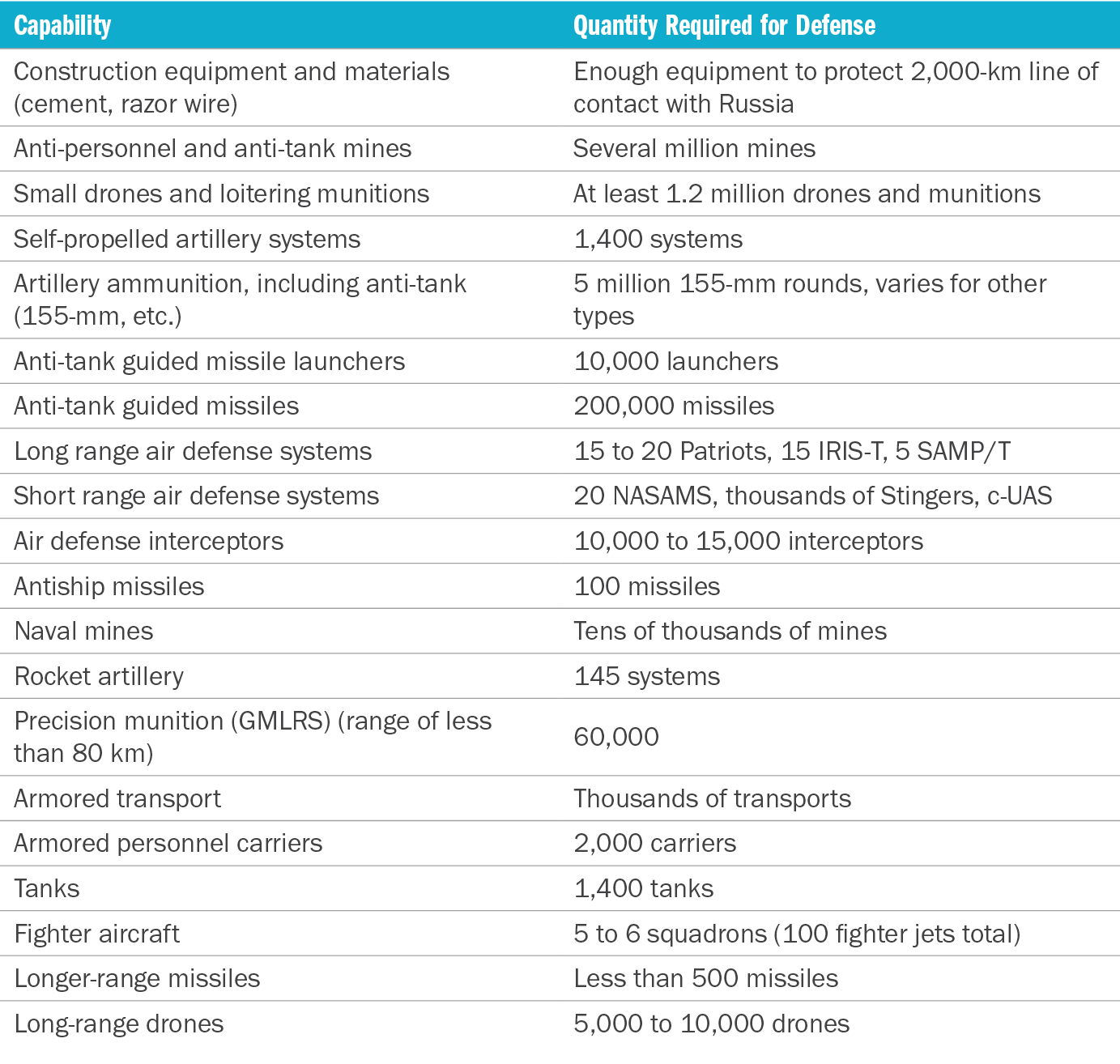
How could Ukraine build the required stockpiles?
The previous section laid out Ukraine’s military requirements. The next question is how and whether Ukraine would be able to resource these requirements.
Under armed nonalignment, Ukraine would build its arsenal from several sources. First, when the war ends, it will have some equipment and weapons left over. How much and which types will depend on when and how the war ends. For drones and ammunition, for example, it can be assumed that minimal numbers would be left behind. For larger platforms, such as tanks, aircraft, and air defense systems, what is left after the war may be substantial.
Second, Ukraine hopes that it will be able to buy U.S. and European weapons (or receive weapons as security assistance in the form of grants and loans) or purchase weapons from other suppliers.283Ukrainian researchers, interview with the author, August 2025. The Trump administration has indicated that it will not provide support to Ukraine over the long term but might offer some short-term support in the event of a settlement that focuses on defensive capabilities that the United States can produce cheaply or has in excess quantities.284Hegseth, “Opening Remarks by Secretary of Defense Pete Hegseth at Ukraine Defense Contact Group (As Delivered).” This support might not come as military aid but as loans that leverage the U.S.-Ukraine critical minerals deal or have European financing.285Baskaran and Schwartz, “What to Know about the Signed U.S.-Ukraine Minerals Deal.”
European NATO allies have indicated a willingness to support Ukraine over a longer period, but their defense industrial base is not up to the task of meeting Ukraine’s needs on its own or in the short term.286Bergmann, “Europe Needs a Paradigm Shift in How It Supports Ukraine.” It will take several years for European countries to produce certain types of military equipment in quantities that meet Ukraine’s requirements, and, even then, they will need to balance filling their own stockpiles—which are already low because of transfers to Ukraine and carry additional needs stemming from the deteriorating security environment—with aiding Ukraine.287Bergmann, “Europe Needs a Paradigm Shift in How It Supports Ukraine.”
Finally, Ukraine’s industrial base holds significant promise and could likely become the primary source of its military capabilities over the longer term.288Kosoy, “Why Ukraine’s Defense Industry Might Be the Best $30 Billion Investment Today”; Kuzmuk and Scarazzato, “The Transformation of Ukraine’s Arms Industry”; Hmyria et al., “Innovations in the Defense-Industrial Complex: Current Status and Development Prospects.” In fact, there are already several areas—especially drones—in which Ukraine can already meet its own needs, and Western countries can invest in Ukraine’s defense industrial base through joint ventures and directly to help speed production at scale of as many systems as possible.289Kosoy, “Why Ukraine’s Defense Industry Might Be the Best $30 Billion Investment Today”; Kuzmuk and Scarazzato, “The Transformation of Ukraine’s Arms Industry”; Milakovsky and Vlasiuk, Industrial Policy for Ukraine’s Survival.
In this section, I consider how Ukraine’s requirements might be resourced over time and across providers, given production and resource constraints. The bottom-line takeaway from this analysis is that—if major European defense contractors come close to hitting their stated production targets over the next five years and the United States contributes on certain key capabilities, such as air defense—Ukraine can have a robust deterrent foundation within about five years after a settlement of the war. Although some of the specifics will depend on how and when the war ends, this general finding should hold so long as a settlement is reached in the next year or two. Although a longer war termination timeline may further damage Ukraine’s capabilities, it would give Europe more time to ramp up defense production and facilitate European support to Ukraine postwar.
The focus of the initial postwar years will be on building Ukraine’s defensive foundation. Ukraine can produce some of what it needs, but it will rely on contributions from the United States and European states for some systems, such as ammunition and air defense. In the rest of this section, I examine how Ukraine’s requirements might be resourced, first describing the most basic elements of the defensive strategy, then the systems that are less essential to the porcupine approach supported in this report. The discussion starts with passive defenses, such as physical barriers, fortifications, and mines, then moves drones and artillery systems and ammunition, then air defense, and concludes with tanks, aircraft, and long-range missiles.
Passive defenses and mines
Ukraine should have little trouble sourcing the cement, razor wire, and other materials needed to construct physical barriers, dragon’s teeth, trenches, tank traps, and other defensive fortifications. Ukraine’s cement industry contracted at the start of the 2022 war but has since grown and expects to be able to scale its production to meet Ukraine’s demand for border defenses.290“Ukraine’s Cement Industry Poised to Meet All Reconstruction Demands.” Ukraine likely has the basic construction equipment that it would need to build these fortifications, but the United States could offer some combat engineering equipment to supplement Ukraine’s capabilities. However, Ukraine should not need much help to meet the demands of building its first line of passive border defenses.291Kavanagh, Safeguarding U.S. Interests in a Ukraine War Settlement; Stares and O’Hanlon, “Defending Ukraine in the Absence of NATO Security Guarantees.”
Minefields will also be an important part of Ukraine’s front line of defense.292Kavanagh, Safeguarding U.S. Interests in a Ukraine War Settlement; Stares and O’Hanlon, “Defending Ukraine in the Absence of NATO Security Guarantees.” As noted, Ukraine will want lots of anti-tank mines and some anti-personnel mines stockpiled, if not in the ground. Since 2022, Ukraine has relied mostly on indigenously produced anti-tank mines, although it has received some anti-personnel mines from the United States.293“Ukraine Develops TM-2025 Anti-Tank Mine with 3D-Printed Smart Fuse”; Human Rights Watch, “Landmine Use in Ukraine.” Ukraine can probably meet its future requirements for anti-tank mines on its own. The same is likely true for anti-personnel mines, but the United States does have more-advanced variants that reduce the humanitarian risks and that it has been willing to provide in the past, along with the systems to deliver them.294Birnbaum and Horton, “Biden Approves Antipersonnel Mines for Ukraine, Undoing His Own Policy.” This aid might continue, but Ukraine can likely take over this production rather quickly.
Drones
Ukraine will need a large stockpile of drones—more than 1 million—but it is a leading global producer of small unmanned systems and can produce at least 4 million military-use drones per year.295Beardsley, “Ukraine’s DIY Drone Makers Are Helping Fighters on the Front Lines”; Bilousova et al., “Ukraine’s Drones Industry.” European allies can invest in Ukraine’s drone manufacturing capabilities and perhaps cooperate on joint ventures. But Ukraine will not need a lot of support when it comes to drone manufacturing and might even be able to export excess capacity. In addition to small drones, Ukraine is capable of producing large numbers of larger drones that have a more substantial payload or can be used for surveillance, as well as sea and subsurface drones that can be used in naval operations. Ukraine should not need external support to produce these systems; in fact, it has been an innovator in this area.
Artillery systems, anti-tank weapons, and ammunition
Though Ukraine’s exact postwar artillery needs will depend on when the conflict ends, if that happens in the next year, Ukraine will need to acquire about 400 short-range artillery systems. Ukraine can produce at least 20 and as many as 36 of its Bohdana system per month, suggesting a yearly total of close to 300 systems.296Khomenko, “Ukraine Almost Doubles Production Rate of Bohdana Self-Propelled Howitzers”; “Ukraine Develops New Bohdana 6.0 155-mm Self-Propelled Howitzer to Expand International Co-Production.” The system does require some Western parts, so is not purely indigenous, but Ukraine is working toward full indigenous production.297Khomenko, “Ukraine Almost Doubles Production Rate of Bohdana Self-Propelled Howitzers.”
With a rate of 300 systems produced per year, Ukraine could reach its 400-system target in about two years. As Ukraine takes over full production of the system, however, production rates may fall somewhat as manufacturing the component parts will take additional time. The timeline would then stretch to three to four years. Still, Ukraine should not need Western support to meet its artillery target and could even modernize its artillery holdings by retiring older systems and replacing them.
Next, there is the question of ammunition. Ukraine will need to build a stockpile of 5 million rounds of 155-mm ammunition. It will also need ammunition of other calibers in lesser quantities, but 155-mm shells have been in highest demand and shortest supply during the war. Ukraine has increased its production of munitions, including 155-mm caliber ammunition, significantly, manufacturing a total of 2.5 million shells since the beginning of the war. Ukraine is aiming to reach 1 million 155-mm shells in indigenous production, although it may not reach this level for several years.298Kyshnikov, “Ukraine Has Produced 2.5 Million Rounds of Artillery Ammunition Since the Beginning of 2024.” To meet the 5 million shell target, Ukraine will need some external support.299Kozatskyi, “Partners to Help Ukraine Produce 1 Million 155-mm Shells Annually.” Many in the Trump administration have been concerned about U.S. expenditures and stockpiles of 155-mm and other types of ammunition, so the United States is likely to be restrictive in what it is willing to provide or sell to Ukraine going forward.300Kube et al., “Pentagon Halts Weapons Shipment to Ukraine amid Concerns over U.S. Stockpile.” However, this is an area in which European contributions and Ukraine’s own production can get Ukraine most of the way to its target, so limited U.S. assistance would be needed.
European states have made and continue to make significant strides in the production of ammunition of various types. Focusing just on 155-mm ammunition, for instance, Germany’s Rheinmetall can produce 700,000 rounds of ammunition per year with a goal of producing more than 1.1 million rounds per year.301Rheinmetall, “Largest Order in Company History: Rheinmetall Receives Framework Contract for 155-mm Artillery Ammunition for the Bundeswehr with a Total Gross Value of up to €8.5 Billion.” This number is more than what the United States produces, which is 650,000 shells per year (below its eventual target).302“Europe’s Armsmakers Have Ramped Up Capacity”; Judson “Army Races to Widen the Bottlenecks of Artillery Shell Production.” Sweden’s SAAB will produce 400,000 rounds in 2025. Other countries in Europe, including the United Kingdom, are working to increase 155-mm ammunition production.303Kington and Gosselin-Malo, “Behind Europe’s Ammo Pledge to Ukraine, Some Manufacturers Grow Leery”; Yermak, “Ukraine Launched Production of 155-mm Artillery Shells, Official Says.” Production of other types of short-range and anti-tank munitions is increasing as well.
Assuming European states can collectively provide Ukraine 600,000 shells per year (about half of German and Swedish production combined) and purchase another 200,000 from the United States, with Ukraine’s own production added, Kyiv could build a 5 million 155-mm round stockpile in five years after the end of the war. If European states need more time to ramp up their production lines, their contributions (3 million rounds total) might be staggered and fall more heavily in the last half of the five-year build-up period. If the United States refused to contribute, European states could offset this by providing 1 million additional rounds over five years—which is not out of the question, given that so many countries are looking to increase production. If Ukraine can ramp up its own production (a stated goal) then total aid amounts would drop. Over the long term, Ukraine should be able to meet much of its own need for ammunition, which would relieve it of one of its most significant dependences of this war.
Ukraine would need other types of ammunition as well (120-mm and 125-mm anti-tank rounds, for example), but these have been used in smaller quantities and have been less essential to Ukraine’s war effort. Ukraine can likely resource its requirements for these other types of ammunition in the same five-year time frame using a mix of indigenous and European production.
Ukraine has already received more than 10,000 anti-tank guided missile systems and should not need additional Western aid in this area. Ukraine also continues to increase the production of its Stugna-P missile system, which can serve as a future source of additional anti-tank missile launchers should Ukraine want to increase its stockpile.304Kramarenko and Baschenko, “What Is Known About Ukraine’s Stugna-P Anti-Tank Missile System.” Ukraine is also increasing its production of the Stugna anti-tank missile. It produced about 1,500 missiles per year before the war but may be able to produce at a higher rate. In five years, at the same production rate or a slightly higher one, Ukraine could produce about 8,000 of these missiles for its own use.305Hambling, “Ukraine’s Homemade Anti-Tank Missiles Taking Out New Russian Targets.” The United States can produce about 3,000 Javelin missiles per year. Ukraine has also relied on the British Next Generation Light Anti-Tank Weapon (NLAW), which has a production rate of 400,000 per year.306Martin, “Saab’s ‘Huge Ramp Up’ in Anti-Tank Weapon, Ammo Production Targets 400,000 Units a Year.” The United States has been concerned about dwindling stockpiles of Javelin missiles but might offer Ukraine 500 per year for five years. The NLAW could make up the rest of Ukraine’s anti-tank missile stockpile. Current levels of production would easily close the remaining 190,000 missile gap. However, Ukraine might choose to turn to systems offered by other countries to diversify its stockpile.
Air defense
Building a robust air defense capability, including systems and missiles, will be Ukraine’s biggest challenge under armed nonalignment. U.S.-made Patriot systems and missiles are considered the gold standard in air defense.307Cooper, “What Are Patriot Missiles, and Why Does Ukraine Want Them?” Ukraine will not be able to rely only on Patriot systems because of their scarcity and expense and would benefit from having a diversity of systems and interceptors. Ukraine will need to leverage its own FrankenSAMs (Soviet systems that have been converted to shoot U.S. missiles) and can use its fighter jets to contribute to air defense operations while turning to European suppliers, such as Germany for IRIS-T systems and France for SAMP/T systems. Ukraine could also look to alternative suppliers such, as Israel and South Korea, which have their own air defense systems and have indicated a willingness to sell these technologies to Ukraine.
Ukraine will want as many air defense systems as it can get, so here I consider what it might reasonably be able to acquire.308Muravska, Getting Serious About Building Ukraine’s Air Defence Capabilities. Patriot batteries are produced at a rate of only 12 per year. However, through its current arrangement with Europe (in which Europe buys Ukraine weapons), Ukraine might be able to get one additional system per year for the next five years, bringing its total to 16 Patriots, which is more than the 15-system requirement noted previously.309Feickert, “PATRIOT Air and Missile Defense System for Ukraine”; Murray, “Germany to Deliver Two Patriot Systems.” It is possible that Ukraine could exceed this goal, but it faces such obstacles as Europe’s own unwillingness to part with its Patriot systems. France and Germany will also be able to provide additional IRIS-T or SAMP/T systems. Germany expects to be able to send 11 more IRIS-T systems in coming years, and France might provide an additional SAMP/T system per year, for a total of five systems.310Manuel, “Ukraine to Receive More IRIS-T Missile Systems from Germany.” NASAMS yearly production is on the low side, but Ukraine might hope to get two additional systems of this type per year to fill its short-range defense needs.311Kongsberg, “NASAMS Air Defence System.” These additional systems would substantially increase Ukraine’s air defense capabilities and more or less meet the targets set in the previous section.
As noted previously, other short-range missile systems could be useful. Additional Stinger missile launchers, the Avenger system, or HAWK air defense systems could support Ukraine’s short-range air defense, but this need is less urgent than Ukraine’s long-range air defense requirements. Ukraine may also eventually develop indigenous air defense capabilities for ballistic and cruise missiles.312Muravska, Getting Serious About Building Ukraine’s Air Defence Capabilities.
Filling Ukraine’s need for 10,000 to 15,000 air interceptor missiles will be a larger challenge. Ukraine will want a large portion of these to be Patriot interceptors, either the most advanced PAC-3 or the PAC-2. The PAC-3 missile is a lighter, more agile missile with a slightly shorter range. It is designed to deal with advanced ballistic and hypersonic threats, but its range is only around 40 km.313Cooper, “What Are Patriot Missiles, and Why Does Ukraine Want Them?”; Hodunova, “Patriot Missiles.” The PAC-2 is heavier but has a longer range (160 km) and is useful against a wider variety of targets, including cruise and other missiles, all of which Russia has employed against Ukraine.314Hodunova, “Patriot Missiles.” The United States can offer Ukraine other types of interceptor missiles. For example, AMRAAM and AIM-9X Sidewinders have been successfully used in Ukraine’s FrankenSAM system and can be fired from F-16s.315Newdick, “Ukraine’s FrankenSAM Air Defense Concept Could Be Used to Protect USAF Bases.” Ukraine has also relied heavily on U.S. Stinger missiles.316Mittal, “Ukraine Is Receiving More Stinger Missiles from the U.S. at a Key Time.”
The United States aims to be able to produce about 750 PAC-3 missiles and about 450 PAC-2 (or GEM-T) missiles per year by the end of 2025 and might be willing to sell a maximum of 200 total Patriot missiles across the two variants per year for five years after a ceasefire.317Kubo and Kelly, “US-Japan Patriot Missile Production Plan Hits Boeing Component Roadblock”; Lockheed Martin, “U.S. Army Awards Lockheed Martin Contract to Increase PAC-3 MSE Production Capacity.” This would give Ukraine 1,000 Patriot missiles in its stockpile. Germany has plans to open a production facility capable of producing 1,000 Patriot missiles per year, including both GEM-T missiles (which are longer range and equivalent in capability to PAC-2s but less effective against ballistic missiles) and PAC-3s.318Burke, “First Patriot Missile Facility Outside US Starts Up in Germany”; Judson, “RTX Gets $478M to Replenish Germany’s Patriot Missiles Sent to Ukraine.” As of this writing, this plant is being built and may not be able to contribute to Ukraine’s air defense interceptor stock in the short term, but it could be a new supply source in the long term.
Other U.S. missiles can add to this total. AIM-9X and AMRAAM missiles are produced at a rate of about 1,200 and 2,000 per year respectively, so the United States might offer to sell 200 of each missile per year for five years, giving Ukraine another 2,000 interceptors.319Marrow, “Raytheon to Max out AMRAAM Production for ‘Foreseeable Future,’ Exec Says”; Hill, “US DoD Increases AIM-9X Sidewinder Production to 2,500 Missiles.” Stinger missiles can supplement Ukraine’s short-run defense requirements. Production sits at just 720 missiles per year, so the United States might sell Ukraine 100 or so per year over five years.320Selinger, “Stinger Missile Production to Rise 50% by 2025, US Army Says.” Over five years, the United States would meet, at most, around 35 percent of the low end of Ukraine’s interceptor goal, leaving the rest to European states and Ukraine. This is an optimistic view of what the United States might be willing to divert to Ukraine, although the likelihood rises if European states agree to pay for the missiles.
Production of the missiles for the IRIS-T and SAMP/T is considerably lower than U.S.-made weapons, although there are plans to address these shortfalls in coming years. French company MDBA, for instance, plans to increase production of its longer-range Aster missile for the SAMP/T to close to 200 missiles per year by 2025 and 300 or more by 2026.321Selinger, “Stinger Missile Production to Rise 50% by 2025, US Army Says.” It will also increase production of its short-range Mistral to about 300 per year.322Ruitenberg, “Europe’s Top Missile Maker MBDA Boosts Output 33% amid Record Orders.” Germany plans to increase production of its IRIS-T missile to 400 to 500 per year by 2025.323“Germany Prioritizes IRIS-T Missile Production for Ukraine to Counter Escalating Russian Missile and Drone Attacks.” These countries will not want to give Ukraine all of their yearly production of missiles, but each might be willing to give Ukraine one-third of their production per year for five years, and this amount could increase over time. This would amount to about 200 SAMP/T compatible missiles and 150 IRIS-T compatible missiles in the first year after a settlement and possibly in the range of 1,500 to 2,000 missiles over five years. Together with the U.S. contribution, Ukraine would have just more than 5,000 interceptors over five years. This would be short of its 10,000-interceptor goal.
This stockpile would, however, be enough to last Ukraine about six months at the rates it is using these missiles during the war, which is significant.
Ukraine could choose to continue investment in this area over subsequent years to further increase its supply of interceptors. If Ukraine purchased other systems from other suppliers, they might also be able to purchase interceptors from those suppliers. Ukraine is also working to develop its indigenously produced air defense capabilities.324Cook, “Ukraine Developing Patriot-Inspired Air Defense System.”
As noted previously, Ukraine will also need counterdrone systems and capabilities.325Mittal and Goetz, “A Quantitative Analysis of the Effects of Drone and Counter-Drone Systems on the Russia-Ukraine Battlefield.” It is a leader in this area and so may be able to rely heavily on indigenous production, although the United Kingdom’s Raven system can add valuable depth and diversity to Ukraine’s arsenal. The advent of laser-based counterdrone weapons would also be revolutionary for Ukraine’s effort to counter the drone threat, but it may take time to produce these weapons at scale.326Bernatskyi et al., “Analysis of the Application of Lasers for Counter-UAV Purposes.” Antidrone guns and simple solutions, such as netting and advances in electronic warfare and jamming, could also be useful.
The bottom line is that, within five years of the war ending and with a modest U.S. contribution, Ukraine would have a robust air defense capability and a stockpile of missiles that can last longer than 200 days with no resupply, even under rather pessimistic assumptions. Contributions in subsequent years would help further bolster Ukraine’s stockpiles and give it a bigger cushion should war resume. Air defense is an area in which U.S. support is perhaps most important.
Rocket artillery and artillery rockets
Ukraine has about 40 HIMARS systems and likely at least 50 of its Vilkha system (about 100 have been produced but some have been lost in war).327Altman, “Ukraine Is Using Guided Rockets with More Range than HIMARS-Launched Ones”; Axe, “The U.S. Is Starving Ukraine’s HIMARS.” This leaves Ukraine around 35 systems short of its goal. Ukraine can produce around 20 of these systems per year, so could meet its target in two years without Western assistance. Some may argue that Ukraine needs HIMARS platforms, specifically, but this seems incorrect. Its Vilkha system is less mobile than the HIMARS, but it is quite accurate and can fire rockets at ranges between 120 and 150 km, which is farther than HIMARS-fired GMLRS missiles.328Altman, “Ukraine Is Using Guided Rockets with More Range.”
Ukraine will need help building a stockpile of munitions (ideally about 60,000 MRLS rockets) for its rocket artillery systems. About 14,000 GMLRS are produced in the United States each year.329Lockheed Martin, “About HIMARS”; Judson, “Extended Range Version of Army Guided Rocket Enters Production.” They are among the cheaper U.S. missiles and have a high yearly production rate relative to other missiles. GMLRS production—like munition production generally—has benefited from high investment and efforts to rapidly increase production rates. The United States is increasing production, and Australia is also set to become a producer of the rockets through a joint venture with the United States.330Blenkin, “Lockheed, Thales Team to Produce Aussie-Made GMLRS Munitions.” European defense contractors can produce MRLS rockets but not in large quantities.331Dean, “Long-Range Rocket Artillery Munitions: A Market Overview”; Toporkova, “Ukraine, the Overlooked Powerhouse of Missile Production.” Ukraine’s rate of production of 300-mm rockets for its Vilkha system is not public. Reports suggest that the rate is increasing but remains low.332Altman, “Ukraine Is Using Guided Rockets with More Range.” Western investment might help speed this development, however, and increase production rates.
Meeting Ukraine’s demand for rockets for these systems will be hard. Concerned about its own magazine depth, the United States may be hesitant to sell too many GMLRS to Ukraine. As production ramps up, it might be willing to provide 2,000 rockets per year for five years, getting Ukraine to 10,000 total GMLRS. Assuming Vilkha rocket production is slower than that of U.S. GMLRS, Ukraine could add maybe 10,000 rockets to this total. European production will take a bit of time to come online, but, across various ventures, it might also produce 10,000 rockets for Ukraine. This additions would get Ukraine halfway to its 60,000-rocket target. Ukraine could probably meet the rest of its target with unguided, cheaper artillery rockets within the same five-year timeline. In any case, the artillery rockets will likely be less important to a defensive Ukrainian strategy than other capabilities already described.333Markov, “A Change in the Way Artillery Is Used, Based on the Russia-Ukraine Conflict.”
Antiship missiles and naval mines
Ukraine will not need Western assistance for its desired stockpile of antiship missiles. Ukraine already has an indigenously produced antiship missile, the R-360 Neptune, which it produces at a rate of about 100 missiles per year.334Johnson, “R-360 Neptune: Ukraine’s ‘New’ Missile That Could Target Putin.” It might be able to increase this rate with some investment, but doing so would be largely unnecessary. One year’s production would meet its target, and Ukraine could then focus its resources on other capabilities.
Ukraine can also likely meet its own need for naval mines, which are simple and cheap to produce in large quantities; it has already proven its ability to use such mines effectively in the current conflict.335Jankowicz, “The Black Sea has a Deadly Naval Mine Problem That Will Long Outlast the Ukraine War.”
Aircraft, tanks, and vehicles
Ukraine will not need any additional tanks, aircraft, or infantry fighting vehicles to meet the requirements outlined here. Ukraine has at least 1,500 tanks remaining (and possibly more), including more than 100 U.S.-made Abrams and German-made Leopards.336Axe, “After Two Years of War, Ukraine Still Has a Thousand Tanks”; Carlough and Harris, “Comparing the Size and Capabilities of the Russian and Ukrainian Militaries.” This number surpasses the proposed 1,400-tank requirement. Ukraine had around 100 Soviet-made fighter jets before the war.337Carlough and Harris, “Comparing the Size and Capabilities of the Russian and Ukrainian Militaries.” The number remaining is not public, but some estimates put it at around 70 fighter jets.338Carlough and Harris, “Comparing the Size and Capabilities of the Russian and Ukrainian Militaries.” Ukraine has also received several dozen F-16s (the exact number has not been disclosed) and some Mirage 2000-5Fs from France.339Koeltzow, Peterson, and Williams, “F-16s Unleashed.” These deliveries (and possibly also Swedish Gripen and other Western fighter aircraft under contract) will continue until the war ends, so Ukraine might have more Western fighter jets at that point. Altogether, this number surpasses the total requirement of 100 jets outlined previously. Ukraine retains the ability to repair its Soviet-era fleet, so at least some of these fighter jets continue to be used and are being modernized to improve their effectiveness.340Axe, “Desperate to Reinforce a Buckling Front Line, Ukraine Is Scourging the Planet for Hundreds of Spare Tanks and Fighting Vehicles”; Statista, “Number of Infantry Fighting Vehicles (IFVS) Allocated to Ukraine”; Axe, “Ukraine Has Thousands of Old Armored Tractors.” These aircraft can contribute to air defense operations, including defending Ukraine’s skies from missiles and the adversary aircraft firing those missiles, in the case of renewed combat operations.
Ukraine has between 1,000 and 2,000 infantry fighting vehicles of different types, so it should not need many more to meet its 2,200 target.341Statista, “Number of Infantry Fighting Vehicles (IFVS) Allocated to Ukraine”; Axe, “Desperate to Reinforce a Buckling Front Line, Ukraine Is Scourging the Planet for Hundreds of Spare Tanks and Fighting Vehicles.” If it does end up needing more because of high loss rates over the remainder of the war, it can rely on domestic production capacity in this area. Ukrainian companies and joint ventures with such foreign firms as Rheinmetall have already started producing modern infantry fighting vehicles in Ukraine.342Bisht, “Kyiv to Receive First Ukraine-Built Lynx Infantry Vehicle This Year”; Malyasov, “Roshel Begins Armored Vehicle Production in Ukraine.” With production rates of at least several hundred vehicles per year, Ukraine should have no problem increasing its stockpile of these vehicles, if needed, or replacing older vehicles, if desired.343Bisht, “Kyiv to Receive First Ukraine-Built Lynx Infantry Vehicle This Year”; Malyasov, “Roshel Begins Armored Vehicle Production in Ukraine.”
Long-range missiles
Finally, as previously described, Ukraine will need only a small stockpile of long-range missiles and drones for a defensive strategy. Ukraine has received several types of long-range missiles from the United States and European states, including ATACMS, Storm Shadow and SCALP missiles, and, most recently, Extended Range Attack Munitions, though its use of these systems has been restricted by U.S. and European policy.344Newdick, “Ukraine Will Receive First of Thousands of New U.S. Made Standoff Missiles in the Coming Weeks.” It may have some systems left at the end of the war, but this is unlikely.
However, Ukraine can meet future needs for long-range systems using indigenous production. Ukraine aims to produce about 30,000 long-range drones per year, easily exceeding the target set above.345Melkozerova, “China Helps Russia Pull Ahead in Lethal Drone War Race with Ukraine.” Ukraine’s production of long-range missiles remains rather low at present, but it aims to produce several hundred of its Peklo and Sapsan missile per year and is hoping to ramp up its longest-range Flamingo missile production as well.346Dickinson, “Ukraine Is Expanding Its Long-Range Arsenal”; “Ukraine Drastically Increases Cruise Missile Production”; Trevithick, “Ukraine Aims to Build Thousands of Flamingo Long-Range Cruise Missiles a Year.” Even if production remains low, Ukraine should be able to build a stockpile if several hundred missiles over the five-year period considered here. Ukraine will not need Western assistance in this area.
Summary: required external support
Whenever the war ends, Ukraine will be self-sufficient in most areas but require external support in a few others. Table 4.3 summarizes Ukraine’s external support needs, possible sources for those needs, and whether the requirements for those needs can be met in the five-year timeline. It also offers an estimate of the cost of equipment and materiel that will come from abroad.
Table 4.3: Sourcing of Ukraine’s self-defense capabilities
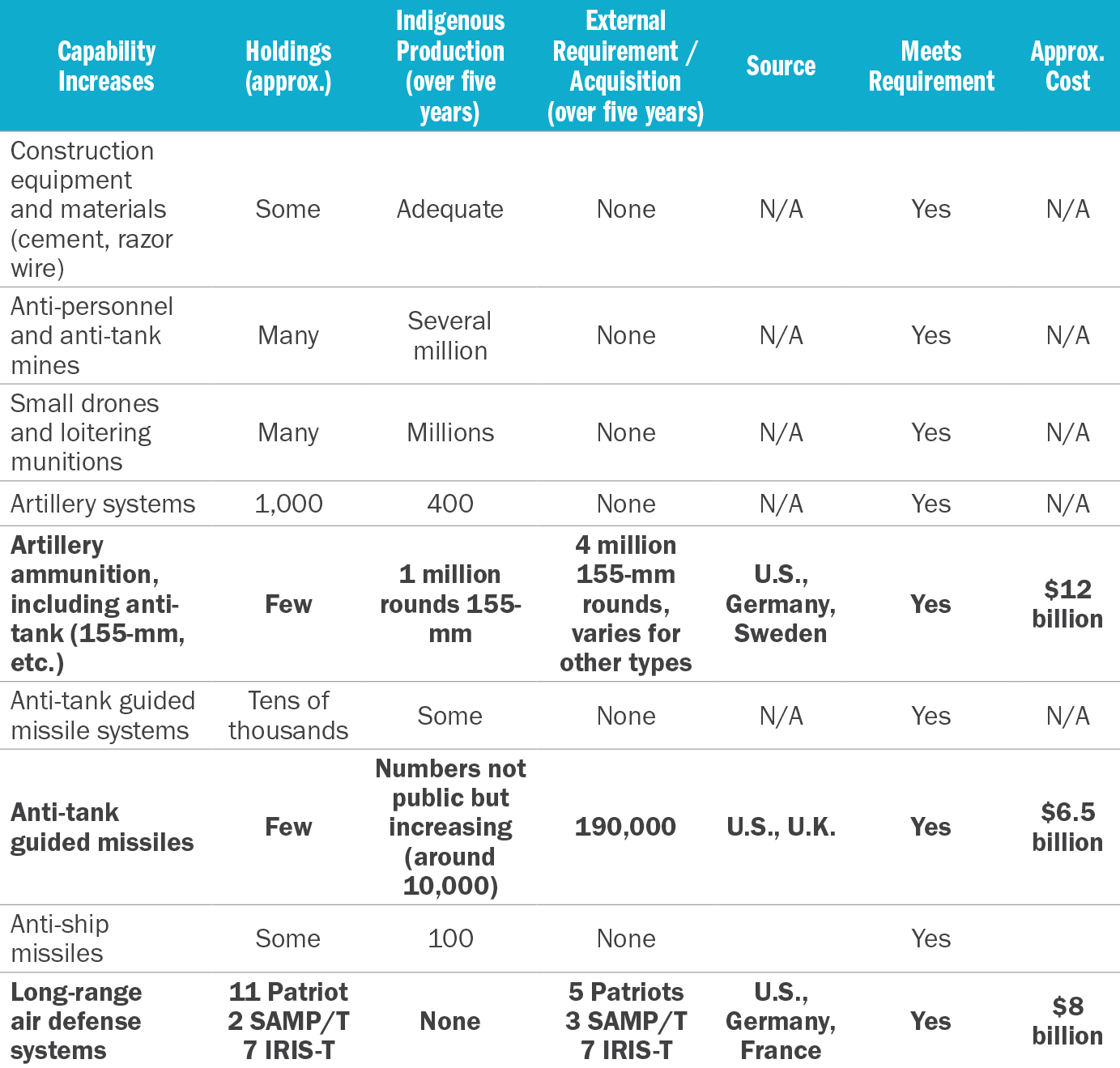

The only crucial area in which Ukraine cannot meet its targets even with Western assistance is air defense. It will likely need to settle for a five-year stockpile that falls short of its desired requirement. It can, however, continue to acquire these missiles beyond the five-year mark. In the case of artillery rockets, what it can acquire is likely enough for a robust campaign over the course of the first year of a future war.
The estimated cost for all Western assistance listed here is about $41.5 billion over five years. This will likely not be the full total expense of building Ukraine’s force because it does not include what Ukraine will spend domestically. There are also some items not included. For example, in addition to simple 155-mm ammunition, Ukraine might also want some antitank precision-guided Excalibur shells. Other ammunition and spare part purchases might also drive up the cost to closer to $50 billion total, but that should be close to an upper limit for five years of assistance following the plan outlined in this report.
Ukraine will not be able to pay for all of this in the near term (or maybe ever). The Trump administration has indicated limited willingness to provide no-cost aid to Ukraine, although some security assistance has been written into the fiscal year 2026 defense appropriation bill.347Stone, “Senate Panel Approves $500 Million Aid for Ukraine in Defense Bill.” Additional assistance like that provided through past U.S. supplemental appropriations seems unlikely, but there is a chance that the U.S. Congress might authorize some additional aid after a settlement is reached.348Denisova, “Biden Leaves Nearly $4 Billion in US Aid to Ukraine Unused.” Europe will likely have to bear a bigger share of the cost going forward, however. For instance, Europe may be able to purchase needed U.S. weapons for Ukraine and can provide its own materiel to Ukraine on a grant basis or through funds using the interest on Russian assets frozen in Europe. The U.S.-Ukraine minerals deal might also be a useful vehicle, assuming it works as planned.349Miller and Politi, “US and Ukraine Sign Natural Resources Deal.”
Regardless of how the United States and Europe decide to manage the funding question, there should be a clear, transparent plan covering which systems will be provided or sold to Ukraine over the next five years, who will provide them, and when they will be provided.350Charap and Priebe, Avoiding a Long War. The document would solidify and formalize the commitments of all parties, allow defense contractors to plan their production timelines, and give Ukraine some certainty and confidence in U.S. and European support. It would also offer transparency to Russia about what Western countries plan to provide and what they will not provide (e.g., aircraft, tanks, long-range missiles).351Charap and Priebe, Avoiding a Long War. Any commitment might be codified by the provider country’s legislature, but this might not be possible in all cases, including any commitments with the United States. Some sort of executive agreement would likely be a reasonable substitute.352Ciaramella, Envisioning a Long-Term Security Arrangement for Ukraine. Agreements could be term-limited (e.g., for a five-year period) but renegotiated at the end of that term if both parties agreed. This approach would simultaneously offer Ukraine and Russia reassurance by providing transparency on what will and will not be offered up front.
Importantly, for the United States to offer the contributions outlined here on the timeline specified, assistance provided and weapons sold to Ukraine would either have to be taken from existing stocks and then backfilled (which is unlikely, given concerns about depletion of U.S. stockpiles), or Ukraine would need to be pushed toward the front of any production queue for a short time (which the United States has shown some willingness to do).353Seligman, “US Gives Ukraine Front-of-the-Line Privileges for Air Defense Missiles”; Seligman, Gramer, and Ward, “U.S. Reshuffles Arms Deliveries to Free Up More Patriots for Ukraine.” Given the precariousness of Ukraine’s immediate postwar defenses and the limited duration of the U.S. commitment, this temporary prioritization makes some sense and would not be unprecedented.354Seligman, “US Gives Ukraine Front-of-the-Line Privileges for Air Defense Missiles”; Seligman, Gramer, and Ward, “U.S. Reshuffles Arms Deliveries to Free Up More Patriots for Ukraine.” The Biden and Trump administrations pushed Ukraine to the front of the queue for air defense, for example.355Seligman, “US Gives Ukraine Front-of-the-Line Privileges for Air Defense Missiles”; Seligman, Gramer, and Ward, “U.S. Reshuffles Arms Deliveries to Free Up More Patriots for Ukraine.” European countries would also need to consider sequencing, specifically, how to manage commitments to their defense and to Ukraine. The plan laid out in this report takes this into account, but policymakers should still examine the issue when setting the terms of their assistance to Ukraine.
One drawback of the approach outlined here is that Ukraine will necessarily end up armed with a variety of systems and types of munitions, only some of which will be compatible. This is the problem that the Ukraine Defense Contact Group capability coalitions were designed to address by effectively coordinating the investments and assistance of members so that aid could be provided more efficiently to Ukraine.356Government Offices of Sweden, “Capability Coalitions in Support of Ukraine”; Martin, “Eight ‘Capability Coalitions’ Are Rushing Arms to Ukraine.” With specific suppliers or countries focused on specific technologies and systems, military assistance to Ukraine might arrive in larger blocks with fewer types of systems, for example. This type of coordination could continue after a settlement. As a positive, having many suppliers offers resilience against production obstacles experienced by any one provider or political challenges affecting any one country. Although this diversity of systems is a challenge, Ukraine is now accustomed to it after three years of war.
Understanding Russian concerns
A final question when it comes to mapping out what an armed and nonaligned Ukraine might look like is how Russia might react if Ukraine is equipped with the set of capabilities laid out in this report. Russia should not have a veto on decisions about Ukraine’s security, but a lasting settlement will require meaningfully addressing Russia’s insecurities. Understanding where Russia might want to limit Ukraine’s military capabilities and which sorts of capabilities Russia might accept will be important for negotiators in balancing Ukraine’s defense requirements with the demands that Russia might make.357Umland, “A Neutral and Demilitarized Ukraine?” The specific challenge will be identifying areas of flexibility and finding space for trades between the two sides. In other words, which commitments might Russia be willing to make for commitments from Ukraine on areas of Russia’s greatest concern and vice versa?
In this section, I identify areas around which Russian officials and interlocutors have expressed concerns in the past and what might be sticking points when it comes to Western assistance or Ukraine’s military holdings. I do not specifically recommend trades that Russia might make or Ukraine might accept to alleviate those concerns. Russia could object to the armed Ukraine model outlined here. Its leaders might be opposed to Ukraine receiving any Western assistance after the war ends. In the most recent draft of Russia’s postwar demands, they suggested that Ukraine would receive no military aid from the United States or Europe after the war.358Soldatkin, Balmforth, and Hayatsever, “Russia Sets Out Punitive Terms at Peace Talks with Ukraine.” At its most extreme, this demand would mean that Russia would object to any Western aid and most of the plan proposed in this report. However, there may be room here for negotiation. Russia may also recognize that some types of aid—especially ammunition—will be hard to interdict or even identify when it is shipped to Ukraine.
Western assistance
When it comes to assistance from the United States and Europe, Russian sensitivities throughout the war have been concentrated on systems that can strike or reach deep into Russian territory, including military targets, civilian infrastructure, and leadership. These systems, however, are the least necessary parts of the proposed strategy and plan. For example, if the United States were to provide more HIMARS (which is not proposed in this plan), it could be an issue for Russia.359Russian military affairs experts, interviews with the authors, June 2025. Although Russia is not especially concerned with the system as a launcher for MLRS missiles, HIMARS can be used to launch longer-range missiles—including ATACMS and the new PRSM missile, which have ranges beyond 500 km.360Trevithick, “Mobile Launcher That Can Fire Four Times More Weapons Than HIMARS Emerges.”
A more relevant area of concern is air defense. Russia is unlikely to be concerned with shorter-range air defense systems and interceptor missiles (e.g., IRIS-T, NASAMS, SAMP/T). However, some Russia interlocutors have expressed concerns about Patriot systems, in particular their long-range radars that can survey deep into Russian territory and PAC-2 missiles, which were used to strike Russian aircraft operating inside Russian airspace several times during the war.361Russian military affairs experts, interviews with the authors, June 2025; Chatterjee, “Ukraine Says It Has Downed Second Russian A-50 Spy Plane in Weeks.” Air defense is obviously a core aspect of Ukraine’s defensive posture, so it must be robust. However, Russia may object to large transfers of Patriot systems and PAC-2 and PAC-3 missiles to Ukraine after the war. Russia would also push back on Ukraine’s access to even more-advanced U.S. air defense systems, including the THAAD or Aegis Ashore. It is unlikely that the United States would sell these systems or missiles to Ukraine, given global shortages.362Russian military affairs experts, interviews with the authors, June 2025; Carroll and Cole, “Putin Goads US to Deploy THAAD in Ukraine”; Mongilio, “U.S. Offered Russians Aegis Ashore Inspections to Ease Ukraine Tensions; More American Troops Headed to Europe.”
This plan does not include the transfer of more Western-made combat aircraft, early warning aircraft, or long-range missiles, but Russia would almost certainly object to any of these transfers. Moscow has already complained about transfers of F-16s to Ukraine and would likely argue against proposals to give Ukraine additional Western early warning aircraft, especially because Ukraine has used the planes to support operations to bring down Russian fighters.363“Saab’s Early Warning Technology Enables Ukraine to Shoot Down Russian Su-35 Fighter”; Tarasova, “Russia Warns West of ‘Enormous Risk’ If Ukraine Is Supplied with F-16 Jets.” This resistance would likely endure past the end of the war because, like advanced air defense, such aircraft can be used to survey deep inside of Russia and feed data back to Kyiv. Similarly, Russian interlocutors consistently indicate that U.S. or European provision of additional long-range strike weapons would cross a redline for Russia.364Grand, “Between the Lines”; Vlasova et al., “Putin Threatens to Strike Ukraine Again with New Missile after Wave of Attacks on Energy.”
Russian concerns in these areas need not automatically exclude these types of military assistance from European NATO allies or the United States. But understanding Russian red lines and the types of Western assistance that might contribute to future conflicts is important. Fortunately, this plan suggests that those capabilities of greatest concern to Russia when it comes to Western assistance are not strictly required for Ukraine’s self-defense or can be replaced with indigenous systems. However, these also might be areas that are suitable for trades between the two sides. For example, the United States and European states might agree to not sell Ukraine long-range missiles in return for Russian commitments in other areas. Similar bargaining might occur for other systems mentioned in this report.
Holdings
The second concern that Russia might have is focused on Ukraine’s holdings, or the size of its total stockpiles and the indigenous production capabilities that feed those stockpiles. Here, Russia may have a longer list of desired terms and conditions—although not all of them may be legitimate, and, again, Russian objections should not be the last word when it comes to Ukraine’s military requirements. Some objections may be minor. Russia might prefer a Ukraine that lacks a robust indigenous drone production capability. However, Russia has now largely surpassed Ukraine in terms of production rate and innovation speed, so it may concede to Ukraine being a major drone producer.365Shevko, “Syrskyi: Russia Gains Edge in Long-Range Fiber-Optic Drones.” Russia also likely recognizes the near impossibility of containing Ukraine’s drone production.366Russian military affairs experts, interviews with the authors, June 2025.
Ukraine’s holdings of artillery systems would likely not be a major issue for Russia.367Russian military affairs experts, interviews with the authors, June 2025. The core Russian consideration is to limit Ukraine’s ability to strike Russian territory or launch offensives against Russia or Russian-held territory in Ukraine. Self-propelled howitzer systems and towed artillery do not offer this capability on their own. Moreover, Russia is likely confident that it will have more artillery systems than Ukraine and would be able to replace lost systems at a faster rate in the event of renewed war.368Mittal, “Artillery Is Still King.” The same is true of any 155-mm ammunition that Ukraine stockpiles.
Russia’s concerns about Ukraine’s rocket artillery holdings and air defense will parallel the previous discussion of the response to Western assistance including this capability. However, Ukraine having such capabilities should not be enough to derail meaningful negotiations to a settlement. Similarly, Russia is unlikely to have major concerns about Ukraine’s antiship missiles, unless the stockpile of these missiles grows immense (which is likely not possible, given current production rates). Russia has indicated that, in a postwar future, it expects to be able to return ships to the Black Sea, so it may object to large Ukrainian stockpiles of antiship missiles that would pose a threat to these plans.369Kitachayev, “As Russia’s Black Sea Fleet Flounders, Moscow Presses Onward with Massive Amphibious Assault Ship”; Sabanadze and Dalay, Understanding Russia’s Black Sea Strategy. These concerns can probably be addressed through geographic considerations and explicit protections for commercial vessels in the Black Sea.
Ukraine’s armored transport vehicles, which pack no firepower, are unlikely to concern Russia. Russia is also unlikely to object to Ukraine’s holding of tanks. Although it protested when the United States and Germany sent Ukraine more-advanced tanks, Russia has since expressed few concerns about these systems.370“Russia Decries German Tanks Decision, Ukraine ‘Sincerely Grateful.’” This is likely because tanks have been largely irrelevant on the battlefield and Russia has many more tanks than Ukraine, even after the staggering losses from the war.371Lee, “US-Supplied Tanks Aren’t Sufficient in a ‘War of Drones,’ Ukrainian Solder Told CNN”; Miesel and Burrows, “Russia Can Afford to Take a Beating in Ukraine.”
Russia has responded more significantly to Ukraine’s use of infantry fighting vehicles—especially Bradleys provided by the United States, which have been quite effective on the battlefield.372Baker, “Old US Bradleys Becoming ‘Legend’ in Ukraine Shows What the Country Can Do When It Gets Enough of the Weapons It Needs.” In addition to praising the performance of Bradley systems, Russia has captured and used Bradleys for its own operations.373Eastwood, “Russia Is Rolling Around Ukraine in a Captured U.S. Bradley Fighting Vehicle.” However, Ukraine has fewer than 300 of these vehicles in its holdings. Furthermore, although infantry fighting vehicles have been useful in the war, they are not a game changer that poses any real threat to Russia.374Russian military experts, interviews with the authors, July 2025.
As already noted, combat aircraft and long-range missiles are likely to be the most sensitive areas, given their long-range capabilities and ability to strike inside Russia. When it comes to aircraft, Ukraine cannot produce its own fighter jets at this time and would not receive any more from the West under the proposal here. Therefore, some of the 89 promised F-16s not yet in Ukraine might not be transferred (the number would depend on how quickly the planes are moved to Ukraine and when the war ends). Still, Russia’s concerns about the reach of Ukraine’s aircraft (to strike Russian aircraft and targets inside Russia) and especially the capabilities of its F-16s would likely persist, but Ukraine’s current holdings of F-16s are unlikely to prevent a settlement from being reached.375Russian military experts, interviews with the authors, June 2025.
However, Ukraine’s possession of long-range strike weapons is likely to be at the top of Russia’s lists of concerns, regardless of the source of those weapons. Russia has reacted strongly to Ukrainian attacks using indigenous long-range missiles and drones.376“Russia Has Used Its Hypersonic Oreshnik Missile for the First Time. What Are Its Capabilities?”; Boffey, “Russia Bombards Kyiv after Putin Vows Revenge for Operation Spiderweb.” As with most states, Russia is most sensitive to systems that can reach deep into of its territory and hold at risk important military assets, especially regime targets, major civilian population centers, and those that are core to its nuclear infrastructure.377Russian military experts, interviews with the authors, June 2025; Hambling, “Phone Call Reveals Putin’s Fear of Ukrainian Long-Range Drones”; Edwards and Hammond, “US Allows Ukraine to Use Long-Range Missile Strikes into Russia”; Charap et al., A New Approach to Conventional Arms Control in Europe. Ukraine does not have many remaining Western-provided long-range weapons; more transfers are possible, but the number will be small, given low stockpiles and escalation concerns from such countries as the United States and Germany.378Altman, “No Long-Range Missiles”; Goncharova, “Germany Still Weighing Taurus Missile Supply to Ukraine, Merz Says.”
Table 4.4: Russian reactions to an armed Ukraine
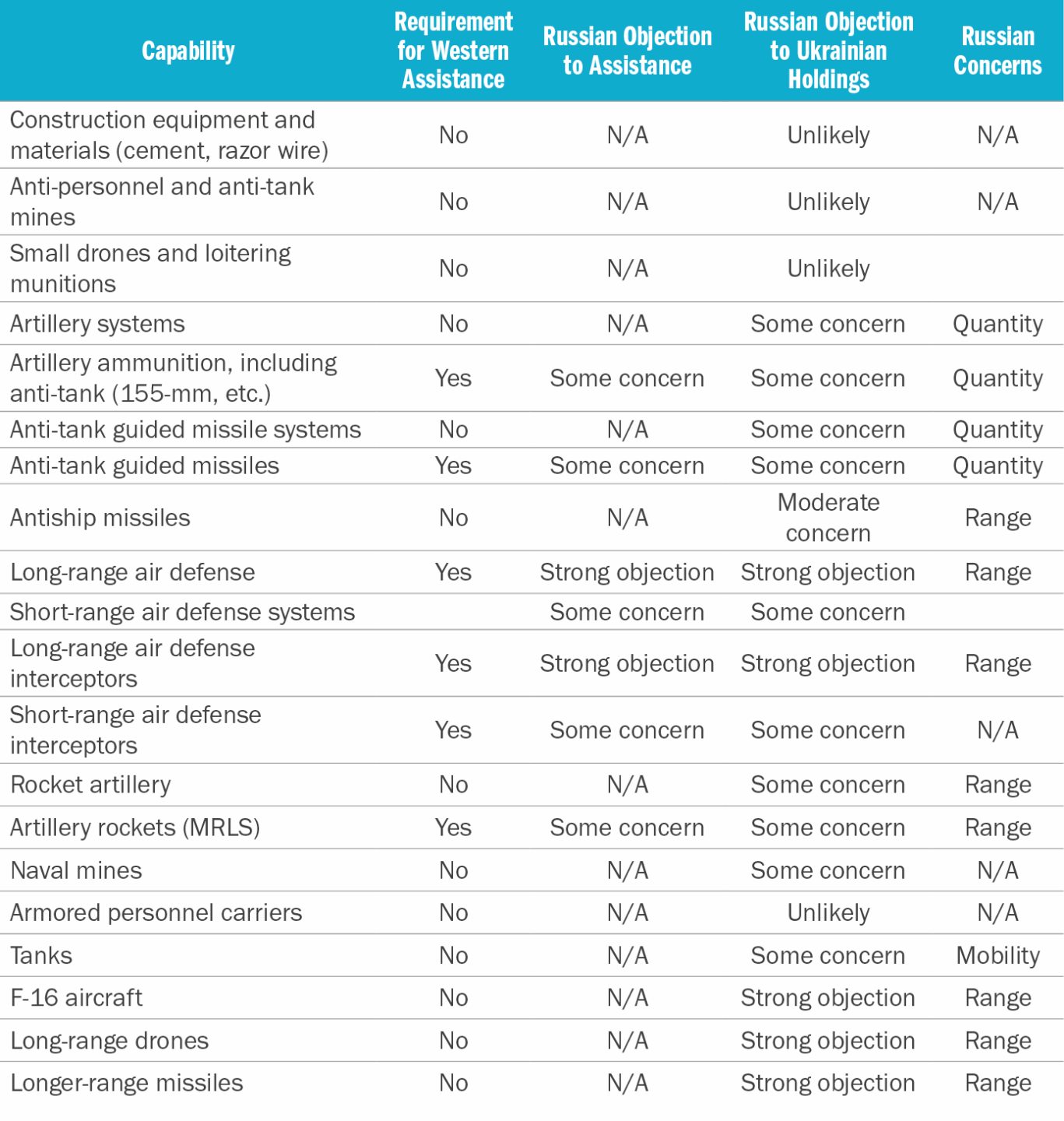
However, Russia will also have objections to Ukraine’s ability to produce its own long-range missiles, including the 600-km Neptune land attack missile, the 700-km Peklo cruise missile, a ballistic missile known as the Sapsan that ranges up to 500 km, the new 3,000-km-range Flamingo missile, and long-range drones that come with smaller, but still deadly, payloads.379Kunyzkyj, “Ukraine’s Neptune Long-Range Missile”; Kabachynskyi, “What Is Sapsan, Ukraine’s First Homegrown High-Speed Missile, and What Can It Really Do?” Ukraine’s holdings of indigenous long-range missiles and production capacity right now are small, but both have already been raised by Russian interlocutors as a key postwar concern, one that will need to be addressed if there is hope for an enduring postwar settlement. Geographic limitations on the locations of long-range missiles may offer some assurance—to both sides assuming they are reciprocal—but this is a case where geographic restrictions may not be sufficient. The next chapter will explore alternatives for addressing the issue of Ukraine’s long-range strike capabilities so that it does not become a dealbreaker in negotiations. As noted previously, this could be an area where negotiators are able to orchestrate useful trades, extracting some concessions from Russia in exchange for some limits on Ukraine’s long-range strike capability.
Table 4.4 offers a summary of Russia’s likely threat assessment flagging those aspects of the armed Ukraine described here that might raise objections from Russia. The table focuses on the postwar context and summarizes responses to capabilities provided as military assistance or sold and Ukrainian holdings separately.
Summary
In this chapter, I have described what Ukraine would require to defend itself without relying on the direct participation of the United States or partners from Europe. Contrary to arguments that this task is out of reach or unrealistic, the analysis shows that self-defense is within reach for Ukraine provided that it receives some Western security assistance in a handful of specific areas for a term of about five years after a settlement.
Ukraine’s best strategy will be one that relies on defensive capabilities and builds and arms a force capable of self-defense. To support this posture, Ukraine will need an active-duty military of approximately 245,000 personnel and a reserve force of 345,000. This goal will be challenging for Ukraine to meet, given demographic and resource limitations, and is likely at the upper edge of what Ukraine can support. A military of this size is larger than what Russia has suggested as its desired outcome for Ukraine, but it is far too small to mount any sort of offensive threat against Russia. This should offer some reassurance to Moscow alongside Ukraine’s commitment to nonalignment.
In terms of capabilities, Ukraine will want to build stockpiles of munitions and other systems capable of supporting the country through a year of war. These stockpiles will include materiel for such passive defenses as barriers and mines, small-drones, artillery and various types of short-range ammunition, and air defense with plenty of interceptor missiles and counterdrone systems. It will also want smaller quantities of antiship missiles and some rocket artillery, although these capabilities are less necessary to the defensive strategy. Ukraine should not need more infantry fighting vehicles, tanks, or aircraft to support a defensive strategy, nor are long-range missiles required.
In some of these areas, Ukraine is already self-sufficient, but it will require Western support to meet its needs for most munitions and air defense. With some limited U.S. support, along with European assistance and financing, Ukraine can likely build the foundations of a self-sufficient defense in about five years, although this timeline will depend somewhat on when and how the war ends and how well Europe builds up its defense industrial base.
The vast majority of the capabilities needed for the strategy proposed here are ones that Russia is unlikely to make the centerpiece of future talks. Conversely, the capabilities most likely to excite Russian concerns and areas in which it may ask for limits on Ukraine’s capabilities are the ones that are least crucial to Ukraine’s defensive strategy. These capabilities are combat aircraft and long-range missiles, even if they are indigenously produced, followed by long-range air defense.
Chapter 5: Geographic considerations and mutual assurances
The armed nonaligned Ukraine defined and described in this report would have the following characteristics:
- Alignment: Ukraine’s formal nonalignment would leave Ukraine outside military alliances but with some cooperation (e.g., training) and some intelligence-sharing with Western partners during peacetime. This cooperation would be on par with what the United States provides to other non-allies and non-partners. EU membership would be possible over the longer term with a protocol to preserve Ukraine’s nonaligned status.
- Security guarantees and commitments: Ukraine is unlikely to receive Article 5–type guarantees. It could receive commitments from external partners that might cover postwar military and economic aid, promises of additional security assistance, more-extensive intelligence-sharing in the event of future aggression, or renewed economic sanctions on future aggressors.
- Military size: Ukraine would need a military of about 245,000 active-duty forces with 345,000 high-readiness reserve forces during peacetime. A larger force would likely not be feasible, given demographic and resource limitations, which makes a formal cap on Ukraine’s forces unnecessary. Ukraine might supplement this force in a future war with a larger pool of veterans and civil defenders.
- Weapons and materiel: Ukraine would be equipped with weapons from its own production and Western assistance, including passive barriers, mines, sea and air drones, artillery and anti-tank guns and ammunition, some rocket artillery, antiship missiles, and air defense and interceptor missiles of different types and ranges. It would retain its holdings of tanks, aircraft, and armored vehicles and indigenous production capacity for long-range missiles and drones.
With these characteristics, Ukraine would be well equipped to manage its self-defense with sufficient capabilities to deter a future invasion and the stockpile to fight for essentially a year without needing much in the way of resupply. However, it would pose little offensive threat to Russia or Russian-held territory. This arrangement should, then, address the basic security concerns of Ukraine and Russia. Ukraine will be able to deter future aggression and defend itself, but Russia will not have to face a Western-backed Ukraine or a Ukraine capable of posing imminent threats to territory under Russian control. However, the lasting and deep mistrust and mutual grievances created by this war might require additional measures to enable enduring peace.
Ensuring that any settlement endures might require further measures to reduce the sensitivities of both sides. One option would be to set up a series of self-imposed geographic restrictions on the deployment of certain military capabilities and forces equipped with certain types of weapons. Such geographic limitations would be adopted on a mutual basis; Russia and Ukraine would agree to reciprocal conditions even if those conditions are not symmetrical. For Ukraine, such accommodation could avoid Russian pressure for more extensive caps placed on Ukraine’s military capabilities. For Russia, some compromises of this type might be acceptable, given the reduced threat that Ukraine would pose as a nonaligned state with a defensively postured military. Such an arrangement would require a verification regime and some kind of enforcement mechanism. At present, those criteria may be difficult to meet. There are no true historical parallels, and the last attempt at such an arrangement in Minsk II was a failure. But it is worthwhile to consider what this arrangement might look like and require.
Geographic restrictions
Both parties will be most sensitive about capabilities close to their shared internationally recognized border and the line of contact that may eventually become the ceasefire line. In particular, long-range strike systems that can reach into their respective territories and hold at risk key political and military targets and systems that could, in large numbers, be used to launch an effective surprise attack will be areas of concern.380Charap et al., A New Approach to Conventional Arms Control in Europe; Charap and Priebe, Avoiding a Long War; Fortna, Peace Time.
As a starting point, any settlement should establish a DMZ in which all military personnel and equipment would be prohibited. Ideally this DMZ would be quite wide, up to 10 or 15 km stretching across both sides of the line of contact between the two parties. This DMZ would be on the larger side compared with those established after past conflicts, but it would be useful in this case, given the history of fighting between the two sides.381Charap et al., A New Approach to Conventional Arms Control in Europe; Charap and Priebe, Avoiding a Long War; Fortna, Peace Time.
A DMZ of this size may not be possible along the entire 2,000-km line of contact, particularly where cities and towns are close to the front line or near a shared border.382Fortna, Peace Time; Soldatenko, “Exploring Ukraine’s Armed Neutrality or Nonalignment.” In the eastern part of the country, for instance, there are cities that lie close to the line of contact and are now effectively garrison towns (e.g., Kharkiv). These cities and towns would need to be left outside of any DMZ. The DMZ will not be symmetrical on the two sides either; it would take into account the geography, demography, and other features that vary on the two sides.383Charap et al., Guidelines for Designing a Ceasefire in the Russia-Ukraine War.
The DMZ would offer assurances to both sides against a surprise attack launched by ground forces, but it would not be sufficient to address concerns about even short-range artillery that can fire further than 10 to 15 km. Some sort of ceasefire monitoring mission using neutral personnel would likely be needed to patrol the DMZ (either along the entire line or at key strategic locations) and report violations. This goal does not seem unreachable, assuming a set of countries acceptable to both Russia and Ukraine are willing to offer personnel to such a mission. Further details are discussed later in this chapter.
Beyond the DMZ, a settlement between Russia and Ukraine could benefit from a series of additional geographic restrictions aimed at creating a larger buffer between the two sides. The idea would be to create additional security zones outside of the DMZ in which numbers and types of forces and capabilities (or the activities of those forces) are limited. Doing so would reduce each side’s ability to reach into neighboring territory or to strike the assets of adversaries. The specific model described here offers one approach, and Russia and Ukraine might end up agreeing to the limits suggested here or others if this approach is adopted.
There are historical precedents for the type of approach outlined here. The arrangement in the Sinai Peninsula is one example. There, the small triangle of land is divided into four zones, with rules about the types and numbers of forces allowed in each. In Zone C, closest to the Israeli border, only civilian police and UN personnel are permitted. In Zone B, no Egyptian mechanized infantry forces are permitted by border guards. In Zone A, closest to Egypt, one infantry division is permitted with a total of 22,000 soldiers. Zone D lies on Israel’s side of the border, and its capabilities are not restricted.384“Military Zones in the Sinai Peninsula.”
Notably, Minsk II, one of two agreements signed to end the fighting after Russia invaded Ukraine in 2014, included some geographic limitations on the deployment of forces and capabilities, although these were never fully implemented.385Trilateral Contact Group, “Package of Measures for the Implementation.” For example, the agreement called for both sides to withdraw heavy weapons from Donetsk and Luhansk to create security zones of different distances for different systems. The plan called for artillery systems to be withdrawn 50 km, MRLS systems (rocket artillery) 70 km, and longer-range missiles 140 km.386Trilateral Contact Group, “Package of Measures for the Implementation”; Åtland, “War, Diplomacy, and More War”; Wittke, “The Minsk Agreements.”
A similar approach could be employed. This time, to be successful, a stronger verification and enforcement mechanism would be required or compliance with agreed terms would have to be linked to a set of consequences, including sanctions or reduced military aid (in the case of Ukraine). It is not clear whether this approach is achievable, but it is still worth considering and is a model for negotiators to keep in mind in discussions with the two sides.
An approach in the current context might include a series of security zones, but it would apply to more weapon systems than in Minsk and also limit personnel. One approach might establish four security zones on each side of any DMZ or line of contact between Russia and Ukraine. In the first zone, only passive defenses, ceasefire monitors, and border police would be permitted. Stretching back 30 km or so would be a second zone where drones would be allowed to operate. This zone could also include artillery, anti-tank, weapons, and some armored vehicles with some heavy forces. Notably, from this distance, neither side would be able to use short-range artillery systems to hit deep inside other’s territory. The third zone would include tanks, fighting vehicles, and rocket artillery at a distance of around 100 km. Once again, the intent would be to limit the ability of such systems to range the other side and key military targets. There would be no limits on the number of personnel in the third zone.
The final zone would apply to long-range missiles and aircraft and might start at a distance of 200 km from the line of contact. This would not entirely limit the reach of these systems into adversary territory. Ukraine’s 600-km-range missile would still be able to reach into Russia, for instance, but it would somewhat reduce the threat by creating a larger buffer. Ukraine would benefit less from such a restriction than Russia would, given its larger size and larger arsenal of long-range missiles. Still, forcing Russia to operate from farther away would offer some advantages when it comes to efforts to defend Ukraine’s skies. As a secondary safeguard, missiles and launchers might be stored separately, offering each side an additional layer of assurance against a surprise strike.387Charap et al., A New Approach to Conventional Arms Control in Europe.
Finally, there is the question of air defense. Limits on short-range air defenses and interceptors should not be needed, but some accommodations might be required for longer-range air defenses, radars, and interceptors. These accommodations would have to include carve-outs for major cities. At the very least, more-advanced air defense systems, such as Patriots, could be excluded from the DMZ and the first two zones with exceptions negotiated on a case-by-case basis for civilian centers and infrastructure. This would put air defense systems at least 50 km from the line of contact in most instances. Other safeguards might include transparency between the two sides when it comes to the locations of long-range air defense radars or arrangements that store interceptor missiles and air defense systems separately.388Charap et al., A New Approach to Conventional Arms Control in Europe; Kreps, “The Institutional Design of Arms Control Agreements.”
A different approach would have some portion of Ukraine’s PAC-2 and PAC-3 missiles stored outside Ukraine—either in the United States or somewhere closer, such as a U.S. facility in Germany or Poland—during peacetime as part of a strategic stockpile for use during a conflict. This move would not be unprecedented. The United States has long stored some Taiwanese-purchased and owned AMRAAM missiles in Guam at Andersen Air Force Base to prevent their offensive use and avoid unnecessarily provoking China.389Newdick, “Taiwanese F-16s Have Fired AIM-120 AMRAAM Missiles Locally for the First Time”; Episkopos, “A Postwar Western Stockpile for Ukraine That Is Amenable to Russia.” These missiles would be owned by Ukraine but released only if conflict were to resume or looked imminent. As noted previously, any restrictions to aid to Ukraine imposed by Ukraine’s nonaligned status would be lifted in the event of any renewed Russian aggression, so even types of assistance limited in peacetime could transferred. Such strategic stockpiles should not be needed for other capabilities but could be used if Ukraine desired to safeguard some portion of its capabilities where they cannot be reached by Russian missiles.
Some caveats are required. First, the zones would not be applied uniformly across territory on each side of any DMZ. As discussed in the context of the DMZ itself, geographic features will interfere. There are also heavily fortified cities and towns not far from the line of contact that may require accommodation or special treatment.390Charap et al., Guidelines for Designing a Ceasefire in the Russia-Ukraine War. Second, the zones might be asymmetrical. Russia continues to have a military advantage because of its greater size and capacity, so it might resist reciprocal and equal restrictions on its military personnel or capabilities. This asymmetry would have to be the subject of negotiations among the parties.
Ukraine would benefit from such an arrangement even if its own restrictions were more extensive because it would meaningfully reduce—though not eliminate—the military challenge that Russia poses to the territory under Ukraine’s control and would lessen its ongoing security requirements. Even a simplified arrangement that places reciprocal restrictions on a small set of capabilities might suffice to achieve these outcomes and could be more feasible to negotiate in the current context.
Third, a complementary arrangement would have to be designed to increase security along Ukraine’s coastal areas and maritime boundaries. A first provision might be that antiship missiles are not stored along Ukraine’s coast during peacetime but are instead kept 50 to 100 km from the coastline. A reciprocal commitment on the Russian side would keep Russian warships away from Ukraine’s shores, preferably by 50 km. Ukraine would observe reciprocal limits, keeping any drones or patrol boats away from waters near Russian-controlled territory.
Other restrictions and assurances
Reciprocal geographic limitations are one type of mutual assurance that Ukraine and Russia might adopt to institutionalize and bolster Ukraine’s armed nonalignment and Russia’s commitment to respect an agreed cessation of hostilities. If implemented, these limitations could reduce threat perceptions for both sides. If restrictions were imposed enforcement, however, they would have to involve real buy-in from both sides and an external enforcement mechanism. If restrictions are instead self-imposed, some monitoring regime would replace enforcement. As of this writing, provisions along these lines have not been discussed. Some additional safeguards and restrictions might be useful or, in some cases, required.
Even with these layers of safeguards, however, certain capabilities may still cause security concerns for one or both sides. Long-range missiles are an example; these missiles have already been identified as a redline by Russian interlocutors, who suggest that they would like to prevent Ukraine from having any long-range capability. Ukraine may feel similarly worried about Russia’s capabilities, given the damage they have done with long-range missiles and drones.
Numerical caps are an obvious solution, but they are unappealing for three reasons. First, Ukraine has flatly rejected such provisions and stated that it will not accept limits on its indigenous defense production. Whether it will have the bargaining power to maintain this stance as the final settlement is negotiated will depend on when and how the war ends. Second, it is unlikely that Russia will accept caps on its missile production, so it would be hard to make such limitations reciprocal. Finally, even if Russia could force Ukraine to accept these limitations, it is not clear how it could verify or enforce them.
Ukraine can produce 30,000 long-range attack drones per year, but they tend to carry only a small payload.391Hambling, “30,000 Ukrainian Attack Drones to Hammer Russian Strategic Targets.” Russia might wish to restrict Ukraine’s access to these attack drones but could find it hard, given the speed and ubiquity of their production. Their lower payload may make them more of a nuisance than a true threat in most cases, although Operation Spiderweb (in which Ukraine used long-range drones to strike Russia’s strategic bomber aircraft, among other targets) may linger in the back of Russian minds.392Gozzi, “How Ukraine Carried Out Daring ‘Spider Web’ Attack on Russian Bombers.” More importantly for Russia, Ukraine also has the capacity to produce Neptune cruise missiles, which ranges up to 600 km, and the Sapsan ballistic missile, which is said to have a slightly longer range than the ATACMS at about 500 km. Ukraine has also announced a new Flamingo missile that has a range of up to 3,000 km and other long-range capabilities under development.393Kunyzkyj, “Ukraine’s Neptune Long-Range Missile”; Kabachynskyi, “What Is Sapsan, Ukraine’s First Homegrown High-Speed Missile, and What Can It Really Do?”
Rather than the numerical caps that Russia will ask for and Ukraine will reject, another option would be to use the strategic stockpile approach described previously in the context of air defense. This approach would have Ukraine domestically stockpile some number of cruise and ballistic missiles (maybe in the low hundreds) and send anything produced above that amount abroad, where the missiles could be placed in strategic stockpiles. In the event of future aggression, these missiles, which would be owned by Ukraine, would be immediately released to Kyiv for use. As noted previously, this would not conflict with Ukraine’s nonalignment. It will take time for Ukraine to produce a large quantity of missiles and launchers, so the need for external strategic stockpiles might not be a concern in the years immediately following the war.394Taradiuk, “Tired of Military Aid Delays, Ukraine Has Designed Its Own Ballistic Missile—and It’s Already in Mass-Production”; Höller, “Germany Vows to Underwrite Ukraine’s Long-Range Missile Production.” Even in this approach, geographic restrictions on domestically produced missiles could still be negotiated, and launchers and missiles might still be stored separately during peacetime. Russia could accept reciprocal geographic restrictions as described above even if the security assurance provided would be limited.
Table 5.1 summarizes the security zones and reciprocal assurances and commitments that might be included as part of armed nonalignment.
Table 5.1. Geographic limitations and mutual assurances
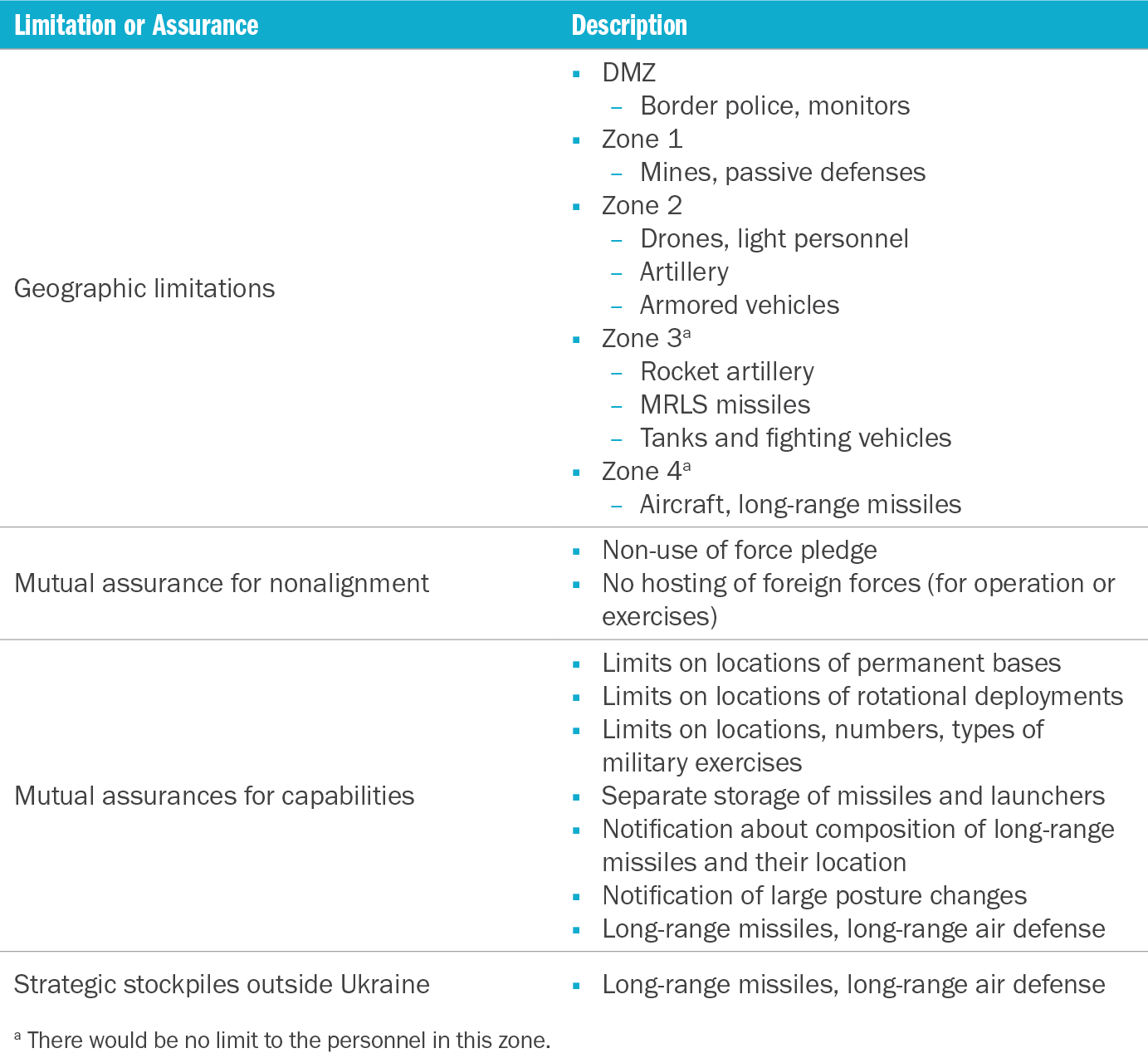
Monitoring and verification
Armed nonalignment would require monitoring and verification of the ceasefire line and compliance with the geographic limitations and other mutual assurances and numerical caps outlined here. Given past breached agreements and distrust on both sides, any verification regime will need to be robust and require buy-in from both Ukrainian and Russian political leaders, as well as some kind of enforcement mechanism. Although this is a tall order, it is a reasonable goal to set.
Only one monitoring force will be needed, but that force would have several responsibilities. First, assuming that armed nonalignment is adopted along with a ceasefire agreement, neutral international monitors charged with observing each side’s adherence to the terms of that ceasefire, especially along the line of contact and DMZ, will be beneficial. Neutral international ceasefire monitors would operate on both sides of the ceasefire line or DMZ and would not need to be numerous or armed. In fact, historically, most ceasefire or peace settlement monitoring forces have been unarmed and limited to fewer than 10,000 personnel, including military and civilians.395Fortna, Peace Time; Charap et al., Guidelines for Designing a Ceasefire in the Russia-Ukraine War. Around 2,000 to 5,000 personnel should be more than enough in Ukraine’s case, especially if monitors focus their attention and patrols on key strategic areas and high-risk zones.
Monitoring forces of this type tend have a narrow and limited remit and are intended to observe compliance and document violations. They are not peace enforcers and rarely have the authority to use military force, except in self-defense.396Charap et al., A New Approach to Conventional Arms Control in Europe; Fortna, Peace Time; Charap et al., Guidelines for Designing a Ceasefire in the Russia-Ukraine War. Russia and Ukraine are likely to insist that they come only from neutral countries—for example, India, Saudi Arabia or its neighbors, and countries in Africa and Southeast Asia. Although a monitoring force could operate under the umbrella of the UN or some other international body, it is more important that Kyiv and Moscow recognize its authority and take action to address or rectify any violations that it identifies.397Fortna, Peace Time.
The cost of maintaining such a force should be considered but is unlikely to be especially large. It will certainly be less expensive than weapons and economic aid to Ukraine. Still, these costs could add up over time if the force were envisioned to be indefinite. Although a force capable of policing the full ceasefire line makes sense in early years after the war ends, it may become less necessary as Ukraine becomes more confident in its military force and adjusts to its postwar reality and especially if Russia comes to see the benefits of normalized ties with the United States as a better alternative to renewed war with Ukraine. The ceasefire monitoring force might be phased out over several years, shifting to focus oversight at key strategic locations and then leaving completely.
The second set of responsibilities would involve verification of the terms of Ukraine’s armed nonalignment, including the geographic limitations and mutual assurances adopted by Kyiv and Moscow. Monitoring could then be carried out in Ukraine and in Russia and Russian-controlled territory. For this mission, monitors would be responsible for assuring that geographic limits on the placement of certain weapons systems or types of forces are fully implemented and that commitments to not host foreign forces are honored. Verification would again apply to both Ukraine and Russia, even if the commitments made by the two sides are not symmetrical. This monitoring might also be carried out by the same set of neutral, international observers.
Summary
In this chapter, I outlined a set of geographic limitations, mutual assurances, and other self-imposed restrictions that might be used to buttress and support Ukraine’s nonalignment. The approach described here would be self-imposed by each side but with some external monitoring to overcome mutual distrust. Both Russia and Ukraine would accept some limitations in return for concessions from the other side. In the end, both sides would be more secure. Russia could address remaining security concerns triggered by Ukraine’s military capabilities; Ukraine could leverage its commitment to nonaligned status to buy itself some reduction in Russian forces near the territory under its control. This would increase Ukraine’s security and likely allow for a smaller and more sustainable military force.
Of course, the arrangement presented here offers only one possible framework. As noted, the specific recommended security zones and distances are intended to be illustrative. Moscow and Kyiv might agree to any set of zones and mutual assurances that accomplish the basic objective of reducing the ability of short- and long-range munitions to reach sensitive targets and limiting the ability of either side to mass forces in sensitive areas or launch surprise attacks. However, whatever the two sides agree to should be spelled out in explicit and detailed terms so that there is no confusion or dispute about the terms of the deal.
One remaining question is how negotiators should respond if one or both sides refuse to accept any geographic limitations or mutual assurances. Ukraine is in the weaker military position and so will likely have to make more compromises to end the war. However, depending on how the war ends, Russia could try to impose harsh restrictions on Ukraine while rejecting any reciprocal arrangements. If it succeeds in this approach at the negotiating table, the result might well backfire: A completely lopsided deal would make for an unstable arrangement and Ukraine constantly searching for more security.
Ukraine’s partners, especially the United States, have a role to play here, possibly by using other incentives to push Russia to accept some mutual limits, including negotiating broader European security arrangements with Moscow. Notably, armed nonalignment does not strictly require geographic limits or other restrictions; if this type of arrangement cannot be agreed to or enforced it does not make armed nonalignment impossible. But an outcome that does include such safeguards may be more enduring and ultimately better for both parties.
Chapter 6: Next steps for implementation
Although it may not be Kyiv’s ideal outcome, armed nonalignment is the most plausible path to a secure future for Ukraine. It is Ukraine’s most credible security arrangement: It would leave the country’s future defenses in the hands of its own military. It is the also the most likely option to support an enduring settlement that avoids a return to war and the most politically feasible outcome, given the constraints on each relevant stakeholder—Ukraine, European states, Russia, and the United States.
Armed nonalignment would not leave Ukraine defenseless. It would ensure that Ukraine has sufficient military capabilities to deter a future attack and protect the territory under its control, but would not threaten Russian or Russian-occupied territory nor become a foothold for NATO. The arrangement would thus address Russia’s security concerns and its objections to Ukraine’s security integration with the West. Both sides would, therefore, be more secure. Armed nonalignment also meets the conditions sought by European states and the United States. European states would be satisfied that Ukraine is secure, and the United States would have limited long-term economic and military commitments to Ukraine.
This report presents the legal pathways that Ukraine might take to formally adopt a nonaligned status, as well as mutual assurances with Russia that it might adopt to institutionalize that status. The most likely pathway seems to be through a binding UNSC resolution of some kind, as proposed at Istanbul in 2022.398Troianovski, Entous, and Schwirtz, “Ukraine-Russia Peace Is as Elusive as Ever.” Nonalignment as defined in this report would prevent Ukraine from joining military alliances or hosting foreign military forces or exercises and would place some limits on military cooperation and intelligence-sharing with Europe and the United States. Some training outside Ukraine and outside the NATO context would be permitted, but Ukraine would not join NATO activities. Intelligence-sharing during peacetime would continue, but information relevant to targeting Russia’s military or critical infrastructure would no longer be relevant. That type of information-sharing could resume in the case of future aggression. Ukraine would be free to pursue membership in the EU, but it could do so with a protocol protecting its nonaligned status.
The requirements for Ukraine’s self-defense outlined here are, for the most part, feasible and within reach over about five years, depending on when and how the war ends. Ukraine would need a military of about 245,000 active-duty and 345,000 reserve personnel, although this is likely at the upper bound of what it can reasonably achieve, given resource and demographic limitations. It could supplement this with a larger civil defense system made up of demobilized veterans who could be called on in a crisis. It will need some Western military assistance, especially for munitions of all kinds and some air defense systems, but will likely be able to support most of its self-defense indigenously.
As a nonaligned state with primarily defensive military capabilities, Ukraine would have limited ability to pose a threat to Russia or Russian-occupied territory. Russia should not have significant objections to most of the capabilities flagged as ones for which Ukraine might need Western assistance, except for long-range air defense and missiles. It will likely want to prevent additional Western assistance in rocket artillery systems, combat and early warning aircraft, and long-range missiles, if Ukraine requests such aid.399Atlantic Council Military Fellows, “Russia Crisis Military Assessment”; Yeung and Kappeler, “Kremlin Criticizes Move by Ukraine’s Allies to Lift Ban on Firing Long-Range Missiles at Russia”; Tarasova, “Russia Warns West of ‘Enormous Risk’ If Ukraine Is Supplied with F-16 Jets.”
Russia may raise more objections about Ukraine’s holdings—especially of longer-range drones and missiles and possibly of combat aircraft—and its indigenous production capacity of these capabilities. The use of geographic restrictions to create a DMZ and then a wider set of security zones that would place limitations on deployments of personnel and equipment, stretching back up to several hundred kilometers on each side. Such zones would not be symmetrical, nor would they be uniform across the line of contact, and carve-outs would be needed to protect major population centers that lie close to the line of contact.400Charap et al., Guidelines for Designing a Ceasefire in the Russia-Ukraine War. The restrictions would be self-imposed and reciprocal, meaning that both sides would accept some limitations even if the terms are not identical. In addition to geographic limitations, the two sides might adopt other types of mutual assurances on the locations and numbers or types of military exercises or information-sharing provisions regarding large changes in military posture. Additional measures might be required for long-range missiles, even those that are indigenously produced. In this report, I have suggested a strategic stockpile approach that would create resources for Ukraine outside its territory rather than numerical caps.
Still, implementing Ukraine’s armed nonalignment will come with some challenges. There will almost certainly be disagreements between Ukraine and Russia over some of the details of commitments on each side and what the ideal armed Ukraine will look like. There will be disputes about the level of Western assistance allowed and required and Ukraine’s growing defense industrial capacity. There are also likely to be differences between Ukraine and Russia related to the mutual assurances that each side is willing to accept. The plan is also contingent on certain assumptions: that Ukraine will be able to raise and support a military force that meets the requirements for its defense and that the United States and European NATO allies will meet their production targets for key systems.
Whatever the terms finally agreed to, the commitments and requirements of each party—including the United States and Europe—should be clearly and transparently defined in one or more agreements.401Charap and Priebe, Avoiding a Long War. For the United States and Europe, such agreements would outline what each party would provide in terms of military assistance and sales and on what timeline. They would also clarify which systems would be excluded entirely.402Charap and Priebe, Avoiding a Long War. For Ukraine and Russia, an agreement would lay out mutual assurances, geographic commitments, and other requirements related to Ukraine’s nonalignment. This type of transparency will offer Ukraine assurance that it will have the capabilities to defend itself and give Russia confidence that Western aid will not enable Ukrainian reconquest of occupied areas or attacks on Russian territory.
A full settlement to the war still seems far off, but progress toward Ukraine’s armed nonalignment can start immediately.403Charap, “Peace Negotiations in Ukraine Haven’t Failed.” Working-level dialogues among the United States, European allies, Ukraine, and Russia can begin to sketch out each side’s requirements and redlines while assessing feasible pathways to implement Ukraine’s nonalignment and ensuring that Ukraine can be sufficiently armed. This process will necessitate the United States working with European allies to identify what each partner can contribute militarily and economically based on current and future production capacity. Efforts to begin to define the boundaries of security zones and necessary carve-outs for key population centers could also begin in advance so that, when there is room for a ceasefire, some of the background work is complete.
If it is too soon for government-led discussions on these issues, they could instead start with track 2 discussions involving think tanks, scholars, business executives, and other representatives from all relevant parties who could begin to sketch out what armed nonaligned Ukraine might require. In addition to being practical, such discussions might be useful for socializing policymakers and the general public to what Ukraine’s future security arrangements might look like and why they will keep Ukraine and Russia secure and avoid future war while limiting U.S. and European commitments. This socialization effort will be especially important given ongoing hope for Ukraine’s NATO membership in the West and in Ukraine and hope for Ukraine’s complete demilitarization in Russia as the outcome of this conflict.
Armed nonalignment is not the perfect solution or any stakeholder’s ideal outcome, but it is the most feasible and achievable option available. Converging on armed nonalignment as the compromise solution may speed progress toward this end goal by advancing the discussions needed to build political support for and ultimately implement this option.
Abbreviations
AMRAAM Advanced Medium-Range Air-to-Air Missile
ATACMS Army Tactical Missile System
CSDP Common Security and Defense Policy
c-UAS counter–Unmanned Aircraft Systems
DMZ Demilitarized Zone
EU European Union
GDP Gross Domestic Product
GMLRS Guided Multiple Launch Rocket System
HIMARS High Mobility Artillery Rocket System
IRIS-T Infrared Imaging System Tail/Thrust Vector-Controlled
MLRS Multiple Launch Rocket System
NASAMS National Advanced Surface-to-Air Missile System
NATO North Atlantic Treaty Organization
SAMP/T Sol-Air Moyenne-Portée/Terrestre (Surface-to-Air Medium Range/Land-Based)
UN United Nations
UNSC United Nations Security Council
Bibliography
Admiral, Kevin D., and Nicholas Drake, “Steel in the Storm: Recent Wars as Guides for Armor Transformation,” War on the Rocks, July 21, 2025.
“Agreement of Friendship, Cooperation, and Mutual Assistance Between the Union of Soviet Socialist Republics and the Republic of Finland,” April 6, 1948.
Ålander, Minna, “Defense Capability—the Secret of Finnish Happiness?” Ethics and Armed Forces, Vol. 2, February 2024.
Aliyev, Huseyn, Who Fights for Governments? Paramilitary Mobilization in Ukraine and Beyond, Bloomsbury Publishing, 2025.
Allison, Roy, “Averting Acute Escalation in Russia’s War Against Ukraine,” International Affairs, Vol. 101, No. 5, 2025.
Altman, Howard, “Are There Enough Guided Rockets for HIMARS to Keep Up with Ukraine War Demand?” War Zone, July 27, 2022.
Altman, Howard, “Ukraine Is Using Guided Rockets with More Range than HIMARS-Launched Ones,” War Zone, March 1, 2023.
Altman, Howard, “No Long-Range Missiles for Ukraine: Trump,” War Zone, July 15, 2025.
Amado, José María Olvera, “Binding or Not? Determining the Legal Status in International Law of UN Security Council Resolutions,” Juris Gentium Law Review, Vol. 10, No. 1, September 2024.
Angelos, James, Nette Nöstlinger, and Clea Caulcutt, “How Europe Found a Workaround to Get Trump to Help Ukraine,” Politico, July 15, 2025.
Antonov, Dmitry, “Putin Says Russia Doesn’t Oppose Ukraine Joining the EU,” Reuters, September 2, 2025.
Armbruster, Ben, “Biden Official Admits US Refused to Address Ukraine and NATO Before Russian Invasion,” Responsible Statecraft, April 14, 2022.
Arms Control Association, “The Conventional Armed Forces in Europe (CFE) Treaty and the Adapted CFE Treaty at a Glance,” fact sheet, November 2023.
Army Recognition Group, “How Ukraine’s Stugna-P Anti-Tank Missile Becomes a Key Asset Against Russian Tanks,” December 3, 2024.
Arter, David, “From Finlandisation and Post-Finlandisation to the End of Finlandisation? Finland’s Road to a NATO Application,” European Security, Vol. 32, No. 2, 2023.
Ash, Timothy, Annete Bohr, Kateryna Busol, Keir Giles, John Lough, Orysia Lutsevych, James Nixey, James Sherr, Simon Smith, and Kataryna Wolczuk, “How to End Russia’s War on Ukraine: Safeguarding Europe’s Future, and the Dangers of a False Peace,” Chatham House, June 2023.
Ashford, Emma, and Kelly A. Grieco, “Red Cell: The Promise and Pitfalls of an ‘Israel Model’ for Ukraine,” Henry L. Stimson Center, July 5, 2023.
Ashford, Emma, and Kelly A. Grieco, “How Ukraine Can Win Through Defense,” Foreign Affairs, January 10, 2024.
Atalan, Yasir, “Russian Firepower Strike Tracker: Analyzing Missile Attacks in Ukraine,” Center for Strategic and International Studies, 2025.
Åtland, Kristian. “War, Diplomacy, and More War: Why Did the Minsk Agreements Fail?” International Politics, November 15, 2024.
Atlantic Council Military Fellows, “Russia Crisis Military Assessment: The Impact of Multiple Rocket Launcher Transfers to Ukraine,” New Atlanticist blog, Atlantic Council, June 9, 2022.
Aunesluoma, Juhana, and Johanna Rainio-Niemi, “Neutrality as Identity? Finland’s Quest for Security in the Cold War,” Journal of Cold War Studies, Vol. 18, No. 4, 2016.
Auran, Jean, “European Ground-Based Air Defence Programs,” European Security & Defence, July 28, 2023.
Axe, David, “Ukraine Has Thousands of Old Armored Tractors. It Just Turned Six of Them into Fighting Vehicles,” Forbes, June 20, 2023.
Axe, David, “As the Ukrainians Fling 50,000 Drones a Month, the Russians Can’t Get Their Drone-Jammers to Work,” Forbes, last updated February 16, 2024.
Axe, David, “After Two Years of War, Ukraine Still Has a Thousand Tanks,” Forbes, February 17, 2024.
Axe, David, “To Keep Ukraine’s Elite 47th Mechanized Brigade Fighting for 15 Months Straight, the U.S. Sent More Than 300 M-2 Bradley Fighting Vehicles,” Forbes, September 9, 2024.
Axe, David, “Desperate to Reinforce a Buckling Front Line, Ukraine Is Scourging the Planet for Hundreds of Spare Tanks and Fighting Vehicles,” Forbes, October 28, 2024.
Axe, David, “New Guns, More Ammo: Ukraine’s Artillery Blasts Away at a Rate of Millions of Shells a Year,” Forbes, last updated March 1, 2025.
Axe, David, “The U.S. Is Starving Ukraine’s HIMARS. Where Can Kyiv Get More Rockets for Its Best Launchers?” Forbes, March 4, 2025.
Baker, Sinéad, “Old US Bradleys Becoming ‘Legend’ in Ukraine Shows What the Country Can Do When It Gets Enough of the Weapons It Needs,” Business Insider, August 26, 2024.
Baltimore Council on Foreign Affairs, “Institute for the Study of War: Top Russian Officials Demand ‘Demilitarization’ and ‘Denazification’ of Ukraine as the Price for Peace,” press release, April 15, 2025.
Barndollar, Gil, “The Deep Strike Dodge: Firepower and Manpower in Ukraine’s War,” War on the Rocks, February 26, 2025.
Barros, George, Kateryna Stepanenko, Daniel Mealie, Harrison Hurwitz, Derik Durbin, Benjamin Cordola, David Schulert, Quinn Deutschendorf, and Lea Corticchiato, “Interactive Map: Russia’s Invasion of Ukraine,” Institute for the Study of War and AEI’s Critical Threats Project, 2025.
Baskaran, Gracelin, and Meredith Schwartz, “What to Know About the Signed U.S.-Ukraine Minerals Deal,” Center for Strategic and International Studies, May 1, 2025.
Battle Order, “U.S. Army Field Artillery Battery (Paladin),” last updated May 16, 2022.
Beardsley, Eleanor, “Ukraine’s DIY Drone Makers Are Helping Fighters on the Front Lines,” NPR, April 12, 2025.
Bergmann, Max, “Europe Needs a Paradigm Shift in How It Supports Ukraine,” Center for Strategic and International Studies, January 17, 2024.
Bernatskyi, Artemii, Volodomyr Lukashenko, Oleksandr Siora, and Mykola Sokolovskyi, “Analysis of the Application of Lasers for Counter-UAV Purposes,” History of Science and Technology, Vol. 14, No. 2, 2024.
Bertrand, Natasha, and Zachary Cohen, “New Pentagon Policy Could Divert Weapons Built for Ukraine Back into US Stockpiles,” CNN, August 8, 2025.
Bertrand, Natasha, Clare Sebastian, and Haley Britzky, “Hegseth Rules Out NATO Membership for Ukraine and Says Europe Must Be Responsible for Country’s Security,” CNN, February 12, 2025.
Bielieskov, Mykola, “ATACMS Missiles Create New Dilemmas for Russian Army in Ukraine,” UkraineAlert blog, Atlantic Council, October 31, 2023.
Bigg, Matthew Mpoke, Lynsey Chutel, and Anton Troianovski, “Why Isn’t Ukraine in NATO?” New York Times, March 14, 2025.
“Bilateral Security Agreement Between the United States of America and Ukraine,” June 13, 2024.
Bilefsky, Dan, “Ukraine Has Asked for ‘Security Guarantees’ to Make Peace with Russia. What Does That Mean?” New York Times, March 21, 2022.
Bilousova, Olena, Emir Omelchenko, Maksym Makarchuk, and Tymofiy Mylovanov, “Ukraine’s Drones Industry: Investments and Product Innovations,” Kyiv School of Economics, October 4, 2024.
Birnbaum, Michael, and Alex Horton, “Biden Approves Antipersonnel Mines for Ukraine, Undoing His Own Policy,” Washington Post, last updated November 19, 2024.
Bisht, Inder Singh, “Kyiv to Receive First Ukraine-Built Lynx Infantry Vehicle This Year,” Defense Post, August 12, 2024.
Blenkin, Max, “Lockheed, Thales Team to Produce Aussie-Made GMLRS Munitions,” Breaking Defense, September 11, 2024.
Boddens Hosang, J. F. R., and P. A. L. Ducheine, “Implementing Article 42.7 of the Treaty on European Union: Legal Foundations for Mutual Defence in the Face of Modern Threats,” Amsterdam Law School, 2020.
Boffey, Daniel, “Russia Bombards Kyiv After Putin Vows Revenge for Operation Spiderweb,” Guardian, June 6, 2025.
Bohnert, Michael, “Here’s What Ukraine Needs in Missiles, Shells, and Troops to Win. It’s Completely Doable,” commentary, RAND Corporation, May 2, 2024. As of August 24, 2025: https://www.rand.org/pubs/commentary/2024/05/heres-what-ukraine-needs-in-missiles-shells-and-troops.html.
Bollfrass, Alexander K., “Are Nuclear Weapons an Option for Ukraine?” International Institute for Strategic Studies, February 7, 2025.
Bose, Nandita, and Kanishka Singh, “Trump: Not Practical for Ukraine to Join NATO, Get Back All Land,” Reuters, February 12, 2025.
Breeden, Aurelien, “Europeans Vow to Stand by Ukraine, but Disagree over Force Proposal,” New York Times, March 27, 2025.
Bright, Jacob R., “Theory to Reality: Defensive Operations Confirm Clausewitz’s Theory,” Military Strategy Magazine, Vol. 10, No 1, Winter 2025.
Brobst, Ryan, and Mariam Wahba, “US Policymakers Beware: Egypt’s Relationship with China Is Preparing for Takeoff,” Breaking Defense, May 15, 2025.
Burke, Matthew M., “First Patriot Missile Facility Outside US Starts Up in Germany,” Stars and Stripes, December 2, 2024.
Cancian, Mark F., “Rebuilding U.S. Inventories: Six Critical Systems,” Center for Strategic and International Studies, January 9, 2023.
Cancian, Mark F., and James Anderson, “Expanding Equipment Options for Ukraine: The Case of Artillery,” Center for Strategic and International Studies, January 23, 2023.
Cancian, Mark F., and Chris H. Park, “Is Ukraine Now Doomed?” Center for Strategic and International Studies, March 1, 2025.
Carlough, Molly, and Benjamin Harris, “Comparing the Size and Capabilities of the Russian and Ukrainian Militaries,” Council on Foreign Relations, June 3, 2025.
Carroll, Michael D., and Brendan Cole, “Putin Goads US to Deploy THAAD in Ukraine: ‘See What Our Boys Can Learn,’” Newsweek, December 19, 2024.
Center for Arms Control and Non-Proliferation, “The Iran Deal, Then and Now,” fact sheet, March 10, 2021.
Centre for Eastern Studies “If Ukraine Was in NATO, Would Russia Have Attacked? Expert on Ukraine’s Road to NATO,” video, March 27, 2024. As of August 21, 2025: https://www.youtube.com/watch?v=dLKk4Wzj1Fc.
Charap, Samuel, “Ukraine’s Best Chance for Peace,” Foreign Affairs, June 1, 2022.
Charap, Samuel, “Peace Negotiations in Ukraine Haven’t Failed. They Haven’t Really Started,” New York Times, July 25, 2025.
Charap, Samuel, Joe Haberman, Katherine Anna Trauger, Benjamin Sakarin, and Scott Savitz, “Guidelines for Designing a Ceasefire in the Russia-Ukraine War: Best Practices, Lessons Learned, and the Role of Technology,” RAND Corporation, RR-A3987-1, September 2025. As of October 14, 2025: https://www.rand.org/pubs/research_reports/RRA3987-1.html.
Charap, Samuel, Alice Lynch, John J. Drennan, Dara Massicot, and Giacomo Persi Paoli, “A New Approach to Conventional Arms Control in Europe,” RAND Corporation, RR-4346, 2020. As of August 22, 2025: https://www.rand.org/pubs/research_reports/RR4346.html.
Charap, Samuel, and Miranda Priebe, “Avoiding a Long War: U.S. Policy and the Trajectory of the Russia-Ukraine Conflict,” RAND Corporation, PE-A2510-1, 2023. As of August 21, 2025: https://www.rand.org/pubs/perspectives/PEA2510-1.html.
Charap, Samuel, and Sergey Radchenko, “The Talks That Could Have Ended the War in Ukraine,” Foreign Affairs, April 16, 2024.
Charap, Samuel, and Jeremy Shapiro, “Elements of an Eventual Russia-Ukraine Armistice and the Prospect for Regional Stability in Europe,” Henry L. Stimson Center, December 14, 2023.
Chatterjee, Phelan, “How Sweden and Finland Went from Neutral to NATO,” BBC News, July 11, 2023.
Chatterjee, Phelan, “Ukraine Says It Has Downed Second Russian A-50 Spy Plane in Weeks,” BBC News, February 23, 2024.
Chivers, C. J., “How Suicide Drones Transformed the Front Lines in Ukraine,” New York Times, December 31, 2024.
Ciarmella, Eric, “Envisioning a Long-Term Security Arrangement for Ukraine,” Carnegie Endowment for International Peace, June 2023.
Ciaramella, Eric, “The Case for a Binding Security Agreement with Ukraine,” Lawfare, March 6, 2024.
Clayton, Thomas, and Jim Zanotti, “Israel-Iran Conflict, U.S. Strikes, and Ceasefire,” Congressional Research Service, IF13032, June 26, 2025.
Cohen, Zachary, and Oren Lieberman, “Ukraine Tells the US It Needs 500 Javelins and 500 Stingers per Day,” CNN, March 24, 2022.
Cook, Ellie, “Ukraine Developing Patriot-Inspired Air Defense System,” Newsweek, January 20, 2025.
Cooper, Helene, “What Are Patriot Missiles, and Why Does Ukraine Want Them?” New York Times, December 21, 2022.
Courtney, William, and John Hoehn, “The Case for Giving Ukraine Long-Range Striking Power in Russia,” Defense News, September 29, 2024.
Cramer, Clara Sophie, and Ulrike Franke, eds., “Ambiguous Alliance: Neutrality, Opt-Outs, and European Defence,” European Council on Foreign Relations, June 28, 2021.
Daly, Jess, “Top 5 Air Defense Systems That Proved Themselves in Combat in Ukraine,” United24, May 23, 2025.
Danylov, Oleg, “$2.9 Billion for Weapons: 6 NASAMS Air Defense Systems, UAVs, Ammunition, but Still No ATACMS,” Mezha, August 25, 2022.
Davies, Alys, “Russia and Ukraine ‘Very Close to a Deal’, Says Trump,” BBC News, April 24, 2025.
Davies, Alys, and Tom Bateman, “US Says It Helped Israel Shoot Down Iran Missiles,” BBC News, October 1, 2024.
Davis, Paul K., “Aggregation, Disaggregation, and the 3:1 Rule in Ground Combat,” RAND Corporation, MR-638, 1995. As of August 24, 2025: https://www.rand.org/pubs/monograph_reports/MR638.html.
Dean, Sidney E., “Long-Range Rocket Artillery Munitions: A Market Overview,” European Security & Defence, March 13, 2025.
Debusmann, Bernd, Jr., “Why Are Some Republicans Opposing More Aid for Ukraine?” BBC News, December 7, 2023.
Denisova, Kateryna, “Biden Leaves Nearly $4 Billion in US Aid to Ukraine Unused. What Will Happen to It Under Trump?” Kyiv Independent, January 14, 2025.
Department of the Army, Commander and Staff Organization and Operations, Field Manual 6-0, May 2022.
Dewan, Angela, “Ukraine and Russia’s Militaries are David and Goliath: Here’s How They Compare,” CNN, February 25, 2025.
Di Mizio, Giorgio, and Michael Gjerstad, “Ukraine’s Gound-Based Air Defence: Evolution, Resilience and Pressure,” Military Balance Blog, International Institute for Strategic Studies, February 24, 2025.
Dickinson, Peter, “New US Aid Package Is Not Enough to Prevent Russian Victory in Ukraine,” UkraineAlert blog, Atlantic Council, April 25, 2024.
Dickinson, Peter, “Ukraine Is Expanding Its Long-Range Arsenal,” UkraineAlert blog, Atlantic Council, December 10, 2024.
Dickinson, Peter, “Russia Applauds US Decision to Halt Key Weapons Deliveries to Ukraine,” UkraineAlert blog, Atlantic Council, July 2, 2025.
Dickinson, Peter, “Putin’s Dream of Demilitarizing Ukraine Has Turned into His Worst Nightmare,” UkraineAlert blog, Atlantic Council, September 30, 2025.
Eastwood, Brent M., “Russia Is Rolling Around Ukraine in a Captured U.S. Bradley Fighting Vehicle,” National Security Journal, April 22, 2025.
Eckel, Mike, “Witkoff and Putin Hold Talks as Trump Says Crimea ‘Will Stay with Russia,’” Radio Free Europe, April 25, 2025.
Edwards, Christian, and Elise Hammond, “US Allows Ukraine to Use Long-Range Missile Strikes into Russia,” CNN, November 18, 2024.
Egnell, Robert, “The Swedish Experience: Overcoming the Non–NATO-Member Conundrum,” in Karl Mueller, ed., Power and Precision: Air Power in the Libyan Civil War, RAND Corporation, July 2015.
Ellyatt, Holly, “Europe Must Take a Stand When It Comes to Ukraine’s Future in NATO, Foreign Ministers Say,” CNBC News, February 15, 2025.
Episkopos, Mark, “A Postwar Western Stockpile for Ukraine That Is Amenable to Russia,” Responsible Statecraft, July 17, 2025.
EU—See European Union.
European Commission, “Ukraine’s Path Towards EU Accession,” webpage, undated. As of August 11, 2025: https://commission.europa.eu/topics/eu-solidarity-ukraine/ukraines-path-towards-eu-accession_en
European Council, “EU Military Support for Ukraine,” last updated September 9, 2025.
European Union, Treaty of Lisbon, “Amending the Treaty on European Union and the Treaty Establishing the European Community,” December 17, 2007.
European Union, “Protocol on the Concerns of the Irish People on the Treaty of Lisbon,” March 2, 2013.
“Europe’s Armsmakers Have Ramped Up Capacity,” Economist, May 20, 2025.
Faulconbridge, Guy, “Putin, Ascendant in Ukraine, Eyes Contours of a Trump Peace Deal,” Reuters, November 20, 2024.
Feickert, Andrew, “PATRIOT Air and Missile Defense System for Ukraine,” Congressional Research Service, IF12297, July 17, 2025.
Flanagan, Stephen, and Fen Osler Hampson, Securing Europe’s Future, Routledge, 1986.
Fornusek, Martin, “‘Coalition of the Willing’ for Ukraine Stalls over Lack of US Backstop, Bloomberg Reports,” Kyiv Independent, August 11, 2025.
Fornusek, Martin, and Oleksiy Sorokin, “200,000–500,000 Men Could Leave Ukraine After War Ends and Borders Open, Minister Says,” Kyiv Independent, March 12, 2025.
Fortna, Virginia Page, Peace Time: Cease-Fire Agreements and the Durability of Peace, Princeton University Press, 2004.
Foy, Henry, “Europe Has ‘Pretty Precise’ Plan to Send Troops to Ukraine, von der Leyen Says,” Financial Times, August 31, 2025.
“France, Italy, and the UK Order More Than 200 Additional Aster Missiles from MBDA,” Naval News, March 14, 2025.
Franke, Ulrike, “Drones in Ukraine and Beyond: Everything You Need to Know,” European Council on Foreign Relations, August 11, 2023.
Frias, Lauren, “Ukraine Has Devastated Russia’s Black Sea Fleet Without Even Having a Real Navy. These Are the Russian Warships Ukraine Has Taken Out,” Business Insider, last updated May 22, 2024.
Friedman, Benjamin, “Neutrality not NATO: Assessing security options for Ukraine,” Defense Priorities, July 12, 2023.
Friedman, Benjamin and McCallion, Christopher, “Make Ukraine a porcupine rather than a protectorate,” Politico Europe, July 12, 2023.
Gady, Franz-Stefan, and Michael Kofman, “Ukraine’s Strategy of Attrition,” Survival, Vol. 65, No. 2, 2023.
Galea, Albert, “Malta and Neutrality: The Story Behind Malta’s Main Foreign Policy Pillar,” Malta Independent, May 15, 2022.
Galston, William A., and Jordan Muchnick, “What Americans Believe About Ending the War in Ukraine,” Brookings Institution, April 4, 2025.
Gardner, Frank, “What Are the Storm Shadow Missiles Ukraine Has Fired into Russia?” BBC News, November 20, 2024.
“Germany Delivers 7 IRIS-T Air Defense Systems to Ukraine, 11 More in Production,” Defense Express, July 29, 2025.
“Germany Prioritizes IRIS-T Missile Production for Ukraine to Counter Escalating Russian Missile and Drone Attacks,” Global Defense News, January 10, 2025.
Glaser, Bonnie S., Richard C. Bush, and Michael J. Green, “Toward a Stronger U.S. Taiwan Relationship,” Center for Strategic and International Studies, 2022.
Goldberg, Jeffrey, “The Obama Doctrine,” Atlantic, April 2016.
Goncharova, Olena, “Germany Still Weighing Taurus Missile Supply to Ukraine, Merz Says,” Kyiv Independent, July 2, 2025.
Gordon, Phil, “A Security Guarantee for Ukraine? Look to the Taiwan Relations Act,” Just Security, August 20, 2025.
Gould, Joe, “Top Republican Senator: Ukraine Should Automatically Join NATO If Russia Invades Again,” Politico Europe, February 15, 2025.
Gould, Joe, “Slow Arms Deliveries to Taiwan Blamed on US Production Bottlenecks,” Defense News, February 24, 2023.
Government Offices of Sweden, “Capability Coalitions in Support of Ukraine,” webpage, last updated June 9, 2025. As of August 24, 2025: https://www.government.se/government-policy/swedens-support-to-ukraine/military-support-to-ukraine/capability-coalitions/.
Government of Ukraine, “What Is Zelenskyy’s 10-Point Peace Plan?” September 17, 2024.
Gozzi, Laura, “How Ukraine Carried Out Daring ‘Spider Web’ Attack on Russian Bombers,” BBC News, June 2, 2025.
Grady, John, “‘Hellscape’ Swarms Could Be a Cost-Effective Taiwan Defense, Says Report,” USNI News, July 1, 2024.
Graham, Thomas, “Russia’s Peace Demands on Ukraine Have Not Budged,” Council on Foreign Relations, March 7, 2025.
Graham, Thomas, “The Precarious Future of NATO’s Open Door Policy,” Engelsberg Ideas, July 3, 2025.
Grand, Camille, “Between the Lines: Monitoring Putin’s Response to Ukraine’s Long-Range Missiles,” European Council on Foreign Relations, November 26, 2024.
Grand, Camille, Jana Kobzova, and Nicu Popescu, “Preventing the Next War: A European Plan for Ukraine,” European Council on Foreign Relations, June 20, 2025.
Green, Michael J., and Bonnie S. Glaser, “What Is the One China Policy and Why Does It Matter?” Center for Strategic and International Studies, January 2017.
Greminger, Thomas, and Jean-Marc Rickli, “Neutrality After the Russian Invasion of Ukraine,” Prism, Vol. 10, No. 3, 2023.
Grisé, Michele, Mark Cozad, Anna M. Dowd, Mark Hvizda, John Kennedy, Marta Kepe, Clara de Lataillade, Krystyna Marcinek, and David Woodworth, “Russia’s Military After Ukraine: Potential Pathways for the Postwar Reconstitution of the Russian Armed Forces,” RAND Corporation, RR-A2713-1, 2025. As of November 6, 2025: https://www.rand.org/pubs/research_reports/RRA2713-1.html.
Guttman, John, “The Neptune Anti-Ship Missile: The Weapon That May Have Sunk the Russia Flagship Moskva,” Military Times, May 12, 2022.
Habib, Md. Tanvir, and Shah Md. Shamrir Al Af, “Maritime Asymmetric Warfare Strategy for Smaller States: Lessons from Ukraine,” Small Wars & Insurgencies, Vol. 36, No. 1, January 2025.
Haig, Al, statement for the record submitted in response to question from Clarence Long, House Appropriations, Subcommittee on Foreign Operations Appropriations, April 28, 1981.
Häkkinen, Teemu, and Miina Kaarkoski, “Willingness to Defend and Foreign Policy in Sweden and Finland from the Early Cold War Period to the 2010s,” Scandinavian Journal of History, Vol. 49, No. 2, 2024.
Hambling, David, “Ukraine’s Homemade Anti-Tank Missiles Taking Out New Russian Targets,” Forbes, December 16, 2022.
Hambling, David, “How Many Missiles Does It Really Take to Sink a Supercarrier?” Forbes, July 3, 2024.
Hambling, David, “Reassessing ‘Saint Javelin’: Crunching Anti-Tank Missile Numbers,” Forbes, November 8, 2024.
Hambling, David, “30,000 Ukrainian Attack Drones to Hammer Russian Strategic Targets,” Forbes, December 4, 2024.
Hambling, David, “Phone Call Reveals Putin’s Fear of Ukrainian Long-Range Drones,” Forbes, March 19, 2025.
Hardie, John, “Ukraine Needs More Missiles to Take Full Advantage of New Biden Policy,” Foundation for Defense of Democracies, November 19, 2024.
Hegseth, Pete, “Opening Remarks by Secretary of Defense Pete Hegseth at Ukraine Defense Contact Group (As Delivered),” U.S. Department of Defense, February 12, 2025.
Hildreth, Steven A., and Paul C. Zinsmeister, “The Patriot Air Defense System and the Search for an Antitactical Ballistic Missile Defense,” Congressional Research Service, No. 91-456 F, 1991.
Hill, John, “US DoD Increases AIM-9X Sidewinder Production to 2,500 Missiles,” Airforce Technology, October 3, 2023.
Hmyria, V., O. Kostiuk, L. Fedoryshyna, M. Halaburda, and D. Zahrebelnyi, “Innovations in the Defense-Industrial Complex: Current Status and Development Prospects,” Scientific Bulletin of the National Mining University, No. 1, 2025.
Hockenos, Paul, “Ukraine’s Narrow Path to Victory Without Trump,” Foreign Policy, June 9, 2025.
Hodunova, Kateryna, “Patriot Missiles—What They Are and Why Everyone Wants Them,” Kyiv Independent, last updated July 14, 2025.
Hoehn, John, and William Courtney, “Why Does Ukraine Want Western Jets?” commentary, RAND Corporation, May 3, 2023. As of August 24, 2025: https://www.rand.org/pubs/commentary/2023/05/why-does-ukraine-want-western-jets.html.
Höller, Linus, “Germany Vows to Underwrite Ukraine’s Long-Range Missile Production,” Defense News, May 28, 2025.
“How Many IRIS-T Systems and Missiles Can Be Procured for €2.2 Billion Under the New Contract for Ukraine?” Defense Express, June 1, 2025.
Human Rights Watch, “Landmine Use in Ukraine,” June 13, 2023.
International Institute for Strategic Studies, The Military Balance 2025, Routledge, 2025.
International Trade Administration, “Vietnam Country Commercial Guide: Defense and Security Sector,” last updated January 30, 2024.
Irish, John, and Elisabeth Pineau, “Europeans Back Strong Ukraine Army, Differ on Future ‘Reassurance Force,’” Reuters, last updated March 27, 2025.
Ismay, John, “How Much Military Aid Has the U.S. Given to Ukraine? Here’s What to Know,” New York Times, July 15, 2025.
Ismay, John, and Ephrat Livni, “What Are ATACMS, the U.S. Missiles That Officials Say Ukraine Fired into Russia?” New York Times, November 20, 2024.
Jakes, Lara, “Do Tanks Have a Place in 21st-Century Warfare?” New York Times, April 20, 2024.
Jakupec, Viktor, “The West’s Response to the Ukraine War: Military Struggles, NATO Challenges, and the Reimagining of Global Politics,” Springer Nature Switzerland, 2025.
Jankowicz, Mia, “The Black Sea Has a Deadly Naval Mine Problem That Will Long Outlast the Ukraine War,” Business Insider, September 26, 2024.
“Japan-U.S. Security Treaty,” signed January 19, 1960.
Jensen, Benjamin, Mark Montgomery, and Jose M. Macias, III, “How to Defend Ukraine’s Skies During Peace Negotiations,” Center for Strategic and International Studies, August 2025.
Johnson, Reuben, “R-360 Neptune: Ukraine’s ‘New’ Missile That Could Target Putin,” 19FortyFive, March 25, 2025.
Jozwiak, Rikard, “A Show of Support but No Action: Ukraine’s Diplomatic Disappointment in Brussels and the Hague,” Radio Free Europe/Radio Liberty, June 27, 2025.
Judson, Jen, “Extended Range Version of Army Guided Rocket Enters Production,” Defense News, June 26, 2024.
Judson, Jen, “RTX Gets $478M to Replenish Germany’s Patriot Missiles Sent to Ukraine,” Defense News, August 6, 2024.
Judson, Jen, “Army Races to Widen the Bottlenecks of Artillery Shell Production,” Defense News, October 14, 2024.
Juurvee, Ivo, “Civil Defence in Ukraine: Preliminary Lessons from the First Months of War,” International Centre for Defence and Security, 2022.
Kabachynskyi, Illia, “What Is Sapsan, Ukraine’s First Homegrown High-Speed Missile, and What Can It Really Do?” United24, last updated July 3, 2025.
Kakissis, Joanna, and Scott Simon, “Zelenskyy Asks Trump for Air Defense Munitions amid Escalating Russian Airstrikes,” NPR, July 5, 2025.
Kallenborn, Zachary, “Seven (Initial) Drone Warfare Lessons from Ukraine,” Modern War Institute, May 12, 2022.
Kass, Harrison, “Ukraine’s MiG-29 Fighters: Old Soviet Jets Making a Big Impact,” National Interest, May 21, 2024.
Kavanagh, Jennifer, “A Defensive Approach to Ukraine Military Aid,” Defense Priorities, November 6, 2024.
Kavanagh, Jennifer, “New Missiles Won’t Change Ukraine’s Broken War Math,” Foreign Policy, November 21, 2024.
Kavanagh, Jennifer, “Safeguarding U.S. Interests in a Ukraine War Settlement,” Defense Priorities, February 18, 2025.
Kavanagh, Jennifer, Bryan Frederick, Alexandra Stark, Nathan Chandler, Meagan, L. Smith, Matthew Povlock, Lynn E. Davis, and Edward Geist, “Characteristics of Successful U.S. Military Interventions,” RAND Corporation, RR-3062, 2019. As of August 21, 2025: https://www.rand.org/pubs/research_reports/RR3062.html.
Kavanagh, Jennifer, and Christopher McCallion, “Armed Neutrality for Ukraine Is NATO’s Least Poor Option,” War on the Rocks, February 18, 2025.
Khomenko, Ivan, “Ukraine Almost Doubles Production Rate of Bohdana Self-Propelled Howitzers,” United24, April 27, 2025.
Khurshudyan, Isabelle, and Anastacia Galouchka, “Front-Line Ukrainian Infantry Units Report Acute Shortage of Soldiers,” Washington Post, last updated February 8, 2024.
Kington, Tom, and Elisabeth Gosselin-Malo, “Behind Europe’s Ammo Pledge to Ukraine, Some Manufacturers Grow Leery,” Defense News, June 18, 2023.
Kirby, Paul, “Putin Rejects Western Security in Ukraine, Warning Troops Would Be Target,” BBC, September 5, 2025.
Kitachayev, Bashir, “As Russia’s Black Sea Fleet Flounders, Moscow Presses Onward with Massive Amphibious Assault Ship,” Moscow Times, May 6, 2025.
Kjellström Elgin, Katherine, and Alexander Lanoszka, “Sweden, Finland, and the Meaning of Alliance Membership,” Texas National Security Review, Vol. 6, No. 2, Spring 2023.
“Knockin’ on Kremlin’s Door: Ukraine’s Kursk Offensive Unmasks Russian Vulnerabilities,” Soufan Center, August 14, 2024.
Koeltzow, Christopher, Brent Peterson, and Eric Williams, “F-16s Unleashed: How They Will Impact Ukraine’s War,” Center for Strategic and International Studies, June 11, 2024.
Kongsberg, “NASAMS Air Defence System,” webpage, undated. As of August 24, 2025: https://www.kongsberg.com/kda/what-we-do/defence-and-security/integrated-air-and-missile-defence/nasams-air-defence-system/.
Korovayny, Serhii, “The Grandfathers Fighting on Ukraine’s Front Lines,” Wall Street Journal, June 28, 2025.
Kosoy, Daniel, “Why Ukraine’s Defense Industry Might Be the Best $30 Billion Investment Today,” United24, June 16, 2025.
Kozatskyi, Sania, “Partners to Help Ukraine Produce 1 Million 155-mm Shells Annually,” Militarnyi, May 21, 2025.
Koziar, Bill, “How the Stryker Brigade Fights and the Alignment of the SBCT in Corps and Division Formations,” Army Magazine, Winter 2023.
Kramarenko, Danylo, and Oleksandra Baschenko, “What Is Known About Ukraine’s Stugna-P Anti-Tank Missile System: Top Advantages over Javelin,” RBC-Ukraine, August 9, 2023.
Kramer, Mark, and Joshua R. Itzkowitz Shifrinson, “NATO Enlargement—Was There a Promise?” International Security, Vol. 42, No. 1, Summer 2017.
Kreps, Sarah E. “The Institutional Design of Arms Control Agreements,” Foreign Policy Analysis, Vol. 14, No. 1, January 2018.
Kube, Courtney, Julie Tsirkin, Dan De Luce, and Katherine Doyle, “Pentagon Halts Weapons Shipment to Ukraine amid Concerns over U.S. Stockpile,” NBC News, last updated July 2, 2025.
Kubo, Nobuhiro, and Tim Kelly, “US-Japan Patriot Missile Production Plan Hits Boeing Component Roadblock,” Reuters, July 21, 2024.
Kulakova, Maryna, “Ukraine Forms New Branch in Air Force: Drone Air Defense Systems,” United24, September 26, 2025.
Kunertova, Dominika, “Drones Have Boots: Learning from Russia’s War in Ukraine,” Contemporary Security Policy, Vol. 44, No. 4, 2023.
Kunyzkyj, Oleksandr, “Will Ukraine’s Neptune Long-Range Missile Make a Difference?” Deutsche Welle, March 21, 2025.
Kupchan, Charles, “Close NATO’s Door to Ukraine,” Foreign Affairs, June 20, 2025.
Kurmanaev, Anatoly, “Can Russia’s Economy Withstand Trump’s Pressure?” New York Times, April 8, 2025.
Kurmanaev, Anatoly, “Russia and Ukraine Met Again. Here’s Where the Peace Talks Stand,” New York Times, July 23, 2025.
Kushnivov, Vladim, “NLAW Production Planned to Increase up to 400,000 per Year,” Militarnyi, February 11, 2023.
Kuzan, Serhii, “Ukraine’s Growing Military Strength Is an Underrated Factor in Peace Talks,” UkraineAlert blog, Atlantic Council, March 25, 2025.
Kuzmuk, Kateryna, and Lorenzo Scarazzato, “The Transformation of Ukraine’s Arms Industry amid War with Russia,” Stockholm International Peace Research Institute, February 21, 2025.
Kyshnikov, Kirilo, “Ukraine Has Produced 2.5 Million Rounds of Artillery Ammunition Since the Beginning of 2024,” Militarnyi, November 19, 2024.
Landsbergis, Gabrielius, “The Coalition of the Willing to Do What?” May 17, 2025.
Lawrence, Christopher A., “The Source of the U.S. Army Three-to-One Rule,” Dupuy Institute, November 14, 2019.
Le Thu, Huong, “Hanoi’s American Hedge,” Foreign Affairs, September 12, 2023.
Lee, Lloyd, “US-Supplied Tanks Aren’t Sufficient in a ‘War of Drones,’ Ukrainian Solder Told CNN,” Business Insider, May 29, 2024.
Lehalau, Yauhen, “With Desertions, Low Recruitment, Ukraine’s Infantry Crisis Deepens,” Radio Free Europe/Radio Liberty, August 10, 2025.
Lendon, Brad, “Moskva Sinking: What Really Happened to the Pride of Russia’s Fleet?” CNN, April 15, 2022.
Levy, Jack S. “The Offensive/Defensive Balance of Military Technology: A Theoretical and Historical Analysis,” International Studies Quarterly, Vol. 28, No. 2, 1984.
Lewis, Samuel, “The United States and Israel: Evolution of an Unwritten Alliance,” Middle East Journal, Vol. 53, No.3, Summer 1999.
Liang, Xiao, Nan Tian, Diego Lopes da Silva, Lorenzo Scarazzato, Zubaid Karim, and Jame Guiberteau Ricard, “Trends in World Military Expenditure, 2024,” fact sheet, Stockholm International Peace Research Institute, April 2025.
Lieber, Keir A., “Grasping the Technological Peace: The Offense-Defense Balance and International Security,” International Security, Vol. 25, No. 1, Summer 2000.
Lieber, Keir A., “Mission Impossible: Measuring the Offense-Defense Balance with Military Net Assessment,” Security Studies, Vol. 20, No. 3, July 2011.
Lieven, Anatol, “Restraining NATO: Ukraine, Russia, and the West,” Washington Quarterly, Vol. 20, No. 4, 1997.
Lister, Tim, “Ukraine Wants Security Guarantees from the US and Europe. But Will Anyone Step Up?” CNN, March 5, 2025.
Litnarovych, Vlad, “Trump Reportedly Considered Sending Tomahawk Missiles to Ukraine Capable of Hitting Moscow,” United24, July 15, 2025.
Litra, Leo, “Can Europe Stand Alone in Supporting Ukraine? Scaling up the Defence Industry and Funding Defence Production,” Stockholm Centre for Eastern European Studies, July 2024.
Lockheed Martin, “About GMLRS,” webpage, undated, as of October 14, 2025: https://www.lockheedmartin.com/en-us/products/guided-mlrs-unitary-rocket/media-kit.html.
Lockheed Martin, “About HIMARS,” webpage, undated, as of October 14, 2025: https://www.lockheedmartin.com/en-us/products/himars/media-kit.html.
Lockheed Martin, “Ramping Up: Lockheed Martin Steadily Increasing Production of High-Demand Systems,” press release, February 15, 2024.
Lockheed Martin “U.S. Army Awards Lockheed Martin Contract to Increase PAC-3 MSE Production Capacity,” press release, November 14, 2024.
Logan, Justin and Shifrinson, Joshua, “Don’t Let Ukraine Join NATO,” Foreign Affairs, July 7, 2023.
Lokker, Nicholas, “For Putin, the EU Is a Bigger Threat Than NATO,” Foreign Policy, July 15, 2024.
Lowell, Hugo, “US Only Has 25% of All Patriot Missile Interceptors Needed for Pentagon’s Military Plans,” Guardian, July 8, 2025.
Lubiejewski, Sylwester, “Conclusions from the Use of Aviation in the First Half of the First Year of the Ukrainian-Russian War,” Security and Defence Quarterly, Vol. 42, No. 2, 2023.
Luck, Philip, “How Sanctions Have Reshaped Russia’s Future,” Center for Strategic and International Studies, February 24, 2025.
Luckenbaugh, Josh, and Stew Magnuson, “Arms Manufacturers Catching Up with World’s Insatiable Need for 155-mm Rounds,” National Defense Magazine, September 11, 2024.
Luxmoore, Matthew, “Inside Ukraine’s Effort to Fortify Hundreds of Miles of Defensive Lines,” Wall Street Journal, July 30, 2025.
Macalpine, Audrey, “How Much Do Weapons Cost? From the Smallest Land Mine to the Largest Missile System,” United24, June 28, 2024.
Mahadzir, Dzirhan, “Pacific Military Balance Tilting in China’s Favor, Says New Defense of Japan Report,” USNI News, July 15, 2025.
Malyasov, Dylan, “Strikers Help Ukraine Achieve Breakthrough in Kursk,” Defence Blog, August 19, 2024.
Malyasov, Dylan, “Roshel Begins Armored Vehicle Production in Ukraine,” Defence Blog, June 5, 2025.
Manuel, Rojoef, “Ukraine to Receive More IRIS-T Missile Systems from Germany,” Defense Post, June 5, 2025.
Markov, Dilyan, “A Change in the Way Artillery Is Used, Based on the Russia-Ukraine Conflict,” Proceedings of the International Scientific and Practical Conference, Vol. 5, 2025.
Marrow, Michael, “Raytheon to Max Out AMRAAM Production for ‘Foreseeable Future,’ Exec Says,” Breaking Defense, September 6, 2023.
Martin, Tim, “Saab’s ‘Huge Ramp Up’ in Anti-Tank Weapon, Ammo Production Targets 400,000 Units a Year,” Breaking Defense, February 10, 2023.
Martin, Tim, “Eight ‘Capability Coalitions’ Are Rushing Arms to Ukraine. Here’s Who Will Donate What,” Breaking Defense, May 9, 2024. As of October 30, 2025: https://www.rand.org/pubs/research_reports/RRA2061-4.html.
Massicot, Dara, “Russian Military Wartime Personnel Recruiting and Retention 2022–2023,” RAND Corporation, RR-A2061-4, 2024, as of November 17, 2025: https://www.rand.org/pubs/research_reports/RRA2061-4.html.
Masters, Jonathan, and Will Merrow, “U.S. Aid to Israel in Four Charts,” Council on Foreign Relations, last updated October 7, 2025.
Maynes, Charles, “Russia Says It Enlisted 300K New Troops to Fight in Ukraine and Doesn’t Plan for More,” NPR, October 28, 2022.
Mazarr, Michael J., Aurthur Chan, Alyssa Demus, Bryan Frederick, Alireza Nader, Stephanie Pezard, Julia A. Thompson, and Elina Treyger, “What Deters and Why: Exploring Requirements for Effective Deterrence of Interstate Aggression,” RAND Corporation, RR-2451-A, 2018, as of October 30, 2025: https://www.rand.org/pubs/research_reports/RR2451.html.
MBDA, “Storm Shadow/Scalp,” webpage, undated, as of August 10, 2025: https://www.mbda-systems.com/products/deep-strike/storm-shadow-scalp.
McGurk, Brett H., “Trump’s New Stance Toward Russia Changes the Calculus in Ukraine. Why Now?” CNN, July 15, 2025.
Mearsheimer, John J., “Assessing the Conventional Balance: The 3:1 Rule and Its Critics,” International Security, Vol. 13, No. 4, Spring 1989.
Mefford, Brian, “The Finlandization Fallacy: Ukrainian Neutrality Will Not Stop Putin’s Russia,” UkraineAlert blog, Atlantic Council, February 27, 2025.
Méheut, Constant, “Ukraine Pursues a Weapons Buildup More Potent Than Any Security Guarantee,” New York Times, September 2, 2025.
Melkozerova, Veronika, “Ukraine Lures New Young Soldiers with Big Money Sparking Anger from Old Guard,” Politico, February 12, 2025.
Melkozerova, Veronika, “China Helps Russia Pull Ahead in Lethal Drone War Race with Ukraine,” Politico Europe, June 5, 2025.
Melkozerova, Veronika, Robbie Gramer and Paul McLeary, “Ukraine Bridles at No-Holds-Barred US Support for Israel,” Politico, October 16, 2024.
“Memorandum of Agreement Between the Governments of Israel and the United States,” September 1, 1975.
Menkiszak, Marek, and Witold Rodkiewicz, “Meeting in Istanbul: The Kremlin’s Maximalist Demands,” Centre for Eastern Studies, June 3, 2025.
Menon, Rajan, and Jack L. Snyder, “Buffer Zones: Anachronism, Power Vacuum, or Confidence Builder?” Review of International Studies, Vol. 43, No. 5, 2017.
Miesel, Collin, and Mathew Burrows, “Russia Can Afford to Take a Beating in Ukraine,” War on the Rocks, May 21, 2025.
Milakovsky, Brian, and Volodymyr Vlasiuk, “Industrial Policy for Ukraine’s Survival,” Friedrich Ebert Stiftung, May 2024.
“Military Zones in the Sinai Peninsula,” RANE Worldview, August 22, 2012.
Miller, Christopher, and James Politi, “US and Ukraine Sign Natural Resources Deal,” Financial Times, April 30, 2025.
Missile Defense Advocacy Alliance, “Missile Interceptors by Cost,” webpage, updated February 2024, as of August 24, 2025: https://missiledefenseadvocacy.org/missile-defense-systems-2/missile-defense-systems/missile-interceptors-by-cost/.
Mittal, Vikram, “Ukraine Is Bolstering Its Defense Industry to Cut Need for Foreign Aid,” Forbes, January 16, 2024.
Mittal, Vikram, “Ukraine Is Receiving More Stinger Missiles from the U.S. at a Key Time,” Forbes, March 23, 2024.
Mittal, Vikram, “Artillery Is Still King, and Ukraine Has Mastered Producing Howitzers,” Forbes, March 26, 2025.
Mittal, Vikram, and John Goetz, “A Quantitative Analysis of the Effects of Drone and Counter-Drone Systems on the Russia-Ukraine Battlefield,” Defense & Security Analysis, Vol. 41, No. 3, July 2025.
Molloy, Oleksandra, “Drones in Modern Warfare: Lessons Learnt from the War in Ukraine,” Australian Army Research Centre, 2024.
Monaghan, Sean, “Europe’s Trillion Dollar Opportunity to Save Ukraine—and the Free World,” Center for Strategic and International Studies, March 5, 2025.
Mongilio, Heather, “U.S. Offered Russians Aegis Ashore Inspections to Ease Ukraine Tensions; More American Troops Headed to Europe,” USNI News, February 2, 2022.
Mueller, Karl, “Alignment Balancing and Stability in Eastern Europe,” Security Studies, Vol. 5, No. 1, Autumn 1995.
Multinational Force & Observers, homepage, undated, as of August 11, 2025: https://mfo.org/.
Mulqueen, John. “Generating More Heat Than Light? The Debate Over Ireland’s Neutrality and the ‘European Army,’” in Jonathan Carroll, Matthew G. O’Neill, and Mark Williams, eds., The EU, Irish Defence Forces and Contemporary Security, Springer International Publishing, 2023.
Muravska, Julia, “Getting Serious About Building Ukraine’s Air Defence Capabilities,” Freeman Air and Space Institute, November 2024.
Murray, Miranda, “Germany to Deliver Two Patriot Systems to Ukraine in Deal with US,” Reuters, August 1, 2025.
“Mutual Defense Treaty Between the United States and the Republic of Korea,” signed October 1, 1953.
Najibullah, Farangis, and Sergei Dobrynin, “How Important Is US Intelligence for Ukraine’s War Effort?” Radio Free Europe/Radio Liberty, March 8, 2025.
NATO—See North Atlantic Treaty Organization.
Newdick, Thomas, “Taiwanese F-16s Have Fired AIM-120 AMRAAM Missiles Locally for the First Time,” War Zone, May 12, 2021.
Newdick, Thomas, “Ukraine’s FrankenSAM Air Defense Concept Could Be Used to Protect USAF Bases,” War Zone, July 10, 2024.
Newdick, Thomas, “Ukraine Will Receive First of Thousands of New U.S. Made Standoff Missiles in the Coming Weeks,” War Zone, August 25, 2024.
Nicastro, Luke A., Andrew S. Bowen, Brendan W. McGarry Daniel M. Gettinger, Jennifer DiMascio, and Christina L. Arabia, “Defense Production for Ukraine: Background and Issues for Congress,” Congressional Research Services, R48182, September 2024.
Norsk Luftvern, “The European Patriot-SAMP/T Air and Missile Defense System,” May 1, 2024.
North Atlantic Treaty Organization, “What Is NATO?” webpage, undated, as of August 11, 2025: https://www.nato.int/nato-welcome/index.html.
North Atlantic Treaty Organization, Handbook, 2006.
North Atlantic Treaty Organization, “Founding Act,” last updated October 12, 2009.
North Atlantic Treaty Organization, “Collective Defence and Article 5,” last updated July 13, 2023.
North Atlantic Treaty Organization, “Statement of the NATO-Ukraine Council,” last updated July 15, 2024.
North Atlantic Treaty Organization, “Enlargement and Article 10,” last updated October 3, 2024.
North Atlantic Treaty Organization, “Setting the Record Straight: De-Bunking Russian Disinformation on NATO,” last updated October 24, 2024.
Nuclear Threat Initiative, “Treaty on Conventional Armed Forces in Europe (CFE),” webpage, undated, as of June 8, 2025: https://www.nti.org/education-center/treaties-and-regimes/treaty-conventional-armed-forces-europe-cfe/.
O’Hanlon, Michael, “The Future of Land Warfare,” Brookings Institution Press, 2015.
Olay, Matthew, “Biden, Zelenskyy Sign 10-Year Bilateral Security Agreement,” Defense News, June 13, 2024.
Oprean, Laurean-Georgel, “Artillery and Drone Action Issues in the War in Ukraine,” Scientific Bulletin, Vol. 28, No. 1, 2023.
Ørvik, Nils, The Decline of Neutrality 1914–1941, Frank Cass, 1971.
Ørvik, Nils, Semi-Aligned Security, Routledge, 1986.
Pabst, Stavroula, “Despite Limited Stockpile, US Gives Israel Another THAAD,” Responsible Statecraft, April 8, 2025.
Palikot, Aleksander, “Long Lines, Worries as Ukraine Pushes to Bolser the Ranks for the Fight Against Russia,” Radio Free Europe/Radio Liberty, July 20, 2024.
Panasyuk, Sergiy, “Some Questions About Ukrainian ‘Way to NATO’ Constitutionality: Some Legal Aspects Which May Become the Stumbling Blocks for Ukrainian Future NATO Membership,” Cornell International Law Journal, December 29, 2023.
Parameswaran, Prashanth, “What’s Next for Vietnam’s Maritime Militia?” Diplomat, January 28, 2020.
Peter G. Peterson Foundation, “Budget Basics: National Defense,” last updated May 2, 2024.
Petraeus, Stephen, and Daniel Reynolds, “Strykers on the Mechanized Battlefield,” Military Review, November–December 2017.
Pifer, Steven, “Ukraine Overturns Its Non-Bloc Status. What Next with NATO?” Brookings Institution, December 26, 2014.
Pifer, Steven, “Ukraine’s Long Path Toward NATO,” American Diplomacy, August 2024.
Piotrowski, Marcin, “Military-Technical Assistance to Ukraine: An Assessment of Its Short- and Medium-Term Needs,” Polish Institute of International Affairs, 2022.
Pomper, Miles, and Vasilii Tuganov, “Role of Missiles in Russia’s War on Ukraine and Its Implications for the Future of Warfare,” in Adérito Vicente, Polina Sinovets, and Julien Theron, eds., Russia’s War on Ukraine: The Implications for the Global Nuclear Order, Springer Nature Switzerland, 2023.
Porter, Tom, “Russia’s Formidable Minefields Are ‘Insane’ to Navigate, with as Many as 5 Mines per Square Meter, Ukrainian Official Says,” Business Insider, August 4, 2023.
Posaner, Joshua, “Patriot Games: How America Is Outgunning Europe on Air Defense,” Politico, August 27, 2024.
Posen, Barry R., “Europe Can Defend Itself,” Survival, Vol. 62, No. 6, December 2020–January 2021.
Posen, Barry R., “Putin’s Preventive War: The 2022 Invasion of Ukraine,” International Security, Vol. 49, No. 3, 2024.
Public Law 96-8, Taiwan Relations Act, January 1, 1979.
Public Law 96-35, Special International Security Assistance Act of 1979, July 20, 1979.
“Putin’s Uncompromising Demands Emerge After the Latest Round of Russia-Ukraine Peace Talks,” Associated Press, June 3, 2025.
Pyka, Agata, “Opposition to Ukraine’s EU and NATO Membership Now Outweighs Support in Poland,” Notes from Poland, June 25, 2025.
Radoman, Jalena, “Military Neutrality and Nonalignment as Security Strategies of Small States: Case Studies of Serbia and Sweden,” dissertation, University of Belgrade, 2019.
Rasmussen, Anders Fogh, “A European Deterrence Force Is a Prerequisite for Peace in Ukraine,” Financial Times, September 2, 2025.
Ravid, Barak, “Russia Submits ‘Usual’ Demands for Peace in Ukraine Talks,” Axios, June 2, 2025.
Rheinmetall, “Largest Order in Company History: Rheinmetall Receives Framework Contract for 155-mm Artillery Ammunition for the Bundeswehr with a Total Gross Value of up to €8.5 Billion,” press release, June 19, 2024.
Riccardi, Nicholas, “How Stalled U.S. Aid for Ukraine Exemplifies GOP’s Softening Stance on Russia,” PBS News, February 19, 2024.
Ries, Tomas, Cold Will: The Defense of Finland, Brassey’s Defense Publishers, 1988.
Roininen, Anna, “Myths & Pretexts: NATO and Origins of the Ukraine Crisis,” Institute of International Relations, May 22, 2017.
Rommen, Rebecca, “Ukraine’s Rapidly Scaling Defense Industry Is Changing How the West Thinks About Future Wars,” Business Insider, July 9, 2025.
Rothstein, Robert L., “Alignment, Nonalignment, and Small Powers: 1945–1965,” International Organization, Vol. 20, Summer 1966.
“Rubio Signs Declaration to Expedite Delivery of $4 Billion in Military Aid to Israel,” Reuters, March 2, 2025.
Ruitenberg, Rudy, “Europe’s Top Missile Maker MBDA Boosts Output 33% amid Record Orders,” Defense News, March 18, 2025.
Rumer, Eugene, “Neutrality: An Alternative to Ukraine’s Membership in NATO,” Council on Foreign Relations, January 7, 2025.
“Russia Decries German Tanks Decision, Ukraine ‘Sincerely Grateful,’” Reuters, January 25, 2023.
“Russia Has Used Its Hypersonic Oreshnik Missile for the First Time. What Are Its Capabilities?” AP News, December 9, 2024.
“Russia in Review, Nov. 15–22, 2024,” Russia Matters, 2024.
“Russia Warns U.S. to Avoid Escalating Ukraine War by Giving OK to Long-Range Missiles,” CBC News, last updated November 19, 2024.
“Russia’s Lavrov Outlines Terms for Ukraine Peace: Big Power Security Guarantee,” Reuters, August 24, 2025.
Ryan, Mick, “The Three Punch Combo Behind Ukraine’s Spectacular Drone Strike on Russia,” Interpreter, June 2, 2025.
“S-300PS SA-10B Grumble B,” Global Defense News, July 2025.
“Saab’s Early Warning Technology Enables Ukraine to Shoot Down Russian Su-35 Fighter,” Defence Industry Europe, June 9, 2025.
Saballa, Joe, “Ukraine Wants More Pilots Trained on F-16 but Allies Have No More Room,” Defense Post, June 7, 2024.
Sabanadze, Natalie, and Galip Dalay, “Understanding Russia’s Black Sea Strategy,” Chatham House, July 28, 2025.
Sampson, Eve, and Lara Jakes, “The Long-Range Weapons Ukraine Wants to Use on Russia, Explained,” New York Times, September 14, 2024.
Sanders, Deborah, “Ukraine’s Third Wave of Military Reform 2016–2022—Building a Military Able to Defend Ukraine Against the Russian Invasion,” Defense & Security Analysis, Vol. 39, No. 3, July 2023.
Sanger, David E., “Trump Says Ukraine Should Look to Europe for Any Security Guarantees,” New York Times, February 26, 2025.
Sauvage, Grégoire, “Did NATO ‘Betray’ Russia by Expanding to the East?” France24, January 30, 2022.
Schaufelbuehl, Janick Marina, Sandra Bott, Jussi Hanhimäki, and Marco Wyss, “Nonalignment, the Third Force, or Fence-Sitting: Independent Pathways in the Cold War,” International History Review, Vol. 37, No. 5, 2015.
Schmitz, Avery, and Michael Conte, “Russia Will Be ‘at War’ with NATO if Ukraine Long-Range Missile Restrictions Lifted, Putin Warns,” ABC7 News, September 13, 2024.
Seligman, Lara, “US Gives Ukraine Front-of-the-Line Privileges for Air Defense Missiles,” Politico, June 20, 2024.
Seligman, Lara, Robbie Gramer, and Alexander Ward, “U.S. Reshuffles Arms Deliveries to Free Up More Patriots for Ukraine,” Wall Street Journal, July 18, 2025.
Selinger, Marc, “Stinger Missile Production to Rise 50% by 2025, US Army Says,” Janes, January 25, 2023.
Sentner, Irie, “Trump Gives His ‘Assurance’ for No US Boots on the Ground in Ukraine,” Politico, August 19, 2025.
Sharp, Jeremy M., “Egypt: Background and U.S. Relations,” Congressional Research Service, RL33003, last updated September 12, 2024.
Shevko, Demian, “Syrskyi: Russia Gains Edge in Long-Range Fiber-Optic Drones,” New Voice of Ukraine, June 22, 2025.
Shidore, Sarang, “What the US Can Learn from Vietnam’s Four No’s,” Responsible Statecraft, September 12, 2023.
Singh, K. R., “Egyptian Nonalignment,” International Studies, Vol. 20, Nos. 1–2, January 1981.
Singh, Kanishka, “Vance Says Europe Will Have to Take ‘Lion’s Share’ of Burden for Ukrainian Security,” Reuters, August 20, 2025.
Slezkine, Peter, “Dmitry Suslov: Russia’s Take on Alaska Talks,” The Trilogue with Peter Slezkine podcast, August 21, 2025.
Slisco, Aila, “Top US Admiral Sounds Alarm on Weapons Stockpile,” Newsweek, November 19, 2024.
Snyder, Jack, The Ideology of the Offensive: Military Decision Making and the Disasters of 1914, Cornell University Press, 1989.
Soldatenko, Mykhailo, “The U.S.-Ukraine Security Agreement Is What the Parties Will Make of It,” Lawfare, August 23, 2024.
Soldatenko, Mykhailo, “Filling the Security Void of the Budapest Memorandum,” Lawfare, February 27, 2025.
Soldatenko, Mykhailo, “Exploring Ukraine’s Armed Neutrality or Nonalignment: Legal and Policy Considerations,” Lawfare Institute, July 29, 2025.
Soldatkin, Vladimir, and Dmitry Antonov, “Putin Says Any Ukraine Peace Deal Must Ensure Russia’s Security, Vows No Retreat,” Reuters, March 6, 2025.
Soldatkin, Vladimir, Tom Balmforth and Huseyin Hayatsever, “Russia Sets Out Punitive Terms at Peace Talks with Ukraine,” Reuters, June 2, 2025.
Sonne, Paul, and Anton Troianovski, “For Putin, Trump Summit Is Key to Securing Ukraine Goals,” New York Times, August 7, 2025.
Stares, Paul B., and Michael O’Hanlon, “Defending Ukraine in the Absence of NATO Security Guarantees,” Council on Foreign Relations, January 2025.
Statista, “Number of Infantry Fighting Vehicles (IFVs) Allocated to Ukraine as of April 2025, by Donor Country,” data set, July 8, 2025, as of August 24, 2025: https://www.statista.com/statistics/1314467/ukraine-military-aid-armored-vehicles/.
Stone, Mike, “Senate Panel Approves $500 Million Aid for Ukraine in Defense Bill,” Reuters, July 11, 2025.
Sweeney, Mike, “Saying “no” to NATO—options for Ukrainian neutrality,” Defense Priorities, August 12, 2020.
Szőke, Júlia, and Kolos Kusica, “Military Assistance to Ukraine and Its Significance in the Russo-Ukrainian War,” Social Sciences, Vol. 12, No. 5, 2023.
Taradiuk, Yuliia, “Tired of Military Aid Delays, Ukraine Has Designed Its Own Ballistic Missile—and It’s Already in Mass-Production,” Kyiv Independent, June 17, 2025.
Tarasova, Darya, “Russia Warns West of ‘Enormous Risk’ If Ukraine Is Supplied with F-16 Jets,” CNN, May 20, 2023.
Thomas, Richard, “Ukraine Increases Production of Its Bohdana 155-mm Artillery System,” Army Technology, April 25, 2025.
Thomas, Richard, “What Is Raven, Ukraine’s Bespoke Air Defence System?” Army Technology, May 12, 2025.
Thorne, Stephen J., “Russia’s Black Sea Fleet Falls Back amid Staggering Losses,” Legion Magazine, May 15, 2024.
Timbie, James, and James O. Ellis, Jr., “A Large Number of Small Things: A Porcupine Strategy for Taiwan,” Texas National Security Review, Vol. 5, No. 1, Winter 2021/2022.
Tokariuk, Olga, Ukraine’s Fight for Its People, Chatham House, February 26, 2025.
Toporkova, Vlada, “Ukraine, the Overlooked Powerhouse of Missile Production,” United24, August 27, 2024.
Torreon, Barbara Salazar, “Defense Primer: Department of the Army and Army Command Structure,” Congressional Research Service, IF10544, last updated January 16, 2024.
“Treaty of London of 1839,” April 19, 1839.
“Treaty on Conventional Armed Forces in Europe,” November 19, 1990.
“Treaty of Peace with Finland,” presented by the Secretary of State for Foreign Affairs to Parliament by Command of His Majesty, February 10, 1947.
Trevithick, Joseph, “Mobile Launcher That Can Fire Four Times More Weapons Than HIMARS Emerges,” War Zone, November 13, 2024.
Trevithick, Joseph, “Ukraine Aims to Build Thousands of Flamingo Long-Range Cruise Missiles a Year,” War Zone, August 21, 2025.
Trilateral Contact Group, “Package of Measures for the Implementation of the Minsk Agreements,” February 12, 2015.
Troianovski, Anton, Adam Entous, and Michael Schwirtz, “Ukraine-Russia Peace Is as Elusive as Ever. But in 2022 They Were Talking,” New York Times, June 15, 2024.
Tuan, Viet, “Vietnam Continues ‘Four Nos’ Defense Policy,” VnExpress, August 2, 2023.
Tucker, Patrick, “Pentagon Pushes US Dronemakers to Innovate as Quickly as Ukraine Does,” Defense One, June 2, 2025.
Tucker, Patrick, “Ukraine Says It Needs at Least 100 HIMARS and Longer-Range Rockets,” Defense One, July 19, 2022.
“Ukraine-Backed Anti-Kremlin Fighters Say They Are Still Operating Inside Russia,” Reuters, March 21, 2025.
“Ukraine’s Cement Industry Poised to Meet All Reconstruction Demands—CBR Study,” Interfax-Ukraine, April 7, 2025.
“Ukraine Develops New Bohdana 6.0 155-mm Self-Propelled Howitzer to Expand International Co-Production,” Global Defense News, July 7, 2025.
“Ukraine Develops TM-2025 Anti-Tank Mine with 3D-Printed Smart Fuse,” Global Defense News, May 3, 2025.
“Ukraine Drastically Increases Cruise Missile Production,” TVP World, April 14, 2025.
“Ukraine’s Most Plausible Security Guarantee Will Not Come from the U.S.,” International Crisis Group, March 7, 2025.
“Ukraine Votes to Abandon Neutrality, Set Sights on NATO,” Radio Free Europe/Radio Liberty, December 23, 2014.
“Ukrainian Air Defense: How Many Air Defense Systems Does Ukraine Have, and How Many Are Needed for Complete Security?” UNN News, July 3, 2025.
Umland, Andreas, “A Neutral and Demilitarized Ukraine? Moscow’s Demands of Kyiv in Geostrategic Perspective,” Stockholm Centre for Eastern European Studies, 2022.
United Kingdom Ministry of Defence, “Latest Defense Intelligence Update on the Situation in Ukraine—04 November 2023,” post on the X platform, November 4, 2023, as of October 30, 2025: https://x.com/DefenceHQ/status/1720740978493948253.
U.S. Army, “32nd Army Air and Missile Defense Command,” webpage, undated, as of August 10, 2025: https://www.army.mil/32ndAAMDC#.
U.S. Department of State, “Camp David Accords and the Arab-Israeli Peace Process,” undated.
U.S. Department of State, “Foreign Assistance by Country: Egypt,” webpage, undated, as of October 30, 2025: https://foreignassistance.gov/cd/egypt/.
U.S. Department of State, “U.S. Policy Toward Malta,” memorandum, July 23, 1984.
U.S. Department of State, “U.S. Security Cooperation with Israel,” fact sheet, April 25, 2025.
U.S. Department of State, “The Camp David Accords: The Framework for Peace in the Middle East,” September 17, 1978.
van Brugen, Isabel, “Every Russian Black Sea Ship Sunk or Disabled by Ukraine,” Newsweek, April 1, 2024.
Van Evera, Stephen, “To prevent war and secure Ukraine, make Ukraine neutral,” Defense Priorities, February 19, 2022.
Velez-Green, Alex, and Robert Peters, “The Prioritization Imperative: A Strategy to Defend America’s Interest in a More Dangerous World,” Heritage Foundation, August 1, 2024.
Verbianyi, Volodymyr, and Kateryna Chursina, “Zelenskiy Plans to Ask Europe to Help Pay Ukraine’s Soldiers,” Bloomberg, July 25, 2025.
Verkhovna Rada of the Ukrainian Soviet Socialist Republic, “Declaration of State Sovereignty of Ukraine,” July 16, 1990.
“Vilkha MLRS—Ukraine’s Locally Produced ‘HIMARS’ Based on the Soviet Smerch,” Defense Magazine, June 24, 2025.
Visuri, Pekka, “Evolution of the Finnish Military Doctrine, 1945–1985,” Finnish Defence Studies, Vol. 1, 1990.
Vital, David, The Survival of Small States, Oxford University Press, 1971.
Vlasova, Svitlana, Victoria Butenko, Edward Szekeres, and Lauren Kent, “Putin Threatens to Strike Ukraine Again with New Missile After Wave of Attacks on Energy,” CNN, November 29, 2024.
von Clausewitz, Carl, On War: Indexed Edition, ed. and trans. by Michael Howard and Peter Paret, Princeton University Press, 1989.
Wahba, Mariam and Jack Burnham, “Egypt’s Embrace of China Warrants a Harder U.S. Line on Military Aid,” Foundation for Defense of Democracies, July 16, 2025.
Walsh, Nick Paton, Natalie Wright, Kosta Gak, and Brice Laine, “Ukraine’s Fishing Net Defense Against High-Tech Threat Shows the Challenges for Kyiv to Respond to Russia’s Summer Offensive,” CNN, July 29, 2025.
Walter, Barbara F., “The Critical Barrier to Civil War Settlement,” International Organization, Vol. 51, No. 3, 1997.
Warpower: Ukraine, “Ukrainian Armed Forces (Manpower),” webpage, undated, as of August 24, 2025: https://www.warpowerukraine.com/manpower.php.
Watling, Jack, “Long-Range Precision Fires in the Russo-Ukrainian War,” in Dag Henriksen and Justin Bronk, eds., The Air War in Ukraine: The First Year of Conflict, Routledge, 2024.
Watling, Jack, “The Peril of Ukraine’s Ammo Shortage,” Time, February 19, 2024.
Watling, Jack, and Justin Bronk, “Giving Ukraine Cluster Munitions Is Necessary, Legal, and Morally Justified,” Royal United Services Institute, July 10, 2023.
Weller, Marc, “Ukraine Settlement Options: Status of Ukraine (Neutrality),” University of Cambridge Initiative on Peace Settlements, May 2022.
Wertheim, Stephen, “Is Europe Misunderstanding Trump’s Position on Ukraine?” Guardian, March 3, 2025.
Westfall, Sammy, and Mary Ilyushina, “Here’s What Russia and Ukraine Have Demanded to End the War,” Washington Post, August 24, 2025.
White House, “President Donald J. Trump Is Ending United States Participation in an Unacceptable Iran Deal,” fact sheet, May 8, 2018.
Wilkins, Thomas S., “‘Alignment’, Not ‘Alliance’—The Shifting Paradigm of International Security Cooperation: Toward a Conceptual Taxonomy of Alignment,” Review of International Studies, Vol. 38, No.1, 2012.
Wither, James Kenneth, “Back to the Future? Nordic Total Defence Concepts,” Defence Studies, Vol. 20, No. 1, 2020.
Wittke, Cindy, “The Minsk Agreements—More Than ‘Scraps of Paper?’” East European Politics, Vol. 35, No. 3, 2019.
Wolf, Fabrice, “IRIS-T SLM vs Aster 15/30: Will Diehl Take Over European Air Defense?” Meta-Defense, April 16, 2024.
Wolf, Zachary B., “Here’s What Biden Has Said About Sending US Troops to Ukraine,” CNN, February 24, 2022.
Work.ua, “Salary Statistics for Ukraine,” data set, undated, as of August 10, 2025: https://www.work.ua/en/stat/.
Wright, Thomas, “Building on Jeddah: What Ukraine Needs to Know,” Brookings Institution, April 4, 2025.
Wright, Thomas, “How Can Europe Defend Ukraine?” Brookings Institution, June 17, 2025.
Yaacob, Abdul Rahman, “Vietnam’s Flexible Nonalignment,” East Asia Forum, April 2, 2024.
Yanchik, Olivia, “Ukraine Needs Enhanced Air Defenses as Russia Expands Missile Arsenal,” UkraineAlert blog, Atlantic Council, March 2, 2024.
Yermak, Natalia, “Ukraine Launched Production of 155-mm Artillery Shells, Official Says,” Kyiv Independent, May 8, 2025.
Yermak, Natalia, “Western Aid Not Enough to Equip ‘Even 4 out of 14’ Underarmed Brigades Needed on the Front, Zelensky Says,” Kyiv Independent, August 12, 2025.
Yeung, Jessie, and Inke Kappeler, “Kremlin Criticizes Move by Ukraine’s Allies to Lift Ban on Firing Long-Range Missiles at Russia,” CNN, May 27, 2025.
Yıldız, Tuğçe, “The European Union–Russia–Ukraine Triangle: Historical Background of Relations, Russia–Ukraine War, and Future Prospects,” in Altuğ Günar and Didem Saygin, eds., The European Union in the Twenty-First Century: Major Political, Economic and Security Policy Trends, Emerald Publishing Limited, 2023.
York, Chris, and Kateryna Hodunova, “Ukraine Wants 10 New Patriots, but Only Has 3 Secured, Zelensky Says,” Kyiv Independent, July 25, 2025.
Zagorodnyuk, Andriy, “Ukraine’s New Theory of Victory Should Be Strategic Neutralization,” Carnegie Endowment for International Peace, June 18, 2025.
Zumbrun, Josh, “How a Simple Ratio Came to Influence Military Strategy,” Wall Street Journal, May 13, 2022.
Endnotes
- 1Charap and Radchenko, “The Talks That Could Have Ended the War in Ukraine.”
- 2NATO, “Statement of the NATO-Ukraine Council.”
- 3O’Hanlon, The Future of Land Warfare; Posen, “Europe Can Defend Itself”; Davis, Aggregation, Disaggregation, and the 3:1 Rule in Ground Combat; Zumbrun, “How a Simple Ratio Came to Influence Military Strategy.”
- 4Department of the Army, Commander and Staff Organization and Operations.
- 5Charap and Radchenko, “The Talks That Could Have Ended the War in Ukraine.”
- 6Faulconbridge, “Putin, Ascendant in Ukraine, Eyes Contours of a Trump Peace Deal”; Soldatkin and Antonov, “Putin Says Any Ukraine Peace Deal Must Ensure Russia’s Security, Vows No Retreat.”
- 7Government of Ukraine, “What Is Zelenskyy’s 10-Point Peace Plan?”
- 8For more on the concept of nonalignment, see Rothstein, “Alignment, Nonalignment, and Small Powers: 1945–1965”; Vital, The Survival of Small States; Radoman, Military Neutrality and Nonalignment as Security Strategies of Small States; Ørvik, The Decline of Neutrality 1914–1941; and Flanagan and Osler Hampson, Securing Europe’s Future; and Ørvik, Semi-Aligned Security.
- 9Kavanagh, Safeguarding U.S. Interests in a Ukraine War Settlement; Kavanagh and McCallion, “Armed Neutrality for Ukraine Is NATO’s Least Poor Option.”
- 10Ash et al., How To End Russia’s War on Ukraine.
- 11Kavanagh and McCallion, “Armed Neutrality for Ukraine Is NATO’s Least Poor Option.”
- 12As quoted in Irish and Pineau, “Europeans Back Strong Ukraine Army, Differ on Future ‘Reassurance Force.’”
- 13Dickinson, “Putin’s Dream of Demilitarizing Ukraine Has Turned into His Worst Nightmare”; Posen, “Putin’s Preventive War.”
- 14Mefford, “The Finlandization Fallacy.”
- 15I thank Eric Ciaramella for his comments on this point.
- 16Grisé et al., Russia’s Military After Ukraine.
- 17Walter, “The Critical Barrier to Civil War Settlement”; Fortna, Peace Time.
- 18Bilefsky, “Ukraine Has Asked for ‘Security Guarantees’ to Make Peace with Russia. What Does That Mean?”; Charap and Shapiro, “Elements of an Eventual Russia-Ukraine Armistice and the Prospect for Regional Stability in Europe.”
- 19Charap and Shapiro, “Elements of an Eventual Russia-Ukraine Armistice and the Prospect for Regional Stability in Europe.”
- 20Charap and Shapiro, “Elements of an Eventual Russia-Ukraine Armistice and the Prospect for Regional Stability in Europe”; Soldatenko, “Exploring Ukraine’s Armed Neutrality or Nonalignment”; Ørvik, Semi-Aligned Security; Mueller, “Alignment Balancing and Stability in Eastern Europe.”
- 21Soldatenko, “Exploring Ukraine’s Armed Neutrality or Nonalignment.”
- 22Kuzan, “Ukraine’s Growing Military Strength Is an Underrated Factor in Peace Talks”; Sanders, “Ukraine’s Third Wave of Military Reform 2016–2022.”
- 23Graham, “Russia’s Peace Demands on Ukraine Have Not Budged.”
- 24Irish and Pineau, “Europeans Back Strong Ukraine Army, Differ on Future ‘Reassurance Force.’”
- 25NATO, Handbook, 2006.
- 26Ørvik, Semi-Alignment and Western Security.
- 27Westfall and Ilyushina, “Here’s What Russia and Ukraine Have Demanded to End the War.”
- 28Japan-U.S. Security Treaty; Mutual Defense Treaty Between the United States and the Republic of Korea.
- 29Goldberg, “The Obama Doctrine”; Wolf, “Here’s What Biden Has Said About Sending US Troops to Ukraine.”
- 30Centre for Eastern Studies “If Ukraine Was in NATO, Would Russia Have Attacked?”
- 31Kavanagh et al., Characteristics of Successful U.S. Military Interventions.
- 32Kavanagh and McCallion, “Armed Neutrality for Ukraine Is NATO’s Least Poor Option.”
- 33Kavanagh and McCallion, “Armed Neutrality for Ukraine Is NATO’s Least Poor Option”; Friedman, “Neutrality not NATO: Assessing security options for Ukraine”; Logan and Shifrinson, “Don’t Let Ukraine Join NATO.”
- 34NATO, “Collective Defence and Article 5.”
- 35Rumer, “Neutrality.”
- 36Fornusek, “‘Coalition of the Willing’ for Ukraine Stalls over Lack of US Backstop, Bloomberg Reports.”
- 37Bose and Singh, “Trump: Not Practical for Ukraine to Join NATO, Get Back All Land.”
- 38Menkiszak and Rodkiewicz, “Meeting in Istanbul.”
- 39Charap and Shapiro, “Elements of an Eventual Russia-Ukraine Armistice and the Prospect for Regional Stability in Europe”; Ciarmella, Envisioning a Long-Term Security Arrangement for Ukraine; Lewis, “The United States and Israel.”
- 40Memorandum of Agreement Between the Governments of Israel and the United States.
- 41Haig, statement for the record submitted in response to question from Clarence Long.
- 42“Rubio Signs Declaration to Expedite Delivery of $4 Billion in Military Aid to Israel”; U.S. Department of State, “U.S. Cooperation with Israel”; Masters and Merrow, “U.S. Aid to Israel in Four Charts.”
- 43Clayton and Zanotti, “Israel-Iran Conflict, U.S. Strikes, and Ceasefire.”
- 44Melkozerova, Gramer, and McLeary, “Ukraine Bridles at No-Holds-Barred US Support for Israel.”
- 45Riccardi, “How Stalled U.S. Aid for Ukraine Exemplifies GOP’s Softening Stance on Russia.”
- 46Ciarmella, Envisioning a Long-Term Security Arrangement for Ukraine.
- 47Public Law 96-8, Taiwan Relations Act.
- 48Glaser, Bush, and Green, Toward a Stronger U.S. Taiwan Relationship.
- 49Ciaramella, Envisioning a Long-Term Security Arrangement for Ukraine; Green and Glaser, “What Is the One China Policy and Why Does It Matter?”
- 50Public Law 96-8, Taiwan Relations Act; Gordon, “A Security Guarantee for Ukraine?”
- 51Bilateral Security Agreement Between the United States of America and Ukraine, June 13, 2024.
- 52Soldatenko, “The U.S.-Ukraine Security Agreement Is What the Parties Will Make of It.”
- 53Public Law 96-8, Taiwan Relations Act.
- 54Sentner, “Trump Gives His ‘Assurance’ for No US Boots on the Ground in Ukraine.”
- 55Treaty of London of 1839.
- 56Treaty of London of 1839; Charap, “Ukraine’s Best Chance for Peace.”
- 57Galea, “Malta and Neutrality”; U.S. Department of State, “U.S. Policy Toward Malta.”
- 58Galea, “Malta and Neutrality”; U.S. Department of State, “U.S. Policy Toward Malta.”
- 59
- 60As quoted in Soldatenko, “Exploring Ukraine’s Armed Neutrality or Nonalignment.”
- 61Troianovski, Entous and Schwirtz, “Ukraine-Russia Peace Is as Elusive as Ever”; Soldatenko, “Exploring Ukraine’s Armed Neutrality or Nonalignment.”
- 62Hegseth, “Opening Remarks by Secretary of Defense Pete Hegseth at Ukraine Defense Contact Group (As Delivered).”
- 63“Russia’s Lavrov Outlines Terms for Ukraine Peace: Big Power Security Guarantee.”
- 64Treaty of Peace with Finland; Aunesluoma and Rainio-Niemi, “Neutrality as Identity?”
- 65Agreement of Friendship, Cooperation, and Mutual Assistance between the Union of Soviet Socialist Republics and the Republic of Finland.
- 66Arter, “From Finlandisation and Post-Finlandisation to the End of Finlandisation?”; Häkkinen and Kaarkoski, “Willingness to Defend and Foreign Policy in Sweden and Finland from the Early Cold War Period to the 2010s.”
- 67Visuri, “Evolution of the Finnish Military Doctrine, 1945–1985.”
- 68Visuri, “Evolution of the Finnish Military Doctrine, 1945–1985.”
- 69Visuri, “Evolution of the Finnish Military Doctrine, 1945–1985.”
- 70Vital, The Survival of Small States; Tomas Ries, Cold Will.
- 71Ålander, “Defense Capability—the Secret of Finnish Happiness?”; Wither, “Back to the Future?”; Ries, Cold Will.
- 72Visuri, “Evolution of the Finnish Military Doctrine, 1945–1985.”
- 73Ries, Cold Will; Vital, The Survival of Small States.
- 74Ålander, “Defense Capability—the Secret of Finnish Happiness?”; Ries, Cold Will; Vital, The Survival of Small States.
- 75Sweeney, “Saying ‘no’ to NATO—options for Ukrainian neutrality”; Van Evera, “To prevent war and secure Ukraine, make Ukraine neutral”; Friedman, “Neutrality not NATO: Assessing security options for Ukraine”; Kavanagh, “Safeguarding U.S. interests in a Ukraine war settlement.”
- 76Vital, The Survival of Small States; Menon and Snyder, “Buffer Zones”; Lieven, “Restraining NATO.”
- 77Soldatenko, “Exploring Ukraine’s Armed Neutrality or Nonalignment”; Ørvik, Semi-Aligned Security; Mueller, “Alignment Balancing and Stability in Eastern Europe.”
- 78Yaacob, “Vietnam’s Flexible Nonalignment.”
- 79Shidore, “What the US Can Learn from Vietnam’s Four No’s”; Tuan, “Vietnam Continues ‘Four Nos’ Defense Policy.”
- 80Shidore, “What the US Can Learn from Vietnam’s Four No’s”; International Trade Administration, “Vietnam Country Commercial Guide: Defense and Security Sector.”
- 81Le Thu, “Hanoi’s American Hedge”; Schaufelbuehl et al., “Non-Alignment, the Third Force, or Fence-Sitting.”
- 82Parameswaran, “What’s Next for Vietnam’s Maritime Militia?”
- 83Chatterjee, “How Sweden and Finland Went from Neutral to NATO”; Kjellström Elgin and Lanoszka, “Sweden, Finland, and the Meaning of Alliance Membership.”
- 84Chatterjee, “How Sweden and Finland Went from Neutral to NATO”; Kjellström, Elgin, and Lanoszka, “Sweden, Finland, and the Meaning of Alliance Membership”; Egnell, “The Swedish Experience.”
- 85See for example, European Council, “EU Military Support for Ukraine”; and Grand, Kobzova, and Popescu, “Preventing the Next War.”
- 86Public Law 96-35, Special International Security Assistance Act of 1979; U.S. Department of State, “Foreign Assistance by Country: Egypt”; Singh, “Egyptian Nonalignment.”
- 87Singh, “Egyptian Nonalignment”; Wahba and Burnham, “Egypt’s Embrace of China Warrants a Harder U.S. Line on Military Aid”; Brobst and Wahba, “US Policymakers Beware.”
- 88Sharp, “Egypt.”
- 89Debusmann, “Why Are Some Republicans Opposing More Aid for Ukraine?”; Galston and Muchnick, “What Americans Believe About Ending the War in Ukraine.”
- 90Ciaramella, “The Case for a Binding Security Agreement with Ukraine.”
- 91Soldatenko, “Exploring Ukraine’s Armed Neutrality or Nonalignment”; Vital, The Survival of Small States; Radoman, Military Neutrality and Nonalignment as Security Strategies of Small States; Ørvik, The Decline of Neutrality 1914–1941; Flanagan and Hampson, Securing Europe’s Future; Ørvik, Semi-Aligned Security.
- 92Soldatenko, “Exploring Ukraine’s Armed Neutrality or Nonalignment”; Radoman, Military Neutrality and Nonalignment as Security Strategies of Small States; Ørvik, The Decline of Neutrality 1914–1941; Flanagan and Hampson, Securing Europe’s Future.
- 93Soldatenko, “Exploring Ukraine’s Armed Neutrality or Nonalignment.”
- 94Soldatenko, “Exploring Ukraine’s Armed Neutrality or Nonalignment.”
- 95Soldatenko, “Exploring Ukraine’s Armed Neutrality or Nonalignment.”
- 96Greminger and Rickli, “Neutrality After the Russian Invasion of Ukraine,.”
- 97Fortna, Peace Time.
- 98Kirby, “Putin Rejects Western Security in Ukraine, Warning Troops Would Be Target.”
- 99Menkiszak and Rodkiewicz, “Meeting in Istanbul.”
- 100Russian military experts, interviews with the author, May–June 2025; Slezkine, “Dmitry Suslov: Russia’s Take on Alaska Talks.”
- 101Rasmussen, “A European Deterrence Force Is a Prerequisite for Peace in Ukraine.”
- 102Wilkins, “‘Alignment’, Not ‘Alliance’—The Shifting Paradigm of International Security Cooperation; Mueller, “Alignment Balancing and Stability in Eastern Europe.”
- 103Méheut, “Ukraine Pursues a Weapons Buildup More Potent Than Any Security Guarantee.”
- 104Foy, “Europe Has ‘Pretty Precise’ Plan to Send Troops to Ukraine, von der Leyen Says.”; Mazarr et al., What Deters and Why.
- 105Hegseth, “Opening Remarks by Secretary of Defense Pete Hegseth at Ukraine Defense Contact Group (As Delivered).”
- 106Singh, “Vance Says Europe Will Have to Take ‘Lion’s Share’ of Burden for Ukrainian Security.”
- 107Davies, “Russia and Ukraine ‘Very Close to a Deal’, Says Trump”; Eckel, “Witkoff and Putin Hold Talks as Trump Says Crimea ‘Will Stay With Russia.’”
- 108Soldatenko, “Exploring Ukraine’s Armed Neutrality or Nonalignment.”
- 109Soldatenko, “Exploring Ukraine’s Armed Neutrality or Nonalignment”; Kavanagh and McCallion, “Armed Neutrality for Ukraine Is NATO’s Least Poor Option.”
- 110Troianovski, Entous, and Schwirtz, “Ukraine-Russia Peace Is as Elusive as Ever.”
- 111Weller, “Ukraine Settlement Options”; Russian military experts, interviews with the author, May–June 2025.
- 112Soldatenko, “Exploring Ukraine’s Armed Neutrality or Nonalignment.”
- 113Soldatenko, “Exploring Ukraine’s Armed Neutrality or Nonalignment.”
- 114Najibullah and Dobrynin, “How Important Is US Intelligence for Ukraine’s War Effort?”
- 115Ravid, “Russia Submits ‘Usual’ Demands for Peace in Ukraine Talks.”
- 116Hockenos, “Ukraine’s Narrow Path to Victory Without Trump.”
- 117Charap et al., A New Approach to Conventional Arms Control in Europe; Fortna, Peace Time.
- 118Charap et al., A New Approach to Conventional Arms Control in Europe; Fortna, Peace Time.
- 119Charap et al., A New Approach to Conventional Arms Control in Europe; Fortna, Peace Time.
- 120Gould, “Top Republican Senator.”
- 121Troianovski, Entous, and Schwirtz, “Ukraine-Russia Peace Is as Elusive as Ever.”
- 122Antonov, “Putin Says Russia Doesn’t Oppose Ukraine Joining the EU”; Yıldız, “The European Union–Russia–Ukraine Triangle.”
- 123EU, Treaty of Lisbon; Boddens Hosang and Ducheine, Implementing Article 42.7 of the Treaty on European Union.
- 124EU, Treaty of Lisbon.
- 125Cramer and Franke, “Ambiguous Alliance.”
- 126EU, Treaty of Lisbon; Mulqueen, “Generating More Heat Than Light?”; EU, “Protocol on the Concerns of the Irish People on the Treaty of Lisbon.”
- 127EU, “Protocol on the Concerns of the Irish People on the Treaty of Lisbon.”
- 128Cramer and Franke, “Ambiguous Alliance.”
- 129Cramer and Franke, “Ambiguous Alliance.”
- 130Cramer and Franke, “Ambiguous Alliance.”
- 131Weller, “Ukraine Settlement Options”; Kavanagh and McCallion, “Armed Neutrality for Ukraine Is NATO’s Least Poor Option.”
- 132Roininen, “Myths & Pretexts.”
- 133Roininen, “Myths & Pretexts.”
- 134Graham, “The Precarious Future of NATO’s Open Door Policy”; Weller, “Ukraine Settlement Options”; Kavanagh and McCallion, “Armed Neutrality for Ukraine Is NATO’s Least Poor Option.”
- 135NATO, “Enlargement and Article 10.”
- 136Graham, “Precarious Future.”
- 137Kupchan, “Close NATO’s Door to Ukraine”; Weller, “Ukraine Settlement Options”; Kavanagh and McCallion, “Armed Neutrality for Ukraine Is NATO’s Least Poor Option.”
- 138Bigg, Chutel, and Troianovski, “Why Isn’t Ukraine in NATO?”; Graham, “The Precarious Future of NATO’s Open Door Policy”; Weller, “Ukraine Settlement Options”; Kavanagh and McCallion, “Armed Neutrality for Ukraine Is NATO’s Least Poor Option.”
- 139Soldatenko, “Exploring Ukraine’s Armed Neutrality or Nonalignment.”
- 140Soldatenko, “Exploring Ukraine’s Armed Neutrality or Nonalignment.”
- 141Soldatenko, “Exploring Ukraine’s Armed Neutrality or Nonalignment.”
- 142Troianovski, Entous, and Schwirtz, “Ukraine-Russia Peace Is as Elusive as Ever.”
- 143Weller, “Ukraine Settlement Options.”
- 144Amado, “Binding or Not?”
- 145White House, “President Donald J. Trump Is Ending United States Participation in an Unacceptable Iran Deal”; Center for Arms Control and Non-Proliferation, “The Iran Deal, Then and Now.”
- 146Soldatenko, “Exploring Ukraine’s Armed Neutrality or Nonalignment.”
- 147Soldatenko, “Exploring Ukraine’s Armed Neutrality or Nonalignment.”
- 148Panasyuk, “Some Questions About Ukrainian ‘Way to NATO’ Constitutionality: Some Legal Aspects Which May Become the Stumbling Blocks for Ukrainian Future NATO Membership.”
- 149Weller, “Ukraine Settlement Options.”
- 150Weller, “Ukraine Settlement Options.”
- 151Weller, “Ukraine Settlement Options.”
- 152Dickinson, “New US Aid Package Is Not Enough to Prevent Russian Victory in Ukraine”; Yermak, “Western Aid Not Enough to Equip ‘Even 4 Out of 14’ Underarmed Brigades Needed on the Front, Zelensky Says.”
- 153Graham, “Russia’s Peace Demands on Ukraine Have Not Budged”; Bollfrass, “Are Nuclear Weapons an Option for Ukraine?”
- 154Kavanagh, “A Defensive Approach to Ukraine Military Aid”; Ashford and Grieco, “How Ukraine Can Win Through Defense.”
- 155Walsh et al., “Ukraine’s Fishing Net Defense Against High-Tech Threat Shows the Challenges for Kyiv to Respond to Russia’s Summer Offensive.”
- 156Kavanagh, “A Defensive Approach to Ukraine Military Aid.”
- 157Charap and Priebe, Avoiding a Long War.
- 158Trilateral Contact Group, “Package of Measures for the Implementation of the Minsk Agreements.”
- 159Kavanagh, “A Defensive Approach to Ukraine Military Aid”; Ashford and Grieco, “How Ukraine Can Win Through Defense.”
- 160Ashford and Grieco, “How Ukraine Can Win Through Defense”; Friedman and McCallion, “Make Ukraine a porcupine rather than a protectorate.”
- 161Timbie and Ellis, “A Large Number of Small Things.”
- 162Mahadzir, “Pacific Military Balance Tilting in China’s Favor, Says New Defense of Japan Report”; International Institute for Strategic Studies, The Military Balance 2025; Kavanagh and McCallion, “Armed Neutrality for Ukraine Is NATO’s Least Poor Option.”
- 163Charap et al., Guidelines for Designing a Ceasefire in the Russia-Ukraine War; Levy, “The Offensive/Defensive Balance of Military Technology.”
- 164Stares and O’Hanlon, “Defending Ukraine in the Absence of NATO Security Guarantees.”
- 165Stares and O’Hanlon, “Defending Ukraine in the Absence of NATO Security Guarantees.”
- 166Snyder, The Ideology of the Offensive.
- 167Kavanagh, “A Defensive Approach to Ukraine Military Aid”; Ashford and Grieco, “How Ukraine Can Win Through Defense.”
- 168Mittal and Goetz, “A Quantitative Analysis of the Effects of Drone and Counter-Drone Systems on the Russia-Ukraine Battlefield”; Kallenborn, “Seven (Initial) Drone Warfare Lessons from Ukraine.”
- 169Kavanagh, “A Defensive Approach to Ukraine Military Aid”; Ashford and Grieco, “How Ukraine Can Win Through Defense.”
- 170Oprean, “Artillery and Drone Action Issues in the War in Ukraine.”
- 171Kavanagh, “A Defensive Approach to Ukraine Military Aid.”
- 172Kavanagh and McCallion, “Armed Neutrality for Ukraine Is NATO’s Least Poor Option.”
- 173Yanchik, “Ukraine Needs Enhanced Air Defenses as Russia Expands Missile Arsenal”; Kakissis and Simon, “Zelenskyy Asks Trump for Air Defense Munitions amid Escalating Russian Airstrikes.”
- 174See for example, Jensen, Mark, and Macias, “How to Defend Ukraine’s Skies During Peace Negotiations.”
- 175Courtney and Hoehn, “The Case for Giving Ukraine Long-Range Striking Power in Russia.”
- 176Watling, “Long-Range Precision Fires in the Russo-Ukrainian War”; Courtney and Hoehn, “The Case for Giving Ukraine Long-Range Striking Power in Russia”; Sampson and Jakes, “The Long-Range Weapons Ukraine Wants to Use on Russia, Explained.”
- 177Kavanagh, “New Missiles Won’t Change Ukraine’s Broken War Math”; Sampson and Jakes, “The Long-Range Weapons Ukraine Wants to Use on Russia, Explained”; Allison, “Averting Acute Escalation in Russia’s War Against Ukraine.”
- 178Bohnert, “Here’s What Ukraine Needs in Missiles, Shells, and Troops to Win”; Cancian and Park, “Is Ukraine Now Doomed?”; Watling, “Long-Range Precision Fires in the Russo-Ukrainian War.”
- 179Charap et al., Guidelines for Designing a Ceasefire in the Russia-Ukraine War.
- 180Stares and O’Hanlon, “Defending Ukraine”; Soldatenko, “Exploring Ukraine’s Armed Neutrality or Nonalignment.”
- 181Charap et al., Guidelines for Designing a Ceasefire in the Russia-Ukraine War; von Clausewitz, On War; Bright, “Theory to Reality.”
- 182Kavanagh, “A Defensive Approach to Ukraine Military Aid.”
- 183Clausewitz, On War; Bright, “Theory to Reality.”
- 184Charap et al., Guidelines for Designing a Ceasefire in the Russia-Ukraine War.
- 185Gady and Kofman, “Ukraine’s Strategy of Attrition.”
- 186O’Hanlon, The Future of Land Warfare; Posen, “Europe Can Defend Itself”; Davis, Aggregation, Disaggregation, and the 3:1 Rule in Ground Combat; Zumbrun, “How a Simple Ratio Came to Influence Military Strategy.”
- 187Davis, Aggregation, Disaggregation, and the 3:1 Rule in Ground Combat; Lawrence, “The Source of the U.S. Army Three-to-One Rule.”
- 188O’Hanlon, The Future of Land Warfare; Posen, “Europe Can Defend Itself”; Department of the Army, Commander and Staff Organization and Operations.
- 189Department of the Army, Commander and Staff Organization and Operations.
- 190Axe, “Desperate to Reinforce a Buckling Front Line, Ukraine Is Scourging the Planet for Hundreds of Spare Tanks and Fighting Vehicles.”
- 191Zumbrun, “How a Simple Ratio Came to Influence Military Strategy”; Stares and O’Hanlon, “Defending Ukraine in the Absence of NATO Security Guarantees.”
- 192Lehalau, “With Desertions, Low Recruitment, Ukraine’s Infantry Crisis Deepens”; Khurshudyan and Galouchka, “Front-Line Ukrainian Infantry Units Report Acute Shortage of Soldiers.”
- 193Khurshudyan, “Front-Line Ukrainian Infantry Units Report Acute Shortage of Soldiers.”
- 194Stares and O’Hanlon, “Defending Ukraine in the Absence of NATO Security Guarantees.”
- 195Jakupec, The West’s Response to the Ukraine War; Barndollar, “The Deep Strike Dodge”; Massicot, Russian Military Wartime Personnel Recruiting and Retention 2022–2023.
- 196Luxmoore, “Inside Ukraine’s Effort to Fortify Hundreds of Miles of Defensive Lines.”
- 197Barros et al., “Interactive Map.’”
- 198Stares and O’Hanlon, “Defending Ukraine in the Absence of NATO Security Guarantees.”
- 199Stares and O’Hanlon, “Defending Ukraine in the Absence of NATO Security Guarantees.”
- 200Charap et al., Guidelines for Designing a Ceasefire in the Russia-Ukraine War.
- 201Stares and O’Hanlon, “Defending Ukraine in the Absence of NATO Security Guarantees.”
- 202Maynes, “Russia Says It Enlisted 300K New Troops to Fight in Ukraine and Doesn’t Plan for More.”
- 203“Ukrainian Air Defense”; “S-300PS SA-10B Grumble B.”
- 204Mittal and Goetz, “A Quantitative Analysis of the Effects of Drone and Counter-Drone Systems on the Russia-Ukraine Battlefield”; Molloy, Drones in Modern Warfare: Lessons Learnt from the War in Ukraine; Kulakova, “Ukraine Forms New Branch in Air Force.”
- 205Warpower: Ukraine, “Ukrainian Armed Forces (Manpower).”
- 206Kavanagh, “A Defensive Approach to Ukraine Military Aid.”
- 207van Brugen, “Every Russian Black Sea Ship Sunk or Disabled by Ukraine”; Habib and Al Af. “Maritime Asymmetric Warfare Strategy for Smaller States.”
- 208Torreon, “Defense Primer.”
- 209Dewan, “Ukraine and Russia’s Militaries are David and Goliath.”
- 210Juurvee, Civil Defence in Ukraine; Kuzan, “Ukraine’s Growing Military Strength Is an Underrated Factor in Peace Talks.”
- 211“Ukraine-Backed Anti-Kremlin Fighters Say They Are Still Operating Inside Russia”; Aliyev, Who Fights for Governments?
- 212Palikot, “Long Lines, Worries as Ukraine Pushes to Bolser the Ranks for the Fight against Russia”; Barndollar, “The Deep Strike Dodge.”
- 213Barndollar, “The Deep Strike Dodge.”
- 214Korovayny, “The Grandfathers Fighting on Ukraine’s Front Lines.”
- 215Tokariuk, Ukraine’s Fight for Its People; Fornusek and Sorokin, “200,000–500,000 Men Could Leave Ukraine After War Ends and Borders Open, Minister Says.”
- 216Work.ua, “Salary Statistics for Ukraine.”
- 217Melkozerova, “Ukraine Lures New Young Soldiers with Big Money Sparking Anger from Old Guard.”
- 218Liang et al., “Trends in World Military Expenditure, 2024.”
- 219Peter G. Peterson Foundation, “Budget Basics: National Defense.”
- 220Verbianyi and Chursina, “Zelenskiy Plans to Ask Europe to Help Pay Ukraine’s Soldiers.”
- 221Troianovski, Entous, and Schwirtz, “Ukraine-Russia Peace Is as Elusive as Ever.”
- 222“Putin’s Uncompromising Demands Emerge After the Latest Round of Russia-Ukraine Peace Talks.”
- 223“Putin’s Uncompromising Demands Emerge After the Latest Round of Russia-Ukraine Peace Talks.”
- 224Zumbrun, “How a Simple Ratio Came to Influence Military Strategy.”
- 225Carlough and Harris, “Comparing the Size and Capabilities of the Russian and Ukrainian Militaries.”
- 226O’Hanlon, The Future of Land Warfare.
- 227Ryan, “The Three Punch Combo Behind Ukraine’s Spectacular Drone Strike on Russia”; Lendon, “Moskva Sinking”; Zagorodnyuk, “Ukraine’s New Theory of Victory Should Be Strategic Neutralization.”
- 228Kavanagh, “A Defensive Approach to Ukraine Military Aid”; Kavanagh, Safeguarding U.S. Interests in a Ukraine War Settlement.
- 229Kavanagh, Safeguarding U.S. Interests in a Ukraine War Settlement; Watling and Bronk, “Giving Ukraine Cluster Munitions is Necessary, Legal, and Morally Justified.”
- 230Luxmoore, “Ukraine’s Effort to Fortify”; United Kingdom Ministry of Defence, “Latest Defense Intelligence Update on the Situation in Ukraine—04 November 2023.”
- 231Porter, “Russia’s Formidable Minefields Are ‘Insane’ to Navigate, with as Many as 5 Mines per Square Meter, Ukrainian Official Says.”
- 232Grady, “‘Hellscape’ Swarms Could Be a Cost-Effective Taiwan Defense, Says Report”; Chivers, “How Suicide Drones Transformed the Front Lines in Ukraine.”
- 233Axe, “As the Ukrainians Fling 50,000 Drones a Month, the Russians Can’t Get Their Drone-Jammers to Work”; Franke, “Drones in Ukraine and Beyond.”
- 234Tucker, “Pentagon Pushes US Dronemakers to Innovate as Quickly as Ukraine Does”; Franke, “Drones in Ukraine and Beyond”; Kunertova, “Drones Have Boots.”
- 235Thomas, “Ukraine Increases Production of Its Bohdana 155-mm Artillery System.”
- 236Axe, “New Guns, More Ammo”; Cancian and Anderson, “Expanding Equipment Options for Ukraine.”
- 237Mittal, “Artillery Is Still King, and Ukraine Has Mastered Producing Howitzers.”
- 238Hambling, “Reassessing ‘Saint Javelin’”; Szőke and Kusica, “Military Assistance to Ukraine and Its Significance in the Russo-Ukrainian War.”
- 239Battle Order, “U.S. Army Field Artillery Battery (Paladin).”
- 240Stares and O’Hanlon, “Defending Ukraine in the Absence of NATO Security Guarantees.”
- 241Axe, “New Guns, More Ammo.”
- 242Luckenbaugh and Magnuson, “Arms Manufacturers Catching Up with World’s Insatiable Need for 155-mm Rounds.”
- 243Watling, “The Peril of Ukraine’s Ammo Shortage.”
- 244Bohnert, “Here’s What Ukraine Needs in Missiles, Shells, and Troops to Win.”
- 245Cohen and Lieberman, “Ukraine Tells the US It Needs 500 Javelins and 500 Stingers per Day.”
- 246Army Recognition Group, “How Ukraine’s Stugna-P Anti-Tank Missile Becomes a Key Asset Against Russian Tanks.”
- 247Di Mizio and Gjerstad “Ukraine’s Gound-Based Air Defence”; Simmill, “Air Defence Insights from the Ukraine-Russia Conflict.”
- 248Yankchik, “Ukraine Needs Enhanced Air Defenses”; Daly, “Top 5 Air Defense Systems That Proved Themselves in Combat in Ukraine.”
- 249Murray, “Germany to Deliver Two Patriot Systems to Ukraine in Deal with US”; Feickert, “PATRIOT Air and Missile Defense System for Ukraine.”
- 250York and Hodunova, “Ukraine Wants 10 New Patriots, but Only Has 3 Secured, Zelensky Says.”
- 251York and Hodunova, “Ukraine Wants 10 New Patriots, but Only Has 3 Secured, Zelensky Says.”
- 252Posaner, “Patriot Games”; Hildreth and Zinsmeister, The Patriot Air Defense System and the Search for an Antitactical Ballistic Missile Defense.
- 253Posaner, “Patriot Games”; Daly, “Top 5 Air Defense Systems That Proved Themselves in Combat in Ukraine.”
- 254“Germany Delivers 7 IRIS-T Air Defense Systems to Ukraine, 11 More in Production”; “Ukrainian Air Defense: How Many Air Defense Systems Does Ukraine Have, and How Many Are Needed for Complete Security?”
- 255Posaner, “Patriot Games”; Daly, “Top 5 Air Defense Systems That Proved Themselves in Combat in Ukraine.”
- 256Newdick, “Ukraine’s FrankenSAM Air Defense Concept Could Be Used to Protect USAF Bases.”
- 257O’Hanlon, Future of Land Warfare; Atalan, “Russian Firepower Strike Tracker.”
- 258O’Hanlon, Future of Land Warfare; Atalan “Russian Firepower Strike Tracker.”
- 259Stares and O’Hanlon, “Defending Ukraine in the Absence of NATO Security Guarantees.”
- 260Gould, “Slow Arms Deliveries to Taiwan Blamed on US Production Bottlenecks”; Velez-Green and Peters, The Prioritization Imperative.
- 261Thorne, “Russia’s Black Sea Fleet Falls Back amid Staggering Losses”; Frias, “Ukraine Has Devastated Russia’s Black Sea Fleet Without Even Having a Real Navy.”
- 262Guttman, “The Neptune Anti-Ship Missile”; Hambling, “How Many Missiles Does it Really Take to Sink a Supercarrier?”
- 263Tucker, “Ukraine Says It Needs at Least 100 HIMARS and Longer-Range Rockets”; Piotrowski, Military-Technical Assistance to Ukraine.
- 264Lockheed Martin, “About GMLRS.”
- 265“Vilkha MLRS—Ukraine’s Locally Produced ‘HIMARS’ Based on the Soviet Smerch.”
- 266Axe, “The U.S. Is Starving Ukraine’s HIMARS”; Altman, “Are There Enough Guided Rockets for HIMARS to Keep Up with Ukraine War Demand?”
- 267Baker, “Old US Bradleys Becoming ‘Legend’ in Ukraine Shows What the Country Can Do When It Gets Enough of the Weapons It Needs.”
- 268Statista, “Number of Infantry Fighting Vehicles (IFVs) Allocated to Ukraine as of April 2025, by Donor Country”; Axe, “To Keep Ukraine’s Elite 47th Mechanized Brigade Fighting for 15 Months Straight, the U.S. Sent More Than 300 M-2 Bradley Fighting Vehicles.”
- 269Axe, “To Keep Ukraine’s Elite 47th Mechanized Brigade Fighting for 15 Months Straight, the U.S. Sent More Than 300 M-2 Bradley Fighting Vehicles.”
- 270See for example, Jensen, Montgomery, and Macias, “How to Defend Ukraine’s Skies During Peace Negotiations”; and Lubiejewski, “Conclusions from the Use of Aviation in the First Half of the First Year of the Ukrainian-Russian War.”
- 271Saballa, “Ukraine Wants More Pilots Trained on F-16 but Allies Have No More Room.”
- 272Jakes, “Do Tanks Have a Place in 21st-Century Warfare?”
- 273Admiral and Drake, “Steel in the Storm.”
- 274Gardner, “What Are the Storm Shadow Missiles Ukraine Has Fired into Russia?”; MBDA, “Storm Shadow/Scalp”; Ismay and Livni, “What Are ATACMS, the U.S. Missiles That Officials Say Ukraine Fired into Russia?”
- 275Litnarovych, “Trump Reportedly Considered Sending Tomahawk Missiles to Ukraine Capable of Hitting Moscow”; Altman, “No Long-Range Missiles for Ukraine.”
- 276Taradiuk, “Tired of Military Aid Delays, Ukraine Has Designed Its Own Ballistic Missile—and It’s Already in Mass-Production”; Kunyzkyj, “Will Ukraine’s Neptune Long-Range Missile Make a Difference?”
- 277Bielieskov, “ATACMS Missiles Create New Dilemmas for Russian Army in Ukraine”; Hardie, “Ukraine Needs More Missiles to Take Full Advantage of New Biden Policy,”
- 278Hardie, “Ukraine Needs More Missiles to Take Full Advantage of New Biden Policy”; Pomper and Tuganov. “Role of Missiles in Russia’s War on Ukraine and Its Implications for the Future of Warfare.
- 279Watling, “Long-Range Precision Fires in the Russo-Ukrainian War”; Bielieskov, “ATACMS Missiles Create New Dilemmas for Russian Army in Ukraine”; Hardie, “Ukraine Needs More Missiles to Take Full Advantage of New Biden Policy.”
- 280Kavanagh, “New Missiles Won’t Change Ukraine’s Broken War Math.”
- 281Kavanagh, “New Missiles Won’t Change Ukraine’s Broken War Math”; Barndollar, “The Deep Strike Dodge.”
- 282Kavanagh, “New Missiles Won’t Change Ukraine’s Broken War Math.”
- 283Ukrainian researchers, interview with the author, August 2025.
- 284Hegseth, “Opening Remarks by Secretary of Defense Pete Hegseth at Ukraine Defense Contact Group (As Delivered).”
- 285Baskaran and Schwartz, “What to Know about the Signed U.S.-Ukraine Minerals Deal.”
- 286Bergmann, “Europe Needs a Paradigm Shift in How It Supports Ukraine.”
- 287Bergmann, “Europe Needs a Paradigm Shift in How It Supports Ukraine.”
- 288Kosoy, “Why Ukraine’s Defense Industry Might Be the Best $30 Billion Investment Today”; Kuzmuk and Scarazzato, “The Transformation of Ukraine’s Arms Industry”; Hmyria et al., “Innovations in the Defense-Industrial Complex: Current Status and Development Prospects.”
- 289Kosoy, “Why Ukraine’s Defense Industry Might Be the Best $30 Billion Investment Today”; Kuzmuk and Scarazzato, “The Transformation of Ukraine’s Arms Industry”; Milakovsky and Vlasiuk, Industrial Policy for Ukraine’s Survival.
- 290“Ukraine’s Cement Industry Poised to Meet All Reconstruction Demands.”
- 291Kavanagh, Safeguarding U.S. Interests in a Ukraine War Settlement; Stares and O’Hanlon, “Defending Ukraine in the Absence of NATO Security Guarantees.”
- 292Kavanagh, Safeguarding U.S. Interests in a Ukraine War Settlement; Stares and O’Hanlon, “Defending Ukraine in the Absence of NATO Security Guarantees.”
- 293“Ukraine Develops TM-2025 Anti-Tank Mine with 3D-Printed Smart Fuse”; Human Rights Watch, “Landmine Use in Ukraine.”
- 294Birnbaum and Horton, “Biden Approves Antipersonnel Mines for Ukraine, Undoing His Own Policy.”
- 295Beardsley, “Ukraine’s DIY Drone Makers Are Helping Fighters on the Front Lines”; Bilousova et al., “Ukraine’s Drones Industry.”
- 296Khomenko, “Ukraine Almost Doubles Production Rate of Bohdana Self-Propelled Howitzers”; “Ukraine Develops New Bohdana 6.0 155-mm Self-Propelled Howitzer to Expand International Co-Production.”
- 297Khomenko, “Ukraine Almost Doubles Production Rate of Bohdana Self-Propelled Howitzers.”
- 298Kyshnikov, “Ukraine Has Produced 2.5 Million Rounds of Artillery Ammunition Since the Beginning of 2024.”
- 299Kozatskyi, “Partners to Help Ukraine Produce 1 Million 155-mm Shells Annually.”
- 300Kube et al., “Pentagon Halts Weapons Shipment to Ukraine amid Concerns over U.S. Stockpile.”
- 301Rheinmetall, “Largest Order in Company History: Rheinmetall Receives Framework Contract for 155-mm Artillery Ammunition for the Bundeswehr with a Total Gross Value of up to €8.5 Billion.”
- 302“Europe’s Armsmakers Have Ramped Up Capacity”; Judson “Army Races to Widen the Bottlenecks of Artillery Shell Production.”
- 303Kington and Gosselin-Malo, “Behind Europe’s Ammo Pledge to Ukraine, Some Manufacturers Grow Leery”; Yermak, “Ukraine Launched Production of 155-mm Artillery Shells, Official Says.”
- 304Kramarenko and Baschenko, “What Is Known About Ukraine’s Stugna-P Anti-Tank Missile System.”
- 305Hambling, “Ukraine’s Homemade Anti-Tank Missiles Taking Out New Russian Targets.”
- 306Martin, “Saab’s ‘Huge Ramp Up’ in Anti-Tank Weapon, Ammo Production Targets 400,000 Units a Year.”
- 307Cooper, “What Are Patriot Missiles, and Why Does Ukraine Want Them?”
- 308Muravska, Getting Serious About Building Ukraine’s Air Defence Capabilities.
- 309Feickert, “PATRIOT Air and Missile Defense System for Ukraine”; Murray, “Germany to Deliver Two Patriot Systems.”
- 310Manuel, “Ukraine to Receive More IRIS-T Missile Systems from Germany.”
- 311Kongsberg, “NASAMS Air Defence System.”
- 312Muravska, Getting Serious About Building Ukraine’s Air Defence Capabilities.
- 313Cooper, “What Are Patriot Missiles, and Why Does Ukraine Want Them?”; Hodunova, “Patriot Missiles.”
- 314Hodunova, “Patriot Missiles.”
- 315Newdick, “Ukraine’s FrankenSAM Air Defense Concept Could Be Used to Protect USAF Bases.”
- 316Mittal, “Ukraine Is Receiving More Stinger Missiles from the U.S. at a Key Time.”
- 317Kubo and Kelly, “US-Japan Patriot Missile Production Plan Hits Boeing Component Roadblock”; Lockheed Martin, “U.S. Army Awards Lockheed Martin Contract to Increase PAC-3 MSE Production Capacity.”
- 318Burke, “First Patriot Missile Facility Outside US Starts Up in Germany”; Judson, “RTX Gets $478M to Replenish Germany’s Patriot Missiles Sent to Ukraine.”
- 319Marrow, “Raytheon to Max out AMRAAM Production for ‘Foreseeable Future,’ Exec Says”; Hill, “US DoD Increases AIM-9X Sidewinder Production to 2,500 Missiles.”
- 320Selinger, “Stinger Missile Production to Rise 50% by 2025, US Army Says.”
- 321Selinger, “Stinger Missile Production to Rise 50% by 2025, US Army Says.”
- 322Ruitenberg, “Europe’s Top Missile Maker MBDA Boosts Output 33% amid Record Orders.”
- 323“Germany Prioritizes IRIS-T Missile Production for Ukraine to Counter Escalating Russian Missile and Drone Attacks.”
- 324Cook, “Ukraine Developing Patriot-Inspired Air Defense System.”
- 325Mittal and Goetz, “A Quantitative Analysis of the Effects of Drone and Counter-Drone Systems on the Russia-Ukraine Battlefield.”
- 326Bernatskyi et al., “Analysis of the Application of Lasers for Counter-UAV Purposes.”
- 327Altman, “Ukraine Is Using Guided Rockets with More Range than HIMARS-Launched Ones”; Axe, “The U.S. Is Starving Ukraine’s HIMARS.”
- 328Altman, “Ukraine Is Using Guided Rockets with More Range.”
- 329Lockheed Martin, “About HIMARS”; Judson, “Extended Range Version of Army Guided Rocket Enters Production.”
- 330Blenkin, “Lockheed, Thales Team to Produce Aussie-Made GMLRS Munitions.”
- 331Dean, “Long-Range Rocket Artillery Munitions: A Market Overview”; Toporkova, “Ukraine, the Overlooked Powerhouse of Missile Production.”
- 332Altman, “Ukraine Is Using Guided Rockets with More Range.”
- 333Markov, “A Change in the Way Artillery Is Used, Based on the Russia-Ukraine Conflict.”
- 334Johnson, “R-360 Neptune: Ukraine’s ‘New’ Missile That Could Target Putin.”
- 335Jankowicz, “The Black Sea has a Deadly Naval Mine Problem That Will Long Outlast the Ukraine War.”
- 336Axe, “After Two Years of War, Ukraine Still Has a Thousand Tanks”; Carlough and Harris, “Comparing the Size and Capabilities of the Russian and Ukrainian Militaries.”
- 337Carlough and Harris, “Comparing the Size and Capabilities of the Russian and Ukrainian Militaries.”
- 338Carlough and Harris, “Comparing the Size and Capabilities of the Russian and Ukrainian Militaries.”
- 339Koeltzow, Peterson, and Williams, “F-16s Unleashed.”
- 340Axe, “Desperate to Reinforce a Buckling Front Line, Ukraine Is Scourging the Planet for Hundreds of Spare Tanks and Fighting Vehicles”; Statista, “Number of Infantry Fighting Vehicles (IFVS) Allocated to Ukraine”; Axe, “Ukraine Has Thousands of Old Armored Tractors.”
- 341Statista, “Number of Infantry Fighting Vehicles (IFVS) Allocated to Ukraine”; Axe, “Desperate to Reinforce a Buckling Front Line, Ukraine Is Scourging the Planet for Hundreds of Spare Tanks and Fighting Vehicles.”
- 342Bisht, “Kyiv to Receive First Ukraine-Built Lynx Infantry Vehicle This Year”; Malyasov, “Roshel Begins Armored Vehicle Production in Ukraine.”
- 343Bisht, “Kyiv to Receive First Ukraine-Built Lynx Infantry Vehicle This Year”; Malyasov, “Roshel Begins Armored Vehicle Production in Ukraine.”
- 344Newdick, “Ukraine Will Receive First of Thousands of New U.S. Made Standoff Missiles in the Coming Weeks.”
- 345Melkozerova, “China Helps Russia Pull Ahead in Lethal Drone War Race with Ukraine.”
- 346Dickinson, “Ukraine Is Expanding Its Long-Range Arsenal”; “Ukraine Drastically Increases Cruise Missile Production”; Trevithick, “Ukraine Aims to Build Thousands of Flamingo Long-Range Cruise Missiles a Year.”
- 347Stone, “Senate Panel Approves $500 Million Aid for Ukraine in Defense Bill.”
- 348Denisova, “Biden Leaves Nearly $4 Billion in US Aid to Ukraine Unused.”
- 349Miller and Politi, “US and Ukraine Sign Natural Resources Deal.”
- 350Charap and Priebe, Avoiding a Long War.
- 351Charap and Priebe, Avoiding a Long War.
- 352Ciaramella, Envisioning a Long-Term Security Arrangement for Ukraine.
- 353Seligman, “US Gives Ukraine Front-of-the-Line Privileges for Air Defense Missiles”; Seligman, Gramer, and Ward, “U.S. Reshuffles Arms Deliveries to Free Up More Patriots for Ukraine.”
- 354Seligman, “US Gives Ukraine Front-of-the-Line Privileges for Air Defense Missiles”; Seligman, Gramer, and Ward, “U.S. Reshuffles Arms Deliveries to Free Up More Patriots for Ukraine.”
- 355Seligman, “US Gives Ukraine Front-of-the-Line Privileges for Air Defense Missiles”; Seligman, Gramer, and Ward, “U.S. Reshuffles Arms Deliveries to Free Up More Patriots for Ukraine.”
- 356Government Offices of Sweden, “Capability Coalitions in Support of Ukraine”; Martin, “Eight ‘Capability Coalitions’ Are Rushing Arms to Ukraine.”
- 357Umland, “A Neutral and Demilitarized Ukraine?”
- 358Soldatkin, Balmforth, and Hayatsever, “Russia Sets Out Punitive Terms at Peace Talks with Ukraine.”
- 359Russian military affairs experts, interviews with the authors, June 2025.
- 360Trevithick, “Mobile Launcher That Can Fire Four Times More Weapons Than HIMARS Emerges.”
- 361Russian military affairs experts, interviews with the authors, June 2025; Chatterjee, “Ukraine Says It Has Downed Second Russian A-50 Spy Plane in Weeks.”
- 362Russian military affairs experts, interviews with the authors, June 2025; Carroll and Cole, “Putin Goads US to Deploy THAAD in Ukraine”; Mongilio, “U.S. Offered Russians Aegis Ashore Inspections to Ease Ukraine Tensions; More American Troops Headed to Europe.”
- 363“Saab’s Early Warning Technology Enables Ukraine to Shoot Down Russian Su-35 Fighter”; Tarasova, “Russia Warns West of ‘Enormous Risk’ If Ukraine Is Supplied with F-16 Jets.”
- 364Grand, “Between the Lines”; Vlasova et al., “Putin Threatens to Strike Ukraine Again with New Missile after Wave of Attacks on Energy.”
- 365Shevko, “Syrskyi: Russia Gains Edge in Long-Range Fiber-Optic Drones.”
- 366Russian military affairs experts, interviews with the authors, June 2025.
- 367Russian military affairs experts, interviews with the authors, June 2025.
- 368Mittal, “Artillery Is Still King.”
- 369Kitachayev, “As Russia’s Black Sea Fleet Flounders, Moscow Presses Onward with Massive Amphibious Assault Ship”; Sabanadze and Dalay, Understanding Russia’s Black Sea Strategy.
- 370“Russia Decries German Tanks Decision, Ukraine ‘Sincerely Grateful.’”
- 371Lee, “US-Supplied Tanks Aren’t Sufficient in a ‘War of Drones,’ Ukrainian Solder Told CNN”; Miesel and Burrows, “Russia Can Afford to Take a Beating in Ukraine.”
- 372Baker, “Old US Bradleys Becoming ‘Legend’ in Ukraine Shows What the Country Can Do When It Gets Enough of the Weapons It Needs.”
- 373Eastwood, “Russia Is Rolling Around Ukraine in a Captured U.S. Bradley Fighting Vehicle.”
- 374Russian military experts, interviews with the authors, July 2025.
- 375Russian military experts, interviews with the authors, June 2025.
- 376“Russia Has Used Its Hypersonic Oreshnik Missile for the First Time. What Are Its Capabilities?”; Boffey, “Russia Bombards Kyiv after Putin Vows Revenge for Operation Spiderweb.”
- 377Russian military experts, interviews with the authors, June 2025; Hambling, “Phone Call Reveals Putin’s Fear of Ukrainian Long-Range Drones”; Edwards and Hammond, “US Allows Ukraine to Use Long-Range Missile Strikes into Russia”; Charap et al., A New Approach to Conventional Arms Control in Europe.
- 378Altman, “No Long-Range Missiles”; Goncharova, “Germany Still Weighing Taurus Missile Supply to Ukraine, Merz Says.”
- 379Kunyzkyj, “Ukraine’s Neptune Long-Range Missile”; Kabachynskyi, “What Is Sapsan, Ukraine’s First Homegrown High-Speed Missile, and What Can It Really Do?”
- 380Charap et al., A New Approach to Conventional Arms Control in Europe; Charap and Priebe, Avoiding a Long War; Fortna, Peace Time.
- 381Charap et al., A New Approach to Conventional Arms Control in Europe; Charap and Priebe, Avoiding a Long War; Fortna, Peace Time.
- 382Fortna, Peace Time; Soldatenko, “Exploring Ukraine’s Armed Neutrality or Nonalignment.”
- 383Charap et al., Guidelines for Designing a Ceasefire in the Russia-Ukraine War.
- 384“Military Zones in the Sinai Peninsula.”
- 385Trilateral Contact Group, “Package of Measures for the Implementation.”
- 386Trilateral Contact Group, “Package of Measures for the Implementation”; Åtland, “War, Diplomacy, and More War”; Wittke, “The Minsk Agreements.”
- 387Charap et al., A New Approach to Conventional Arms Control in Europe.
- 388Charap et al., A New Approach to Conventional Arms Control in Europe; Kreps, “The Institutional Design of Arms Control Agreements.”
- 389Newdick, “Taiwanese F-16s Have Fired AIM-120 AMRAAM Missiles Locally for the First Time”; Episkopos, “A Postwar Western Stockpile for Ukraine That Is Amenable to Russia.”
- 390Charap et al., Guidelines for Designing a Ceasefire in the Russia-Ukraine War.
- 391Hambling, “30,000 Ukrainian Attack Drones to Hammer Russian Strategic Targets.”
- 392Gozzi, “How Ukraine Carried Out Daring ‘Spider Web’ Attack on Russian Bombers.”
- 393Kunyzkyj, “Ukraine’s Neptune Long-Range Missile”; Kabachynskyi, “What Is Sapsan, Ukraine’s First Homegrown High-Speed Missile, and What Can It Really Do?”
- 394Taradiuk, “Tired of Military Aid Delays, Ukraine Has Designed Its Own Ballistic Missile—and It’s Already in Mass-Production”; Höller, “Germany Vows to Underwrite Ukraine’s Long-Range Missile Production.”
- 395Fortna, Peace Time; Charap et al., Guidelines for Designing a Ceasefire in the Russia-Ukraine War.
- 396Charap et al., A New Approach to Conventional Arms Control in Europe; Fortna, Peace Time; Charap et al., Guidelines for Designing a Ceasefire in the Russia-Ukraine War.
- 397Fortna, Peace Time.
- 398Troianovski, Entous, and Schwirtz, “Ukraine-Russia Peace Is as Elusive as Ever.”
- 399Atlantic Council Military Fellows, “Russia Crisis Military Assessment”; Yeung and Kappeler, “Kremlin Criticizes Move by Ukraine’s Allies to Lift Ban on Firing Long-Range Missiles at Russia”; Tarasova, “Russia Warns West of ‘Enormous Risk’ If Ukraine Is Supplied with F-16 Jets.”
- 400Charap et al., Guidelines for Designing a Ceasefire in the Russia-Ukraine War.
- 401Charap and Priebe, Avoiding a Long War.
- 402Charap and Priebe, Avoiding a Long War.
- 403Charap, “Peace Negotiations in Ukraine Haven’t Failed.”
Author

More on Eurasia

Events on Ukraine-Russia