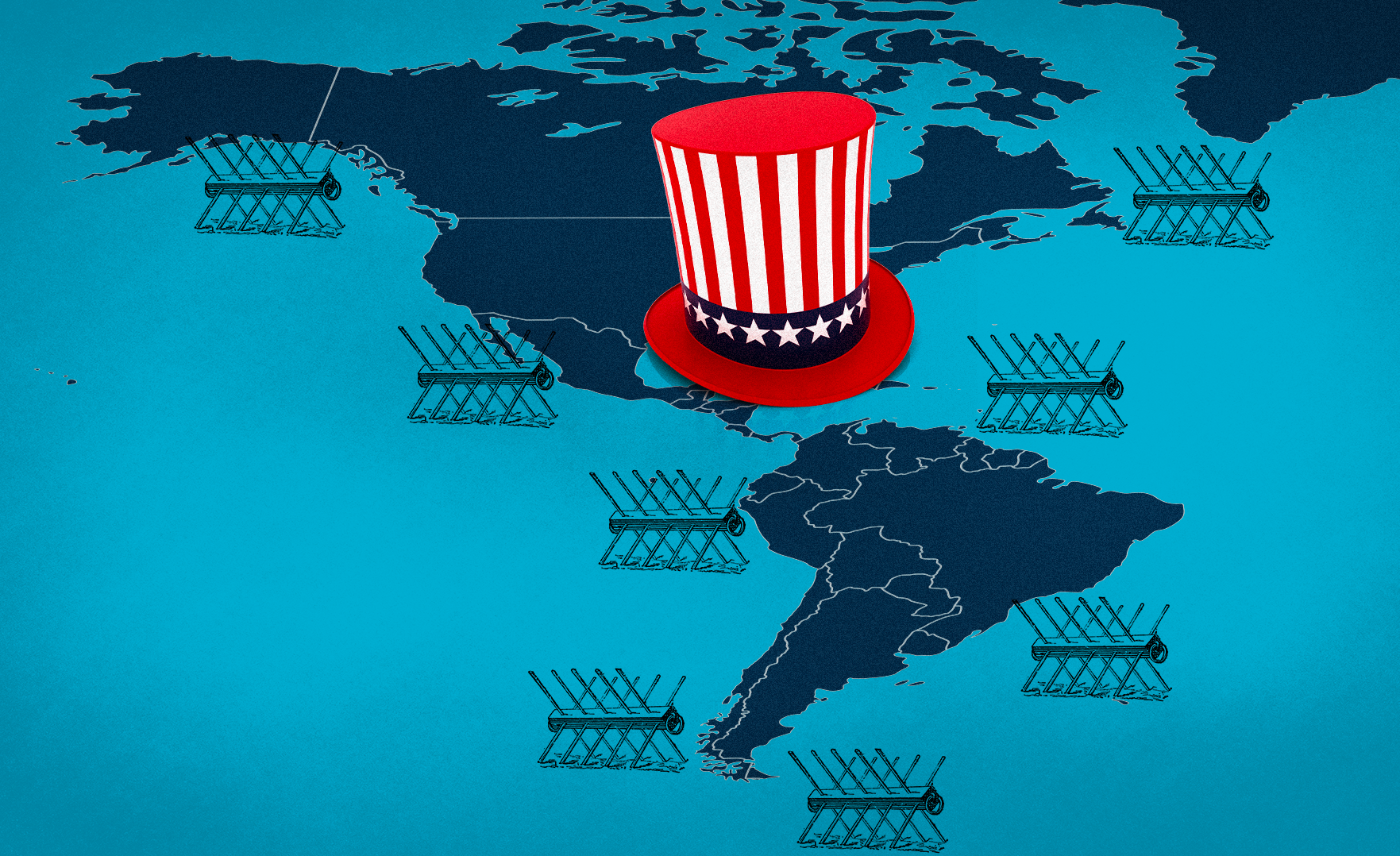
Washington has recently pursued a more aggressive policy approach toward the Western Hemisphere. Defense Priorities organized this symposium to encourage thinking about this change and articulate what U.S. hemispheric defense should—and shouldn’t—look like. Top experts shared their insights in an effort to inform and improve U.S. policy. Each contributor provided an answer to the question: “What is the most prudent way to pursue a foreign policy focused on hemispheric defense?”

Beware of military misadventures in the Western Hemisphere
True to its campaign rhetoric, National Security Strategy, and National Defense Strategy, the Trump administration has put the Western Hemisphere front and center in its foreign policy. In just over a year, this reified concept of “hemispheric defense” has caused chaos and consternation in both hemispheres. But thus far, Trump and his team have been lucky.
Set aside the northern thrust of Trumpian ambitions, which has created unprecedented tensions with Canada and may yet destroy NATO. Looking south, the administration’s overriding policy objective is reducing illegal immigration through both stronger border security and (now brazenly lawless) domestic detentions and deportations. Yet nothing could bring on a renewed flood of migrants faster than reckless American military action in Central or South America.
In America’s post-9/11 wars, ill-considered military interventions created millions of refugees in Africa, the Middle East, and Central Asia. Protected by a pair of oceans and thousands of miles, the U.S. mostly escaped the direct consequences of its militarized foreign policy.
The abduction of Venezuelan President Nicolás Maduro has had a muted effect on Venezuelans, since the rest of his regime remains in place and in control, likely after selling him out. But attempted regime change, or just unilateral American strikes, in Cuba, Colombia, or Mexico will be playing with fire. The administration, and the United States, are unlikely to keep getting lucky as the stakes get much bigger.
Secretary of Defense Pete Hegseth is fond of warning American adversaries to “FAFO.” He should consider how that might apply to America’s military misadventures in the Western Hemisphere. A very similar admonition is never far from the lips of the non-commissioned officers in the U.S. military Hegseth currently directs: “Play stupid games, win stupid prizes.”

A return to win-win diplomacy
The best way to ensure a positive outcome for the United States in the Western Hemisphere is to stop focusing on a military-first policy and return to win-win diplomacy.
Too many elite voices have virtually jettisoned diplomacy as a primary means of attaining beneficial economic and national security outcomes for our country. Win-win diplomacy, in which the needs and desires of all parties get a fair hearing—even those on the lower end of the power spectrum—is messy and often frustrating. But it also produces the most beneficial outcomes that have the best chance at long-term success.
When all parties have buy-in on an outcome, when they feel they will derive long-term benefits from a given arrangement, they are more likely to abide by the terms of that arrangement.
On the contrary, when we lead with coercion, when the side or sides in inferior power positions feel they have no choice but to concede to outcomes unfavorable to them, they will abide only under duress and only to the minimum level required. They will also cease complying as soon as they feel they can do so without penalty.
America has pronounced differences with many of the governments in our hemisphere. Having all nations fully submit to our views is not necessary to our national security or economic benefit. Cuba poses no threat of any kind to the United States yet we have had an adversarial relationship with Havana since the early 1960s that benefits neither side. We could easily remove many sanctions and other restrictions on Cuba, costing us less, improving their quality of life, and possibly buying us more goodwill in the region.
Seeking win-win solutions with every nation in the hemisphere—whether currently friendly or adversarial—could go a long way toward lowering the cost of maintaining our national security and increasing our economic opportunities.

Maintaining benevolent neighbors
The Trump administration’s doctrine in the Western Hemisphere might best be summed up in one word: dominance. Despite constant references to the 1823 Monroe Doctrine, President Trump’s approach is more aligned with the 1904 Roosevelt Corollary, in which the United States bestowed upon itself the role of Latin America’s exclusive policing power. Though unlike President Roosevelt, President Trump isn’t concerned with a respective country’s internal stability as much as its willingness to submit to U.S. policy demands.
President Trump is using U.S. power to subjugate states in the Western Hemisphere, producing some short-term results. In Venezuela, the U.S. captured former President Nicolás Maduro, a long-standing irritant to Washington in Latin America, and is effectively controlling the country’s oil industry by determining where Venezuelan export revenues are allocated. In Panama, President Trump’s threatening language about taking the Panama Canal by force likely led its President José Raúl Mulino to distance his government from China’s Belt and Road Initiative. Periodic threats of tariffs and unilateral U.S. military action in Mexico have moved Mexican President Claudia Sheinbaum towards adopting a far more aggressive anti-cartel strategy.
Even so, short-term wins don’t necessarily lead to long-term victories. Over time, President Trump’s aggressive efforts will compel small and middle powers—even those traditionally aligned with the United States—to hedge their behavior. This is already occurring to some degree. Brazil, for instance, has responded to U.S. tariffs by broadening its trade with China, which President Trump is trying to push out of the region (to little avail). Canada, a constant target of President Trump’s territorial fantasies, is doing the same thing. President Trump’s unilateral war against drug traffickers in the Caribbean is hurting Washington’s intelligence relationships with critical partners like Colombia. And President Trump’s willingness to leave the annexation of Greenland by force on the table for so long likely reinforced concern among other states in the hemisphere about what U.S. hegemony could entail.
The United States remains the Western Hemisphere’s paramount power, and there’s strategic logic in keeping it that way. A strategy of coercion, however, could spark intense great power competition in America’s own near-abroad and weaken one of its biggest geopolitical strengths: benevolent neighbors that see the United States as a partner, not a threat.

The Monroe Doctrine was always overrated
We shouldn’t lend the Trump administration’s capture of Venezuela’s president and theft of its oil, threats against Mexico and Greenland, and lawless strikes on alleged drug boats achieve false coherence by associating them with the Monroe Doctrine, “hemispheric defense,” or any other grand concept. These moves are better understood as a grab bag of discredited ideas: that territory reliably brings riches that trade cannot; that limited force makes targets pliant rather than stiffening their resistance; and that choking drug supply lines can meaningfully reduce drug consumption.
These policies “extend” the Monroe Doctrine—a warning to foreign powers to stay out of the Americas—and “hemispheric defense”—a pre–World War II notion that treats the region as a single defense zone—only in one sense. They continue the tradition of abusing doctrines as cover for militarized meddling in other states’ politics.
U.S. presidential doctrines are often post-hoc rationales for one policy that later misled others. Historically, they’ve encouraged foolish wars, and the Monroe Doctrine is especially overrated. It was articulated when the United States was too weak to enforce it. For decades afterward, presidents largely ignored it and looked the other way as Britain intervened in Central and South America. Once U.S. power grew, the doctrine—like “hemispheric defense”—became an extra rationale for needless interventions.
Chile is an example. Henry Kissinger derided it as “a dagger pointed at the heart of Antarctica” a few years before helping overthrow its government in a fit of Cold War hysteria. The problem with U.S. interventions in Latin America isn’t only that they exaggerate the danger of rival influence. It’s that, even if such influence materialized, it would rarely matter much to U.S. security. Even the Soviet missiles that triggered the Cuban Missile Crisis did not meaningfully alter the nuclear balance of terror or suddenly imperil Americans.
Many would dislike a Chinese military foothold in South America. But it is hard to see how it would give China the ability to attack or coerce the United States. Our safety doesn’t require “hemispheric defense.”

Hemispheric defense needs a spheres of influence approach
A U.S. focus on hemispheric defense is a good idea in theory, but it has been plagued by major difficulties in practice. The main benefits of such a focus should not only be enhancing the security of the homeland but easing the national defense burden overall and facilitating a more peaceful world order.
This might be possible since a hemispheric approach is consistent with the new multipolarity, spheres of influence, and great power cooperation. But the Trump administration’s original focus on the Western Hemisphere has quickly gone off the rails. Its initial move to secure greater U.S. control over the Panama Canal did at least comport with vital U.S. national security interests whereas neither the Venezuela military operation nor threats to conquer Greenland rise to that level. On the contrary, these reckless and unnecessary moves alienated neighbors and allies, wasted resources, and distracted attention from more pressing matters.
In mid-2022, scholars Lindsey O’Rourke and Joshua Shifrinson made a cogent argument for why spheres of influence could help to stabilize the world order. They explain that spheres of influence create buffer zones, clarify red lines, pacify conflicts within spheres, discourage adventurism, and facilitate needed bargaining among the great powers.
An effective hemispheric defense policy, therefore, would naturally prioritize security issues in directly adjacent regions while avoiding the recklessness seen from the U.S. in recent months. But to genuinely improve U.S. national security, these policies would have to be accompanied by a concomitant commitment to lower tensions with other great powers like Russia and China by embracing spheres of influence.

Airpower is no substitute for strategy
“This was one of the most stunning, effective, and powerful displays of American military might and competence in American history,” President Donald Trump declared after U.S. forces seized Venezuela’s leader in a dramatic raid on Caracas. “We had a fighter jet for every possible situation.”
What Trump failed to mention is that, aside from limited small-arms fire at low altitude, Venezuela posed no credible air threat. Its fighter fleet was largely grounded and its air defenses were easily suppressed, leaving U.S. forces operating in largely uncontested airspace.
The ease of the Venezuela operation risks misleading policymakers into overestimating airpower as a quick, cheap, and effective way to enforce the Trump administration’s “Donroe Doctrine,” an expanded Monroe Doctrine “to restore American preeminence in the Western Hemisphere.”
First, airpower only looks cheap when it is uncontested—and even then, appearances are deceptive. Operation Southern Spear, the broader U.S. campaign targeting suspected drug-running boats, has cost hundreds of millions. The Caracas raid itself involved over 150 aircraft, some flying 10-hour missions from the United States requiring extensive aerial refueling. Airpower may look effortless, but it is expensive to make it appear so.
Second, airpower is rarely quick—the preparation time is just hidden. The raid required months of intelligence collection, interagency coordination, and military planning. As Chairman of the Joint Chiefs of Staff General Dan Caine noted, it took “incredible work by various intelligence agencies” and “was meticulously planned.”
Finally, airpower alone is rarely decisive. The raid captured Nicolás Maduro, but what it will achieve in the long term is unclear, and the administration’s evolving explanations of its aims signal strategic confusion. U.S. strikes have mostly redirected smuggling without addressing the governance failures or socioeconomic conditions driving the narcotics trade.
The smarter approach is to use airpower sparingly and only when it serves a clear strategic purpose. Otherwise tactical triumphs like Venezuela risk becoming strategic traps, drawing the United States deeper into conflicts that airpower alone cannot solve. Strikes may impress, but they cannot be a substitute for sound strategy.

Don't bring the war on terror to the Western Hemisphere
Early on in President Donald Trump’s second term, the administration designated gangs such as Tren de Aragua and Mexican cartels as foreign terrorist organizations. “They are now officially in the same category as ISIS, and that’s not good for them,” Trump said in his joint address to Congress in March 2025.
In a sense, he was heralding the war on terror’s expansion into the Western Hemisphere.
Drugs are a major problem in the United States and its near-abroad. A new national security approach to Western Hemisphere affairs ought to prioritize stemming drug trafficking and its connections to governments. But the president, who pledged to end forever wars on the campaign trail, should not reach for the flawed tools of a counterterrorism campaign that defined two decades of American militarism.
At this point, the strategies and tactics that the United States deployed in Afghanistan, Iraq, and across the Middle East are associated with policy failure: the vagueness of the mission led to deadly and self-defeating overreach while the secrecy begot massive violations of Americans’ rights. From Bush to Obama to Trump to Biden, few leaders were willing to own their missteps. Each president had opportunities to officially conclude the war on terror and scrap its flawed legal architecture, yet none of them did.
Now, in the parlance of this administration, “narco-terrorism” has become a new enemy and at times a pretense for military strikes, regime change, and other potentially dangerous interventions. The White House’s National Security Strategy says, “We want to ensure that the Western Hemisphere remains reasonably stable.” But the more than 171 people already killed by U.S. airstrikes in the Caribbean represent the continuation of the war on terror’s worst tendencies, with real risks of accentuating instability.
The slipperiness of a “narco-terrorism” frame may very well lead to an ever-expanding new forever war, rather than more security for citizens of the United States and people living throughout the Americas.

The U.S. faces no conventional security threats from its neighborhood
The United States is right to prioritize the Western Hemisphere. But a prudent U.S. foreign policy toward the region must begin with the realization that Washington faces no conventional security threats from its immediate neighborhood.
There are 35 independent states in North America, South America, and the Caribbean. The United States is by far the largest and most powerful of them all. Its population of around 343 million is about the same size as Brazil and Mexico (the next largest countries) combined. Eleven states in the Western Hemisphere have populations of less than one million. The median population is around seven million. No country in the hemisphere has a military that can remotely threaten the U.S. homeland. Only Cuba, Nicaragua, and Venezuela have close relations with America’s adversaries and these relationships are limited. In short, the Western Hemisphere is a placid region from the perspective of U.S. national security.
American foreign policy should aim at ensuring that this remains the case. The best way to achieve this isn’t to invoke the Monroe Doctrine but to reprise Franklin D. Roosevelt’s Good Neighbor Policy. As far as possible, U.S. foreign policy towards its neighbors should be defined by mutual respect, non-intervention, economic cooperation, and inclusive regional institutions. Military interventions should be a last resort, with a preference for multilateralism over unilateralism. While the Western Hemisphere does suffer from several “non-traditional” security problems—organized crime, human trafficking, and drug smuggling, for example—these issues should be handled by law enforcement agencies rather than the U.S. armed forces. Overreliance on military power risks alienating regional partners, perhaps even pushing them into the arms of hostile actors in other regions, undermining U.S. national security in the long run.

Trump’s ‘pivot home’ should focus on security, not dominance
Directionally, President Donald Trump’s prioritization of the U.S. homeland and its near abroad makes sense. A largely secure nation like the United States (protected by oceans on two sides and facing only weak neighbors to the north and south) does not need a muscular, global military posture to maintain its prosperity. It can afford to “pivot home,” concentrating its energies on challenges in the Western Hemisphere that have the greatest potential to spill over its borders. However, the Trump administration is making two mistakes as it pursues this “pivot home” that are squandering resources and creating new risks.
First, President Trump’s National Security Strategy asserts an intention to “restore American preeminence in the Western Hemisphere,” but the United States is already the dominant power across this region. It does not need to dramatically increase its military activities or its political and economic interference in neighboring states to improve its strategic position. It has no military challengers and with the largest trade and financial market, it remains the most important economic player even as China’s involvement has grown. Unilateral and aggressive gambits, like the raid on Venezuela’s former president Nicolás Maduro or the threat to take Greenland by force, only create the potential for new military quagmires. The Trump administration could instead achieve its regional objectives by doing much less and then investing the balance in important domestic priorities.
Second, when confronting the challenges to U.S. security that do exist in the Western Hemisphere, the Trump administration has turned almost exclusively to military power. Trump has ordered strikes on alleged narco-terrorists, amassed a sizable armada in the Caribbean as a means of intimidation, and placed thousands of U.S. military personnel on the southern border.
These are the wrong tools for the problems at hand. Countering drug cartels and reducing illegal immigration are law enforcement challenges best addressed by the Coast Guard and Customs and Border Protection, or by working with partners in neighboring countries. Similarly, to counter Chinese influence in the region, the United States needs an economic (not military) strategy.
The Trump administration should continue to prioritize the Western Hemisphere, but it should recalibrate its approach, putting security above dominance and political and economic tools above military ones.

A Middle East in our own backyard
The Trump administration’s new focus on “hemispheric defense” is unnecessary, counterproductive, and could unleash Middle East-like chaos in our own backyard.
The United States has benefited tremendously from living in a good neighborhood—a region so geographically removed from potential rivals like Russia and China that neither can match U.S. influence or power projection capabilities. The Western Hemisphere is extraordinarily peaceful, with vanishingly few interstate wars occurring over the past 125 years. Several countries, including Costa Rica, Panama, and multiple Caribbean islands, have no militaries at all.
The U.S. should have left well-enough alone and simply enjoyed its regional security windfall. Instead, President Trump’s “hemispheric defense” concept threatens to upset the peace while straining U.S. resources. Just like the global war on terrorism mired the United States in obscure conflicts with no military solutions, setting its sights on “narco-terrorism” dooms the U.S. to fight ill-defined wars across the myriad countries scarred by drug trafficking: Mexico, Colombia, Peru, Bolivia, Venezuela, the Dominican Republic—to name a few.
More disturbing is President Trump’s pursuit of regime change, which doesn’t work. President Trump’s military buildup in the Caribbean and meddling in Venezuela has indefinitely pinned down U.S. assets in a coercive campaign against a weak country that did not attack the United States first. President Trump’s embargo on oil to Cuba, apparently intended to foster regime change in that country, could cause a humanitarian disaster a mere 90 miles off the Florida coast.
Turmoil in Cuba or Venezuela could unleash massive migration and drug crises that blow back on the United States. In the Middle East, strife in Syria spread massive refugee outflows all the way to Europe, with over 500,000 Syrians fleeing to EU countries in 2015. Production of the illicit drug Captagon soared and became so lucrative that the government co-opted the trade, transforming Syria into an unlikely narco-state. In 2011, the NATO-orchestrated overthrow of Moammar Gaddafi spurred chaos, impelling tens of thousands of Libyan “boat people” to cross the Mediterranean into Europe.
Latin America is not the Middle East, but toppling dictators often yields unhappy surprises. Trump has avoided quagmire in Venezuela so far—but what happens if his luck runs out?

Hemispheric stability means rethinking the war on drugs
Last fall, Politico inflamed the Washington policy establishment with a splashy story promising that the government’s latest National Defense Strategy would prioritize the Western Hemisphere. The NDS did wind up placing the territory of the United States and the Western Hemisphere first on its list of priorities, but no strategy document is going to constrain President Donald Trump. It seems highly unlikely he has even read either the NDS or NSS. The president’s attention has swung wildly from Iran to Gaza to Ukraine back closer to home.
An effective strategy focused on the Western Hemisphere would seek to solidify a region of prosperous, stable countries with good relations with Washington. Both in the context of competition with China and on its own terms, this outcome serves U.S. interests.
With the notable exceptions of countries like Venezuela and pre-Javier Milei Argentina, Latin America already has experienced significant economic growth over the past several decades. Even so, an effort to “nearshore” production away from China and toward countries in the Western Hemisphere could contribute to more growth and potentially more stability in the region.
Stability and security are the harder parts of this strategy. U.S. policymakers are committed to fighting a war on drugs that destabilizes countries in Latin America in pursuit of a supply-side campaign against narcotics. The economic logic here is insane. According to a 2023 indictment of a Mexican cartel, $800 in fentanyl precursor chemicals can yield over $1 million in street value of fentanyl. The idea that any amount of interdiction is going to disincentivize production enough to affect these drugs’ availability defies logic.
Considering a more demand-side approach and acknowledging the drug war’s unwinnability would be a tough pill to swallow, but greater stability in our hemisphere requires it.

Trump’s hemispheric belligerence is self-defeating
The Trump administration’s recent actions in the Western Hemisphere—bombing civilian boats in the Caribbean and Pacific, removing Venezuela’s president by force, leveling punitive tariffs and making territorial threats against a raft of neighbors—are counterproductive to the ends of U.S. security and prosperity. Rather than consolidating the United States’ power position in the region, they diminish other countries’ willingness to consent to Washington’s long-term preferences while incentivizing them to align with extra-hemispheric rivals for protection from U.S. coercion.
The point of “hemispheric defense” should be to keep potential rivals at arm’s length and to maintain predictable access to transit and trade within the region. The fact that there is no comparably powerful state in the Western Hemisphere and that no outside great power has a foothold in the region affords the United States copious strategic depth. The U.S. has few, if any, threats of significance nearby to worry about.
The Trump administration should stop its belligerent policies towards its neighbors, which are unnecessary to preserve the United States’ advantages and may erode them over time.
Low-level threats like gang or drug violence are problems for intelligence, law enforcement, and perhaps social policy at home, requiring cross-border cooperation with neighbors, not military campaigns that violate their sovereignty and provoke their resistance. The United States can access whatever resources it needs in the region through trade, not coercive expropriations or assertions of imperial prerogative. The absence of a competitor like the Soviet Union makes implacable hostility to neighbors on the basis of ideology—already inflated and unnecessary during the Cold War—particularly unjustified.
It’s self-defeating for the United States to use costly and potentially risky military means to get what it could otherwise receive through the cultivation of respectful diplomatic and economic relations.

Hemispheric defense should mean protecting the U.S. from attack
The Trump administration’s prioritization of the Western Hemisphere could be salutary. During World War II, a focus on national defense, defined narrowly in terms of protecting the United States from attack, was eclipsed by a focus on national security, defined broadly in terms of shaping a congenial international order. With the latter being much more demanding than the former, it was nearly inevitable that primacy, or the pursuit of a preponderance of power abroad, would follow.
With the realism and restraint movement committed to a move away from primacy, renewed attention to hemispheric defense should be welcome. At the very least, it should allow for more discriminating assessments about what counts as a first-order threat to the United States itself, as opposed to the broader international order that the United States has been associated with.
If a focus on hemispheric defense is to be productive, however, two considerations need to be kept front of mind. First, hemispheric defense should be defined narrowly in terms of protecting the United States from attack. In other words, the United States has every right to be concerned if a neighbor invites an outside great power to set up a military base on its territory. If that neighbor is doing nothing more than increasing trade and investment ties, however, then it is premature to describe the development as threatening. Second, the United States can minimize the chances of outside great powers being invited in militarily by being a good neighbor itself. The more the United States abuses its hegemonic position by bullying and threatening its neighbors, the more inclined they will be to seek protection from outside the hemisphere.

Joshua Shifrinson
Associate Professor of International Relations
University of Maryland School of Public Policy
America’s turn to hemispheric defense is unnecessary
The Trump administration’s turn to hemispheric defense is deeply problematic because it is unnecessary. Proponents of the policy argue that, in an era of great power competition, the United States needs to shore up its regional hegemony after decades of neglect. Such arguments are delusional.
By definition, hegemony means being so strong that no actor or group of actors can realistically oppose one’s ambitions. That Washington has paid proportionally less attention to the Western Hemisphere than other parts of the world in recent decades is thus not evidence of American weakness but rather of hegemony’s operation: there’s no need to devote attention to an area you already dominate!
Even then, the United States has worked to structure politics in the area. This has included a range of development initiatives, intelligence sharing, continued military efforts via a major combatant command (SOUTHCOM), counter-narcotics operations (remember Plan Colombia?), and more. For all that the Trump administration has emphasized the great power drivers of U.S. policy, neither China nor Russia has meaningfully played around in the Western Hemisphere. Beijing’s investment in the region, for example, pales in comparison to its investments in Africa or Asia.
If the argument for the administration’s policy is bad, the consequences may be worse. States balance in response to threats, just as distant offshore powers—such as China vis-à-vis the Western Hemisphere—tend to be invited onshore when local threats mount. Having put countries like Brazil and Mexico on notice that it may use force against them, Washington is thus increasing the incentive for regional actors to check the United States by coordinating with other great powers. This is likely to increase rather than decrease pressure on U.S. regional dominance, even as Washington’s commitment to regional hegemony implies that the U.S. will respond aggressively to any counterbalancing.
The policy is thus poised to doubly backfire, at once spurring, instead of stopping, challenges to U.S. regional hegemony while undermining, rather than bolstering, the stability of America’s own neighborhood.

A genuinely multilateral approach to Latin America
Historically, the United States has advanced its defense priorities in Latin America through unilateral measures. Although these actions sometimes yield short-term gains, they frequently generate long-term security dilemmas and overlook opportunities to collaborate with capable, stable regional partners.
Countries like Brazil, Mexico, Panama, and Colombia share U.S. interests in stability and public safety. Yet recent unilateral U.S. initiatives have drawn substantial regional and international criticism. The central question is not whether Nicolás Maduro posed a threat, but how the U.S. intervention in Venezuela was pursued. Washington’s approach sidelined allied governments that sought to mediate a peaceful resolution, leaving them with little role in shaping outcomes in Venezuela and little space to express concerns without fear of U.S. punitive economic retaliation. Such practices undermine the basis of a durable hemispheric strategy, are unlikely to withstand future electoral turnover in the United States, and will diminish U.S. influence.
The United States must share responsibility for regional defense. While ideological and economic differences inevitably exist between the U.S. and Latin American nations, they do not preclude cooperation on core security issues. Transnational criminal organizations pose a serious threat that may require near-term military involvement. Such efforts, however, should occur jointly with regional governments and institutions and be paired with reforms addressing structural violence.
If the United States consistently follows this collaborative model—and maintains it across presidential administrations—questions about potential involvement in places like Cuba will be addressed more organically and with regional consensus. The Trump administration has cast much needed attention on Latin America, but in all the wrong ways. Sustainable defense policy requires a shared, regionally coordinated approach aimed at reducing combat operations over time and expanding humanitarian and civic actions to achieve lasting stability.

America’s approach to its hemisphere should be partner-based
The Trump administration’s renewed focus on the Western Hemisphere is a good thing. The United States has legitimate interests here, like stopping the flow of illicit drugs, strategic minerals, Arctic security, and stemming what are currently modest intrusions by China and Russia into the region. A greater focus on the Hemisphere should also help reset global priorities and pare down the U.S. military presence in other parts of the world.
The big issue now is how the United States goes about pursuing its goals in the region. Washington should pursue a measured, minimally coercive, and partner-based approach that builds on the many common interests the United States has with other states in the Hemisphere. Without that, the U.S. will likely find itself dangerously overstretched in ways that do more harm than good to its national security.
Right now, the Trump administration is missing the boat on this kind of partner-based strategy. Its heavy-handed, overly militarized approach to the Hemisphere might bring some short-term concessions from states (like Panama on the Canal), but will backfire in the long run.
When faced with overwhelming threats, states typically don’t cave, but instead look for other options or hedge. We’re already seeing states turn to Beijing as an economic counter to U.S. pressure.
Likewise, military coercion just doesn’t work to fix some problems, like stemming drug flows and immigration. Moreover, U.S. history shows that force against weaker states especially can lead to the “meddler’s trap,” whereby military actions generate whole new “vital interests” that, in reality, aren’t vital at all. Force begets more force, leading to strategically detrimental overstretch.
Fortunately, the United States has better strategic options than coercion. Regional states have many of the same interests as the U.S., so engage them as partners, not pawns. Instead of compelling states to cut ties with China, offer better economic alternatives and establish mutually beneficial relations that meet U.S. and regional needs. Work cooperatively on border security and policing to stem the flow of drugs and immigrants into the United States. Finally, work with NATO allies on Arctic security and mineral extraction—they want the same ends, so take advantage of that.
In sum, partnership is viable, more strategically effective, and cheaper than coercion. Who can argue with that?

Stephen Wertheim
Senior Fellow, American Statecraft Program
Carnegie Endowment for International Peace
President Trump strips the Monroe Doctrine of its Pan-Americanism
When James Monroe announced his eponymous doctrine in 1823, his purpose was to oppose further European colonization of “our Southern brethren,” as he called the United States’ American neighbors. For him, the peoples of the New World shared a commitment to republican self-government that only the imposition of the Old World could stifle. Over the next century, a sense of inter-American solidarity endured. Even Theodore Roosevelt, whose inaptly named corollary to the Monroe Doctrine asserted a U.S. right to police the hemisphere, promoted the cause of “Pan-Americanism,” personally laying the cornerstone of the Pan American Union Building blocks from the White House.
In 2025, the United States, in its National Security Strategy, proclaimed a “Trump Corollary” to the Monrovian creed. Not unreasonably, the strategy insists on prioritizing the United States’ own hemisphere over more distant realms. Yet not a trace of Pan-American identification remains. According to the document, the hemisphere teems with grievous threats to the United States: migrants, drugs, and malign overseas influence. The rest of the hemisphere contains foreign entities to be enlisted, or coerced, to follow Washington’s agenda. “Our Southern minions,” the document might as well have called them.
The strategy itself is oddly capacious. From the text, one wouldn’t know that the Trump administration has launched a sprawling war on “narco-terror,” blowing alleged drug boats out of the water mainly for the spectacle of it, and sending in Delta Forces to oust and capture Venezuelan leader Nicolás Maduro. The people who wrote the document are more concerned with stopping the “incursions” (unspecified, but mostly economic) of “non-Hemispheric competitors” (unnamed, but principally China) into the U.S. sphere of influence. The Trump Corollary is all about this. Portentously it asserts a U.S. imperative to pressure Latin American states to excise extra-hemispheric influence “from control of military installations, ports, and key infrastructure to the purchase of strategic assets broadly defined.”
How the Trump administration acts will be far more important than the intentions it professes. For a guide to what’s coming, look less to the long history of U.S. relations with Latin America than to the recent record—and the ongoing, metastasizing reality—of the global war on terror.