Six months into the war with Iran, the Trump administration has yet to achieve any of its strategic goals. The administration’s stated objectives—ranging from ending Iran’s nuclear program to regime change—reflect decades of U.S. misdiagnosis of the threat Iran poses to the U.S. and Tehran’s strategic ambitions.
In this DEFP Q&A, Middle East Program Director Rose Kelanic discusses her new paper on the U.S.-Iran security dilemma and what the U.S. should do now as it struggles to find an exit from the war. (This interview has been lightly edited for clarity. Watch the full interview here.)
What is a “security dilemma” and how has U.S. policy created one between the U.S. and Iran?
Kelanic: A security dilemma is an international relations concept that observes that sometimes countries that are not inherently aggressive do things to make themselves more secure that might look aggressive to other countries. For example, they build weapons of various kinds or base their forces near other countries. They’re doing it for defensive purposes, but another nation might construe that behavior as offensive. That country then responds with its own defensive measures, which look like offense to the first country. This can lead to spirals of arms races or other measures that are interpreted as offensive when they’re really defensive.
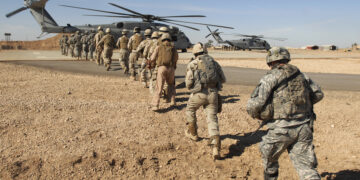
I use the concept in the paper to explain why the U.S.-Iran antagonism has gotten as bad as it has over the past several decades. I argue that the United States and Iran are locked in a security dilemma because the United States has bases throughout the Middle East, which we’ve expanded since the 1990s. The United States invaded Afghanistan, Iran’s eastern neighbor, in 2001 and Iraq, its western neighbor, in 2003. U.S. officials have repeatedly said they want to overthrow the Iranian government.
The U.S. has done a lot to make Iran nervous, convincing Tehran long before this war that the United States is out to get them. Turns out they were right. Iran has responded to moves that Washington sees as purely defensive, construing them as offensive. Iran has built a ballistic missile program to deter the United States and Israel from attacking them, not because Iran is necessarily aggressive, but because they interpret the U.S. as aggressive due to our presence in the region. This has led to a cycle where both sides take more and more offensive measures. Now, unfortunately, we’ve come to a full-scale war.
How has the war exacerbated these dynamics?
Kelanic: The war basically confirmed to the Iranians, rightly or wrongly, that the United States is out to get them. That has created incentives for Iran to respond by making itself more secure, which will seem threatening to the United States. Iran has already demonstrated that they have leverage over the Strait of Hormuz and can threaten shipping through it. There’s the possibility that Iran could try to restart its nuclear program: building nuclear weapons is something that states often do in response to a security dilemma. While Iran might see this as a defensive measure, from the U.S. perspective it would appear offensive.
Overall, the war has strengthened Iran’s hand because it showed that the regime is resilient to U.S. and Israeli air power. It showed how vulnerable U.S. bases in the Middle East are. And it allowed Iran to demonstrate even more leverage over Hormuz than observers realized it had, and perhaps even more than Iran itself realized that it had. Iran has seen now that it can essentially shut down shipping, not by attacking every ship that attempts to pass but by attacking enough ships that most shippers don’t want to go through the strait, which effectively closes it.
What should the U.S. do now?
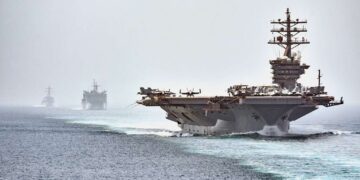
Kelanic: The United States needs to get out and end the war with Iran. Iran has shown it has this leverage over the strait, which depends on geography that we can’t change. The military capabilities it needs are cheap and easy for Iran to build. The U.S. needs to either make a deal with Iran to reopen Hormuz in exchange for some concessions or it can simply stop the war, drop the blockade, and go home.
More broadly, this sort of hostility was created largely by a U.S. military presence that has long outlived its usefulness. Washington has known for years that it needs to get out of the Middle East and that other theaters, like Asia, matter more. We kicked the can down the road for too long, and now it’s catching up with us. The war has shown that U.S. regional bases are extremely vulnerable liabilities that the U.S. can’t defend.
If the U.S. does pull back forces from the region, I expect that that would make the U.S.-Iran relationship less hostile over time. The U.S. could have left of its own accord, in a better way. It didn’t, and now events are forcing Washington’s hand. But it’s what needs to happen.
Author

More on Middle East