Key points
- Iran’s foreign policy reflects the country’s deep insecurity in a greater Middle East dominated by U.S. and Israeli military power. The permanent U.S. military presence in the region creates a security dilemma between the U.S. and Iran, whereby the steps each side takes to increase its own military capabilities threaten the other side, resulting in spirals that heighten tension and poison trust.
- Confusion about Iran’s intent and exaggeration of its capabilities to harm U.S. interests have created a long-standing sense in Washington that Iran is a bigger threat than it is.
- The stated goals of the Iran war reflect these errors. Whereas Iran views its nuclear program, support for proxy forces, and missile capabilities as defensive measures designed to balance U.S. and Israeli power, the Trump administration argues incorrectly that these features make it a pressing threat.
- The war has failed to meet Trump’s four stated objectives: ending Iran’s nuclear program, severing its support for regional terrorists and militias, destroying its missile capabilities, and collapsing its repressive regime. It has also strengthened Iran’s position by demonstrating the resilience of its regime and transforming its latent power over the Strait of Hormuz into tangible and lasting leverage.
- U.S.-Israeli attacks represent existential threats to Iran as a state, not just the Islamic Republic as a regime. Because the war has worsened the U.S.-Iran security dilemma, Iran will likely double down on its resistance strategies to reestablish deterrence.
U.S. policymakers have misread Iran for decades, portraying a fundamentally weak and insecure country as a relentless and dangerous aggressor. These misinterpretations laid the foundation for President Trump to launch a disastrous war that has strengthened Iran’s hand while bogging down the U.S. in yet another aimless Middle Eastern conflict.
The main problem underlying the Trump administration’s Iran strategy is that it has attempted to treat the symptoms of U.S.-Iran hostility while misdiagnosing the causes of Iran’s behavior, which derive from its deep insecurity in the shadow of U.S. and Israeli military preponderance in the Middle East. Iran’s grand strategy of resistance is a largely a backlash against U.S. power that is designed to push U.S. forces out of the region as a matter of self-defense. As long as the U.S. maintains a posture of heavy forward presence in the Persian Gulf, Iran will continue to balance and resist that presence.
Unfortunately, Trump’s war has exacerbated, rather than alleviated, the threats posed by Iran. Trump cited four main justifications for the conflict: the Iranian regime’s unwillingness to completely abandon its nuclear activities; its support for violent non-state actors; its ballistic missile program and conventional military power more broadly; and its brutality in crushing anti-government protesters.
Iran views these policies as defensive—they are its core means of deterrence and self-preservation from external threats. By attacking Iran, Trump merely reinforced the regime’s insecurity, which will likely prompt Iran to double down on these strategies, worsening its behavior from a U.S. point of view. The conduct of the war also led Iran to discover a new and endemic source of leverage—its ability to suppress commerce through the Strait of Hormuz with the threat of military force—which is likely to persist long after the conflict ends.
The war has strengthened Iran’s position, but the overall threat Iran poses to the United States remains modest. The Iran problem cannot be “solved” through more war, but it can be effectively managed with a pragmatic U.S. approach that does less rather than more. Redeploying U.S. forces away from the Middle East would move vulnerable U.S. bases out of range of Iranian missiles and drones and alleviate the U.S.-Iran security dilemma that provoked Iranian resistance in the first place. A pivot away from the Middle East is necessary on its own merits and would better meet U.S. strategic goals, irrespective of the conflict with Iran.
This paper reviews the conduct and staggering costs of the Iran war thus far. It argues that the rationales Trump offered to justify war were predicated on exaggerations and misunderstandings. It explains how the war worsened existing problems and created new leverage for Iran by demonstrating its ability to suppress traffic through the Strait of Hormuz. It closes by arguing that the Iran threat, though worsened by the war, remains manageable—and the wisest U.S. response is not escalation but disengagement.
The costs and realities of a protracted war
On February 28, 2026, President Donald Trump joined Israel to launch a major war against Iran despite ongoing U.S.-Iran nuclear negotiations. U.S.-Israeli airstrikes targeted Iran’s leadership, killing Supreme Leader Ayatollah Ali Khamenei, and aimed to degrade Iranian conventional military capabilities, including navy assets and missile facilities. The Trump administration apparently expected the war to end in a quick victory, either by cowing the remaining leadership into capitulation or through a popular uprising that replaced the Islamic Republic with a friendlier regime. Neither of these things happened.
Iran responded with broad retaliation across the Persian Gulf and beyond, targeting at least 13 countries with its fiercest blows against the Gulf states that host U.S. bases.1These countries are Israel, Iraq, Kuwait, Saudi Arabia, the UAE, Bahrain, Qatar, Oman, Jordan, Turkey, Cyprus, Azerbaijan, and Mauritius (Diego Garcia) Publicly available information suggests that Iranian counterstrikes have hit as many as 20 U.S. installations, killing at least 18 U.S. servicemembers and wounding over 600.2Merlyn Thomas, Alex Murray, and Matt Murphy, “Iran Attacks Damage 20 U.S. Military Sites since Start of War, Satellite Images Show,” BBC, June 1, 2026, https://www.bbc.com/news/articles/c2l2yl7r8r2o; Davis Winkie, “Iran War Casualty Count Eclipses 600 as Pentagon Quietly Changes Accounting,” CNN, July 27, 2026, https://www.cnn.com/2026/07/26/politics/iran-war-casualties. The full extent of the casualties and damage remains unknown, as the Trump administration has been reluctant to provide details, prompting criticism of a lack of transparency.3Nick Turse, “We Called Out the Pentagon for Undercounting U.S. Casualties in Iran. They Keep Doing It,” The Intercept, April 8, 2026, https://theintercept.com/2026/04/08/us-military-casualties-wounded-iran-war/; “Trump Administration Withholds Iran War Costs but Wants Historic $441 Billion More for Defense,” MSNOW, April 21, 2026, https://www.ms.now/news/trump-administration-withholds-iran-war-costs-but-wants-historic-441-billion-more-for-defense.
Iran has also attacked commercial shipping in the Persian Gulf, hitting at least 22 merchant vessels during the active phase of war.4Marium Ali, “How Many Ships Have Passed the Strait of Hormuz and How Many Were Attacked?” Al Jazeera, April 14, 2026, https://www.aljazeera.com/news/2026/4/14/how-many-ships-have-passed-the-strait-of-hormuz-and-how-many-were-attacked. That has proved enough to suppress traffic through the Strait of Hormuz, shutting off the main route for roughly 20 million barrels of oil per day, or about 20 percent of global petroleum supplies, as well as choking off about 20 percent of global liquid natural gas (LNG) output.5“Oil Market Report: March 2026,” International Energy Agency, March 2026, https://www.iea.org/reports/oil-market-report-march-2026. Though Saudi Arabia and the UAE have rerouted some oil exports through pipelines that bypass the strait, its closure forced Persian Gulf countries to curb output by some 14.4 million barrels per day at the conflict’s height, creating the largest supply shock in oil market history.6“Oil Market Report.” Oil prices and inflation rose sharply in the immediate aftermath of the conflict, and the economic consequences of infrastructure damage, production shut-ins, and global inventory depletion will reverberate for months if not years.7Andrew Ackerman and Federica Cocco, “Iran War Fuels Sharpest Inflation Spike in Nearly Three Years at 3.8 Percent,” Washington Post, May 12, 2026, https://www.washingtonpost.com/business/2026/05/12/iran-inflation-trump-oil-gas-prices/.
The war has been extremely costly in budget and matériel, with the U.S. burning through munitions at a staggering rate and reducing its preparedness for contingencies in other theaters, perhaps for years.8Mark F. Cancian and Chris H. Park, “Rebuilding U.S. Missile Inventory: A Multiyear Project,” Center for Strategic and International Studies, May 27, 2026, https://www.csis.org/analysis/rebuilding-us-missile-inventory-multiyear-project. The Pentagon has put direct operating costs at $37.5 billion, while acknowledging the number is not comprehensive. It has also requested $70 billion in emergency funding to replace munitions and cover Iran war costs.9Greg Jaffe, “Hegseth Estimates Iran War Has Cost $37.5 Billion,” New York Times, July 21, 2026, https://www.nytimes.com/2026/07/21/us/politics/iran-war-cost-estimate.html. Linda Bilmes of Harvard University estimates the all-in cost will ultimately reach $1 trillion once munitions replacement, veterans’ healthcare, and borrowing costs are counted.10“Why Is the War in Iran So Expensive?” interview with Linda Bilmes, Harvard Kennedy School, April 7, 2026, https://www.hks.harvard.edu/faculty-research/policy-topics/international-relations-security/why-war-iran-so-expensive. The pace of expenditure is its own warning sign, the U.S. and allied forces fired more Patriot interceptors in the first four days of the Iran war than Ukraine received over the previous four years.11Macdonald Amoah, Morgan D. Bazilian, and Jahara Matisek, “Scaling Patriot Production: The Industrial Base Crisis Explained,” Foreign Policy Research Institute, May 18, 2026, https://www.fpri.org/article/2026/05/scaling-patriot-production-the-industrial-base-crisis-explained/; Kim Barker, “Ukraine Helps U.S. Bases in the Mideast With Stopping Drones,” New York Times, March 9, 2026, https://www.nytimes.com/2026/03/09/world/middleeast/ukraine-shahed-drone-middle-east.html Some experts now warn that the U.S. cannot carry out other missions including contingencies to defend Taiwan.12Alexander Ward, Shelby Holliday, and Yoko Kubota, “Iran War Complicates Contingency Plans to Defend Taiwan, Some U.S. Officials Say,” Wall Street Journal, April 23, 2026, https://www.wsj.com/politics/national-security/iran-war-complicates-contingency-plans-to-defend-taiwan-some-u-s-officials-say-4384f7c1.
Attempts to end the war with a negotiated settlement have repeatedly foundered. On April 8, the U.S. and Iran agreed to a ceasefire that paused major combat operations but did not resolve the underlying strategic issues, and shortly afterward, Trump placed Iran under a U.S. naval blockade in a failed bid to force concessions.
After two months of shipping at a near standstill, President Trump signed a June 17 memorandum of understanding (MOU) with Iran to reopen the Strait of Hormuz and resume nuclear negotiations in exchange for ending the U.S. blockade, waiving U.S. sanctions on Iranian oil, and unfreezing Iranian assets. But that arrangement fell apart roughly three weeks later, with Trump resuming sanctions. Active hostilities reignited in the form of nightly tit-for-tat U.S. airstrikes and Iranian drone and missile attacks. With the war now entering its sixth month, President Trump appears trapped in a protracted conflict with no possibility of victory yet remains unwilling to cut U.S. losses and admit failure.
How Washington misdiagnosed Iran
The four rationales behind Trump’s war reflect a single, deeply flawed, and long-entrenched Washington assumption: that Iran was implacably aggressive and therefore undeterrable. The Trump administration appears to have read Iran’s nuclear activities, missiles, and proxies as signs of offensive intent, concluded that a deal was impossible, and embraced an Israeli-style “mow the lawn” strategy of hobbling Iran indefinitely, even at the cost of a forever war.
Yet this view of Iran verges on caricature. A more compelling read recognizes that the country is deeply insecure, has long feared attack (from the U.S., Israel, and previously, Saddam Hussen’s Iraq), and has used militias, missiles, and nuclear activities as asymmetric means of deterrence.13Vali Nasr, Iran’s Grand Strategy: A Political History (Princeton: Princeton University Press, 2025). Because it is too weak to defend itself against superior U.S. and Israeli conventional force, the regime invested in capabilities that threaten unacceptable retaliatory costs, essentially pursuing deterrence by punishment rather than denial. Iran behaves less like a predator than a porcupine, with missiles and proxies serving as its quills. In this interpretation, the U.S. and Iran have been locked for decades in a security dilemma in which each side’s defensive measures are read by the other as offensive, creating a spiral of insecurity and distrust.
If Iran is motivated by security rather than implacable aggression, the war will likely impel Iran to redouble its investments in nuclear activities, missiles, drones, and proxies. Repeatedly attacking Iran merely entrenches the security dilemma and pushes Tehran to rebuild newer and better retaliatory capabilities in the hope of restoring deterrence.
Latent nuclear capability for leverage and deterrence
Many in Washington have mistakenly viewed Iran’s nuclear program, and particularly its insistence on a right to enrich uranium, as proof of an intent to get a bomb.14“Remarks on the U.S. Military Operations Against Iran,” Miller Center Presidential Speech Archive, February 28, 2026, https://millercenter.org/the-presidency/presidential-speeches/february-28-2026-remarks-us-military-operations-against-iran. Trump himself has alleged that Iran was engaged in a “relentless quest for nuclear weapons,” would not hesitate to use them, and would be emboldened by a “nuclear shield” to terrorize and extort the world.15“Address to the Nation on Iran,” Miller Center Presidential Speech Archive, April 1, 2026, https://millercenter.org/the-presidency/presidential-speeches/april-1-2026-address-nation-iran. Yet the evidence does not support these claims. Iran’s nuclear program exists to provide leverage and deterrence. If anything, the regime has slow-walked its nuclear progress over a span of years to avoid signaling aggressive intent.
Iran’s actions over the last decade suggest that the nuclear program primarily functioned as a negotiating device—a way for the regime to reset facts on the ground to build leverage to trade away for sanctions relief. That appears to be the explicit motive behind the increased pace of nuclear activities Iran embarked upon under the “maximum pressure” campaign pursued by President Trump and continued by President Biden.
The lesson Iran had learned from past iterations of diplomacy was that a lasting deal would only be possible if it significantly built up its nuclear program and used it as leverage for a robust agreement.16Nasr, Iran’s Grand Strategy, 256–257. Iran’s negotiations with the Trump administration in Oman before the 2026 conflict, and its apparent willingness to sacrifice key portions of its nuclear program, including its 60 percent enriched HEU stockpile, suggest the Islamic regime was serious about offering concessions in exchange for economic relief.17Peace ‘Within Reach’ as Iran Agrees No Nuclear Material Stockpile: Oman FM,” Al Jazeera, February 28, 2026, https://www.aljazeera.com/news/2026/2/28/peace-within-reach-as-iran-agrees-no-nuclear-material-stockpile-oman-fm.
Prior to Trump striking Iran, Tehran was not on the cusp of building nuclear weapons. The U.S. intelligence community concluded in March 2025 that Iran had not made a decision to weaponize and had not moved significantly closer to a bomb.18Tulsi Gabbard, “DNI Gabbard Opening Statement as Delivered to the HPSCI on the 2025 Annual Threat Assessmentof the U.S. Intelligence Community,” Office of the Director of National Intelligence, 2025, https://www.dni.gov/index.php/newsroom/congressional-testimonies/congressional-testimonies-2025/4061-ata-hpsci-opening-statement-as-delivered. U.S. airstrikes on Iran’s major nuclear sites at Fordo, Natanz, and Isfahan in June 2025 subsequently degraded Iran’s capabilities and set back its nuclear program by up to two years, according to Pentagon damage assessments.19Lara Seligman and Michael R. Gordon, “Pentagon Says U.S. Strikes Delayed Iran’s Nuclear Program by Up to TwoYears,” Wall Street Journal, July 2, 2025, https://www.wsj.com/world/middle-east/pentagon-says-u-s-strike-delayed-irans-nuclear-program-by-up-to-two-years-8d51eb8 In March 2026, Director of National Intelligence Tulsi Gabbard testified to Congress that Iran had neither rebuilt the damaged sites nor resumed enrichment activities, reinforcing reporting by the International Atomic Energy Agency (IAEA) that there was no evidence Iran had restarted enrichment.20Richard Hall and Rebecca Schneid, “Gabbard Says Iran Did Not Rebuild Nuclear Program After 2025 Strikes,” TIME, March 18, 2026, https://time.com/article/2026/03/18/tulsi-gabbard-iran-nuclear-trump/; Farnoush Amiri, “IAEA Chief Says Iran Isn’t Actively Enriching Uranium but Movement Detected near Stockpile,” Associated Press, October 29, 2025, https://www.pbs.org/newshour/world/iaea-chief-says-iran-isnt-actively-enriching-uranium-but-movement-detected-near-stockpile.
Iran’s choice not to immediately weaponize its nuclear activities is significant because the constraint on Iranian proliferation isn’t a lack of capabilities—it’s a lack of intent. Iranian scientists have already mastered the nuclear fuel cycle and cleared roughly 90 percent of the technical hurdles to produce weapons-grade fuel—the hardest part of building a bomb.21Fact Sheet: Uranium Enrichment—For Peace or for Weapons,” Center for Arms Control and Non-Proliferation, August 26, 2021, https://armscontrolcenter.org/uranium-enrichment-for-peace-or-for-weapons/. Yet as the IAEA documented in its final pre-war verification in May 2025, Iran’s enrichment did not exceed 60 percent, stopping short of the 90 percent required for weapons-grade uranium.22Verification and Monitoring in the Islamic Republic of Iran in Light of United Nations Security Council Resolution 2231,” International Atomic Energy Agency, June 20, 2025, https://www.iaea.org/sites/default/files/25/06/gov2025-24.pdf; “IAEA Director General Grossi’s Statement to UNSC on Situation in Iran,” International Atomic Energy Agency, June 20, 2025, https://www.iaea.org/newscenter/statements/iaea-director-general-grossis-statement-to-unsc-on-situation-in-iran-20-june-2025.
Iran’s centrifuge cascades were configured as a three-step ladder: from natural uranium to 5 percent enrichment, from 5 percent to 20 percent, and from 20 percent to 60 percent. They deliberately terminated at 60 percent, leaving the final stage of 60 percent to 90 percent conspicuously absent.23IAEA’s December 6th Update on Iran,” Institute for Science and International Security, December 10, 2024, https://isis-online.org/isis-reports/iaeas-december-6th-update-on-iran. This signaled that Iran did not intend to pursue weaponization. As Robert E. Kelley, a nuclear specialist at SIPRI, argued, the configuration was best read as a political message: “‘We have gone as far as we can go in response to provocations without producing weapons-grade uranium.’”24Robert E. Kelley, “Why Is Iran Producing 60 Per Cent-Enriched Uranium?” Stockholm International Peace ResearchInstitute, April 29, 2021, https://www.sipri.org/commentary/essay/2021/why-iran-producing-60-cent-enriched-uranium.
Iran telegraphed its nuclear progress through regular inspections by the IAEA even as it enriched beyond the limits of the defunct JCPOA, which suggests a desire to assure Washington it wasn’t pursuing more developed capabilities in secret. The IAEA conducted 493 inspections of Iranian nuclear sites in 2024 and 232 inspections in 2025, including weekly inspections of its uranium stockpiles, until the June 2025 U.S. and Israeli airstrikes prompted Iran to suspend cooperation while remaining within the Non-Proliferation Treaty framework.25Iran Nuclear Weapons Risk Rises After U.S.-Israel Attacks, IAEA Warns,” Bloomberg, June 3, 2026, https://www.bloomberg.com/news/articles/2026-06-03/iran-nuclear-risk-seen-higher-than-before-trump-attacks-began. The counterproductive result of U.S.-Israeli attacks is that the international community now knows dramatically less about Iran’s nuclear sites and uranium stockpiles than before the 12–Day War.
Iran’s deliberate, telegraphed behavior is not consistent with a regime hell-bent on acquiring a bomb or even a rapid nuclear breakout capability. Despite alarmist Washington rhetoric, there is no indication that Iran’s nuclear program was ever motivated by a desire to dominate the region. Rather, the chief rationales behind the program’s inception during the days of the Shah were security through deterrence, national pride, and the creation of an alternative energy source to conserve Iranian oil for export rather than domestic consumption.26Sina Azodi, Iran and the Bomb: The United States, Iran, and the Nuclear Question (London: Bloomsbury Academic, 2026); Vali Nasr, Iran’s Grand Strategy, 231–232, 256–257. Some Iranian officials apparently believed the country could achieve deterrence without weaponization by maintaining the latent capability to weaponize at a future time.27Matthew Fuhrmann, “U.S. Allies and Adversaries Are Attempting Nuclear Deterrence Without Weapons—Will ItWork?” War on the Rocks, April 7, 2025, https://warontherocks.com/u-s-allies-and-adversaries-are-attempting-nuclear-deterrence-without-weapons-will-it-work/. If so, that was a miscalculation, because Iranian nuclear activities invited exactly the kind of intervention by the U.S. and Israel that the latent deterrence strategy was meant to dissuade.
There can be little doubt that the war has been counterproductive to the goal of preventing Iranian proliferation. According to U.S. intelligence sources, the conflict did not meaningfully degrade Iran’s nuclear program because it already lay in ruins after the 12–Day War.28Gram Slattery, Jonathan Landay, and Erin Banco, “U.S. Intelligence Indicates Limited New Damage to Iran’s Nuclear Program, Sources Say,” Reuters, May 4, 2026, https://www.reuters.com/world/middle-east/us-intelligence-indicates-limited-new-damage-irans-nuclear-program-sources-say-2026-05-04/. Instead, by pursuing a regime change war against Iran that also threatened its existence as a sovereign state, the U.S. and Israel have strengthened the regime’s incentives to obtain nuclear weapons to deter future attack. Nuclear proliferation by Iran is not inevitable, but it is more likely now than it was before Trump attacked.
The Iran war also produced a more extreme government in Tehran that could prove friendlier to the goal of weaponization. Airstrikes killed the supreme leader, Ayatollah Ali Khamenei, who had forbidden the pursuit of an Iranian nuclear bomb on religious grounds. They ultimately elevated hardliners whose family members, friends, and colleagues had often been killed.29Samia Nakhoul, Parisa Hafezi, and Asif Shahzad, “Iran’s Guards Seize Wartime Power, Weakening Supreme Leader’s Role,” Reuters, April 28, 2026, https://www.reuters.com/world/asia-pacific/irans-guards-seize-wartime-power-blunting-supreme-leaders-role-2026-04-28/; Danny Citrinowicz, “How the War Saved the Iranian Regime,” Foreign Affairs, April 29, 2026, https://www.foreignaffairs.com/iran/how-war-saved-iranian-regime. The obvious lesson for them to draw is that Iran needs a deterrent to prevent such strikes from recurring. Indeed, U.S. intelligence indicates that Mojtaba Khameini, the new Supreme Leader, appears to be more receptive to building a bomb.30Julian E. Barnes, “Iran’s New Leader is More Open to Pursuing a Nuclear Weapon, U.S. Intelligence Says,” New York Times, July 24, 2026, https://www.nytimes.com/2026/07/24/us/politics/iran-nuclear-weapon.html.
More broadly, attacking Iran not once but twice during ongoing nuclear negotiations—in June 2025 and again in February 2026—damaged the entire premise of IAEA inspections by removing the incentives for countries with nuclear programs to provide information on their activities that could be used for targeting. Washington often forgets that cooperation with the nuclear nonproliferation regime is risky. The more that is known about the particulars of Iran’s nuclear architecture, the better the military options that can be formulated to destroy it.
The U.S. specifically has a history of using IAEA inspections for covert intelligence gathering—most notably against Saddam Hussein’s regime in Iraq—which may deter Iran from future cooperation now that the U.S. has targeted its nuclear sites twice.31Gregory D. Koblentz, “Saddam versus the Inspectors: The Impact of Regime Security on the Verification of Iraq’s WMD Disarmament,” Journal of Strategic Studies 41, no. 3 (2018): 372–409, https://doi.org/10.1080/01402390.2016.1224764. Iran also mistrusts IAEA data security, fearing that sensitive information gleaned from inspections could be hacked by third-party countries such as the U.S. and Israel.32Steven Ditto, “Iranian Suspicions About the IAEA,” Washington Institute for Near East Policy, March 21, 2014, https://www.washingtoninstitute.org/policy-analysis/iranian-suspicions-about-iaea. Those two major risks of nuclear cooperation—the possibility that nuclear inspections could be used to gather intelligence and the potential vulnerability of IAEA databases to espionage—have always been present, but they now appear higher to Iran because of the war, creating real obstacles to Iranian reengagement with nuclear nonproliferation efforts.
Proxies demonstrate Iran’s weakness and insecurity
Trump justified the Iran war by citing Iranian sponsorship of violent groups that have killed U.S. citizens.33“Address to the Nation on Iran.” “The Iranian Regime’s Decades of Terrorism Against American Citizens,” White House, March 2, 2026, https://www.whitehouse.gov/releases/2026/03/the-iranian-regimes-decades-of-terrorism-against-american-citizens/. But reliance on proxies demonstrates Iran’s weakness and insecurity, not strength. Iran’s proxy network reflects a strategic logic of “forward defense” against stronger foes that compensates for conventional military weakness by pushing threats outward, creating a form of strategic depth, and raising the potential costs of attacking Iran itself.34Mohsen M. Milani, Iran’s Rise and Rivalry with the U.S. in the Middle East (London: Oneworld Publications, 2025), 31–32.
The concept of “forward defense” arose from Iran’s inability to repel Iraqi invasion during the brutal 1980–1988 Iran-Iraq War, when Saddam Hussein’s armies were equipped with superior U.S. weaponry. Iran’s conventional difficulties, juxtaposed against the apparent success of the 1983 Beirut barracks bombing in pushing U.S. military forces out of Lebanon, led Iran to conclude that asymmetric strategies like terrorism, guerrilla tactics, and proxy warfare were more effective at resisting conventionally superior adversaries.35Nasr, Iran’s Grand Strategy, 81 Tehran especially invested in building up proxy networks after the United States seemingly encircled Iran by invading and occupying two of its neighbors in rapid succession—Afghanistan in 2001 and Iraq in 2003.
Iranian support for terrorism, while reprehensible, does not represent a significant threat to the United States. Attacks on U.S. citizens by Iran-sponsored groups fall into two categories: insurgency, which is a form of irregular warfare directed against uniformed military personnel; and terrorism, which is defined as violence against civilians to achieve political objectives. To the extent that Iranian proxy groups have attacked Americans, they have done so almost exclusively within the Middle East region as part of a strategy that Iran views as self-defense.
Iranian-backed insurgencies have killed and injured U.S. servicemembers deployed to the Middle East as part of a broader effort to push U.S. forces out of the region. During the U.S. occupation of Iraq from 2003–2011, Iraqi insurgents supported by Iran killed an estimated 603 U.S. soldiers, accounting for one-sixth of U.S. combat fatalities, but those attacks ended with the war and subsequent drawdown of U.S. combat troops.36Kyle Rempfer, “Iran Killed More U.S. Troops in Iraq Than Previously Known, Pentagon Says, ” Military Times, April 4, 2019, https://www.militarytimes.com/news/your-military/2019/04/04/iran-killed-more-us-troops-in-iraq-than-previously-known-pentagon-says/. Since 2019, insurgents linked to Iran have harassed U.S. troops in Iraq and Syria to compel a full U.S. withdrawal from those countries.37Ranj Alaaldin, “The Popular Mobilization Force is Turning Iranian Client State, ” Brookings, February 2, 2024, https://www.brookings.edu/articles/the-popular-mobilization-force-is-turning-iraq-into-an-iranian-client-state/; Rena Netjes and Samer al-Ahmad, “Iran is Attempting to Push the United States out of Syria via Hasaka Province,” Washington Institute, March 8, 2024, https://www.washingtoninstitute.org/policy-analysis/iran-attempting-push-united-states-out-syria-hasaka-province Other significant cases of Iran-linked violence against U.S. troops—the 1983 Marine barracks bombing by Hezbollah in Beirut and the 1996 Khobar Towers attack in Saudi Arabia—also represent attempts to push U.S. forces out of the Middle East.38Responsibility for the Khobar bombing is disputed. Some U.S. officials and analysts have blamed al-Qaeda for the attack, but most experts attribute it to Saudi Hezbollah, a group closely linked to Iran. Thomas Hegghammer, “Deconstructing the Myth about al-Qa`ida and Khobar,” CTC Sentinel 1, issue 3 (February 2008). The evidence ofIranian involvement has been sufficiently robust for U.S. courts to hold the Islamic Republic legally responsible for the bombing. Carol D. Leonnig, “Iran Held Liable in Khobar Attack,” Washington Post, December 23, 2006, http://washingtonpost.com/archive/politics/2006/12/23/iran-held-liable-in-khobar-attack-span-classbankheadjudge-orders-254-million-paymentspan/6a93eae4-7e03-4167-9cf8-c3b11f42d160/. If the U.S. did not station troops in Iran’s strategic vicinity, it is unlikely Tehran would target U.S. forces at all.
Prior to the 2026 Iran war, the terrorist threat to U.S. civilians from Iranian proxies was more historical than current. Iran-backed groups had not deliberately targeted U.S. civilians in nearly four decades—not since the 1982–1992 Lebanese hostage crisis, when Hezbollah perpetrated a wave of kidnappings and killings targeting Westerners in Lebanon.39Hezbollah’s Record on War & Politics,” Wilson Center, October 25, 2023, https://www.wilsoncenter.org/article/hezbollahs-record-war-politics. Violence by Hamas against Israel, including the October 7, 2023 attacks, had killed U.S. citizens, but they were not singled out for being American—they were incidental casualties, along with victims of other nationalities, in a broader campaign targeting Israeli civilians.40200 Foreigners, Dual Nationals Cut Down in Hamas Assault. Here’s Where They Were From,” Times of Israel, October 27, 2023, https://www.timesofisrael.com/200-foreigners-dual-nationals-cut-down-in-hamas-assault-heres-where-they-were-from/.
U.S. bases near Iran
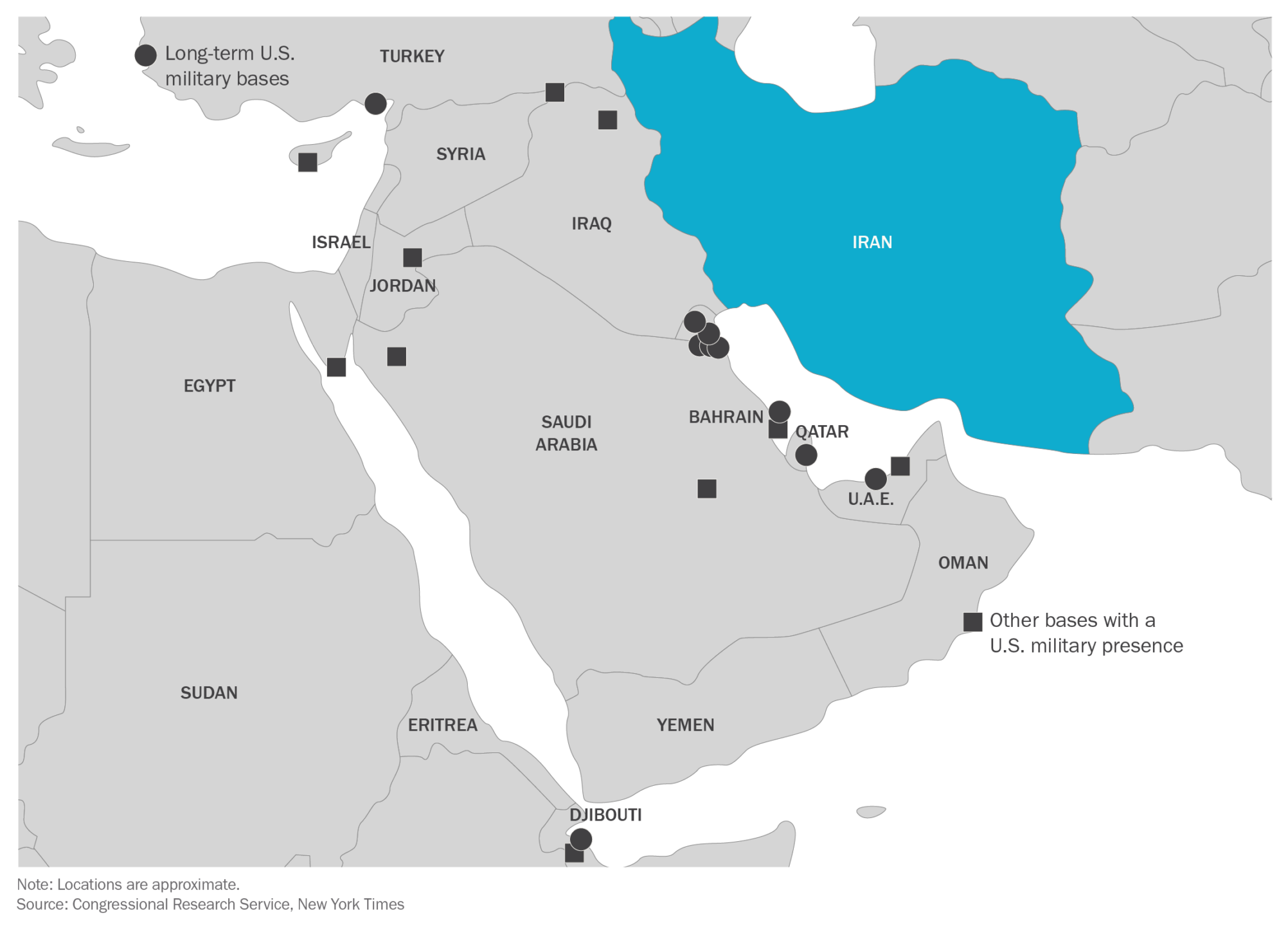
The United States maintains a number of military installations near Iranian territory, which have contributed to a sense of insecurity on Iran’s part.
The Iran war itself, however, has created new grievances that could metastasize into terrorism threats. The deaths of 175 civilians, mostly children, at a girls’ primary school in Minab apparently struck by a U.S. Tomahawk missile—and the unwillingness of the Trump administration to admit responsibility or offer contrition—is exactly the sort of incident that terrorist groups use as a rallying cry for recruitment.41Susannah George, “Families of Children Killed in Strike on Iranian School Join Leader’s Funeral, ” Washington Post, July 5, 2026, https://www.washingtonpost.com/world/2026/07/05/families-children-killed-iran-school-bombing-join-leaders-funeral-tehran/ In April 2026, U.S. authorities uncovered a plot by Kata’ib Hizballah, an Iraqi militia connected to Iran, to attack synagogues and Jewish centers in New York, Los Angeles, and Scottsdale “to compel the United States to stop military attacks against Iran.”42United States v. Mohammad Baqer Saad Dawood Al-Saadi, Criminal Complaint no. 25-Mag-4425, Southern District of New York, May 15, 2026, Paragraph 8, https://www.justice.gov/usao-sdny/media/1440956/dl. The attack was foiled and the overall threat remains low, but war with Iran has arguably increased, not decreased, terrorism threats to Americans.
The war is unlikely to reduce Iranian support for actors such as Hamas, Hezbollah, and the Houthis. To the contrary, given that the U.S. attack has heightened Iran’s insecurity, the regime may lean harder on its proxy support strategy, which is low-cost, deniable, and resilient. It is telling that despite U.S. and Israeli pressure, Iran has not lessened its diplomatic support for Hezbollah against Israel’s incursion into Lebanon, repeatedly insisting that a Lebanon ceasefire be included in any peace deal to end the war.
Iran’s conventional forces were built for deterrence, not expansion
As the U.S. Defense Intelligence Agency has put it, “Iran’s ‘way of war’ emphasizes the need to avoid or deter conventional conflict” through the threat of retaliation against an attacker.43Iran Military Power, Defense Intelligence Agency, 2019, 23, https://www.dia.mil/portals/110/images/news/military_powers_publications/iran_military_power_lr.pdf. Having concluded many years ago that it could not compete with the qualitatively superior forces of its regional rivals or the United States, Iran invested in asymmetric capabilities like missiles, drones, and proxies to compensate for its weakness.44Joshua Rovner, “After America: The Flow of Persian Gulf Oil in the Absence of U.S. Military Force,” in Charles L. Glaser and Rosemary A. Kelanic, eds., Crude Strategy: Rethinking the U.S. Military Commitment to Defend Persian Gulf Oil (Washington, DC: Georgetown University Press, 2016), 150–153. Iran has not built, and was not building, conventional military capabilities required to expand beyond its borders because such forces are prohibitively expensive to obtain—especially with Iran the subject of long-standing arms embargoes.
Iran’s small military budget reflects the weakness of its economic base, which has been crippled by decades of U.S. sanctions and economic mismanagement by the regime.45Iran Military Power, 18. The country’s defense spending is miniscule and dwarfed by its competitors. In 2024, the Iranian defense budget was a paltry $8 billion, compared to an Israeli defense budget of $33.7 billion, a Saudi defense budget of $71.7 billion, and a U.S. defense budget of $968 billion.46The Military Balance 2025, International Institute for Strategic Studies (New York: Routledge, February 12, 2025), 34, 337, 344, 366. Owing to severe resource constraints, Iran’s conventional military has been systematically underfunded and underequipped, keeping it far inferior to the militaries of regional rivals. Even before Trump degraded Iran’s military with thousands of airstrikes during Operation Epic Fury, Iran’s conventional forces relied on equipment that was “obsolete, obsolescent, or of relatively low quality,” including force systems inherited from the Shah’s army that likely had high non-operational rates.47Anthony H. Cordesman and Nicholas Harrington, “The Arab Gulf States and Iran: Military Spending, Modernization, and the Shifting Military Balance,” Center for Strategic and International Studies, December 12, 2018, https://www.csis.org/analysis/arab-gulf-states-and-iran-military-spending-modernization-and-shifting-military-balance.
The Iranian military has been further weakened by its bifurcated internal structure, consisting of the better-resourced Islamic Revolutionary Guard Corps (IRGC), which was built to protect the regime from internal threats, and the regular Iranian army, the Artesh, which is tasked with territorial defense and receives less funding despite its larger size.48Iran Military Power, 18, 25. Rivalries and redundancies across the two organizations hamper the overall effectiveness of Iran’s armed forces. This divided structure is common in authoritarian regimes where leaders fear that having too strong a military could threaten their rule because it raises the prospect of coups.49James T. Quinlivan, “Coup-Proofing: Its Practice and Consequences in the Middle East,” International Security 24, no. 2 (1999), 131–165 Leaders thus engage in “coup-proofing” practices that stymie battlefield effectiveness, such as promotion based on loyalty, not competence; an aversion to live-fire training; rigid and centralized command structures; and tightly restricted communications management.50Caitlin Talmadge, The Dictator’s Army: Battlefield Effectiveness in Authoritarian Regimes (Ithaca, NY: Cornell University Press, 2015), 16–17.
Iran’s battlefield effectiveness suffered enormously during the 1980–1988 Iran-Iraq War—the only major land war fought by the Islamic Republic—because of the dysfunctional coup-proofing measures imposed on the military to preempt threats against the Ayatollah Khomeini’s government.51Talmadge, 236–237 Since then, Iran has only doubled down on military practices that prioritize regime protection over effectiveness, such as loyalty-based recruitment and promotion, indoctrination and propaganda efforts to promote ideological conformity, and extensive surveillance of military personnel.52Saeid Golkar, “The Supreme Leader and the Guard: Civil-Military Relations and Regime Survival in Iran,” policy note 58, Washington Institute for Near East Policy, February 15, 2019, https://www.washingtoninstitute.org/policy-analysis/supreme-leader-and-guard-civil-military-relations-and-regime-survival-iran; Saeid Golkar, “Might the Islamic Revolutionary Guard Corps Use the Iranian Protests to Supplant the Ruling Clerical Establishment?” Carnegie Endowment for International Peace, January 19, 2023. https://carnegieendowment.org/middle-east/diwan/2023/01/might-the-islamic-revolutionary-guard-corps-use-the-iranian-protests-to-supplant-the-ruling-clerical-establishment. All of these efforts suggest that in actual conventional combat, the Iranian military would punch significantly below its weight, which has already been diminished by insufficient resources.
Even before Operation Epic Fury, Iran lacked a modern, functioning air force. Nearly half of its aircraft are considered obsolescent, consisting largely of Soviet-made platforms and U.S. aircraft left over from the Shah.53Jassim al-Azzawi, “From Rust to Rockets: The Battle to Modernise Iran’s Legacy Air Force,” Middle East Monitor, August 1, 2025, https://www.middleeastmonitor.com/20250801-from-rust-to-rockets-the-battle-to-modernize-irans-legacy-air-force/; Anna Ahronheim, “Iran’s Air Force Receives Batch of Russian MiG-29s,” Jerusalem Post, September 24, 2025, https://www.jpost.com/defense-and-tech/article-868452; The Military Balance 2025, 313. Experts have described the force as a “flying museum,” but “non-flying museum” might be a better characterization: Iran grounded its combat aircraft during the 12–Day War to avoid certain destruction by superior U.S. and Israeli capabilities.54Al-Azzawi, “From Rust to Rockets”; David Rising and Sam Metz, “Iran’s Military Degraded by 12-Day War with Israel, but Still Has Significant Capabilities,” AP News, February 13, 2026, https://apnews.com/article/iran-israel-us-trump-military-carrier-war-931c25411eeef7d8cee679b3544b792a
Iran built a significant missile arsenal to compensate for its toothless air force and inability to defend its territory and airspace. Iran’s missiles exist to deter attack through the threat of punishing retaliation—they do not serve as an offensive capability. Because Iran cannot defend against the superior capabilities of adversaries like the U.S. and Israel, the logic of missiles is to raise the costs of attacking Iran—to make it hurt. Without missiles, Iran would have no real means to dissuade external aggression.
To justify war, President Trump claimed that Iran’s missiles constituted an unacceptable threat to U.S. allies in Europe and the Middle East, asserting without apparent foundation that Iran was developing long-range ballistic missiles that “could soon reach the American homeland.”55Remarks on the U.S. Military Operations Against Iran.” U.S. intelligence has estimated that it would take Iran 10 years to produce a militarily viable missile capable of hitting the continental U.S. and has not judged that Iran was actively pursuing intercontinental missile capabilities.56Daniel M. Gettinger and Clayton Thomas, “Iran’s Ballistic Missile Programs: Background and Context,” CRS In Focus IF13035.1, Congressional Research Service, June 17, 2025, https://www.congress.gov/crs_external_products/IF/PDF/IF13035/IF13035.1.pdf. Iran’s missiles can hit U.S. military installations in the Middle East, which is a good reason to reconsider and ideally remove those bases. But Iranian missiles are not an intercontinental threat to the U.S. homeland.
Iran’s limited missile range
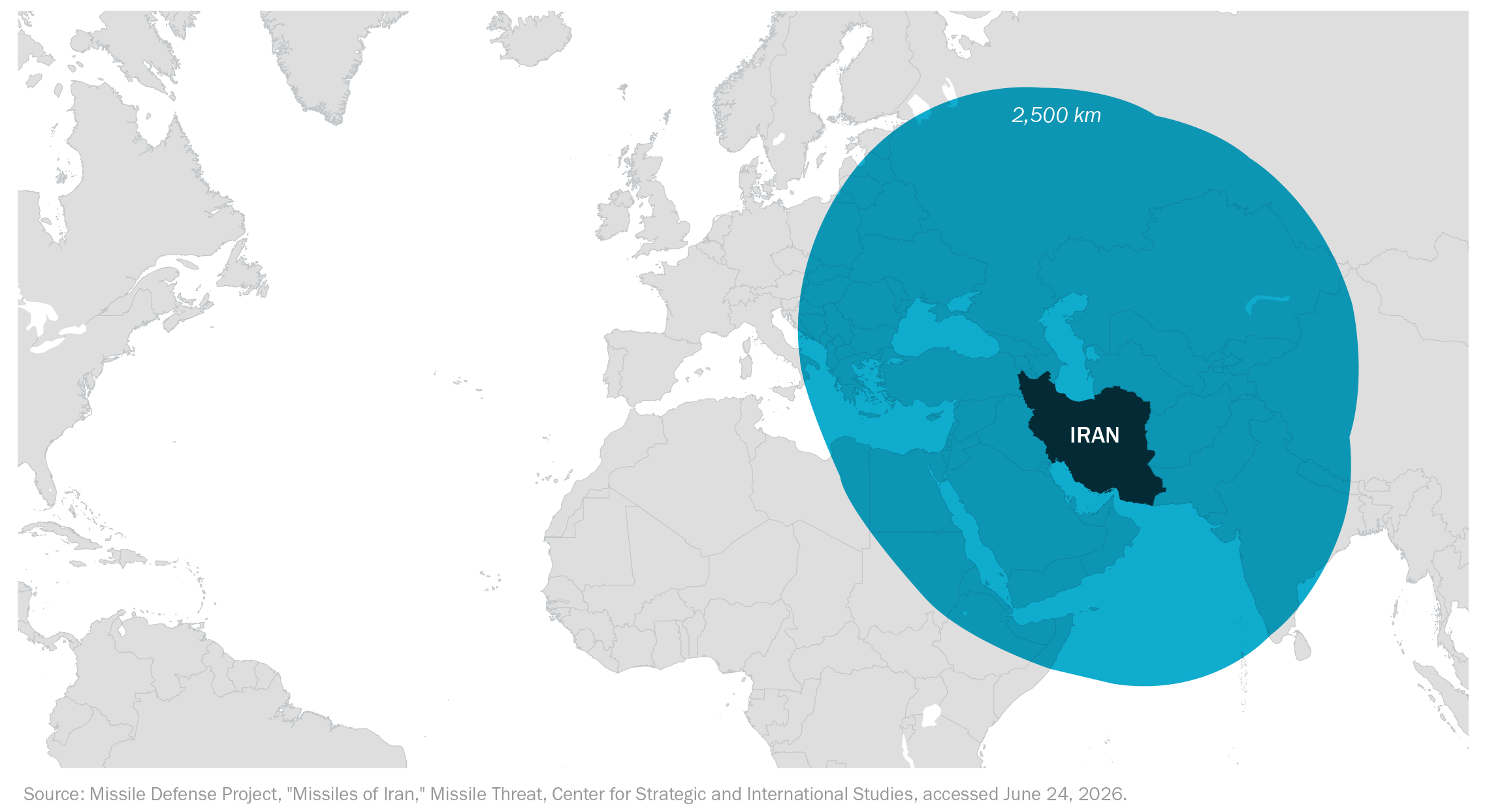
Iran’s missiles, with a maximum range of under 1,600 miles, cannot reach anywhere close to the United States homeland.
The damage to Iran’s missile and drone capabilities from Operation Epic Fury is unlikely to prove lasting. An estimated 70 percent of Iranian missile stockpiles and missile launchers survived the war, according to U.S. intelligence officials.57Adam Entous, Maggie Haberman, and Jonathan Swan, “U.S. Intelligence Shows Iran Retains Substantial Missile Capabilities,” New York Times, May 12, 2026, https://www.nytimes.com/2026/05/12/us/politics/iran-missiles-us-intelligence.html. The numbers are high because while U.S. airstrikes collapsed the entrances to deeply buried Iranian “missile cities,” they could not effectively destroy them. Iran has since unearthed these facilities with simple bulldozers and dump trucks—a stark illustration of the unfavorable cost-exchange ratio that has haunted U.S. military efforts throughout the conflict, whereby Iran can defeat million- or billion-dollar U.S. capabilities through inexpensive means.58“Iran Is Quickly Unearthing Its Huge Missile Arsenal, CNN Analysis Shows,” CNN, May 27, 2026, https://www.cnn.com/2026/05/27/world/video/investigates-iran-unearths-missile-arsenal-digvid.
U.S. airstrikes also targeted Iran’s four major missile production sites, but the extent of the damage is difficult to independently assess, and Israeli intelligence suggests Iran’s missile industry could be repaired within several months to a year.59Missy Ryan, Joby Warrick, and Samuel Oakford, “Four of Iran’s Key Ballistic Missile Manufacturing Locations and at Least 29 Ballistic Missile Launch Sites Have Been Damaged,” Washington Post, March 29, 2026, https://www.washingtonpost.com/investigations/2026/03/29/iran-ballistic-missile-sites/; Ailin Vilches Arguello, “Iran Reportedly Restarts Key Missile Production, Potentially Rebuilding Strike Capabilities Within Months,” Algemeiner, May 26, 2026. https://www.algemeiner.com/2026/05/26/iran-reportedly-restarts-key-missile-production-potentially-rebuilding-strike-capabilities-within-months/. Iran has already begun rebuilding its drone and missile manufacturing and has moved more quickly than expected, according to U.S. intelligence.60Natasha Bertrand, Katie Bo Lillis, and Oren Liebermann, “Iran Rebuilding Military Industrial Base Faster Than Expected, Already Producing Drones, According to U.S. Intel,” CNN, May 21, 2026, https://www.cnn.com/2026/05/21/politics/iran-military-rebuild.
An odious regime is more entrenched
U.S. policymakers have long decried the thuggish nature of Iran’s regime, and President Trump is no exception. After the January 2026 crackdown on anti-government protesters that killed thousands, Trump called on the Iranians to depose their government, and upon announcement of the Iran war, he expressed hope that the regime would be toppled.61Remarks on the U.S. Military Operations Against Iran”; “Address to the Nation on Iran.”
Iranian government repression is morally reprehensible and deserves condemnation, but it is not a threat to the United States. While Americans sympathize with the plight of the Iranian people, it is not a U.S. responsibility to fight wars for better governance in other countries, and U.S. efforts to support the Iranian opposition are more likely to hurt than to help.62Rosemary Kelanic, “Bombing Iran Would Shore Up Its Regime,” Defense One, January 22, 2026, https://www.defenseone.com/ideas/2026/01/bombing-iran-would-shore-its-regime/410868/.
In fact, the war appears to have bolstered the regime—a result as perverse as it was predictable.63Danny Citrinowicz, “How the War Saved the Iranian Regime,” Foreign Affairs, April 29, 2026, https://www.foreignaffairs.com/iran/how-war-saved-iranian-regime. Political scientists have long argued that external threats increase the durability of regimes through rally-around-the-flag effects that strengthen internal cohesion and discredit reformers. That same dynamic showed up in Iran. One of the regime’s justifications for cracking down on dissidents was the claim that the U.S. and Israel were covertly orchestrating the protests—a suspicion that comments by President Trump later seemed to confirm.64Simon Speakman Cordall, “Iran Accuses Foreign Intelligence of Being Behind Protest Movement,” Al Jazeera, January 14, 2026, https://www.aljazeera.com/news/2026/1/14/iran-accuse-foreign-intelligence-behind-protest-movement; Shola Lawal, “Has Trump Confirmed Iran’s Claim That Protestors Were U.S.-Armed?” Al Jazeera, April 6, 2026, https://www.aljazeera.com/news/2026/4/6/has-trump-confirmed-irans-claim-that-protesters-were-us-armed
More broadly, it would be misguided to assume that Iran would become friendlier to Washington if it democratized. Iran’s foreign policy is a straightforward reflection of its harsh security environment, not its internal character. The country’s history, geography, and military weakness would predispose any Iranian regime—even a democratic one—toward fearing U.S. intentions.
Iranian distrust of the United States reflects a long history of U.S. intervention in Iranian and Middle Eastern politics. The CIA orchestrated a coup that overthrew Iran’s democratically elected leader, Mohammad Mossadeq, in 1953 after his nationalization of the Iranian petroleum industry—an episode well known among ordinary Iranians. Over the past 25 years, Washington has invaded and occupied two of Iran’s neighbors (Iraq and Afghanistan), armed and supported regional rivals like Saudi Arabia and Israel, and retained permanent U.S. standing forces in the region some 40,000 troops strong. The U.S. has launched unprovoked military operations against Iran twice in 12 months, both times during ongoing negotiations and without being attacked first. That history nearly guarantees that any organically developed Iranian regime would view the U.S. with deep suspicion.
Even if the U.S. managed to forcibly install a new regime—a costly and risky action that would require large numbers of U.S. ground forces—the chances of a better outcome are small. Robust scholarship shows that foreign-imposed regime change seldom produces stable or compliant governments.65Alexander B. Downes and Lindsey A. O’Rourke, “You Can’t Always Get What You Want: Why Foreign-Imposed Regime Change Seldom Improves Interstate Relations,” International Security 41, no. 2 (Fall 2016): 43–89 Moreover, new democracies and nations still in the process of democratization often behave more aggressively than countries with settled political regimes.66Edward D. Mansfield and Jack Snyder, “Democratization and the Danger of War,” International Security 20, no. 1 (Summer 1995), 5–38
A newly realized problem: Hormuz
The war did not just fail to remove the capabilities associated with Iran’s threats—it created a new problem. Iran’s leverage over the Strait of Hormuz, previously latent, has now been vividly demonstrated, and there is no viable military solution to reverse it.
This leverage is a product of geography, guerrilla tactics, risk aversion by shippers, and prevailing military technology—especially the proliferation of inexpensive and precision-guided missiles and drones, which Iran can produce domestically in large quantities or procure from third-party countries like Russia and China. The conduct of the war so far has shown that Iran can effectively shut down Strait of Hormuz crossings if it attacks a few commercial vessels—not necessarily sinking or even disabling them. Hitting a few ships conveys a credible enough military threat that private shippers have refused to transit the waterway, grounding traffic to a halt.
Weekly arrivals through the Strait of Hormuz
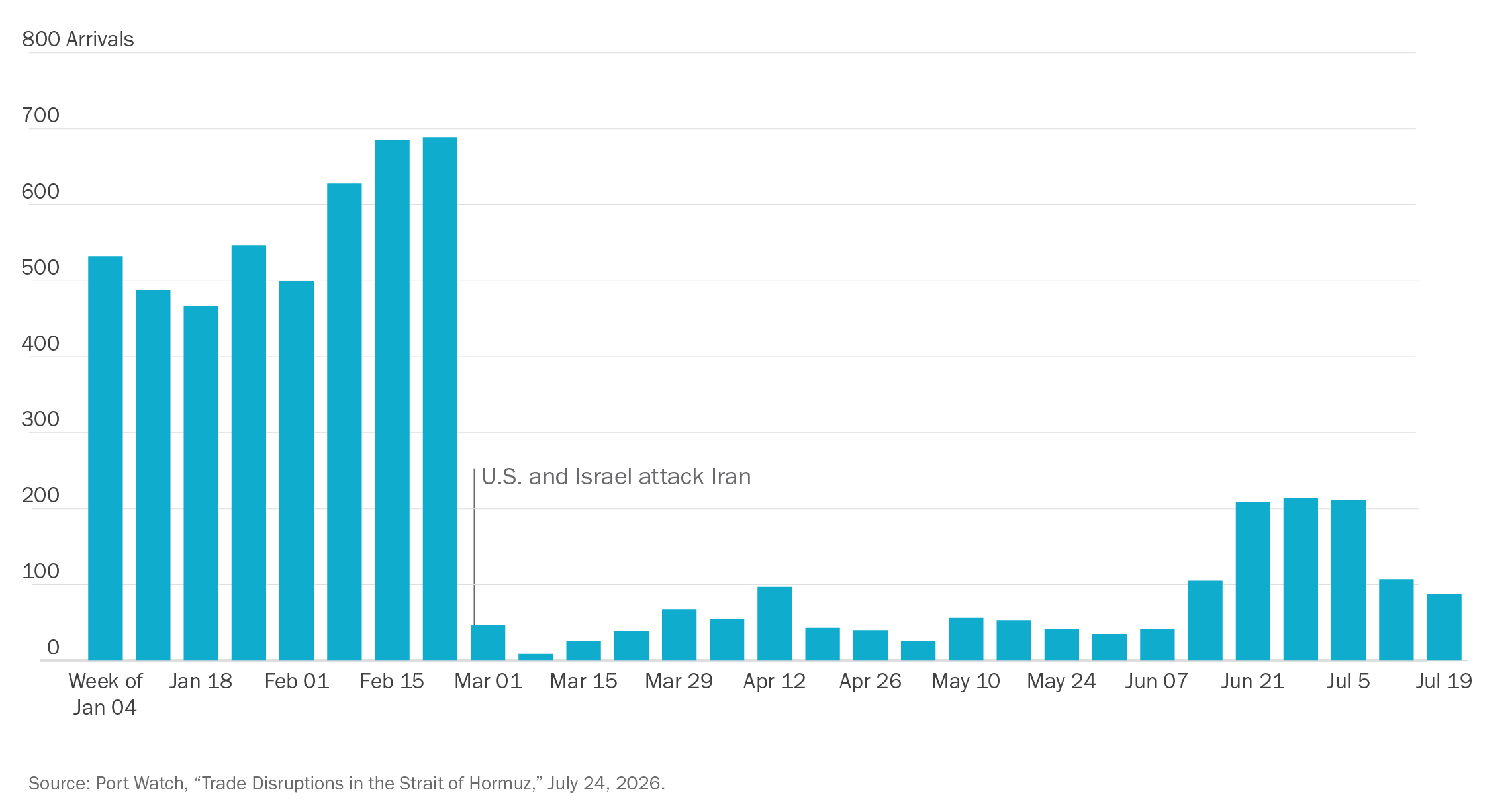
The Iran war has suppressed much of the shipping in the Strait of Hormuz, choking oil and natural gas shipments and creating the largest oil shock in history.
As long as commercial actors remain highly risk averse, the bar the U.S. military must meet to guarantee safe shipping will be set unrealistically high. Given the close-in environment of the rugged Iranian coastline, where mobile missile, drone, and attack boat launchers can hide, it is functionally impossible to attain 100 percent success in preventing Iranian ordnance from hitting ships. Most private industry players seem unwilling to risk the lives of seafarers or vessels costing hundreds of millions of dollars for less than perfect success. For instance, after tit-for-tat U.S.-Iran strikes and the apparent collapse of the MOU in early July, tanker transits through the strait again plummeted.67Jonathan Saul, “Oil Tanker Traffic Through Hormuz at Near Standstill as Attacks Strain Iran Truce,” Reuters, July 9, 2026, https://www.reuters.com/world/middle-east/oil-tanker-traffic-through-hormuz-near-standstill-attacks-strain-iran-truce-2026-07-09/.
Attempts by the U.S. military to protect tanker transits through the strait have been costly, risky, and unable to restore prewar levels of oil shipping. In early May, the Trump administration abandoned its highly public “Project Freedom” effort to guide ships through the Strait of Hormuz after barely two days, following an Iranian missile and drone barrage that spooked Saudi Arabia and Kuwait into refusing the use of their airspace and U.S. bases on their territories for the mission.68Jared Malsin, Costas Paris, Shelby Holliday and Rebecca Feng, “Inside ‘Project Freedom,’ Trump’s Aborted Bid to Reopen the Persian Gulf,” Wall Street Journal, May 7, 2026, https://www.wsj.com/world/middle-east/project-freedom-trump-iran-persian-gulf-ff02c827?msockid=150513ada7696ead11d5058ea6066f2e. Secret U.S. operations to smuggle oil out of the Persian Gulf with ship-to-ship transfers in May and June successfully moved about three million barrels per day over five weeks, but led to the downing of a U.S. Apache helicopter involved in the mission by an Iranian drone.69Peter Eavis, “Even with U.S. Help, Little Oil Has Gone Through Strait of Hormuz,” New York Times, June 13, 2026, https://www.nytimes.com/2026/06/13/business/oil-strait-of-hormuz.html; Feras Dalatey, Jonathan Saul, Dmitry Zhdannikov, and Edward Carron, “Exclusive: The U.S. is Using an Iranian Smuggling Tactic to Sneak Oil out of the Gulf,” Reuters, June 16, 2026, https://www.reuters.com/business/energy/us-is-using-an-iranian-smuggling-tactic-sneak-oil-out-gulf-2026-06-16/.
Iran is interested in monetizing its leverage by charging tolls for safe passage through the Strait of Hormuz. Iran gaining a new revenue source would be an unfortunate outcome of U.S. policy, but monetizing safe passage would incentivize it to allow as many ships as possible to pass through Hormuz unmolested. The tolls Iran has reportedly charged are modest—some $2 million per vessel, according to Lloyd’s List, or roughly a $1 per barrel premium on a Very Large Crude Carrier (VLCC) carrying two million barrels of oil.70“‘Zombie’ Tankers Take Tehran Toll Booth Route as More Vessels Make Detour,” Lloyd’s List, March 23, 2026, https://www.lloydslist.com/LL1156694/Zombie-tankers-take-Tehran-Toll-Booth-route-as-more-vessels-make-detour. The global economy can afford these tolls far more than the indefinite stoppage of traffic through the waterway.
Persian Gulf oil transit will likely become more expensive as markets price in a new standing risk premium, regardless of whether Iran charges tolls. But the importance of Iran’s leverage over Hormuz will wane over time. It is a wasting asset—meaning the more Iran uses it, the less potency it will have. Markets will adapt to higher prices and new levels of risk—rerouting, drawing on reserves, and, in the long run, shifting consumption away from oil as buyers turn to electric vehicles. The United States can use a variety of policy levers to speed that de-risking.71Rosemary Kelanic, “The Real U.S. Energy Security Problem—And How to Fix It,” Washington Quarterly 49, no. 1 (Spring 2026), 45–67. https://doi.org/10.1080/0163660X.2026.2639838 Much as the 1973 oil weapon ushered in a generation of energy efficiency gains that blunted its power, the Hormuz weapon will, over time, confront the same fate.
A worsened but manageable threat
The Trump administration’s rationales for war exaggerated the magnitude and imminence of the threats posed by Iran. The war did not solve the problems of Iran’s nuclear and missile programs, support for proxies, or regime brutality in any lasting way, and most likely made them worse because it was premised on deep misunderstandings going back decades and reinforced by the Trump administration. It aimed to treat the symptoms of the U.S.-Iran conflict rather than its deep causes, and it failed even at that.
Though the war backfired, the actual Iranian threat to the United States remains manageable. Iran’s military capabilities are limited and its control of Hormuz is far more likely to be used as a source of revenue for rebuilding the war-devastated Iranian economy than as a springboard for aggression.
Iran’s nuclear activities, missile capabilities, support for violent militant groups, and, to an extent, even the brutality of its regime are all symptoms of the same underlying condition—an intense security dilemma between the United States and Iran, which has impeded diplomacy for decades. Each of Iran’s capabilities was exaggerated by Trump, which is the predictable result of the United States also being a party to the security dilemma. The steps Iran took to make itself more secure made the U.S. feel less secure, even if irrationally so.
The rationales Trump put forward to justify war were not the deep causes of the U.S.-Iran conflict but merely its symptoms. The real cause was a misreading of the strategic situation—one that exaggerated the Iranian threat and mistook a strategy of asymmetric deterrence for a posture of aggression. More war will not fix that mistake. Instead, the U.S. needs to disengage from the conflict, even if it means that Iran imposes transit fees through the Strait of Hormuz. That is the cost of a foolish and failed war, but one the U.S. can live with.
Endnotes
- 1These countries are Israel, Iraq, Kuwait, Saudi Arabia, the UAE, Bahrain, Qatar, Oman, Jordan, Turkey, Cyprus, Azerbaijan, and Mauritius (Diego Garcia) ↩︎
- 2Merlyn Thomas, Alex Murray, and Matt Murphy, “Iran Attacks Damage 20 U.S. Military Sites since Start of War, Satellite Images Show,” BBC, June 1, 2026, https://www.bbc.com/news/articles/c2l2yl7r8r2o; Davis Winkie, “Iran War Casualty Count Eclipses 600 as Pentagon Quietly Changes Accounting,” CNN, July 27, 2026, https://www.cnn.com/2026/07/26/politics/iran-war-casualties. ↩︎
- 3Nick Turse, “We Called Out the Pentagon for Undercounting U.S. Casualties in Iran. They Keep Doing It,” The Intercept, April 8, 2026, https://theintercept.com/2026/04/08/us-military-casualties-wounded-iran-war/; “Trump Administration Withholds Iran War Costs but Wants Historic $441 Billion More for Defense,” MSNOW, April 21, 2026, https://www.ms.now/news/trump-administration-withholds-iran-war-costs-but-wants-historic-441-billion-more-for-defense. ↩︎
- 4Marium Ali, “How Many Ships Have Passed the Strait of Hormuz and How Many Were Attacked?” Al Jazeera, April 14, 2026, https://www.aljazeera.com/news/2026/4/14/how-many-ships-have-passed-the-strait-of-hormuz-and-how-many-were-attacked. ↩︎
- 5“Oil Market Report: March 2026,” International Energy Agency, March 2026, https://www.iea.org/reports/oil-market-report-march-2026. ↩︎
- 6“Oil Market Report.” ↩︎
- 7Andrew Ackerman and Federica Cocco, “Iran War Fuels Sharpest Inflation Spike in Nearly Three Years at 3.8 Percent,” Washington Post, May 12, 2026, https://www.washingtonpost.com/business/2026/05/12/iran-inflation-trump-oil-gas-prices/. ↩︎
- 8Mark F. Cancian and Chris H. Park, “Rebuilding U.S. Missile Inventory: A Multiyear Project,” Center for Strategic and International Studies, May 27, 2026, https://www.csis.org/analysis/rebuilding-us-missile-inventory-multiyear-project. ↩︎
- 9Greg Jaffe, “Hegseth Estimates Iran War Has Cost $37.5 Billion,” New York Times, July 21, 2026, https://www.nytimes.com/2026/07/21/us/politics/iran-war-cost-estimate.html. ↩︎
- 10“Why Is the War in Iran So Expensive?” interview with Linda Bilmes, Harvard Kennedy School, April 7, 2026, https://www.hks.harvard.edu/faculty-research/policy-topics/international-relations-security/why-war-iran-so-expensive. ↩︎
- 11Macdonald Amoah, Morgan D. Bazilian, and Jahara Matisek, “Scaling Patriot Production: The Industrial Base Crisis Explained,” Foreign Policy Research Institute, May 18, 2026, https://www.fpri.org/article/2026/05/scaling-patriot-production-the-industrial-base-crisis-explained/; Kim Barker, “Ukraine Helps U.S. Bases in the Mideast With Stopping Drones,” New York Times, March 9, 2026, https://www.nytimes.com/2026/03/09/world/middleeast/ukraine-shahed-drone-middle-east.html ↩︎
- 12Alexander Ward, Shelby Holliday, and Yoko Kubota, “Iran War Complicates Contingency Plans to Defend Taiwan, Some U.S. Officials Say,” Wall Street Journal, April 23, 2026, https://www.wsj.com/politics/national-security/iran-war-complicates-contingency-plans-to-defend-taiwan-some-u-s-officials-say-4384f7c1. ↩︎
- 13Vali Nasr, Iran’s Grand Strategy: A Political History (Princeton: Princeton University Press, 2025). ↩︎
- 14“Remarks on the U.S. Military Operations Against Iran,” Miller Center Presidential Speech Archive, February 28, 2026, https://millercenter.org/the-presidency/presidential-speeches/february-28-2026-remarks-us-military-operations-against-iran. ↩︎
- 15“Address to the Nation on Iran,” Miller Center Presidential Speech Archive, April 1, 2026, https://millercenter.org/the-presidency/presidential-speeches/april-1-2026-address-nation-iran. ↩︎
- 16Nasr, Iran’s Grand Strategy, 256–257. ↩︎
- 17Peace ‘Within Reach’ as Iran Agrees No Nuclear Material Stockpile: Oman FM,” Al Jazeera, February 28, 2026, https://www.aljazeera.com/news/2026/2/28/peace-within-reach-as-iran-agrees-no-nuclear-material-stockpile-oman-fm. ↩︎
- 18Tulsi Gabbard, “DNI Gabbard Opening Statement as Delivered to the HPSCI on the 2025 Annual Threat Assessmentof the U.S. Intelligence Community,” Office of the Director of National Intelligence, 2025, https://www.dni.gov/index.php/newsroom/congressional-testimonies/congressional-testimonies-2025/4061-ata-hpsci-opening-statement-as-delivered. ↩︎
- 19Lara Seligman and Michael R. Gordon, “Pentagon Says U.S. Strikes Delayed Iran’s Nuclear Program by Up to TwoYears,” Wall Street Journal, July 2, 2025, https://www.wsj.com/world/middle-east/pentagon-says-u-s-strike-delayed-irans-nuclear-program-by-up-to-two-years-8d51eb8 ↩︎
- 20Richard Hall and Rebecca Schneid, “Gabbard Says Iran Did Not Rebuild Nuclear Program After 2025 Strikes,” TIME, March 18, 2026, https://time.com/article/2026/03/18/tulsi-gabbard-iran-nuclear-trump/; Farnoush Amiri, “IAEA Chief Says Iran Isn’t Actively Enriching Uranium but Movement Detected near Stockpile,” Associated Press, October 29, 2025, https://www.pbs.org/newshour/world/iaea-chief-says-iran-isnt-actively-enriching-uranium-but-movement-detected-near-stockpile. ↩︎
- 21Fact Sheet: Uranium Enrichment—For Peace or for Weapons,” Center for Arms Control and Non-Proliferation, August 26, 2021, https://armscontrolcenter.org/uranium-enrichment-for-peace-or-for-weapons/. ↩︎
- 22Verification and Monitoring in the Islamic Republic of Iran in Light of United Nations Security Council Resolution 2231,” International Atomic Energy Agency, June 20, 2025, https://www.iaea.org/sites/default/files/25/06/gov2025-24.pdf; “IAEA Director General Grossi’s Statement to UNSC on Situation in Iran,” International Atomic Energy Agency, June 20, 2025, https://www.iaea.org/newscenter/statements/iaea-director-general-grossis-statement-to-unsc-on-situation-in-iran-20-june-2025. ↩︎
- 23IAEA’s December 6th Update on Iran,” Institute for Science and International Security, December 10, 2024, https://isis-online.org/isis-reports/iaeas-december-6th-update-on-iran. ↩︎
- 24Robert E. Kelley, “Why Is Iran Producing 60 Per Cent-Enriched Uranium?” Stockholm International Peace ResearchInstitute, April 29, 2021, https://www.sipri.org/commentary/essay/2021/why-iran-producing-60-cent-enriched-uranium. ↩︎
- 25Iran Nuclear Weapons Risk Rises After U.S.-Israel Attacks, IAEA Warns,” Bloomberg, June 3, 2026, https://www.bloomberg.com/news/articles/2026-06-03/iran-nuclear-risk-seen-higher-than-before-trump-attacks-began. ↩︎
- 26Sina Azodi, Iran and the Bomb: The United States, Iran, and the Nuclear Question (London: Bloomsbury Academic, 2026); Vali Nasr, Iran’s Grand Strategy, 231–232, 256–257. ↩︎
- 27Matthew Fuhrmann, “U.S. Allies and Adversaries Are Attempting Nuclear Deterrence Without Weapons—Will ItWork?” War on the Rocks, April 7, 2025, https://warontherocks.com/u-s-allies-and-adversaries-are-attempting-nuclear-deterrence-without-weapons-will-it-work/. ↩︎
- 28Gram Slattery, Jonathan Landay, and Erin Banco, “U.S. Intelligence Indicates Limited New Damage to Iran’s Nuclear Program, Sources Say,” Reuters, May 4, 2026, https://www.reuters.com/world/middle-east/us-intelligence-indicates-limited-new-damage-irans-nuclear-program-sources-say-2026-05-04/. ↩︎
- 29Samia Nakhoul, Parisa Hafezi, and Asif Shahzad, “Iran’s Guards Seize Wartime Power, Weakening Supreme Leader’s Role,” Reuters, April 28, 2026, https://www.reuters.com/world/asia-pacific/irans-guards-seize-wartime-power-blunting-supreme-leaders-role-2026-04-28/; Danny Citrinowicz, “How the War Saved the Iranian Regime,” Foreign Affairs, April 29, 2026, https://www.foreignaffairs.com/iran/how-war-saved-iranian-regime. ↩︎
- 30Julian E. Barnes, “Iran’s New Leader is More Open to Pursuing a Nuclear Weapon, U.S. Intelligence Says,” New York Times, July 24, 2026, https://www.nytimes.com/2026/07/24/us/politics/iran-nuclear-weapon.html. ↩︎
- 31Gregory D. Koblentz, “Saddam versus the Inspectors: The Impact of Regime Security on the Verification of Iraq’s WMD Disarmament,” Journal of Strategic Studies 41, no. 3 (2018): 372–409, https://doi.org/10.1080/01402390.2016.1224764. ↩︎
- 32Steven Ditto, “Iranian Suspicions About the IAEA,” Washington Institute for Near East Policy, March 21, 2014, https://www.washingtoninstitute.org/policy-analysis/iranian-suspicions-about-iaea. ↩︎
- 33“Address to the Nation on Iran.” “The Iranian Regime’s Decades of Terrorism Against American Citizens,” White House, March 2, 2026, https://www.whitehouse.gov/releases/2026/03/the-iranian-regimes-decades-of-terrorism-against-american-citizens/. ↩︎
- 34Mohsen M. Milani, Iran’s Rise and Rivalry with the U.S. in the Middle East (London: Oneworld Publications, 2025), 31–32. ↩︎
- 35Nasr, Iran’s Grand Strategy, 81 ↩︎
- 36Kyle Rempfer, “Iran Killed More U.S. Troops in Iraq Than Previously Known, Pentagon Says, ” Military Times, April 4, 2019, https://www.militarytimes.com/news/your-military/2019/04/04/iran-killed-more-us-troops-in-iraq-than-previously-known-pentagon-says/. ↩︎
- 37Ranj Alaaldin, “The Popular Mobilization Force is Turning Iranian Client State, ” Brookings, February 2, 2024, https://www.brookings.edu/articles/the-popular-mobilization-force-is-turning-iraq-into-an-iranian-client-state/; Rena Netjes and Samer al-Ahmad, “Iran is Attempting to Push the United States out of Syria via Hasaka Province,” Washington Institute, March 8, 2024, https://www.washingtoninstitute.org/policy-analysis/iran-attempting-push-united-states-out-syria-hasaka-province ↩︎
- 38Responsibility for the Khobar bombing is disputed. Some U.S. officials and analysts have blamed al-Qaeda for the attack, but most experts attribute it to Saudi Hezbollah, a group closely linked to Iran. Thomas Hegghammer, “Deconstructing the Myth about al-Qa`ida and Khobar,” CTC Sentinel 1, issue 3 (February 2008). The evidence ofIranian involvement has been sufficiently robust for U.S. courts to hold the Islamic Republic legally responsible for the bombing. Carol D. Leonnig, “Iran Held Liable in Khobar Attack,” Washington Post, December 23, 2006, http://washingtonpost.com/archive/politics/2006/12/23/iran-held-liable-in-khobar-attack-span-classbankheadjudge-orders-254-million-paymentspan/6a93eae4-7e03-4167-9cf8-c3b11f42d160/. ↩︎
- 39Hezbollah’s Record on War & Politics,” Wilson Center, October 25, 2023, https://www.wilsoncenter.org/article/hezbollahs-record-war-politics. ↩︎
- 40200 Foreigners, Dual Nationals Cut Down in Hamas Assault. Here’s Where They Were From,” Times of Israel, October 27, 2023, https://www.timesofisrael.com/200-foreigners-dual-nationals-cut-down-in-hamas-assault-heres-where-they-were-from/. ↩︎
- 41Susannah George, “Families of Children Killed in Strike on Iranian School Join Leader’s Funeral, ” Washington Post, July 5, 2026, https://www.washingtonpost.com/world/2026/07/05/families-children-killed-iran-school-bombing-join-leaders-funeral-tehran/ ↩︎
- 42United States v. Mohammad Baqer Saad Dawood Al-Saadi, Criminal Complaint no. 25-Mag-4425, Southern District of New York, May 15, 2026, Paragraph 8, https://www.justice.gov/usao-sdny/media/1440956/dl. ↩︎
- 43Iran Military Power, Defense Intelligence Agency, 2019, 23, https://www.dia.mil/portals/110/images/news/military_powers_publications/iran_military_power_lr.pdf. ↩︎
- 44Joshua Rovner, “After America: The Flow of Persian Gulf Oil in the Absence of U.S. Military Force,” in Charles L. Glaser and Rosemary A. Kelanic, eds., Crude Strategy: Rethinking the U.S. Military Commitment to Defend Persian Gulf Oil (Washington, DC: Georgetown University Press, 2016), 150–153. ↩︎
- 45Iran Military Power, 18. ↩︎
- 46The Military Balance 2025, International Institute for Strategic Studies (New York: Routledge, February 12, 2025), 34, 337, 344, 366. ↩︎
- 47Anthony H. Cordesman and Nicholas Harrington, “The Arab Gulf States and Iran: Military Spending, Modernization, and the Shifting Military Balance,” Center for Strategic and International Studies, December 12, 2018, https://www.csis.org/analysis/arab-gulf-states-and-iran-military-spending-modernization-and-shifting-military-balance. ↩︎
- 48Iran Military Power, 18, 25. ↩︎
- 49James T. Quinlivan, “Coup-Proofing: Its Practice and Consequences in the Middle East,” International Security 24, no. 2 (1999), 131–165 ↩︎
- 50Caitlin Talmadge, The Dictator’s Army: Battlefield Effectiveness in Authoritarian Regimes (Ithaca, NY: Cornell University Press, 2015), 16–17. ↩︎
- 51Talmadge, 236–237 ↩︎
- 52Saeid Golkar, “The Supreme Leader and the Guard: Civil-Military Relations and Regime Survival in Iran,” policy note 58, Washington Institute for Near East Policy, February 15, 2019, https://www.washingtoninstitute.org/policy-analysis/supreme-leader-and-guard-civil-military-relations-and-regime-survival-iran; Saeid Golkar, “Might the Islamic Revolutionary Guard Corps Use the Iranian Protests to Supplant the Ruling Clerical Establishment?” Carnegie Endowment for International Peace, January 19, 2023. https://carnegieendowment.org/middle-east/diwan/2023/01/might-the-islamic-revolutionary-guard-corps-use-the-iranian-protests-to-supplant-the-ruling-clerical-establishment. ↩︎
- 53Jassim al-Azzawi, “From Rust to Rockets: The Battle to Modernise Iran’s Legacy Air Force,” Middle East Monitor, August 1, 2025, https://www.middleeastmonitor.com/20250801-from-rust-to-rockets-the-battle-to-modernize-irans-legacy-air-force/; Anna Ahronheim, “Iran’s Air Force Receives Batch of Russian MiG-29s,” Jerusalem Post, September 24, 2025, https://www.jpost.com/defense-and-tech/article-868452; The Military Balance 2025, 313. ↩︎
- 54Al-Azzawi, “From Rust to Rockets”; David Rising and Sam Metz, “Iran’s Military Degraded by 12-Day War with Israel, but Still Has Significant Capabilities,” AP News, February 13, 2026, https://apnews.com/article/iran-israel-us-trump-military-carrier-war-931c25411eeef7d8cee679b3544b792a ↩︎
- 55Remarks on the U.S. Military Operations Against Iran.” ↩︎
- 56Daniel M. Gettinger and Clayton Thomas, “Iran’s Ballistic Missile Programs: Background and Context,” CRS In Focus IF13035.1, Congressional Research Service, June 17, 2025, https://www.congress.gov/crs_external_products/IF/PDF/IF13035/IF13035.1.pdf. ↩︎
- 57Adam Entous, Maggie Haberman, and Jonathan Swan, “U.S. Intelligence Shows Iran Retains Substantial Missile Capabilities,” New York Times, May 12, 2026, https://www.nytimes.com/2026/05/12/us/politics/iran-missiles-us-intelligence.html. ↩︎
- 58“Iran Is Quickly Unearthing Its Huge Missile Arsenal, CNN Analysis Shows,” CNN, May 27, 2026, https://www.cnn.com/2026/05/27/world/video/investigates-iran-unearths-missile-arsenal-digvid. ↩︎
- 59Missy Ryan, Joby Warrick, and Samuel Oakford, “Four of Iran’s Key Ballistic Missile Manufacturing Locations and at Least 29 Ballistic Missile Launch Sites Have Been Damaged,” Washington Post, March 29, 2026, https://www.washingtonpost.com/investigations/2026/03/29/iran-ballistic-missile-sites/; Ailin Vilches Arguello, “Iran Reportedly Restarts Key Missile Production, Potentially Rebuilding Strike Capabilities Within Months,” Algemeiner, May 26, 2026. https://www.algemeiner.com/2026/05/26/iran-reportedly-restarts-key-missile-production-potentially-rebuilding-strike-capabilities-within-months/. ↩︎
- 60Natasha Bertrand, Katie Bo Lillis, and Oren Liebermann, “Iran Rebuilding Military Industrial Base Faster Than Expected, Already Producing Drones, According to U.S. Intel,” CNN, May 21, 2026, https://www.cnn.com/2026/05/21/politics/iran-military-rebuild. ↩︎
- 61Remarks on the U.S. Military Operations Against Iran”; “Address to the Nation on Iran.” ↩︎
- 62Rosemary Kelanic, “Bombing Iran Would Shore Up Its Regime,” Defense One, January 22, 2026, https://www.defenseone.com/ideas/2026/01/bombing-iran-would-shore-its-regime/410868/. ↩︎
- 63Danny Citrinowicz, “How the War Saved the Iranian Regime,” Foreign Affairs, April 29, 2026, https://www.foreignaffairs.com/iran/how-war-saved-iranian-regime. ↩︎
- 64Simon Speakman Cordall, “Iran Accuses Foreign Intelligence of Being Behind Protest Movement,” Al Jazeera, January 14, 2026, https://www.aljazeera.com/news/2026/1/14/iran-accuse-foreign-intelligence-behind-protest-movement; Shola Lawal, “Has Trump Confirmed Iran’s Claim That Protestors Were U.S.-Armed?” Al Jazeera, April 6, 2026, https://www.aljazeera.com/news/2026/4/6/has-trump-confirmed-irans-claim-that-protesters-were-us-armed ↩︎
- 65Alexander B. Downes and Lindsey A. O’Rourke, “You Can’t Always Get What You Want: Why Foreign-Imposed Regime Change Seldom Improves Interstate Relations,” International Security 41, no. 2 (Fall 2016): 43–89 ↩︎
- 66Edward D. Mansfield and Jack Snyder, “Democratization and the Danger of War,” International Security 20, no. 1 (Summer 1995), 5–38 ↩︎
- 67Jonathan Saul, “Oil Tanker Traffic Through Hormuz at Near Standstill as Attacks Strain Iran Truce,” Reuters, July 9, 2026, https://www.reuters.com/world/middle-east/oil-tanker-traffic-through-hormuz-near-standstill-attacks-strain-iran-truce-2026-07-09/. ↩︎
- 68Jared Malsin, Costas Paris, Shelby Holliday and Rebecca Feng, “Inside ‘Project Freedom,’ Trump’s Aborted Bid to Reopen the Persian Gulf,” Wall Street Journal, May 7, 2026, https://www.wsj.com/world/middle-east/project-freedom-trump-iran-persian-gulf-ff02c827?msockid=150513ada7696ead11d5058ea6066f2e. ↩︎
- 69Peter Eavis, “Even with U.S. Help, Little Oil Has Gone Through Strait of Hormuz,” New York Times, June 13, 2026, https://www.nytimes.com/2026/06/13/business/oil-strait-of-hormuz.html; Feras Dalatey, Jonathan Saul, Dmitry Zhdannikov, and Edward Carron, “Exclusive: The U.S. is Using an Iranian Smuggling Tactic to Sneak Oil out of the Gulf,” Reuters, June 16, 2026, https://www.reuters.com/business/energy/us-is-using-an-iranian-smuggling-tactic-sneak-oil-out-gulf-2026-06-16/. ↩︎
- 70“‘Zombie’ Tankers Take Tehran Toll Booth Route as More Vessels Make Detour,” Lloyd’s List, March 23, 2026, https://www.lloydslist.com/LL1156694/Zombie-tankers-take-Tehran-Toll-Booth-route-as-more-vessels-make-detour. ↩︎
- 71Rosemary Kelanic, “The Real U.S. Energy Security Problem—And How to Fix It,” Washington Quarterly 49, no. 1 (Spring 2026), 45–67. https://doi.org/10.1080/0163660X.2026.2639838 ↩︎
Author

More on Middle East