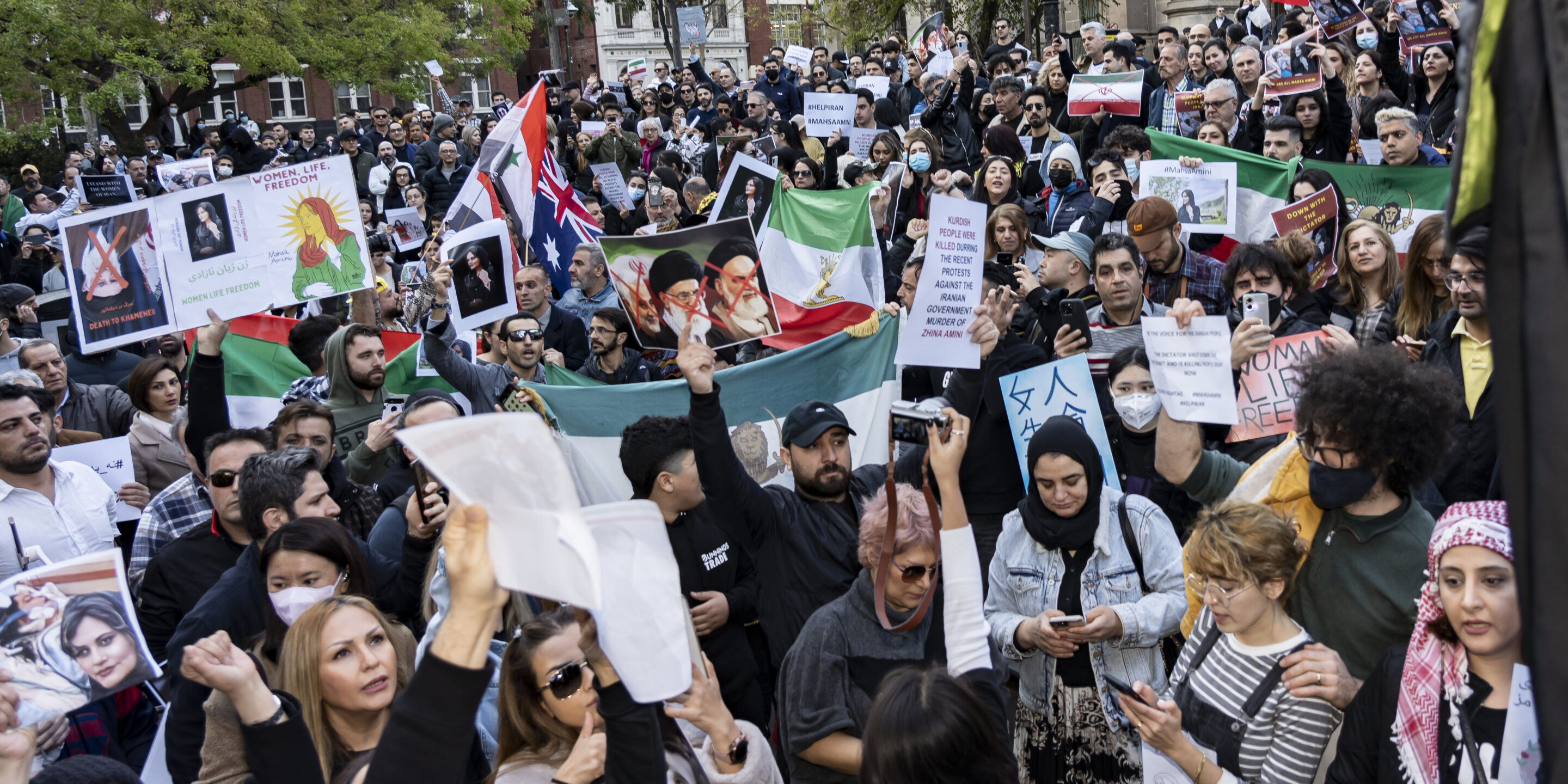
In recent weeks, Iran has been shaken by the largest protests the country has seen in decades. The regime has responded with a predictably draconian crackdown, killing thousands and arresting over 10,000. Meanwhile, President Trump has threatened military action against Iran’s government if it continues to respond with force.
In this DEFP Q&A, Middle East Program Director Rose Kelanic discusses what’s driving these protests, how U.S. strikes on Iran would affect American interests, and how the U.S. should respond to the unfolding situation. (This interview has been lightly edited for clarity.)
What’s driving these protests?
Kelanic: The protests are being driven fundamentally by economic weakness in Iran coupled with the government’s severe mismanagement of the economic crisis. Iran’s currency has crashed in recent weeks. That means that everybody’s money is worth a lot less. We’ve had droughts and severe water mismanagement in the capital, and we’ve also seen that people are fed up with a regime that can’t protect them. One of the grievances of the protesters is the fact that the regime was unable to prevent Israel or the United States from attacking Iran earlier this year. So it’s really a broad-based set of reasons why they’re rebelling.
What is President Trump aiming to accomplish by threatening, or even initiating, military force against Iran? How would it advance U.S. interests?
Kelanic: It’s a great question, and Trump has not been clear at all about his objectives. He’s essentially said things like “Help is on the way” for the protesters, but very little beyond that. Unfortunately, he’s not taken the case to the American people to give us a strategic narrative for why force is necessary. But it seems like this time around, Trump either wants to protect the protesters or simply wants the Iranian regime to fall. It’s not clear what the endgame is, but he has said that it’s about protecting the protesters.
That’s very different from what he said on the campaign trail and what he said for many years, which is that the United States is not supposed to be going into other countries trying to promote democracy. And this would be promoting democracy, in a sense—it would be promoting protesters’ ability to go out in the street and protest their government. It’s not a traditional “America first” strategy. It’s much closer to the neoconservative sorts of interventions that we’ve seen in the past.
Now, the goal could be something beyond that. There’s some sense that Trump might be trying to use this moment as leverage to get something out of Iran. So if Iran wants to avoid a U.S. attack, the argument goes, now is the time to come to the table and make a nuclear deal. But I don’t think it’s just a bargaining gambit. I think there’s something more to it than that.
Trump and Israeli Prime Minister Benjamin Netanyahu both have talked about Iranian missile threats to the region as a reason to strike Iran again. That’s not a threat to the United States because Iran can’t reach America with its missiles. But there’s some suggestion that maybe Trump really has it out for the regime. He may not think that he’s going to have a new regime come into power, but at the very least he could weaken the current one, or cause regime collapse.
What should the U.S. do instead?
Kelanic: I think a lot of Americans, myself included, are rooting for the protesters. I would love to see a peaceful democratic Iran, or at least just a peaceful Iran with a better regime in place. But there are questions about whether it’s in the United States’ interests to intervene to try to create that outcome, and whether our intervention could prove counterproductive to the protesters’ cause—which isn’t about U.S. strategic interests.
As much as I want things to work out for the people in Iran, it doesn’t mean it’s under the United States’ purview to ensure that we have better governance in places like Iran. Iran is a country where there is a long history of U.S. involvement that has not played out well for us in the end. There is a lot of resentment still over U.S. intervention in Iran in the 1950s and over our support for the Shah’s brutal regime.
The best thing for U.S. interests is to allow this to unfold organically and see what happens in Iran. If we bomb the regime, we risk making it more popular. It is a truism of international politics that there’s a “rally-around-the-flag” effect anytime a leader or regime gets attacked. The last thing we want to do is turn the protesters’ anger against us.
When you have social upheaval, you can have chaos. This could turn into some kind of civil war. It could turn into a long conflict, like we’ve seen in places like Libya or Syria. That’s not a direct threat to the United States, but it’s not good for a region where the U.S. has 40,000 troops, and it underlines the dangers of indefinitely stationing U.S. forces in the Middle East.
If the U.S. does strike Iran, the likelihood of retaliation is much higher than in the summer. Last summer, regime hardliners made the case that Iran had to strike back harder after the U.S. bombed Iranian nuclear facilities, that Iran’s telegraphed retaliation at the U.S. Al-Udeid Air Base in Qatar wasn’t enough to reestablish deterrence. Their argument will be strengthened by another attack. If we strike Iran, those hardliners are going to say to the Supreme Leader, “We told you we should have acted more strongly. So we have to act strongly now.”
Iran can’t directly threaten the United States, but they can attack our forces in the region, which include 2,500 troops in Iraq and another 1,000 in Syria that are not in big bases like Al-Udeid. They’re in these little outposts that don’t have the same kind of missile defense capabilities, and they are, frankly, vulnerable. The U.S. does need to be mindful of the possibility for retaliation. This, again, raises the questions, is this any of our business? Should the U.S. be using force in Iran? And I think the answer clearly is no.
Author

More on Middle East




Events on Iran