Defense Priorities Defense Priorities
  • Policy Topics
    • US-Israel-Iran
    • Ukraine-Russia
    • Western Hemisphere
    • NATO
    • China
  • Analysis
    • Policy Papers
    • Symposia
    • Q&A
    • Polls
    • Grand Strategy Explained
    • Target Taiwan
  • Programs
    • Grand Strategy Program
    • Military Analysis Program
    • Asia Program
    • Middle East Program
  • Experts
  • Events
  • Media
  • About
    • Mission & Vision
    • People
    • Jobs
    • Contact
  • Donate
Select Page
Home / China / Trump-Xi summit should build on ‘constructive strategic stability’ framework
China, Asia, Diplomacy

September 23, 2026

Trump-Xi summit should build on ‘constructive strategic stability’ framework

By Lyle Goldstein

FOR IMMEDIATE RELEASE:
September 23, 2026
Contact: press@defensepriorities.org

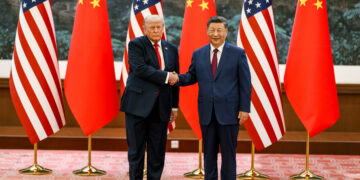
WASHINGTON, DC—Today, Chinese President Xi Jinping arrived in Washington to meet with President Donald Trump for a multi-day summit. Lyle Goldstein, senior fellow & director of the Asia Program at Defense Priorities, issued the following statement in response:

“President Donald Trump’s meeting with Chinese President Xi Jinping in Washington on Thursday is a good thing, especially if it leads to a broader diplomatic engagement between the two superpowers.

“Personal diplomacy between the two leaders in their past meeting has helped stabilize the U.S.-China economic relationship and reduce military tensions, partly by broaching the sensitive issue of Taiwan. The main task ahead is to further the bilateral ‘constructive strategic stability’ that was agreed upon in Beijing back in May. That engagement should center on five points.

“These multi-day U.S.-China summits should be held annually.

“U.S. and Chinese leaders should move more ambitiously in the trade realm, embracing synergistic growth as a way to reduce tension.

“The U.S. and China should have continuous dialogue about sensitive global flashpoints, like Iran. President Trump should recognize that Beijing both wants the Strait of Hormuz open to trade and leverage its influence to help craft a diplomatic settlement.

“The countries should discuss ways to reduce tension over Taiwan, with a shift in U.S. military posture part of the discussion.

“The U.S. and China should explore whether progress on Taiwan could lead to agreements on strategic nuclear weapons.”

Author

Photo of Lyle Goldstein

Lyle
Goldstein

Director, Asia Program

Defense Priorities

More on China

In the mediaChina, Asia, China‑Taiwan

AI, Trade, Taiwan—Here’s What To Expect From The Trump-Xi DC Summit: Expert

Featuring Lyle Goldstein

September 21, 2026

In the mediaChina, Asia

Could mystery Shanghai vessel be a mothership for China’s underwater drones?

September 18, 2026

In the mediaChina, Asia, Naval power

U.S. Marine Stand-In Forces in the Pacific worry China, report details

Featuring Lyle Goldstein

September 15, 2026

In the mediaChina‑Taiwan, Asia, Basing and force posture, China, Military analysis

Trump and ‘strategic ambiguity’ over Taiwan

Featuring Jennifer Kavanagh

September 14, 2026

In the mediaChina‑Taiwan, Asia, Basing and force posture, China, Military analysis

Trump’s relations with China

Featuring Jennifer Kavanagh

September 13, 2026

Op-edChina, Asia

How President Donald Trump’s summit with China’s Xi Jinping can yield dividends

By Lyle Goldstein

September 13, 2026

Events on China

See All Events
virtualGreat power competition, Balance of power, China, Grand strategy, Middle East

U.S.-China competition and the value of Middle East influence

June 10, 2025
virtualChina, Alliances, Balance of power, Diplomacy, Grand strategy, Russia

China-Russia: Cooperation or a no-limits alliance?

April 3, 2025
virtualAsia, Basing and force posture, Burden sharing, China, Grand strategy

Rethinking U.S. strategy in East Asia: do more bases mean more deterrence?

January 24, 2024

Receive expert foreign policy analysis

Join the hub of realism and restraint

Expert updates and analysis to enhance your understanding of vital U.S. national security issues

Defense Priority Mono Logo

Our mission is to inform citizens, thought leaders, and policymakers of the importance of a strong, dynamic military—used more judiciously to protect America’s narrowly defined national interests—and promote a realistic grand strategy prioritizing restraint, diplomacy, and free trade to ensure U.S. security.

Defense Priorities Foundation is a 501(c)(3) non-profit organization supported entirely by American individuals and foundations—no funding comes from the United States government or any foreign government.

  • Experts
  • Papers
  • Symposia
  • Q&A
  • Polls
  • Events
  • Media
  • Terms and Conditions
  • Privacy Policy
  • About
  • Jobs
  • Contact
  • Donate
© 2026 Defense Priorities Foundation. All rights reserved.