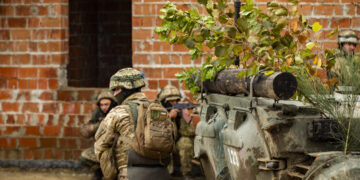
In a forest somewhere between Kyiv and the front line, nine men are learning how to stay alive. They are literal graybeards; all of them look older than 40, if not 50. Under the watchful eyes of a mixed team of army instructors and civilian volunteers, the men execute a “drunk drill.” Rifles elevated skyward, they spin slowly in circles. When they are sufficiently dizzy and disoriented (in order to simulate head wounds), a sharp command drops them to the ground, where they each scramble to apply a tourniquet to one of their limbs.
This is one of dozens of tasks they will need to master to fight and survive on the deadly battlefields of the Donbas. Success at turning these civilians into soldiers is the hinge between victory and defeat in Ukraine.
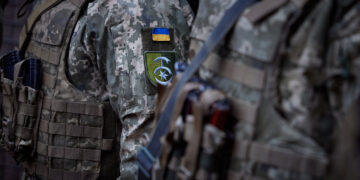
A few hours east of the training camp, in Kharkiv, a brigade mobilization officer tells me about finding the raw material to feed the training camps and then the frontline forces. His unit, though one of the most elite in the Armed Forces of Ukraine, now relies on conscripted soldiers for 80 percent of its manpower. Recruited volunteers and transfers of men who have gone SZCH (the Ukrainian acronym for AWOL, absent without official leave) from other brigades account for the remainder. At least 20 percent of the entire Ukrainian military is estimated to be SZCH at any given time.
Finding enough men to man the 1,200-kilometer front line is a ceaseless struggle for Ukraine. The country has more than ten million military-aged men but is struggling to keep an army of one million in the field. There is no meaningful reserve and no ability to give soldiers the clarity and hope of a fixed term of service. Ukraine’s soldiers are serving until death, severe wounds, or the war’s end. Many soldiers are exhausted after years of war without rest.
Author

Events on Ukraine-Russia