Defense Priorities Defense Priorities
  • Policy Topics
    • US-Israel-Iran
    • Ukraine-Russia
    • Western Hemisphere
    • NATO
    • China
  • Analysis
    • Policy Papers
    • Symposia
    • Q&A
    • Polls
    • Grand Strategy Explained
    • Target Taiwan
  • Programs
    • Grand Strategy Program
    • Military Analysis Program
    • Asia Program
    • Middle East Program
  • Experts
  • Events
  • Media
  • About
    • Mission & Vision
    • People
    • Jobs
    • Contact
  • Donate
Select Page
Home / China / Can the U.S. and China avoid a catastrophic clash?
China, Asia

September 4, 2024

Can the U.S. and China avoid a catastrophic clash?

By Daniel DePetris

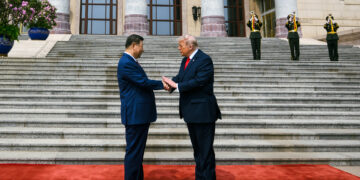
Last week, U.S. National Security Adviser Jake Sullivan travelled to China for a multi-day trip in an attempt to keep relations between Washington and Beijing on a somewhat even-keel as the United States prepares for a political transition in several months’ time.

The trip was notable in several respects. It was the first time in eight years that a U.S. national security adviser made the trip to Beijing, and Sullivan managed to grab a meeting with General Zhang Youxia, the Vice Chairman of the Central Military Commission. The mere fact that this specific meeting occurred, after a two-year freeze in communications with its military officials, suggests that China’s President Xi Jinping is as interested in maintaining stability over the proceeding months as the Biden administration is.

The readouts of the conversations don’t tell us much. On the U.S. side, the word of the day was “responsibility,” as in both superpowers have a responsibility to ensure the competition between them doesn’t veer into a conflict. While this phrase has taken on a robotic-like character over the years, it happens to be true.

The consequences of a direct U.S.-China conflict, either over Taiwan, the disputed shoals of the South China Sea or by sheer miscalculation, are unfathomable. One war-game conducted earlier in the year assessed that tens of thousands of U.S. service members would be lost in addition to dozens of ships and hundreds of aircraft. The economic repercussions would be just as gargantuan, with perhaps as much as 10 per cent of global gross domestic product wiped out.

Read at Lowy Institute

Author

Photo of Daniel DePetris

Daniel
DePetris

Fellow

Defense Priorities

More on Asia

Q&AAsia, China, Europe and Eurasia, Great power competition, Russia

How the U.S. pushes China and Russia together

By Lyle Goldstein

June 29, 2026

Op-edChina, Asia, Russia

The myth of a China-Russia axis

By Lyle Goldstein

June 26, 2026

Op-edChina, Asia, North Korea

The world should welcome Xi Jinping’s efforts to improve ties with North Korea

By Lyle Goldstein

June 17, 2026

ExplainerAlliances, Asia, China, Europe and Eurasia, Russia

Assessing the China-Russia quasi-alliance

By Lyle Goldstein

June 16, 2026

Op-edChina‑Taiwan, Asia, China

Trump Steps Back From the Brink on Taiwan

By Lyle Goldstein

June 2, 2026

Q&AIran, Asia, China, China‑Taiwan, Great power competition

Takeaways from Trump’s China Trip

By Lyle Goldstein

May 26, 2026

Events on China

See All Events
virtualGreat power competition, Balance of power, China, Grand strategy, Middle East

U.S.-China competition and the value of Middle East influence

June 10, 2025
virtualChina, Alliances, Balance of power, Diplomacy, Grand strategy, Russia

China-Russia: Cooperation or a no-limits alliance?

April 3, 2025
virtualAsia, Basing and force posture, Burden sharing, China, Grand strategy

Rethinking U.S. strategy in East Asia: do more bases mean more deterrence?

January 24, 2024

Receive expert foreign policy analysis

Join the hub of realism and restraint

Expert updates and analysis to enhance your understanding of vital U.S. national security issues

Defense Priority Mono Logo

Our mission is to inform citizens, thought leaders, and policymakers of the importance of a strong, dynamic military—used more judiciously to protect America’s narrowly defined national interests—and promote a realistic grand strategy prioritizing restraint, diplomacy, and free trade to ensure U.S. security.

  • Experts
  • Papers
  • Symposia
  • Q&A
  • Polls
  • Events
  • Media
  • Donate
  • About
  • Jobs
  • Contact
© 2026 Defense Priorities Foundation. All rights reserved.