Key points
- The United States’ false security promises to Ukraine over the past two decades increased Kyiv’s risk tolerance, helping to provoke and prolong the Ukraine war. This is a classic example of moral hazard.
- Before the Russian invasion, the U.S. pledge to make Ukraine a NATO member, its continuing support despite Ukraine’s failure to implement the Minsk accords, and its increasing armament and operational integration with Ukraine all inflamed Russian security concerns while giving Ukraine false hope of protection.
- After Russia’s initial assault on Ukraine was blunted, Ukraine and Russia were close to negotiating an end to the conflict. The United States encouraged Ukraine’s hopes they could get a better outcome if they continued fighting and grew ever more integrated into Ukrainian war-planning.
- As the war settled into a stalemate, the United States enabled Ukraine with arms and intelligence support as it made a series of ill-advised and costly offensives. This made Ukraine’s situation even more desperate and produced gambits that risked drawing the U.S. into the conflict.
- Had the United States not made these false security commitments, Ukraine would likely have avoided the heavy losses of life, territory, and wealth the war has entailed. This tragic experience offers sharp lessons to U.S. policymakers about the perils of making reckless pledges of support to countries they are ultimately unwilling to defend.
U.S. security relationships and moral hazard
Moral hazard is a recurring feature of the United States’ relationship with many of its allies and security partners. Since security dependents can pass their burden for defense onto the United States, and because the United States is especially powerful, it creates an incentive for dependents to act less prudently toward adversaries in their own backyard. These actions might include negligence—failing to mobilize the means to independently defend oneself, as in the case of Taiwan, Europe, or Japan—or recklessness—taking provocative actions or failing to conciliate neighbors, as in the case of Israel, Taiwan (again), or, indeed, Ukraine.
These relationships can expose the United States to risks that are out of balance with the interests it has at stake—particularly when it makes unconditional commitments to another state’s security or substitutes another state’s definition of security interests for its own—while also leaving the dependent country in the lurch.
The security relationship between the United States and Ukraine before and during the latter’s war with Russia has been an acute case of moral hazard in U.S. foreign policy. Washington’s false promises to protect Ukraine distorted Kyiv’s decision-making with regard to the threat posed by Russia, creating unnecessary risks for the United States while exposing Ukraine to enormous destruction.
This paper will start with an overview of moral hazard and reckless driving in general and as they apply to Ukraine. It will then demonstrate how Washington, starting with NATO’s 2008 Bucharest summit, has fed Ukraine false hope of protection from Russia, encouraging or enabling Kyiv to make misguided decisions up to and including in the present war. The conclusion it draws is that neither the United States nor its partners benefit from phony security promises; on the contrary, such promises put both the U.S. and its partners at great peril while obviating the need to forge political compromises with rivals, even when unsavory.
Moral hazard and reckless driving
“Moral hazard” is an economic term borrowed from the insurance industry. It refers, essentially, to a perverse incentive structure, whereby an actor’s decisions and behavior are distorted when they know they are insured by a third party. As economist Paul Krugman says, “[e]ventually the term came to refer to any situation in which one person makes the decision about how much risk to take, while someone else bears the cost if things go badly.”1Paul Krugman, The Return of Depression Economics (New York: W.W. Norton & Co., 2000), 66.
Political scientist Barry Posen has applied a similar concept called “reckless driving” to describe the perverse incentives facing allies or protectorates of the United States in their relations with others.2Barry R. Posen, Restraint: A New Foundation for U.S. Grand Strategy (Ithaca, NY: Cornell University Press, 2014), 44–50. If a state is confident that it will be protected by Uncle Sam if it gets into trouble with a more powerful neighbor, it may act more provocatively—or simply less prudently or accommodatingly—than it would were it alone responsible for its own security.
Though the general pattern of the U.S.-Ukraine security relationship reflects the logic of moral hazard, it has, in some ways, actually been worse, i.e. less rational, than the term suggests. For example, moral hazard usually assumes the insurer will pay to cover risk on behalf of the other party. Yet while the United States has certainly helped Ukraine with military and financial support, it has become clear that Washington is unwilling to take on too much risk for Ukraine and will therefore avoid directly fighting on its behalf. As outgoing President Barack Obama acknowledged in 2016:
The fact is that Ukraine, which is a non-NATO country, is going to be vulnerable to military domination by Russia no matter what we do… this is an example of where we have to be very clear about what our core interests are and what we are willing to go to war for.3Barack Obama, quoted by Jeffrey Goldberg, “The Obama Doctrine,” The Atlantic, April 2016, https://www.theatlantic.com/magazine/archive/2016/04/the-obama-doctrine/471525/.
Even after the United States increased its involvement in Ukraine following the Russian invasion in 2022, it has avoided direct intervention in the war to defend Ukraine when its existence is imperiled by Russia. As the guarantor of NATO, this makes the United States’ pledge to bring Ukraine into the alliance, and the risks it has been willing to run against Russia ever since, particularly vexing. It also raises the question of why Washington does not abandon commitments it has demonstrated it has no intention of keeping. The clear asymmetry of interests between the United States and Russia over Ukraine renders any insurance Washington might offer to Kyiv blatantly non-credible.4Benjamin H. Friedman, “Neutrality not NATO: Assessing Security Options for Ukraine,” Defense Priorities, July 12, 2023, https://www.defensepriorities.org/explainers/neutrality-not-nato-assessing-security-options-for-ukraine/; Jennifer Kavanagh and Christopher McCallion, “Armed Neutrality for Ukraine is NATO’s Least Poor Option,” War on the Rocks, February 18, 2025, https://warontherocks.com/armed-neutrality-for-ukraine-is-natos-least-poor-option/.
Moral hazard also usually assumes that the principal actor is confident enough in the insurer’s guarantee to act less risk-averse than it otherwise would. But given Washington’s clear determination to avoid bearing the final burden of ensuring Ukraine’s security and therefore its—predictable and logical—refusal to make good on its promises, Ukraine had little reason to be confident that Western pledges would ever be honored.
Were Kyiv’s decision-makers sober in acknowledging this fact, their behavior would most likely have been different. By virtue of its geography and the local balance of power, Ukraine would have had to swallow the bitter pill of modifying its foreign policy to assuage Russian concerns. Instead, Kyiv based its decisions in wishful thinking, choosing to believe that the West could be induced, in the fullness of time, to make good on its hollow promises.
There were understandable reasons for Ukrainians to fall into the trap of believing what they wanted to be the case. To many Ukrainians, the West seemed a more attractive economic, political, and cultural model than remaining in a Russian sphere of influence. Moreover, pre-existing Ukrainian nationalism and the hatred toward Russia stoked by the war make it difficult for any Ukrainian leader to forge a compromise with Putin and Moscow. The result, however, has been that Washington has encouraged an all-too-willing Ukraine to believe that it will ultimately have the full backing of NATO against Russia, when in reality they have been drawn into a disastrous war the United States, despite all its aid, cannot and will not rescue them from.
Hoping to force Washington to make good on its pledges, Kyiv has repeatedly taken actions since 2022 that have threatened to draw the United States and NATO more directly into the war, making the “reckless driving” problem more acute. These include Kyiv’s demands for a “no-fly zone,” use of U.S.-supplied weapons inside Russian territory, and attacks on Russian early-warning nuclear systems, as discussed later in this paper.
While the United States has sought to maintain a barrier between itself and direct engagement in the war, it has also been deeply integrated behind the scenes into battle-planning and targeting while providing most of the weaponry used by Ukraine. Yet, while at times the conflict has appeared like a NATO war fought with Ukrainian troops, the United States has little at stake and could back out at little cost. Ukraine cannot, and as a result, has been left holding the bag.
Prelude to the Ukraine crisis
The 2008 NATO pledge and the Russo-Georgian war
The origins of the Ukraine war can be traced back at least to the NATO summit in Bucharest in 2008, when the United States, against the objections of France and Germany, pushed for a declaration that Ukraine and Georgia would eventually become members of the alliance. By pledging to become the patron of Ukraine and Georgia, the United States distorted both countries’ decisions—making them more risk-acceptant than they would otherwise be—while also provoking Russia.
High-ranking members of the Bush administration knew this was a bridge too far, but the initiative continued anyway. As Secretary of Defense Robert Gates later stated:
Trying to bring Georgia and Ukraine into NATO was truly overreaching…. Were the Europeans, much less the Americans, willing to send their sons and daughters to defend Ukraine or Georgia? Hardly. So NATO expansion was a political act, not a carefully considered military commitment, thus undermining the purpose of the alliance and recklessly ignoring what the Russians considered their own vital national interests.5Robert M. Gates, Duty: Memoirs of a Secretary at War (New York: Alfred A. Knopf, 2014), 157–158.
Ambassador to Russia William Burns—later CIA director during the Biden administration and the first years of the Ukraine war—said in a memo at the time:
Ukrainian entry into NATO is the brightest of all red lines for the Russian elite (not just Putin). In more than two and a half years of conversations with key Russian players, from knuckle-draggers in the dark recesses of the Kremlin to Putin’s sharpest liberal critics, I have yet to find anyone who views Ukraine in NATO as anything other than a direct challenge to Russian interests.6William J. Burns, The Back Channel: A Memoir of American Diplomacy and the Case for Its Renewal (New York: Random House, 2019), 233.
Burns also cabled Washington to say:
Experts tell us that Russia is particularly worried that the strong divisions in Ukraine over NATO membership, with much of the ethnic-Russian community against membership, could lead to a major split, involving violence or at worst, civil war. In that eventuality, Russia would have to decide whether to intervene; a decision Russia does not want to have to face.7Ambassador William J. Burns, “Nyet Means Nyet: Russia’s NATO Enlargement Redlines,” Wikileaks Diplomatic Cable: 08MOSCOW265_a, February 1, 2008, https://web.archive.org/web/20220225001758/https://wikileaks.org/plusd/cables/08MOSCOW265_a.html.
For his part, Russian President Vladimir Putin, attending the NATO summit, reportedly warned Western leaders: “If Ukraine joins NATO, it will do so without Crimea and the eastern regions.”8Mikhail Zygar, All the Kremlin’s Men: Inside the Court of Vladimir Putin (New York: Public Affairs, 2016), 154.
Only four months after it was declared at Bucharest that Ukraine and Georgia would join NATO, the 2008 Russo-Georgian War offered a striking precedent for the moral hazard problem which later would fuel the Ukraine conflict. The Western-friendly Georgian President Mikheil Saakashvili provoked a foolish confrontation with Russia over the separatist enclaves of South Ossetia and Abkhazia, apparently believing the United States and NATO would back him up.9Paul J. Saunders, “Georgia’s Recklessness,” Washington Post, August 15, 2008, https://www.washingtonpost.com/wp-dyn/content/article/2008/08/14/AR2008081403053.html. Russia had been seeking a pretext to make an example of Georgia in the wake of the Bucharest pledge by NATO and the United States’ backing of Kosovar independence. Gates later said, “[t]he Russians had baited a trap, and the impetuous Saakashvili walked right into it.”10Gates, Duty, 168.
In August 2008, Saakashvili launched an artillery assault on the South Ossetian capital Tskhinvali, providing the Russians the pretext they’d been preparing for.11Heidi Tagliavini, et al., “Independent International Fact-Finding Mission on the Conflict in Georgia, ”Council of the European Union, September 2009, https://www.echr.coe.int/documents/d/echr/hudoc_38263_08_Annexes_eng,10–11 As a result, the Russians steamrolled the Georgians and came within 40 miles of the capital Tbilisi. Georgia effectively surrendered and Moscow declared the independence of the enclaves under Russian protection, citing the recent precedent set by NATO earlier that year in Kosovo and revenging what the Kremlin saw as yet another Western overreach.12Thomas de Waal, The Caucasus: An Introduction (New York: Oxford University Press, 2010), 194–224; Mark Ames, “The War We Don’t Know,” The Nation, August 13, 2008, https://www.thenation.com/article/archive/war-we-dont-know/;Gates, Duty, 167–170. Ironically, Saakashvili, by then disgraced and wanted within Georgia, was appointed in 2014 by Ukrainian President Poroshenko to be governor of Odessa, having been granted Ukrainian citizenship a day before taking office.
Needless to say, the United States did not fight a war with Russia in 2008 to defend Georgia, demonstrating that the pledge to do so only months before was predictably hollow. This outcome presumably was part of the point the Russians were trying to make. Since 2008, Georgia’s path to NATO membership has been stalled, while Tbilisi has increasingly sought to conciliate Moscow.13Maria Katamadze, “What Happened with Georgia’s NATO Ambitions?,” DW, July 12, 2023, https://www.dw.com/en/what-happened-with-georgias-nato-ambitions/a-66190054; Beka Chedia,“Georgian Dream Moves Away from North Atlantic Treaty Organization Aspirations,” Jamestown Foundation, June 18, 2025, https://jamestown.org/georgian-dream-moves-away-from-north-atlantic-treaty-organization-aspirations/.
The Russo-Georgian War should have been a cautionary tale to both Washington about Russia’s red lines and Kyiv about the United States’ unwillingness to risk a war with Russia over, at best, peripheral interests. The parallels with Russia’s later conflict with Ukraine over the separatist oblasts of Donetsk and Luhansk are particularly stark. As Gates put it, “plainly the Russians were… sending a warning to other governments in Central Asia (and Ukraine) about the risks of trying to integrate with NATO.”14Gates, Duty, 168.
The false confidence instilled in Georgia by the Bucharest pledge was a clear case of moral hazard. That it led them to defeat should have ended NATO’s courtship of Ukraine and Kyiv’s confidence in NATO. Unfortunately, this did not happen. As discussed below, the 2014 seizure of Crimea, the 2022 invasion of Ukraine, and absorption of the breakaway oblasts of Donetsk and Luhansk are all direct echoes of the 2008 Georgia war and the moral hazard engendered by false U.S. promises.
From Maidan to Minsk: failure to resolve a crisis
The Maidan revolution in 2013–4 turned the potential crisis caused in 2008 by the Bucharest pledge into a reality for Ukraine. The prospect of the new Ukrainian government’s economic and security integration with the West was front and center in the revolution itself, the subsequent Russian response, and the Minsk deal agreed to by Moscow and Kyiv—which was never implemented. By gradually increasing its military support for Ukraine over the subsequent years without encouraging Kyiv to implement the Minsk Accords, the United States and its allies allowed Ukraine to believe that a better military solution would be forthcoming. This ultimately set the conditions for the Russian invasion of Ukraine in 2022.
In late 2013, protests erupted in Ukraine against President Yanukovych’s withdrawal—under Russian pressure—from an association agreement with the EU. While the protestors who descended on Maidan wanted Ukraine to integrate with the West, the country as a whole, according to polling by the Kyiv International Institute of Sociology, was evenly divided on whether Ukraine should align more with the EU or Russia, with opinion split largely between the eastern and western regions.15“Which Way Ukraine Should Go – Which Union Should It Join? (Population Preferences for Two Weeks Before the Vilnius Summit),” Kyiv International Institute of Sociology, November 26, 2013, https://www.kiis.com.ua/?lang=eng&cat=reports&id=204&page=1&y=2013&m=11. The United States was considerably involved in supporting the Euromaidan movement, providing diplomatic and financial backing to the opposition.16Ukraine Crisis: Transcript of Leaked Nuland-Pyatt Call,” BBC News, February 7, 2014, https://www.bbc.com/news/world-europe-26079957; Victoria Nuland, “Remarks at the U.S.-Ukraine Foundation Conference,” Department of State, December 13, 2013, https://2009-2017.state.gov/p/eur/rls/rm/2013/dec/218804.htm; “Where We Work: Ukraine, 2013,”National Endowment for Democracy, archived July 29, 2014, https://web.archive.org/web/20140729005422/http://www.ned.org/where-we-work/eurasia/ukraine. While the Maidan events were catalyzed by Ukraine’s attempt to integrate into the EU—not NATO—the association agreement contained unmistakable security provisions, stipulating “convergence on foreign and security matters with the aim of Ukraine’s ever-deeper involvement in the European security area.”17“Association Agreement Between the European Union and Its Member States, of the One Part, and Ukraine, of the Other Part,” Title II, Article 4.1, May 29, 2014, https://web.archive.org/web/20220225010609/https://trade.ec.europa.eu/doclib/docs/2016/november/tradoc_155103.pdf, 161/7.
In a series of much-contested events, Yanukovich was forced out of power and into exile in February 2014. For Russia, the prospect of a new government in Kyiv intent on joining the EU and NATO—and taking the key Russian naval base at Sevastopol with it—was like waving a red flag in front of a bull. Days after Yanukovich was pushed out, Russian troops from Sevastopol occupied Crimea. Meanwhile, counterprotests in the eastern and southern regions of Ukraine that had supported Yanukovich were suppressed by the new government in Kyiv, leading to a civil war between the new government and separatist forces.18For a detailed account of Maidan and its aftermath, see Richard Sakwa, Frontline Ukraine: Crisis in the Borderlands (London: I.B. Tauris, 2015). The separatists held referendums for independence in Donetsk and Luhansk, which neither Ukraine nor Russia agreed to recognize.19For a detailed account of Maidan and its aftermath, see Richard Sakwa, Frontline Ukraine: Crisis in the Borderlands (London: I.B. Tauris, 2015). On the Donbas referendums, also see C.J. Chivers and David M. Herszenhorn, “Separatists Defy Kiev and Putin on Referendum,” New York Times, May 8, 2014, https://www.nytimes.com/2014/05/09/world/europe/ukraine.html.
With unofficial Russian support, the separatists had badly defeated Ukrainian forces by the beginning of 2015, forcing Ukrainian President Poroshenko to agree to the second Minsk agreement with Russia, sponsored by France and Germany.20Andrew Roth, “Details of the Ukraine Cease-Fire Negotiated in Minsk,” New York Times, February 12, 2015, https://www.nytimes.com/2015/02/13/world/europe/ukraine-cease-fire-negotiated-in-minsk.html; Neil Buckley and Roman Olearchyk, “Fierce Battle for Debaltseve Ends in Ukraine Withdrawal,” Financial Times, February 18, 2015, https://www.ft.com/content/470b14da-b785-11e4-981d-00144feab7de. Minsk II would have maintained Donetsk and Luhansk within Ukraine and given Kyiv back control over its eastern border, in exchange for greater autonomy and representation for the eastern regions within a federal, rather than unitary, Ukrainian state. For the Russians, this also served as a de facto veto against Ukrainian entry into NATO given the political representation the east of the country would gain.21Ukraine-Russia Crisis: What is the Minsk Agreement?” Al-Jazeera, February 9, 2022, https://www.aljazeera.com/news/2022/2/9/what-is-the-minsk-agreement-and-why-is-it-relevant-now.
Minsk II was never implemented either, however, leaving the crisis unresolved and sustaining the conditions leading to the 2022 Russian invasion. Within Ukraine, implementation of Minsk would have put leaders in Kyiv in the crosshairs of an empowered paramilitary far-right and might have provoked another upheaval. For example, when Poroshenko seemed to be moving ahead with a bill granting the Donbas more autonomy in 2015, violent far-right protests killed three and injured 140.22Ukraine Crisis: Third Death After Kiev Anti-Autonomy Rally,” BBC News, September 1, 2015, https://www.bbc.com/news/world-europe-34112881; Volodymyr Ischenko, “Ukraine’s government bears more responsibility for ongoing conflict than the far-right,” Guardian, September 4, 2015, https://www.theguardian.com/world/2015/sep/04/ukraine-government-svoboda-clashes-conflict. During the rest of his term, Poroshenko effectively slow-walked implementation of Minsk while holding out for future Western support.23Andreas Umland, “Poroshenko’s Line, the Minsk Agreement, and the Special Status for the Donbas,” Vox Ukraine, February 2, 2016, https://voxukraine.org/en/poroshenkos-line-the-minsk-agreement-and-the-special-status-for-the-donbas-en; Fred Weir, “Politics over Peace? Critics Say Ukraine’s President Sidelining Minsk Accords,” Christian Science Monitor, January 29, 2018, https://www.csmonitor.com/World/Europe/2018/0129/Politics-over-peace-Critics-say-Ukraine-s-president-sidelining-Minsk-accords In 2019, months before Poroshenko left office, the Ukrainian Rada inserted its intention to join NATO into the country’s constitution.24Steven Pifer, “NATO’s Ukraine Challenge,” Brookings Institution, June 6, 2019, https://www.brookings.edu/articles/natos-ukraine-challenge/.
Ukraine’s territorial losses at present
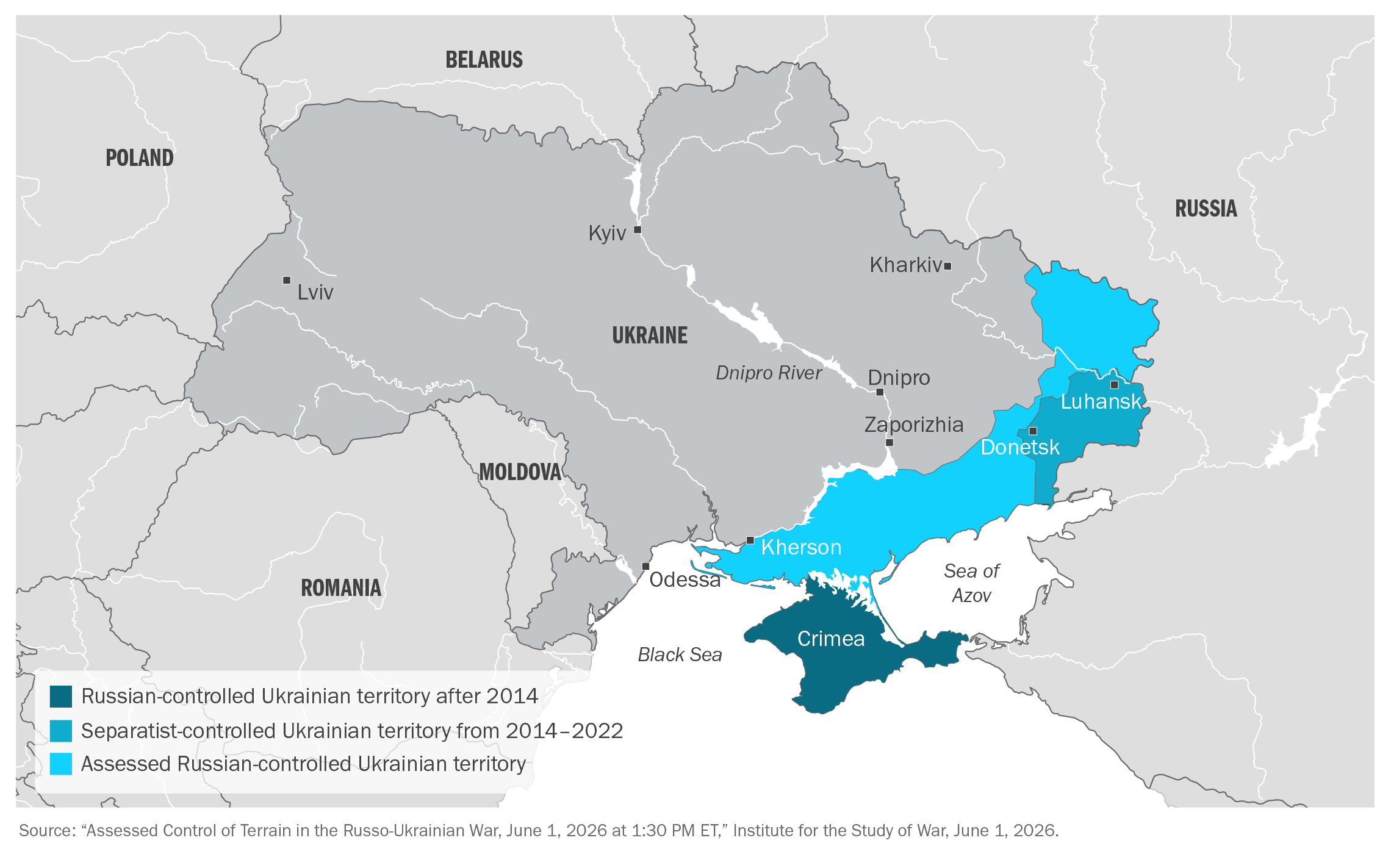
NATO’s attempts since 2008 to incorporate Ukraine have been detrimental to Ukraine’s security and sovereignty, leading to Russia’s annexation of Crimea in 2014 and invasion of Ukraine in 2022.
After Volodymyr Zelensky was elected with over 70 percent of the vote in 2019 on a platform of making peace with Russia, he too was obstructed and threatened by internal paramilitaries not to implement provisions of the deal disengaging forces, holding local elections, and giving amnesty to separatists.25Far-Right Groups Protest Ukrainian President’s Peace Plan,” Associated Press, October 14, 2019, https://www.latimes.com/world-nation/story/2019-10-14/ukraine-protest-zelensky-peace-plan; Oksana Grytsenko, ‘“I’m Not a Loser’: Zelensky Clashes with Veterans over Donbas Disengagement,” Kyiv Post, October 28, 2019, https://www.kyivpost.com/post/6652; Lilia Ragutskaya, “Yarosh: If Zelensky Betrays Ukraine, He Will Lose not His Position, but His Life,” Obozrevatel, May 27, 2019, https://incident-obozrevatel-com.translate.goog/crime/dmitrij-yarosh-esli-zelenskij-predast-ukrainu-poteryaet-ne-dolzhnost-a-zhizn.htm?_x_tr_sl=uk&_x_tr_tl=en&_x_tr_hl=en&_x_tr_pto=wapp. Like Poroshenko, Zelensky shifted his position, refusing to proceed with Ukraine’s obligations under the agreement until Russia withdrew and Ukraine regained control of its border, shifting the order of the deal’s provisions and effectively halting its progress.26Mykhailo Soldatenko, “In the Shadow of the Minsk Agreements: Lessons for a Potential Ukraine-RussiaArmistice,” Carnegie Endowment for International Peace,” February 10, 2025,https://carnegieendowment.org/research/2025/02/ukraine-russia-ceasefire-security-agreement. Only a month before the Russian invasion, Oleksiy Danilov, the Ukrainian Secretary of the National Security and Defense Council, said that the “fulfillment of the Minsk agreement means the country’s destruction” and that “it could lead to a very difficult internal situation.”27Yuras Karmanau, “Ukraine Security Chief: Minsk Peace Deal May Create Chaos,” Associated Press, January 31, 2022, https://apnews.com/article/russia-ukraine-russia-france-germany-europe-d9a2ed365b58d35274bf0c3c18427e81.
Yet even without Ukraine’s internal dynamics, there are doubts about whether the deal was ever intended to be implemented in the first place by Ukrainian leaders or their Western backers.28Luis Ramirez, “For Ukrainians, Minsk Agreements ‘Poison,’” Voice of America, March 2, 2016,https://www.voanews.com/a/for-ukrainians-minsk-agreements-are-poison/3216013.html. After Russia’s 2022 invasion was blunted, the three non-Russian signatories to Minsk—Poroshenko, former German Chancellor Angela Merkel, and former French President Francois Hollande—all claimed that the purpose of Minsk was to buy time for Ukraine to rebuild and rearm, not to resolve the conflict on the terms agreed with Moscow.29Tina Hildebrandt and Giovanni di Lorenzo, “”Hatten Sie Gedacht, ich Komme mit Pferdeschwanz?,” Die Zeit, December 7, 2022, https://www.zeit.de/2022/51/angela-merkel-russland-fluechtlingskrise-bundeskanzler/komplettansicht; Theo Prouvost, “Hollande: ‘There Will Only be a Way out of the Conflict When Russia Fails on the Ground,’” Kyiv Independent, December 28, 2022, https://kyivindependent.com/hollande-there-will-only-be-a-way-out-of-the-conflict-when-russia-fails-on-the-ground/; Kateryna Hodunova, “What Were the Minsk Agreements and Why Did They Fail to Bring Peace in Ukraine?,” Kyiv Independent, March 24, 2025, https://kyivindependent.com/what-were-the-minsk-agreements-and-why-did-they-fail-to-bring-peace-in-ukraine/.
While this may be a case of leaders rewriting history to appear less deferential to Russia, the fact remains that the failure of Kyiv and its Western backers to follow through on Minsk II meant the sources of the conflict would continue to fester. The U.S. and its allies, which imposed hundreds of sanctions designations after 2014, claimed sanctions would remain in place until Russia implemented its side of the Minsk deal.30Obama: Russia Sanctions Must Remain Until Moscow Complies with Minsk Deal,” Radio Free Europe/Radio Liberty, April 24, 2026, https://www.rferl.org/a/russia-ukraine-obama-merkel-sanctions-remain-until-minsk-deal/27693954.html; Francis Shin, “Sanctions by the Numbers: Spotlight on Russia,” Center for a New American Security, January 21, 2021, https://www.cnas.org/publications/reports/sanctions-by-the-numbers-russia But since Russia’s implementation was codependent on Ukraine’s implementation, continuing support for Ukraine while sustaining pressure on Russia meant the U.S. and Europe were effectively enabling Ukraine to avoid a resolution of the crisis.
Lead-up to war: Increasing U.S. security ties with Ukraine
In late 2017, the Trump administration began approving arms shipments to Ukraine, which the Obama administration had previously ruled out.31Michelle Kosinski and Ryan Browne, “US Will Provide Anti-Tank Weapons to Ukraine, State Dept. OfficialSays,” CNN, December 23, 2017, https://www.cnn.com/2017/12/22/politics/us-ukraine-anti-tank-weapons-russia. The arms increased Ukraine’s capabilities and cemented new security bonds with Washington—causing alarm in Moscow—even as Kyiv avoided a political settlement of the conflict. This gave Ukraine new false hope for a military solution in the future that deepened moral hazard.
Despite Trump’s supply of arms to Ukraine, the “Russiagate” affair turned Ukraine into a defining partisan issue in the United States, with Trump painted by Democrats as being suspiciously soft on Russia and insufficiently supportive of Ukraine. Democrats, meanwhile, increasingly identified the Kremlin as the central locus of both domestic and foreign dangers.32Rob Suls, “Share of Democrats Calling Russia ‘Greatest Danger’ to U.S. is at Its Highest Since End of Cold War,” Pew Research, April 20, 2017, https://www.pewresearch.org/short-reads/2017/04/20/share-of-democrats-calling-russia-greatest-danger-to-u-s-at-its-highest-since-end-of-cold-war/. Trump’s first impeachment was not simply prosecuted over the constitutional and legal issues raised by threatening to halt congressionally appropriated aid to Ukraine in order to target a domestic political rival; it was also advanced on the grounds that Trump had betrayed U.S. interests and values.33Zachary B. Wolf and Sean O’Key, “The Trump-Ukraine Impeachment Inquiry Report, Annotated,” CNN, December 3, 2019, https://www.cnn.com/interactive/2019/12/politics/trump-ukraine-impeachment-inquiry-report-annotated/. As House Intelligence Chairman Adam Schiff said during the impeachment proceedings, “The United States aids Ukraine and her people so that they can fight Russia over there, and we don’t have to fight Russia here.”34“Read Adam Schiff’s Opening Argument at Senate Impeachment Trial,” Politico, January 22, 2020, https://www.politico.com/news/2020/01/22/adam-schiff-opening-argument-trump-impeachment-trial-102202.
As a result of the increasingly partisan nature of the Ukraine issue, incoming President Joe Biden made clear upon his election at the end of 2020 that he would distinguish himself from his predecessor by increasing U.S. support for Ukraine and adopting a more confrontational attitude toward Putin.35Alex Ward, “Biden Had His First Call with Putin. He Said Everything Trump Wouldn’t,” Vox, January 26, 2021, https://www.vox.com/2021/1/26/22250858/biden-putin-call-election-ukraine-navalny-bounties-solarwinds; Alexandra Alper and Steve Holland, “Biden Tells Putin: U.S. no Longer ‘Rolling Over,’” Reuters, February 4, 2021, https://www.reuters.com/article/us-russia-usa-biden/biden-tells-putin-u-s-no-longer-rolling-over-idUSKBN2A42QZ; Vladimir Isachenkov and Matthew Lee, “US-Russia Ties Nosedive After Biden-Putin Tit-for-Tat,” Associated Press, March 18, 2021, https://apnews.com/article/putin-cites-us-ills-response-to-biden-remark-bf49dbdd1dd47dc90aba36a67b344727
Kyiv clearly saw Biden’s election as an opportunity to cement the U.S.-Ukraine security relationship. Zelensky, elected nearly two years before as the peace candidate, called shortly after Biden’s inauguration in 2021 for Ukraine to be admitted to NATO and was echoed two weeks later by his foreign minister.36“Interview of the President of Ukraine for the Axios Program Broadcast on the HBO Platform,” President of Ukraine, February 1, 2021, https://www.president.gov.ua/en/news/intervyu-prezidenta-ukrayini-programi-axios-sho-vihodit-na-p-66313; Dmytro Kuleba, “Why is Ukraine Still Not in NATO?” Atlantic Council, February 16, 2021, https://www.atlanticcouncil.org/blogs/ukrainealert/why-is-ukraine-still-not-in-nato/.
Days later, in a move that then-Ukrainian national security advisor Oleksandr Danyliuk said was “conceived as a welcome gift to the Biden Administration” and “calculated to fit in with the U.S. agenda,” Zelensky sanctioned Viktor Medvedchuk, the leader of a pro-Russian party leading in the Ukrainian polls and a close personal friend of Putin.37Simon Shuster, “The Untold Story of the Ukraine Crisis,” TIME, February 2, 2022, https://time.com/6144109/russia-ukraine-vladimir-putin-viktor-medvedchuk/. In March, Zelensky released a defense strategy that emphasized the recapture of Crimea.38Zelensky Approves Strategy for De-Occupation, Reintegration of Crimea,” Kyiv Post, March 24, 2021, https://www.kyivpost.com/ukraine-politics/zelensky-approves-strategy-for-de-occupation-reintegration-of-crimea.html.
That spring, Russia began a military build-up on Ukraine’s border, nominally for military exercises but which continued after the exercises had concluded. As the build-up increased through 2021, the U.S. and NATO undertook a number of initiatives to increase their security integration with Ukraine. These included a reiteration at that year’s NATO summit in June of the 2008 Bucharest pledge with the additional mention of a “membership action plan” and the announcement and signing of a U.S.-Ukraine “strategic partnership.”39Brussels Summit Communiqué,” North Atlantic Treaty Organization, June 14, 2021, https://www.nato.int/cps/en/natohq/news_185000.htm;“Joint Statement on the U.S.-Ukraine Strategic Partnership,” White House, September 1, 2021, https://www.whitehouse.gov/briefing-room/statements-releases/2021/09/01/joint-statement-on-the-u-s-ukraine-strategic-partnership/; “U.S.-Ukraine Charter on Strategic Partnership,” Department of State, November 10, 2021, https://www.state.gov/u-s-ukraine-charter-on-strategic-partnership/.
NATO and Ukraine also held a series of joint military exercises that summer which signaled to Moscow that even in the absence of formal NATO membership, the alliance was increasingly integrating Ukraine into the “Euro-Atlantic” security architecture.40For a fuller account of the growing security integration between NATO and Ukraine and its effect on Russian decision-making, see Barry R. Posen, “Putin’s Preventive War: The 2022 Invasion of Ukraine,” International Security 49, no. 3 (Winter 2023/2024): 7-49. Also see John J. Mearsheimer, “The Causes and Consequences of the Ukraine Crisis,” National Interest, June 23, 2022, https://nationalinterest.org/feature/causes-and-consequences-ukraine-crisis-203182. In July, NATO and Ukraine held their most ambitious iteration of “Operation Sea Breeze,” joint naval and amphibious exercises held for decades in the Black Sea, and which had escalated in scale and intensity since 2014.41Robyn Dixon, “The U.S.-Ukraine Sea Breeze Naval Exercises, Explained,” Washington Post, July 2, 2021, https://www.washingtonpost.com/world/2021/07/02/ukraine-us-military-black-sea/; Posen, “Putin’s Preventive War,” 19, 34–41 The “Sea Breeze” exercises in July 2021 included “amphibious warfare, land maneuver warfare, diving operations, maritime interdiction operations, air defense, special operations integration, anti-submarine warfare, and search and rescue operations.”42Quoted in Posen, “Putin’s Preventive War,” 40–41. Russia responded with live-fire exercises.43Gabrielle Tétrault-Farber, “Russian Navy Conducts Live Fire Exercise in Black Sea as Ukraine, NATO Drill,” Reuters, July 1, 2021, https://www.reuters.com/world/europe/russian-navy-conducts-live-fire-exercise-black-sea-ukraine-nato-drill-2021-07-01/. In September, NATO and Ukraine participated in “Rapid Trident,” a NATO exercise inside Ukraine designed to “enhance interoperability” and validate NATO training of Ukrainian forces.44Sgt. 1st Class Chad Menegay and Capt. Aimee Valles, “U.S., NATO, Ukraine Enhance Interoperability with Rapid Trident Exercise,” U.S. Army, September 21, 2021, https://www.army.mil/article/250444/us_nato_ukraine_enhance_interoperability_with_rapid_trident_exercise; Posen, “Putin’s Preventive War,” 37–41.
As alarm grew in the West that the Russian build-up was preparing for a winter attack on eastern Ukraine, Russia provided the United States with two draft treaties expressing a set of demands to resolve escalating NATO-Russia tensions. The draft treaties called for Washington to halt any further eastward expansion of NATO—most obviously to Ukraine—and to remove forces from NATO’s eastern flank in a return to the 1997–2014 status quo.45“Agreement on Measures to Ensure the Security of the Russian Federation and Member States of the North Atlantic Treaty Organization,” Ministry of Foreign Affairs of the Russian Federation, December 17, 2021, https://mid.ru/ru/foreign_policy/rso/nato/1790803/?lang=en; “Treaty Between the United States of America and the Russian Federation on Security Guarantees,” Ministry of Foreign Affairs of the Russian Federation, December 17, 2021, https://mid.ru/ru/foreign_policy/rso/nato/1790818/?lang=en. Despite claims at the time that removing forces from Eastern Europe would mean the end of NATO, even committed trans-Atlanticist Steven Pifer, who brushed off the Russian demands, acknowledged that in “May 1997… NATO committed not to permanently station substantial combat forces in new members and said it had ‘no intention, no plan, and no reason’ to deploy nuclear weapons on their territory. From 1997 to 2014, NATO deployed virtually no troops or equipment in new member states.” Steven Pifer, “Russia’s Draft Agreements with NATO and the United States: Intended for Rejection?,” Brookings Institution, December 21, 2021, https://www.brookings.edu/articles/russias-draft-agreements-with-nato-and-the-united-states-intended-for-rejection/. U.S. principals later made clear that they did not regard the proposals seriously and were unwilling to compromise on NATO’s “open door” policy, instead offering “trust-building measures” well short of the Russian ultimatums.46Shane Harris, et al., “Road to War: U.S. Struggled to Convince Allies, and Zelensky, of Risk of Invasion,” Washington Post, August 16, 2022, https://www.washingtonpost.com/national-security/interactive/2022/ukraine-road-to-war/; Ben Armbruster, “Biden Official Admits US Refused to Address Ukraine and NATO Before Russian Invasion,” Responsible Statecraft, April 14, 2022, https://responsiblestatecraft.org/2022/04/14/biden-official-admits-us-refused-to-address-ukraine-and-nato-before-russian-invasion/; Branko Marcetic, “Pranked Biden Official Exposes Lie That Ukraine War WasInevitable,” Responsible Statecraft, December 17, 2025, https://responsiblestatecraft.org/ukraine-nato-sloat/ The talks held in January 2022 fell apart, and the next month Russia recognized the Donetsk and Luhansk separatist republics and invaded Ukraine.
From 2008 to 2022, the United States and its European allies repeatedly pushed Ukraine in a direction they knew would goad Russia while emboldening Ukraine’s leaders to avoid compromise and hold out for Western rescue. Unfortunately, this pattern of moral hazard not only continued after Russia’s invasion, the invasion itself served as a confirmation in the minds of many U.S. policymakers that their earlier errors had been wise all along.
Dismissing offramps
The Istanbul talks
Soon after Ukraine’s successful initial defense against the Russian invasion, both sides met for peace talks that initially seemed promising. Whether or not Western leaders actively discouraged Kyiv from accepting a deal in early 2022, as some allege, what is harder to dispute is that continued U.S. military support convinced Zelensky that an alternative military option existed: victory over Russia. Absent this encouragement from the U.S. and its European allies, Ukraine would have been more likely to finalize a deal with Russia that would have preserved its sovereignty and avoided greater destruction in exchange for declaring its neutrality.
While many expected that Russian forces would swiftly overrun Ukraine, the first weeks of the war were stunning in their demonstration of Ukrainians’ resilience and the Russian military’s dysfunction.47Paul Sonne, et al., “Battle for Kyiv: Ukrainian Valor, Russian Blunders Combined to Save the Capital,” Washington Post, August 24, 2022, https://www.washingtonpost.com/national-security/interactive/2022/kyiv-battle-ukraine-survival/. By March, the initial Russian invasion had stalled. Unable to score a quick and decisive blow, Putin was now faced with the prospect of a long, costly, and potentially unpopular war in the face of unprecedented Western sanctions and growing military resistance. The Ukrainians, meanwhile, were eager to end the destruction on their own soil. This provided some common interest between Kyiv and Moscow for a quick settlement.
According to the draft treaties reportedly presented during the talks, Ukraine would have to agree to formal neutrality, probable territorial concessions, certain domestic measures banning far-right political activities inside Ukraine, and limitations to the size of its military, in exchange for multilateral security guarantees from the West and Russia, and an open path to eventual EU membership. As revealed later, by April, both sides seemed very close to an agreement that, if implemented, would have ended the war, saving countless lives and avoiding Ukraine’s dismemberment.48Samuel Charap and Sergey Radchenko, “The Talks That Could Have Ended the War in Ukraine,” Foreign Affairs, April 16, 2024, https://www.foreignaffairs.com/ukraine/talks-could-have-ended-war-ukraine.
The failure to reach an agreement in April 2022 has spawned considerable debate. Some allege that leaders from the U.S. and UK scuttled the talks by promising Ukraine that Russia could be defeated outright with increased Western military support.49See, for example, Aaron Sobczak, “Did the West Scuttle the Istanbul talks or not?,” Responsible Statecraft, September 13, 2024, https://responsiblestatecraft.org/ukraine-russia-2669196351/. Those accusing the West of scuttling the talks have pointed to statements to this effect, including in Fiona Hilland Angela Stent, “The World Putin Wants,” Foreign Affairs, August 25, 2022, https://www.foreignaffairs.com/russian-federation/world-putin-wants-fiona-hill-angela-stent; Iryna Balachuk and Roman Romaniuk, “Possibility of Talks Between Zelenskyy and Putin Came to a Halt AfterJohnson’s Visit – UP Sources,” Ukrainska Pravda, May 5, 2022, https://www.pravda.com.ua/eng/news/2022/05/5/7344206/ These accusations seemed to be affirmed by Defense Secretary Lloyd Austin’s remarks at the end of April 2022, which defined the United States’ goal as not just defending Ukraine but “weakening” Russia:
We want to see Russia weakened to the degree that it can’t do the kinds of things that it has done in invading Ukraine… [I]t has already lost a lot of military capability, and a lot of its troops… And we want to see them not have the capability to very quickly reproduce that capability.50“Transcript: Secretary of State Antony J. Blinken and Secretary of Defense Lloyd J. Austin III Remarks to Traveling Press,” Department of Defense, April 25, 2022, https://www.defense.gov/News/Transcripts/Transcript/Article/3009051/secretary-of-state-antony-j-blinken-and-secretary-of-defense-lloyd-j-austin-iii/. Also see David E. Sanger, “Behind Austin’s Call for a‘Weakened’ Russia, Hints of a Shift,” New York Times, April 25, 2022, https://www.nytimes.com/2022/04/25/us/politics/ukraine-russia-us-dynamic.html.
A more nuanced view is that while Western leaders were reluctant to sign onto a deal that could be seen as rewarding Russia for its aggression, they were also pushing on an open door by encouraging Ukraine to keep fighting rather make peace. Ukrainians had been emboldened by their successful defense of their capital, were outraged by simultaneous revelations of atrocities committed by Russian troops in Bucha and Irpin, had become less willing to make concessions to Moscow, and were, needless to say, less trusting of Russia’s future intentions.51Charap and Radchenko, “The Talks That Could Have Ended the War in Ukraine.” Western leaders may have needed to apply pressure to get Kyiv to sign a deal, and refrained from doing so, rather than twisting their arm to walk away from the talks.
At the least, one could say that continuing the war was the path of least resistance for the West. The alternatives were either a deal that would be seen as “giving Putin a win,” or one which would formally demand the U.S. provide guarantees to Ukraine that would obligate it—in terms more explicit than those even of NATO’s Article 5 guarantee—to fight Russia should the latter attack Ukraine again.52Charap and Radchenko, “The Talks That Could Have Ended the War in Ukraine.”
Ukraine’s GDP and population over time
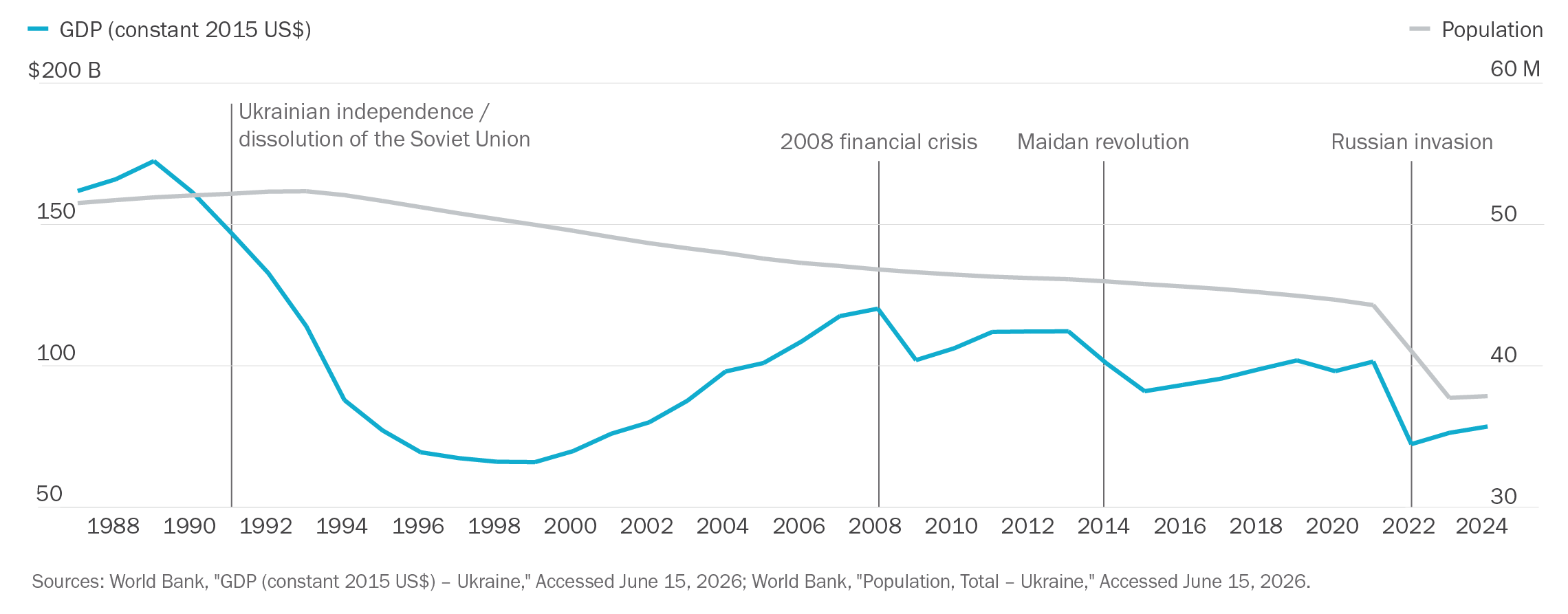
The war with Russia has cratered the Ukrainian economy to a level near its post-Soviet nadir while Ukraine has also undergone an unprecedented population collapse.
Regardless of whether the West decisively pressured Kyiv not to make a deal with Russia in the spring of 2022, Ukraine’s expectation of continued Western military support likely encouraged its decision to keep fighting—an example of moral hazard. During this period, calls for a negotiated settlement were widely met with accusations of “appeasement,” and the slogan “nothing about Ukraine without Ukraine” became a constant refrain among Biden administration officials. This amounted to saying “we’ll keep providing aid to Ukraine as long as they want to fight.” It also effectively meant that the United States would not make any agreement with Russia with consequences for Ukraine—even if those consequences were ultimately to Ukraine’s benefit by ending the war, or to the benefit of the United States by reducing its exposure to risk. Moreover, given the draft treaties issued before the war, there were issues outside Ukraine’s control that had to be resolved between the United States and Russia and which effected states beyond Ukraine—for example, the posture of NATO forces on the alliance’s eastern flank. By refusing to engage in diplomacy with its adversary, the United States was essentially locking Ukraine into a perpetual conflict.
The Kharkiv-Kherson counteroffensives
For many in Kyiv, Washington, and other Western capitals, Ukraine’s successful—albeit limited—fall 2022 counteroffensive confirmed that military support for Ukraine was paying off, and that with enough help Ukraine could win a decisive victory over Russia. Yet the 2022 counteroffensive proved to be the apex of Ukraine’s bargaining power. By forgoing that opportunity and continuing the war with complete dependence on the U.S., Ukraine’s prospects have since only grown worse.
During the summer of 2022, the war seemed to have settled into a stalemate. Yet in September, Ukraine again exceeded expectations by forcing the Russians to retreat from parts of Kharkiv and Kherson oblasts.53Julian E. Barnes, Eric Schmitt, and Helene Cooper, “The Critical Moment Behind Ukraine’s Rapid Advance,” New York Times, September 13, 2022, https://www.nytimes.com/2022/09/13/us/politics/ukraine-russia-pentagon.html; Isabelle Khurshudyan, et al., “Inside the Ukrainian Counteroffensive That Shocked Putin and Reshaped the War,” Washington Post, December 29, 2022, https://www.washingtonpost.com/world/2022/12/29/ukraine-offensive-kharkiv-kherson-donetsk/. Many commentators throughout the West interpreted the counteroffensive as proof that Ukraine, with the right weaponry, could push back the Russians and retake their lost territory.54Andriy Zagorodnyuk, “Ukraine’s Path to Victory,” Foreign Affairs, October 12, 2022, https://www.foreignaffairs.com/ukraine/ukraines-path-victory; Phillips Payson O’Brien, “Time is on Ukraine’s Side, Not Russia’s,” The Atlantic, January 14, 2023, https://www.theatlantic.com/ideas/archive/2023/01/russia-ukraine-weapon-production-nato-supply/672719/; Michael McFaul, “How to Get a Breakthrough in Ukraine,” Foreign Affairs, January 30, 2023, https://www.foreignaffairs.com/ukraine/how-get-breakthrough-ukraine; Eliot A. Cohen, “The Shortest Pathto Peace,” The Atlantic, February 28, 2023, https://www.theatlantic.com/ideas/archive/2023/02/russia-invasion-ukraine-peace-military-history/673231/.
In response, Putin declared the annexation of Donetsk, Luhansk, Zaporizhzhia, and Kherson oblasts—none of which Russia entirely controlled—and called for Kyiv to negotiate an end to the war.55Joshua Berlinger, Anna Chernova, and Tim Lister, “Putin Announces Annexation of Ukrainian Regions in Defiance of International Law,” CNN, September 30, 2022, https://www.cnn.com/2022/09/30/europe/putin-russia-ukraine-annexation-intl; Vladimir Socor, “Zelenskyy Bans Negotiations with Putin,” Jamestown Foundation, October 5, 2022, https://jamestown.org/program/zelenskyy-bans-negotiations-with-putin/. In an exercise of rhetorical boat-burning, Zelensky signed an order banning negotiations with Putin in response to the annexation.56Vladimir Socor, “Zelenskyy Bans Negotiations with Putin,” Jamestown Foundation, October 5, 2022, https://jamestown.org/program/zelenskyy-bans-negotiations-with-putin/
Sensing that the counteroffensive had given Ukraine a strong hand for the moment amidst an otherwise unfavorable war of attrition, Chairman of the Joint Chiefs Mark Milley repeatedly suggested in November 2022 that the time had come to negotiate a peace deal.57Peter Baker, “Top U.S. General Urges Diplomacy in Ukraine While Biden Advisers Resist,” New York Times, November 10, 2022, https://www.nytimes.com/2022/11/10/us/politics/biden-ukraine-russia-diplomacy.html; Mark Episkopos, “Milley Doubles Down on Support for Ukraine Negotiations,” National Interest, November 17, 2022, https://nationalinterest.org/blog/buzz/milley-doubles-down-support-ukraine-negotiations-205906. The Biden administration rushed to walk back Milley’s public remarks, returning to the “nothing without Ukraine” mantra.58Alexander Ward, Lara Seligman, and Erin Banco, “U.S. Scrambles to Reassure Ukraine After Milley Comments on Negotiations,” Politico, November 14, 2022, https://www.politico.com/news/2022/11/14/u-s-ukraine-milley-negotiations-00066777; John Hudson, “The Ukraine War is Antony Blinken’s Defining Moment,” Washington Post, March 16, 2023, https://www.washingtonpost.com/national-security/2023/03/16/antony-blinken-ukraine-russia/.
Milley’s comments—vindicated in time—were derided amidst the euphoria of the moment. Supporters of Ukraine in the West argued that a ceasefire would only benefit Russia and that instead the pressure should be kept up, more weapons sent, more red lines tested, and another ambitious counteroffensive prepared—including the retaking of Crimea.59Daniel Fried, “Putin’s War Against Ukraine and the Risks of Rushing to Negotiations,” Just Security, November 9, 2022, https://www.justsecurity.org/84023/putins-war-against-ukraine-and-the-risks-of-rushing-to-negotiations/; Eliot A. Cohen, “Cut the Baloney Realism,” The Atlantic, November 22, 2022, https://www.theatlantic.com/ideas/archive/2022/11/russia-ukraine-negotations-mark-milley/672198/; Raphael S. Cohen and Gian Gentile, “What’s the Harm in Talking to Russia? A Lot, Actually,” Foreign Policy, November 22, 2022, https://foreignpolicy.com/2022/11/22/russia-ukraine-war-negotiation-diplomacy-settlement-peace-ceasefire-armistice-putin/; Stephen Pifer, “Ukraine is the Victim. Negotiations Should be Kyiv’s Decision,” Brookings Institution, December 6, 2022, https://www.brookings.edu/articles/ukraine-is-the-victim-negotiations-should-be-kyivs-decision/; Andriy Zagorodnyuk, “The Case for Taking Crimea,” Foreign Affairs, January 2, 2023, https://www.foreignaffairs.com/ukraine/case-taking-crimea.
This stance presented a contradiction regarding Western aid. When Ukraine looked like it was at a disadvantage, calls for Western aid grew to prevent a Russian victory, and negotiations could only be pursued if Ukraine had a strong hand. If Ukraine had the wind at its back, calls for aid grew to help them keep up the momentum, negotiations were seen as helping Russia regain its footing, and the war goal shifted to the maximalist objective of retaking lost territory. Merely defending the territory that Ukrainian forces held was frequently equated with appeasement, countered in much of the foreign policy discourse by calls for what in the Cold War would have been called “rollback.”
The effect of the counteroffensive in the West was to suppress skepticism about Ukraine’s chances of a full victory. Congress passed a $12 billion aid package in September 2022 and a $47 billion aid package at the end of that year, at that point the largest of the war.60Jonathan Masters and Will Merrow, “Here’s How Much Aid the United States Has Sent Ukraine,” Council on Foreign Relations, July 15, 2025, https://www.cfr.org/article/how-much-us-aid-going-ukraine.
This episode likely also impressed on Ukraine that in order to maintain Western enthusiasm, and thereby the aid which was keeping the country and war going, they would need to continue pursuing dramatic offensive gambits of the kind that had paid off in fall 2022. That lesson proved toxic, subsequently producing military decisions that were counterproductive to both Western support and Ukraine’s ability to defend the existing frontlines.
Enabling Ukrainian overreach
Bakhmut and the 2023 counteroffensive
By feeding Ukraine’s false hopes and providing continued support for doomed offensives rather than encouraging Kyiv to capitalize on their victories, focus on defense, and make a deal—as Milley had urged—Washington helped accelerate Ukraine’s devastation. After Kharkiv and Kherson, Ukraine made a number of consequential—and predictable—mistakes that would prove costly. Unwilling to make diplomatic concessions or to fully embrace the defensive advantages to offset Russian superiority in troops and ammunition, Kyiv instead went on offense to galvanize continued Western support and to demoralize the Russian war effort.
Despite disagreements among his commanders, Zelensky fed enormous numbers of Ukrainian troops into the city of Bakhmut to defend it from attacking Russian forces from late 2022 into 2023.61Adam Entous, “The Partnership: The Secret History of the War in Ukraine,” New York Times, March 29, 2025, https://www.nytimes.com/interactive/2025/03/29/world/europe/us-ukraine-military-war-wiesbaden.html. While reliable casualty figures are unavailable, both sides undoubtedly lost tens of thousands of personnel in what was likely the bloodiest battle in Europe since World War II.62Bryan Powers, “The Battle for Bakhmut: When Is a Battlefield Loss a Strategic Victory?” U.S. Army, March 31, 2025, https://www.army.mil/article/284124/the_battle_for_bakhmut_when_is_a_battlefield_loss_a_strategic_victory. Zelensky seems to have believed that despite lacking any intrinsic strategic value, Bakhmut would be a decisive battle for morale on both sides, and the city could be turned into a meat grinder for the Russians to wear down their numbers.63James Landale, “Ukraine War: Why Bakhmut Matters for Russia and Ukraine,” BBC, March 8, 2023, https://www.bbc.com/news/world-europe-64877991 This proved to be misguided, as the intense urban and trench warfare at Bakhmut consumed far more troops than the Ukrainians could afford to lose, particularly given their recruitment problems.
In the aftermath of their retreat in Kharkiv and Kherson, the Russians mobilizied an additional 300,000 reservists and spent the winter reconsolidating defenses in-depth along the frontlines.64“Russia Calls up 300,000 Reservists, Says 6,000 Soldiers Killed in Ukraine,” Reuters, September 21, 2022, https://www.reuters.com/world/europe/russias-partial-mobilisation-will-see-300000-drafted-defence-minister-2022-09-21/; Marco Hernandez and Josh Holder, “Defenses Carved into the Earth,” New York Times, December 14, 2022, https://www.nytimes.com/interactive/2022/12/14/world/europe/russian-trench-fortifications-in-ukraine.html. Planning was already underway for a spring counteroffensive by Ukraine, seeking again to push back Russian forces in the east of the country. Expectations for the counteroffensive were inflated in the West, with many expressing expectations of a rout of Russian forces.65Ben Armbruster, “Why Blind Optimism Leads Us Astray on Ukraine,” Responsible Statecraft, September 5, 2023, https://responsiblestatecraft.org/ukraine-counteroffensive/. These hopes were quickly disappointed, however, as Ukraine’s attempts at advancing were halted by dense Russian defenses along the frontlines.66In Ukraine, a War of Incremental Gains as Counteroffensive Stalls,” Washington Post, December 4, 2023, https://www.washingtonpost.com/world/2023/12/04/ukraine-counteroffensive-stalled-russia-war-defenses/.
Much of the commentary on the failure of the 2023 counteroffensive has emphasized the disagreements between U.S. and Ukrainian commanders, or has blamed the Ukrainians for reverting to “Soviet-style” tactics. U.S. generals, deeply integrated into Ukraine’s war-planning, were pushing for Ukraine to concentrate its advance on the southern city of Melitopol in order to sever the Russian land bridge to Crimea, a plan which Zaluzhny had pushed for in 2022. Ukraine, however, changed the plan by diverting forces to Bakhmut and Luhansk, hoping to spread Russian defenders thin but instead weakening their own offensive.67Helene Cooper and Julian E. Barnes, “Zelensky’s Visit Reveals Strategy Divide Between Ukraine and U.S.,” New York Times, September 22, 2023, https://www.nytimes.com/2023/09/22/us/politics/zelensky-biden-ukraine-war-strategy.html; “Miscalculations, Divisions Marked Offensive Planning by U.S., Ukraine,” Washington Post, December 4, 2023, https://www.washingtonpost.com/world/2023/12/04/ukraine-counteroffensive-us-planning-russia-war/; Entous, “The Partnership.” U.S. support for Israel’s war in Gaza after the October 7 attack meant that stockpiles of U.S. ammunition for Ukraine were also becoming increasingly stretched.68Oren Liebermann and Natasha Bertrand, “US Eyes Weapons Stockpiles as Concern Grows AboutSupporting Both Ukraine and Israel’s Wars,” CNN, October 11, 2023, https://www.cnn.com/2023/10/11/politics/us-weapons-stockpiles-ukraine-israel/index.html.
But these issues distract from the larger problem: that launching a counteroffensive in the first place made little military sense given Ukraine’s position. Some U.S. and Ukrainian leaders must have thought, either from exuberance or desperation, that a decisive offensive blow could rupture what would otherwise be a war of attrition struggle that was unfavorable to a less populous and armed Ukraine.69Barry R. Posen, “Ukraine Has a Breakthrough Problem,” Foreign Policy, August 3, 2023, https://foreignpolicy.com/2023/08/03/ukraine-counteroffensive-breakthrough-problem/;John J. Mearsheimer, “Bound to Lose,” Substack, September 2, 2023, https://mearsheimer.substack.com/p/bound-to-lose; Stephen Biddle, “How Russia Stopped Ukraine’s Momentum,” Foreign Affairs, January 29, 2024, https://www.foreignaffairs.com/ukraine/how-russia-stopped-ukraines-momentum. But the main driver of the ill-advised counteroffensive was likely Biden and Zelensky’s desire to stage another dramatic victory that could justify continued Western support and keep the war going, without asking difficult questions about how it would likely end.70Jonathan Lemire and Alexander Ward, “White House Anxiously Watches Ukraine’s Counteroffensive, Seeing the War and Biden’s Reputation at Stake,” Politico, June 8, 2023, https://www.politico.com/news/2023/06/08/biden-ukraine-counteroffensive-00101088; Entous, “The Partnership.” Whether or not the Ukrainians had adhered more closely to Washington’s strategy was irrelevant, since the odds of successfully retaking—let alone holding—Crimea were virtually nil.
By November, Ukrainian Commander-in-Chief Valery Zaluzhny stated that the counteroffensive had effectively failed and the war had become a “stalemate.”71Ukraine’s Commander-in-Chief on the Breakthrough He Needs to Beat Russia,” The Economist, November 1, 2023, https://www.economist.com/europe/2023/11/01/ukraines-commander-in-chief-on-the-breakthrough-he-needs-to-beat-russia. Zaluzhny’s continuing pessimistic public statements, likely along with his increasing political popularity within Ukraine, led to his dismissal as commander-in-chief in early 2024 in favor of Oleksandr Syrsky, the architect of the failed Bakhmut campaign.72Andrew E. Kramer and Marc Santora, “Zelensky Removes His Top General, in Major Shake-Up of Ukraine Military,” New York Times, February 8, 2024, https://www.nytimes.com/2024/02/08/world/europe/zelensky-general-valery-zaluzhny-ukraine-military.html The change in personnel yet again reflected how Ukrainian decision-making was distorted by false hopes of an eventual coup de main with Western support that could overcome Ukraine’s increasingly severe constraints and turn the tide.
Zaluzhny’s sober admission should have been mirrored by a long overdue reckoning in Washington about the downward trajectory of the war and the need to temper Kyiv’s expectations. As discussed below, however, the contrary proved to be the case: as Ukraine’s situation—and actions—became ever more desperate, the United States exceeded limits it had previously set on its support, enabling Ukrainian initiatives—including attacks within Russia—that Washington had previously considered out of bounds. These actions only compounded Ukraine’s manpower problems while increasing the risk of direct Russian retaliation against the United States and Europe, making Washington’s willingness to underwrite and facilitate them even more inexplicable.
Reckless driving and U.S. escalation risks
On the battlefield, it was Ukraine, not the West, which suffered the consequences of continuing the war. Yet while Washington’s ill-fated involvement in Ukraine helped push the latter over a cliff, it has also exposed the United States to risks that are remarkably severe and particularly unjustifiable in view of the U.S. interests at stake, which are minimal.
The United States would gain no security whatsoever by incorporating Ukraine into NATO, yet its military backing for Ukraine has exposed it to what President Biden acknowledged to be the greatest risk of nuclear war since the Cuban Missile Crisis. 73Nathan Williams, “Ukraine War: Biden Says Nuclear Risk Highest Since 1962 Cuban Missile Crisis,” BBC News, October 7, 2022, https://www.bbc.com/news/world-us-canada-63167947. Moreover, tying the U.S. to Ukraine’s fate has allowed Kyiv—which has every incentive to have the United States enter the war on their behalf—to take actions that raise the danger of direct conflict between the U.S. and Russia. Worse still, most of these reckless actions by Ukraine have only been possible with the aid of U.S. weapons and support. For its part, Washington has succumbed to the sunk-cost fallacy by refusing to cut its losses, thereby exposing itself to risks it had previously forsworn, increasingly—and irresponsibly—allowing its own risk-tolerance to be shaped by Kyiv’s growing desperation.
The Biden administration sought to minimize escalation risks in the early days of the war, refusing Kyiv’s pleas for a “no-fly zone” over Ukraine.74Steven Erlanger and Lara Jakes, “NATO Rejects Intervening in Ukraine, Including with a No-Fly Zone,” New York Times, March 4, 2022, https://www.nytimes.com/2022/03/04/world/europe/ukraine-russia-nato.html; Joseph R. Biden Jr., “President Biden: What America Will and Will not Do in Ukraine,” New York Times, May 31, 2022, https://www.nytimes.com/2022/05/31/opinion/biden-ukraine-strategy.html. Western countries were also reticent to supply Ukraine with advanced weapons systems, but as the UAF increasingly showed its competence on the battlefield, NATO began providing HIMARS, Abrams and Leopard tanks, and F-16 fighter jets, among others.75Dan DeLuce, “Ukraine is Asking Biden Administration for Anti-Ship Missiles, Drones and Rocket Launchers, Says Lawmaker,” NBC News, May 4, 2022, https://www.nbcnews.com/politics/national-security/ukraine-asking-biden-admin-anti-ship-missiles-drones-rocket-launchers-rcna27406; Lolita C. Baldour and Ben Fox, “US Sends Rocket Systems to Ukraine to Stall Russian Advance,” Associated Press, June 1, 2022, https://apnews.com/article/russia-ukraine-technology-government-and-politics-d3265158d6fff41594d247340fa4d53a; Courtney Kube, Carol E. Lee, and Raf Sanchez, “Top U.S. Officials Don’t Want to Give Ukraine Tanks Despite German Pressure,” NBC News, January 20, 2023, https://www.nbcnews.com/politics/national-security/top-us-officials-dont-want-give-ukraine-tanks-rcna66753; Nandita Bose, Steve Holland, and Phil Stewart, “In Change of Course, U.S. Agrees to Send 31 Abrams Tanks to Ukraine,” Reuters, January 25, 2023, https://www.reuters.com/world/us/reversal-us-agrees-send-31-abrams-tanks-ukraine-2023-01-25/; Adam Durbin, “Ukraine War: Germany Sends Much-Awaited Leopard Tanks,” BBC, March 28, 2023, https://www.bbc.com/news/world-europe-65095126; Aamer Madhani and Lolita C. Baldor, “Biden’s Shift on F-16s for Ukraine Came After Months of Internal Debate,” Associated Press, August 25, 2023, https://apnews.com/article/biden-ukraine-f16-decision-russia-64538af7c10489d7c2243dadbad31008 Increasingly, U.S.-supplied weapons allowed Ukraine to strike into Russian territory, increasing the risk of direct escalation, even as its own defenses were being eroded. There was little sign, meanwhile, that Washington was willing to condition its support on a more realistic and less reckless strategy.
Throughout the war, Ukraine also conducted a campaign of sabotage, assassinations, and drone strikes against Russia, some of which the United States has claimed to have been either unapprised of beforehand or unable to prevent.76William M. Arkin, “Exclusive: The CIA’s Blind Spot About the Ukraine War,” Newsweek, July 5, 2023, https://www.newsweek.com/2023/07/21/exclusive-cias-blind-spot-about-ukraine-war-1810355.html; Julian E. Barnes, et al., “U.S. Believes Ukrainians Were Behind an Assassination in Russia,” New York Times, October 5, 2022, https://www.nytimes.com/2022/10/05/us/politics/ukraine-russia-dugina-assassination.html; Jon Jackson, “Ukraine Admits it Assassinated Russian Propagandists,” Newsweek, May 18, 2023, https://www.newsweek.com/ukraine-assassinated-russian-propagandists-1801233; Julian E. Barnes, et al., “Ukrainians Were Likely Behind Kremlin Drone Attack, U.S. Officials Say,” New York Times, May 24, 2023, https://www.nytimes.com/2023/05/24/us/politics/ukraine-kremlin-drone-attack.html; Mike Eckel, “The Ukrainian Fingerprints on a Shadowy Assassination Campaign on Russian Soil,” Radio Free Europe/Radio Liberty, December 7, 2023, https://www.rferl.org/a/ukraine-russia-assassination-campaign/32721025.html; Maria Varenikova, “Ukraine Fires Hundreds of Drones at Russia, Moscow Says,” New York Times, May 22, 2025, https://www.nytimes.com/2025/05/22/world/europe/ukraine-russia-drones.html. If reports are to be believed, this included the destruction of the Nordstream gas pipelines from Russia to Germany, which was technically also an attack on a NATO ally’s critical infrastructure at a time when sanctions on Russia were producing an energy shortage across Europe.77Bojan Pancevski, et al., “U.S. Warned Ukraine Not to Attack Nord Stream,” Wall Street Journal, June 14, 2023, https://www.wsj.com/world/u-s-warned-ukraine-not-to-attack-nord-stream-7777939b.
NATO—though principally the U.S.—used a base in Wiesbaden, Germany as its main liaison point with the Ukrainian high command to plan operations and shape Ukraine’s strategy. The HIMARS were a particularly contentious issue, since they generally required U.S. ISR to target Russian forces—alleviating concerns about how Ukraine might independently use the weapons but also putting the U.S. directly in the “kill chain” targeting Russian troops.78Isabelle Khurshudyan, et al., “Ukraine’s Rocket Campaign Reliant on U.S. Precision Targeting, Officials Say,” Washington Post, February 9, 2023, https://www.washingtonpost.com/world/2023/02/09/ukraine-himars-rocket-artillery-russia/; Entous, “The Partnership.”
As the 2022 counteroffensive pushed the Russians back, fears among U.S. intelligence that Moscow might use nuclear weapons rose dramatically, particularly after its declared annexation of the four eastern oblasts. Indeed, U.S. intelligence assessed a 50 percent chance that Russia would resort to nuclear use if its troops around Kherson were encircled, leading to intense crisis management with Moscow.79“US Scrambled to Urge Putin not to Use Nuclear Weapons in Ukraine, Woodward Book Says,” Associated Press, October 8, 2024, https://apnews.com/article/russia-ukraine-war-putin-biden-nuclear-weapons-90cb3bb3499a5e211095b3f93173a575 CIA director William Burns later stated, “There was a moment in the fall of 2022 when I think there was a genuine risk of… the potential use of tactical nuclear weapons.”80Dan DeLuce, “There Was Real Risk Russia Would Use Nuclear Weapons in Ukraine, CIA Director Says,” NBC News, September 7, 2024, https://www.nbcnews.com/news/world/cia-william-burns-mi6-richard-moore-rcna170058. Similarly, the 2023 counteroffensive also produced fears of Russian nuclear use. U.S. war planners later admitted that the campaign to isolate Crimea would inflame the “core tension” of the conflict if it endangered the peninsula, regarded as Russia’s most-valued prize in Ukraine.81Entous, “The Partnership.”
After the failure of the previous year’s counteroffensive, the U.S. had started encouraging Ukraine to pursue a primarily defensive “hold and build” strategy to prevent Russia from gaining further territory.82Julian E. Barnes, Eric Schmitt, David E. Sanger, and Thomas Gibbons-Neff, “U.S. and Ukraine Search forNew Strategy After Failed Counteroffensive,” New York Times, December 11, 2023, https://www.nytimes.com/2023/12/11/us/politics/us-ukraine-war-strategy.html. Also see Michael Kofman, Rob Lee, and Dara Massicot, “Hold, Build, and Strike: A Vision for Rebuilding Ukraine’s Advantage in 2024,” War on the Rocks, January 26, 2024, https://warontherocks.com/2024/01/hold-build-and-strike-a-vision-for-rebuilding-ukraines-advantage-in-2024/; Emma Ashford and Kelly A. Grieco, “How Ukraine Can Win Through Defense,” Foreign Affairs, January 10, 2024, https://www.foreignaffairs.com/ukraine/how-ukraine-can-win-through-defense. Meanwhile, as enthusiasm for the war soured in the West, congressional Republicans began opposing new aid packages for Ukraine, drying up already low stockpiles of ammunition and equipment as Ukraine’s personnel shortages reached a crisis point.83Karoum Demirjian, “Republicans Block Aid to Ukraine, Jeopardizing Its Fight Against Russia,” New YorkTimes, December 6, 2023, https://www.nytimes.com/2023/12/06/us/politics/senate-ukraine-aid-bill.html; Oren Lieberman and Natasha Bertrand, “US Eyes Weapons Stockpiles as Concern Grows About Supporting Both Ukraine and Israel’s Wars,” CNN, October 11, 2023, https://www.cnn.com/2023/10/11/politics/us-weapons-stockpiles-ukraine-israel/index.html; Michael DiMino, “No Silver Bullet: Aid is Not a Shortcut to Victory for Ukraine,” Defense Priorities, June 21, 2024, https://www.defensepriorities.org/explainers/no-silver-bullet/ Ukraine’s disadvantage in troop numbers was always its primary weakness compared to Russia, compounded by the fact that Ukraine, with an average troop age of 43, resisted lowering its draft age from 27 until spring 2024, when it was only lowered to 25.84Elsa Court, “As US Pushes Ukraine to Lower Conscription Age, Why Won’t Kyiv Draft Younger Men?,” Kyiv Independent, December 16, 2024, https://kyivindependent.com/as-us-pushes-for-ukraine-to-lower-draft-age-why-wont-ukraine-conscript-younger-men/; Andrew E. Kramer, Josh Holder and Lauren Leather by, “Can Ukraine Find New Soldiers Without Decimating a Whole Generation?,” New York Times, April 11, 2024, https://www.nytimes.com/interactive/2024/04/11/world/europe/ukraine-demographics.html. Ukraine is already experiencing a historic shortage of men age 18-30, not only the most capable fighting age but also a crucial future workforce to rebuild the country after the war.85Kramer, Holder, and Leatherby, “Can Ukraine Find New Soldiers Without Decimating a Whole Generation?”
As Ukraine became increasingly desperate, its strategy seemed to become more oriented toward escalation that would implicate the United States and NATO. Ukraine publicly pleaded for longer-range ATACMS to strike into Russian territory, from which the latter had long been able to target Ukrainian forces without retaliation.86Adam Entous and Julian E. Barnes, “U.S. Intelligence Stresses Risks in Allowing Long-Range Strikes by Ukraine,” New York Times, September 26, 2024, https://www.nytimes.com/2024/09/26/us/politics/us-ukraine-strikes.html. In May of 2024, Ukraine bombed Russian radar systems that provide early warning in case of nuclear attack, alarming U.S. officials about the increased risk of Russian nuclear use.87Ellen Nakashima and Isabelle Khurshudyan, “U.S. concerned about Ukraine strikes on Russian nuclear radar stations,” Washington Post, May 29,2024, https://www.washingtonpost.com/national-security/2024/05/29/us-ukraine-nuclear-warning-strikes/; James M. Acton, “The United States Should Not Further Loosen Its Prohibition on Ukraine’s Using U.S.-Supplied Weapons to Strike Russia,” Carnegie Endowment for International Peace, June 6, 2024, https://carnegieendowment.org/russia-eurasia/posts/2024/06/ukraine-prohibition-us-weapons-strike-russia. Russia responded by revising its nuclear doctrine, claiming that non-nuclear attacks by a proxy on Russian territory would make it legitimate to use nuclear weapons against the backer—NATO.88Anton Troianovski and Ivan Nechepurenko, “Putin Declares Changes to Russian Nuclear Doctrine,” New York Times, September 25, 2024, https://www.nytimes.com/2024/09/25/world/europe/putin-russia-nuclear-doctrine.html
At the same time, Ukraine launched a baffling ground incursion into Russian territory, focused on Kursk. The Kursk incursion seemed designed to pursue three goals for Kyiv: 1) to seize a bargaining chip in what were likely to be increasingly unfavorable negotiations with Russia over territory, 2) to give embattled Ukrainian troops some breathing room by drawing Russian troops from the frontlines, and 3) to galvanize flagging Western support by scoring a PR win.
Washington interpreted the move as a breach of trust but did not try to stop it.89Entous, “The Partnership.” Unsurprisingly, by devoting much-needed troops and equipment to a region of no intrinsic value, Ukraine was thinning its defenses on its own soil. The Russians started making territorial gains in eastern Ukraine at their fastest pace since the initial invasion.90Constant Méheut and Josh Holder, “Russia’s Swift March Forward in Ukraine’s East,” New York Times, October 31, 2024, https://www.nytimes.com/interactive/2024/10/31/world/europe/russia-gains-ukraine-maps.html.
Ukraine’s male population by age (as of 2024)
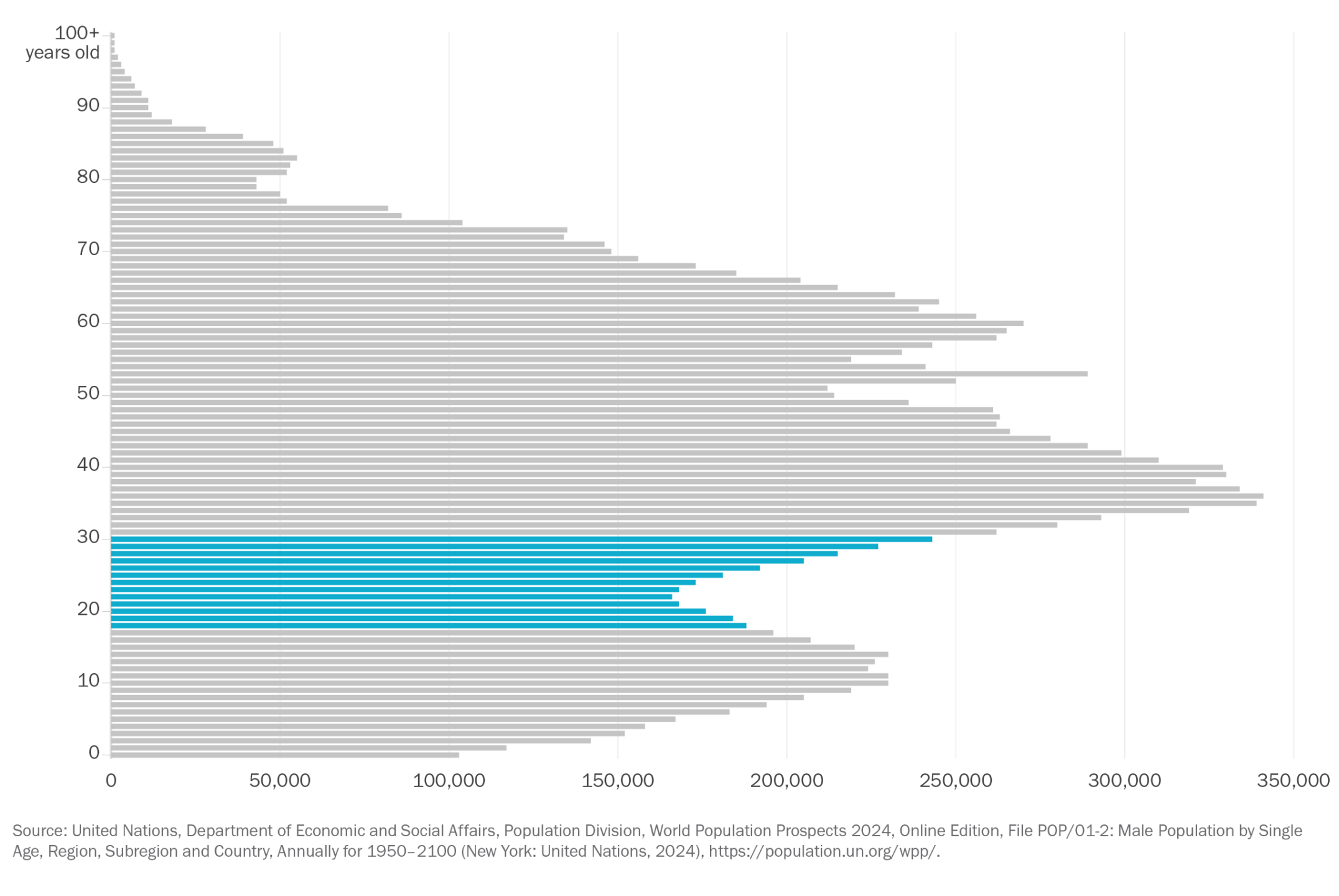
Ukraine’s manpower problem is compounded by its refusal to draft men of prime fighting age—a crucial constraint on its ability to sustain the war against Russia.
In November, the United States elected Donald Trump to a second term, who had promised to end the war “within 24 hours.” Soon after, the Biden administration began allowing Ukraine to use ATACMS on targets inside Russia.91Adam Entous, Eric Schmitt, and Julian E. Barnes, “Biden Allows Ukraine to Strike Russia with Long-Range U.S. Missiles,” New York Times, November 17, 2024, https://www.nytimes.com/2024/11/17/us/politics/biden-ukraine-russia-atacms-missiles.html. Russia reacted by lowering its threshold for nuclear use and striking Ukraine with a conventionally armed but nuclear-capable hypersonic missile.92“Putin Lowers the Threshold for Using His Nuclear Arsenal After Biden’s Arms Decision for Ukraine,” Associated Press, November 19, 2024, https://apnews.com/article/russia-nuclear-doctrine-putin-91f20e0c9b0f9e5eaa3ed97c35789898; Robert Greenall, “Putin Warns West as Russia Hits Ukraine with New Missile,” BBC, November 21, 2024, https://www.bbc.com/news/articles/cy4n9vgwnnyo.
This parting decision by the Biden administration was especially irresponsible, as it essentially allowed Ukraine to expose the U.S. and NATO to risks that it had sought to avoid throughout the war, and to no strategic end. It was, however, emblematic of the Biden administration’s baffling tendency throughout to increase its own risk acceptance in direct proportion with Ukraine’s declining prospects.
Even though the United States has avoided direct conflict with Russia, it has been deeply involved in war-planning while providing Ukraine with targeting and advanced weaponry. By doing so, it has put itself at risk of either being treated by Russia as a belligerent itself, or at the very least creating the conditions for inadvertent escalation whereby the U.S. or a NATO ally might find themselves drawn into direct engagement with Russian forces. It serves as a prime example of why the United States should be circumspect about the assurances it offers to others and the dangers it may incur by doing so.
Outcomes and prospects
Throughout the Ukraine conflict, the United States has acted like a casino, extending new lines of credit to Kyiv as it tries to gamble its way out of a hole, only to find itself ever deeper in the red. There has been no shortage of cheerleaders in Washington, Brussels, and the media happy to offer encouragement before each of Ukraine’s ill-fated rolls—yet whatever their intentions may have been, they have acted as enablers, not responsible and honest friends. While Russia is primarily responsible for the war and the devastation it has caused, and Ukraine is the ultimate victim of it, the United States’ recklessness and negligence since 2008 also give it considerable moral culpability for the outcome.
The United States Congress has so far appropriated $195 billion for Ukraine, including $134 billion for security assistance.93“Funding,” Special Inspector General for Operation Atlantic Resolve, Ukraine Oversight, https://www.ukraineoversight.gov/Funding/. While reliable reports of casualties are difficult to establish, Harvard’s Russia Matters reports that at least 250,000–300,000 Ukrainian troops have been killed or injured, 16,431 Ukrainian civilians have been killed, and 9.6 million Ukrainians have been displaced.94“The Russia-Ukraine War Report Card,” Russia Matters, May 13, 2026, https://www.russiamatters.org/news/russia-ukraine-war-report-card/russia-ukraine-war-report-card-may-13-2026. Russia controls approximately 20 percent of Ukraine’s original territory, and is (very) gradually accumulating more.95Guy Faulconbridge, “How Much Territory Does Russia Control in Ukraine?,” Reuters, August 15, 2025, https://www.reuters.com/world/americas/how-much-territory-does-russia-control-ukraine-2025-08-14/. According to Gallup, 66 percent of Ukrainians support negotiations to end the war as quickly as possible.96Benedict Vigers, “Ukrainian Support for War Effort Collapses,” Gallup, August 7, 2025, https://news.gallup.com/poll/693203/ukrainian-support-war-effort-collapses.aspx.
U.S. aid to Ukraine in context
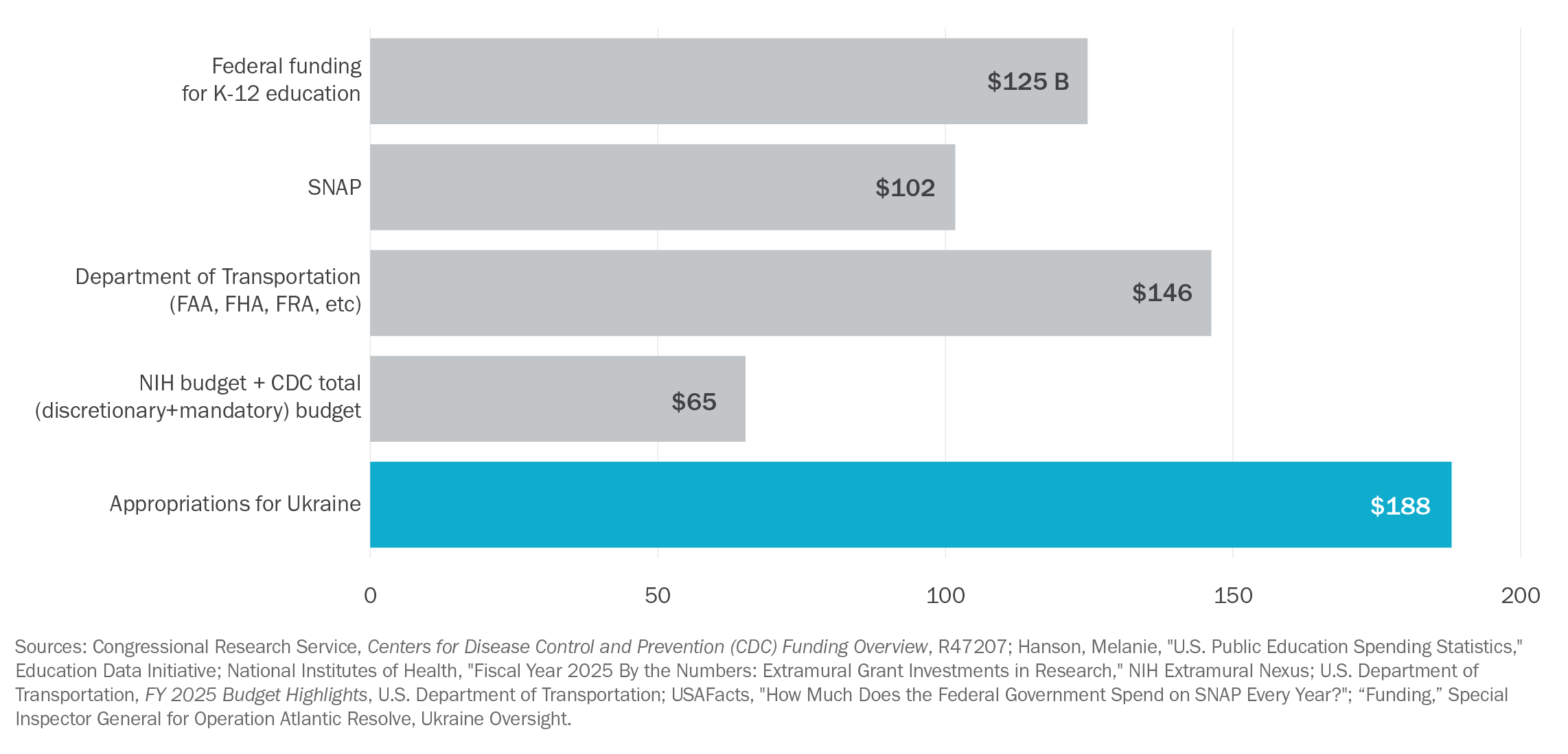
U.S. taxpayer money spent on Ukraine exceeds the annual budgets for education, food security, transportation and infrastructure, and health and disease prevention research.
The Trump administration’s attempts to bring an end to the war through diplomacy have shown little progress. Trump has sought to strongarm Kyiv to make concessions by turning the aid spigot off, only to turn it on again in order to avoid conceding defeat to Russia.97Justin Fishel and Kelsey Walsh, “The Trump Administration’s Shifting Explanation of Ukraine WeaponsPause,” ABC News, July 9, 2025, https://abcnews.com/Politics/trump-admin-decision-pause-restart-weapons-shipments-ukraine/story?id=123622383. As the war grinds on and other priorities take precedence in the U.S., Washington has found its leverage to reach a diplomatic resolution to be limited beyond merely halting all aid to Ukraine in order to force it to effectively surrender.
At this point, Ukraine has little choice but to either make strategic and territorial concessions for peace, or to keep fighting indefinitely at great cost and risk. Zelensky has continued to seek security guarantees from the West; such guarantees would be as hollow as the 2008 pledge to bring Ukraine into NATO and would only perpetuate the cycle of moral hazard and ruin that followed from that fateful and foolish decision. Moreover, these guarantees will not be accepted by Moscow, meaning that the war would continue and any formal guarantees would immediately be rendered null.98Friedman, “Neutrality not NATO: Assessing Security Options for Ukraine”; Kavanagh and McCallion,“Armed Neutrality for Ukraine is NATO’s Least Poor Option.” There are signs that Ukraine is beginning to accept that its future will have to be as an armed neutral, pursuing an autonomous mix of deterrence and reassurance to keep Russia at bay.99Constant Meheut, “Ukraine Pursues a Weapons Buildup More Potent Than Any Security Guarantee,” New York Times, September 2, 2025, https://www.nytimes.com/2025/09/02/world/europe/ukraine-weapons-security.html Nonetheless, Kyiv continues to grasp at a chimeric U.S. bailout, and even Trump has proven willing to continue to lead the Ukrainians on.100Tom Balmforth and Gram Slattery, “Trump, in Rhetorical Shift, Says Ukraine Can Retake All Its Land,” Reuters, September 24, 2025, https://www.reuters.com/business/aerospace-defense/zelenskiy-meet-trump-un-push-new-us-sanctions-russia-2025-09-23/; John Irish, “U.S. Backs Security Guarantees for Ukraine at Summit of Kyiv’s Allies in Paris,” Reuters, January 6, 2026, https://www.reuters.com/business/aerospace-defense/us-backs-security-guarantees-ukraine-summit-kyivs-allies-paris-2026-01-06/.
The best thing that the United States could do—for itself, for Europe, and for Ukraine—is to make official the obvious: that Ukraine will not be a member of NATO nor a U.S. security dependent under another name. This would remove one of the central causes of the war and might induce Putin to make a deal under terms that will no doubt be painful but would still leave Ukraine an independent state with most of its territory intact. It would also eliminate any delusions that persist in Ukraine about an eventual Western rescue, focusing their attention on developing an autonomous national defense and rebuilding their badly damaged country.
Washington should also derive more general lessons for how its military support for other allies and partners shapes their behavior while putting the United States at unnecessary risk. The Ukraine example shows that checks should not be written if they cannot be cashed; the United States has been too casual in the commitments it makes to defend others when its vital interests are not at stake. Moreover, the Ukraine war demonstrates a tendency among Washington policymakers to refuse to cut their losses when their bluff has been called, threatening against all reason to draw the United States into disaster. It is better to be clear with sympathetic nations what the limits of the United States’ interests truly are and avoid a descent into moral hazard, rather than lead partners into false confidence and the United States into peril.
Endnotes
- 1Paul Krugman, The Return of Depression Economics (New York: W.W. Norton & Co., 2000), 66. ↩︎
- 2Barry R. Posen, Restraint: A New Foundation for U.S. Grand Strategy (Ithaca, NY: Cornell University Press, 2014), 44–50. ↩︎
- 3Barack Obama, quoted by Jeffrey Goldberg, “The Obama Doctrine,” The Atlantic, April 2016, https://www.theatlantic.com/magazine/archive/2016/04/the-obama-doctrine/471525/. ↩︎
- 4Benjamin H. Friedman, “Neutrality not NATO: Assessing Security Options for Ukraine,” Defense Priorities, July 12, 2023, https://www.defensepriorities.org/explainers/neutrality-not-nato-assessing-security-options-for-ukraine/; Jennifer Kavanagh and Christopher McCallion, “Armed Neutrality for Ukraine is NATO’s Least Poor Option,” War on the Rocks, February 18, 2025, https://warontherocks.com/armed-neutrality-for-ukraine-is-natos-least-poor-option/. ↩︎
- 5Robert M. Gates, Duty: Memoirs of a Secretary at War (New York: Alfred A. Knopf, 2014), 157–158. ↩︎
- 6William J. Burns, The Back Channel: A Memoir of American Diplomacy and the Case for Its Renewal (New York: Random House, 2019), 233. ↩︎
- 7Ambassador William J. Burns, “Nyet Means Nyet: Russia’s NATO Enlargement Redlines,” Wikileaks Diplomatic Cable: 08MOSCOW265_a, February 1, 2008, https://web.archive.org/web/20220225001758/https://wikileaks.org/plusd/cables/08MOSCOW265_a.html. ↩︎
- 8Mikhail Zygar, All the Kremlin’s Men: Inside the Court of Vladimir Putin (New York: Public Affairs, 2016), 154. ↩︎
- 9Paul J. Saunders, “Georgia’s Recklessness,” Washington Post, August 15, 2008, https://www.washingtonpost.com/wp-dyn/content/article/2008/08/14/AR2008081403053.html. ↩︎
- 10Gates, Duty, 168. ↩︎
- 11Heidi Tagliavini, et al., “Independent International Fact-Finding Mission on the Conflict in Georgia, ”Council of the European Union, September 2009, https://www.echr.coe.int/documents/d/echr/hudoc_38263_08_Annexes_eng,10–11 ↩︎
- 12Thomas de Waal, The Caucasus: An Introduction (New York: Oxford University Press, 2010), 194–224; Mark Ames, “The War We Don’t Know,” The Nation, August 13, 2008, https://www.thenation.com/article/archive/war-we-dont-know/;Gates, Duty, 167–170. Ironically, Saakashvili, by then disgraced and wanted within Georgia, was appointed in 2014 by Ukrainian President Poroshenko to be governor of Odessa, having been granted Ukrainian citizenship a day before taking office. ↩︎
- 13Maria Katamadze, “What Happened with Georgia’s NATO Ambitions?,” DW, July 12, 2023, https://www.dw.com/en/what-happened-with-georgias-nato-ambitions/a-66190054; Beka Chedia,“Georgian Dream Moves Away from North Atlantic Treaty Organization Aspirations,” Jamestown Foundation, June 18, 2025, https://jamestown.org/georgian-dream-moves-away-from-north-atlantic-treaty-organization-aspirations/. ↩︎
- 14Gates, Duty, 168. ↩︎
- 15“Which Way Ukraine Should Go – Which Union Should It Join? (Population Preferences for Two Weeks Before the Vilnius Summit),” Kyiv International Institute of Sociology, November 26, 2013, https://www.kiis.com.ua/?lang=eng&cat=reports&id=204&page=1&y=2013&m=11. ↩︎
- 16Ukraine Crisis: Transcript of Leaked Nuland-Pyatt Call,” BBC News, February 7, 2014, https://www.bbc.com/news/world-europe-26079957; Victoria Nuland, “Remarks at the U.S.-Ukraine Foundation Conference,” Department of State, December 13, 2013, https://2009-2017.state.gov/p/eur/rls/rm/2013/dec/218804.htm; “Where We Work: Ukraine, 2013,”National Endowment for Democracy, archived July 29, 2014, https://web.archive.org/web/20140729005422/http://www.ned.org/where-we-work/eurasia/ukraine. ↩︎
- 17“Association Agreement Between the European Union and Its Member States, of the One Part, and Ukraine, of the Other Part,” Title II, Article 4.1, May 29, 2014, https://web.archive.org/web/20220225010609/https://trade.ec.europa.eu/doclib/docs/2016/november/tradoc_155103.pdf, 161/7. ↩︎
- 18For a detailed account of Maidan and its aftermath, see Richard Sakwa, Frontline Ukraine: Crisis in the Borderlands (London: I.B. Tauris, 2015). ↩︎
- 19For a detailed account of Maidan and its aftermath, see Richard Sakwa, Frontline Ukraine: Crisis in the Borderlands (London: I.B. Tauris, 2015). On the Donbas referendums, also see C.J. Chivers and David M. Herszenhorn, “Separatists Defy Kiev and Putin on Referendum,” New York Times, May 8, 2014, https://www.nytimes.com/2014/05/09/world/europe/ukraine.html. ↩︎
- 20Andrew Roth, “Details of the Ukraine Cease-Fire Negotiated in Minsk,” New York Times, February 12, 2015, https://www.nytimes.com/2015/02/13/world/europe/ukraine-cease-fire-negotiated-in-minsk.html; Neil Buckley and Roman Olearchyk, “Fierce Battle for Debaltseve Ends in Ukraine Withdrawal,” Financial Times, February 18, 2015, https://www.ft.com/content/470b14da-b785-11e4-981d-00144feab7de. ↩︎
- 21Ukraine-Russia Crisis: What is the Minsk Agreement?” Al-Jazeera, February 9, 2022, https://www.aljazeera.com/news/2022/2/9/what-is-the-minsk-agreement-and-why-is-it-relevant-now. ↩︎
- 22Ukraine Crisis: Third Death After Kiev Anti-Autonomy Rally,” BBC News, September 1, 2015, https://www.bbc.com/news/world-europe-34112881; Volodymyr Ischenko, “Ukraine’s government bears more responsibility for ongoing conflict than the far-right,” Guardian, September 4, 2015, https://www.theguardian.com/world/2015/sep/04/ukraine-government-svoboda-clashes-conflict. ↩︎
- 23Andreas Umland, “Poroshenko’s Line, the Minsk Agreement, and the Special Status for the Donbas,” Vox Ukraine, February 2, 2016, https://voxukraine.org/en/poroshenkos-line-the-minsk-agreement-and-the-special-status-for-the-donbas-en; Fred Weir, “Politics over Peace? Critics Say Ukraine’s President Sidelining Minsk Accords,” Christian Science Monitor, January 29, 2018, https://www.csmonitor.com/World/Europe/2018/0129/Politics-over-peace-Critics-say-Ukraine-s-president-sidelining-Minsk-accords ↩︎
- 24Steven Pifer, “NATO’s Ukraine Challenge,” Brookings Institution, June 6, 2019, https://www.brookings.edu/articles/natos-ukraine-challenge/. ↩︎
- 25Far-Right Groups Protest Ukrainian President’s Peace Plan,” Associated Press, October 14, 2019, https://www.latimes.com/world-nation/story/2019-10-14/ukraine-protest-zelensky-peace-plan; Oksana Grytsenko, ‘“I’m Not a Loser’: Zelensky Clashes with Veterans over Donbas Disengagement,” Kyiv Post, October 28, 2019, https://www.kyivpost.com/post/6652; Lilia Ragutskaya, “Yarosh: If Zelensky Betrays Ukraine, He Will Lose not His Position, but His Life,” Obozrevatel, May 27, 2019, https://incident-obozrevatel-com.translate.goog/crime/dmitrij-yarosh-esli-zelenskij-predast-ukrainu-poteryaet-ne-dolzhnost-a-zhizn.htm?_x_tr_sl=uk&_x_tr_tl=en&_x_tr_hl=en&_x_tr_pto=wapp. ↩︎
- 26Mykhailo Soldatenko, “In the Shadow of the Minsk Agreements: Lessons for a Potential Ukraine-RussiaArmistice,” Carnegie Endowment for International Peace,” February 10, 2025,https://carnegieendowment.org/research/2025/02/ukraine-russia-ceasefire-security-agreement. ↩︎
- 27Yuras Karmanau, “Ukraine Security Chief: Minsk Peace Deal May Create Chaos,” Associated Press, January 31, 2022, https://apnews.com/article/russia-ukraine-russia-france-germany-europe-d9a2ed365b58d35274bf0c3c18427e81. ↩︎
- 28Luis Ramirez, “For Ukrainians, Minsk Agreements ‘Poison,’” Voice of America, March 2, 2016,https://www.voanews.com/a/for-ukrainians-minsk-agreements-are-poison/3216013.html. ↩︎
- 29Tina Hildebrandt and Giovanni di Lorenzo, “”Hatten Sie Gedacht, ich Komme mit Pferdeschwanz?,” Die Zeit, December 7, 2022, https://www.zeit.de/2022/51/angela-merkel-russland-fluechtlingskrise-bundeskanzler/komplettansicht; Theo Prouvost, “Hollande: ‘There Will Only be a Way out of the Conflict When Russia Fails on the Ground,’” Kyiv Independent, December 28, 2022, https://kyivindependent.com/hollande-there-will-only-be-a-way-out-of-the-conflict-when-russia-fails-on-the-ground/; Kateryna Hodunova, “What Were the Minsk Agreements and Why Did They Fail to Bring Peace in Ukraine?,” Kyiv Independent, March 24, 2025, https://kyivindependent.com/what-were-the-minsk-agreements-and-why-did-they-fail-to-bring-peace-in-ukraine/. ↩︎
- 30Obama: Russia Sanctions Must Remain Until Moscow Complies with Minsk Deal,” Radio Free Europe/Radio Liberty, April 24, 2026, https://www.rferl.org/a/russia-ukraine-obama-merkel-sanctions-remain-until-minsk-deal/27693954.html; Francis Shin, “Sanctions by the Numbers: Spotlight on Russia,” Center for a New American Security, January 21, 2021, https://www.cnas.org/publications/reports/sanctions-by-the-numbers-russia ↩︎
- 31Michelle Kosinski and Ryan Browne, “US Will Provide Anti-Tank Weapons to Ukraine, State Dept. OfficialSays,” CNN, December 23, 2017, https://www.cnn.com/2017/12/22/politics/us-ukraine-anti-tank-weapons-russia. ↩︎
- 32Rob Suls, “Share of Democrats Calling Russia ‘Greatest Danger’ to U.S. is at Its Highest Since End of Cold War,” Pew Research, April 20, 2017, https://www.pewresearch.org/short-reads/2017/04/20/share-of-democrats-calling-russia-greatest-danger-to-u-s-at-its-highest-since-end-of-cold-war/. ↩︎
- 33Zachary B. Wolf and Sean O’Key, “The Trump-Ukraine Impeachment Inquiry Report, Annotated,” CNN, December 3, 2019, https://www.cnn.com/interactive/2019/12/politics/trump-ukraine-impeachment-inquiry-report-annotated/. ↩︎
- 34“Read Adam Schiff’s Opening Argument at Senate Impeachment Trial,” Politico, January 22, 2020, https://www.politico.com/news/2020/01/22/adam-schiff-opening-argument-trump-impeachment-trial-102202. ↩︎
- 35Alex Ward, “Biden Had His First Call with Putin. He Said Everything Trump Wouldn’t,” Vox, January 26, 2021, https://www.vox.com/2021/1/26/22250858/biden-putin-call-election-ukraine-navalny-bounties-solarwinds; Alexandra Alper and Steve Holland, “Biden Tells Putin: U.S. no Longer ‘Rolling Over,’” Reuters, February 4, 2021, https://www.reuters.com/article/us-russia-usa-biden/biden-tells-putin-u-s-no-longer-rolling-over-idUSKBN2A42QZ; Vladimir Isachenkov and Matthew Lee, “US-Russia Ties Nosedive After Biden-Putin Tit-for-Tat,” Associated Press, March 18, 2021, https://apnews.com/article/putin-cites-us-ills-response-to-biden-remark-bf49dbdd1dd47dc90aba36a67b344727 ↩︎
- 36“Interview of the President of Ukraine for the Axios Program Broadcast on the HBO Platform,” President of Ukraine, February 1, 2021, https://www.president.gov.ua/en/news/intervyu-prezidenta-ukrayini-programi-axios-sho-vihodit-na-p-66313; Dmytro Kuleba, “Why is Ukraine Still Not in NATO?” Atlantic Council, February 16, 2021, https://www.atlanticcouncil.org/blogs/ukrainealert/why-is-ukraine-still-not-in-nato/. ↩︎
- 37Simon Shuster, “The Untold Story of the Ukraine Crisis,” TIME, February 2, 2022, https://time.com/6144109/russia-ukraine-vladimir-putin-viktor-medvedchuk/. ↩︎
- 38Zelensky Approves Strategy for De-Occupation, Reintegration of Crimea,” Kyiv Post, March 24, 2021, https://www.kyivpost.com/ukraine-politics/zelensky-approves-strategy-for-de-occupation-reintegration-of-crimea.html. ↩︎
- 39Brussels Summit Communiqué,” North Atlantic Treaty Organization, June 14, 2021, https://www.nato.int/cps/en/natohq/news_185000.htm;“Joint Statement on the U.S.-Ukraine Strategic Partnership,” White House, September 1, 2021, https://www.whitehouse.gov/briefing-room/statements-releases/2021/09/01/joint-statement-on-the-u-s-ukraine-strategic-partnership/; “U.S.-Ukraine Charter on Strategic Partnership,” Department of State, November 10, 2021, https://www.state.gov/u-s-ukraine-charter-on-strategic-partnership/. ↩︎
- 40For a fuller account of the growing security integration between NATO and Ukraine and its effect on Russian decision-making, see Barry R. Posen, “Putin’s Preventive War: The 2022 Invasion of Ukraine,” International Security 49, no. 3 (Winter 2023/2024): 7-49. Also see John J. Mearsheimer, “The Causes and Consequences of the Ukraine Crisis,” National Interest, June 23, 2022, https://nationalinterest.org/feature/causes-and-consequences-ukraine-crisis-203182. ↩︎
- 41Robyn Dixon, “The U.S.-Ukraine Sea Breeze Naval Exercises, Explained,” Washington Post, July 2, 2021, https://www.washingtonpost.com/world/2021/07/02/ukraine-us-military-black-sea/; Posen, “Putin’s Preventive War,” 19, 34–41 ↩︎
- 42Quoted in Posen, “Putin’s Preventive War,” 40–41. ↩︎
- 43Gabrielle Tétrault-Farber, “Russian Navy Conducts Live Fire Exercise in Black Sea as Ukraine, NATO Drill,” Reuters, July 1, 2021, https://www.reuters.com/world/europe/russian-navy-conducts-live-fire-exercise-black-sea-ukraine-nato-drill-2021-07-01/. ↩︎
- 44Sgt. 1st Class Chad Menegay and Capt. Aimee Valles, “U.S., NATO, Ukraine Enhance Interoperability with Rapid Trident Exercise,” U.S. Army, September 21, 2021, https://www.army.mil/article/250444/us_nato_ukraine_enhance_interoperability_with_rapid_trident_exercise; Posen, “Putin’s Preventive War,” 37–41. ↩︎
- 45“Agreement on Measures to Ensure the Security of the Russian Federation and Member States of the North Atlantic Treaty Organization,” Ministry of Foreign Affairs of the Russian Federation, December 17, 2021, https://mid.ru/ru/foreign_policy/rso/nato/1790803/?lang=en; “Treaty Between the United States of America and the Russian Federation on Security Guarantees,” Ministry of Foreign Affairs of the Russian Federation, December 17, 2021, https://mid.ru/ru/foreign_policy/rso/nato/1790818/?lang=en. Despite claims at the time that removing forces from Eastern Europe would mean the end of NATO, even committed trans-Atlanticist Steven Pifer, who brushed off the Russian demands, acknowledged that in “May 1997… NATO committed not to permanently station substantial combat forces in new members and said it had ‘no intention, no plan, and no reason’ to deploy nuclear weapons on their territory. From 1997 to 2014, NATO deployed virtually no troops or equipment in new member states.” Steven Pifer, “Russia’s Draft Agreements with NATO and the United States: Intended for Rejection?,” Brookings Institution, December 21, 2021, https://www.brookings.edu/articles/russias-draft-agreements-with-nato-and-the-united-states-intended-for-rejection/. ↩︎
- 46Shane Harris, et al., “Road to War: U.S. Struggled to Convince Allies, and Zelensky, of Risk of Invasion,” Washington Post, August 16, 2022, https://www.washingtonpost.com/national-security/interactive/2022/ukraine-road-to-war/; Ben Armbruster, “Biden Official Admits US Refused to Address Ukraine and NATO Before Russian Invasion,” Responsible Statecraft, April 14, 2022, https://responsiblestatecraft.org/2022/04/14/biden-official-admits-us-refused-to-address-ukraine-and-nato-before-russian-invasion/; Branko Marcetic, “Pranked Biden Official Exposes Lie That Ukraine War WasInevitable,” Responsible Statecraft, December 17, 2025, https://responsiblestatecraft.org/ukraine-nato-sloat/ ↩︎
- 47Paul Sonne, et al., “Battle for Kyiv: Ukrainian Valor, Russian Blunders Combined to Save the Capital,” Washington Post, August 24, 2022, https://www.washingtonpost.com/national-security/interactive/2022/kyiv-battle-ukraine-survival/. ↩︎
- 48Samuel Charap and Sergey Radchenko, “The Talks That Could Have Ended the War in Ukraine,” Foreign Affairs, April 16, 2024, https://www.foreignaffairs.com/ukraine/talks-could-have-ended-war-ukraine. ↩︎
- 49See, for example, Aaron Sobczak, “Did the West Scuttle the Istanbul talks or not?,” Responsible Statecraft, September 13, 2024, https://responsiblestatecraft.org/ukraine-russia-2669196351/. Those accusing the West of scuttling the talks have pointed to statements to this effect, including in Fiona Hilland Angela Stent, “The World Putin Wants,” Foreign Affairs, August 25, 2022, https://www.foreignaffairs.com/russian-federation/world-putin-wants-fiona-hill-angela-stent; Iryna Balachuk and Roman Romaniuk, “Possibility of Talks Between Zelenskyy and Putin Came to a Halt AfterJohnson’s Visit – UP Sources,” Ukrainska Pravda, May 5, 2022, https://www.pravda.com.ua/eng/news/2022/05/5/7344206/ ↩︎
- 50“Transcript: Secretary of State Antony J. Blinken and Secretary of Defense Lloyd J. Austin III Remarks to Traveling Press,” Department of Defense, April 25, 2022, https://www.defense.gov/News/Transcripts/Transcript/Article/3009051/secretary-of-state-antony-j-blinken-and-secretary-of-defense-lloyd-j-austin-iii/. Also see David E. Sanger, “Behind Austin’s Call for a‘Weakened’ Russia, Hints of a Shift,” New York Times, April 25, 2022, https://www.nytimes.com/2022/04/25/us/politics/ukraine-russia-us-dynamic.html. ↩︎
- 51Charap and Radchenko, “The Talks That Could Have Ended the War in Ukraine.” ↩︎
- 52Charap and Radchenko, “The Talks That Could Have Ended the War in Ukraine.” ↩︎
- 53Julian E. Barnes, Eric Schmitt, and Helene Cooper, “The Critical Moment Behind Ukraine’s Rapid Advance,” New York Times, September 13, 2022, https://www.nytimes.com/2022/09/13/us/politics/ukraine-russia-pentagon.html; Isabelle Khurshudyan, et al., “Inside the Ukrainian Counteroffensive That Shocked Putin and Reshaped the War,” Washington Post, December 29, 2022, https://www.washingtonpost.com/world/2022/12/29/ukraine-offensive-kharkiv-kherson-donetsk/. ↩︎
- 54Andriy Zagorodnyuk, “Ukraine’s Path to Victory,” Foreign Affairs, October 12, 2022, https://www.foreignaffairs.com/ukraine/ukraines-path-victory; Phillips Payson O’Brien, “Time is on Ukraine’s Side, Not Russia’s,” The Atlantic, January 14, 2023, https://www.theatlantic.com/ideas/archive/2023/01/russia-ukraine-weapon-production-nato-supply/672719/; Michael McFaul, “How to Get a Breakthrough in Ukraine,” Foreign Affairs, January 30, 2023, https://www.foreignaffairs.com/ukraine/how-get-breakthrough-ukraine; Eliot A. Cohen, “The Shortest Pathto Peace,” The Atlantic, February 28, 2023, https://www.theatlantic.com/ideas/archive/2023/02/russia-invasion-ukraine-peace-military-history/673231/. ↩︎
- 55Joshua Berlinger, Anna Chernova, and Tim Lister, “Putin Announces Annexation of Ukrainian Regions in Defiance of International Law,” CNN, September 30, 2022, https://www.cnn.com/2022/09/30/europe/putin-russia-ukraine-annexation-intl; Vladimir Socor, “Zelenskyy Bans Negotiations with Putin,” Jamestown Foundation, October 5, 2022, https://jamestown.org/program/zelenskyy-bans-negotiations-with-putin/. ↩︎
- 56Vladimir Socor, “Zelenskyy Bans Negotiations with Putin,” Jamestown Foundation, October 5, 2022, https://jamestown.org/program/zelenskyy-bans-negotiations-with-putin/ ↩︎
- 57Peter Baker, “Top U.S. General Urges Diplomacy in Ukraine While Biden Advisers Resist,” New York Times, November 10, 2022, https://www.nytimes.com/2022/11/10/us/politics/biden-ukraine-russia-diplomacy.html; Mark Episkopos, “Milley Doubles Down on Support for Ukraine Negotiations,” National Interest, November 17, 2022, https://nationalinterest.org/blog/buzz/milley-doubles-down-support-ukraine-negotiations-205906. ↩︎
- 58Alexander Ward, Lara Seligman, and Erin Banco, “U.S. Scrambles to Reassure Ukraine After Milley Comments on Negotiations,” Politico, November 14, 2022, https://www.politico.com/news/2022/11/14/u-s-ukraine-milley-negotiations-00066777; John Hudson, “The Ukraine War is Antony Blinken’s Defining Moment,” Washington Post, March 16, 2023, https://www.washingtonpost.com/national-security/2023/03/16/antony-blinken-ukraine-russia/. ↩︎
- 59Daniel Fried, “Putin’s War Against Ukraine and the Risks of Rushing to Negotiations,” Just Security, November 9, 2022, https://www.justsecurity.org/84023/putins-war-against-ukraine-and-the-risks-of-rushing-to-negotiations/; Eliot A. Cohen, “Cut the Baloney Realism,” The Atlantic, November 22, 2022, https://www.theatlantic.com/ideas/archive/2022/11/russia-ukraine-negotations-mark-milley/672198/; Raphael S. Cohen and Gian Gentile, “What’s the Harm in Talking to Russia? A Lot, Actually,” Foreign Policy, November 22, 2022, https://foreignpolicy.com/2022/11/22/russia-ukraine-war-negotiation-diplomacy-settlement-peace-ceasefire-armistice-putin/; Stephen Pifer, “Ukraine is the Victim. Negotiations Should be Kyiv’s Decision,” Brookings Institution, December 6, 2022, https://www.brookings.edu/articles/ukraine-is-the-victim-negotiations-should-be-kyivs-decision/; Andriy Zagorodnyuk, “The Case for Taking Crimea,” Foreign Affairs, January 2, 2023, https://www.foreignaffairs.com/ukraine/case-taking-crimea. ↩︎
- 60Jonathan Masters and Will Merrow, “Here’s How Much Aid the United States Has Sent Ukraine,” Council on Foreign Relations, July 15, 2025, https://www.cfr.org/article/how-much-us-aid-going-ukraine. ↩︎
- 61Adam Entous, “The Partnership: The Secret History of the War in Ukraine,” New York Times, March 29, 2025, https://www.nytimes.com/interactive/2025/03/29/world/europe/us-ukraine-military-war-wiesbaden.html. ↩︎
- 62Bryan Powers, “The Battle for Bakhmut: When Is a Battlefield Loss a Strategic Victory?” U.S. Army, March 31, 2025, https://www.army.mil/article/284124/the_battle_for_bakhmut_when_is_a_battlefield_loss_a_strategic_victory. ↩︎
- 63James Landale, “Ukraine War: Why Bakhmut Matters for Russia and Ukraine,” BBC, March 8, 2023, https://www.bbc.com/news/world-europe-64877991 ↩︎
- 64“Russia Calls up 300,000 Reservists, Says 6,000 Soldiers Killed in Ukraine,” Reuters, September 21, 2022, https://www.reuters.com/world/europe/russias-partial-mobilisation-will-see-300000-drafted-defence-minister-2022-09-21/; Marco Hernandez and Josh Holder, “Defenses Carved into the Earth,” New York Times, December 14, 2022, https://www.nytimes.com/interactive/2022/12/14/world/europe/russian-trench-fortifications-in-ukraine.html. ↩︎
- 65Ben Armbruster, “Why Blind Optimism Leads Us Astray on Ukraine,” Responsible Statecraft, September 5, 2023, https://responsiblestatecraft.org/ukraine-counteroffensive/. ↩︎
- 66In Ukraine, a War of Incremental Gains as Counteroffensive Stalls,” Washington Post, December 4, 2023, https://www.washingtonpost.com/world/2023/12/04/ukraine-counteroffensive-stalled-russia-war-defenses/. ↩︎
- 67Helene Cooper and Julian E. Barnes, “Zelensky’s Visit Reveals Strategy Divide Between Ukraine and U.S.,” New York Times, September 22, 2023, https://www.nytimes.com/2023/09/22/us/politics/zelensky-biden-ukraine-war-strategy.html; “Miscalculations, Divisions Marked Offensive Planning by U.S., Ukraine,” Washington Post, December 4, 2023, https://www.washingtonpost.com/world/2023/12/04/ukraine-counteroffensive-us-planning-russia-war/; Entous, “The Partnership.” ↩︎
- 68Oren Liebermann and Natasha Bertrand, “US Eyes Weapons Stockpiles as Concern Grows AboutSupporting Both Ukraine and Israel’s Wars,” CNN, October 11, 2023, https://www.cnn.com/2023/10/11/politics/us-weapons-stockpiles-ukraine-israel/index.html. ↩︎
- 69Barry R. Posen, “Ukraine Has a Breakthrough Problem,” Foreign Policy, August 3, 2023, https://foreignpolicy.com/2023/08/03/ukraine-counteroffensive-breakthrough-problem/;John J. Mearsheimer, “Bound to Lose,” Substack, September 2, 2023, https://mearsheimer.substack.com/p/bound-to-lose; Stephen Biddle, “How Russia Stopped Ukraine’s Momentum,” Foreign Affairs, January 29, 2024, https://www.foreignaffairs.com/ukraine/how-russia-stopped-ukraines-momentum. ↩︎
- 70Jonathan Lemire and Alexander Ward, “White House Anxiously Watches Ukraine’s Counteroffensive, Seeing the War and Biden’s Reputation at Stake,” Politico, June 8, 2023, https://www.politico.com/news/2023/06/08/biden-ukraine-counteroffensive-00101088; Entous, “The Partnership.” ↩︎
- 71Ukraine’s Commander-in-Chief on the Breakthrough He Needs to Beat Russia,” The Economist, November 1, 2023, https://www.economist.com/europe/2023/11/01/ukraines-commander-in-chief-on-the-breakthrough-he-needs-to-beat-russia. ↩︎
- 72Andrew E. Kramer and Marc Santora, “Zelensky Removes His Top General, in Major Shake-Up of Ukraine Military,” New York Times, February 8, 2024, https://www.nytimes.com/2024/02/08/world/europe/zelensky-general-valery-zaluzhny-ukraine-military.html ↩︎
- 73Nathan Williams, “Ukraine War: Biden Says Nuclear Risk Highest Since 1962 Cuban Missile Crisis,” BBC News, October 7, 2022, https://www.bbc.com/news/world-us-canada-63167947. ↩︎
- 74Steven Erlanger and Lara Jakes, “NATO Rejects Intervening in Ukraine, Including with a No-Fly Zone,” New York Times, March 4, 2022, https://www.nytimes.com/2022/03/04/world/europe/ukraine-russia-nato.html; Joseph R. Biden Jr., “President Biden: What America Will and Will not Do in Ukraine,” New York Times, May 31, 2022, https://www.nytimes.com/2022/05/31/opinion/biden-ukraine-strategy.html. ↩︎
- 75Dan DeLuce, “Ukraine is Asking Biden Administration for Anti-Ship Missiles, Drones and Rocket Launchers, Says Lawmaker,” NBC News, May 4, 2022, https://www.nbcnews.com/politics/national-security/ukraine-asking-biden-admin-anti-ship-missiles-drones-rocket-launchers-rcna27406; Lolita C. Baldour and Ben Fox, “US Sends Rocket Systems to Ukraine to Stall Russian Advance,” Associated Press, June 1, 2022, https://apnews.com/article/russia-ukraine-technology-government-and-politics-d3265158d6fff41594d247340fa4d53a; Courtney Kube, Carol E. Lee, and Raf Sanchez, “Top U.S. Officials Don’t Want to Give Ukraine Tanks Despite German Pressure,” NBC News, January 20, 2023, https://www.nbcnews.com/politics/national-security/top-us-officials-dont-want-give-ukraine-tanks-rcna66753; Nandita Bose, Steve Holland, and Phil Stewart, “In Change of Course, U.S. Agrees to Send 31 Abrams Tanks to Ukraine,” Reuters, January 25, 2023, https://www.reuters.com/world/us/reversal-us-agrees-send-31-abrams-tanks-ukraine-2023-01-25/; Adam Durbin, “Ukraine War: Germany Sends Much-Awaited Leopard Tanks,” BBC, March 28, 2023, https://www.bbc.com/news/world-europe-65095126; Aamer Madhani and Lolita C. Baldor, “Biden’s Shift on F-16s for Ukraine Came After Months of Internal Debate,” Associated Press, August 25, 2023, https://apnews.com/article/biden-ukraine-f16-decision-russia-64538af7c10489d7c2243dadbad31008 ↩︎
- 76William M. Arkin, “Exclusive: The CIA’s Blind Spot About the Ukraine War,” Newsweek, July 5, 2023, https://www.newsweek.com/2023/07/21/exclusive-cias-blind-spot-about-ukraine-war-1810355.html; Julian E. Barnes, et al., “U.S. Believes Ukrainians Were Behind an Assassination in Russia,” New York Times, October 5, 2022, https://www.nytimes.com/2022/10/05/us/politics/ukraine-russia-dugina-assassination.html; Jon Jackson, “Ukraine Admits it Assassinated Russian Propagandists,” Newsweek, May 18, 2023, https://www.newsweek.com/ukraine-assassinated-russian-propagandists-1801233; Julian E. Barnes, et al., “Ukrainians Were Likely Behind Kremlin Drone Attack, U.S. Officials Say,” New York Times, May 24, 2023, https://www.nytimes.com/2023/05/24/us/politics/ukraine-kremlin-drone-attack.html; Mike Eckel, “The Ukrainian Fingerprints on a Shadowy Assassination Campaign on Russian Soil,” Radio Free Europe/Radio Liberty, December 7, 2023, https://www.rferl.org/a/ukraine-russia-assassination-campaign/32721025.html; Maria Varenikova, “Ukraine Fires Hundreds of Drones at Russia, Moscow Says,” New York Times, May 22, 2025, https://www.nytimes.com/2025/05/22/world/europe/ukraine-russia-drones.html. ↩︎
- 77Bojan Pancevski, et al., “U.S. Warned Ukraine Not to Attack Nord Stream,” Wall Street Journal, June 14, 2023, https://www.wsj.com/world/u-s-warned-ukraine-not-to-attack-nord-stream-7777939b. ↩︎
- 78Isabelle Khurshudyan, et al., “Ukraine’s Rocket Campaign Reliant on U.S. Precision Targeting, Officials Say,” Washington Post, February 9, 2023, https://www.washingtonpost.com/world/2023/02/09/ukraine-himars-rocket-artillery-russia/; Entous, “The Partnership.” ↩︎
- 79“US Scrambled to Urge Putin not to Use Nuclear Weapons in Ukraine, Woodward Book Says,” Associated Press, October 8, 2024, https://apnews.com/article/russia-ukraine-war-putin-biden-nuclear-weapons-90cb3bb3499a5e211095b3f93173a575 ↩︎
- 80Dan DeLuce, “There Was Real Risk Russia Would Use Nuclear Weapons in Ukraine, CIA Director Says,” NBC News, September 7, 2024, https://www.nbcnews.com/news/world/cia-william-burns-mi6-richard-moore-rcna170058. ↩︎
- 81Entous, “The Partnership.” ↩︎
- 82Julian E. Barnes, Eric Schmitt, David E. Sanger, and Thomas Gibbons-Neff, “U.S. and Ukraine Search forNew Strategy After Failed Counteroffensive,” New York Times, December 11, 2023, https://www.nytimes.com/2023/12/11/us/politics/us-ukraine-war-strategy.html. Also see Michael Kofman, Rob Lee, and Dara Massicot, “Hold, Build, and Strike: A Vision for Rebuilding Ukraine’s Advantage in 2024,” War on the Rocks, January 26, 2024, https://warontherocks.com/2024/01/hold-build-and-strike-a-vision-for-rebuilding-ukraines-advantage-in-2024/; Emma Ashford and Kelly A. Grieco, “How Ukraine Can Win Through Defense,” Foreign Affairs, January 10, 2024, https://www.foreignaffairs.com/ukraine/how-ukraine-can-win-through-defense. ↩︎
- 83Karoum Demirjian, “Republicans Block Aid to Ukraine, Jeopardizing Its Fight Against Russia,” New YorkTimes, December 6, 2023, https://www.nytimes.com/2023/12/06/us/politics/senate-ukraine-aid-bill.html; Oren Lieberman and Natasha Bertrand, “US Eyes Weapons Stockpiles as Concern Grows About Supporting Both Ukraine and Israel’s Wars,” CNN, October 11, 2023, https://www.cnn.com/2023/10/11/politics/us-weapons-stockpiles-ukraine-israel/index.html; Michael DiMino, “No Silver Bullet: Aid is Not a Shortcut to Victory for Ukraine,” Defense Priorities, June 21, 2024, https://www.defensepriorities.org/explainers/no-silver-bullet/ ↩︎
- 84Elsa Court, “As US Pushes Ukraine to Lower Conscription Age, Why Won’t Kyiv Draft Younger Men?,” Kyiv Independent, December 16, 2024, https://kyivindependent.com/as-us-pushes-for-ukraine-to-lower-draft-age-why-wont-ukraine-conscript-younger-men/; Andrew E. Kramer, Josh Holder and Lauren Leather by, “Can Ukraine Find New Soldiers Without Decimating a Whole Generation?,” New York Times, April 11, 2024, https://www.nytimes.com/interactive/2024/04/11/world/europe/ukraine-demographics.html. ↩︎
- 85Kramer, Holder, and Leatherby, “Can Ukraine Find New Soldiers Without Decimating a Whole Generation?” ↩︎
- 86Adam Entous and Julian E. Barnes, “U.S. Intelligence Stresses Risks in Allowing Long-Range Strikes by Ukraine,” New York Times, September 26, 2024, https://www.nytimes.com/2024/09/26/us/politics/us-ukraine-strikes.html. ↩︎
- 87Ellen Nakashima and Isabelle Khurshudyan, “U.S. concerned about Ukraine strikes on Russian nuclear radar stations,” Washington Post, May 29,2024, https://www.washingtonpost.com/national-security/2024/05/29/us-ukraine-nuclear-warning-strikes/; James M. Acton, “The United States Should Not Further Loosen Its Prohibition on Ukraine’s Using U.S.-Supplied Weapons to Strike Russia,” Carnegie Endowment for International Peace, June 6, 2024, https://carnegieendowment.org/russia-eurasia/posts/2024/06/ukraine-prohibition-us-weapons-strike-russia. ↩︎
- 88Anton Troianovski and Ivan Nechepurenko, “Putin Declares Changes to Russian Nuclear Doctrine,” New York Times, September 25, 2024, https://www.nytimes.com/2024/09/25/world/europe/putin-russia-nuclear-doctrine.html ↩︎
- 89Entous, “The Partnership.” ↩︎
- 90Constant Méheut and Josh Holder, “Russia’s Swift March Forward in Ukraine’s East,” New York Times, October 31, 2024, https://www.nytimes.com/interactive/2024/10/31/world/europe/russia-gains-ukraine-maps.html. ↩︎
- 91Adam Entous, Eric Schmitt, and Julian E. Barnes, “Biden Allows Ukraine to Strike Russia with Long-Range U.S. Missiles,” New York Times, November 17, 2024, https://www.nytimes.com/2024/11/17/us/politics/biden-ukraine-russia-atacms-missiles.html. ↩︎
- 92“Putin Lowers the Threshold for Using His Nuclear Arsenal After Biden’s Arms Decision for Ukraine,” Associated Press, November 19, 2024, https://apnews.com/article/russia-nuclear-doctrine-putin-91f20e0c9b0f9e5eaa3ed97c35789898; Robert Greenall, “Putin Warns West as Russia Hits Ukraine with New Missile,” BBC, November 21, 2024, https://www.bbc.com/news/articles/cy4n9vgwnnyo. ↩︎
- 93“Funding,” Special Inspector General for Operation Atlantic Resolve, Ukraine Oversight, https://www.ukraineoversight.gov/Funding/. ↩︎
- 94“The Russia-Ukraine War Report Card,” Russia Matters, May 13, 2026, https://www.russiamatters.org/news/russia-ukraine-war-report-card/russia-ukraine-war-report-card-may-13-2026. ↩︎
- 95Guy Faulconbridge, “How Much Territory Does Russia Control in Ukraine?,” Reuters, August 15, 2025, https://www.reuters.com/world/americas/how-much-territory-does-russia-control-ukraine-2025-08-14/. ↩︎
- 96Benedict Vigers, “Ukrainian Support for War Effort Collapses,” Gallup, August 7, 2025, https://news.gallup.com/poll/693203/ukrainian-support-war-effort-collapses.aspx. ↩︎
- 97Justin Fishel and Kelsey Walsh, “The Trump Administration’s Shifting Explanation of Ukraine WeaponsPause,” ABC News, July 9, 2025, https://abcnews.com/Politics/trump-admin-decision-pause-restart-weapons-shipments-ukraine/story?id=123622383. ↩︎
- 98Friedman, “Neutrality not NATO: Assessing Security Options for Ukraine”; Kavanagh and McCallion,“Armed Neutrality for Ukraine is NATO’s Least Poor Option.” ↩︎
- 99Constant Meheut, “Ukraine Pursues a Weapons Buildup More Potent Than Any Security Guarantee,” New York Times, September 2, 2025, https://www.nytimes.com/2025/09/02/world/europe/ukraine-weapons-security.html ↩︎
- 100Tom Balmforth and Gram Slattery, “Trump, in Rhetorical Shift, Says Ukraine Can Retake All Its Land,” Reuters, September 24, 2025, https://www.reuters.com/business/aerospace-defense/zelenskiy-meet-trump-un-push-new-us-sanctions-russia-2025-09-23/; John Irish, “U.S. Backs Security Guarantees for Ukraine at Summit of Kyiv’s Allies in Paris,” Reuters, January 6, 2026, https://www.reuters.com/business/aerospace-defense/us-backs-security-guarantees-ukraine-summit-kyivs-allies-paris-2026-01-06/. ↩︎
Author

More on Europe