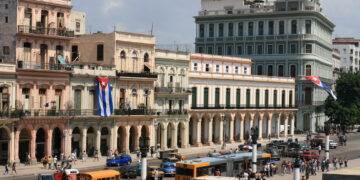
One of the top priorities in the Trump administration’s new National Security Strategy is to reestablish U.S. preeminence in the Western Hemisphere. Yet America’s policy toward Cuba remains mired in the past, a relic of Cold War thinking that does little to serve U.S. interests today.
As the Trump administration aims to update U.S. foreign policy for a new era, will it reform America’s antiquated approach to Cuba or double down on an ineffective policy?
In this Q&A, DEFP Fellow Daniel DePetris explains why our Cuba policy is due for a revision, how the longstanding embargo hurts U.S. economic interests, and what benefits would come from a U.S.-Cuba détente.
Why is U.S. policy toward Cuba still anchored in a Cold War framework and what threat does Cuba pose to the United States today?
With great power competition now the north star of U.S. foreign policy, U.S. officials are increasingly concerned about Cuba’s efforts to strengthen relations with China and Russia, Washington’s two biggest adversaries. This, combined with the continued influence of hardline domestic constituencies and a strong Cuban-American lobby that view any loosening of the U.S. embargo on the island as unjustifiable appeasement, helps explain why an ineffective U.S. policy on Cuba persists today.
READ THE EXPLAINERYet the reality is that Cuba poses little direct threat to U.S. national security. The Cuban military, already small in relation to the United States, is far less impressive than it was during the Cold War, when the Cuban government dispatched troops to select hotspots in Africa and Latin America to prop up Marxist governments there. The Cuban economy is in the doldrums, its energy shortages are severe, and its ability to project force is limited. Cuba’s threat comes from its weakness, leading to problems like irregular migration, rather than its strengths.
What is the real scope of China’s and Russia’s presence in Cuba, and how are U.S. assessments overstating the threat?
Although the Soviet Union retained a decades-long military presence in Cuba, those bases were vacated after the end of the Cold War. Russia’s military engagement with Cuba, such as its 2024 small-scale navy deployment to the island, is largely performative and designed more to retaliate against the United States for its support for Ukraine than to attempt to re-establish a durable presence there.
While China possesses surveillance sites in Cuba to monitor U.S. military activity in the Caribbean, this phenomenon is nothing new; states spy on each other as the normal course of doing business. Even so, the United States continues to inflate the threat Russia and China pose in the Western Hemisphere. This is not a surprise: big powers are traditionally paranoid about hostile competitors encroaching into their spheres of influence, even if the perception does not match the reality. Indeed, the Trump administration partly justified the capture of Venezuelan dictator Nicolás Maduro as an attempt to solidify U.S. dominance in the Western Hemisphere and undercut strategic rivals located in the region.
In what ways does the embargo harm U.S. economic interests?
The U.S. embargo was originally crafted to overthrow, and then weaken, the Cuban government’s capacity to govern itself. Yet after more than six decades, the policy has clearly failed. If anything, the embargo is proving to be an albatross around the United States, limiting U.S. business opportunities on an island only 90 miles south of Florida to the advantage of competitors in Europe and China.
Diplomatically, the embargo remains a constant irritant between the United States on one side and the rest of Latin America on the other, with the latter opposing it as a stale Cold War-era construct that punishes the Cuban people for the sins of their leaders. Geopolitically, the embargo provides Cuba with an even greater incentive to establish strategic ties with countries like China and Russia—resulting in the very great power competition in the Western Hemisphere that the United States aims to prevent.
What strategic benefits could a U.S.–Cuba détente realistically deliver?
A U.S.-Cuba detente or rapprochement won’t deliver groundbreaking economic or security concessions for the United States. Cuba, for instance, is highly unlikely to stop its symbolic military engagements with Russia or cease diplomatic relations with China. But there are at least four moral and practical benefits associated with policy reform.
- The United States will be able to chip away at the embargo, which remains one of the biggest substantive disagreements between Washington and the rest of the Western Hemisphere
- With improved U.S. ties a realistic possibility, Cuba will be able to better navigate great power politics instead of throwing its lot in with China and Russia.
- Fewer U.S. economic restrictions on the island could result in the growth of the Cuban private sector to the detriment of the state.
- The better U.S.-Cuba relations become, the more likely both sides can better manage the two issues in the Western Hemisphere the Trump administration cares about most: combating drug trafficking and managing illegal migration.
Author