In the coming weeks, the Trump administration is expected to release its Global Posture Review (GPR), which will evaluate the U.S. military posture around the world. As of 2025, over 200,000 U.S. servicemen are stationed at hundreds of U.S. bases, risking entanglements that could drag the United States into needless wars.
Will the Trump administration realign the U.S. global military footprint with U.S. national interests?
In this Q&A, Defense Priorities Director of Military Analysis Jennifer Kavanagh, who co-authored a recent DEFP explainer with Dan Caldwell on the GPR, details their recommendations for force posture changes that would better advance U.S. interests.
What is the purpose of the Global Posture Review?
The GPR is meant to take stock of how the United States positions its forces overseas and whether those deployments remain necessary, effective, and affordable. In essence, the GPR is about matching ends and means—assessing what the United States seeks to achieve in the world and determining the appropriate level of forward presence to support those objectives.
U.S. forces have been spread across the globe to respond to perceived threats and crises, often without much consideration for whether these missions advance core U.S. security. Once deployed, military forces often remain overseas, even after their original mission has concluded. As a result, American troops are engaged in a wide range of activities, many of which have little to do with protecting the homeland or deterring major threats. The GPR offers an opportunity to identify where military resources are being wasted and where they can be drawn down without undermining U.S. security.
Ultimately, the purpose of the GPR is not to prepare for every possible contingency but to ensure that U.S. military resources are matched to strategic priorities. By reviewing its global posture, the United States can concentrate its military presence where it matters most, reduce unnecessary obligations, and ensure that defense resources are used efficiently. The review is thus an essential step if the Pentagon hopes to implement a more disciplined strategy, one that resists the temptation of open-ended commitments and instead focuses on safeguarding the country’s most important national interests.
With its GPR, the Trump administration can refocus the U.S. global military footprint to better align it with American national interests, correcting the mistakes of recent decades that have led to an overextended military presence.
How did you approach the review? What principles guided your thinking?
My co-author, Dan Caldwell, and I approached the posture review with the aim of aligning U.S. global military deployments to a narrower definition of national interests. We started from the position that the United States is very secure. It has oceans on two sides and weak neighbors to the north and south. This means that a large forward military presence is not required to keep the homeland safe. When looking at the current global military footprint, we tried to assess where U.S. forces are required to serve core U.S. security needs and where they are unnecessary or involved in activities that create risks or work against U.S. interests.
Guiding our analysis were several principles that align with the Trump administration’s stated priorities:
- Placing homeland defense at the center of our recommendations and stressing that U.S. posture must ensure sufficient capacity to defend American territory, airspace, and borders.
- Highlighting the need to safeguard U.S. economic security, particularly by protecting access to vital waterways and natural resources.
- Focusing on preventing the rise of regional hegemons in Asia, Europe, and the Middle East.
- Advocating for shifting greater responsibility onto allies and partners, making clear that the United States should not indefinitely underwrite the defense of wealthy and capable states.
We set practical constraints on this approach. Assuming largely flat defense budgets, our recommendations are achievable without new, large spending commitments. We also considered only changes that could be realistically implemented within a single presidential term, acknowledging the time and logistical limits of shifting forces. The approach we provide assumes there will be no U.S. territorial expansion, keeping the focus on posture adjustments within existing commitments. Taken together, these principles and assumptions provide a strategic framework for reshaping U.S. global military posture.
What major changes did you recommend and how would they advance U.S. interests?
The vast majority of the U.S. forward deployed posture is in Europe, the Middle East, and Asia. (See our explainer for recommendations on other regions and missions.) Here’s what we recommend in those regions:
- Europe: The recommended posture changes in Europe would reduce the U.S. military presence there by 40–50 percent, essentially returning the footprint to pre-2014 levels. This would involve withdrawing three brigade combat teams, a combat aviation brigade, and associated headquarters units, along with canceling the planned deployment of a multi-domain task force. Airpower and naval forces would be cut in half, including the reduction of fighter squadrons from seven to four and destroyers in Rota from six to three. These adjustments would conserve resources, push European allies to assume primary responsibility for their own defense, and free up high-demand capabilities for use in Asia or homeland defense. The drawdown reflects the reality that Russia does not pose a major conventional threat to the United States and that Europe, wealthy and technologically advanced, is capable of defending itself.
- Middle East: We call for removing U.S. forces from Syria, Iraq, and Kuwait, closing Al-Udeid airbase in Qatar, and reducing the overall U.S. footprint by roughly two-thirds. Surge forces deployed after October 7, 2023—including extra fighter squadrons, air defenses, and carrier strike groups—would be returned home or shifted to Asia. Naval posture would also be reduced, with an end to the frequent rotational deployments of carriers in the Persian Gulf and Mediterranean Sea. Most importantly, these changes would end legacy deployments from the post-9/11 era which are now unnecessary and expose U.S. forces to continued risk. They would also make the United States more resilient to ongoing instability and conflict in the region and reduce the chance that the United States gets pulled into crises like the Israel-Iran war that occurred in June 2025. At the same time, a smaller but capable presence of submarines, naval forces at Bahrain, limited rotational air deployments, and the smaller number of ground forces that would remain in the Gulf would enable the United States to respond to crises that directly affect its core interests.
- Asia: Here our recommendations shift U.S. posture toward resilience and survivability while shifting more responsibilities for frontline defense to allies. The United States would not withdraw from the region but would move its forces away from high-risk locations on the first island chain in favor of locations along the second island chain. Since these forces would be highly vulnerable in any war with China, this move would strengthen rather than weaken the U.S. strategic position. U.S. forces in South Korea would be cut by more than half, leaving about 10,000 personnel focused on logistics and support roles while Seoul assumes primary responsibility for its own defense. In Japan, the most significant changes would be an expedited move of 9,000 Marines out of Okinawa, the relocation of some fighter squadrons farther north, and a reduction of the vulnerable footprint on the island. At the same time, the U.S. presence along the second island chain would expand, including more submarines forward-based in Australia under AUKUS. Trainers would be withdrawn from Taiwan to avoid unnecessary escalation. These steps would disperse U.S. forces to more defensible positions and ensure U.S. posture is better aligned with a sustainable balancing strategy in the Indo-Pacific.
Summary of recommended posture changes
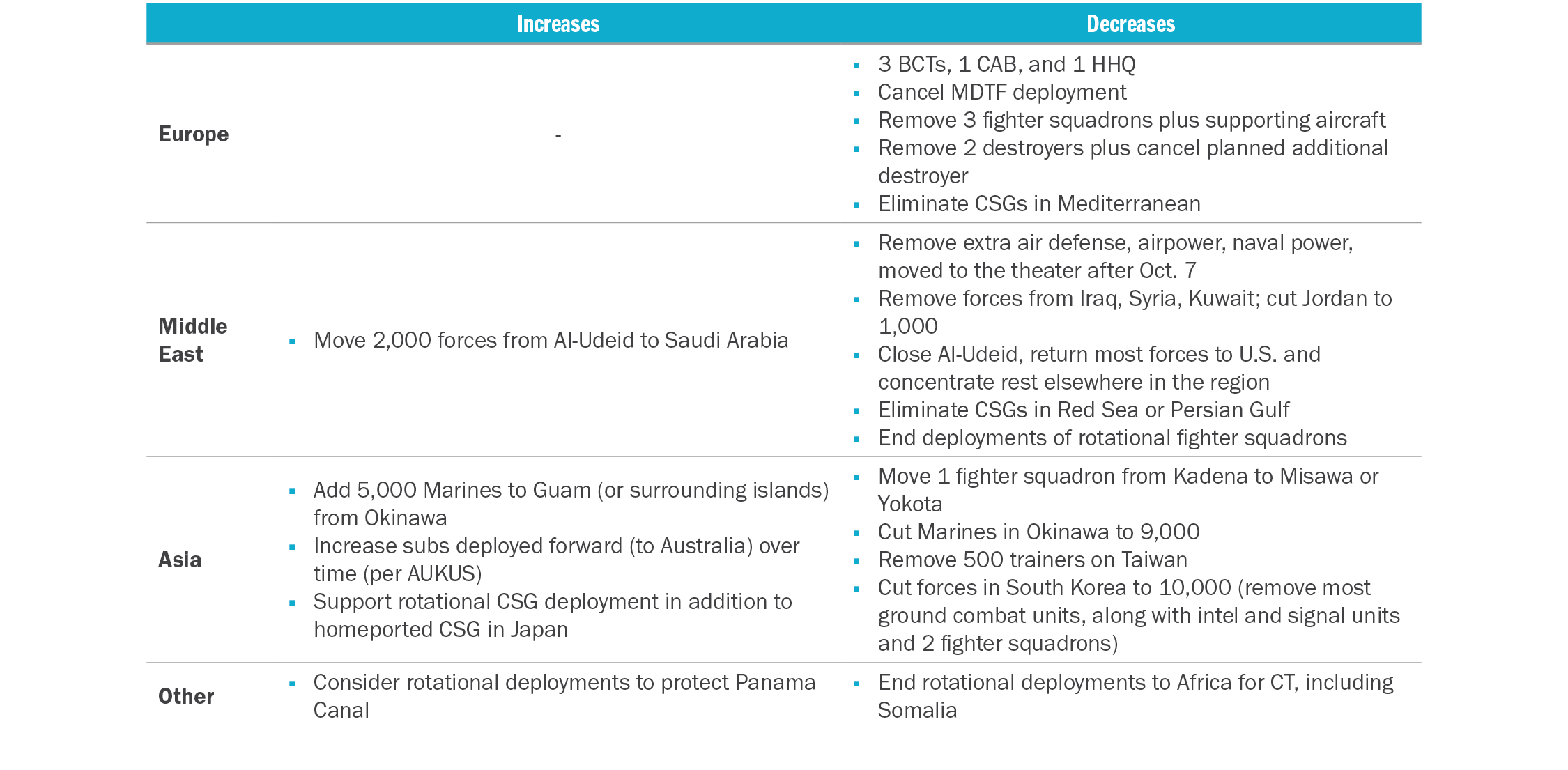
Our recommendations do not constitute an end point, so this could be just the first round of cuts to be followed by additional reductions.
What happens next? What should observers watch for as the real GPR comes out?
The GPR is a classified document but usually Pentagon officials will provide the public with a summary of major conclusions and planned moves. In 2021, very few changes were made. This time, most observers expect that adjustments will be made to force posture. Some reductions to the U.S. ground force presences in Europe and the Middle East are likely, as is a reduced focus on rotational missions in Africa. Changes to the U.S. military footprint in South Korea are also possible, though this might include updates to the types of forces based there rather than simply a reduction. It is also likely that the GPR will include changes to the U.S. military footprint in Latin America, though this may be comprised primarily of rotational air and naval forces for now.
Another thing to look for is any indication on the timing of planned changes. Are they staggered over the three remaining years of Trump’s term? Or will they occur quickly, leaving time for more modifications later? The Pentagon may signal aspirations for the future where they hope to make or seize opportunities for more adjustments. For instance, some defense leaders hope to find more locations to base U.S. forces in Asia while others may anticipate further drawdowns in Europe or the Middle East if conflicts in either region draw to a close.
Author

The Latest




Events on Military analysis