Key points
- As the Trump administration renews negotiations with Iran amidst a massive U.S. military buildup in the Middle East, U.S. policymakers face a critical choice: focus exclusively on reaching a new nuclear deal or pursue a much more comprehensive agreement.
- U.S. interests are best served by a narrow, nuclear-only diplomatic approach. Iran’s present weakness creates an opportunity for the United States to negotiate stronger nuclear restrictions—but only if Washington avoids overloading the talks with extraneous demands.
- Military action would not durably achieve any negotiating objectives at acceptable cost and would eliminate the possibility of a robust verification regime that could provide transparency into Iran’s nuclear activities.
- Nuclear proliferation by Iran, while undesirable, is not imminent. A strengthened nuclear agreement would reduce proliferation risks, a beneficial outcome because additional nuclear-armed states increase the statistical probability of nuclear use or accident.
- Critically, the United States does not need to confront Iran and should prefer diplomatic disengagement to military conflict if negotiations fail.
What type of deal?
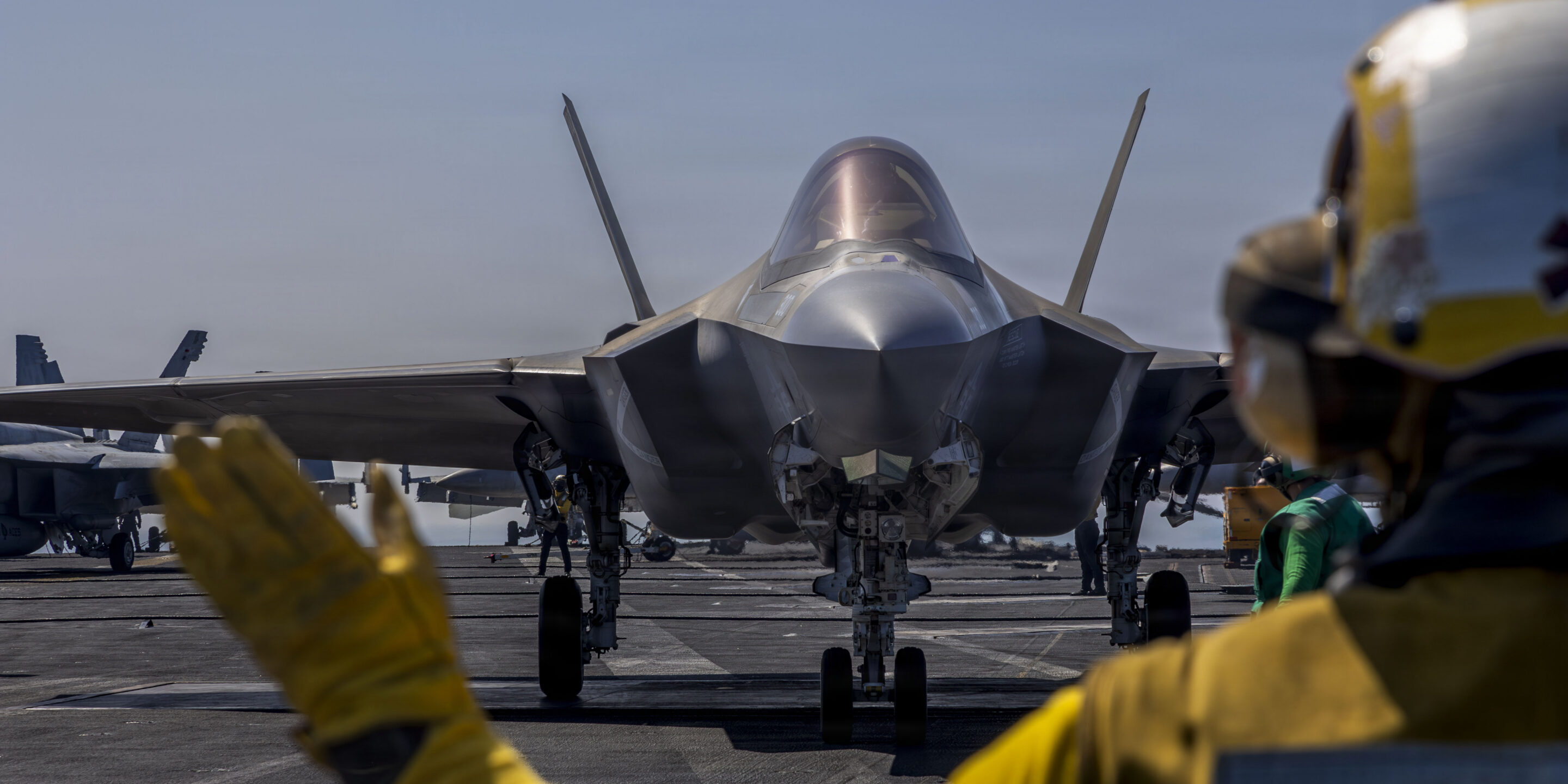
Renewed U.S.-Iran talks are underway as President Donald Trump assembles U.S. forces in the Middle East to pressure the Islamic Republic. Two aircraft carrier strike groups—the USS Abraham Lincoln and the USS Gerald R. Ford—along with dozens of warships and an estimated 15,000 additional service members now constitute the largest American military buildup in the region since the 2003 Iraq War.1Filip Timotija, “Trump’s ‘Massive Armada’ near Iran Mirrors Military Buildup in Caribbean,” Hill, January 31, 2026, https://thehill.com/policy/defense/5715910-us-military-iran-options/; Lara Seligman et al., “U.S. Gathers the Most Air Power in the Mideast Since the 2003 Iraq Invasion,” Wall Street Journal, February 19, 2026, https://www.wsj.com/world/middle-east/u-s-gathers-the-most-air-power-in-the-mideast-since-the-2003-iraq-invasion-98ced89f. Iran is entering negotiations from a position of historic vulnerability, with its nuclear infrastructure severely damaged, its economy in freefall, and its regime shaky after it brutally repressed nationwide protests in January 2026.
Trump’s exact objectives in confronting Iran are not clear, but four potential goals have emerged in policy discussions: (1) preventing Iran from attaining nuclear weapons; (2) securing limits on Iran’s ballistic missile capabilities; (3) compelling Iran to sever ties with militant groups like Hamas and Hezbollah; and (4) encouraging domestic political transformation, meaning regime change. U.S. negotiators must now decide whether to pursue a comprehensive agreement covering all of these issues or a nuclear-first agreement that focuses on achievable limitations on Iranian nuclear activities.
President Trump has said that a nuclear-only agreement with Iran could be “acceptable.”2Andrew England et al., “Trump Praises ‘Very Good’ Talks with Iran but Warns of ‘Steep’ Consequences,” Financial Times, February 6, 2026, https://www.ft.com/content/5edc63d6-8870-426e-9397-0d64d288aca4. But some members of his administration, as well as Israeli Prime Minister Benjamin Netanyahu, have insisted that any deal must also encompass issues like ballistic missiles and the elimination of Iranian support to regional militants.3Jacob Magid, “Rubio Says US Ready to Meet Iran but Missiles, Proxies, Repression Must Be on Table,” Times of Israel, February 4, 2026, https://www.timesofisrael.com/liveblog_entry/rubio-says-us-ready-to-meet-iran-but-missiles-proxies-repression-must-be-on-table/; Steven Scheer, “Israel’s Netanyahu Says Trump May Be Creating Conditions for Iran Deal,” Reuters, February 12, 2026, https://www.reuters.com/world/middle-east/israels-netanyahu-says-trump-may-be-creating-conditions-iran-deal-2026-02-12/. Iran has declared an openness to major nuclear concessions but has stated that its missile program is a red line.4“Iran Says It Won’t Negotiate over Its Missile Capabilities,” Reuters, February 11, 2026, https://www.reuters.com/world/middle-east/iran-says-it-wont-negotiate-over-its-missile-capabilities-2026-02-11/. Insisting on a maximalist agenda is therefore a recipe for negotiations to fail, creating a possible pretext for war.
This paper considers which objectives genuinely serve U.S. national security and how achievable each objective is through military versus diplomatic means. It finds that maximalist demands incorporating all objectives serve neither strategic logic nor American security. Iran views its nuclear program, ballistic missiles, and support for militant groups as key instruments of an asymmetric strategy to deter attacks from conventionally superior opponents, especially the United States and Israel.5Vali Nasr, Iran’s Grand Strategy: A Political History (Princeton: Princeton University Press, 2025). It will not simultaneously relinquish all three.
Instead, the U.S. should pursue a nuclear-exclusive framework building on a proposal put forward by mediators from Qatar, Turkey, and Egypt that contains stricter provisions than the Obama-era Joint Comprehensive Plan of Action (JCPOA) agreement. A strong nuclear deal could pave the way for better U.S.-Iran relations, which in time could ameliorate the high-insecurity threat perceptions that drive Iran to build missiles and support militant groups in the first place.
Iran’s vulnerability affords the United States significant leverage to secure a strong nuclear deal, but only if Washington focuses on the nuclear file rather than overloading talks with additional priorities. If an agreement proves impossible, the United States should walk away from confrontation rather than resort to military force against a country that cannot threaten the American homeland.
The nuclear deal: A real, if limited, American interest
Concerns about Iran’s nuclear activities justify reasonable diplomatic efforts to prevent Iranian weaponization, but do not warrant costly and risky military action.
The danger of Iranian proliferation is generally overstated. There are no indications that Iran is on the cusp of building nuclear weapons. In March 2025, U.S. intelligence determined that Iran lacked a weaponization program and would need at least a year to develop the capacity to build a bomb. This was before U.S. airstrikes on Natanz, Fordo, and Isfahan during the 12-Day War severely damaged Iranian uranium enrichment facilities, potentially setting Iran’s nuclear program back even further.6“DNI Gabbard Opening Statement for the SSCI As Prepared on the 2025 Annual Threat Assessment of the U.S. Intelligence Community,” Office of the Director of National Intelligence, March 25, 2025, https://www.dni.gov/index.php/newsroom/congressional-testimonies/congressional-testimonies-2025/4059-ata-opening-statement-as-prepared; Julian E. Barnes et al., “In New Assessment, C.I.A. Chief Says U.S. Strikes ‘Severely Damaged’ Iranian Program,” New York Times, June 26, 2025, https://www.nytimes.com/2025/06/25/us/politics/trump-iran-nuclear.html; Lara Seligman and Michael R. Gordon, “Pentagon Says U.S. Strikes Delayed Iran’s Nuclear Program by Up to Two Years,” Wall Street Journal, July 2, 2025, https://www.wsj.com/world/middle-east/pentagon-says-u-s-strike-delayed-irans-nuclear-program-by-up-to-two-years-8d51eb81. Iran has neither rebuilt the damaged nuclear sites nor resumed uranium enrichment since the attacks.7Samuel Granados and Aurelien Breeden, “Iran Is at Work on Missile and Nuclear Sites, Satellite Images Show,” New York Times, February 6, 2026, https://www.nytimes.com/2026/02/06/world/middleeast/iran-missile-nuclear-repairs.html. Thus, at present, the threat of Iranian proliferation remains remote, not imminent.
Nuclear proliferation is less common and less destabilizing than conventional wisdom suggests. During the Cold War, predictions of proliferation by dozens of states proved dramatically wrong.8Scott D. Sagan, “Why Do States Build Nuclear Weapons? Three Models in Search of a Bomb,” International Security 21, no. 3 (1996): 54–86. States that did acquire weapons—including U.S. adversaries like China and the Soviet Union—arguably became more cautious in their behavior, not less. New nuclear states tend to adopt conservative postures focused on deterrence rather than aggression.9Kenneth N. Waltz, “More May Be Better” in The Spread of Nuclear Weapons: An Enduring Debate, 3rd. Ed. (New York: Norton, 2013). Concerns about regional proliferation cascades if Iran obtained the bomb are similarly overstated. Saudi Arabia, Turkey, and Egypt face significant barriers to weaponization.10Colin H. Kahl, Raj Pattani, and Jacob Stokes, “If Iran Gets the Bomb: Regional Proliferation Scenarios,” Washington Quarterly 36, no. 3 (Summer 2013): 51–67.
Nevertheless, the United States has legitimate reasons to prefer that Iran not acquire nuclear weapons. The concern is not that Iranian weapons would enable aggressive expansionism or nuclear blackmail—the supposed threat of nuclear emboldenment is a mirage. The scholarship is unambiguous: nuclear weapons do not offer coercive leverage beyond deterrence from attack.11Todd S. Sechser and Matthew Fuhrmann, Nuclear Weapons and Coercive Diplomacy (Cambridge: Cambridge University Press, 2017). Nor does Iran have missiles capable of delivering nuclear weapons to the Western Hemisphere.12Dan Caldwell and Simone Ledeen, “Debate: Should the U.S. intervene in Iran,” Free Press, June 16, 2025, https://www.thefp.com/p/debate-should-the-us-intervene-in. Superior U.S. military capabilities would deter aggressive behaviors, as they have with other nuclear-armed states like Russia and North Korea.
Rather, the problem is statistical. Each additional nuclear-armed state increases the number of fingers on nuclear triggers, which in turn raises the probability of nuclear use through accident, miscalculation, unauthorized launch, or crisis escalation.13Scott D. Sagan, “More Will Be Worse” in The Spread of Nuclear Weapons: An Enduring Debate, 3rd. Ed. (New York: Norton, 2013). The U.S.-Soviet experience during the Cold War demonstrates just how dangerous and common nuclear accidents can be.14Eric Schlosser, “World War Three, By Mistake,” New Yorker, December 23, 2016, https://www.newyorker.com/news/news-desk/world-war-three-by-mistake. That is reason alone for the U.S. preference to avoid the further spread of nuclear weapons.
Additionally, no state—including the United States—wants to see potential adversaries increase their relative military capabilities by acquiring nuclear weapons, even if U.S. capabilities remain far superior. States prefer to maximize their relative power because that is the best route to achieving security in the competitive international system.15John J. Mearsheimer, The Tragedy of Great Power Politics (New York: Norton, 2001), 32–36.
The U.S. has a historic opportunity to negotiate a significantly more restrictive nuclear deal than the JCPOA, reflecting Iran’s weakened position. The JCPOA agreement capped enrichment at 3.67 percent, but only for 15 years.16“Factbox: The Atomic Restrictions Imposed by the Iran Nuclear Deal,” Reuters, June 26, 2019, https://www.reuters.com/article/world/us-politics/factbox-the-atomic-restrictions-imposed-by-the-iran-nuclear-deal-idUSKCN1TR1IT/. The framework proposed by Qatar, Turkey, and Egypt is stronger: a three-year halt on all uranium enrichment, after which enrichment would be limited to below 1.5 percent in perpetuity with no apparent sunset clauses.17Virginia Pietromarchi, “Mediators Propose Framework for Crucial Iran-US Talks This Week,” Al Jazeera, February 4, 2026, https://www.aljazeera.com/news/2026/2/4/mediators-propose-framework-for-crucial-iran-us-talks-this-week. The deal also includes the transfer of Iran’s highly enriched uranium stockpile out of the country. In exchange, the United States would provide phased sanctions relief tied to verified compliance and, perhaps eventually, economic normalization.
A successful nuclear-only agreement would restore the IAEA verification infrastructure—the best way to ensure that Iran would never build a nuclear bomb. It would create momentum toward broader détente, reducing the risk of recurring crisis. And it would provide Washington with leverage to restrain Israeli military actions that might trigger a regional war.
This last point deserves emphasis. If the United States concludes a nuclear agreement with Iran, it acquires a substantial interest in preventing developments that might collapse the deal. Israeli airstrikes against Iran would represent precisely such a destabilizing development, giving Washington both motivation and justification to demand Israeli restraint. A nuclear agreement thus serves as a tool for managing not only the Iranian threat but also the risk of unilateral Israeli escalation that could drag the United States into an unwanted war.
Military action cannot durably achieve U.S. nuclear objectives. Airstrikes can set back Iran’s program but cannot eliminate the knowledge, infrastructure, or national will to rebuild.18Carlo J. V. Caro, “Why Iran’s Nuclear Program Cannot Be Dismantled from the Air,” Cipher Brief, June 18, 2025, https://www.thecipherbrief.com/iran-nuclear-airstrikes; Mark F. Cancian and Chris H. Park, “Disentangling the Five Key Questions on Iran’s Nuclear Program,” Center for Strategic and International Studies, July 2, 2025, https://www.csis.org/analysis/disentangling-five-key-questions-irans-nuclear-program; Doreen Horschig, “Why Striking Iranian Nuclear Facilities Is a Bad Idea,” Center for Strategic and International Studies, October 25, 2024, https://www.csis.org/analysis/why-striking-iranian-nuclear-facilities-bad-idea. Verifying dismantlement requires boots on the ground. Far better that they belong to IAEA inspectors in peacetime than U.S. troops in the chaos of war.
Iran’s battered nuclear infrastructure and economic isolation, along with Trump’s demonstrated willingness to use force, give Washington significant leverage to acquire a tough deal. The United States should seize this opening—but doing so requires focusing leverage on the nuclear file rather than dissipating it across secondary issues.
Missile caps
Limitations on Iran’s missile program should not be a high priority for U.S. negotiations because Iranian missiles do not meaningfully threaten the United States. Iran only builds short- and medium-range missiles with ranges that top out at 1,550 miles (2,500 km).19Elwely Elwelly, “What Are Iran’s Ballistic Missile Capabilities?” Reuters, February 4, 2026, https://www.reuters.com/business/aerospace-defense/what-are-irans-ballistic-missile-capabilities-2026-02-04/. U.S. intelligence has estimated that Iran would need at least 10 years to develop the capabilities to produce militarily viable intercontinental ballistic missiles (ICBMs) should it undertake such a program, but nothing indicates it has done so.20Daniel M. Gettinger and Thomas Clayton, Iran’s Ballistic Missile Programs: Background and Context, In Focus, Library of Congress, June 17, 2025, https://www.congress.gov/crs-product/IF13035.
Iranian missiles can reach U.S. military installations in the Middle East—but then that is another reason to reconsider those bases. Heavy forward basing is costly, risky, and ultimately unnecessary to achieve limited U.S. interests in the region.21Dan Caldwell and Jennifer Kavanagh, “The Iran Strike Shows We Don’t Need Bases in the Middle East,” Washington Post, June 28, 2025, https://www.washingtonpost.com/opinions/2025/06/28/iran-strike-american-military-vulnerability/; Jennifer Kavanagh and Dan Caldwell, “Aligning Global Military Posture with U.S. Interests,” Defense Priorities, July 9, 2025, https://www.defensepriorities.org/explainers/aligning-global-military-posture-with-us-interests/. Instead, the U.S. should adopt an over-the-horizon military posture for multiple reasons, including to reduce the political backlash created by large military footprints.22Eugene Gholz and Daryl G. Press, “Footprints in the Sand,” American Interest, March 1, 2010, https://www.the-american-interest.com/2010/03/01/footprints-in-the-sand/.
More broadly, Iran is deterrable and has been deterred from attacking U.S. forces in the Middle East. Iran has never started a war against any country since at least the dawn of the twentieth century. It has only fired missiles in direct retaliation, whether against Saddam Hussein’s Iraq, Israel, or the United States. Even after the U.S. struck its nuclear facilities during the 12-Day War, Iran’s response was calibrated and limited. Its strike on the U.S. base at Al Udeid in Qatar was telegraphed in advance and produced no American casualties—a clear signal that Tehran sought to avoid escalation with the United States even under duress. This behavior is consistent with decades of evidence that Iran acts as a rational regional power that responds to incentives and constraints, despite its aggressive rhetoric.
Iranian missiles represent a greater challenge to Israel than to the United States, given Israel’s closer proximity to Iran, but Israel is very capable of deterring Iranian missile threats. Like the U.S., Israel has a robust nuclear deterrent and its conventional capabilities are superior to Iran’s. Iran has only used missiles against Israel in direct retaliation against Israeli strikes on Iranian soil or strikes that killed top Iranian commanders abroad.23Michael Eisenstadt, “Iran’s Retaliation: Choreography, Escalation Management, and the Mirage of ‘All-Out’ War,” Washington Institute for Near East Policy, June 25, 2025, https://www.washingtoninstitute.org/policy-analysis/irans-retaliation-choreography-escalation-management-and-mirage-all-out-war; Benjamin Jensen and Yasir Atalan, “Iran’s Options for Retaliating Against Israel,” Center for Strategic and International Studies, June 13, 2025, https://www.csis.org/analysis/irans-options-retaliating-against-israel.
Though seemingly an offensive capability, Iran’s missile program actually serves a deterrence function—which is why Iran is loath to compromise it.24Nasr, Iran’s Grand Strategy, 207–209. Iran’s pursuit of ballistic missiles began during the Iran-Iraq War, when Iraqi Scud attacks on Iranian cities killed thousands of civilians and Tehran had no means to respond in kind. The trauma of the so-called “War of the Cities” remains a foundational memory in Iranian strategic culture and a powerful driver of the regime’s insistence on retaining a retaliatory missile capability.25Michael Eisenstadt, The Role of Missiles in Iran’s Military Strategy, Research Note 39, Washington Institute for Near East Policy, 2016, https://www.washingtoninstitute.org/policy-analysis/role-missiles-irans-military-strategy. Iran lacks the resources to compete with American or Israeli conventional military capabilities and can neither adequately defend its territory nor its airspace. It has no missile defense interceptors akin to U.S. THAAD or Patriot batteries. Its rudimentary air defenses performed so poorly during the 12-Day War that Israel established air superiority over the country within a few days.26Sam Lair, “Shallow Ramparts: Air and Missile Defenses in the June 2025 Israel-Iran War,” Foreign Policy Research Institute, October 17, 2025, https://www.fpri.org/article/2025/10/shallow-ramparts-air-and-missile-defenses-in-the-june-2025-israel-iran-war/.
Iran’s air force, composed mainly of vintage U.S.-made F-4, F-5, and F-14 fighters that predate the 1979 Islamic Revolution and Cold War-era MiG-29s, has been characterized by experts as a “flying museum.”27Anna Ahronheim, “Iran’s Air Force Receives Batch of Russian MiG-29s,” Jerusalem Post, September 24, 2025, https://www.jpost.com/defense-and-tech/article-868452; Jasim Al-Azzawi, “From Rust to Rockets: The Battle to Modernise Iran’s Legacy Air Force,” Middle East Monitor, August 1, 2025, https://www.middleeastmonitor.com/20250801-from-rust-to-rockets-the-battle-to-modernize-irans-legacy-air-force/. Actually, “non-flying museum” might be more apt—Iran grounded its air force during the 12-Day War to avoid near-certain destruction by advanced Israeli and U.S. fighters.28David Rising and Sam Metz, “Iran’s Military Degraded by 12-Day War with Israel, But Still Has Significant Capabilities,” AP News, February 13, 2026, https://apnews.com/article/iran-israel-us-trump-military-carrier-war-931c25411eeef7d8cee679b3544b792a.
U.S. military force can temporarily degrade Iran’s missile capabilities but cannot eliminate them entirely. Short- and medium-range ballistic missiles are relatively uncomplicated to build and Iran has mastered the technology to do so. With a multitude of production sites distributed widely across the country, Iran can rapidly reconstitute its missile capabilities even after heavy losses.29Can Kasapoğlu, “Tehran Reloads: Examining the Current and Future Threat of Iran’s Missile Programs,” Hudson Institute, February 5, 2026, https://www.hudson.org/missile-defense/tehran-reloads-examining-current-future-threat-irans-missile-programs-can-kasapoglu; Yaakov Lappin, “Iran – Situation Assessment (February 2026): The Race to Rebuild the Nuclear and Missile Array, Casual Terror and the CRINK,” Alma Research and Education Center, February 17, 2026, https://israel-alma.org/iran-situation-assessment-february-2026-the-race-to-rebuild-the-nuclear-and-missile-array-casual-terror-and-the-crink/.
The 12-Day War demonstrated Iran’s capacity to rebuild. During that conflict, Iran fired approximately 550 ballistic missiles and Israel destroyed roughly two-thirds of Iran’s mobile launchers, reducing its arsenal from an estimated 2,500 missiles and 480 launchers to between 1,000 and 1,200 missiles and approximately 100 serviceable launchers.30Lappin, “Iran – Situation Assessment (February 2026).” Yet satellite imagery suggests that underground missile infrastructure survived intact and major launch bases show clear signs of reconstruction.31Colin David and Tal Beeri, “Iran – The Main Launch Bases for Medium-Range Ballistic Missiles – Damage Assessment and Scope of Restoration (January 2026),” Alma Research and Education Center, February 11, 2026, https://israel-alma.org/iran-the-main-launch-bases-for-medium-range-ballistic-missiles-damage-assessment-and-scope-of-restoration-january-2026/. By November 2025, Israeli security officials estimated that Tehran had restocked its arsenal to 2,000 missiles capable of reaching Israel.32Melissa Bell and Gianluca Mezzofiore, “Western Intelligence Says Iran Is Rearming despite UN Sanctions, with China’s Help,” CNN, October 29, 2025, https://www.cnn.com/2025/10/29/middleeast/iran-rebuilding-ballistic-weapons-program-intl; Elad Benari Canada, “Report: Iran Nears 2,000 Missiles, Restoring Arsenal after Rising Lion,” Israel National News, November 21, 2025, https://www.israelnationalnews.com/news/418161.
Iran developed its missile capabilities to provide deterrent value against vastly superior adversaries like the U.S. and Israel. Demanding that Iran dismantle capabilities that serve as its primary deterrent—while offering no compensating security guarantees—is not a serious negotiating position.
The Gulf mediators’ framework proposes a pledge to not initiate missile use—a meaningful confidence-building measure—rather than the wholesale dismantlement Iran will not accept. Iran might eventually agree to cosmetic limits—pledging not to produce long-range missiles it has never planned to build, for example—but that is at best a long-term negotiation point, not a matter of urgency for the present crisis.
Militant groups: A marginal impact on U.S. security
Iranian support for militant groups like Hamas, Hezbollah, Iraqi militias, and the Houthis is repugnant, but it primarily creates problems for Israel rather than the United States. None of these actors have demonstrated the capability or intent to strike the U.S. homeland. U.S. military personnel in the region have been repeatedly targeted by militias linked to Iran, thankfully with few casualties, but as with missiles, the best solution to the challenge is to reduce the bloated U.S. military presence in the Middle East, not threaten a war with Iran.33Nick Turse, “The U.S. Has Dozens of Secret Bases Across the Middle East. They Keep Getting Attacked,” The Intercept, August 6, 2024, https://theintercept.com/2024/08/06/secret-military-bases-middle-east-attacks/.
Moreover, the idea that the U.S. should demand the severance of Iranian ties to regional militants fundamentally misreads Iran’s relationships with these groups and ignores the substantial verification problems attendant with any agreement that incorporates such provisions.
The standard framing of Hezbollah, Hamas, and the Houthis as “Iranian proxies” suggests a centralized command-and-control relationship that does not exist. These organizations emerged spontaneously from local political conditions, not Iranian design. Hezbollah grew out of the Israeli invasion of Lebanon in 1982; Hamas was founded by Palestinian Islamists in 1987 during the first intifada; the Houthis arose from a domestic insurgency against Yemen’s central government.34“What Is Hamas? What to Know about Its Origins, Leaders and Funding,” PBS News, October 13, 2023, https://www.pbs.org/newshour/world/what-is-hamas-what-to-know-about-its-origins-leaders-and-funding; Bruce Riedel, “Who Are the Houthis, and Why Are We at War with Them?” Brookings Institution, December 18, 2017, https://www.brookings.edu/articles/who-are-the-houthis-and-why-are-we-at-war-with-them/; What Is Hezbollah and Why Has It Been Fighting Israel in Lebanon?, BBC, February 14, 2025, https://www.bbc.com/news/world-middle-east-67307858. Iran cultivated relationships with these actors on the basis of shared adversaries and, in some cases, shared religious identity.35Afshon Ostovar, “The Grand Strategy of Militant Clients: Iran’s Way of War,” Security Studies 28, no. 1 (2019). But alignment is not control. These groups maintain independent command structures, pursue their own political agendas, and have repeatedly acted in ways Tehran neither authorized nor desired.
The distinction has practical consequences. If the United States demands that Iran stop supporting militant groups, what would compliance look like? Iran could halt weapons shipments, cut funding, and withdraw Islamic Revolutionary Guard Corps (IRGC) advisers—and Hezbollah, the Houthis, and Hamas would continue to exist. These organizations have independent revenue, deeply rooted domestic constituencies, and some indigenous manufacturing capabilities.36Fabian Hinz, “Made in Yemen? Assessing the Houthis’ Arms-Production Capacity,” International Institute for Strategic Studies, April 10, 2025, https://www.iiss.org/online-analysis/missile-dialogue-initiative/2025/04/made-in-yemen-assessing-the-houthis-arms-production-capacity/. They do not require Iranian permission to operate.
Nuclear nonproliferation agreements are viable because their provisions can be monitored by rigorous third-party inspections: centrifuges can be counted, enrichment levels measured, stockpiles weighed. None of this applies to relationships between a state and nonstate actors. How would inspectors confirm that the IRGC is no longer advising Houthi commanders? If Hamas launches an attack on Israel after a deal is signed, how would Washington determine whether Iran authorized, facilitated, or merely failed to prevent it? The ambiguity inherent in clandestine relationships means that any militant attack could trigger a political crisis over Iranian compliance—regardless of whether Iran was actually involved.
If the administration wants to reduce Iranian support for terrorism despite the challenges monitoring compliance, it should pursue the objective through a separate diplomatic track rather than load it onto nuclear negotiations. Achievable nuclear restrictions should not be sacrificed for unachievable objectives. Nor should Trump repeat the mistakes of past administrations by prosecuting a new Global War on Terrorism (GWOT) with Iran as its target.
Regime change: Neither achievable nor necessary
The January 2026 protests in Iran, which were met with a deadly government crackdown that killed thousands, have created an opening for Iran hawks to argue that the regime is fragile and ripe for toppling. But the history of U.S. involvement in Iranian politics—from the 1953 CIA-backed coup against Mohammad Mossadegh to decades of sanctions—suggests that American intervention is more likely to rally domestic support for the regime than to undermine it.
The notion that military action could catalyze favorable regime change rests on assumptions discredited by recent history. The 2003 Iraq invasion, which cost the U.S. trillions of dollars and thousands of casualties, produced years of sectarian violence and a Shia-dominated government closely aligned with Iran.37Ali A. Allawi, The Occupation of Iraq: Winning the War, Losing the Peace (New Haven: Yale University Press, 2007), 387–419. Military intervention rarely produces stable democracies, and in fact every American-backed regime change attempt in the Middle East has yielded results contrary to U.S. interests.38Alexander B. Downes and Jonathan Monten, “Forced to Be Free? Why Foreign-Imposed Regime Change Rarely Leads to Democratization,” International Security 37, no. 4 (Spring 2013): 90–131; Philip H. Gordon, Losing the Long Game: The False Promise of Regime Change in the Middle East (New York: St. Martin’s Press, 2020).
Not only is the regime change fantasy dangerous, but so is its rhetoric. Trump’s recent statement that regime change “would be the best thing that could happen” in Iran risks jeopardizing the negotiations by undermining U.S. assurances that it will not attack Iran in the future after it hands over nuclear materials as part of a deal.39“Trump Says Regime Change ‘Best Thing That Could Happen’ In Iran,” Radio Free Europe/Radio Liberty, February 14, 2026, https://www.rferl.org/a/trump-aircraft-carrier-ford-iran-nuclear-armada/33677882.html; Jennifer Kavanagh and Rosemary Kelanic, “The Real Obstacle to Peace With Iran,” Foreign Affairs, June 25, 2025, https://www.foreignaffairs.com/iran/iran-nuclear-kavanagh-kelanic. Threatening regime change against Iran is therefore completely counterproductive to Trump’s other goals, most notably a sensible nuclear deal.
Regime change in Iran is also unnecessary for American security. The Iranian regime may be thuggish toward its own people, but its external behavior has been rational and self-preservatory.40Kenneth N. Waltz, Theory of International Politics (New York: McGraw-Hill, 1979). A nuclear agreement requires only that Iran reliably implement technical restrictions, not that it become a liberal democracy.
If the goal is to empower the Iranian people to transform their government, the most effective tool is an economic opening through a nuclear deal that strengthens regime moderates, not military threats that allow hardliners to claim the nation is under siege.
The U.S. doesn’t need to confront Iran
Iran’s vulnerability gives the United States an opening to secure nuclear restrictions that surpass any previous agreement. The Gulf mediators’ framework—a full enrichment pause, the removal of highly enriched uranium, enhanced inspections, and a nonaggression pact—provides the right starting point. This is not a return to the JCPOA; it is a significantly stronger arrangement made possible by Iran’s weakened position and America’s demonstrated willingness to use force.
If Trump succeeds, then the administration can credibly claim to have achieved what its predecessors could not—a deal that genuinely forecloses Iran’s path to the bomb rather than merely slowing it down. But achieving this requires discipline: focusing leverage on the nuclear objective rather than diffusing it across secondary issues like missile caps, terrorism funding, and domestic regime behavior.
The administration should recognize that Iran’s flexibility on nuclear issues does not extend to other matters and should exploit the opening where it exists. Iran will not surrender all three core pillars of its deterrence strategy. No state would. Insisting on all demands guarantees getting none. The nuclear-only approach avoids this trap by pursuing the one objective that is both genuinely important to U.S. security and realistically attainable.
The ongoing U.S.-Iran talks present a real opportunity for a transformational nuclear deal, but if negotiations fail, the United States should walk away from confrontation rather than escalate to military force. Trump manufactured the current crisis by parking large U.S. military forces offshore of Iran—and he can offramp from it just as swiftly. There was no imminent security threat that prompted a U.S.-Iran standoff. The juncture at which Trump has dangerously positioned the United States is completely optional.
Critics might argue that walking away from confrontation with Iran after Trump’s military buildup could hurt U.S. credibility. But credibility not backed by actual U.S. security interests is no credibility at all.41M. Walt, “America Has an Unhealthy Obsession with Credibility,” Foreign Policy, January 29, 2022, https://foreignpolicy.com/2022/01/29/us-credibility-ukraine-russia-grand-strategy/. It would be wrongheaded and deeply irresponsible for any president to risk the lives of U.S. soldiers purely to “maintain credibility.” Choosing not to use force reflects strategic wisdom, not weakness.
The United States does not need to confront Iran. Washington can maintain deterrence through its existing regional posture, support the defensive capabilities of partners genuinely threatened by Iranian activities, and pursue diplomatic opportunities when they arise. It can refuse to be drawn into conflicts that serve neither American interests nor strategic logic.
Endnotes
- 1Filip Timotija, “Trump’s ‘Massive Armada’ near Iran Mirrors Military Buildup in Caribbean,” Hill, January 31, 2026, https://thehill.com/policy/defense/5715910-us-military-iran-options/; Lara Seligman et al., “U.S. Gathers the Most Air Power in the Mideast Since the 2003 Iraq Invasion,” Wall Street Journal, February 19, 2026, https://www.wsj.com/world/middle-east/u-s-gathers-the-most-air-power-in-the-mideast-since-the-2003-iraq-invasion-98ced89f.
- 2Andrew England et al., “Trump Praises ‘Very Good’ Talks with Iran but Warns of ‘Steep’ Consequences,” Financial Times, February 6, 2026, https://www.ft.com/content/5edc63d6-8870-426e-9397-0d64d288aca4.
- 3Jacob Magid, “Rubio Says US Ready to Meet Iran but Missiles, Proxies, Repression Must Be on Table,” Times of Israel, February 4, 2026, https://www.timesofisrael.com/liveblog_entry/rubio-says-us-ready-to-meet-iran-but-missiles-proxies-repression-must-be-on-table/; Steven Scheer, “Israel’s Netanyahu Says Trump May Be Creating Conditions for Iran Deal,” Reuters, February 12, 2026, https://www.reuters.com/world/middle-east/israels-netanyahu-says-trump-may-be-creating-conditions-iran-deal-2026-02-12/.
- 4“Iran Says It Won’t Negotiate over Its Missile Capabilities,” Reuters, February 11, 2026, https://www.reuters.com/world/middle-east/iran-says-it-wont-negotiate-over-its-missile-capabilities-2026-02-11/.
- 5Vali Nasr, Iran’s Grand Strategy: A Political History (Princeton: Princeton University Press, 2025).
- 6“DNI Gabbard Opening Statement for the SSCI As Prepared on the 2025 Annual Threat Assessment of the U.S. Intelligence Community,” Office of the Director of National Intelligence, March 25, 2025, https://www.dni.gov/index.php/newsroom/congressional-testimonies/congressional-testimonies-2025/4059-ata-opening-statement-as-prepared; Julian E. Barnes et al., “In New Assessment, C.I.A. Chief Says U.S. Strikes ‘Severely Damaged’ Iranian Program,” New York Times, June 26, 2025, https://www.nytimes.com/2025/06/25/us/politics/trump-iran-nuclear.html; Lara Seligman and Michael R. Gordon, “Pentagon Says U.S. Strikes Delayed Iran’s Nuclear Program by Up to Two Years,” Wall Street Journal, July 2, 2025, https://www.wsj.com/world/middle-east/pentagon-says-u-s-strike-delayed-irans-nuclear-program-by-up-to-two-years-8d51eb81.
- 7Samuel Granados and Aurelien Breeden, “Iran Is at Work on Missile and Nuclear Sites, Satellite Images Show,” New York Times, February 6, 2026, https://www.nytimes.com/2026/02/06/world/middleeast/iran-missile-nuclear-repairs.html.
- 8Scott D. Sagan, “Why Do States Build Nuclear Weapons? Three Models in Search of a Bomb,” International Security 21, no. 3 (1996): 54–86.
- 9Kenneth N. Waltz, “More May Be Better” in The Spread of Nuclear Weapons: An Enduring Debate, 3rd. Ed. (New York: Norton, 2013).
- 10Colin H. Kahl, Raj Pattani, and Jacob Stokes, “If Iran Gets the Bomb: Regional Proliferation Scenarios,” Washington Quarterly 36, no. 3 (Summer 2013): 51–67.
- 11Todd S. Sechser and Matthew Fuhrmann, Nuclear Weapons and Coercive Diplomacy (Cambridge: Cambridge University Press, 2017).
- 12Dan Caldwell and Simone Ledeen, “Debate: Should the U.S. intervene in Iran,” Free Press, June 16, 2025, https://www.thefp.com/p/debate-should-the-us-intervene-in.
- 13Scott D. Sagan, “More Will Be Worse” in The Spread of Nuclear Weapons: An Enduring Debate, 3rd. Ed. (New York: Norton, 2013).
- 14Eric Schlosser, “World War Three, By Mistake,” New Yorker, December 23, 2016, https://www.newyorker.com/news/news-desk/world-war-three-by-mistake.
- 15John J. Mearsheimer, The Tragedy of Great Power Politics (New York: Norton, 2001), 32–36.
- 16“Factbox: The Atomic Restrictions Imposed by the Iran Nuclear Deal,” Reuters, June 26, 2019, https://www.reuters.com/article/world/us-politics/factbox-the-atomic-restrictions-imposed-by-the-iran-nuclear-deal-idUSKCN1TR1IT/.
- 17Virginia Pietromarchi, “Mediators Propose Framework for Crucial Iran-US Talks This Week,” Al Jazeera, February 4, 2026, https://www.aljazeera.com/news/2026/2/4/mediators-propose-framework-for-crucial-iran-us-talks-this-week.
- 18Carlo J. V. Caro, “Why Iran’s Nuclear Program Cannot Be Dismantled from the Air,” Cipher Brief, June 18, 2025, https://www.thecipherbrief.com/iran-nuclear-airstrikes; Mark F. Cancian and Chris H. Park, “Disentangling the Five Key Questions on Iran’s Nuclear Program,” Center for Strategic and International Studies, July 2, 2025, https://www.csis.org/analysis/disentangling-five-key-questions-irans-nuclear-program; Doreen Horschig, “Why Striking Iranian Nuclear Facilities Is a Bad Idea,” Center for Strategic and International Studies, October 25, 2024, https://www.csis.org/analysis/why-striking-iranian-nuclear-facilities-bad-idea.
- 19Elwely Elwelly, “What Are Iran’s Ballistic Missile Capabilities?” Reuters, February 4, 2026, https://www.reuters.com/business/aerospace-defense/what-are-irans-ballistic-missile-capabilities-2026-02-04/.
- 20Daniel M. Gettinger and Thomas Clayton, Iran’s Ballistic Missile Programs: Background and Context, In Focus, Library of Congress, June 17, 2025, https://www.congress.gov/crs-product/IF13035.
- 21Dan Caldwell and Jennifer Kavanagh, “The Iran Strike Shows We Don’t Need Bases in the Middle East,” Washington Post, June 28, 2025, https://www.washingtonpost.com/opinions/2025/06/28/iran-strike-american-military-vulnerability/; Jennifer Kavanagh and Dan Caldwell, “Aligning Global Military Posture with U.S. Interests,” Defense Priorities, July 9, 2025, https://www.defensepriorities.org/explainers/aligning-global-military-posture-with-us-interests/.
- 22Eugene Gholz and Daryl G. Press, “Footprints in the Sand,” American Interest, March 1, 2010, https://www.the-american-interest.com/2010/03/01/footprints-in-the-sand/.
- 23Michael Eisenstadt, “Iran’s Retaliation: Choreography, Escalation Management, and the Mirage of ‘All-Out’ War,” Washington Institute for Near East Policy, June 25, 2025, https://www.washingtoninstitute.org/policy-analysis/irans-retaliation-choreography-escalation-management-and-mirage-all-out-war; Benjamin Jensen and Yasir Atalan, “Iran’s Options for Retaliating Against Israel,” Center for Strategic and International Studies, June 13, 2025, https://www.csis.org/analysis/irans-options-retaliating-against-israel.
- 24Nasr, Iran’s Grand Strategy, 207–209.
- 25Michael Eisenstadt, The Role of Missiles in Iran’s Military Strategy, Research Note 39, Washington Institute for Near East Policy, 2016, https://www.washingtoninstitute.org/policy-analysis/role-missiles-irans-military-strategy.
- 26Sam Lair, “Shallow Ramparts: Air and Missile Defenses in the June 2025 Israel-Iran War,” Foreign Policy Research Institute, October 17, 2025, https://www.fpri.org/article/2025/10/shallow-ramparts-air-and-missile-defenses-in-the-june-2025-israel-iran-war/.
- 27Anna Ahronheim, “Iran’s Air Force Receives Batch of Russian MiG-29s,” Jerusalem Post, September 24, 2025, https://www.jpost.com/defense-and-tech/article-868452; Jasim Al-Azzawi, “From Rust to Rockets: The Battle to Modernise Iran’s Legacy Air Force,” Middle East Monitor, August 1, 2025, https://www.middleeastmonitor.com/20250801-from-rust-to-rockets-the-battle-to-modernize-irans-legacy-air-force/.
- 28David Rising and Sam Metz, “Iran’s Military Degraded by 12-Day War with Israel, But Still Has Significant Capabilities,” AP News, February 13, 2026, https://apnews.com/article/iran-israel-us-trump-military-carrier-war-931c25411eeef7d8cee679b3544b792a.
- 29Can Kasapoğlu, “Tehran Reloads: Examining the Current and Future Threat of Iran’s Missile Programs,” Hudson Institute, February 5, 2026, https://www.hudson.org/missile-defense/tehran-reloads-examining-current-future-threat-irans-missile-programs-can-kasapoglu; Yaakov Lappin, “Iran – Situation Assessment (February 2026): The Race to Rebuild the Nuclear and Missile Array, Casual Terror and the CRINK,” Alma Research and Education Center, February 17, 2026, https://israel-alma.org/iran-situation-assessment-february-2026-the-race-to-rebuild-the-nuclear-and-missile-array-casual-terror-and-the-crink/.
- 30Lappin, “Iran – Situation Assessment (February 2026).”
- 31Colin David and Tal Beeri, “Iran – The Main Launch Bases for Medium-Range Ballistic Missiles – Damage Assessment and Scope of Restoration (January 2026),” Alma Research and Education Center, February 11, 2026, https://israel-alma.org/iran-the-main-launch-bases-for-medium-range-ballistic-missiles-damage-assessment-and-scope-of-restoration-january-2026/.
- 32Melissa Bell and Gianluca Mezzofiore, “Western Intelligence Says Iran Is Rearming despite UN Sanctions, with China’s Help,” CNN, October 29, 2025, https://www.cnn.com/2025/10/29/middleeast/iran-rebuilding-ballistic-weapons-program-intl; Elad Benari Canada, “Report: Iran Nears 2,000 Missiles, Restoring Arsenal after Rising Lion,” Israel National News, November 21, 2025, https://www.israelnationalnews.com/news/418161.
- 33Nick Turse, “The U.S. Has Dozens of Secret Bases Across the Middle East. They Keep Getting Attacked,” The Intercept, August 6, 2024, https://theintercept.com/2024/08/06/secret-military-bases-middle-east-attacks/.
- 34“What Is Hamas? What to Know about Its Origins, Leaders and Funding,” PBS News, October 13, 2023, https://www.pbs.org/newshour/world/what-is-hamas-what-to-know-about-its-origins-leaders-and-funding; Bruce Riedel, “Who Are the Houthis, and Why Are We at War with Them?” Brookings Institution, December 18, 2017, https://www.brookings.edu/articles/who-are-the-houthis-and-why-are-we-at-war-with-them/; What Is Hezbollah and Why Has It Been Fighting Israel in Lebanon?, BBC, February 14, 2025, https://www.bbc.com/news/world-middle-east-67307858.
- 35Afshon Ostovar, “The Grand Strategy of Militant Clients: Iran’s Way of War,” Security Studies 28, no. 1 (2019).
- 36Fabian Hinz, “Made in Yemen? Assessing the Houthis’ Arms-Production Capacity,” International Institute for Strategic Studies, April 10, 2025, https://www.iiss.org/online-analysis/missile-dialogue-initiative/2025/04/made-in-yemen-assessing-the-houthis-arms-production-capacity/.
- 37Ali A. Allawi, The Occupation of Iraq: Winning the War, Losing the Peace (New Haven: Yale University Press, 2007), 387–419.
- 38Alexander B. Downes and Jonathan Monten, “Forced to Be Free? Why Foreign-Imposed Regime Change Rarely Leads to Democratization,” International Security 37, no. 4 (Spring 2013): 90–131; Philip H. Gordon, Losing the Long Game: The False Promise of Regime Change in the Middle East (New York: St. Martin’s Press, 2020).
- 39“Trump Says Regime Change ‘Best Thing That Could Happen’ In Iran,” Radio Free Europe/Radio Liberty, February 14, 2026, https://www.rferl.org/a/trump-aircraft-carrier-ford-iran-nuclear-armada/33677882.html; Jennifer Kavanagh and Rosemary Kelanic, “The Real Obstacle to Peace With Iran,” Foreign Affairs, June 25, 2025, https://www.foreignaffairs.com/iran/iran-nuclear-kavanagh-kelanic.
- 40Kenneth N. Waltz, Theory of International Politics (New York: McGraw-Hill, 1979).
- 41M. Walt, “America Has an Unhealthy Obsession with Credibility,” Foreign Policy, January 29, 2022, https://foreignpolicy.com/2022/01/29/us-credibility-ukraine-russia-grand-strategy/.
Author

More on Middle East