Key points
- The United States has been deepening its role in Somalia’s civil war. Despite having pulled U.S. troops out of Somalia in his first term, Donald Trump has launched more strikes there in his second term than Joe Biden ever did.
- U.S. involvement in Somalia may increase further if Washington recognizes Somaliland, a contiguous breakaway state, and establishes new military bases there.
- The U.S. has very few interests in Somalia, security or otherwise. Terrorist groups like al-Shabaab and ISIS-Somalia are focused on local issues, pose no threat to the U.S. homeland, and have been arguably strengthened by ongoing U.S. military operations there.
- The United States gains little or nothing from recognizing Somaliland, which would deepen the chaos in Somalia and threaten to pull the U.S. in further. America does not need bases in Somaliland to check the Houthis in Yemen, who are contained.
- By increasing its involvement in East Africa, the United States risks squandering more power, while failing to achieve outcomes vital for U.S. security and prosperity. The U.S. should acknowledge military strikes have not worked, decline to recognize Somaliland, and bring its troops home from Somalia.
The United States has quietly escalated its forever war in Somalia. Since February 1, 2025, the Trump administration has launched nearly four times the number of air and drone strikes against the country’s two main terrorist groups, al-Shabaab and ISIS-Somalia, than the Biden administration did in its entire four years in office.1“The War in Somalia,” New America, updated May 29, 2026, https://www.newamerica.org/future-security/reports/americas-counterterrorism-wars/the-war-in-somalia/. Talk of President Donald Trump drawing down U.S. ground troops from Somalia, like he did in late 2020, has gone quiet. Despite the air war underway there, Somalia is not even mentioned in the 2025–2026 National Security Strategy or National Defense Strategy.2John Vandiver, “U.S. Military Presence in Somalia Likely to be Scrutinized by Incoming Trump Administration,” Stars and Stripes, December 30, 2024, https://www.stripes.com/theaters/africa/2024-12-30/africom-trump-somalia-16322045.html; “National Security Strategy of the United States of America,” White House, November 2025, https://www.whitehouse.gov/wp-content/uploads/2025/12/2025-National-Security-Strategy.pdf; “2026 National Defense Strategy,” Department of Defense, January 2026, https://media.defense.gov/2026/Jan/23/2003864773/-1/-1/0/2026-NATIONAL-DEFENSE-STRATEGY.PDF.
Instead, Trump is debating whether to recognize Somaliland, a breakaway republic in northern Somalia, and establish up to four new military bases there on par with the large U.S. presence in Djibouti.3Julian Pecquet, “Trump: Chairman of Senate Africa Panel Joins Calls to Recognise Somaliland,” Africa Report, August 15, 2025, https://www.theafricareport.com/390149/trump-chairman-of-senate-africa-panel-joins-calls-to-recognise-somaliland/?utm_source=newsletter-tar-daily&utm_campaign=tar_nl_daily_news_2025-08-18; Kate Bartlett, “No Country Recognizes Somaliland’s Independence. Why the US Might,” Christian Science Monitor, June 12, 2025, https://www.csmonitor.com/World/Africa/2025/0612/somaliland-us-recognition-somalia-trump. Throw in increased U.S. military strikes of late on Puntland, another breakaway region in northern Somalia, and the picture becomes clear: the United States is deepening its role in Somalia’s civil war.
It’s a point that was reinforced when the new U.S. AFRICOM commander, General Dagvin Anderson, made Somalia the first bilateral meeting on his maiden tour of Africa and restated the U.S. commitment to the war effort there.4Mary Wambui, “AFRICOM Commander Dagvin Anderson Begins East Africa Tour in Somalia,” Eastleigh Voice, September 3, 2025, https://eastleighvoice.co.ke/aussom/205110/africom-commander-dagvin-anderson-begins-east-africa-tour-in-somalia; Mary Wambui, “Somali Intelligence Announces Killing of Three al-Shabaab Leaders After Airstrike in Hiran Region,” Eastleigh Voice, September 3, 2025, https://eastleighvoice.co.ke/somalia%20al%20shabaab/205367/somali-intelligence-announce-killing-of-three-al-shabaab-leaders-after-airstrike-in-hiran-region. AFRICOM argues that these moves are necessary to counter terrorist threats to the United States.5Bartlett, “No Country Recognizes Somaliland’s Independence”; Dennis Ade Peter, “US Unchanged Policy on Somalia Stalls Somaliland Recognition Quest,” Okayafrica, August 19, 2025, https://www.okayafrica.com/us-unchanged-policy-on-somalia-stalls-somaliland-recognition-quest/799320. That argument is mostly wrong and reflects the kind of threat inflation that officials from the first Trump administration openly criticized.6Christopher C. Miller, Soldier Secretary: Warnings from the Battlefield and the Pentagon About America’s Most Dangerous Enemies (Nashville: Center Street, 2023): 191–195; Mark T. Esper, A Sacred Oath: Memoirs of a Secretary of Defense During Extraordinary Times (New York: Harper Collins, 2022): 604–612.
This paper explores how current policy in Somalia offers the U.S. no strategic benefits while piling up considerable costs. Al-Shabaab and ISIS-Somalia are not global reach terrorist organizations that threaten U.S. security, and force hasn’t worked to curb either group anyway.7William Walldorf, “Overreach in Africa: Rethinking U.S. Counterterrorism Strategy,” Defense Priorities, August 31, 2023, https://www.defensepriorities.org/explainers/overreach-in-africa-rethinking-us-counterterrorism-strategy/. U.S. recognition of Somaliland will only destabilize Somalia and East Africa at great cost to the United States.8Hagos Gebereamlak, “Ethiopia’s Recognition of Somaliland and the Repercussions for African Borders,” The Reporter, October 2, 2024, https://thereportermagazines.com/3214/; Maxwell Webb, “There’s a Rare Opportunity to Deepen US-Somaliland Ties. But Several Obstacles Stand in the Way,” Atlantic Council, December 17, 2024, https://www.atlanticcouncil.org/blogs/africasource/theres-a-rare-opportunity-to-deepen-us-somaliland-ties-but-several-obstacles-stand-in-the-way/. U.S. troops will be caught in the middle of the political chaos, meaning the United States could get sucked into new nation-building wars in Somaliland and/or Somalia.9“U.S. and Somaliland in Talks Over Recognition and Military Bases,” Horn Review, March 26, 2026, https://hornreview.org/2025/03/15/u-s-and-somaliland-in-talks-over-recognition-and-military-base-deal/.
By escalating in Somalia, the U.S. risks falling victim to a sunk-cost fallacy whereby it justifies future action through its past investment. Instead, the U.S. should acknowledge it has few interests at stake in Somalia, end direct U.S. military involvement there, step back from recognizing Somaliland, and opt against any new bases or troops in East Africa.
The U.S. forever war in Somalia
The United States has been engaged militarily in Somalia for the better part of the post-Cold War era. In 1992, the U.S. sent 28,000 troops to Somalia on a humanitarian mission to help feed starving Somalis. The mission soon grew into a manhunt for Somali warlords and a nation-building operation that eventually led to the October 1993 “Black Hawk Down” tragedy where 18 U.S. soldiers died. Recognizing that the costs of the mission had outpaced U.S. national interests, President Bill Clinton drew down all U.S. forces from Somalia in March 1994.10Jon Western, Selling Intervention and War (Baltimore: Johns Hopkins University Press, 2005): 133–36; William G. Hyland, Clinton’s World: Remaking American Foreign Policy (New York: Praeger, 1999): 49–58; David Halberstam, War in a Time of Peace: Bush, Clinton, and the Generals (New York: Scribner, 2002): 248–256, 261–265.
U.S. military operations in Somalia began again in the 2000s as part of the global war on terror, specifically to combat al-Shabaab, a local Islamist insurgency aligned with al-Qaeda. Al-Shabaab started as a youth militia that helped the Islamic Courts Union (ICU) seize control of Mogadishu, the Somali capital, in June 2006. After Ethiopian troops invaded and unseated the ICU in December 2006, al-Shabaab shifted operations to south-central Somalia, becoming the most powerful insurgency movement in the country. In 2012, the group affiliated with al-Qaeda. Three years later, al-Shabaab’s leadership opted not to shift allegiance to ISIS, leading a small faction to split off and form ISIS-Somalia. The two groups have battled each other ever since, which is why ISIS-Somalia is based today in Puntland in northern Somalia far from the center of al-Shabaab operations. 11“Al-Shabaab,” Council on Foreign Relations, December 6, 2022, https://www.cfr.org/backgrounders/al-shabaab; Tricia Bacon, “Inside the Minds of Somalia’s Ascendant Insurgents: An Identity, Mind, Emotions and Perceptions Analysis of Al-Shabaab,” George Washington University, March 2022, 44–45, https://extremism.gwu.edu/sites/g/files/zaxdzs5746/files/Al-Shabaab-IMEP_Bacon_March-2022.pdf?utm_source=chatgpt.com.
U.S. reengagement in Somalia started small in 2003 with covert operations and from there occasional airstrikes. U.S. security assistance and training for the Somali army began in the late 2000s. As al-Shabaab demonstrated ongoing strength, airstrikes increased (especially during President Trump’s first term), and in 2017 approximately 700 special operations forces were sent to Somalia to work beside Somali forces in combating al-Shabaab insurgents. Those U.S. ground forces were the first in Somalia since 1994. Today, the United States operates six known military bases in-country. U.S. troops moved onto the Baledogle Airfield and two bases in Kismayo and Mogadishu in the 2000s and 2010s, while new bases in Baidoa, Dushanbe, and Jowhar have been opened since early 2024.12Samar al-Bulushi and Ahmed Ibrahim, “US Inks Deal to Build up to 5 Bases in Somalia,” Responsible Statecraft, February 21, 2024, https://responsiblestatecraft.org/us-base-somalia/; Hartig and Hathaway, “Still at War”; Loren DeJonge Schulman, “Working Case Study: Congress’s Oversight of the Tongo Tongo, Nigeria, Ambush,” Center for New American Security, October 15, 2020, https://www.cnas.org/publications/reports/working-case-study-congresss-oversight-of-the-tongo-tongo-niger-ambush; Nick Turse, “Pentagon’s Own Map of U.S. Bases in Africa Contradicts Its Claim of ‘Light’ Footprint,” The Intercept, February 20, 2020, https://theintercept.com/2020/02/27/africa-us-military-bases-africom/; Carla Babb, “VOA Exclusive: Dozens More US Troops Deployed to Somalia,” Voice of America, April 13, 2017, https://www.voanews.com/a/dozens-more-us-troops-deployed-somalia-voa-exclusive/3809351.html; William Walldorf, “Overreach in Africa: Rethinking U.S. Counterterrorism Strategy,” Defense Priorities, August 31, 2023, 13, https://www.defensepriorities.org/explainers/overreach-in-africa-rethinking-us-counterterrorism-strategy; “United States Increases Security Assistance Through Construction of SNA Bases,” U.S. Embassy Somalia, February 16, 2024, https://so.usembassy.gov/united-states-increases-security-assistance-through-construction-of-sna-bases/.
Somalia and breakaway province Somaliland
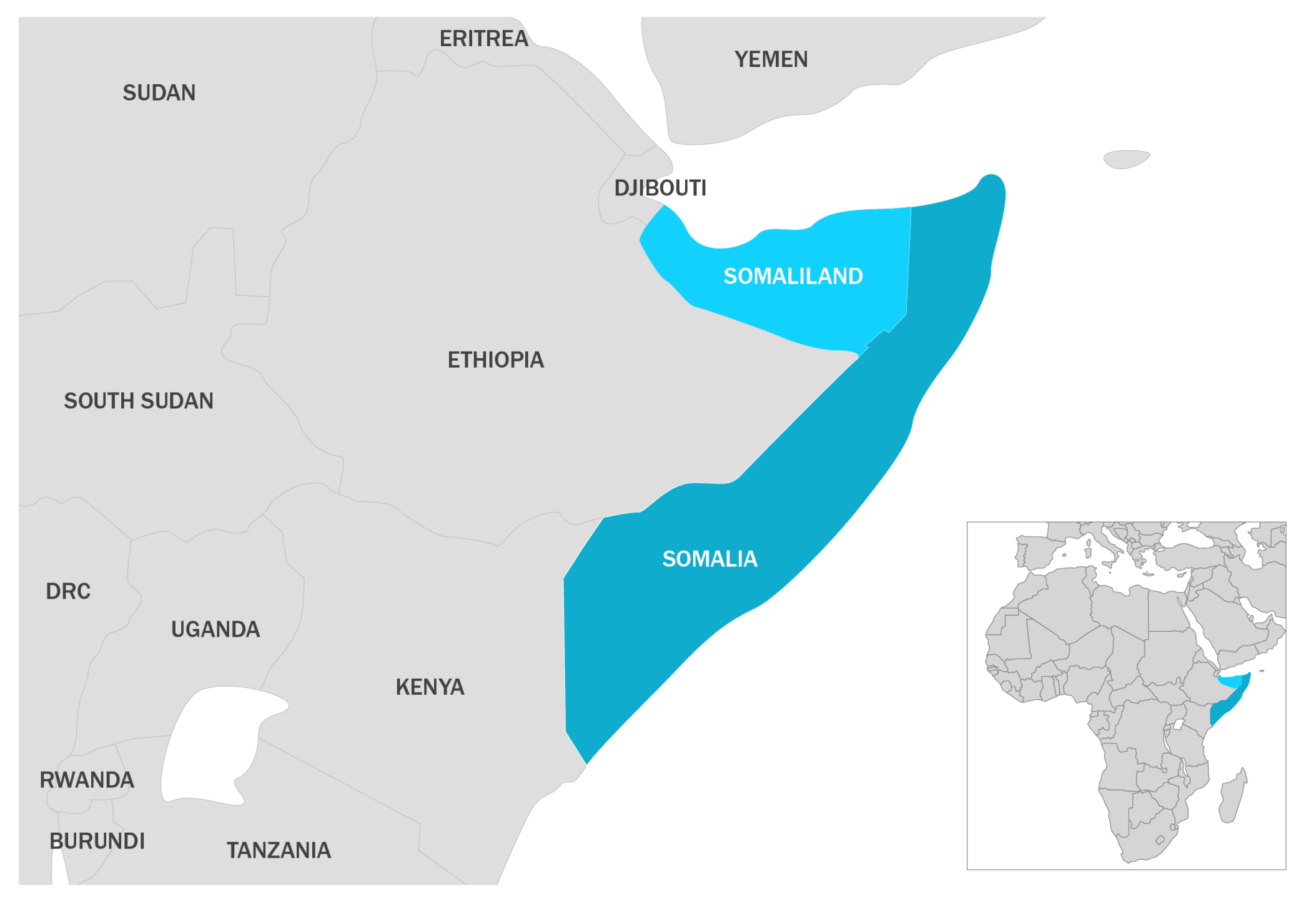
The partially recognized state of Somaliland lies north of Somalia and proximate to the Gulf of Aden and Yemen. This has made it a tempting U.S. basing site for continued strikes on Somalia and/or the Houthis.
In 2020, President Trump withdrew all 700 U.S. troops from Somalia.13“Trump Orders Withdrawal of US Troops from Somalia,” BBC, December 5, 2020, https://www.bbc.com/news/world-us-canada-55196130; Declan Walsh, “In Somalia, U.S. Troop Withdrawal is Seen as Badly Timed,” New York Times, December 5, 2020, https://www.nytimes.com/2020/12/05/world/africa/somalia-us-troops-withdraw.html. The withdrawn troops pivoted to Kenya, which allowed special operations raids and drone strikes inside Somalia to continue, which made Trump’s drawdown merely a tactical shift rather than a change in overall strategy.14Walsh, “In Somalia, U.S. Troop Withdrawal is Seen as Badly Timed”; “Somalia: President Biden Reverses Trump’s Withdrawal of US Troops,” BBC, May 16, 2022, https://www.bbc.com/news/world-africa-61467478; Esper, A Sacred Oath, 610–612. The Biden administration concluded this hadn’t worked. Calling Trump’s move a “precipitous decision” and citing the need to provide more efficient and effective support to partners fighting al-Shabaab, Biden sent approximately 450 troops back to Somalia in 2022.15Charlie Savage and Eric Schmitt, “Biden Approves Plan to Redeploy Several Hundred Forces into Somalia,” New York Times, May 16, 2022, https://www.nytimes.com/2022/05/16/us/politics/biden-military-somalia.html. Those troops remain there today.
Trump has dramatically escalated the war in Somalia
Under the second Trump administration, the number of airstrikes against Somalia has nearly quadrupled (198) over what Biden launched (51) during his entire term, and is on pace to far surpass the number of strikes (219) launched in Trump’s first term.16Mohamed Gabobe, “Under Trump, US Strikes on Somalia Have Doubled Since Last Year. Why?” Al Jazeera, June 24, 2025, https://www.aljazeera.com/news/2025/6/24/under-trump-us-strikes-on-somalia-have-doubled-since-last-year-why/; “The War in Somalia,” New America, updated July 6, 2026, https://www.newamerica.org/insights/americas-counterterrorism-wars/the-war-in-somalia/.
U.S. air, drone, and ground operations in Somalia by administration and year
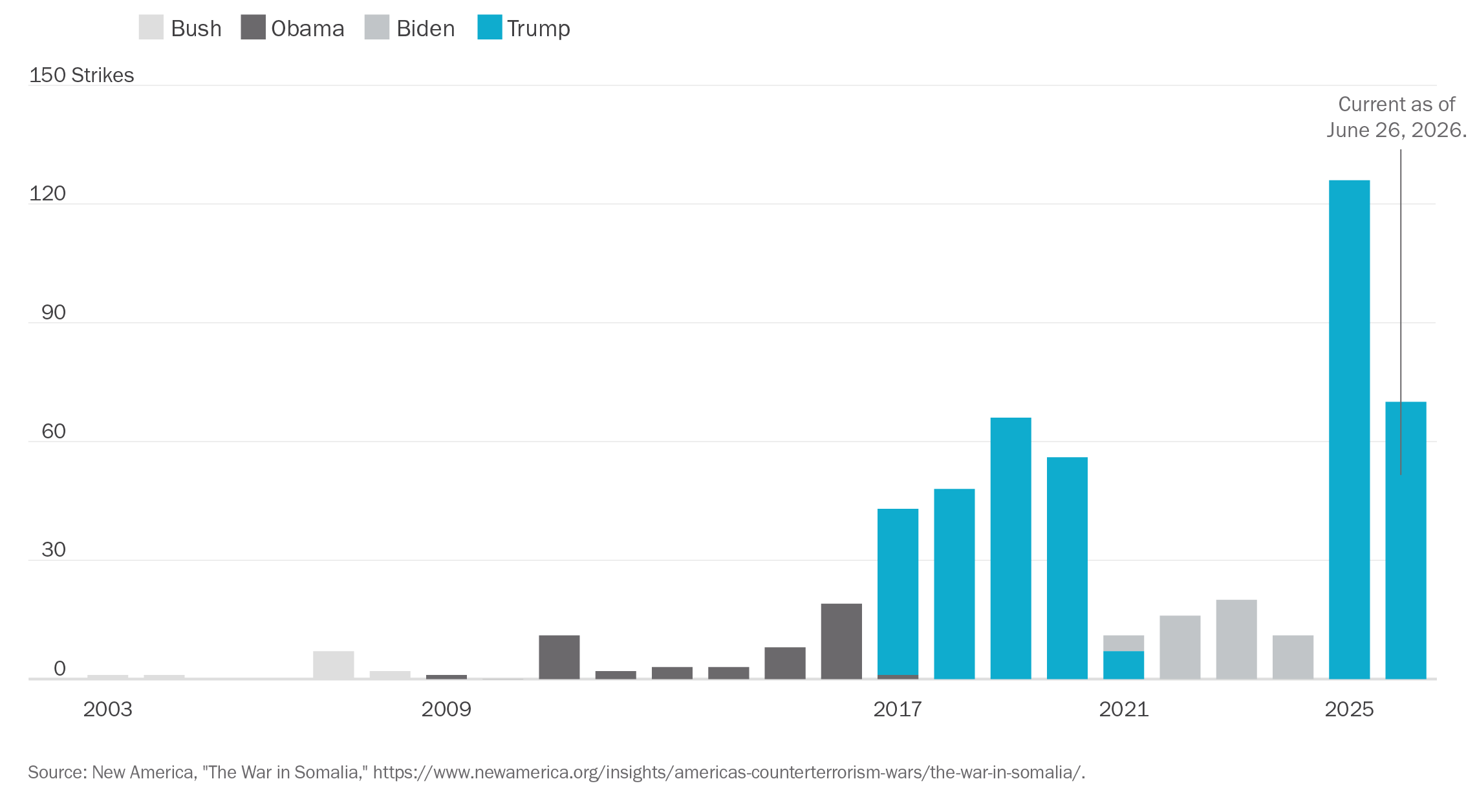
U.S. strikes against targets in Somalia expanded in President Trump’s first term and surged to record highs when he returned to office in 2025. They’re on the same pace in 2026.
The new fear of ISIS-Somalia
Most of Trump’s increased airstrikes have come against ISIS-Somalia. By comparison, the Biden administration carried out only two attacks (one by air, the other using special operations forces) against ISIS-Somalia, with both targeting specific senior leaders of ISIS global operations—all other strikes targeted al-Shabaab.17David Sterman, “The Escalation of U.S. Airstrikes in Somalia and the Role of Perceived Threats to the U.S. Homeland,” CTC Sentinel, vol. 18, no. 7 (July 2025): 29–36, https://ctc.westpoint.edu/wp-content/uploads/2025/07/CTC-SENTINEL-072025_article-4.pdf; Eric Schmitt and Helene Cooper, “Senior ISIS Leader in Somalia Killed in U.S. Special Operations Raid,” New York Times, January 26, 2023, https://www.nytimes.com/2023/01/26/us/politics/isis-leader-us-somalia-raid.html. In November 2025, the Trump administration carried out a special operations raid in Puntland—just the second ever ground operation in that region—and reportedly killed a senior leader of ISIS-Somalia who had no apparent connection to global ISIS operations.18“Somalia: US-Puntland Joint Operation Hits ISIS Stronghold, Senior Militants Killed and Captured,” Garowe Online, November 25, 2025, https://www.garoweonline.com/en/news/somalia/somalia-us-puntland-joint-operation-hits-isis-stronghold-senior-militants-killed-and-captured.
The Trump administration might be deepening U.S. engagement in Somalia in other ways. It’s reportedly in negotiations to recognize Somaliland in return for rights to mine critical minerals and build four new naval and air bases there.19“Kenya: US Upgrades Lamu Military Base,” Africa Intelligence, November 21, 2025, https://www.africaintelligence.com/eastern-africa-and-the-horn/2025/11/21/us-upgrades-lamu-military-base,110561974-art.
Somaliland is a semi-autonomous region in northern Somalia that broke away from Mogadishu in 1991.20“Somaliland: The Horn of Africa’s Breakaway State,” Council on Foreign Relations, January 21, 2025, https://www.cfr.org/backgrounder/somaliland-horn-africas-breakaway-state. In December 2025, Israel became the first UN member to formally recognize it.21Interview, Bryan Ellis, Deputy Assistant Secretary of Defense, October 6, 2025; Paul Tilsley, “Is Trump Considering Bold Africa Play to Push Back on China, Russia and Islamic Terrorists?” Fox News, August 28, 2025, https://www.foxnews.com/world/trump-considering-bold-africa-play-push-back-china-russia-islamic-terrorists; Frederico Donelli, “Israel’s Recognition of Somaliland: The Strategic Calculations at Play,” The Conversation, January 25, 2026, https://theconversation.com/israels-recognition-of-somaliland-the-strategic-calculations-at-play-273817. The Trump administration is now considering doing the same because it sees a greater U.S. presence in Somaliland as beneficial for striking ISIS-Somalia, protecting Red Sea shipping lanes from Houthi threats, and countering growing Chinese influence in East Africa.22Jackie Ducharme, “Reinforcing U.S. Power in the Horn of Africa: The Case for a Base in Somaliland,” Orion Policy Institute, May 16, 2025, https://orionpolicy.org/reinforcing-u-s-power-in-the-horn-of-africa-the-case-for-a-base-in-somaliland; Alec Birnbach and Benjamin Fogel, “Why the Trump Administration Should Recognize Somaliland,” National Interest, July 1, 2025, https://nationalinterest.org/feature/why-the-trump-administration-should-recognize-somaliland; Maxwell Webb, “There’s a Rare Opportunity to Deepen US-Somaliland Ties. But Several Obstacles Stand in the Way,” Atlantic Council, December 17, 2024, https://www.atlanticcouncil.org/blogs/africasource/theres-a-rare-opportunity-to-deepen-us-somaliland-ties-but-several-obstacles-stand-in-the-way/.
Trump’s stepped-up attacks on Somalia appear motivated by a new threat assessment from the administration and AFRICOM (see below) that views ISIS-Somalia as a global-reach terrorist group intent on attacking the U.S. homeland. “These killers, who we found hiding in caves, threatened the United States and our Allies,” Trump posted on X on February 1, 2025. He also seems motivated to appear stronger than his predecessor, posting, “Our Military has targeted this ISIS Attack Planner for years, but Biden and his cronies wouldn’t act quickly enough to get the job done. I did!”23Donald J. Trump (@realdonaldtrump), “This morning I ordered precision Military air strikes on the Senior ISIS Attack Planner and other terrorists he recruited and led in Somalia…” X, February 1, 2025, https://x.com/realDonaldTrump/status/1885740103223648412.
Sebastian Gorka, the senior director for counterterrorism at the National Security Council, put ISIS-Somalia at the center of all global operations by the Islamic State, claiming its leaders had trained, recruited, financed, and deployed “jihadis across the world to kill Americans.” Picking up a major theme within the Trump administration, Gorka tied escalation against ISIS-Somalia to border security and protecting the homeland.24“’Let Me Tell a Story of What He’s Really Like’: Gorka Tells Behind-the-Scenes Story About Trump,” posted February 20, 2025, Forbes Breaking News, YouTube, https://www.youtube.com/watch?v=-g_BD54-iR4.
Terrorist groups in Somalia threaten them, not the United States
The cost of U.S. military engagement in Somalia since 2003 is largely unknown but likely amounts to hundreds of millions of dollars.25Lauren Ploch Blanchard, “Somalia,” IF10155, Library of Congress, June 30, 2025, https://www.congress.gov/crs-product/IF10155. As a 2023 report from Brown University’s Costs of War Project observed, “trying to understand and track how much money is moving into Somalia has become nearly impossible.”26Eniola Anuoluwapo Soyemi, “Making Crisis Inevitable: The Effects of U.S. Counterterrorism Training and Spending in Somalia,” Costs of War Project, Watson Center, Brown University, April 27, 2023, 13, https://costsofwar.watson.brown.edu/sites/default/files/papers/Soyemi_Costs-of-War_CTSomalia.pdf. The reason? The Department of Defense does not release information about spending on intelligence, military operations (i.e., drone and airstrikes, special operations forces, and related support personnel), and subcontractors in Somalia. According to congressional staffers, the lack of data has hamstrung Congress’s ability to oversee operations in Somalia, let alone apply pressure to wind down the war.27Soyemi, “Making Crisis Inevitable,” 10–13.
But whatever cost the United States is paying for the war in Somalia, it isn’t worth it. Nor is it worth the added costs of building new bases in Somaliland or offering formal recognition to Somaliland. Contra Trump and Gorka, the threat posed by al-Shabaab and ISIS-Somalia to U.S. security is overblown.28Robie Gramer, “Biden OKs Plan to Send U.S. Troops Back to Somalia,” Foreign Policy, May 16, 2022, https://foreignpolicy.com/2022/05/16/us-troops-somalia-return/. Neither group necessitates anything remotely close to the level of military force the U.S. is using today.
The best standard to determine the threat level posed by a terrorist group is not who the group affiliates with (i.e., ISIS or al-Qaeda) but where the group chooses to carry out (or attempts to carry out) strikes. If it’s against the U.S. or its closest allies in Europe, the group is generally considered to have “global reach” intentions and is a potential threat to U.S. interests. By contrast, if the group strikes only local or regional targets, it’s typically labeled a “local reach” organization, essentially an insurgency group focused on local political ends that poses no threat to the security of the U.S. homeland.29William Walldorf, “Overreach in Africa: Rethinking U.S. Counterterrorism Strategy,” Defense Priorities, August 31, 2023, https://www.defensepriorities.org/explainers/overreach-in-africa-rethinking-us-counterterrorism-strategy/.
Neither Al-Shabaab nor ISIS-Somalia are global reach terrorist threats
Both al-Shabaab and ISIS-Somalia are regional or local insurgencies with almost exclusively local interests. The U.S. Office of the Director of National Intelligence concludes that al-Shabaab is “predominantly interested in the nationalist battle against the Somali government,” not attacking the United States and its allies.30“Al Shabaab,” Counter-Terrorism Guide, National Counterterrorism Center, https://www.dni.gov/nctc/groups/al_shabaab.html. Experts agree.31“Extremists Attack Kenya Military Base, 3 Americans Killed,” PBS News, January 5, 2020, https://www.pbs.org/newshour/world/al-shabab-attacks-military-base-used-by-us-forces-in-kenya; Claire Klobucista, Jonathan Masters, and Mohammed Aly Sergie, “Backgrounder: Al-Shabaab,” Council on Foreign Relations, December 6, 2022, https://www.cfr.org/backgrounder/al-shabaab; “Considering Political Engagement with Al-Shabaab in Somalia,” International Crisis Group, June 21, 2022, 21, https://www.crisisgroup.org/africa/horn-africa/somalia/309-considering-political-engagement-al-shabaab-somalia. For a good detailing of attacks against countries/forces fighting in Somalia, see Luke Hartig and Oona A. Hathaway, “Still at War: The United States in Yemen,” Just Security, March 24, 2022, https://www.justsecurity.org/80806/still-at-war-the-united-states-in-yemen/; Mohammed Ibrahim Shire, “Now is the Time to Engage Al-Shabaab,” War on the Rocks, October 19, 2021, https://warontherocks.com/2021/10/now-is-the-time-to-engage-al-shabaab-religious-leaders-and-clan-elders-can-help/. Tricia Bacon, professor at American University and former foreign officer on counterterrorism at the State Department, observes that al-Shabaab’s “Muslim and clan identities are deeply entrenched in the organization, reflecting its Somali-centric nature.” The group’s al-Qaeda affiliation is of “little consequence to rank and file members” or to how the organization defines itself, according to Bacon.32Bacon, “Inside the Minds…” 6, 13, 23.
The first Trump administration agreed with these assessments. Al-Shabaab’s local, rather than global, focus was the reason Trump withdrew U.S. troops from Somalia in 2020, according to former Acting Secretary of Defense Christopher Miller.33Christopher C. Miller, Soldier Secretary: Warnings from the Battlefield and the Pentagon About America’s Most Dangerous Enemies (New York: Center Street, 2023): 192. For similar assessments by Trump officials at the time, see J. Peter Phame, “Africa in the Second Trump Administration,” Jerusalem Strategic Tribune, November 2024, https://www.jstribune.com/pham-africa-in-the-second-trump-administration/.
As an insurgency movement, the driving objective for al-Shabaab is not global jihad but to unseat the regime in Mogadishu and expel all foreign forces from Somali soil. This has been a central motivation of al-Shabaab (the group was founded in response to the 2006 Ethiopian invasion of Somalia) and a major source of support and recruitment inside Somalia since al-Shabaab’s inception. “The group’s Somali identity is reinforced by external interference,” according to Bacon.34Bacon, “Inside the Minds,” 17, see also 6–8, 23.
This local focus explains al-Shabaab’s strike patterns. Almost all its attacks have been carried out inside Somalia, against the government or related forces. All high-profile regional strikes (including one in 2020 on a U.S. military base in Kenya) have been in support of its local agenda. And all strikes have taken place in countries with forces fighting in Somalia in support of the government in Mogadishu. Likewise, while al-Shabaab attempted a strike on the United States in 2017, according to experts, this was solely because U.S. troops were on the ground in Somalia.35“Kenyan National Indicted for Conspiring to Hijack Aircraft on Behalf of the al Qaeda-Affiliated Terrorist Organization Al-Shabaab,” Department of Justice, December 16, 2020, https://www.justice.gov/opa/pr/kenyan-national-indicted-conspiring-hijack-aircraft-behalf-al-qaeda-affiliated-terrorist; “AQAP (Al-Qaeda in the Arabian Peninsula),” Counter-Extremism Project, 2025, https://www.counterextremism.com/threat/aqap-al-qaeda-arabian-peninsula; Katherine Zimmerman, “No Competition Without Presence: Should the U.S. Leave Africa?” Prism, vol. 9, no. 1 (October 21, 2020): 81, https://ndupress.ndu.edu/Media/News/News-Article-View/Article/2383110/no-competition-without-presence-should-the-us-leave-africa/; Bacon, “Inside the Minds,” 22–23, 88; Shire, “Now is the Time.” According to Bacon, al-Shabaab merely “pays lip-service” to al-Qaeda. Attacking U.S. targets is about getting foreign forces out “rather than… furtherance of al-Qaida’s global agenda.”36Bacon, “Inside the Minds,” 87–88.
ISIS-Somalia is too localized and weak to threaten the U.S.
Despite taking the name of a global terrorist brand, ISIS-Somalia has even less reach than al-Shabaab. Since its founding, attacks by ISIS-Somalia have all been local, focused on Somalia or Puntland.37For discussion and examples of strikes, see The Islamic State in Somalia: Responding to an Evolving Threat, International Crisis Group, 2024, 8–9, https://www.crisisgroup.org/brf/africa/somalia/b201-islamic-state-somalia-responding-evolving-threat; “ISIS-Somalia,” Counterterrorism Guide, National Counterterrorism Center, https://www.dni.gov/nctc/terrorist_groups/isis_somalia.html#:~:text=ISIS%2DSomalia%20supports%20global%20ISIS,authorities%20disrupted%20in%20early%202024; “Islamic State Somalia,” Australian National Security, updated September 22, 2024, https://www.nationalsecurity.gov.au/what-australia-is-doing/terrorist-organisations/listed-terrorist-organisations/islamic-state-somalia-%28is-somalia%29. Allegations that ISIS-Somalia organized global attacks are unfounded.38David Sterman, “The Escalation of U.S. Airstrikes in Somalia,” 33.
Even as a domestic actor, the group is very weak—a fraction of the size of al-Shabaab. If AFRICOM’s numbers are accurate, ISIS-Somalia has around 1,500 fighters with roughly 60 percent of those being foreign, mostly from East African countries in search of better wages.39John Vandiver, “AFRICOM’s 2025 Airstrike Numbers in Somalia Poised for a Record,” Stars and Stripes, May 8, 2025, https://www.stripes.com/theaters/africa/2025-05-08/africom-isis-somalia-airstrikes-17722974.html; “The Islamic State in Somalia: Responding to an Evolving Threat,” International Crisis Group, September 12, 2024, 2–9, https://www.crisisgroup.org/brf/africa/somalia/b201-islamic-state-somalia-responding-evolving-threat. Due to clan dynamics, competition from al-Shabaab, and pressure from the Puntland government, local recruitment has been a big problem for ISIS-Somalia—its roughly 600 local fighters is a paltry number for a group founded over a decade ago. Unlike ISIS in Syria and Iraq in 2014–15, which controlled a large swath of those countries, ISIS-Somalia has not expanded its territorial reach beyond its remote base in the Golis mountains. The group still can’t capture and hold small towns in Puntland. 40“The Islamic State in Somalia,” 2–9.
Coming into the second Trump administration, ISIS-Somalia appeared weaker than ever. A late 2024 report by the International Crisis Group found that local ISIS-Somalia attacks in Puntland and the surrounding region fell from around 60 per year in 2018 and 2019 to less than a dozen in 2023 and 2024 combined. That trend continued into 2025. ISIS-Somalia activity was so minimal in 2025 that it was barely mentioned in the Global Terrorism Index covering that year.41“Global Terrorism Index 2026,” Institute for Economics and Peace, March 2026, https://www.visionofhumanity.org/wp-content/uploads/2026/03/Global-Terrorism-Index-2026-Report.pdf. It’s little wonder the International Crisis Group called any potential ISIS-S takeover of Somalia “far-fetched,” while the World Peace Organization labeled the group “a limited threat.”42“Islamic State in Somalia,” Organization for World Peace, 2026, https://theowp.org/crisis_index/islamic-state-in-somalia; “The Islamic State in Somalia,” 11.
AFRICOM’s inflated threat assessment of ISIS-Somalia
Despite this, U.S. AFRICOM has stepped up threat inflation around ISIS-Somalia (in lockstep with the Trump administration) and increased airstrikes. Since January 2025, every AFRICOM press release on an airstrike against ISIS-Somalia has included language about stopping threats to the U.S. homeland, whereas only one press release included that language in 2024, according to the Combatting Terrorism Center (CTC).43“The Islamic State in Somalia,” 32. The same language has been used in public and congressional statements by AFRICOM commanders.44“The Islamic State in Somalia,” 32; John Vandiver, “Somalia Sees Sharp Rise in US Strikes against ISIS and al-Shabaab,” Stars and Stripes, July 28, 2025, https://www.stripes.com/theaters/africa/2025-07-28/africom-somalia-air-strikes-18583199.html.
AFRICOM is known for overblowing threats. In 2020, Secretary of Defense Mark Esper used the global-versus-local-reach standard to argue internally that al-Shabaab posed little threat to the United States and advocate for a drawdown of U.S. troops from Somalia. “AFRICOM disagreed, of course,” according to Esper. “Such an assessment would threaten their resources” so they would “stretch the risk assessment to justify their demands.”45Esper, A Sacred Oath, 606–607. Christopher Miller succeeded Esper and said the same about AFRICOM, noting that Trump’s order to draw down from Africa “had been slow-rolled by the Pentagon.”46Miller, Soldier Secretary, 192.
In their accounts of the last months of the first Trump administration, neither Esper nor Miller mention ISIS-Somalia, presumably because the group was considered even less strategically consequential than al-Shabaab. At the time, ISIS-Somalia had roughly the same composition it does now in terms of number of fighters, territorial control, and limited scope of operations. That lack of attention during Trump’s first term raises serious suspicions about AFRICOM’s sudden escalation of the threat assessment over the last year. Following Esper’s logic, AFRICOM may view threat inflation as its best chance to prevent Trump from picking up where he left off in 2020, trying to cut the U.S. military presence in Africa.
Counterterrorism expert David Sterman of the New America Foundation expressed skepticism about AFRICOM’s threat assessments in a detailed 2025 study of foreign fighters partnering with ISIS-Somalia. “The cases… do not suggest an imminent threat [from ISIS-Somalia],” Sterman argued, “and do not show a developed capability or effort to send fighters back to the United States to conduct attacks.” If there is an increased threat, Sterman concludes, “the American public and policymakers would benefit from greater clarity on the basis for any such assessment.”47David Sterman, “The Escalation of U.S. Airstrikes in Somalia.”
AFRICOM’s amped-up threat arguments might also be related to the purported ties ISIS-Somalia has to the Houthis in Yemen. This concern is not new, however, and again appears overblown. While the Houthis have transferred some military supplies to ISIS-Somalia, the two groups are deeply divided ideologically, which limits cooperation, and the Houthis have no intention of attacking the U.S. homeland.48Danielle Cosgrove and Doug Livermore, “The US Must Sustain Counterterrorism Operations in Somalia—the Costs of Retreat Are Too High,” New Atlanticist, April 17, 2025, https://www.atlanticcouncil.org/blogs/new-atlanticist/the-us-must-sustain-counterterrorism-operations-in-somalia-the-costs-of-retreat-are-too-high.
High-ranking operatives in ISIS’s global financial network reportedly filter through the ranks of ISIS-Somalia at times.49Katharine Houreld, “The Islamic State Has Regrouped in Somalia—and Has Global Ambitions,” Washington Post, February 11, 2026, https://www.washingtonpost.com/world/2025/02/09/somalia-islamic-state-puntland-terrorism/. Regardless, these elements are outweighed in size and influence by the rank-and-file membership, which remains overwhelmingly focused on Somalia, not global terrorist activity. The U.S. has been able to take out these global elements with targeted special operations and drone strikes, which raises questions, again, about the utility and necessity of the sustained air war that’s currently underway.50“Bilal al-Sudani: US Forces Kill Islamic State Somalia Leader in Cave Complex,” BBC, January 27, 2023, https://www.bbc.com/news/world-africa-64423598.
ISIS-Somalia is a two-bit insurgency spinoff that poses little to no significant threat to U.S. national security interests. The war currently being conducted against it makes little strategic sense and is a waste of U.S. resources.
The failure of the U.S. counterterrorism war
Lack of interests aside, military force against al-Shabaab and ISIS-Somalia doesn’t work. Every time al-Shabaab seems to be losing ground, it resurges in strength. The real solution in Somalia lies not in military force but at the negotiating table between the government and al-Shabaab.51“Sustaining Gains in Somalia’s Offensive against Al-Shabaab,” International Crisis Group, no. 187, March 21, 2023, https://www.crisisgroup.org/brf/africa/horn-africa/somalia/b187-sustaining-gains-somalias-offensive-against-al-shabaab.
Despite what policymakers might hope for, airpower is a limited tool of statecraft, incapable of achieving ends like destroying terrorist groups.52Will Walldorf, “In Yemen, Trump Risks Falling into an ‘Airpower Trap’ That Has Drawn Past US Presidents into Costly Wars,” The Conversation, May 5, 2025, https://theconversation.com/in-yemen-trump-risks-falling-into-an-airpower-trap-that-has-drawn-past-us-presidents-into-costly-wars-255651. This has certainly been the case in Somalia over the past two decades. According to the Congressional Research Service, “After over 15 years of counterinsurgency operations… [a]irstrikes have eliminated some ‘high-value’ targets and supported partner operations, but al-Shabaab maintains the capacity to conduct complex, asymmetric attacks in Somalia and assaults in neighboring countries.” 53“Al Shabaab,” Congressional Research Service, February 14, 2023, https://sgp.fas.org/crs/row/IF10170.pdf. For others arguing the same, see “Letter Dated 28 September 2020 from the Chair of the Security Council Committee Pursuant to Resolution 751 (1992) Concerning Somalia Addressed to the President of the Security Council,” United Nations Security Council, distributed September 18, 2020, 11–12, https://www.securitycouncilreport.org/atf/cf/%7B65BFCF9B-6D27-4E9C-8CD3-CF6E4FF96FF9%7D/S_2020_949.pdf; “East Africa Counterterrorism Operation,” Office of the Lead Inspector General, July 1 2020–September 30, 2020, https://oig.usaid.gov/sites/default/files/2020-12/LEAD%20IG%20EAST%20AFRICA%20AND%20NORTH%20AND%20WEST%20AFRICA%20COUNTERTERRORISM%20OPERATIONS.pdf; Paul D. Williams, “Understanding US Policy in Somalia: Current Challenges and Future Options,” Chatham House, July 2020, 15–18, https://www.chathamhouse.org/sites/default/files/publications/research/2020-07-14-us-policy-somalia-williams.pdf.
Against ISIS-Somalia today, a familiar pattern of ineffective airstrikes is playing out. Some fighters and a lone senior operative have been killed, but the group persists largely unencumbered, as recent terrorist strikes in the Puntland region demonstrate.54David Sterman, “AFRICOM Provides Death Tolls for 2025 Strikes,” New America Foundation, April 3, 2025, https://www.newamerica.org/future-security/articles/africom-provides-death-tolls-for-2025-strikes/; Peter Van Ostaeyen, “The Islamic State in Puntland, Somalia,” Counterextremism Project, February 21, 2025, https://www.counterextremism.com/blog/islamic-state-puntland-somalia#:~:text=Following%20a%20rare%20U.S.%20airstrike,forces%20sustained%20%E2%80%9Climited%20casualties.%E2%80%9; Dan Lamothe, Patrick Svitek, and Karen DeYoung, “U.S. to End Bombings of Houthi Militants in Yemen, Trump Says,” Washington Post, May 6, 2025, https://www.washingtonpost.com/politics/2025/05/06/trump-houthis-bombing-yemen/.
After the first attack against ISIS-Somalia on February 1, Trump boasted, “The strikes destroyed the caves they live in, and killed many terrorists.”55Donald J. Trump (@realDonaldTrump), “This morning I ordered precision Military air strikes on the Senior ISIS Attack Planner and other terrorists he recruited and led in Somalia…” Truth Social, February 1, 2025, https://truthsocial.com/@realDonaldTrump/posts/113929767736564719. Obviously, they weren’t that effective: the United States has launched over 180 follow-on strikes and counting since then.
Arguing that force generally fails to end terrorist groups may even understate the case because attacks by outside powers often enhance their legitimacy in ways that make them stronger. This has especially been the case with al-Shabaab. Top experts at a 2022 conference hosted by the Combating Terrorism Center at West Point used terms like “lackluster,” “harmful at worst,” “unsustainable,” and “ineffective” to describe current U.S. counterterrorism in Africa.56William Walldorf, “Overreach in Africa: Rethinking U.S. Counterterrorism Strategy,” Defense Priorities, August 31, 2023, 8–9, https://www.defensepriorities.org/explainers/overreach-in-africa-rethinking-us-counterterrorism-strategy/.
Since the U.S. initiated military operations against African jihadists in the mid-2000s, the amount of local terrorist activity and the number of jihadist groups on the continent have exploded. Attacks by Islamic terrorists increased by 22 percent continent-wide in 2022 alone, a pace that’s continued since.57William Walldorf, “Overreach in Africa”; “Preventing Extremism in Fragile States: A New Approach,” Task Force on Extremism in Fragile States, United States Institute of Peace, 2019: 9, https://www.usip.org/sites/default/files/2019-02/preventing-extremism-in-fragile-states-a-new-approach.pdf. In short, as Katherine Zimmerman of the American Enterprise Institute notes, U.S. policies have worked to “preserve or worsen the local conditions that jihadists thrive in.”58Katherine Zimmerman, “Fragility and Failure: A Better Foreign Policy to Counter New Threats,” American Enterprise Institute, October 2020, https://www.aei.org/research-products/report/fragility-and-failure-a-better-foreign-policy-to-counter-new-threats/.
U.S. force doesn’t fit with Somali domestic politics
The force-based approach to counterterrorism in Somalia is counterproductive because it’s a poor fit with Somali politics and society that inadvertently helps al-Shabaab.
U.S.-backed counterterrorism policy works through the federal government in Mogadishu. According to detailed reports by the International Crisis Group, Brown University’s Costs of War Project, and the Council on Foreign Relations, the aid provided by the United States has significantly contributed to the centralization of political power in the Somali capital.59Soyemi, “Making Crisis Inevitable,” 13; “Out of the Box: How to Rebalance U.S. Somalia Policy,” International Crisis Group, no. 7, June 27, 2023, https://www.crisisgroup.org/rpt/us-horn-africa-somalia/7-out-box-how-rebalance-us-somalia-policy; Bronwyn E. Bruton, “Somalia: A New Approach,” Council on Foreign Relations, no. 52, March 2010, https://ciaotest.cc.columbia.edu/wps/cfr/0018433/f_0018433_15786.pdf; “How Much Foreign Aid Does the US Provide to Somalia?,” USA Facts, https://usafacts.org/answers/how-much-foreign-aid-does-the-us-provide/countries/somalia/. The government siphons U.S. assistance away from counterterrorism to internal security initiatives meant to bring Somali member states, like Jubaland, under the heel of federal authority. Non-military U.S. assistance—much of which runs through Mogadishu—has contributed to the centralization of authority as well.60“How Much Foreign Aid”; “Out of the Box.”
This centralization runs counter to Somalia’s political tradition of decentralized state authority, which is a product of its complex clan divisions. Not surprisingly, centralization has fueled suspicion and conflict between Mogadishu and many of Somalia’s clans, especially in the south-central regions of the country. Corruption and the Somali government’s failure to provide basic services and governance structures make the problem worse.61William Walldorf, “Overreach in Africa: Rethinking U.S. Counterterrorism Strategy,” Defense Priorities, August 31, 2023, 10, https://www.defensepriorities.org/explainers/overreach-in-africa-rethinking-us-counterterrorism-strategy/; Lauren Ploch Blanchard, “Al Shabaab,” IF10170, Congressional Research Service, February 14, 2023, https://www.congress.gov/crs-product/IF10170; Omar S. Mahmood, “Could Somalia Be the Next Afghanistan?” Foreign Policy, September 22, 2021, https://foreignpolicy.com/2021/09/22/could-somalia-alshabab-taliban-next-afghanistan/; Ahmed Ibrahim, “Why the US Can’t Beat Al-Shabaab in Somalia,” Responsible Statecraft, April 23, 2025, https://responsiblestatecraft.org/trump-somalia-al-shabaab/. For these reasons, the Costs of War Project observes that “U.S. military training in Somalia makes the potential for conflict inevitable.”62Soyemi, Making Crisis Inevitable.”
The U.S.-assisted centralization of power in Somalia has especially worked to al-Shabaab’s advantage. According to Bacon, al-Shabaab portrays itself as “Robin Hood” to “marginalized and minority clans” aggrieved by government policies.63Bacon, “Inside the Minds,” 18–19; “Considering Political Engagement,” 3–15. It does so, in part, by filling important governance gaps and furnishing local services like schools and a justice system that Mogadishu can’t or won’t offer. This gives al-Shabaab legitimacy and provides it with a constant flow of recruits.64Bacon, “Inside the Minds,” 18–19, 85–91; Shire, “Now is the Time”; Molan Quinn, “From Separation to Salafism: Militance on the Swahili Coast,” Council on Foreign Relations, January 13, 2021, https://www.cfr.org/articles/separatism-salafism-militancy-swahili-coast; Oona A. Hathaway and Luke Hartig, “Still at War: The United States in Somalia,” Just Security, March 31, 2022, https://www.justsecurity.org/80921/still-at-war-the-united-states-in-somalia/.
Anti-Americanism and foreign forces have been huge recruiting tools for al-Shabaab too.65William Walldorf, “Overreach in Africa: Rethinking U.S. Counterterrorism Strategy,” Defense Priorities, August 31, 2023, 12, https://www.defensepriorities.org/explainers/overreach-in-africa-rethinking-us-counterterrorism-strategy/; Anneli Botha, “Al-Shabaab, a Proto-State Replacing the State,” Newsletter of the Italian Institute for International Political Studies, May 7, 2021, https://www.ispionline.it/en/publication/al-shabaab-proto-state-replacing-state-30364. After the United States supported the 2006 intervention of Ethiopian forces in Somalia, Roland Marchal found, for instance, that “anti-American sentiment brought the local population together” behind al-Shabaab.66William Walldorf, “Overreach in Africa,” 12; “IntelBrief: Al-Shabaab Shows No Signs of Decline in East Africa,” Soufan Center, July 3, 2023, https://thesoufancenter.org/intelbrief-2023-july-3/. That messaging intensified dramatically after direct U.S. military intervention in the mid-2010s.67William Walldorf, “Overreach in Africa,” 12; Bacon, “Inside the Minds,” 58.
In sum, the U.S.-led war against al-Shabaab has helped the insurgency entrench itself. To that end, over the past 20 years, every hope for victory by the central government has soon turned out to be “illusory,” according the Atlantic Council’s Bronwyn Bruton, as Somali government forces prove incapable of holding ground regained from al-Shabaab.68Bruton, “Somalia: A New Approach.” Success always fades, a pattern evident yet again just in the last year.69Matt Bryden, “Somalia at Risk of Becoming a Jihadist State,” Africa Security Brief, no. 45, November 17, 2025, https://africacenter.org/publication/asb45en-somalia-risk-jihadist-state/.
Somaliland recognition adds nothing to U.S. security
Recognition of Somaliland and the construction of new U.S. bases there will do little to advance U.S. strategic interests. But it will increase U.S. security costs in the region—and perhaps dramatically so.
The Houthi threat is fading in the Red Sea
The rationale for building new U.S. bases in Somaliland to combat the Houthis is dubious. The Red Sea is important for global shipping, but at the height of the conflict with the Houthis in 2025, ships were able to reroute with little impact to the global, much less the U.S., economy. Moreover, the percentage of U.S.-based shipping through the Red Sea is minimal compared to that of other countries, especially in Europe—a point Vice President J.D. Vance emphasized when Trump amped up airstrikes against the Houthis in spring 2025.
The Houthi threat in the Red Sea has now largely receded. The group is not on some kind of permanent war footing but had been striking ships to protest Israel’s war in Gaza. With the ceasefire last year between Israel and Hamas, the group ended all strikes. That ceasefire has fractured since the start of the Iran war in March 2026, with the Houthis having launched several rounds of strikes against Israel at the height of the war. But strikes on shipping in the Red Sea have not resumed.70“Conflict in Yemen and the Red Sea,” Council on Foreign Relations, April 14, 2026, https://www.cfr.org/global-conflict-tracker/conflict/war-yemen#RecentDevelopments-1; “Yemen’s Rebels Signal That They’ve Stopped Attacks on Israel and Red Sea Shipping,” Associated Press, November 11, 2025, https://apnews.com/article/mideast-wars-yemen-houthis-red-sea-ee7be23641e9e3fd227d2c1677e03472.
The issue with defeating the Houthis last year was not one of capacity—the U.S. launched a massive show of force without having a base in Somaliland.71Eric Schmitt, Edward Wong, and John Ismay, “U.S. Strikes in Yemen Burning Through Munitions with Limited Success,” New York Times, April 4, 2025, https://www.nytimes.com/2025/04/04/us/politics/us-strikes-yemen-houthis.html. The problem was the theory of victory, namely that bombing successfully destroys terrorist groups. It doesn’t and, predictably, it didn’t work against the Houthis either.
The Houthi problem—which has minimal impact on U.S. interests to begin with—is largely gone today. If Trump feels obligated to keep it that way (which he doesn’t need to, given limited U.S. interests), he shouldn’t build new bases in Somaliland. He should instead take steps to reduce the seed beds of Houthi animosity by ending the war against Iran and pressuring all involved parties toward peace in Gaza.
Somaliland recognition will not help counter real terrorist threats
As with Yemen, the U.S. problem in Somalia is not insufficient ordinance dropped on terrorists but the idea that airpower can eliminate terrorist groups. In fact, Robert Pape, a professor at the University of Chicago and leading scholar on airpower, argues that bombing often creates local sympathy for terrorists and this helps with terrorist recruitment.72Robert A. Pape, “Dying to Kill Us,” New York Times, September 22, 2003, https://www.nytimes.com/2003/09/22/opinion/dying-to-kill-us.html.
There are other dangers here for the United States. Any new bases in Somaliland could become targets for future terrorist attacks, or for missiles fired from Yemen or elsewhere. Furthermore, if the U.S. invests in new air and naval bases in Somaliland, the temptation to put U.S. boots on the ground in Puntland to finish the job, so to speak, will increase when U.S. operations against ISIS-Somalia from the new bases predictably fail. (That may be the reason, in fact, that U.S. special operations forces carried out a ground attack in Puntland in November 2025.)
In short, the weight of sunk costs (see more below) in Somaliland—i.e., “we’ve invested a lot and have to get this right”—could pull the U.S. further in.
U.S. bases in Somaliland won’t stem Chinese influence in Africa
The argument that U.S. actions in Somaliland are needed to counter growing Chinese influence in the region makes even less sense. It’s true that China has increased its presence in Africa in a commercial sense.73Ducharme, “Horn of Africa”; Joshua Meservey, “The U.S. Should Recognize Somaliland,” Heritage Foundation, no. 3660, October 19, 2021, https://www.heritage.org/sites/default/files/2021-10/BG3660.pdf. Today, China is Sub-Saharan Africa’s biggest trading partner with its foreign direct investment in Africa skyrocketing from $75 million in 2003 to $3.3 billion in 2024.74Wenjie Chen, Michele Fornino, and Henry Rawlings, “Navigating the Evolving Landscape Between China and Africa’s Economic Engagements,” International Monetary Fund, February 23, 2024, https://www.elibrary.imf.org/view/journals/001/2024/037/article-A001-en.xml/; Marcus Vincincius de Freitas, “The Impact of Chinese Investments in Africa: Neocolonialism or Cooperation?,” Policy Center for the New South, August 2023, https://www.policycenter.ma/publications/impact-chinese-investments-africa-neocolonialism-or-cooperation/; Bartlett, “No Country Recognizes; Edward A. Lynch, “China’s Belt and Road Initiatives in East Africa: Finding Success in Failure?” Military Review, May–June 2023, https://www.armyupress.army.mil/Journals/Military-Review/English-Edition-Archives/May-June-2023/Chinas-Belt/. In East Africa, China’s improved status over the past decade has come due to massive infrastructure projects in Kenya and Uganda that transformed transportation networks, expanding trade and economic growth regionwide.75Rosemary Mnongya, “China and Infrastructure Development in East Africa: The Case of Kenya and Uganda,” Insights, Africa-China Centre for Policy and Advisory, September 2023, https://africachinacentre.org/china-and-infrastructure-development-in-east-africa-the-case-of-kenya-and-uganda/. These cases are cited by some who advocate for U.S. military bases in and U.S. recognition of Somaliland. See Ducharme, “Horn of Africa.” China has expanded arms sales and military training that some say can be a source of influence. See Paul Nantulya, “China Widening Its Influence in Africa Through Expanded Security Engagement,” Africa Center for Strategic Studies, June 10, 2025, https://africacenter.org/spotlight/china-influence-africa-security-engagements/. Last year, China agreed to a $1.2 billion infrastructure investment deal with Somalia.76Diksha Jain, “China’s Gamble: Infrastructure & Influence in Somalia,” Centre for Land Warfare Studies, no. 432, April 2025, https://claws.co.in/wp-content/uploads/2025/04/IB-432-I-Chinas-Gamble-Infrastructure-and-Influence-in-Somalia.pdf.
There is no good reason to consider Chinese trade in Africa a threat to Americans. But even if there was, more U.S. bases in Somalia are hardly the way to meet the challenge. The expansive web of U.S. bases in Africa (approximately 29) established over more than two decades has done nothing to stymie Chinese economic engagement (China by contrast has only one base, in Djibouti).77Erica Downs, Jeffrey Becker, and Patrick deGategno, “China’s Military Support Facility in Djibouti: The Economic and Security Dimensions of China’s First Overseas Base,” Center for Naval Analysis, July 2017, https://www.cna.org/reports/2017/07/DIM-2017-U-015308-Final3.pdf. In short, there is no reason to expect new U.S. bases in Somaliland to work any better at stymying Chinese economic influence.
Beijing may actually come to see bases in Somaliland as a threat to its investments in East Africa and in turn establish new bases of its own in the region. If that happens, the move could backfire on the U.S. and yield the exact thing the bases were meant to prevent—a greater Chinese military presence in Africa.
Chasing influence just for the sake of influence (i.e., disconnected from concrete security interests) is a fool’s game for any great power. It leads to unintended consequences (like more Chinese bases) or new commitments that drag the great power into local conflicts that are messy and outside its national interest.
The costs of Somaliland recognition will be high for the United States
Somaliland recognition will increase U.S. security costs. Beyond the above-mentioned escalation dangers against ISIS-Somalia, costs will also rise thanks to new regional instability.
Recognition could further destabilize Somalia
Recognition will fuel long-held Somali nationalistic concerns about foreign encroachment, which in turn will fuel al-Shabaab recruitment and increase the chances of state collapse in Somalia. There’s good evidence for this. In 2024, Ethiopia and Somaliland signed a Memorandum of Understanding (MOU) that would eventually exchange Ethiopian recognition of Somaliland for Ethiopian access to the Port of Berbera on the Red Sea.78“Ethiopia Signs Agreement with Somaliland Paving Way to Sea Access,” BBC, January 2, 2024, https://www.bbc.com/news/world-africa-67858566 The MOU fueled a surge in al-Shabaab recruitment that has helped the insurgency make its recent gains against Mogadishu. A report by the Council on Foreign Relations concluded that the deal was “weaponized by al-Shabaab to generate new recruits to undermine regional security.”79“Somaliland: The Horn of Africa’s Breakaway State,” Council on Foreign Relations, January 21, 2025, https://www.cfr.org/backgrounder/somaliland-horn-africas-breakaway-state/. The group used the MOU to portray itself as “the defender of Somali nationalism and autonomy,” according to a pair of Africa experts.80Samar al-Bulushi and Ahmed Ibrahim, “US Inks Deal to Build up to 5 Bases in Somalia,” Responsible Statecraft, February 21, 2024, https://responsiblestatecraft.org/us-base-somalia/; see also, Maxwell Webb, “Nine Months Later: The Regional Implications of the Ethiopia-Somaliland MOU,” Atlantic Council, October 2, 2024, https://www.atlanticcouncil.org/blogs/africasource/nine-months-later-the-regional-implications-of-the-ethiopia-somaliland-mou/.
U.S. recognition of Somaliland would likely have the same recruitment benefits for al-Shabaab. It could also fuel other semi-independent regions—Puntland and Jubaland—to move toward independence, which would further strengthen al-Shabaab and move Somalia closer to full-blown state collapse.81“Somalia’s Jubaland Governments Suspends Ties with Federal Administration,” Reuters, November 28, 2024, https://www.reuters.com/world/africa/somalias-jubbaland-government-suspends-ties-with-federal-administration-2024-11-28/.
U.S. recognition might create regional tension that could destabilize Somalia. Ethiopia would likely be at the center of this. As a landlocked country, it has long pushed for port access to allow easier passage of goods through the Gulf of Aden. This explains its warming ties with Somaliland in recent years.82Hisham Qadri Ahmed, “Somalia’s Strategic Counterbalance to Ethiopian Influence in the Horn of Africa,” Carnegie Endowment, November 7, 2024, https://carnegieendowment.org/sada/2024/11/somalia-ethiopia-relations. If the U.S. recognizes Somaliland, Ethiopia will almost certainly follow suit. That would lead to direct conflict between Ethiopia and Somalia (which views Ethiopian cooperation with Somaliland as encroachment on its sovereignty and a bid for regional hegemony) and perhaps with Egypt, a longstanding rival of Ethiopia.
Costs will rise for the United States
Without a shift away from the current counterterrorism strategy, U.S. forces will be stuck in the middle of the regional mess that recognition of Somaliland causes. This will increase costs—perhaps dramatically—for the United States. As Somalia sinks further into chaos and Somaliland faces challenges from that chaos, the United States will face extreme pressure to stabilize both countries.
Why? Here again, in part, because of sunk costs. Research shows that states are often loss-averse in ways that cause them to chase sunk costs, which leads in turn to plowing more resources into existing endeavors when they get in trouble or start to fail. Leaders are prone to protect the original investment/policy in part to prove the strategy has merit and recoup potential losses as costs mount. This kind of sunk-cost thinking has contributed to some of the United States’ biggest debacles, including Vietnam and the forever wars in Afghanistan and Iraq.83Jack S. Levey, “Prospect Theory and International Relations: Theoretical and Analytical Problems,” Political Psychology, vol. 13, no. 2 (June 1992): 283–310; Rose McDermott, Risk-Taking in International Politics: Prospect Theory in American Foreign Policy (Ann Arbor: University of Michigan Press, 1998).
Sunk-cost dynamics could drag the U.S. further into Somalia if it becomes a failed state after Somaliland recognition (or even before). Without a shift in U.S. counterterrorism strategy in East Africa, it’s unlikely U.S. leaders can just walk away from their two-decade-old, Mogadishu-centric strategy as the country splinters and al-Shabaab grows in strength. Instead, Washington is likely to try to stand up a rump state in Somalia, carrying more costs and perhaps even requiring more U.S. forces to salvage an already bad and costly policy.
Some may argue that Trump is generally immune to sunk-cost thinking and won’t get dragged into Somalia if it falls apart. Like with the Houthi ceasefire in 2025, he’ll just declare victory and walk away when things get messy for the United States.84Helene Cooper, et al, “Why Trump Suddenly Declared Victory over the Houthi Militia,” New York Times, May 12, 2025, https://www.nytimes.com/2025/05/12/us/politics/trump-houthis-bombing.html/. That may happen, but as we see today in Iran, Trump is sometimes prone to avoiding exiting failed wars for fear of the political consequences.
Better to be safe than sorry, then. To minimize sunk-cost pressures, it just seems smart to stay away from creating situations that generate those pressures in the first place. With Somalia, that means staying away from recognizing Somaliland.
Policy recommendations: Withdraw U.S. troops and move over the horizon
The war in Somalia is not in the U.S. national interest and is not working. The Trump administration needs to wind down military operations and avoid deepening U.S. engagement there. This involves several specific steps.
First, the United States should not recognize Somaliland. Recognition would yield almost no benefits for the U.S. but could come with great costs. New bases are not worth the additional costs and are strategically unnecessary. Given limited U.S. strategic interests in Africa, the United States gets all it needs from its nearby base in Djibouti. The Houthi threat to Red Sea shipping is all but gone following the U.S. deal with the Houthis and the ceasefire in Gaza.
Second, last year, the Trump administration rightly wound down an air war in Yemen against the Houthis. Time to follow suit in Somalia, especially the intense bombing in Puntland. Again, it’s unnecessary given that both ISIS-Somalia and al-Shabaab are not global reach terrorist groups. The war is a waste of U.S. resources and doesn’t fit with the overall thrust of the Trump administration’s latest National Security Strategy, which deemphasizes Africa in general. The Puntland government can carry the load against ISIS-Somalia with the help of other regional states.85“The National Security Strategy”; “Why Trump is on the Warpath in Somalia,” BBC, February 6, 2025, https://www.bbc.com/news/articles/cyv4270gljpo; Harun Maruf Jeff Seldin, “Islamic State in Retreat after Offensive in Somalia’s Puntland,” VOA News, March 5, 2025, https://www.voanews.com/a/islamic-state-in-retreat-after-offensive-in-somalia-puntland/7999111.html.
Washington should only ever consider military action in Somalia if good intelligence indicates a high-ranking member of the ISIS global network is filtering through Puntland. Given the rare presence of these high-value targets in Somalia, such strikes should be rare as well and look nothing like the expansive, regularized air campaign being waged right now.86Nancy A. Youssef, “So This is What ‘America First’ Looks Like,” The Atlantic, December 11, 2025, https://www.theatlantic.com/national-security/2025/12/somalia-trump-america-first-military/685207/?gift=SxyRHfVqhztHEfsXqceDjA_z261q6hLiyw5arWxI02Q. As with the 2023 raid that killed Bilal al-Sudani, an ISIS operative who organized funding for numerous ISIS affiliates in Africa, these one-off strikes should be limited to drones and occasionally special operations raids for high-value targets.87Jacob Zenn, “A Profile of Islamic State’s Former Top Operative in Somalia: Bilal al-Sidani,” Military Leadership Monitor, vol. 14, issue 2 (March 2, 2023), https://jamestown.org/brief/a-profile-of-islamic-states-former-top-operative-in-somalia-bilal-al-sudani/.
To set proper limits here and ensure selectivity, the White House should take back control of strike authorization from AFRICOM. Presidential oversight offers the best chance of staying focused on the national interest, a lesson Bill Clinton learned the hard way with the Black Hawk Down incident in 1993. For Trump, avoiding that kind of outcome makes sense given the general aversion of his MAGA base to military conflicts and frustrations over Trump’s recent decisions to attack Iran and continue aid to Ukraine.
Third, the United States should withdraw ground forces from Somalia, given that ISIS-Somalia and al-Shabaab are not threats to U.S. security. The costs of keeping troops in place are not worth it, which Trump seems to understand. He recently said Somalia “stinks” and “is no good for a reason.”88“Trump Rails Against Somali Migrants: ‘I Don’t Want Them in Our Country,” Washington Post, December 2, 2025, https://www.washingtonpost.com/politics/2025/12/02/somalis-minnesota-trump-walz-immigration-enforcement/.
In Somalia today, U.S. interests are so limited that Trump could simply withdraw troops as he did before. Doing so too expeditiously, however, might lead to the quick collapse of the Somali state—an outcome Trump probably won’t want to own politically, the way Biden owned the messy drawdown from Afghanistan.
A better option might be a phased withdrawal coordinated over several months that hands responsibility over to the government in Mogadishu and the UN-authorized African Union Stabilization and Support Mission in Somalia (AUSSOM). AUSSOM is substantial, consisting of approximately 12,000 forces, which reflects the interests that Somalia’s neighbors have in its stability. Added to that, Turkey and the United Arab Emirates (UAE) have a military presence in Somalia, while Qatar and Saudi Arabia have interests there too.89“About AUSSOM,” African Union Support and Stabilization Mission in Somalia (AUSSOM), https://au-ssom.org/about-aussom/; “Considering Political Engagement”; Frederico Donelli, “Red Sea Politics: Why Turkey is Helping Somalia Defend its Water,” The Conversation, February 28, 2024, https://theconversation.com/red-sea-politics-why-turkey-is-helping-somalia-defend-its-waters-224377/; Ahmed Ibrahim, “Why the US Can’t Beat Al-Shabaab in Somalia,” Responsible Statecraft, April 23, 2025, https://responsiblestatecraft.org/trump-somalia-al-shabaab/; Ido Levy, “Emirati Military Support is Making a Difference in Somalia,” Washington Institute for Near East Policy, no. 3846, March 18, 2024, https://www.washingtoninstitute.org/policy-analysis/emirati-military-support-making-difference-somalia/; Samar al-Bulushi and Ahmed Ibrahim, “US Inks Deal to Build up to 5 Bases in Somalia,” Responsible Statecraft, February 21, 2024, https://responsiblestatecraft.org/us-base-somalia/.
In short, there are a lot of countries with far more at stake in Somalia than the United States that can figure out a path forward. Perhaps a U.S. drawdown could even help get to a negotiated settlement between Mogadishu and al-Shabaab.90“Sustaining Gains in Somalia’s Offensive.” Absent U.S. support, AUSSOM nations along with Turkey and the UAE may find it easier to move away from long-standing force-centric approaches to counterterrorism and toward a bottom-up peace process. That’s how Somaliland became so stable, leading many to advocate the same for Somalia.91Daniel Larison, “Report: US Military Driving and Exacerbating Violence in Somalia,” Responsible Statecraft, May 5, 2023, https://responsiblestatecraft.org/2023/05/05/conflict-in-somalia-has-no-us-military-solution/; Michelle Gavin, “Somali Stability Depends on More Than Just Counterterrorism,” Council on Foreign Relations, January 22, 2021, https://www.cfr.org/blog/somali-stability-depends-more-just-counterterrorism.
Trump has dropped more than four times the number of bombs on Somalia as on boats in the Caribbean. If he recognizes Somaliland and approves new U.S. military bases there, he will deepen U.S. involvement in volatile East Africa more than any U.S. president since Bill Clinton before the disastrous Black Hawk Down incident.
That’s not good. To avoid getting sucked further into this pointless and futile war, Trump should return to the policy he adopted at the end of his first term. He should wind down the air war in Somalia, set a timetable to withdraw all U.S. troops, step away from recognizing Somaliland, and encourage regional actors to initiate peace talks between the Somali government and al-Shabaab.
Endnotes
- 1“The War in Somalia,” New America, updated May 29, 2026, https://www.newamerica.org/future-security/reports/americas-counterterrorism-wars/the-war-in-somalia/. ↩︎
- 2John Vandiver, “U.S. Military Presence in Somalia Likely to be Scrutinized by Incoming Trump Administration,” Stars and Stripes, December 30, 2024, https://www.stripes.com/theaters/africa/2024-12-30/africom-trump-somalia-16322045.html; “National Security Strategy of the United States of America,” White House, November 2025, https://www.whitehouse.gov/wp-content/uploads/2025/12/2025-National-Security-Strategy.pdf; “2026 National Defense Strategy,” Department of Defense, January 2026, https://media.defense.gov/2026/Jan/23/2003864773/-1/-1/0/2026-NATIONAL-DEFENSE-STRATEGY.PDF. ↩︎
- 3Julian Pecquet, “Trump: Chairman of Senate Africa Panel Joins Calls to Recognise Somaliland,” Africa Report, August 15, 2025, https://www.theafricareport.com/390149/trump-chairman-of-senate-africa-panel-joins-calls-to-recognise-somaliland/?utm_source=newsletter-tar-daily&utm_campaign=tar_nl_daily_news_2025-08-18; Kate Bartlett, “No Country Recognizes Somaliland’s Independence. Why the US Might,” Christian Science Monitor, June 12, 2025, https://www.csmonitor.com/World/Africa/2025/0612/somaliland-us-recognition-somalia-trump. ↩︎
- 4Mary Wambui, “AFRICOM Commander Dagvin Anderson Begins East Africa Tour in Somalia,” Eastleigh Voice, September 3, 2025, https://eastleighvoice.co.ke/aussom/205110/africom-commander-dagvin-anderson-begins-east-africa-tour-in-somalia; Mary Wambui, “Somali Intelligence Announces Killing of Three al-Shabaab Leaders After Airstrike in Hiran Region,” Eastleigh Voice, September 3, 2025, https://eastleighvoice.co.ke/somalia%20al%20shabaab/205367/somali-intelligence-announce-killing-of-three-al-shabaab-leaders-after-airstrike-in-hiran-region. ↩︎
- 5Bartlett, “No Country Recognizes Somaliland’s Independence”; Dennis Ade Peter, “US Unchanged Policy on Somalia Stalls Somaliland Recognition Quest,” Okayafrica, August 19, 2025, https://www.okayafrica.com/us-unchanged-policy-on-somalia-stalls-somaliland-recognition-quest/799320. ↩︎
- 6Christopher C. Miller, Soldier Secretary: Warnings from the Battlefield and the Pentagon About America’s Most Dangerous Enemies (Nashville: Center Street, 2023): 191–195; Mark T. Esper, A Sacred Oath: Memoirs of a Secretary of Defense During Extraordinary Times (New York: Harper Collins, 2022): 604–612. ↩︎
- 7William Walldorf, “Overreach in Africa: Rethinking U.S. Counterterrorism Strategy,” Defense Priorities, August 31, 2023, https://www.defensepriorities.org/explainers/overreach-in-africa-rethinking-us-counterterrorism-strategy/. ↩︎
- 8Hagos Gebereamlak, “Ethiopia’s Recognition of Somaliland and the Repercussions for African Borders,” The Reporter, October 2, 2024, https://thereportermagazines.com/3214/; Maxwell Webb, “There’s a Rare Opportunity to Deepen US-Somaliland Ties. But Several Obstacles Stand in the Way,” Atlantic Council, December 17, 2024, https://www.atlanticcouncil.org/blogs/africasource/theres-a-rare-opportunity-to-deepen-us-somaliland-ties-but-several-obstacles-stand-in-the-way/. ↩︎
- 9“U.S. and Somaliland in Talks Over Recognition and Military Bases,” Horn Review, March 26, 2026, https://hornreview.org/2025/03/15/u-s-and-somaliland-in-talks-over-recognition-and-military-base-deal/. ↩︎
- 10Jon Western, Selling Intervention and War (Baltimore: Johns Hopkins University Press, 2005): 133–36; William G. Hyland, Clinton’s World: Remaking American Foreign Policy (New York: Praeger, 1999): 49–58; David Halberstam, War in a Time of Peace: Bush, Clinton, and the Generals (New York: Scribner, 2002): 248–256, 261–265. ↩︎
- 11“Al-Shabaab,” Council on Foreign Relations, December 6, 2022, https://www.cfr.org/backgrounders/al-shabaab; Tricia Bacon, “Inside the Minds of Somalia’s Ascendant Insurgents: An Identity, Mind, Emotions and Perceptions Analysis of Al-Shabaab,” George Washington University, March 2022, 44–45, https://extremism.gwu.edu/sites/g/files/zaxdzs5746/files/Al-Shabaab-IMEP_Bacon_March-2022.pdf?utm_source=chatgpt.com. ↩︎
- 12Samar al-Bulushi and Ahmed Ibrahim, “US Inks Deal to Build up to 5 Bases in Somalia,” Responsible Statecraft, February 21, 2024, https://responsiblestatecraft.org/us-base-somalia/; Hartig and Hathaway, “Still at War”; Loren DeJonge Schulman, “Working Case Study: Congress’s Oversight of the Tongo Tongo, Nigeria, Ambush,” Center for New American Security, October 15, 2020, https://www.cnas.org/publications/reports/working-case-study-congresss-oversight-of-the-tongo-tongo-niger-ambush; Nick Turse, “Pentagon’s Own Map of U.S. Bases in Africa Contradicts Its Claim of ‘Light’ Footprint,” The Intercept, February 20, 2020, https://theintercept.com/2020/02/27/africa-us-military-bases-africom/; Carla Babb, “VOA Exclusive: Dozens More US Troops Deployed to Somalia,” Voice of America, April 13, 2017, https://www.voanews.com/a/dozens-more-us-troops-deployed-somalia-voa-exclusive/3809351.html; William Walldorf, “Overreach in Africa: Rethinking U.S. Counterterrorism Strategy,” Defense Priorities, August 31, 2023, 13, https://www.defensepriorities.org/explainers/overreach-in-africa-rethinking-us-counterterrorism-strategy; “United States Increases Security Assistance Through Construction of SNA Bases,” U.S. Embassy Somalia, February 16, 2024, https://so.usembassy.gov/united-states-increases-security-assistance-through-construction-of-sna-bases/. ↩︎
- 13“Trump Orders Withdrawal of US Troops from Somalia,” BBC, December 5, 2020, https://www.bbc.com/news/world-us-canada-55196130; Declan Walsh, “In Somalia, U.S. Troop Withdrawal is Seen as Badly Timed,” New York Times, December 5, 2020, https://www.nytimes.com/2020/12/05/world/africa/somalia-us-troops-withdraw.html. ↩︎
- 14Walsh, “In Somalia, U.S. Troop Withdrawal is Seen as Badly Timed”; “Somalia: President Biden Reverses Trump’s Withdrawal of US Troops,” BBC, May 16, 2022, https://www.bbc.com/news/world-africa-61467478; Esper, A Sacred Oath, 610–612. ↩︎
- 15Charlie Savage and Eric Schmitt, “Biden Approves Plan to Redeploy Several Hundred Forces into Somalia,” New York Times, May 16, 2022, https://www.nytimes.com/2022/05/16/us/politics/biden-military-somalia.html. ↩︎
- 16Mohamed Gabobe, “Under Trump, US Strikes on Somalia Have Doubled Since Last Year. Why?” Al Jazeera, June 24, 2025, https://www.aljazeera.com/news/2025/6/24/under-trump-us-strikes-on-somalia-have-doubled-since-last-year-why/; “The War in Somalia,” New America, updated July 6, 2026, https://www.newamerica.org/insights/americas-counterterrorism-wars/the-war-in-somalia/. ↩︎
- 17David Sterman, “The Escalation of U.S. Airstrikes in Somalia and the Role of Perceived Threats to the U.S. Homeland,” CTC Sentinel, vol. 18, no. 7 (July 2025): 29–36, https://ctc.westpoint.edu/wp-content/uploads/2025/07/CTC-SENTINEL-072025_article-4.pdf; Eric Schmitt and Helene Cooper, “Senior ISIS Leader in Somalia Killed in U.S. Special Operations Raid,” New York Times, January 26, 2023, https://www.nytimes.com/2023/01/26/us/politics/isis-leader-us-somalia-raid.html. ↩︎
- 18“Somalia: US-Puntland Joint Operation Hits ISIS Stronghold, Senior Militants Killed and Captured,” Garowe Online, November 25, 2025, https://www.garoweonline.com/en/news/somalia/somalia-us-puntland-joint-operation-hits-isis-stronghold-senior-militants-killed-and-captured. ↩︎
- 19“Kenya: US Upgrades Lamu Military Base,” Africa Intelligence, November 21, 2025, https://www.africaintelligence.com/eastern-africa-and-the-horn/2025/11/21/us-upgrades-lamu-military-base,110561974-art. ↩︎
- 20“Somaliland: The Horn of Africa’s Breakaway State,” Council on Foreign Relations, January 21, 2025, https://www.cfr.org/backgrounder/somaliland-horn-africas-breakaway-state. ↩︎
- 21Interview, Bryan Ellis, Deputy Assistant Secretary of Defense, October 6, 2025; Paul Tilsley, “Is Trump Considering Bold Africa Play to Push Back on China, Russia and Islamic Terrorists?” Fox News, August 28, 2025, https://www.foxnews.com/world/trump-considering-bold-africa-play-push-back-china-russia-islamic-terrorists; Frederico Donelli, “Israel’s Recognition of Somaliland: The Strategic Calculations at Play,” The Conversation, January 25, 2026, https://theconversation.com/israels-recognition-of-somaliland-the-strategic-calculations-at-play-273817. ↩︎
- 22Jackie Ducharme, “Reinforcing U.S. Power in the Horn of Africa: The Case for a Base in Somaliland,” Orion Policy Institute, May 16, 2025, https://orionpolicy.org/reinforcing-u-s-power-in-the-horn-of-africa-the-case-for-a-base-in-somaliland; Alec Birnbach and Benjamin Fogel, “Why the Trump Administration Should Recognize Somaliland,” National Interest, July 1, 2025, https://nationalinterest.org/feature/why-the-trump-administration-should-recognize-somaliland; Maxwell Webb, “There’s a Rare Opportunity to Deepen US-Somaliland Ties. But Several Obstacles Stand in the Way,” Atlantic Council, December 17, 2024, https://www.atlanticcouncil.org/blogs/africasource/theres-a-rare-opportunity-to-deepen-us-somaliland-ties-but-several-obstacles-stand-in-the-way/. ↩︎
- 23Donald J. Trump (@realdonaldtrump), “This morning I ordered precision Military air strikes on the Senior ISIS Attack Planner and other terrorists he recruited and led in Somalia…” X, February 1, 2025, https://x.com/realDonaldTrump/status/1885740103223648412. ↩︎
- 24“’Let Me Tell a Story of What He’s Really Like’: Gorka Tells Behind-the-Scenes Story About Trump,” posted February 20, 2025, Forbes Breaking News, YouTube, https://www.youtube.com/watch?v=-g_BD54-iR4. ↩︎
- 25Lauren Ploch Blanchard, “Somalia,” IF10155, Library of Congress, June 30, 2025, https://www.congress.gov/crs-product/IF10155. ↩︎
- 26Eniola Anuoluwapo Soyemi, “Making Crisis Inevitable: The Effects of U.S. Counterterrorism Training and Spending in Somalia,” Costs of War Project, Watson Center, Brown University, April 27, 2023, 13, https://costsofwar.watson.brown.edu/sites/default/files/papers/Soyemi_Costs-of-War_CTSomalia.pdf. ↩︎
- 27Soyemi, “Making Crisis Inevitable,” 10–13. ↩︎
- 28Robie Gramer, “Biden OKs Plan to Send U.S. Troops Back to Somalia,” Foreign Policy, May 16, 2022, https://foreignpolicy.com/2022/05/16/us-troops-somalia-return/. ↩︎
- 29William Walldorf, “Overreach in Africa: Rethinking U.S. Counterterrorism Strategy,” Defense Priorities, August 31, 2023, https://www.defensepriorities.org/explainers/overreach-in-africa-rethinking-us-counterterrorism-strategy/. ↩︎
- 30“Al Shabaab,” Counter-Terrorism Guide, National Counterterrorism Center, https://www.dni.gov/nctc/groups/al_shabaab.html. ↩︎
- 31“Extremists Attack Kenya Military Base, 3 Americans Killed,” PBS News, January 5, 2020, https://www.pbs.org/newshour/world/al-shabab-attacks-military-base-used-by-us-forces-in-kenya; Claire Klobucista, Jonathan Masters, and Mohammed Aly Sergie, “Backgrounder: Al-Shabaab,” Council on Foreign Relations, December 6, 2022, https://www.cfr.org/backgrounder/al-shabaab; “Considering Political Engagement with Al-Shabaab in Somalia,” International Crisis Group, June 21, 2022, 21, https://www.crisisgroup.org/africa/horn-africa/somalia/309-considering-political-engagement-al-shabaab-somalia. For a good detailing of attacks against countries/forces fighting in Somalia, see Luke Hartig and Oona A. Hathaway, “Still at War: The United States in Yemen,” Just Security, March 24, 2022, https://www.justsecurity.org/80806/still-at-war-the-united-states-in-yemen/; Mohammed Ibrahim Shire, “Now is the Time to Engage Al-Shabaab,” War on the Rocks, October 19, 2021, https://warontherocks.com/2021/10/now-is-the-time-to-engage-al-shabaab-religious-leaders-and-clan-elders-can-help/. ↩︎
- 32Bacon, “Inside the Minds…” 6, 13, 23. ↩︎
- 33Christopher C. Miller, Soldier Secretary: Warnings from the Battlefield and the Pentagon About America’s Most Dangerous Enemies (New York: Center Street, 2023): 192. For similar assessments by Trump officials at the time, see J. Peter Phame, “Africa in the Second Trump Administration,” Jerusalem Strategic Tribune, November 2024, https://www.jstribune.com/pham-africa-in-the-second-trump-administration/. ↩︎
- 34Bacon, “Inside the Minds,” 17, see also 6–8, 23. ↩︎
- 35“Kenyan National Indicted for Conspiring to Hijack Aircraft on Behalf of the al Qaeda-Affiliated Terrorist Organization Al-Shabaab,” Department of Justice, December 16, 2020, https://www.justice.gov/opa/pr/kenyan-national-indicted-conspiring-hijack-aircraft-behalf-al-qaeda-affiliated-terrorist; “AQAP (Al-Qaeda in the Arabian Peninsula),” Counter-Extremism Project, 2025, https://www.counterextremism.com/threat/aqap-al-qaeda-arabian-peninsula; Katherine Zimmerman, “No Competition Without Presence: Should the U.S. Leave Africa?” Prism, vol. 9, no. 1 (October 21, 2020): 81, https://ndupress.ndu.edu/Media/News/News-Article-View/Article/2383110/no-competition-without-presence-should-the-us-leave-africa/; Bacon, “Inside the Minds,” 22–23, 88; Shire, “Now is the Time.” ↩︎
- 36Bacon, “Inside the Minds,” 87–88. ↩︎
- 37For discussion and examples of strikes, see The Islamic State in Somalia: Responding to an Evolving Threat, International Crisis Group, 2024, 8–9, https://www.crisisgroup.org/brf/africa/somalia/b201-islamic-state-somalia-responding-evolving-threat; “ISIS-Somalia,” Counterterrorism Guide, National Counterterrorism Center, https://www.dni.gov/nctc/terrorist_groups/isis_somalia.html#:~:text=ISIS%2DSomalia%20supports%20global%20ISIS,authorities%20disrupted%20in%20early%202024; “Islamic State Somalia,” Australian National Security, updated September 22, 2024, https://www.nationalsecurity.gov.au/what-australia-is-doing/terrorist-organisations/listed-terrorist-organisations/islamic-state-somalia-%28is-somalia%29. ↩︎
- 38David Sterman, “The Escalation of U.S. Airstrikes in Somalia,” 33. ↩︎
- 39John Vandiver, “AFRICOM’s 2025 Airstrike Numbers in Somalia Poised for a Record,” Stars and Stripes, May 8, 2025, https://www.stripes.com/theaters/africa/2025-05-08/africom-isis-somalia-airstrikes-17722974.html; “The Islamic State in Somalia: Responding to an Evolving Threat,” International Crisis Group, September 12, 2024, 2–9, https://www.crisisgroup.org/brf/africa/somalia/b201-islamic-state-somalia-responding-evolving-threat. ↩︎
- 40“The Islamic State in Somalia,” 2–9. ↩︎
- 41“Global Terrorism Index 2026,” Institute for Economics and Peace, March 2026, https://www.visionofhumanity.org/wp-content/uploads/2026/03/Global-Terrorism-Index-2026-Report.pdf. ↩︎
- 42“Islamic State in Somalia,” Organization for World Peace, 2026, https://theowp.org/crisis_index/islamic-state-in-somalia; “The Islamic State in Somalia,” 11. ↩︎
- 43“The Islamic State in Somalia,” 32. ↩︎
- 44“The Islamic State in Somalia,” 32; John Vandiver, “Somalia Sees Sharp Rise in US Strikes against ISIS and al-Shabaab,” Stars and Stripes, July 28, 2025, https://www.stripes.com/theaters/africa/2025-07-28/africom-somalia-air-strikes-18583199.html. ↩︎
- 45Esper, A Sacred Oath, 606–607. ↩︎
- 46Miller, Soldier Secretary, 192. ↩︎
- 47David Sterman, “The Escalation of U.S. Airstrikes in Somalia.” ↩︎
- 48Danielle Cosgrove and Doug Livermore, “The US Must Sustain Counterterrorism Operations in Somalia—the Costs of Retreat Are Too High,” New Atlanticist, April 17, 2025, https://www.atlanticcouncil.org/blogs/new-atlanticist/the-us-must-sustain-counterterrorism-operations-in-somalia-the-costs-of-retreat-are-too-high. ↩︎
- 49Katharine Houreld, “The Islamic State Has Regrouped in Somalia—and Has Global Ambitions,” Washington Post, February 11, 2026, https://www.washingtonpost.com/world/2025/02/09/somalia-islamic-state-puntland-terrorism/. ↩︎
- 50“Bilal al-Sudani: US Forces Kill Islamic State Somalia Leader in Cave Complex,” BBC, January 27, 2023, https://www.bbc.com/news/world-africa-64423598. ↩︎
- 51“Sustaining Gains in Somalia’s Offensive against Al-Shabaab,” International Crisis Group, no. 187, March 21, 2023, https://www.crisisgroup.org/brf/africa/horn-africa/somalia/b187-sustaining-gains-somalias-offensive-against-al-shabaab. ↩︎
- 52Will Walldorf, “In Yemen, Trump Risks Falling into an ‘Airpower Trap’ That Has Drawn Past US Presidents into Costly Wars,” The Conversation, May 5, 2025, https://theconversation.com/in-yemen-trump-risks-falling-into-an-airpower-trap-that-has-drawn-past-us-presidents-into-costly-wars-255651. ↩︎
- 53“Al Shabaab,” Congressional Research Service, February 14, 2023, https://sgp.fas.org/crs/row/IF10170.pdf. For others arguing the same, see “Letter Dated 28 September 2020 from the Chair of the Security Council Committee Pursuant to Resolution 751 (1992) Concerning Somalia Addressed to the President of the Security Council,” United Nations Security Council, distributed September 18, 2020, 11–12, https://www.securitycouncilreport.org/atf/cf/%7B65BFCF9B-6D27-4E9C-8CD3-CF6E4FF96FF9%7D/S_2020_949.pdf; “East Africa Counterterrorism Operation,” Office of the Lead Inspector General, July 1 2020–September 30, 2020, https://oig.usaid.gov/sites/default/files/2020-12/LEAD%20IG%20EAST%20AFRICA%20AND%20NORTH%20AND%20WEST%20AFRICA%20COUNTERTERRORISM%20OPERATIONS.pdf; Paul D. Williams, “Understanding US Policy in Somalia: Current Challenges and Future Options,” Chatham House, July 2020, 15–18, https://www.chathamhouse.org/sites/default/files/publications/research/2020-07-14-us-policy-somalia-williams.pdf. ↩︎
- 54David Sterman, “AFRICOM Provides Death Tolls for 2025 Strikes,” New America Foundation, April 3, 2025, https://www.newamerica.org/future-security/articles/africom-provides-death-tolls-for-2025-strikes/; Peter Van Ostaeyen, “The Islamic State in Puntland, Somalia,” Counterextremism Project, February 21, 2025, https://www.counterextremism.com/blog/islamic-state-puntland-somalia#:~:text=Following%20a%20rare%20U.S.%20airstrike,forces%20sustained%20%E2%80%9Climited%20casualties.%E2%80%9; Dan Lamothe, Patrick Svitek, and Karen DeYoung, “U.S. to End Bombings of Houthi Militants in Yemen, Trump Says,” Washington Post, May 6, 2025, https://www.washingtonpost.com/politics/2025/05/06/trump-houthis-bombing-yemen/. ↩︎
- 55Donald J. Trump (@realDonaldTrump), “This morning I ordered precision Military air strikes on the Senior ISIS Attack Planner and other terrorists he recruited and led in Somalia…” Truth Social, February 1, 2025, https://truthsocial.com/@realDonaldTrump/posts/113929767736564719. ↩︎
- 56William Walldorf, “Overreach in Africa: Rethinking U.S. Counterterrorism Strategy,” Defense Priorities, August 31, 2023, 8–9, https://www.defensepriorities.org/explainers/overreach-in-africa-rethinking-us-counterterrorism-strategy/. ↩︎
- 57William Walldorf, “Overreach in Africa”; “Preventing Extremism in Fragile States: A New Approach,” Task Force on Extremism in Fragile States, United States Institute of Peace, 2019: 9, https://www.usip.org/sites/default/files/2019-02/preventing-extremism-in-fragile-states-a-new-approach.pdf. ↩︎
- 58Katherine Zimmerman, “Fragility and Failure: A Better Foreign Policy to Counter New Threats,” American Enterprise Institute, October 2020, https://www.aei.org/research-products/report/fragility-and-failure-a-better-foreign-policy-to-counter-new-threats/. ↩︎
- 59Soyemi, “Making Crisis Inevitable,” 13; “Out of the Box: How to Rebalance U.S. Somalia Policy,” International Crisis Group, no. 7, June 27, 2023, https://www.crisisgroup.org/rpt/us-horn-africa-somalia/7-out-box-how-rebalance-us-somalia-policy; Bronwyn E. Bruton, “Somalia: A New Approach,” Council on Foreign Relations, no. 52, March 2010, https://ciaotest.cc.columbia.edu/wps/cfr/0018433/f_0018433_15786.pdf; “How Much Foreign Aid Does the US Provide to Somalia?,” USA Facts, https://usafacts.org/answers/how-much-foreign-aid-does-the-us-provide/countries/somalia/. ↩︎
- 60“How Much Foreign Aid”; “Out of the Box.” ↩︎
- 61William Walldorf, “Overreach in Africa: Rethinking U.S. Counterterrorism Strategy,” Defense Priorities, August 31, 2023, 10, https://www.defensepriorities.org/explainers/overreach-in-africa-rethinking-us-counterterrorism-strategy/; Lauren Ploch Blanchard, “Al Shabaab,” IF10170, Congressional Research Service, February 14, 2023, https://www.congress.gov/crs-product/IF10170; Omar S. Mahmood, “Could Somalia Be the Next Afghanistan?” Foreign Policy, September 22, 2021, https://foreignpolicy.com/2021/09/22/could-somalia-alshabab-taliban-next-afghanistan/; Ahmed Ibrahim, “Why the US Can’t Beat Al-Shabaab in Somalia,” Responsible Statecraft, April 23, 2025, https://responsiblestatecraft.org/trump-somalia-al-shabaab/. ↩︎
- 62Soyemi, Making Crisis Inevitable.” ↩︎
- 63Bacon, “Inside the Minds,” 18–19; “Considering Political Engagement,” 3–15. ↩︎
- 64Bacon, “Inside the Minds,” 18–19, 85–91; Shire, “Now is the Time”; Molan Quinn, “From Separation to Salafism: Militance on the Swahili Coast,” Council on Foreign Relations, January 13, 2021, https://www.cfr.org/articles/separatism-salafism-militancy-swahili-coast; Oona A. Hathaway and Luke Hartig, “Still at War: The United States in Somalia,” Just Security, March 31, 2022, https://www.justsecurity.org/80921/still-at-war-the-united-states-in-somalia/. ↩︎
- 65William Walldorf, “Overreach in Africa: Rethinking U.S. Counterterrorism Strategy,” Defense Priorities, August 31, 2023, 12, https://www.defensepriorities.org/explainers/overreach-in-africa-rethinking-us-counterterrorism-strategy/; Anneli Botha, “Al-Shabaab, a Proto-State Replacing the State,” Newsletter of the Italian Institute for International Political Studies, May 7, 2021, https://www.ispionline.it/en/publication/al-shabaab-proto-state-replacing-state-30364. ↩︎
- 66William Walldorf, “Overreach in Africa,” 12; “IntelBrief: Al-Shabaab Shows No Signs of Decline in East Africa,” Soufan Center, July 3, 2023, https://thesoufancenter.org/intelbrief-2023-july-3/. ↩︎
- 67William Walldorf, “Overreach in Africa,” 12; Bacon, “Inside the Minds,” 58. ↩︎
- 68Bruton, “Somalia: A New Approach.” ↩︎
- 69Matt Bryden, “Somalia at Risk of Becoming a Jihadist State,” Africa Security Brief, no. 45, November 17, 2025, https://africacenter.org/publication/asb45en-somalia-risk-jihadist-state/. ↩︎
- 70“Conflict in Yemen and the Red Sea,” Council on Foreign Relations, April 14, 2026, https://www.cfr.org/global-conflict-tracker/conflict/war-yemen#RecentDevelopments-1; “Yemen’s Rebels Signal That They’ve Stopped Attacks on Israel and Red Sea Shipping,” Associated Press, November 11, 2025, https://apnews.com/article/mideast-wars-yemen-houthis-red-sea-ee7be23641e9e3fd227d2c1677e03472. ↩︎
- 71Eric Schmitt, Edward Wong, and John Ismay, “U.S. Strikes in Yemen Burning Through Munitions with Limited Success,” New York Times, April 4, 2025, https://www.nytimes.com/2025/04/04/us/politics/us-strikes-yemen-houthis.html. ↩︎
- 72Robert A. Pape, “Dying to Kill Us,” New York Times, September 22, 2003, https://www.nytimes.com/2003/09/22/opinion/dying-to-kill-us.html. ↩︎
- 73Ducharme, “Horn of Africa”; Joshua Meservey, “The U.S. Should Recognize Somaliland,” Heritage Foundation, no. 3660, October 19, 2021, https://www.heritage.org/sites/default/files/2021-10/BG3660.pdf. ↩︎
- 74Wenjie Chen, Michele Fornino, and Henry Rawlings, “Navigating the Evolving Landscape Between China and Africa’s Economic Engagements,” International Monetary Fund, February 23, 2024, https://www.elibrary.imf.org/view/journals/001/2024/037/article-A001-en.xml/; Marcus Vincincius de Freitas, “The Impact of Chinese Investments in Africa: Neocolonialism or Cooperation?,” Policy Center for the New South, August 2023, https://www.policycenter.ma/publications/impact-chinese-investments-africa-neocolonialism-or-cooperation/; Bartlett, “No Country Recognizes; Edward A. Lynch, “China’s Belt and Road Initiatives in East Africa: Finding Success in Failure?” Military Review, May–June 2023, https://www.armyupress.army.mil/Journals/Military-Review/English-Edition-Archives/May-June-2023/Chinas-Belt/. ↩︎
- 75Rosemary Mnongya, “China and Infrastructure Development in East Africa: The Case of Kenya and Uganda,” Insights, Africa-China Centre for Policy and Advisory, September 2023, https://africachinacentre.org/china-and-infrastructure-development-in-east-africa-the-case-of-kenya-and-uganda/. These cases are cited by some who advocate for U.S. military bases in and U.S. recognition of Somaliland. See Ducharme, “Horn of Africa.” China has expanded arms sales and military training that some say can be a source of influence. See Paul Nantulya, “China Widening Its Influence in Africa Through Expanded Security Engagement,” Africa Center for Strategic Studies, June 10, 2025, https://africacenter.org/spotlight/china-influence-africa-security-engagements/. ↩︎
- 76Diksha Jain, “China’s Gamble: Infrastructure & Influence in Somalia,” Centre for Land Warfare Studies, no. 432, April 2025, https://claws.co.in/wp-content/uploads/2025/04/IB-432-I-Chinas-Gamble-Infrastructure-and-Influence-in-Somalia.pdf. ↩︎
- 77Erica Downs, Jeffrey Becker, and Patrick deGategno, “China’s Military Support Facility in Djibouti: The Economic and Security Dimensions of China’s First Overseas Base,” Center for Naval Analysis, July 2017, https://www.cna.org/reports/2017/07/DIM-2017-U-015308-Final3.pdf. ↩︎
- 78“Ethiopia Signs Agreement with Somaliland Paving Way to Sea Access,” BBC, January 2, 2024, https://www.bbc.com/news/world-africa-67858566 ↩︎
- 79“Somaliland: The Horn of Africa’s Breakaway State,” Council on Foreign Relations, January 21, 2025, https://www.cfr.org/backgrounder/somaliland-horn-africas-breakaway-state/. ↩︎
- 80Samar al-Bulushi and Ahmed Ibrahim, “US Inks Deal to Build up to 5 Bases in Somalia,” Responsible Statecraft, February 21, 2024, https://responsiblestatecraft.org/us-base-somalia/; see also, Maxwell Webb, “Nine Months Later: The Regional Implications of the Ethiopia-Somaliland MOU,” Atlantic Council, October 2, 2024, https://www.atlanticcouncil.org/blogs/africasource/nine-months-later-the-regional-implications-of-the-ethiopia-somaliland-mou/. ↩︎
- 81“Somalia’s Jubaland Governments Suspends Ties with Federal Administration,” Reuters, November 28, 2024, https://www.reuters.com/world/africa/somalias-jubbaland-government-suspends-ties-with-federal-administration-2024-11-28/. ↩︎
- 82Hisham Qadri Ahmed, “Somalia’s Strategic Counterbalance to Ethiopian Influence in the Horn of Africa,” Carnegie Endowment, November 7, 2024, https://carnegieendowment.org/sada/2024/11/somalia-ethiopia-relations. ↩︎
- 83Jack S. Levey, “Prospect Theory and International Relations: Theoretical and Analytical Problems,” Political Psychology, vol. 13, no. 2 (June 1992): 283–310; Rose McDermott, Risk-Taking in International Politics: Prospect Theory in American Foreign Policy (Ann Arbor: University of Michigan Press, 1998). ↩︎
- 84Helene Cooper, et al, “Why Trump Suddenly Declared Victory over the Houthi Militia,” New York Times, May 12, 2025, https://www.nytimes.com/2025/05/12/us/politics/trump-houthis-bombing.html/. ↩︎
- 85“The National Security Strategy”; “Why Trump is on the Warpath in Somalia,” BBC, February 6, 2025, https://www.bbc.com/news/articles/cyv4270gljpo; Harun Maruf Jeff Seldin, “Islamic State in Retreat after Offensive in Somalia’s Puntland,” VOA News, March 5, 2025, https://www.voanews.com/a/islamic-state-in-retreat-after-offensive-in-somalia-puntland/7999111.html. ↩︎
- 86Nancy A. Youssef, “So This is What ‘America First’ Looks Like,” The Atlantic, December 11, 2025, https://www.theatlantic.com/national-security/2025/12/somalia-trump-america-first-military/685207/?gift=SxyRHfVqhztHEfsXqceDjA_z261q6hLiyw5arWxI02Q. ↩︎
- 87Jacob Zenn, “A Profile of Islamic State’s Former Top Operative in Somalia: Bilal al-Sidani,” Military Leadership Monitor, vol. 14, issue 2 (March 2, 2023), https://jamestown.org/brief/a-profile-of-islamic-states-former-top-operative-in-somalia-bilal-al-sudani/. ↩︎
- 88“Trump Rails Against Somali Migrants: ‘I Don’t Want Them in Our Country,” Washington Post, December 2, 2025, https://www.washingtonpost.com/politics/2025/12/02/somalis-minnesota-trump-walz-immigration-enforcement/. ↩︎
- 89“About AUSSOM,” African Union Support and Stabilization Mission in Somalia (AUSSOM), https://au-ssom.org/about-aussom/; “Considering Political Engagement”; Frederico Donelli, “Red Sea Politics: Why Turkey is Helping Somalia Defend its Water,” The Conversation, February 28, 2024, https://theconversation.com/red-sea-politics-why-turkey-is-helping-somalia-defend-its-waters-224377/; Ahmed Ibrahim, “Why the US Can’t Beat Al-Shabaab in Somalia,” Responsible Statecraft, April 23, 2025, https://responsiblestatecraft.org/trump-somalia-al-shabaab/; Ido Levy, “Emirati Military Support is Making a Difference in Somalia,” Washington Institute for Near East Policy, no. 3846, March 18, 2024, https://www.washingtoninstitute.org/policy-analysis/emirati-military-support-making-difference-somalia/; Samar al-Bulushi and Ahmed Ibrahim, “US Inks Deal to Build up to 5 Bases in Somalia,” Responsible Statecraft, February 21, 2024, https://responsiblestatecraft.org/us-base-somalia/. ↩︎
- 90“Sustaining Gains in Somalia’s Offensive.” ↩︎
- 91Daniel Larison, “Report: US Military Driving and Exacerbating Violence in Somalia,” Responsible Statecraft, May 5, 2023, https://responsiblestatecraft.org/2023/05/05/conflict-in-somalia-has-no-us-military-solution/; Michelle Gavin, “Somali Stability Depends on More Than Just Counterterrorism,” Council on Foreign Relations, January 22, 2021, https://www.cfr.org/blog/somali-stability-depends-more-just-counterterrorism. ↩︎
Author

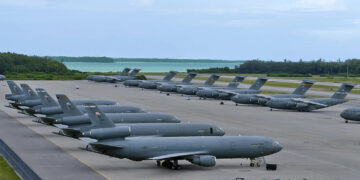
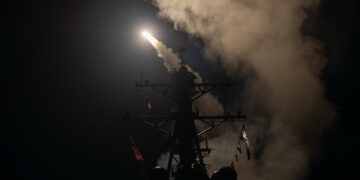
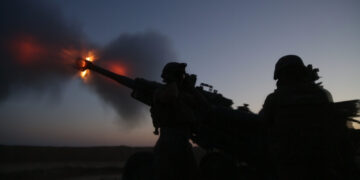
Events on Counterterrorism