Key points
- The United States has two core interests in Asia worth protecting with military power: defending the U.S. homeland and safeguarding access to key economic markets and trade routes. The first priority requires little in the way of a forward military presence while the second benefits from a modest air and naval presence to hedge against outcomes that would threaten U.S. interests.
- A strategy that shifts U.S. military commitments and presence from the vulnerable “first island chain” toward a more defensible “second island chain” would reduce U.S. military requirements and the risk of a war with China while still protecting U.S. interests.
- The United States should narrow its defense commitments in the region, shifting to a clear non-intervention position on Taiwan, ending mutual defense alliances with South Korea, Australia, the Philippines, and Japan, and negotiating narrower and flexible security partnerships in their place. U.S. military posture should change accordingly.
- The United States should remove most Army and Marine Corps deployments from Asia and cut air and naval power significantly. The remaining U.S. forces should be consolidated at more survivable bases farther from China’s coast and tasked with securing U.S. economic interests and signaling continued U.S. involvement in the Pacific region.
- The United States should provide a clear plan of its intentions and communicate carefully with its allies and China. Changes should be phased over a period of three to eight years, with most changes complete by 2030 and all finalized by 2035.
For over a decade, the United States has defined Asia as its priority theater, that is, the region of greatest importance for U.S. national security and economic interests.1“FACT SHEET: Advancing the Rebalance to Asia and the Pacific,” White House, November 16, 2015, https://obamawhitehouse.archives.gov/the-press-office/2015/11/16/fact-sheet-advancing-rebalance-asia-and-pacific; Kenneth G. Lieberthal, “The American Pivot to Asia,” Brookings Institution, December 21, 2011, https://www.brookings.edu/articles/the-american-pivot-to-asia/. This designation owes most obviously to the region’s economic importance. Asia is home to several of the most important U.S. trade partners, including China, Taiwan, and Japan. It is a hub of manufacturing and technological development and the site of many of the world’s most important trade routes.2Bethany Allen-Ebrahimian, “Special Report: Trump’s U.S.-China transformation,” Axios, January 19, 2021, https://www.axios.com/2021/01/19/trump-china-policy-special-report; Robert D. Blackwill and Richard Fontaine, Lost Decade: The U.S. Pivot to Asia and the Rise of Chinese Power (New York: Oxford University Press, 2024).
Asia is also home to the only serious U.S. peer competitor, the People’s Republic of China. Today, China is the geopolitical equal of the United States, with a nearly equivalent GDP and formidable military force. Over the past two decades, U.S. policymakers have become increasingly concerned about the trajectory and purpose of this military development. Many worry that China intends to use its growing military power to push the United States out of Asia or that it has aggressive intentions against U.S. allies such as Japan and South Korea.3Blackwill and Fontaine, Lost Decade; “Military and Security Developments Involving the People’s Republic of China 2025,” U.S. Department of War, December 23, 2025, https://media.defense.gov/2025/Dec/23/2003849070/-1/-1/1/ANNUAL-REPORT-TO-CONGRESS-MILITARY-AND-SECURITY-DEVELOPMENTS-INVOLVING-THE-PEOPLES-REPUBLIC-OF-CHINA-2025.PDF.
The United States has long maintained a massive military presence in Asia, spread across Japan, South Korea, the Philippines, Australia, and U.S. territories such as Guam. The origins of this posture go back at least to the end of World War II, when the United States occupied Japan and turned many of its regional outposts into permanent military installations. Long-term alliances with Japan, South Korea, and the Philippines gave the United States an enduring stake in the region’s security. Over time, these relationships became the central pillars of U.S. military dominance over the western Pacific.
Since the height of the Cold War, the number of U.S. military personnel stationed in the region has fallen, with most U.S. military forces leaving the Philippines and many exiting South Korea as well. But about 90,000 personnel remain, and the institutional barriers to removing them are fierce.4“Where Are U.S. Military Members Stationed?” USA Facts, March 4, 2026, https://usafacts.org/articles/where-are-us-military-members-stationed-and-why/. Especially since President Barack Obama announced an intention to “pivot to Asia” in 2011, the Pentagon has explored increasing its access to regional military bases for rotational U.S. military deployments or the forward positioning of U.S. assets.5“FACT SHEET: Advancing the Rebalance to Asia and the Pacific”; “Indo-Pacific Strategy of the United States,” U.S. Embassy and Consulates in Indonesia, February 2022, https://id.usembassy.gov/fact-sheet-indo-pacific-strategy-of-the-united-states/; “2026 National Defense Strategy,” Department of War, January 23, 2026, https://media.defense.gov/2026/Jan/23/2003864773/-1/-1/0/2026-national-defense-strategy.pdf.
U.S. active-duty military personnel in East Asia
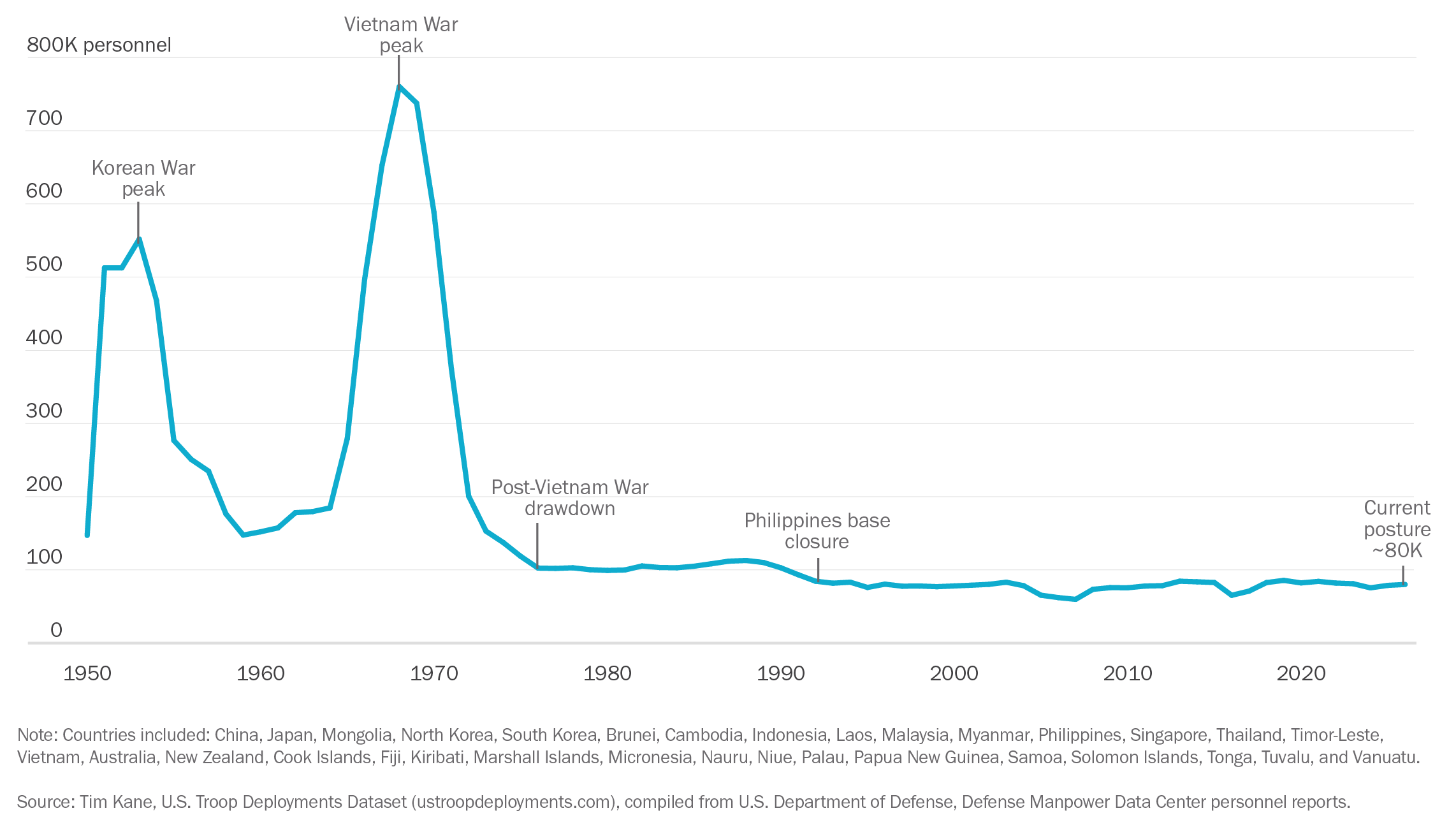
U.S. troop counts in East Asia peaked during the Vietnam War and have largely held steady since the end of that conflict.
The U.S. policy debate about strategy in Asia is imbalanced. It starts from the assumption that the current U.S. posture in Asia is the minimum required for U.S. national security. When alternatives to the status quo are considered, they involve additions to U.S. presence and commitments—deploying more forces, more warships, more aircraft, and more weapons platforms to “strengthen deterrence.” But this leaves out a fundamental question: do U.S. military commitments and the existing U.S. posture really make Americans safer and more prosperous?
This paper will examine this question. It will start by clearly defining U.S. vital interests in Asia and separating them from the maximalist intentions set out by proponents of U.S. military dominance. It will then consider what military partnerships and what types of military capabilities are required to defend these interests.
The recommendations presented here would move the United States toward a “second island chain strategy” that would concentrate U.S. military force farther from the Chinese coast in places like Guam, the Northern Mariana Islands, Palau, Micronesia, Marshall Islands, and other U.S. operating locations nearby. This strategy would stand in contrast to the “first island chain strategy” the United States currently maintains, which focuses on Japan, Taiwan, South Korea, and the Philippines. It would reduce the overall U.S. regional footprint without sacrificing U.S. interests. Over time, the proposed posture would leave the United States more secure rather than less and with a more sustainable military footprint.
What are U.S. interests in Asia?
A narrow but complete definition of U.S. interests in Asia would include just two things: defense against any threat that might target the U.S. homeland and protection of access to key economic markets and trade routes.
Achieving the first objective is relatively straightforward. There are few threats emerging from Asia that pose an immediate danger to the United States homeland and none that require a large forward military presence.
The risk of a conventional Chinese attack on the U.S. homeland is low. To be sure, China could use ICBMs during a contingency.6Aaron-Matthew Lariosa, “Chinese Forces Fielding Intercontinental Anti-Ship Ballistic Missiles Capable of Reaching U.S. West Coast, Pentagon Says,” USNI News, December 26, 2025, https://news.usni.org/2025/12/26/chinese-forces-fielding-intercontinental-anti-ship-ballistic-missiles-capable-of-reaching-u-s-west-coast-pentagon-says. The same is true for North Korea, though in neither case is a “bolt from the blue” attack likely. An attack might occur as part of a larger military campaign, but staying out of a war with China or North Korea is the best way to defend against such a scenario.
China could also pose nuclear or cyber threats to the United States and is a competitor in space. But the U.S. does not need a large forward presence in Asia to combat these challenges. After all, if the United States were less involved in the region, the likelihood of certain types of threats would be vanishingly small. Most challenges coming from the region could be addressed by improved missile defense, investment in expanded satellite capabilities, and more advanced cybersecurity, as well as diplomacy to decrease the risk of conflict that might result in an attack on the homeland.
U.S. territories located in the South Pacific, including Guam, are more vulnerable to conventional strikes because they are closer to China and within range of more of its missiles. Still, the security threats these locations face result from the U.S. military presence and are thus not a problem the United States must be deployed forward to neutralize. None of these locations along the second island chain are natural conflict “flashpoints” in the way Taiwan or the South China Sea might be. They have become contested only in the role they might play in a war closer to China’s coastline.
The second U.S. priority, access to economic markets, is more challenging. From the perspective of the United States, no country can be allowed to dictate the terms of U.S. economic engagement in Asia. This could occur in one of two ways. One would be for another power, namely China, to physically block U.S. access to key markets, resources, or supply chains. Some argue that if China were to seize Taiwan or expand its control of small islands, rocks, and reefs in surrounding waters, this task would be easier. Success in such an effort might not be total, but it need not be to impose substantial economic costs. Yet China likely could take these steps today even without territorial expansion and has never done so. In fact, as a trade-dependent country, such a move would run counter to China’s own economic interests.
A second approach for a power hoping to set U.S. terms of trade would be to use political or economic control of its companies and neighbors to create market barriers like export controls, tariffs, or legal restrictions. This might occur if, for example, China gained the political and economic influence over Japan, South Korea, and other Asian countries to cut off all semiconductor cooperation with the United States, sharply constraining the U.S. ability to buy these chips or access necessary input parts. China likely has this influence in Southeast Asia already. Obtaining it in Japan or South Korea would very hard but not impossible.
This type of influence could also be achieved through Chinese conquest of surrounding countries, but this would be even more difficult and unlikely (whether the United States offers support or not). China does not have the military capabilities to conquer Japan, the Philippines, or South Korea and will not for some time. These countries are also quite defensible using asymmetric capabilities. They are well-protected by water and for Japan and the Philippines, their archipelagic geography offers additional advantages.7Stephen M. Walt, “Hedging on Hegemony: The Realist Debate over How to Respond to China,” International Security 49, no. 4 (Spring 2025): 37–70, https://doi.org/10.1162/isec_a_00508; David W. Blagden, Jack S. Levy, and William R. Thompson, “Sea Powers, Continental Powers, and Balancing Theory,” International Security 36, no. 2 (Fall 2011), 190–202, https://www.jstor.org/stable/41289702.
Of course, blocking or restricting U.S. access to regional economic markets (and its own) would be costly for China, making such actions less likely, but in the context of competition between two rivals, such self-harm is not unprecedented. After all, the United States itself has made similar decisions, blocking exports of some technologies to China, limiting Chinese investment, and using tariffs and sanctions to achieve geopolitical goals.8“China – U.S. Export Controls,” U.S. Department of Commerce, last modified September 25, 2025, https://www.trade.gov/country-commercial-guides/china-us-export-controls; Karen M. Sutter, “U.S. Export Controls and China: Advanced Semiconductors,” CRS Report no. R48642, Congressional Research Service, September 19, 2025, https://www.congress.gov/crs-product/R48642. It is possible that in the context of worsening U.S.-China relations, Beijing might decide that some limited interdiction to impose costs on the United States is worth the domestic economic pain. Such an effort would have to be extreme to pose existential threats to U.S. prosperity, but we cannot rule out the possibility. It is not a likely scenario, but still one worth hedging against.
To prevent such an outcome, the United States would ideally like to maintain a balance of power in Asia in which China does not decisively dominate. The United States need not retain dominance for such an outcome, but Japan and South Korea would need to remain outside China’s camp, either as independent hedgers or aligned in some way with the United States.9Kelly A. Grieco and Jennifer Kavanagh, “The Elusive Indo-Pacific Coalition: Why Geography Matters,” Washington Quarterly 47, no. 1 (2024): 103–121, https://doi.org/10.1080/0163660X.2024.2326324. This is a reasonable goal for the United States and can be obtained with just a modest military U.S. footprint in Asia.
Neither Japan nor South Korea is likely to shift its alignment voluntarily, not least because neither has any interest in being a Chinese vassal or protectorate. These countries are unlikely to bandwagon with or without U.S military support. They are fiercely nationalistic and have been investing in their own military capabilities to ensure their own autonomy.10Walt, “Hedging on Hegemony.” Moreover, their geography would work against hypothetical Chinese regional dominance.11Walt, “Hedging on Hegemony”; Blagden, Levy, and Thompson, “Sea Powers, Continental Powers, and Balancing Theory.”
Even if these nations did choose to align more closely with China, the United States would still have significant economic leverage and the military capabilities to protect its economic position. The size of the U.S. market will always make it appealing, and Washington could likely negotiate favorable or at least acceptable trade arrangements (though perhaps not dictate terms like it can today) even in the case of a Chinese hegemony in East Asia.
Overcoming physical interdiction would be easier in many respects. The United States benefits from commercial trade through the South China Sea and Taiwan Strait, but in the unlikely event that access to these routes was restricted, trade could be rerouted through other regional waters that would be easier for the United States to secure, for example the Philippine Sea to the east of Japan and the Indonesian archipelagic waters.12Grieco and Kavanagh, “The Elusive Indo-Pacific Coalition”; Jennifer Kavanagh, “A Strategy for Staying Out: Recalibrating U.S. Support to Taiwan,” Brookings Institution, March 20, 2026, https://www.brookings.edu/articles/a-strategy-for-staying-out-recalibrating-us-support-to-taiwan/. Given their size and location, Chinese dominance of waterways in either region is unlikely, meaning the United States should be able to guarantee at least windows of control (this would mean establishing control for limited periods of time, using escorts or convoys, while commercial ships transit). It could do this even with a much smaller military presence, mostly air and naval forces (including submarines) that would be based along the second island chain.
Preventing China from dictating U.S. terms of trade in Asia cannot be achieved with military power alone. Military power can be used to secure access to key sea lines of communication running through the region’s waters and to markets in places like Japan and South Korea, in the event that China opted for a physical interdiction.13Grieco and Kavanagh, “The Elusive Indo-Pacific Coalition.” But military power cannot do much to protect against China using political and economic control. Some security cooperation with countries like Japan and South Korea could reduce their incentives to accommodate Chinese demands, but ultimately a U.S. economic strategy will be more effective.
To summarize, to defend core U.S. interests, U.S. military power in Asia should aim at two main objectives: supporting a regional balance of power in East Asia that does not leave China decisively dominant and defending access to key regional trade routes and maritime passageways as a hedge against physical interdiction. The next section will review the current portfolio of U.S. commitments in Asia to set a benchmark for future reductions.
What commitments does the United States have in Asia?
Today, the United States has far-reaching military commitments in Asia, both in terms of forward presence and alliances.
The United States has four mutual defense commitments in the western Pacific, with South Korea, Japan, the Philippines, and Australia. (Some analysts include Thailand on this list, but legally the U.S. commitment to Thailand is both much weaker and not mutual.) These agreements vary slightly in their specifics, but all require the United States to provide direct military support should any of these allies face threat or aggression.14“U.S. Collective Defense Arrangements,” U.S. Department of State Archive (2009–2017), Office of the Legal Adviser, last accessed September 2, 2026, https://2009-2017.state.gov/s/l/treaty/collectivedefense/.
Outside of these formal commitments, the United States has several other obligations in the region with military requirements. First, there is Washington’s long-standing position of strategic ambiguity with respect to Taiwan, which does not commit the U.S. to defend the island but also does not disavow it in the case of external aggression.15Susan V. Lawrence, Taiwan: Background and U.S. Relations, CRS In Focus IF10275, Congressional Research Service, August 5, 2026, https://www.congress.gov/crs-product/IF10275. Though not a formal commitment, a defense of Taiwan is considered the pacing scenario for the United States military.16Terri Moon Cronk, “Testimony: DOD Is Laser-Focused on China Pacing Challenge, Meeting Our Commitments Under the Taiwan Relations Act,” DOD News, U.S. Department of War, December 8, 2021, https://www.war.gov/News/News-Stories/Article/Article/2867003/testimony-dod-is-laser-focused-on-china-pacing-challenge-meeting-our-commitment/. This means that it guides to a large extent U.S. military posture and spending across the region despite its less than codified status.
The United States is also responsible for defending U.S. outlying territories in the region, such as Guam, as well as three Freely Associated States, the Federated States of Micronesia, the Marshall Islands, and Palau.17Jared G. Tupuola, “The Compacts of Free Association,” CRS In Focus no. IF12194, Congressional Research Service, December 3, 2025, https://www.congress.gov/crs-product/IF12194. The United States has full responsibility for the defense of these territories.
To support these alliance commitments, the United States has military forces and bases established across the Indo-Pacific region. U.S. military forces are concentrated where the United States has formal alliances, but the Pentagon also relies on access agreements elsewhere (including in Papua New Guinea) and hosts rotational forces in places like Singapore and at Diego Garcia in the Indian Ocean.
Right now, the United States has about 90,000 total forces spread across Asia. The largest number are in Japan, about 55,000 Marines, soldiers, sailors, and airmen. More than half of these forces are based in Okinawa, including almost all of the Marines and a significant percentage of forward deployed airpower. The United States also hosts two squadrons of fighter aircraft at Misawa in northern Japan. The U.S. Navy homeports a naval carrier strike group in Japan at Yokosuka. There is also a small number of U.S. Army forces in Japan, mostly focused on combat support and related tasks. Most personnel based in Japan are there on a permanent basis, meaning they deploy for up to three years rather than rotating for nine or so months at a time.18“About USFJ,” U.S. Forces Japan, last accessed September 2, 2026, https://www.usfj.mil/About-USFJ/.
In South Korea, the United States has about 25,000 personnel deployed on a permanent basis. (This number is slightly below the legally mandated 28,500 due to troop rotations and fluctuations.)19“The Reality Behind the ‘28,500 U.S. Troops in Korea’ Number,” Hankyoreh, December 30, 2025, https://english.hani.co.kr/arti/english_edition/e_international/1237158.html. These are mostly Army, including a Stryker Brigade Combat Team. Alongside these ground forces, the United States has three squadrons of fighter aircraft and their support units. A range of intelligence and logistics units is also based in South Korea and while there is no permanent naval presence based forward, naval assets including nuclear submarines visit the country’s ports on a frequent basis.
Other large concentrations of U.S. military forces are located at Guam and increasingly in Australia which the United States is building into a forward logistics hub. Australia is home only to U.S. rotational forces, including about 7,000 U.S. Marines and a range of logistical and combat support forces. In the future, under the AUKUS security agreement, the United States will homeport nuclear submarines in Australia.
At Guam, the United States currently has about 8,000 personnel, but this is expected to rise as some Marines currently based in Okinawa are moved.20Mari Yamaguchi, “U.S. Marines Start Partial Transfer from Okinawa to Guam,” Associated Press, December 16, 2024, https://www.marinecorpstimes.com/news/your-marine-corps/2024/12/16/us-marines-start-partial-transfer-from-okinawa-to-guam/; “The Evolving U.S. Military Presence on Guam,” WatchBlog, Government Accountability Office, June 15, 2017, https://www.gao.gov/blog/2017/06/15/the-evolving-u-s-military-presence-on-guam. Other forces based permanently on Guam include five U.S. nuclear submarines and a range of other naval assets. Andersen Air Force Base hosts key support and communications units, including those that service U.S. strategic bombers.21Luke A. Nicastro, “U.S. Defense Infrastructure in the Indo-Pacific: Background and Issues for Congress,” CRS Report no. R47589, Congressional Research Service, June 6, 2023, https://www.congress.gov/crs-product/R47589; “Andersen Air Force Base, Guam,” U.S. Air Force, last accessed September 2, 2026, https://www.andersen.af.mil/; “The Evolving U.S. Military Presence on Guam.”
The United States used to host large numbers of forces in the Philippines, but they were expelled in the 1990s. Under the Enhanced Defense Cooperation Agreement, signed in 2014, the U.S. military can now host rotational forces at a select set of nine locations in the Philippines.22Nicastro, “U.S. Defense Infrastructure in the Indo-Pacific”; “U.S. Security Cooperation with the Philippines,” U.S. Department of State, January 20, 2025, https://www.state.gov/u-s-security-cooperation-with-the-philippines. U.S. investment in the Philippines has focused on building infrastructure, including ports and airfields, especially in Northern Luzon and Palawan. But rotational deployments of U.S. Marines (about 3,000 personnel) and some Army soldiers (especially communications, intelligence, and signals units) are also common.23“U.S. Security Cooperation with the Philippines.” Since 2024, the United States has hosted a Typhon missile system in the Philippines, capable of firing long-range missiles at targets in mainland China.24Leilani Chavez, “U.S. Typhon Missile System in Philippines Is a Subtle Headache for China,” Defense News, May 14, 2025, https://www.defensenews.com/global/asia-pacific/2025/05/14/us-typhon-missile-system-in-philippines-is-a-subtle-headache-for-china/.
Outside of these locations, the U.S. military presence is limited to small contingents of specialized personnel deployed for limited periods of time. For instance, the United States has about 500 military trainers based in Taiwan, a few support commands based in Singapore (where U.S. military aircraft, submarines, and naval assets sometimes refuel or stop for repairs), and support forces at Diego Garcia where the United States often bases bomber aircraft (most recently for use in the Middle East).25Nityah Labh, “U.S. Military Base on Diego Garcia: What Is Its Strategic Importance?,” Chatham House, February 19, 2026, https://www.chathamhouse.org/2026/02/us-military-base-diego-garcia-what-its-strategic-importance.
Along the second island chain, the United States also has scattered military bases, at locations in the COFA states as well as the Northern Mariana Islands (for example on Tinian, a U.S. territory). These tend to be small in size, but the United States is investing to expand their capacity to host larger U.S. military deployments and handle a greater volume of military operations.26Nicastro, “U.S. Defense Infrastructure in the Indo-Pacific.”
The United States maintains a rotational naval presence in the region, typically one additional carrier strike group operating in the PACOM area, though lately this extra naval presence has been absent, supporting U.S. military operations elsewhere. U.S. submarines also are often in the western Pacific, though their presence is not often revealed publicly.27“U.S. Navy Carrier Strike Groups Absent from Middle East as Iran Crisis Deepens, Raising Major Deterrence and Escalation Risks,” Defence Security Asia, January 11, 2026, https://defencesecurityasia.com/en/us-navy-carrier-absence-middle-east-iran-crisis-deterrence-gap/.
Despite this massive presence, many argue that the current U.S. military footprint must grow to counter threats posed by China’s large and growing military might. The focus of much of this U.S. energy is the first island chain where U.S. military planners believe that more forces could help deter Chinese aggression toward Japan and Taiwan, though infrastructure limitations and host country permissions remain obstacles. The U.S. National Defense Strategy doubles down on this commitment, even as the United States rhetorically seeks a stabler relationship with China.28“Bolstering U.S. Presence in Japan ‘Top Priority’: Senior Pentagon Official,” Kyodo News, April 23, 2026, https://english.kyodonews.net/articles/-/74753; “2026 National Defense Strategy.”
At times, the Pentagon’s efforts to increase military posture in Asia seem to run on autopilot, with the basic assumption that more is better. U.S. alliances are rarely, if ever, assessed to see if they serve U.S. interests. The next section will examine which of the commitments outlined above are worth keeping and which can be discarded.
What military commitments are required to protect U.S. interests?
As it stands today, the United States maintains a much larger footprint in Asia than is necessary for the defense of its interests.
The first question is one of commitments. Specifically, which alliances and security partnerships should the United States maintain, and which should it eliminate? The second is one of personnel and bases required to support those commitments.
U.S. allies and territories in the Western Pacific
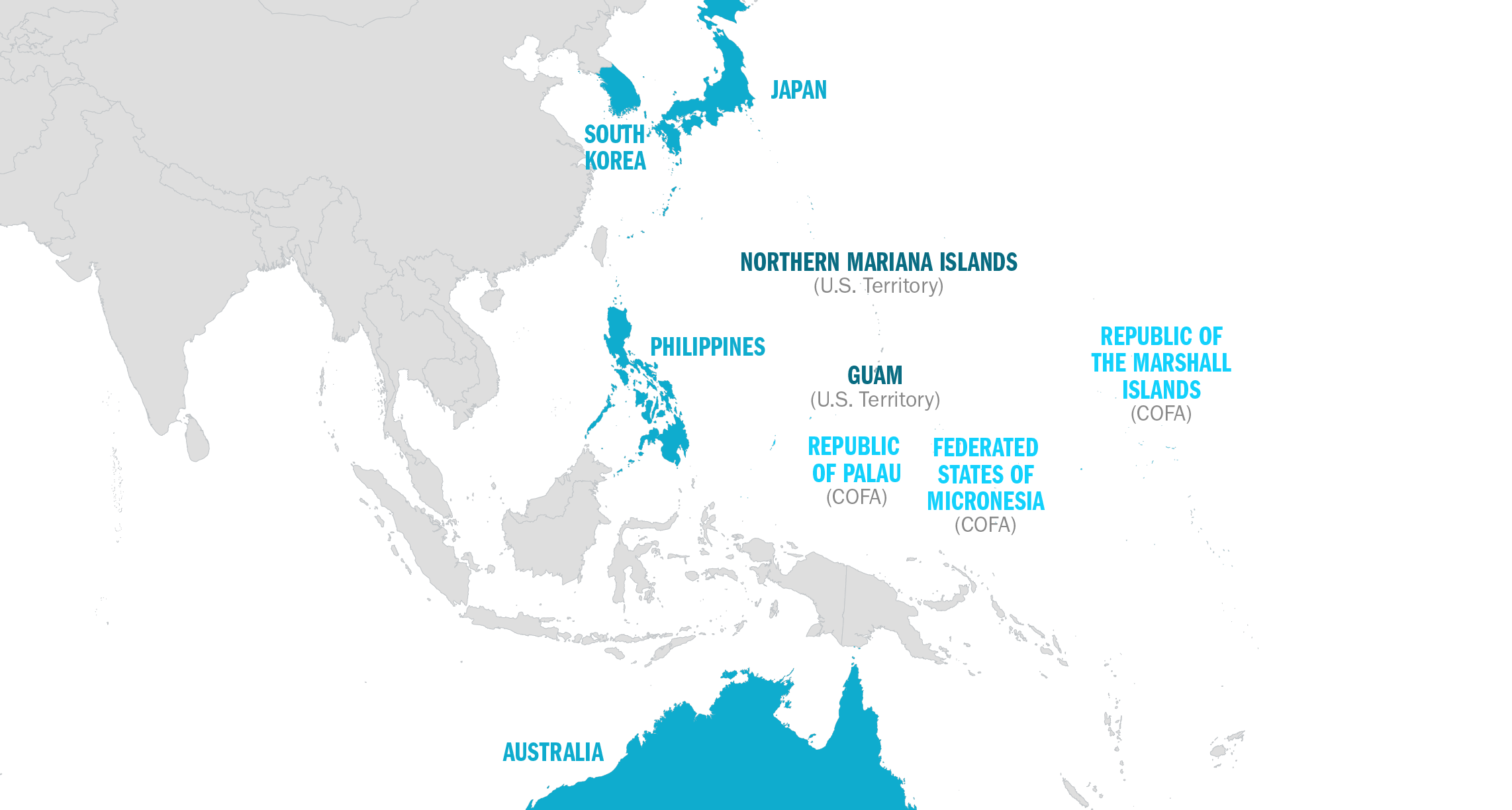
When it comes to alliances, we should distinguish the value of security partnerships, which can help the United States advance its interests, and mutual defense commitments that create binding military obligations. The United States does need security partners to advance its objectives around the world, but what these partnerships look like will change and evolve over time. The United States does not need commitments that bind and reduce the flexibility of U.S. policymakers or military forces.
Though many claim U.S. alliances in Asia are essential for American security (they are often called the greatest American comparative advantage), the reality is that most of what the United States wants to accomplish could be achieved with narrow, interest-based partnerships.29Christine Wormuth, “The Role of Allies and Partners in U.S. Military Strategy and Operations,” testimony before the House Armed Services Committee, RAND Corporation, September 23, 2020, https://www.rand.org/content/dam/rand/pubs/testimonies/CTA800/CTA867-1/RAND_CTA867-1.pdf. In other words, the material and strategic costs of U.S. alliances in Asia, and especially the risk that the United States might be dragged into a war as a result of allied behavior, far exceed their benefits.
South Korea
Of all the U.S. treaty commitments, it is the alliance with South Korea that offers the fewest benefits to the United States, especially when compared to its costs and risks. The U.S. government spends about $5 billion on its presence in South Korea according to one estimate, even accounting for what Seoul contributes.30David Vine, “The True Cost of the U.S. Military in South Korea,” Center for International Policy, July 23, 2026, https://internationalpolicy.org/publications/us-forces-korea-cost/. Remaining tied to South Korea forces the U.S. military to maintain a larger ground force than it might otherwise need and to take on the risk of a war with North Korea that would not advantage core U.S. interests. In addition, U.S. forces based in South Korea are effectively locked in place there, unable to contribute to regional contingencies elsewhere.31Daniel J. Longo, “U.S.-South Korea Alliance: Background and Issues for Congress,” CRS Report no. R48877, Congressional Research Service, March 16, 2026, https://www.congress.gov/crs-product/R48877.
The U.S. role in South Korea is an unnecessary one. South Korea is already capable of defending itself against conventional military threats from North Korea, the primary basis for the relationship between Seoul and Washington.32Daniel Han Tae Choi, “The Missing Metric: Why the 12th Special Measures Agreement Cannot Close South Korea’s OPCON Readiness Gap,” The Pilot, June 17, 2026, https://pacforum.org/publications/the-pilot-39-the-missing-metric-why-the-12th-special-measures-agreement-cannot-close-south-koreas-opcon-readiness-gap/; Ju Hyung Kim, “How South Korea Might Fight a North Korean Invasion in a Dual-Contingency Scenario,” 38 North, April 23, 2026, https://www.38north.org/2026/04/how-south-korea-might-fight-a-north-korean-invasion-in-a-dual-contingency-scenario/. South Korea has a deep arsenal of conventional weapons, including long-range missiles and artillery, while Seoul has increasingly taken over command responsibilities for military operations on the Korean Peninsula, both during peacetime and in contingency planning.33Ju Hyung Kim, “How South Korea Might Fight a North Korean Invasion”; Doug Bandow, “South Korea Must Grow Up and Defend Itself,” Cato Institute, July 18, 2024, https://www.cato.org/commentary/south-korea-must-grow-defend-itself. The delayed transfer of operational control (OPCON) during a contingency owes less to South Korean preparedness than political and technical barriers created largely by the American side.34Choi, “The Missing Metric.” South Korea must still develop its enabling and combat support capabilities—it continues to rely heavily on the United States in these areas—but this is an achievable goal in the near term.35Bandow, “South Korea Must Grow Up”; Sungmin Cho, “South Korea’s Offensive Military Strategy and Its Dilemma,” Center for Strategic and International Studies, February 29, 2024, https://www.csis.org/analysis/south-koreas-offensive-military-strategy-and-its-dilemma.
In the unlikely event of a war between South Korea and North Korea, the outcome of the conflict would not be decisive for U.S. regional interests. It would not shift the balance of power sharply toward China nor would it cut off U.S. access to key regional economic opportunities. If North Korea was victorious (which is wildly unlikely given the balance of power between the sides), this might strengthen China’s hand on the margins, but it would also likely increase North Korea’s independence from its Chinese ally. If South Korea came out on top, this would benefit the United States by getting rid of a minor adversary. If the two sides fought to a stalemate, the damage caused by the war might affect U.S. economic interests to an extent, but it would hurt China at least as much, and the United States could shift its trade to alternative partners. More importantly, such a conflict is unlikely, and committing U.S. forces wastes resources and gives South Korea less incentive to spend properly on its defense and pursue a policy toward North Korea that favors stability over confrontation. With North Korea having removed reunification with its southern neighbor as a goal, the risk of war seems especially diminished.36Richard Connor, “North Korea Drops Reunification Goal from Constitution,” DW, May 6, 2026, https://www.dw.com/en/north-korea-drops-reunification-goal-from-constitution/a-77061282.
Some will argue that the U.S. alliance with South Korea serves an important role in U.S. competition with China, but even if this is true, it is largely an unwilling one. South Korea has long avoided antagonizing China given economic ties and its desire to focus on the threat coming from North Korea. The United States has moved ahead unilaterally, using military bases in South Korea for air and naval activities deemed provocative by China, often without permission from (and even without informing) South Korean authorities.37Kelly A. Grieco and J. James Kim, “The United States’ Korea Strategy is Working Against Itself,” Foreign Policy, May 6, 2026, https://foreignpolicy.com/2026/05/06/china-us-south-korea-alliance-military-diplomacy/. The commander of U.S. forces in South Korea made waves recently when he called South Korea “a dagger pointed at the heart of China.”38“Commander of U.S. Forces in Korea Hails Forward Bases as ‘Dagger’ Pointed at China: Will America Drag Seoul into Conflict?,” Military Watch Magazine, May 30, 2026, https://militarywatchmagazine.com/article/commander-us-forces-korea-dagger-china.
The reality is that the U.S. presence in South Korea contributes little to the protection of U.S. interests in Asia. The forces based in South Korea, mostly U.S. Army personnel, are hard to move quickly, have limited mobility under the current terms of the alliance, and would play a small role in any sort of regional contingency. Not only is their deployment limited under the terms of the current bilateral alliance, it is not clear what ground combat forces would do in a regional contingency, which would occur primarily in the sea and air domains. And this assumes Seoul would allow the United States to use its bases, which is not guaranteed.
Some of the intelligence and logistics capabilities and air and naval assets based in South Korea could be useful, for example, to support U.S. operations to protect maritime commerce. South Korea could also serve as a secure hub for maintenance and resupply in the event of a conflict. However, it is not clear that permanently locating forces in South Korea is any better to achieve this goal than keeping them in the United States to deploy as needed, or along the second island chain where they would be more defensible and where the United States would have more authority over their use. The United States could maintain some access permissions in South Korea, which it might purchase or negotiate after terminating its alliance, and use a small number of bases or ports for a rotational presence.
Taiwan
Today, the United States is not formally committed to defend Taiwan, but its policy of strategic ambiguity leaves the door open should Beijing launch an attack.39Lawrence, “Taiwan: Background and U.S. Relations.” Some U.S. officials have subtly shifted the meaning of the U.S. stance toward Taiwan, suggesting that even peaceful unification between Taiwan and China would be unacceptable.40Ely Ratner, “Statement of Dr. Ely Ratner,” House Armed Services Committee, 118th Cong., 1st sess., September 19, 2023, https://www.congress.gov/118/meeting/house/116355/witnesses/HHRG-118-AS00-Wstate-RatnerE-20230919.pdf.
Even strategic ambiguity, however, is increasingly untenable, carrying risks far out of proportion to the U.S. interests at stake.
Advocates of Taiwan’s strategic importance justify their position in military and economic terms. Neither holds up to scrutiny. It is certainly true that Washington has interests at stake in Taiwan and that a successful Chinese unification effort would have implications for the United States. But those implications are manageable and do not warrant the costs of war with China or the risks involved in continuing military efforts to prepare for such a war.
Some U.S. analysts maintain that if China were to seize Taiwan, it would gain military advantages sufficient to dramatically shift the balance of power in the region, including a launch point for further expansion and the ability to physically restrict commercial traffic from the South China Sea and Taiwan Strait.41Brendan Rittenhouse Green and Caitlin Talmadge, “Then What? Assessing the Military Implications of Chinese Control of Taiwan,” International Security 47, no. 1 (Summer 2022): 7–45, https://doi.org/10.1162/isec_a_00437.
For many, the biggest concern is that after a successful unification, Beijing could use the island as a kind of military base, stationing submarines and ships on Taiwan’s eastern coast, where deeper water and a forward location would make them harder to track. China could also establish missiles and radars at Taiwan’s highest elevations, improving range and targeting for precision strikes.42Green and Talmadge, “Then What?”
Subsequent research has challenged the scope of these benefits, however. Locating submarines on the east coast of Taiwan would allow China to avoid only some types of local detection.43Jonathan D. Caverley, “So What? Reassessing the Military Implications of Chinese Control of Taiwan,” Texas National Security Review 8, no. 3 (Summer 2025), https://tnsr.org/2025/06/so-what-reassessing-the-military-implications-of-chinese-control-of-taiwan/. In any case, China will eventually be able to evade U.S. sensors even without access to Taiwan, and fighting a war with China over an expiring advantage makes little strategic sense.44Chris Panella, “China’s Submarines Are Getting Quieter and Deadlier in the Seas Closest to Home, Analysts Warn,” Business Insider, October 21, 2025, https://www.businessinsider.com/chinas-submarines-quieter-deadlier-to-match-us-analysts-2025-10; Stephen Chen, “China’s Super Quiet Submarine Tech Halves Engine Noise Detection Range: Study,” South China Morning Post, May 27, 2025, https://www.scmp.com/news/china/science/article/3311772/chinas-super-quiet-submarine-tech-halves-engine-noise-detection-range-study. Basing missiles and radars on Taiwan would offer China some advantages in terms of range and targeting precision, but only on the margins, with most Chinese targeting to be done by China’s advanced satellite network in the future.45Caverley, “So What?” Far more likely is that the ability to dominate water and airspace far into the Pacific is a prerequisite for China to seize Taiwan, not a consequence of it.46Caverley, “So What?”; Mike Sweeney, “How Militarily Useful Would Taiwan Be to China?,” Defense Priorities, April 12, 2022, https://www.defensepriorities.org/explainers/how-militarily-useful-would-taiwan-be-to-china/.
Taiwan’s location, 90 miles of China’s coast, also casts some doubt on the notion that seizing the island would be a difference maker for any bid at Chinese regional hegemony. Taiwan is marginally closer to Japan’s southernmost islands than to China, but even if Chinese forces were to seize these locations, it would not shift the regional balance of power nor would it threaten U.S. interests. Major campaigns against Japan or the Philippines would be extremely difficult, even for the powerful Chinese military, and remain highly unlikely. Controlling Taiwan could make it easier for China to restrict access to nearby waters in the South China Sea, but it could likely do this now if it chose to.47Oriana Skylar Mastro, “Beijing Can Take the South China Sea Without Firing a Shot,” New York Times, July 25, 2024, https://www.nytimes.com/2024/07/25/opinion/china-us-military-south-china-sea.html.
In fact, as noted already, China’s road to regional hegemony would be quite difficult (though not impossible), due to both geography and the nationalism of regional countries.48Walt, “Hedging on Hegemony.” As noted previously, neighbors like South Korea and Japan have no interest in being in China’s sphere of influence. China might have more luck with economic coercion and political control than military conquest, but it still seems unlikely that these nations would choose to bandwagon with China.49Walt, “Hedging on Hegemony.”
More likely, China’s neighbors would react by arming themselves to the teeth, strengthening their position vis-à-vis China. This might mean less U.S. influence, but it would not directly damage U.S. interests. In any case, keeping military forces in Asia and retaining the U.S commitment to Taiwan may not be sufficient to prevent China from exploiting political and economic tools against its neighbors. To counter that type of activity, Washington will need an economic and diplomatic strategy.
China’s economic and industrial gains from a successful seizure of Taiwan would be more substantial. There are two considerations: U.S. access to markets in the region and the fate of Taiwan’s semiconductor industry.50Chris Miller, Chip War: The Fight for the World’s Most Critical Technology (New York: Scribner, 2022). As noted already, China’s ability to restrict access to the South China Sea does not depend on its control of Taiwan. It can already do this, by diverting or physically stopping all ships associated with U.S. trade as they move through chokepoints near its coast. However, even if China were to try to restrict access to these waters, the United States could still ensure its ability to operate in key economic markets using regional alternatives, including straits in Southeast Asia, through the Philippine and Indonesian archipelagoes, and the Philippine Sea to the east of Japan. This is a militarily feasible task for the United States.
Chinese control of Taiwan could be a bigger problem for the U.S. if it led to a loss of Taiwan’s advanced semiconductors.51Gina Raimondo, “Remarks on CHIPS Act and a Long-Term Vision for America’s Technological Leadership,” U.S. Department of Commerce, February 23, 2023, https://www.commerce.gov/news/speeches/2023/02/remarks-us-secretary-commerce-gina-raimondo-chips-act-and-long-term-vision. Such a shutdown could occur due to damage to Taiwan’s semiconductor manufacturing facilities and equipment during an invasion.52James Pethokoukis, “How Disruptive Would a Chinese Invasion of Taiwan Be?” American Enterprise Institute, November 11, 2024, https://www.aei.org/articles/how-disruptive-would-a-chinese-invasion-of-taiwan-be/. Alternatively, if China seized the production facilities intact, the United States would likely choose to cut off access to the intellectual property that Taiwan’s companies need to produce the most advanced chips (this IP is housed outside of Taiwan), which also disrupt production and U.S. supplies.
Of course, this would be a policy choice. The United States could instead make a deal with China, trading access to necessary IP for Chinese guarantees to sell Washington advanced semiconductors produced in Taiwan. In the current political environment, this seems unlikely, however. Critics of such a plan would rightly argue that access to U.S. IP would give China’s own semiconductor industry new advantages and leave the United States too vulnerable to a strategic competitor. China could always decide to cut off U.S. access to certain types of chips, despite any economic cost, to advance its own interests (as the United States has done to China) or in the context of a contingency.
Chokepoints in East Asia
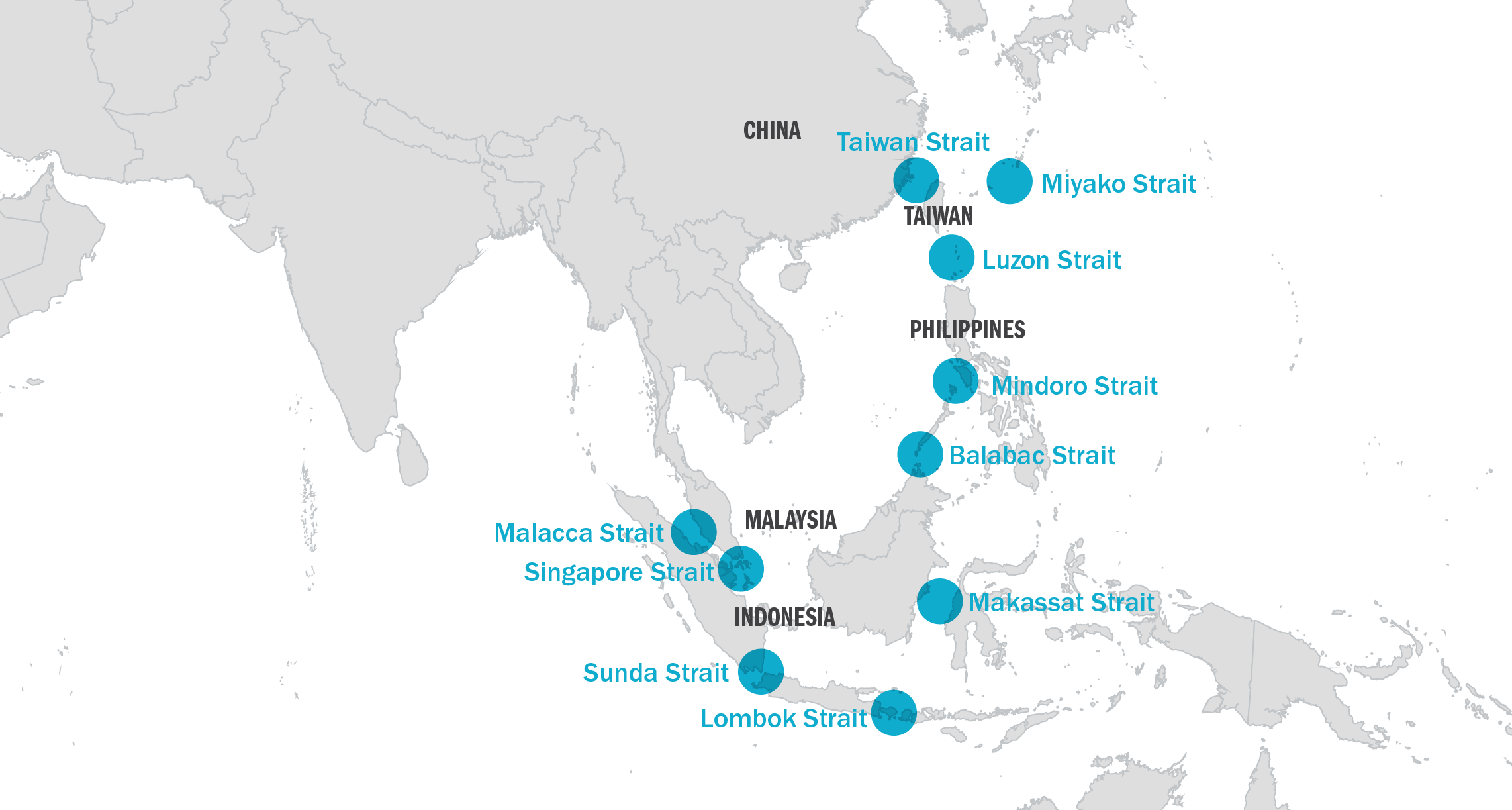
The large number of chokepoints in East Asian waters would make it difficult for China to strangle U.S. trade in the region.
No matter how it occurs, however, disruption of the U.S. supplies of the most advanced semiconductors would be temporary. The United States would have the IP required to reconstruct the semiconductor supply chain outside of Taiwan, including production and packaging. This would take some time but is a surmountable challenge. In the interim, the United States could lean on other trade partners that offer some alternatives for certain types of semiconductors. South Korea, for instance, produces many of the most sophisticated chips involved in memory and data storage, while Japan dominates in image sensors and machines involved in manufacturing.53Emily Benson, Japhet Quitzon, and William Alan Reinsch, “Securing Semiconductor Supply Chains in the Indo-Pacific Economic Framework for Prosperity,” Center for Strategic and International Studies, May 30, 2023, https://www.csis.org/analysis/securing-semiconductor-supply-chains-indo-pacific-economic-framework-prosperity; Raj Varadarajan et al., “Emerging Resilience in the Semiconductor Supply Chain,” Boston Consulting Group, May 8, 2024, https://www.bcg.com/publications/2024/emerging-resilience-in-semiconductor-supply-chain. China also makes semiconductors, though they are less advanced than those manufactured in U.S. supply chains. China would likely continue selling these chips to the United States even after a war over Taiwan, as they do today.54Ana Swanson and Paul Mozur, “U.S. Takes Aim at China’s Production of Essential Computer Chips,” New York Times, December 23, 2024, https://www.nytimes.com/2024/12/23/business/economy/us-china-semiconductor-legacy-chips.html. This would be enough to meet most U.S. needs because advanced semiconductors produced in Taiwan are most important for high-end consumer electronics, which are arguably less crucial to U.S. economic prosperity than other inputs.55Raimondo, “Remarks on CHIPS Act.”
These scenarios do underline the virtue of finding new sources of supply. Because the United States owns the intellectual property and software used to design the most sophisticated semiconductors, it has a near-term advantage and window to build domestic resilience.56Owen J. Daniels and Will Hunt, “Sustaining and Growing the U.S. Semiconductor Advantage: A Primer,” Center for Security and Emerging Technology, June 2022, https://cset.georgetown.edu/publication/sustaining-and-growing-the-u-s-semiconductor-advantage-a-primer/. Efforts in this direction are underway, but Washington should move more quickly to expand chip manufacturing and packaging capacity.
The bottom line is the implications of a Chinese unification with Taiwan are manageable for the United States. China would undoubtedly get some military benefits from unification (though there would also be costs associated with governance, especially if a local resistance emerged), but the United States would still have advantages in intelligence and the space and undersea domains.57Jude Blanchette and Richard McGregor, “After the Invasion: China Considers the Problem of Ruling Taiwan,” War on the Rocks, June 5, 2026, https://warontherocks.com/after-the-invasion-china-considers-the-problem-of-ruling-taiwan/; “Military and Security Developments.” Moreover, it could still protect against any unlikely threat to U.S. commercial interests across the western Pacific and the security of the homeland with investments along the second island chain. The United States should scale up its domestic production of semiconductors, but the extent of any disruption would depend on the timeline.
In contrast to the modest U.S. interests at stake, the costs of a war with China over Taiwan would be immense and unmanageable, especially after the U.S. expended significant military power fighting a war in Iran. The death toll for each combatant would likely be in the tens or hundreds of thousands, and there would be a risk of nuclear escalation.58Sheena Chestnut Greitens et al., “If China Attacks Taiwan: The Consequences for China of ‘Minor Conflict’ and ‘Major War’ Scenarios,” German Marshall Fund of the United States, January 5, 2026, https://www.gmfus.org/news/if-china-attacks-taiwan; Mark F. Cancian, Matthew Cancian, and Eric Heginbotham, “The First Battle of the Next War,” Center for Strategic and International Studies, January 9, 2023, https://www.csis.org/analysis/first-battle-next-war-wargaming-chinese-invasion-taiwan. Both the United States and China could lose dozens of warships and hundreds of aircraft.59Greitens et al., “If China Attacks Taiwan”; Cancian, Cancian, and Heginbotham, “The First Battle of the Next War.” The global economic toll could reach into the tens of trillions of dollars, due to the demands of warfighting and the disruption to major international trading routes, investments, and financial markets.60Jennifer Welsh and Maeva Cousin, “The $10 Trillion Fight: Modeling a U.S.-China War over Taiwan,” Bloomberg News, February 10, 2026, https://www.bloomberg.com/news/articles/2026-02-10/the-10-trillion-fight-modeling-a-us-china-war-over-taiwan.
Finally, there is the question of military resources. When the United States made its commitment to Taiwan in 1979, China’s military was no match for its American counterpart. Today, China has a formidable military force, while limits on U.S. military power are real and obvious.61“Military and Security Developments.” The United States enjoys some advantages, but China’s naval capacity is rapidly closing the remaining gaps. China’s missile capabilities also pose a significant challenge, able to place U.S. military bases at risk and force U.S. warships to operate far from the Chinese coast.62“Military and Security Developments.” Questions about the sufficiency of the U.S. military’s own missile stockpile also abound, especially after the war in Iran called into doubt U.S. resilience.63Jennifer Kavanagh, “Iran Killed Any Delusions of U.S. Military Domination over China,” Responsible Statecraft, April 29, 2026, https://responsiblestatecraft.org/us-military-unprepared-war-china/. U.S. readiness for a war dominated by drones is also questionable. The United States has not been able to defend against drone attacks during the 2026 Iran war and would almost certainly fare worse against China, the global leader in drone production.64Bilal Y. Saab and Natasha Ahmed, “The Iran Problem Won’t Be Solved Without a Counter-Drone Coalition,” Atlantic Council, May 22, 2026, https://www.atlanticcouncil.org/dispatches/the-iran-problem-wont-be-solved-without-a-counter-drone-coalition/; Natasha Bertrand, et al, “U.S. Air Defenses May not Be Able to Intercept Many of Iran’s One-Way Drones,” CNN, March 4, 2026, https://www.cnn.com/2026/03/04/politics/us-air-defenses-iran-attack-drones-challenge.
The United States could, certainly, use its military power to complicate a Chinese effort to seize Taiwan, but it is not clear that it could outlast China. Even a denial campaign would come at exorbitant cost for the United States, far in excess of any benefits at stake. With a cost-benefit calculation this lopsided, a change in the U.S. commitment to Taiwan seems wise. The United States should shift from strategic ambiguity to a clear non-intervention policy in the event of any military confrontation over Taiwan.
The Philippines
The U.S. mutual defense treaty with the Philippines commits Washington to defend not only the country’s main islands but also claimed land formations in the South China Sea.65“Readout of Secretary of Defense Lloyd J. Austin III’s Call with Philippine Secretary of National Defense Gilberto Teodoro Jr.,” U.S. Department of War, March 27, 2024, https://www.war.gov/News/Releases/Release/Article/3719906/readout-of-secretary-of-defense-lloyd-j-austin-iiis-call-with-philippine-secret/. While a Chinese attack on the former remains a remote possibility, a serious threat to the latter (or a conflict spurred by miscalculation) is not out of the question. The Philippine military is quite weak, likely incapable of defending its remote territorial claims and even its western-most territory, the island of Palawan, from a serious Chinese takeover attempt. Under the current mutual defense treaty, then, the United States could easily be dragged into a direct war with China over what some have called “rocks and reefs” in the South China Sea.
To warrant such a tremendous risk, defense of the Philippines and its outlying claims would need to clearly advance U.S. interests in a significant and sustained way. This is simply not the case.
For those who support this expansive commitment, the guiding justification turns on the Philippines’ geostrategic value. There are two pieces to this argument. First, advocates contend that the mutual defense commitment comes with benefits for the United States, including access to Philippine bases and airfields.66Japhet Quitzon, “The Uniquely Stable U.S.-Philippines Partnership,” Center for Strategic and International Studies, September 4, 2025, https://www.csis.org/analysis/uniquely-stable-us-philippines-partnership; William Piekos, “The Philippines: Background and U.S. Relations,” CRS Report no. R47055, Congressional Research Service, 2022, https://www.congress.gov/crs-product/R47055. As noted above, since the signing of the Enhanced Defense Cooperation Agreement in 2014, the United States has gradually increased its investment in the Philippines, building new runways and larger ports and naval facilities especially in northern Luzon.
Second, proponents of the mutual defense agreement argue that if China were to further expand its territorial control in the South China Sea, militarize newly seized land formations, or even take control of Palawan, it could more easily interdict maritime commerce and disrupt global trade.67Quitzon, “The Uniquely Stable U.S.-Philippines Partnership”; Piekos, “The Philippines: Background and U.S. Relations.”
Neither rationale justifies keeping the U.S.-Philippine relationship as is. For starters, there is no guarantee that maintaining the defense treaty with the Philippines will guarantee the United States access to the bases it hopes to use.68Stacie L. Pettyjohn and Jennifer Kavanagh, “Access Granted: Political Challenges to the U.S. Overseas Military Presence, 1945–2014,” RAND Corporation, November 21, 2016, https://www.rand.org/pubs/research_reports/RR1339.html. Some will argue that the United States would just use the bases anyway, permission or not, but in the Iran war (and other historical cases) this did not happen. Project Freedom, President Trump’s effort to reopen the Strait of Hormuz by force, was forced to pause when Saudi Arabia refused to allow U.S. aircraft to take off from its soil.69Julian Borger, “Iran Mocks Trump’s ‘Project Freedom’ as Adversaries Wrestle Over Talks to End War,” The Guardian, May 7, 2026, https://www.theguardian.com/world/2026/may/07/iran-mocks-donald-trump-project-freedom. Similarly, in 2003, when Turkey denied the United States access to its bases for the U.S. invasion of Iraq, the United States revised its operational plans rather than ignore allied restrictions.70“Turkey Rejects U.S. Troop Proposal,” CNN, March 1, 2003, https://www.cnn.com/2003/WORLD/meast/03/01/sprj.irq.main/.
Furthermore, China’s advanced missile capabilities make fixed bases so close to the Chinese coast less useful than they might have been in the past. In any contingency, these facilities will be easy targets for Chinese missiles and drones, making them liabilities rather than assets. This does not mean the United States needs no forward operating locations, but since these can be acquired through leases and other temporary arrangements, basing access is a bad reason to preserve the U.S.-Philippine (or any) alliance.71Doug Bandow, “Lessons from Trump’s Reckless Iran War,” Cato Institute, June 22, 2026, https://www.cato.org/commentary/lessons-trumps-reckless-iran-war; Helene Cooper and Eric Schmitt, “Iran’s Attacks Force U.S. Troops to Work Remotely,” New York Times, March 25, 2026, https://www.nytimes.com/2026/03/25/us/politics/iran-us-bases.html. If the United States gives up its commitment to Taiwan, then locations in northern Luzon will no longer be necessary to U.S. strategic planning.
As for concerns about limited access to the South China Sea or nearby waterways, as already discussed above, the reality is that China likely already has the capacity to block the South China Sea transit routes even without additional territorial control. The U.S.-Philippine alliance does not protect the United States against this risk.
It is possible that a narrower commitment of some military support to the Philippines’ sovereignty could serve U.S. interests. The Philippines does occupy an important geographic position, and its archipelagic waters could serve as alternative maritime routes (commercial or military) in case of interdiction in the South China Sea. But this commitment would only make strategic sense for the United States if it excluded shoals in the South China Sea and Palawan.
For example, the United States might try to maintain some military access locations, ports, and airfields that could host rotational air and naval forces as it does in many countries. In a crisis, it might offer some combat support or air and naval backstops to support the security of major Philippine ports and airfields—if it could do so without getting into a direct war with China. However, this narrowly framed military support would not need to be encompassed in a mutual defense treaty or even a formal security partnership. At the very least, then, the U.S.-Philippine mutual defense treaty should be renegotiated to a much narrower and more limited commitment.
Australia
The U.S. mutual defense commitment to Australia (considered part of the Pacific theater for military purposes but not a part of geographic Asia) is low-cost for the United States. Australia faces few direct military threats, meaning an alliance is unlikely to drag the United States into a conflict. But it is also a low-benefit commitment that does little to clearly advance U.S. strategic interests. Although Australia might help the United States protect access to regional waterways, it’s unlikely to do more. A treaty commitment is not required for this level of cooperation, which, after all, is in Australia’s own interests.72Mark Harrison, “Australia’s Understanding and Preparedness for a Taiwan Strait Contingency,” Australian Outlook, Australian Institute of International Affairs, November 6, 2025, https://www.internationalaffairs.org.au/australianoutlook/australias-understanding-and-preparedness-for-a-taiwan-strait-contingency/; Lyle Goldstein, “Target Taiwan: Limits of Allied Support,” Defense Priorities, October 16, 2025. https://www.defensepriorities.org/explainers/target-taiwan-limits-of-allied-support/.
Maintaining security partnerships with Australia makes good sense, but this need not take the form of an alliance. The United States has been working to expand cooperation with Australia through arrangements like AUKUS, defense-industrial cooperation, and rotational deployments that enhance Australia’s value as a forward operating base. Maintaining basing access and some rotational presence in Australia could be also useful to safeguard necessary access to sea lanes and chokepoints in southeast Asia for U.S.-linked commercial trade. But this partnership need not include a mutual defense clause.
Japan
While the United States could end its alliance commitments to Australia, the Philippines, and South Korea without major consequences, its relationship with Japan may require a different approach, at least in the near term.
Japan remains the most important player in the region’s balance of power. Protecting U.S. interests in East Asia does not mean keeping Japan as a formal treaty ally, but it does mean ensuring that Japan remains outside of China’s orbit. As already noted, a Japan that fully bandwagons with China is unlikely, due as much to its own nationalism and historical grievances against Beijing as anything else. But ensuring this never happens seems important enough to be worth a bit of U.S. hedging, especially if it can be done at moderate cost. This would not mean an alliance with a mutual defense clause, but it might mean a slower reduction in the U.S. commitment and posture, as well as a slightly more expansive long-term security relationship.
The United States does, as noted above, have a stake in Japan’s continued independence, but the current U.S. commitment is too broad for three reasons. First, it extends too far geographically. If U.S. interests in the region are primarily focused on preserving a regional balance of power that keeps China from dominating, then the orientation of Japan as a whole matters a good deal, but the status of outlying territorial claims like the Senkaku/Diaoyu islands does not. Yet these small islands and rock formations are covered by the U.S. security commitment.
Second, the broad U.S. commitment disincentivizes Japan from spending properly on its defense despite being a wealthy and technologically advanced nation. Finally, while Japan’s outlying islands and even Okinawa may be difficult to defend and vulnerable, its mainland is not. Surrounded by water and located much farther from Chinese territory than Taiwan, Japan is easily defensible with the right mix of denial capabilities.73Goldstein, “Target Taiwan”; Michael Beckley, “The Emerging Military Balance in East Asia: How China’s Neighbors Can Check Chinese Naval Expansion,” International Security 42, no. 2 (Fall 2017): 78–119, https://doi.org/10.1162/ISEC_a_00294.
The U.S. security treaty with Japan is thus counterproductive and unnecessary, as it offers Japan guarantees against aggression that is both unlikely and that Japan could handle mostly on its own.
A bigger concern is how Japan would respond if the United States were to reduce its military commitment to countries in the region. There are two theories. One, already discussed, is that Japan would respond by investing in its own defense (including by getting a nuclear weapon), forming other partnerships, and balancing against a much stronger China.74Christopher P. Twomey, “Japan, a Circumscribed Balancer: Building on Defensive Realism to Make Predictions about East Asian Security,” Security Studies 9, no. 4 (2000): 167–205, https://doi.org/10.1080/09636410008429416; Kei Koga, “The Concept of ‘Hedging’ Revisited: The Case of Japan’s Foreign Policy Strategy in East Asia’s Power Shift,” International Studies Review 20, no. 4 (December 2018): 633–660, https://doi.org/10.1093/isr/vix059; Adam P. Liff, “Unambivalent Alignment: Japan’s China Strategy, the U.S. Alliance, and the ‘Hedging’ Fallacy,” International Relations of the Asia-Pacific 19, no. 3 (September 2019): 453–91, https://doi.org/10.1093/irap/lcz015. The other is that, acting on fears that it cannot rearm quickly enough, Japan would choose to accommodate Chinese demands, becoming an effective Chinese satellite.75Dylan Motin, Bandwagoning in International Relations: China, Russia, and Their Neighbors (Wilmington, DE: Vernon Press, 2024); Jae Ho Chung, “East Asia Responds to the Rise of China: Patterns and Variations,” Pacific Affairs 82, no. 4 (2009): 657–75, https://doi.org/10.5509/2009824657. Under the nationalist Prime Minister Sanae Takaichi, this latter outcome is unlikely, but it cannot be ruled out in the future. Constitutional limits on Japan’s military activity and its current “Three Non-Nuclear Principles” pose some limits on its ability to rearm. This could make accommodation more likely under certain circumstances than some estimate.76Nobumasa Akiyama, Yuki Ohara, and Yuhi Matsushita, “Ambivalent Japan: Japanese Public Attitudes Toward Nuclear Weapons,” Nonproliferation Review 32, no. 1–3 (2025): 75–106, https://doi.org/10.1080/10736700.2025.2588830; Michiru Nishida, “Changing Security Environment in East Asia and Its Implications on Japan’s Nuclear Policy,” Journal for Peace and Nuclear Disarmament 6, no. 2 (2023): 327–345, https://doi.org/10.1080/25751654.2023.2285024.
The ideal U.S. commitment, then, would be just enough to push Japan down the balancing road, giving it incentives not to bandwagon with China while slowing removing U.S. support. Since the likelihood of bandwagoning may decrease as Japan gets stronger, a phased reduction in U.S. military support and presence in Japan and a longer-term security arrangement that promises combat support, weapons, and intelligence in case of a conflict should be sufficient.
Maintaining basing access—through negotiation or by paying an administrative fee—in northern Japan or on Japan’s eastern coast could also help protect access to commercial ports in South Korea and Japan against attack or any type of blockade, especially one conducted using underwater assets. But these bases would similarly be vulnerable to Chinese missiles and so should be small in number and hardened. The United States does not need a treaty for such access but can likely negotiate it as part of a separate arrangement.
In the longer term, the United States might only need to keep a small number of logistical and intelligence personnel, anti-submarine capabilities, and some rotational and periodic air and naval power at these locations. This type of U.S. military presence would remove most ground forces from Japan, especially from Okinawa where they are politically unpopular.77Molly Jackson, “Why Okinawa Is Outraged Again over U.S. Military Presence,” Christian Science Monitor, October 13, 2015, https://www.csmonitor.com/World/Global-News/2015/1013/Why-Okinawa-is-outraged-again-over-US-military-presence; Jon Letman, “Okinawans Want Their Land Back. Is That So Hard to Understand?,” Foreign Policy in Focus, June 1, 2015, https://fpif.org/okinawans-want-their-land-back-is-that-so-hard-to-understand/. Such reductions make sense not only in the context of a reduced U.S. commitment to Japan but a change to U.S. policy on Taiwan. U.S. military forces based in Okinawa are considered most useful by the Pentagon not for their support to Japan’s security but Taiwan’s.
The United States should push for full Japanese self-sufficiency perhaps by 2035, though maintaining at least some rotational presence in Japan could remain in U.S. interests over a longer period.
Compact of free association (COFA) states (Palau, Micronesia, Marshall Islands) and Guam
Finally, we should consider the U.S. commitment to the COFA states, Palau, Micronesia, and the Marshall Islands, along with other nearby territories. These states have signed long-term agreements giving the United States full access to military installations across their territories, in return for guaranteed U.S. protection and economic benefits such as healthcare.78Jared G. Tupuola, “The Freely Associated States and Issues for Congress,” CRS Report no. R48311, Congressional Research Service, December 10, 2024, https://www.congress.gov/crs-product/R48311; “The Marshall Islands and Micronesia: Amendments to the Compact of Free Association with the United States,” CRS Report no. RL31737, Congressional Research Service, May 3, 2004, https://www.everycrsreport.com/reports/RL31737.html. The financial costs of these arrangements have risen over time, doubling since the original agreement was signed in 1986 to about $350 million per year. This reflects the COFA states recognizing their own bargaining power and increasing their demands each time the governing agreements are renegotiated.79Tupuola, “The Freely Associated States and Issues for Congress”; “The Marshall Islands and Micronesia.”
These locations provide the United States with relatively survivable bases far from the Chinese coast, where air and naval forces can position assets forward if required to support operations in the region. This is especially true for those focused on securing sea lanes in case of attempted physical interdiction, as well as acting as a backstop against Chinese power projection across the Pacific.
The same rationale should apply to Guam and other formal U.S. territories such as the Northern Mariana Islands. Guam serves an important purpose for the U.S. military as a hub for logistics and the basing of long-range, kinetic assets. It makes sense for the United States to maintain its commitments to Guam and other U.S. territories, though relinquishing them would hardly undercut U.S. territorial sovereignty (notably, there is a movement in Guam that favors independence from the United States).80“The Commission on Decolonization – COD,” Government of Guam, Commission on Decolonization, last accessed September 2, 2026, https://decol.guam.gov/. The cost of defending these locations is relatively low in peacetime and the risks of a conflict minimal should the United States pull back from its extensive first island chain footprint. Dispersing forces across second island chain locations and away from the concentration on Guam would offer some advantages in resilience (though having too many bases is also a vulnerability that can spread resources thin).
Summary
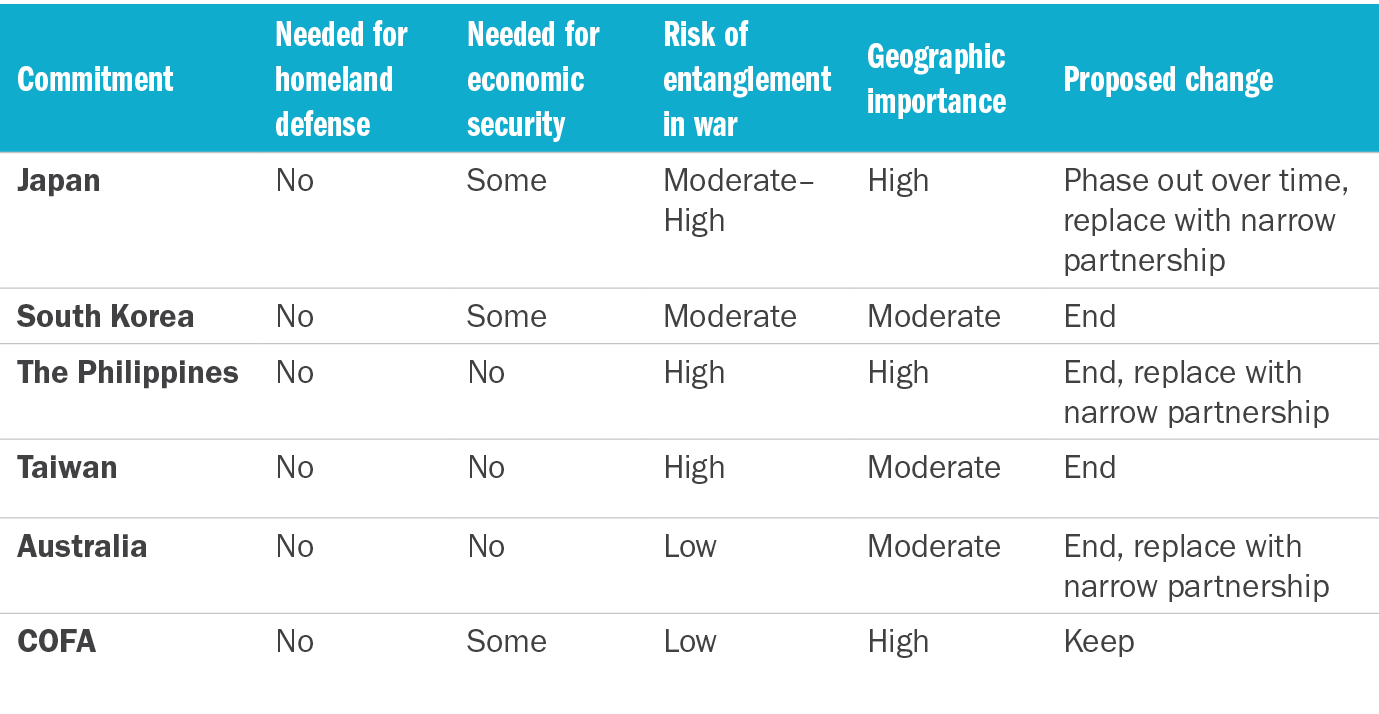
To summarize, of the myriad U.S. military commitments in the western Pacific, there are only a few worth keeping in some form. Current treaty relationships with South Korea, the Philippines, and Australia could be phased out or shifted to more ad hoc security partnerships without negative consequences for U.S. interests. The United States should also end its limited commitment to Taiwan, closing the door on a war with China over the small island. Its commitment to the COFA states might remain. Its commitment to Japan should be narrowed and phased out over time, though more slowly than others in the region to offer Japan reassurance as it shifts to self-sufficiency.
With the narrowing of conventional commitments would also come the end of nuclear commitments, namely security under the U.S. nuclear umbrella. Table 1 summarizes the discussion in this section as a basis for the next: an assessment of the military posture requirements necessary to support this revised set of commitments.
Table 1: U.S. military requirements for U.S. allies
A second island chain posture
The previous section discussed how U.S. military commitments in Asia might be reconfigured to better match U.S. regional interests while reducing unnecessary entanglements and risky deployments. Since much of the current U.S. military posture is intended to support security guarantees to regional allies, downsizing these commitments should bring corresponding reductions to the U.S. posture.
This section will offer a revised posture that accords with a narrower set of commitments but still protects U.S. interests. The current focus of the U.S. military presence in Asia is along the first island chain. The recommendations here offer instead a “second island chain strategy” that would shift the center of gravity from the first island chain (Japan, the Philippines, Taiwan, South Korea) to the second island chain (Guam, Palau, the Marshall Islands, Micronesia, Australia). Such a presence would be sufficient to support core U.S. interests in the region while also being more survivable. It would reduce the risk of a catastrophic conflict with China, as it would be located some distance from Chinese territory and away from the region’s greatest flashpoints in the Taiwan Strait and South China Sea.
To start, we should consider which U.S. forces based in the region can be returned to the United States once U.S. commitments are downsized as suggested in the previous section. With the U.S. military commitment to Taiwan ended, U.S. military trainers based on Taiwan should be among the first and easiest to redeploy. These forces currently serve little strategic purpose for the United States while creating significant risk, serving as a tripwire (if these personnel were to be killed in an attack on the island, it could force the United States to enter the conflict) and inflating Taiwan’s expectations about U.S. military support.
Similarly, an end to the U.S. treaty with South Korea would allow for the removal of most military forces from the Korean Peninsula, including all the ground combat units and permanently stationed air forces. It is possible that maintaining some intelligence and support units along with rotational air and naval forces would be in U.S. interests, but at most this might include a few battalions’ worth of specialized Army personnel, a rotational fighter squadron, and perhaps infrequent visits by a U.S. submarines (this might include SSBNs which carry nuclear weapons, though the end of the U.S. commitment to South Korea would mean the country was no longer covered by the U.S. nuclear umbrella).
However, it is not clear these forces would be needed all the time. The best solution would be to negotiate some basing access in South Korea that would allow periodic deployments of specialized Army battalions (intelligence or logistics) as well as fighter squadrons and submarines. This presence would be small and periodic, not enough to serve as a tripwire but granting the United States flexibility to operate from South Korea if it was deemed in both countries’ interests.
In the Philippines, the U.S. military footprint is already quite small, typically no more than a few thousand forces at any given time. This type of rotational deployment might continue under a second island chain strategy, though the United States should reduce infrastructure investment across the Philippines, especially in Luzon and Palawan where the focus has long been on regional contingencies, including Taiwan and the South China Sea. The United States should also remove the long-range fire system (the Typhon) currently located in the Philippines, as it’s both unnecessary to support the commitments outlined here and highly escalatory. The U.S. should curtail the use of the Philippines as a base for live-fire U.S. military exercises. It is true that China has similar weapons along its coast but deploying weapons on home territory and thousands of miles away are two very different things.
The U.S. military presence in Australia stands at about 7,000 personnel and there is no real need to reduce or augment it. For now, rotational forces of this number are plenty to support Australia as a logistics hub and a base for intelligence and standoff operations if needed. Its position far from China makes Australia a non-escalatory and useful place to base U.S. forces as part of a second island chain strategy. China might complain about the basing of U.S. bombers and submarines in Australia (which will increase under AUKUS), but the risk of a confrontation over this issue is quite small. Moreover, the benefits of having additional submarines based forward in Asia are high for the United States, given its undersea advantages and the effective power projection capabilities of submarines.
Turning to Japan, the United States will want to reduce its military presence gradually, starting with forces and locations that are least survivable and tied to the defense of Taiwan and then reducing presence in northern and eastern Japan as well.
Once the United States gives up its position of strategic ambiguity on Taiwan, it can move its military forces away from locations where their presence is focused less on Japan’s defense than Taiwan’s. This would include Okinawa. That these forces are intended primarily to support Taiwan’s security is obvious from recent changes in U.S. posture there, including the temporary deployment of long-range missile platforms and the updated Marine Littoral Regiment, developed with an eye toward a potential war with China.81Gidget Fuentes, “Storied U.S. Marine Regiment Retooled for New Mission,” USNI News, April 15, 2025, https://news.usni.org/2025/04/15/storied-u-s-marine-regiment-retooled-for-new-mission. These are not the assets necessary to defend Japan (which would require defensive forces like land and sea mines, artillery, drones, and air defense). In Okinawa and elsewhere in the southwestern islands, U.S. forces are highly vulnerable, well within the range of Chinese missiles.82Kavanagh, “Iran Killed Any Delusions.”
The United States should start by removing all U.S. Marines from Okinawa. There are currently plans to deploy 5,000 of these Marines to Guam. This plan could continue, though their presence in Guam should be temporary and by 2030 all 18,000 Marines in Okinawa should be returned to the United States.
The U.S. Air Force presence at Kadena, currently made up of rotational fighter squadrons, should also be redeployed to the United States. With two fighter squadrons already based at Misawa, it is not clear that the United States needs additional air forces in Japan, especially once its security partnership with Japan is narrowed.
Outside of Okinawa, some additional U.S. posture changes in Japan are desirable, though these should occur in two phases. Initially, the United States should retain its air presence at Misawa and Yokota (the location of most U.S. airlift in Japan). These are relatively survivable locations and forces at these bases could operate in support of Japan in a crisis or in regional operations in cases of a contingency that did involve the United States in Northeast Asia. This would not be a high-cost deployment and would have some benefits. Its most important purpose would be as a hedge against Japanese bandwagoning with China or the opposite, rash actions by an insecure Japan to bolster its own defenses (such as a sprint for a nuclear weapon). Although these are opposite responses, neither can be ruled out, and a phased drawdown of the U.S. presence in Japan could guard against either.
On the other hand, Washington should immediately move the homeported carrier strike group at Yokosuka and the Marine Aircraft Group at Iwakuni back to the United States for use on missions elsewhere. There has been much coverage of the shortage of U.S. carrier strike groups globally, and while these can serve a power projection role in Asia, having one permanently based in Japan constrains U.S. flexibility. Furthermore, if a war were to begin, that CSG would be forced to deploy out of and far from Japan. Some rotational naval presence might remain at Yokosuka, including possibly two or three destroyers along with some smaller vessels and visits from U.S. nuclear submarines.
These changes would leave a much reduced but more resilient U.S. military posture in Japan, comprised of two fighter squadrons at Misawa and an airlift wing at Yokota; a rotational naval presence at Yokosuka; and a small number of Army personnel, mostly logistics, intelligence, air defense, and combat support at Camp Zama. The total number of personnel would be about 5,000 total.
As Japan’s capabilities grow, the aim should be to reduce U.S. forces further by 2035, eventually removing all permanent presence and maintaining just a few access locations in eastern and northern Japan (Misawa, Yokosuka, and possibly a few others) for rotational deployments of U.S. air and naval assets (up to two fighter squadrons, submarines, and two to three warships) as well as intelligence, logistics, and combat support. In addition to offering some reassurance to Japan of continued U.S. engagement, the main function of these forces would be to support U.S. maritime security missions alongside regional partners across East Asia. This might include reinforcing regional convoys or preventing blockades and quarantines (though these are unlikely scenarios as already noted). Any peacetime deployment would be largely a hedge against the emergence of a threat, justified given the stakes of U.S. economic interests in Asia. Their crisis role is discussed in more detail below.
Finally, there is the question of U.S. forces along the second island chain—which would become the focal point of U.S. military posture in Asia under the strategy recommended here. Currently, the United States has at least 8,000 forces here, mostly in Guam. Under a second island chain strategy, the United States could keep the total number about the same (as noted above, any redeployment from Okinawa to Guam would be temporary), or reduce it slightly, but would distribute personnel across second island chain locations to Palau, the Marshall Islands, Micronesia, and small air bases like Tinian.
The three island chains
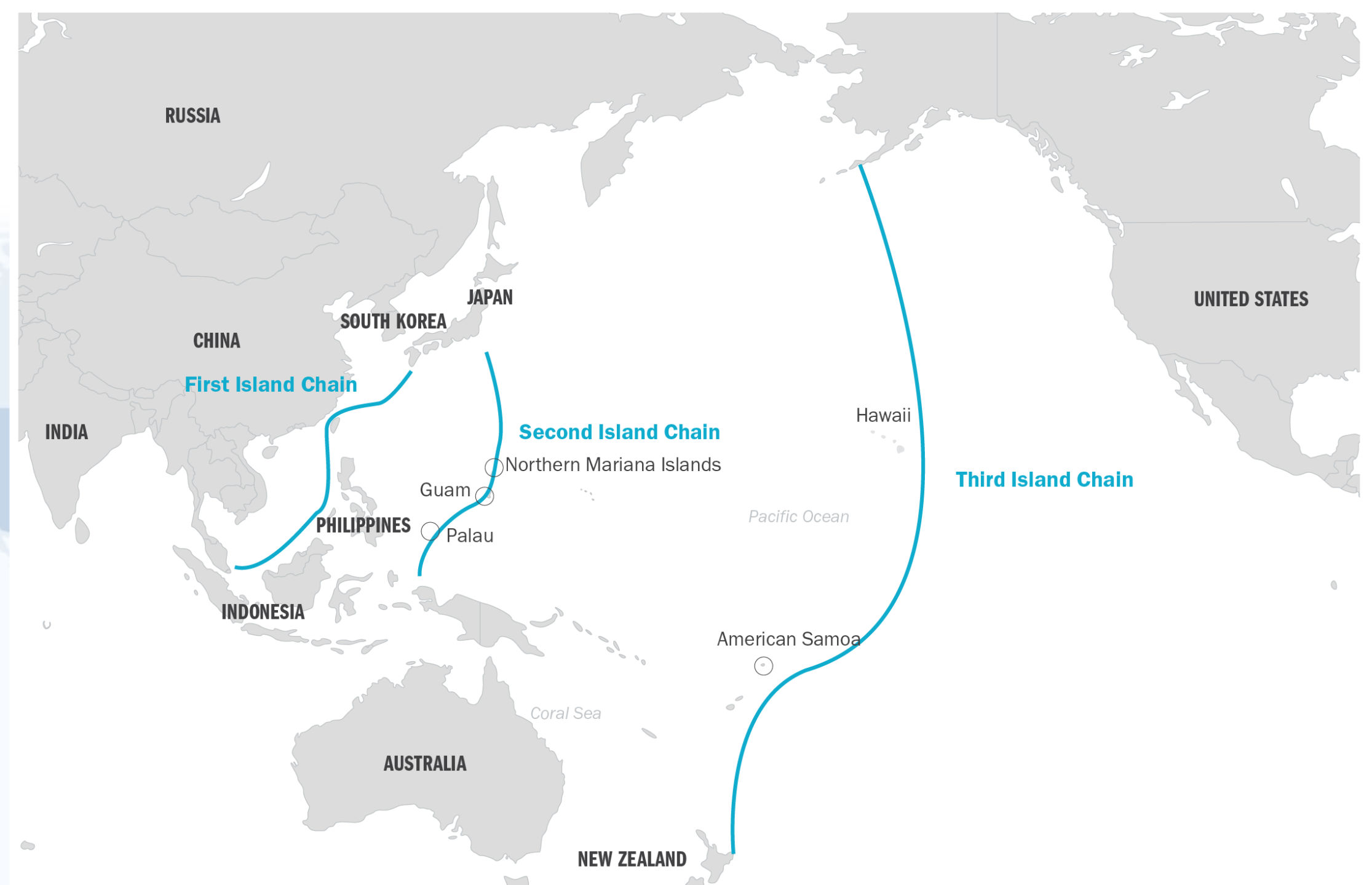
Most U.S. personnel in East Asia are stationed along the first island chain. Moving them to the second island chain would make their positions more defensible while reducing the risk of a catastrophic war with China.
Forces based in these locations would include some intelligence and combat support units as well as air defense. Small groups of Marines armed with drones and mobile anti-ship missiles could also be included, though any amphibious or sea-based attack on these locations is unlikely. Over time, the total number of ground forces could be reduced to about 5,000, mostly Marines and some Army personnel.
The primary purpose of second island chain bases would be as locations for forward deployed air and naval power as a hedge against emerging threats to commercial traffic in east or southeast Asia. There currently is no such threat, but in the context of a contingency or severe decline in U.S.-China ties, Beijing could decide that the economic costs of disrupting U.S. trade in Asia make strategic sense. Though very unlikely, the costs of this to the U.S. would be high, and a small air and naval footprint seems reasonable to prevent or hedge against such an outcome. The United States might base two fighter squadrons along with other specialized aircraft, including those to support early warning and anti-submarine operations (AWACS, P-8s) at locations along the second island chain. Drones of different types and sizes, especially reconnaissance and intelligence, could also be based at these locations.
Naval forces rotating through ports can offer additional heft to the second island chain presence. The United States should position some larger warships like cruisers or destroyers along the second island chain, but equally useful will be smaller assets like uncrewed surface and undersea vessels and de-mining vessels (though the United States has very few of these). Uncrewed air assets should also be based in this area. The United States also homeports five submarines at Guam and these should stay, though hardened pens will be necessary.
This air and naval power, along with that based in Australia, would not be enough to respond to threats to commercial trade impacting the United States, but it would allow for a quicker response. For example, these forces could offer some escort support for commercial vessels under threat, establish and protect safe transit routes through the region’s waters or chokepoints if primary routes become contested, or push back on quarantines or blockades established against important ports (including using submarines). Their operations could expand if supplemented by additional air and naval power over time, like forces based in operating locations in Japan. Moreover, these locations and the intelligence and logistics assets they house would serve as hubs for security operations in the event of a maritime crisis.
Having these forces based forward would come with advantages (as opposed to just surging them forward). It would speed response time, ensure that necessary support, logistics, and intelligence infrastructure was set up in advance, and provide guaranteed and established access points for air and naval operations across the region. Carrier-based air and naval power can play a supporting role, but as seen in the Middle East, carriers are both increasingly vulnerable and insufficient for large maritime and air campaigns. The forward bases would serve as a signal that the United States intends to stay engaged in Asia, which would reassure Japan and discourage it from bandwagoning with China.
Like the ground forces, new air assets should be dispersed across second island chain bases. Doing so would likely require additional investments in U.S. military infrastructure. Lessons from the Middle East suggest that the United States will want to harden its bases, including adding hardened aircraft shelters and air defenses and investing in the materials needed to rapidly repair damaged runways.
These changes would increase U.S. posture along the second island chain to something like 5,000 military personnel, plus two fighter squadrons and additional rotational air and naval presence. Also based forward would be the five nuclear submarines at Guam. Along with the 7,000 Marines and several homeported submarines based in Australia, these forces would constitute the bulk of the U.S. presence in the region. The United States could also keep a rotational CSG in the region if desired, though it should remain around the second island chain, the new hub of U.S. operations in the region.
All told, the posture changes recommended here would result in a U.S. presence in Japan of about 20,000 U.S. military personnel by 2030, falling to between 12,000–15,000 by 2035. The presence would include two fighter squadrons (four until 2030 or so, with some rotational presence after that) and associated support and airlift units; a rotational CSG deployment plus half a dozen additional warships, most on a rotational basis; Army air defense along with intelligence and logistics units; rotational marine units in the Philippines and Australia; and between five and 10 nuclear submarines deployed in and around the theater.
Table 2: Current and proposed U.S. military postures
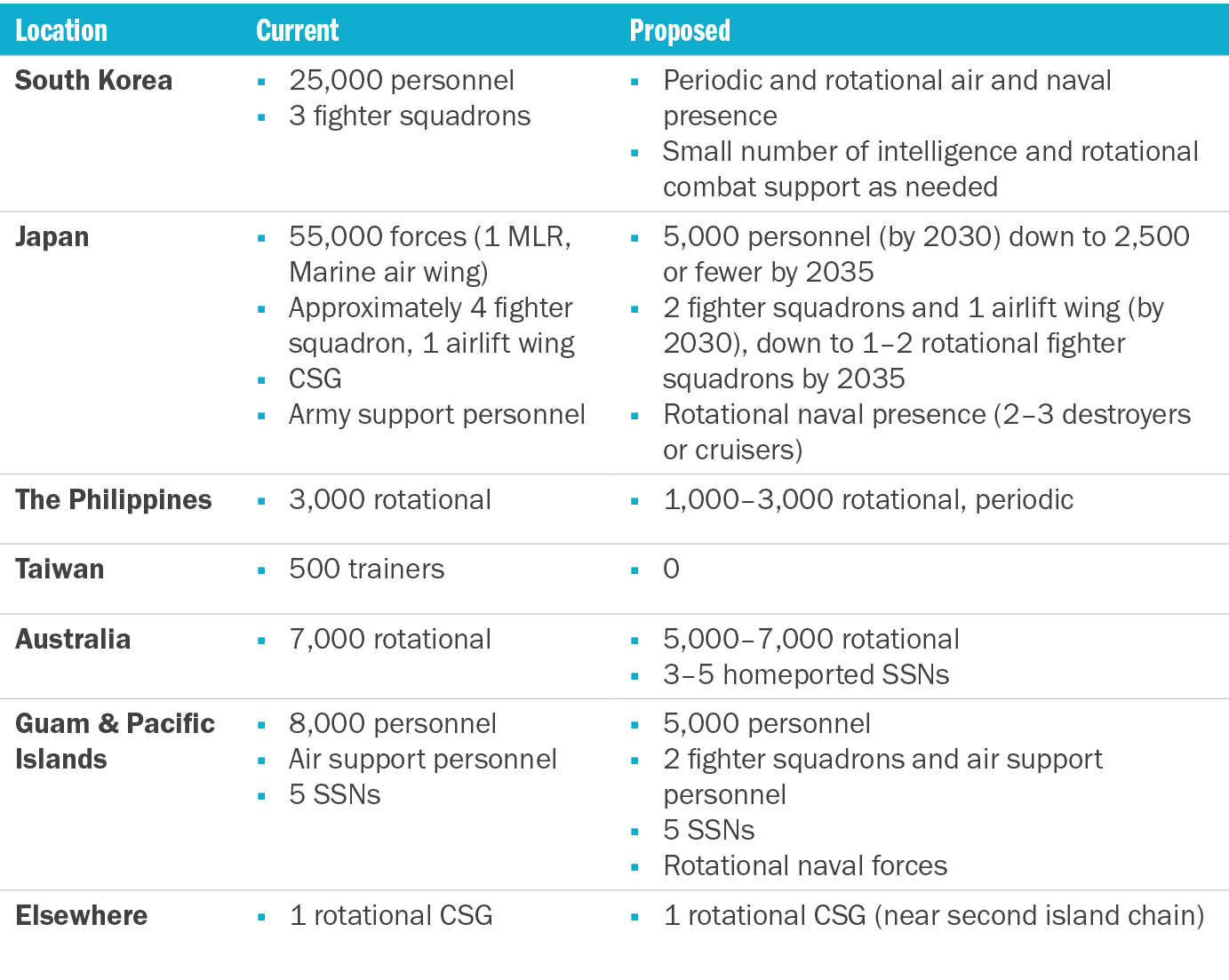
This would amount to a reduction of about 70 percent of the fighter aircraft and 85 percent of the personnel there today. It would also reduce U.S. Navy surface vessels by about 50 percent while potentially doubling the number of submarines, resulting in a more survivable footprint that is still able to project significant power quickly into the region. Also added would be uncrewed capabilities, including sea and air drones of various ranges, sizes, and types to support kinetic and non-kinetic missions like intelligence and combat support. Overall, the changes recommended to U.S. posture would pull U.S. forces away from the Chinese coast and toward the second island chain, increasing naval and some air assets, especially those associated defensive denial and maritime security roles.
The posture recommended is clearly not suited to maintaining today’s full set of U.S. commitments, but it is sufficient to support the narrow set of U.S. interests as defined here. Of course, any posture reduction will come with risks. The final section of this report will discuss how these posture changes can be implemented to reduce those risks, including feasible timelines and implications for U.S. allies.
Managing risks and implementation
The changes outlined here will come with risks and challenges worth considering upfront.
The first set of challenges has to do with allied reactions. Japan’s first and only security plan is to rely on the United States for its defense.83Jennifer Lind, “Japan’s Security Evolution,” Policy Analysis no. 788, Cato Institute, February 25, 2016, https://www.cato.org/policy-analysis/japans-security-evolution; Mari Yamaguchi, “As Regional Threats Rise, Japan Shifts Away from Defense-Only Strategy,” PBS NewsHour, December 16, 2022, https://www.pbs.org/newshour/world/as-regional-threats-rise-japan-shifts-away-from-defense-only-strategy. It has no model for its national defense that does not include U.S. military forces defending the island, though it and other countries in the region are working to hedge a bit by building new cooperative mechanisms that do not include the United States. It similarly has no plan beyond the United States for managing threats that might emerge if Taiwan were to be unified with China. The Philippines, too, is highly dependent on the U.S. military for its defense, and although South Korea has a more formidable standalone military capacity, it still relies on the U.S. nuclear umbrella to face North Korea’s growing nuclear arsenal.
For these states, hearing that the United States will no longer commit unconditionally to their defense and plans to reduce military posture accordingly could trigger anger and insecurity. Some U.S. allies might decide to pursue nuclear weapons. For South Korea and Japan, an independent nuclear weapon is within reach, though experts disagree on how likely either state is to pursue one.84Daniel Sneider, “How the War in Iran Reshapes South Korea and Japan’s Nuclear Strategy,” Korea Economic Institute of America, March 13, 2026, https://keia.org/analysis/how-the-war-in-iran-reshapes-south-korea-and-japans-nuclear-strategy/. For states not seeking nuclear weapons, increased defense spending is likely as is the formation of new regional security coalitions like in Europe today. Notably, none of these outcomes would work against U.S. interests. The United States benefits from its allies spending more on their defense and being able to protect themselves without U.S. support.
Those opposed to any change in U.S. military posture make three primary counterarguments worth considering. The first is that by narrowing U.S. military commitments, ending treaty relationships, and reducing military presence, the United States will undermine its credibility and invite aggression from adversaries who perceive weakness.85Daryl G. Press, Calculating Credibility: How Leaders Assess Military Threats (Ithaca, NY: Cornell University Press, 2005). However, because the recommendations here argue for backing away from all security guarantees and withdrawing most military forces from the region, this critique does not apply. Under the proposal here, the United States would form a new set of security partnerships consistent with its adjusted military presence. As noted throughout, this posture would be enough to hedge against threats to U.S. economic interests, given that such challenges are unlikely.
The second critique is that by building up their defense, U.S. allies risk triggering instability that increases the risk of conflict. For example, Beijing has already expressed concern over what it has termed Japan’s “remilitarization.”86“China Imposes Export Controls on 40 Japanese Entities as Tensions with Tokyo Rise,” ABC News, June 29, 2026, https://abcnews.com/International/wireStory/china-imposes-export-controls-40-japanese-entities-tensions-134300236. If Japan were to ramp up its defense spending, and especially if it were to seek a nuclear weapon, some experts worry about a preventative attack by Chinese forces or a nuclear cascade to other countries in the region. The same might be true in South Korea, where North Korea might feel pressured to strike before Seoul completes a nuclear project.
These are reasonable concerns. We should not dismiss the potential for nuclear curiosity and even proliferation in Asia if the United States retrenches its conventional military presence, as the U.S. nuclear umbrella will become little more than a bluff. However, while nuclear proliferation is not desirable, it is likely, and its risk is not worth maintaining the current U.S. posture and set of commitments. In any case, the amount of nuclear proliferation is likely limited due to factors like the cost and technical difficulty of developing a viable nuclear program.
That conventional defensive capabilities currently (though not permanently) have an advantage over offensive ones acts as another check on the proliferation at least for now. Since any nuclear project will take time, the United States should be working with allies and the international community now to manage proliferation and ensure the necessary safeguards are in place to contain risk and fallout.87Jennifer Lind and Daryl G. Press, “The Broken Umbrella: What Comes After Extended Deterrence,” Foreign Affairs, June 23, 2026, https://www.foreignaffairs.com/united-states/broken-nuclear-umbrella-lind-press; Jennifer Kavanagh and Daniel DePetris, “The End of the Non-Proliferation Paradigm,” Compact Magazine, July 20, 2026, https://www.compactmag.com/article/the-end-of-the-non-proliferation-paradigm/. That Asian allies would turn to nuclear weapons is also not assured. In Japan, there is cultural resistance, and the cost and challenge of a nuclear program may also act as a barrier.88Victor Cha and Kristi Govella, “Why Japan and South Korea Won’t Go Nuclear: But America Still Needs to Worry About Proliferation in East Asia,” Foreign Affairs, May 7, 2026, https://www.foreignaffairs.com/japan/why-japan-and-south-korea-wont-go-nuclear.
The other fear among some U.S. analysts is that U.S. retrenchment will drive not rearmament but bandwagoning, effectively giving Beijing a regional hegemony.89Michael D. Swaine, “Taiwan: An Important but Non-Vital U.S. Interest,” Quincy Institute for Responsible Statecraft, September 25, 2025, https://quincyinst.org/research/taiwan-an-important-but-non-vital-u-s-interest/. It is likely that once they no longer have ironclad security guarantees, countries across Asia will be forced to recalibrate their positions toward Beijing to a degree. One of the downsides of U.S. security guarantees are the ways they distort the behavior and incentives of states that fall under their protection. Comparing countries like Vietnam and the Philippines underscores the different calculations made by states that have and lack U.S. security protections. Vietnam is not a Chinese vassal but does make security decisions intended to avoid provoking conflict with its much larger neighbor.90Huynh Trung Dung and Vu Thanh Tu Anh, “Balancing Without Allying: Vietnam’s Middle-Power Strategy Amid U.S.-China Rivalry,” Belfer Center for Science and International Affairs, Spring 2026, https://www.belfercenter.org/research-analysis/balancing-without-allying-vietnams-middle-power-strategy-amid-us-china-rivalry. As the U.S. retrenches, it is inevitable that other states will make similar calculations, and this is a good thing.
But as discussed above, it is unlikely that countries like Japan and South Korea will, after losing U.S. protection, line up squarely behind China, even if they must pursue a more cautious policy toward Beijing.91Walt, “Hedging on Hegemony.” The Philippines is a different case. Its current rapprochement with the United States is a function of domestic politics and could be reversed with new leadership, regardless of U.S. policy in the region. Closer Philippine alignment with China is something the United States has experienced before and could manage once again if necessary.
Taiwan is the only real instance where retrenchment by the United States might drive true political accommodation. But as discussed above, this outcome is manageable for U.S. interests and will not dramatically shift the balance of power in the region. Washington should accept this possibility and focus on protecting U.S. interests no matter what Taiwan chooses.92Kavanagh, “A Strategy for Staying Out”; Bonnie S. Glaser and Jennifer Lan, “Taiwan’s Growing Distrust of the United States,” German Marshall Fund of the United States, August 18, 2025, https://www.gmfus.org/news/taiwans-growing-distrust-united-states.
More broadly, the United States should be aware of how its decisions will affect allied behavior but not be controlled by their reactions. To reduce instability caused by U.S. retrenchment, Washington should lay out a clear plan and timeline for its changes and then stick to them no matter what allies do. Giving allies some warning that the United States no longer remains committed to their defense will allow them to decide how they want to adjust and recalibrate their foreign and defense policy. But timelines should be short. Having defined a large portion of U.S. defense commitments in Asia as out of sync with U.S. interests, it does not make sense to retain them for long periods of time.
The United States should also sequence its policy changes. Such sequencing has two advantages. First, it reduces the number of changes happening at once and the related risk of destabilization. Any change in U.S. posture—up or down—can be destabilizing. Sequencing changes can allow U.S. allies and adversaries to adjust over time and modify their own posture accordingly.93Stephen Watts et al., “Deterrence and Escalation in Competition with Russia: The Role of Ground Forces in Preventing Hostile Measures Below Armed Conflict in Europe,” RAND Corporation, January 20, 2022, https://www.rand.org/pubs/research_reports/RRA720-1.html.
Second, sequencing changes can overcome the other major challenge facing the United States as it tries to adjust its military posture, specifically the logistical burdens of closing dozens of bases and military installations and redeploying some 70,000 military forces along with naval assets and aircraft. This will take time. It will be necessary to find locations in the United States where assets can be moved and schedule the movement of these forces around the region.
Since a reduced set of U.S. commitments in Asia will free up a lot of military forces, military planners will also need to make choices about force structure—which units to keep and which to cut. A full discussion of how force structure might adjust to changes in U.S. military commitments in Asia is outside the scope of this report, largely because it is difficult to offer recommendations without also considering commitments in other theaters. Some general observations are, however, possible.
For example, given that this paper recommends that most U.S. Army and Marine units leave East Asia, it will make sense to cut the ground force units the United States keeps in its active duty and reserve force across both services. In the Army especially, force structure has long been kept on the books purely for the sake of a possible Korean scenario and could be eliminated. Reductions to naval and air forces might be possible as well, though in smaller numbers. As it brings home deployed fighter squadrons, the United States might retire some of its older aircraft and then cut related units from the force entirely. The Navy, meanwhile, should retire old warships and shift away from the large surface vessels it has relied on historically. Some of these may be useful, but they are too big to be survivable in many environments. Instead, the Navy should invest more in submarines (used heavily in the strategy proposed here) and uncrewed air and naval vessels.
Sequencing changes to U.S. posture in Asia can also address a final risk created by U.S. retrenchment: miscalculation on the Chinese side that leads to escalation and unintended conflict. China hawks argue that if the United States pulls back, Beijing will see an opening for territorial expansion, seizing Taiwan and then moving on to other conquests across the region. This is exceedingly unlikely. For starters, seizing Taiwan militarily would be a massive challenge for China, even if the United States stays out of the conflict. It is also possible that if Washington reduced its commitment, Taipei would accept accommodation with China to a greater extent than today.
The simple fact of U.S. retrenchment is not sufficient to eliminate the challenges China would face in trying to seize other territories, for example Japan’s southwestern islands or territory claimed by the Philippines.94Eugene Gholz, Benjamin Friedman, and Enea Gjoza, “Defensive Defense: A Better Way to Protect U.S. Allies in Asia,” Washington Quarterly 42, no. 4 (2019): 171–89, https://doi.org/10.1080/0163660X.2019.1693103; Michael Beckley, “The Power Index: Measuring the Nature of the Multipolar World,” International Security 42, no. 3 (Winter 2017–18): 40, https://www.belfercenter.org/sites/default/files/pantheon_files/files/publication/ISEC_a_00294-Beckley_proof3.pdf. More importantly, Beijing has shown no real interest in such expansion other than seeking unification with Taiwan, and, in fact, explicitly rejects such goals.95David C. Kang, Jackie S.H. Wong, and Zenobia T. Chan, “What Does China Want?,” International Security 50, no. 1 (2025): 46–81, https://doi.org/10.1162/ISEC.a.5.
The greater risk is that Beijing might interpret U.S. retrenchment from Asia as a withdrawal from Asia—an outcome which is unlikely even under a more restrained U.S. foreign policy. Moreover, despite reductions in formal commitments to allies in Asia, the United States will still have a vested interest in supporting countries like Japan and South Korea, both in the military and economic domains, albeit in more limited ways.
To avoid misunderstandings about the ultimate disposition of U.S. military power and forces, the United States should be sure to communicate extensively and continually with China, framing its posture changes within the broader rubric of constructive strategic stability—the direction the two countries have chosen for their relationship—not retreat or abandonment. Washington should underscore its enduring interests in Asia while indicating that its narrow posture changes are intended to be stabilizing rather than an abandonment of allies.
So if sequencing is the key to avoiding risks as the U.S. retrenches, what is the best approach?
The first commitment the United States should eliminate is that in South Korea, the ally that is best prepared to manage its security challenges without U.S. support. Drawing down the military presence there may be considerably more straightforward than doing so elsewhere. Since this should facilitate cuts to Army force structure, a simple strategy would be to eliminate the deployed units as they rotate home, distributing relevant equipment to stockpiles or units in need. Air Force units based in South Korea could be rotated home or redeployed elsewhere. The associated narrowing of the U.S. security commitment could occur at the same time, with all posture changes completed within two years, leaving the United States with just a small rotational presence on the Peninsula. It is true that Congress has legislated minimum levels of U.S. military forces for South Korea, but the requirement for bypassing this restriction is simply a clear statement of why a reduction is in U.S. interests. The rationale for this move has been articulated in this paper.
Higher-priority are those that pose the highest risk of entanglement to the United States, namely U.S. Taiwan policy and U.S. security guarantees to the Philippines—specifically those extended to claims in the South China Sea. The United States will need a bit more time to unwind these commitments, especially in the case of Taiwan, but it should start immediately by informing regional allies of the coming changes and beginning to adjust posture as required.
Some argue that the United States must pull back from Taiwan slowly, perhaps over a decade or more, but this would mean maintaining the risk of a war with China for an extended period.96Michael D. Swaine, “Taiwan: Defending a Non-Vital U.S. Interest,” Washington Quarterly 48, no. 1 (2025): 165–85, https://doi.org/10.1080/0163660X.2025.2478779; Kavanagh, “A Strategy for Staying Out.” Changes to U.S. posture and strategy, the end of formal and informal security commitments to Taiwan, and the removal of U.S. military trainers from the island should also occur quickly.
Once these adjustments are in motion, further changes across the first and second island chains will follow naturally. The United States will want to reposition forces within Japan, for instance, as it pulls back from Okinawa, and reinforce and redistribute its second island chain posture. It will also want to shift its investments in the Philippines away from Luzon and toward other parts of the archipelago while withdrawing long-range fires platforms. It makes sense to renegotiate or narrow U.S. security partnerships with the Philippines and Japan at the same time, clearly defining the roles the United States is turning over to local forces and the types of support it might still provide in a crisis.
In total, these changes could be accomplished over a period of several years. Most of them could be complete by 2030 with the second round of withdrawals from Japan complete by 2035. As reductions along the first island chain occur, the United States could continue to refine its second island posture while adjusting its rotational presence across the region as needed, especially its naval forces, and moving additional submarines to new homeports in Australia as allowed under the AUKUS agreement. These moves would gradually bolster the new U.S. center of gravity along the second island chain.
With a reduced posture, the number of U.S. military bases could be dramatically reduced. In certain areas, all or most U.S. bases should be closed, including on Okinawa. As noted, the increasing number and accuracy of Chinese missiles and improvements in U.S. standoff capabilities make forward bases so close to China vulnerabilities not assets, all risk and little reward. Closing bases that are not defensible and consolidating forces in locations that are more survivable (and hardening those bases) is the smarter strategy.
In Japan, South Korea, and the Philippines, the United States should aim to keep a small number of access points, but this could mean operating out of host nation facilities rather than permanent bases. In South Korea, for instance, the United States would need a handful of operating locations, perhaps three or four, including some intelligence and combat support assets along with some airfields and ports. The United States should maintain its facilities in and around Misawa and Yokosuka and might negotiate agreements to operate out of other Japanese air and naval bases. In the Philippines, the United States could retain access to a few of the nine bases it currently operates from but should focus investments away from Luzon and Palawan.
The United States operates out of a select number of bases across Southeast Asia with limited access permissions and has a small number of operating locations worth preserving in Australia. Finally, along the second island chain, the United States should look for opportunities to bolster its infrastructure, including by investing in airfields that can host a more extensive set of military activities and expanding opportunities and partnerships (though perhaps not bases), for example the Solomon Islands and Vanuatu.
As the United States retrenches and narrows its commitments, some countries in the region may become less interested in hosting U.S. military forces. Without the promise of a U.S. security guarantee, the Philippines or South Korea might decide they are better off with no U.S. military personnel. This would force the United States to rely more heavily on a smaller number of locations, but it would not fundamentally damage U.S. interests. The United States is likely to find some regional partners willing to host U.S. forces at least on a temporary or periodic basis, perhaps in return for other benefits—monetary or access to U.S. military assistance or technology. In any case, the U.S. has guaranteed access to most second island chain locations, which are more important to the strategy recommended here.
A sustainable approach to Asia
The U.S. approach to the region outlined here would be both more sustainable and, if military force structure was cut, cheaper than its current strategy, while still protecting core U.S. interests. Divested units and capabilities could free up resources for investment in new technologies or in other economic sectors, such as domestic development. The U.S. might develop a better economic strategy in Asia, already highlighted as a missing piece in U.S. policy toward the region. Critics will argue that the changes recommended here leave the United States at risk, but it is the current posture and commitments that expose U.S. military forces to the risk of unnecessary wars.
Some will suggest that the assessment provided here is too negative and the U.S. should instead double down on military spending and investment in Asia. To some extent, this seems to be the position held by the Trump administration with its proposed FY2027 $1.5 trillion defense budget. However, the problems in the current U.S. approach to Asia are not simply ones of resources but also strategic solvency. Money on its own cannot solve the problems of strategic overextension nor can it rebalance the misaligned incentives of U.S. allies or address the mismatch in U.S. interests and current deployments.
More restraint-minded critics might suggest that even keeping a small presence in Asia is unnecessary to safeguard U.S. interests in the region. After all, as noted throughout this paper, China’s path to regional hegemony would be a difficult one, threats to the U.S. homeland emanating from Asia are few, and challenges to U.S. economic interests are unlikely and to some extent self-deterring.
Still, although the potential for threats to U.S. interests is minimal, it is not zero, and the costs of possible threat scenarios, should they emerge, would be high. Maintaining a minimal presence hedges against these worst-case outcomes in a sustainable way. If over the longer term, U.S. officials deem that the security environment in Asia has improved or U.S.-China relations stabilized sufficiently to effectively eliminate all risks to core U.S. interests, then further reductions in posture, including removing rotational presence from Australia, the Philippines, and Japan, would be warranted.
The United States could spend less and have less risk of war and be better off. The additional burden the U.S. carries does not advantage the United States but the security of other countries, subsidizing their defense at a cost to the U.S. taxpayer.
There are many reasons why the current set of U.S. commitments in Asia evolved to be what they are, but this does not mean the current posture is the best suited for U.S. interests today. In fact, when it comes to stabilizing the U.S.-China relationship, reducing military presence in Asia is one of the most important steps that the United States could take. Inertia in U.S. foreign policy is powerful, but policymakers should not be afraid to reassess the status quo and make radical changes based on changing U.S. interests.
Endnotes
- 1“FACT SHEET: Advancing the Rebalance to Asia and the Pacific,” White House, November 16, 2015, https://obamawhitehouse.archives.gov/the-press-office/2015/11/16/fact-sheet-advancing-rebalance-asia-and-pacific; Kenneth G. Lieberthal, “The American Pivot to Asia,” Brookings Institution, December 21, 2011, https://www.brookings.edu/articles/the-american-pivot-to-asia/. ↩︎
- 2Bethany Allen-Ebrahimian, “Special Report: Trump’s U.S.-China transformation,” Axios, January 19, 2021, https://www.axios.com/2021/01/19/trump-china-policy-special-report; Robert D. Blackwill and Richard Fontaine, Lost Decade: The U.S. Pivot to Asia and the Rise of Chinese Power (New York: Oxford University Press, 2024). ↩︎
- 3Blackwill and Fontaine, Lost Decade; “Military and Security Developments Involving the People’s Republic of China 2025,” U.S. Department of War, December 23, 2025, https://media.defense.gov/2025/Dec/23/2003849070/-1/-1/1/ANNUAL-REPORT-TO-CONGRESS-MILITARY-AND-SECURITY-DEVELOPMENTS-INVOLVING-THE-PEOPLES-REPUBLIC-OF-CHINA-2025.PDF. ↩︎
- 4“Where Are U.S. Military Members Stationed?” USA Facts, March 4, 2026, https://usafacts.org/articles/where-are-us-military-members-stationed-and-why/. ↩︎
- 5“FACT SHEET: Advancing the Rebalance to Asia and the Pacific”; “Indo-Pacific Strategy of the United States,” U.S. Embassy and Consulates in Indonesia, February 2022, https://id.usembassy.gov/fact-sheet-indo-pacific-strategy-of-the-united-states/; “2026 National Defense Strategy,” Department of War, January 23, 2026, https://media.defense.gov/2026/Jan/23/2003864773/-1/-1/0/2026-national-defense-strategy.pdf. ↩︎
- 6Aaron-Matthew Lariosa, “Chinese Forces Fielding Intercontinental Anti-Ship Ballistic Missiles Capable of Reaching U.S. West Coast, Pentagon Says,” USNI News, December 26, 2025, https://news.usni.org/2025/12/26/chinese-forces-fielding-intercontinental-anti-ship-ballistic-missiles-capable-of-reaching-u-s-west-coast-pentagon-says. ↩︎
- 7Stephen M. Walt, “Hedging on Hegemony: The Realist Debate over How to Respond to China,” International Security 49, no. 4 (Spring 2025): 37–70, https://doi.org/10.1162/isec_a_00508; David W. Blagden, Jack S. Levy, and William R. Thompson, “Sea Powers, Continental Powers, and Balancing Theory,” International Security 36, no. 2 (Fall 2011), 190–202, https://www.jstor.org/stable/41289702. ↩︎
- 8“China – U.S. Export Controls,” U.S. Department of Commerce, last modified September 25, 2025, https://www.trade.gov/country-commercial-guides/china-us-export-controls; Karen M. Sutter, “U.S. Export Controls and China: Advanced Semiconductors,” CRS Report no. R48642, Congressional Research Service, September 19, 2025, https://www.congress.gov/crs-product/R48642. ↩︎
- 9Kelly A. Grieco and Jennifer Kavanagh, “The Elusive Indo-Pacific Coalition: Why Geography Matters,” Washington Quarterly 47, no. 1 (2024): 103–121, https://doi.org/10.1080/0163660X.2024.2326324. ↩︎
- 10Walt, “Hedging on Hegemony.” ↩︎
- 11Walt, “Hedging on Hegemony”; Blagden, Levy, and Thompson, “Sea Powers, Continental Powers, and Balancing Theory.” ↩︎
- 12Grieco and Kavanagh, “The Elusive Indo-Pacific Coalition”; Jennifer Kavanagh, “A Strategy for Staying Out: Recalibrating U.S. Support to Taiwan,” Brookings Institution, March 20, 2026, https://www.brookings.edu/articles/a-strategy-for-staying-out-recalibrating-us-support-to-taiwan/. ↩︎
- 13Grieco and Kavanagh, “The Elusive Indo-Pacific Coalition.” ↩︎
- 14“U.S. Collective Defense Arrangements,” U.S. Department of State Archive (2009–2017), Office of the Legal Adviser, last accessed September 2, 2026, https://2009-2017.state.gov/s/l/treaty/collectivedefense/. ↩︎
- 15Susan V. Lawrence, Taiwan: Background and U.S. Relations, CRS In Focus IF10275, Congressional Research Service, August 5, 2026, https://www.congress.gov/crs-product/IF10275. ↩︎
- 16Terri Moon Cronk, “Testimony: DOD Is Laser-Focused on China Pacing Challenge, Meeting Our Commitments Under the Taiwan Relations Act,” DOD News, U.S. Department of War, December 8, 2021, https://www.war.gov/News/News-Stories/Article/Article/2867003/testimony-dod-is-laser-focused-on-china-pacing-challenge-meeting-our-commitment/. ↩︎
- 17Jared G. Tupuola, “The Compacts of Free Association,” CRS In Focus no. IF12194, Congressional Research Service, December 3, 2025, https://www.congress.gov/crs-product/IF12194. ↩︎
- 18“About USFJ,” U.S. Forces Japan, last accessed September 2, 2026, https://www.usfj.mil/About-USFJ/. ↩︎
- 19“The Reality Behind the ‘28,500 U.S. Troops in Korea’ Number,” Hankyoreh, December 30, 2025, https://english.hani.co.kr/arti/english_edition/e_international/1237158.html. ↩︎
- 20Mari Yamaguchi, “U.S. Marines Start Partial Transfer from Okinawa to Guam,” Associated Press, December 16, 2024, https://www.marinecorpstimes.com/news/your-marine-corps/2024/12/16/us-marines-start-partial-transfer-from-okinawa-to-guam/; “The Evolving U.S. Military Presence on Guam,” WatchBlog, Government Accountability Office, June 15, 2017, https://www.gao.gov/blog/2017/06/15/the-evolving-u-s-military-presence-on-guam. ↩︎
- 21Luke A. Nicastro, “U.S. Defense Infrastructure in the Indo-Pacific: Background and Issues for Congress,” CRS Report no. R47589, Congressional Research Service, June 6, 2023, https://www.congress.gov/crs-product/R47589; “Andersen Air Force Base, Guam,” U.S. Air Force, last accessed September 2, 2026, https://www.andersen.af.mil/; “The Evolving U.S. Military Presence on Guam.” ↩︎
- 22Nicastro, “U.S. Defense Infrastructure in the Indo-Pacific”; “U.S. Security Cooperation with the Philippines,” U.S. Department of State, January 20, 2025, https://www.state.gov/u-s-security-cooperation-with-the-philippines. ↩︎
- 23“U.S. Security Cooperation with the Philippines.” ↩︎
- 24Leilani Chavez, “U.S. Typhon Missile System in Philippines Is a Subtle Headache for China,” Defense News, May 14, 2025, https://www.defensenews.com/global/asia-pacific/2025/05/14/us-typhon-missile-system-in-philippines-is-a-subtle-headache-for-china/. ↩︎
- 25Nityah Labh, “U.S. Military Base on Diego Garcia: What Is Its Strategic Importance?,” Chatham House, February 19, 2026, https://www.chathamhouse.org/2026/02/us-military-base-diego-garcia-what-its-strategic-importance. ↩︎
- 26Nicastro, “U.S. Defense Infrastructure in the Indo-Pacific.” ↩︎
- 27“U.S. Navy Carrier Strike Groups Absent from Middle East as Iran Crisis Deepens, Raising Major Deterrence and Escalation Risks,” Defence Security Asia, January 11, 2026, https://defencesecurityasia.com/en/us-navy-carrier-absence-middle-east-iran-crisis-deterrence-gap/. ↩︎
- 28“Bolstering U.S. Presence in Japan ‘Top Priority’: Senior Pentagon Official,” Kyodo News, April 23, 2026, https://english.kyodonews.net/articles/-/74753; “2026 National Defense Strategy.” ↩︎
- 29Christine Wormuth, “The Role of Allies and Partners in U.S. Military Strategy and Operations,” testimony before the House Armed Services Committee, RAND Corporation, September 23, 2020, https://www.rand.org/content/dam/rand/pubs/testimonies/CTA800/CTA867-1/RAND_CTA867-1.pdf. ↩︎
- 30David Vine, “The True Cost of the U.S. Military in South Korea,” Center for International Policy, July 23, 2026, https://internationalpolicy.org/publications/us-forces-korea-cost/. ↩︎
- 31Daniel J. Longo, “U.S.-South Korea Alliance: Background and Issues for Congress,” CRS Report no. R48877, Congressional Research Service, March 16, 2026, https://www.congress.gov/crs-product/R48877. ↩︎
- 32Daniel Han Tae Choi, “The Missing Metric: Why the 12th Special Measures Agreement Cannot Close South Korea’s OPCON Readiness Gap,” The Pilot, June 17, 2026, https://pacforum.org/publications/the-pilot-39-the-missing-metric-why-the-12th-special-measures-agreement-cannot-close-south-koreas-opcon-readiness-gap/; Ju Hyung Kim, “How South Korea Might Fight a North Korean Invasion in a Dual-Contingency Scenario,” 38 North, April 23, 2026, https://www.38north.org/2026/04/how-south-korea-might-fight-a-north-korean-invasion-in-a-dual-contingency-scenario/. ↩︎
- 33Ju Hyung Kim, “How South Korea Might Fight a North Korean Invasion”; Doug Bandow, “South Korea Must Grow Up and Defend Itself,” Cato Institute, July 18, 2024, https://www.cato.org/commentary/south-korea-must-grow-defend-itself. ↩︎
- 34Choi, “The Missing Metric.” ↩︎
- 35Bandow, “South Korea Must Grow Up”; Sungmin Cho, “South Korea’s Offensive Military Strategy and Its Dilemma,” Center for Strategic and International Studies, February 29, 2024, https://www.csis.org/analysis/south-koreas-offensive-military-strategy-and-its-dilemma. ↩︎
- 36Richard Connor, “North Korea Drops Reunification Goal from Constitution,” DW, May 6, 2026, https://www.dw.com/en/north-korea-drops-reunification-goal-from-constitution/a-77061282. ↩︎
- 37Kelly A. Grieco and J. James Kim, “The United States’ Korea Strategy is Working Against Itself,” Foreign Policy, May 6, 2026, https://foreignpolicy.com/2026/05/06/china-us-south-korea-alliance-military-diplomacy/. ↩︎
- 38“Commander of U.S. Forces in Korea Hails Forward Bases as ‘Dagger’ Pointed at China: Will America Drag Seoul into Conflict?,” Military Watch Magazine, May 30, 2026, https://militarywatchmagazine.com/article/commander-us-forces-korea-dagger-china. ↩︎
- 39Lawrence, “Taiwan: Background and U.S. Relations.” ↩︎
- 40Ely Ratner, “Statement of Dr. Ely Ratner,” House Armed Services Committee, 118th Cong., 1st sess., September 19, 2023, https://www.congress.gov/118/meeting/house/116355/witnesses/HHRG-118-AS00-Wstate-RatnerE-20230919.pdf. ↩︎
- 41Brendan Rittenhouse Green and Caitlin Talmadge, “Then What? Assessing the Military Implications of Chinese Control of Taiwan,” International Security 47, no. 1 (Summer 2022): 7–45, https://doi.org/10.1162/isec_a_00437. ↩︎
- 42Green and Talmadge, “Then What?” ↩︎
- 43Jonathan D. Caverley, “So What? Reassessing the Military Implications of Chinese Control of Taiwan,” Texas National Security Review 8, no. 3 (Summer 2025), https://tnsr.org/2025/06/so-what-reassessing-the-military-implications-of-chinese-control-of-taiwan/. ↩︎
- 44Chris Panella, “China’s Submarines Are Getting Quieter and Deadlier in the Seas Closest to Home, Analysts Warn,” Business Insider, October 21, 2025, https://www.businessinsider.com/chinas-submarines-quieter-deadlier-to-match-us-analysts-2025-10; Stephen Chen, “China’s Super Quiet Submarine Tech Halves Engine Noise Detection Range: Study,” South China Morning Post, May 27, 2025, https://www.scmp.com/news/china/science/article/3311772/chinas-super-quiet-submarine-tech-halves-engine-noise-detection-range-study. ↩︎
- 45Caverley, “So What?” ↩︎
- 46Caverley, “So What?”; Mike Sweeney, “How Militarily Useful Would Taiwan Be to China?,” Defense Priorities, April 12, 2022, https://www.defensepriorities.org/explainers/how-militarily-useful-would-taiwan-be-to-china/. ↩︎
- 47Oriana Skylar Mastro, “Beijing Can Take the South China Sea Without Firing a Shot,” New York Times, July 25, 2024, https://www.nytimes.com/2024/07/25/opinion/china-us-military-south-china-sea.html. ↩︎
- 48Walt, “Hedging on Hegemony.” ↩︎
- 49Walt, “Hedging on Hegemony.” ↩︎
- 50Chris Miller, Chip War: The Fight for the World’s Most Critical Technology (New York: Scribner, 2022). ↩︎
- 51Gina Raimondo, “Remarks on CHIPS Act and a Long-Term Vision for America’s Technological Leadership,” U.S. Department of Commerce, February 23, 2023, https://www.commerce.gov/news/speeches/2023/02/remarks-us-secretary-commerce-gina-raimondo-chips-act-and-long-term-vision. ↩︎
- 52James Pethokoukis, “How Disruptive Would a Chinese Invasion of Taiwan Be?” American Enterprise Institute, November 11, 2024, https://www.aei.org/articles/how-disruptive-would-a-chinese-invasion-of-taiwan-be/. ↩︎
- 53Emily Benson, Japhet Quitzon, and William Alan Reinsch, “Securing Semiconductor Supply Chains in the Indo-Pacific Economic Framework for Prosperity,” Center for Strategic and International Studies, May 30, 2023, https://www.csis.org/analysis/securing-semiconductor-supply-chains-indo-pacific-economic-framework-prosperity; Raj Varadarajan et al., “Emerging Resilience in the Semiconductor Supply Chain,” Boston Consulting Group, May 8, 2024, https://www.bcg.com/publications/2024/emerging-resilience-in-semiconductor-supply-chain. ↩︎
- 54Ana Swanson and Paul Mozur, “U.S. Takes Aim at China’s Production of Essential Computer Chips,” New York Times, December 23, 2024, https://www.nytimes.com/2024/12/23/business/economy/us-china-semiconductor-legacy-chips.html. ↩︎
- 55Raimondo, “Remarks on CHIPS Act.” ↩︎
- 56Owen J. Daniels and Will Hunt, “Sustaining and Growing the U.S. Semiconductor Advantage: A Primer,” Center for Security and Emerging Technology, June 2022, https://cset.georgetown.edu/publication/sustaining-and-growing-the-u-s-semiconductor-advantage-a-primer/. ↩︎
- 57Jude Blanchette and Richard McGregor, “After the Invasion: China Considers the Problem of Ruling Taiwan,” War on the Rocks, June 5, 2026, https://warontherocks.com/after-the-invasion-china-considers-the-problem-of-ruling-taiwan/; “Military and Security Developments.” ↩︎
- 58Sheena Chestnut Greitens et al., “If China Attacks Taiwan: The Consequences for China of ‘Minor Conflict’ and ‘Major War’ Scenarios,” German Marshall Fund of the United States, January 5, 2026, https://www.gmfus.org/news/if-china-attacks-taiwan; Mark F. Cancian, Matthew Cancian, and Eric Heginbotham, “The First Battle of the Next War,” Center for Strategic and International Studies, January 9, 2023, https://www.csis.org/analysis/first-battle-next-war-wargaming-chinese-invasion-taiwan. ↩︎
- 59Greitens et al., “If China Attacks Taiwan”; Cancian, Cancian, and Heginbotham, “The First Battle of the Next War.” ↩︎
- 60Jennifer Welsh and Maeva Cousin, “The $10 Trillion Fight: Modeling a U.S.-China War over Taiwan,” Bloomberg News, February 10, 2026, https://www.bloomberg.com/news/articles/2026-02-10/the-10-trillion-fight-modeling-a-us-china-war-over-taiwan. ↩︎
- 61“Military and Security Developments.” ↩︎
- 62“Military and Security Developments.” ↩︎
- 63Jennifer Kavanagh, “Iran Killed Any Delusions of U.S. Military Domination over China,” Responsible Statecraft, April 29, 2026, https://responsiblestatecraft.org/us-military-unprepared-war-china/. ↩︎
- 64Bilal Y. Saab and Natasha Ahmed, “The Iran Problem Won’t Be Solved Without a Counter-Drone Coalition,” Atlantic Council, May 22, 2026, https://www.atlanticcouncil.org/dispatches/the-iran-problem-wont-be-solved-without-a-counter-drone-coalition/; Natasha Bertrand, et al, “U.S. Air Defenses May not Be Able to Intercept Many of Iran’s One-Way Drones,” CNN, March 4, 2026, https://www.cnn.com/2026/03/04/politics/us-air-defenses-iran-attack-drones-challenge. ↩︎
- 65“Readout of Secretary of Defense Lloyd J. Austin III’s Call with Philippine Secretary of National Defense Gilberto Teodoro Jr.,” U.S. Department of War, March 27, 2024, https://www.war.gov/News/Releases/Release/Article/3719906/readout-of-secretary-of-defense-lloyd-j-austin-iiis-call-with-philippine-secret/. ↩︎
- 66Japhet Quitzon, “The Uniquely Stable U.S.-Philippines Partnership,” Center for Strategic and International Studies, September 4, 2025, https://www.csis.org/analysis/uniquely-stable-us-philippines-partnership; William Piekos, “The Philippines: Background and U.S. Relations,” CRS Report no. R47055, Congressional Research Service, 2022, https://www.congress.gov/crs-product/R47055. ↩︎
- 67Quitzon, “The Uniquely Stable U.S.-Philippines Partnership”; Piekos, “The Philippines: Background and U.S. Relations.” ↩︎
- 68Stacie L. Pettyjohn and Jennifer Kavanagh, “Access Granted: Political Challenges to the U.S. Overseas Military Presence, 1945–2014,” RAND Corporation, November 21, 2016, https://www.rand.org/pubs/research_reports/RR1339.html. ↩︎
- 69Julian Borger, “Iran Mocks Trump’s ‘Project Freedom’ as Adversaries Wrestle Over Talks to End War,” The Guardian, May 7, 2026, https://www.theguardian.com/world/2026/may/07/iran-mocks-donald-trump-project-freedom. ↩︎
- 70“Turkey Rejects U.S. Troop Proposal,” CNN, March 1, 2003, https://www.cnn.com/2003/WORLD/meast/03/01/sprj.irq.main/. ↩︎
- 71Doug Bandow, “Lessons from Trump’s Reckless Iran War,” Cato Institute, June 22, 2026, https://www.cato.org/commentary/lessons-trumps-reckless-iran-war; Helene Cooper and Eric Schmitt, “Iran’s Attacks Force U.S. Troops to Work Remotely,” New York Times, March 25, 2026, https://www.nytimes.com/2026/03/25/us/politics/iran-us-bases.html. ↩︎
- 72Mark Harrison, “Australia’s Understanding and Preparedness for a Taiwan Strait Contingency,” Australian Outlook, Australian Institute of International Affairs, November 6, 2025, https://www.internationalaffairs.org.au/australianoutlook/australias-understanding-and-preparedness-for-a-taiwan-strait-contingency/; Lyle Goldstein, “Target Taiwan: Limits of Allied Support,” Defense Priorities, October 16, 2025. https://www.defensepriorities.org/explainers/target-taiwan-limits-of-allied-support/. ↩︎
- 73Goldstein, “Target Taiwan”; Michael Beckley, “The Emerging Military Balance in East Asia: How China’s Neighbors Can Check Chinese Naval Expansion,” International Security 42, no. 2 (Fall 2017): 78–119, https://doi.org/10.1162/ISEC_a_00294. ↩︎
- 74Christopher P. Twomey, “Japan, a Circumscribed Balancer: Building on Defensive Realism to Make Predictions about East Asian Security,” Security Studies 9, no. 4 (2000): 167–205, https://doi.org/10.1080/09636410008429416; Kei Koga, “The Concept of ‘Hedging’ Revisited: The Case of Japan’s Foreign Policy Strategy in East Asia’s Power Shift,” International Studies Review 20, no. 4 (December 2018): 633–660, https://doi.org/10.1093/isr/vix059; Adam P. Liff, “Unambivalent Alignment: Japan’s China Strategy, the U.S. Alliance, and the ‘Hedging’ Fallacy,” International Relations of the Asia-Pacific 19, no. 3 (September 2019): 453–91, https://doi.org/10.1093/irap/lcz015. ↩︎
- 75Dylan Motin, Bandwagoning in International Relations: China, Russia, and Their Neighbors (Wilmington, DE: Vernon Press, 2024); Jae Ho Chung, “East Asia Responds to the Rise of China: Patterns and Variations,” Pacific Affairs 82, no. 4 (2009): 657–75, https://doi.org/10.5509/2009824657. ↩︎
- 76Nobumasa Akiyama, Yuki Ohara, and Yuhi Matsushita, “Ambivalent Japan: Japanese Public Attitudes Toward Nuclear Weapons,” Nonproliferation Review 32, no. 1–3 (2025): 75–106, https://doi.org/10.1080/10736700.2025.2588830; Michiru Nishida, “Changing Security Environment in East Asia and Its Implications on Japan’s Nuclear Policy,” Journal for Peace and Nuclear Disarmament 6, no. 2 (2023): 327–345, https://doi.org/10.1080/25751654.2023.2285024. ↩︎
- 77Molly Jackson, “Why Okinawa Is Outraged Again over U.S. Military Presence,” Christian Science Monitor, October 13, 2015, https://www.csmonitor.com/World/Global-News/2015/1013/Why-Okinawa-is-outraged-again-over-US-military-presence; Jon Letman, “Okinawans Want Their Land Back. Is That So Hard to Understand?,” Foreign Policy in Focus, June 1, 2015, https://fpif.org/okinawans-want-their-land-back-is-that-so-hard-to-understand/. ↩︎
- 78Jared G. Tupuola, “The Freely Associated States and Issues for Congress,” CRS Report no. R48311, Congressional Research Service, December 10, 2024, https://www.congress.gov/crs-product/R48311; “The Marshall Islands and Micronesia: Amendments to the Compact of Free Association with the United States,” CRS Report no. RL31737, Congressional Research Service, May 3, 2004, https://www.everycrsreport.com/reports/RL31737.html. ↩︎
- 79Tupuola, “The Freely Associated States and Issues for Congress”; “The Marshall Islands and Micronesia.” ↩︎
- 80“The Commission on Decolonization – COD,” Government of Guam, Commission on Decolonization, last accessed September 2, 2026, https://decol.guam.gov/. ↩︎
- 81Gidget Fuentes, “Storied U.S. Marine Regiment Retooled for New Mission,” USNI News, April 15, 2025, https://news.usni.org/2025/04/15/storied-u-s-marine-regiment-retooled-for-new-mission. ↩︎
- 82Kavanagh, “Iran Killed Any Delusions.” ↩︎
- 83Jennifer Lind, “Japan’s Security Evolution,” Policy Analysis no. 788, Cato Institute, February 25, 2016, https://www.cato.org/policy-analysis/japans-security-evolution; Mari Yamaguchi, “As Regional Threats Rise, Japan Shifts Away from Defense-Only Strategy,” PBS NewsHour, December 16, 2022, https://www.pbs.org/newshour/world/as-regional-threats-rise-japan-shifts-away-from-defense-only-strategy. ↩︎
- 84Daniel Sneider, “How the War in Iran Reshapes South Korea and Japan’s Nuclear Strategy,” Korea Economic Institute of America, March 13, 2026, https://keia.org/analysis/how-the-war-in-iran-reshapes-south-korea-and-japans-nuclear-strategy/. ↩︎
- 85Daryl G. Press, Calculating Credibility: How Leaders Assess Military Threats (Ithaca, NY: Cornell University Press, 2005). ↩︎
- 86“China Imposes Export Controls on 40 Japanese Entities as Tensions with Tokyo Rise,” ABC News, June 29, 2026, https://abcnews.com/International/wireStory/china-imposes-export-controls-40-japanese-entities-tensions-134300236. ↩︎
- 87Jennifer Lind and Daryl G. Press, “The Broken Umbrella: What Comes After Extended Deterrence,” Foreign Affairs, June 23, 2026, https://www.foreignaffairs.com/united-states/broken-nuclear-umbrella-lind-press; Jennifer Kavanagh and Daniel DePetris, “The End of the Non-Proliferation Paradigm,” Compact Magazine, July 20, 2026, https://www.compactmag.com/article/the-end-of-the-non-proliferation-paradigm/. ↩︎
- 88Victor Cha and Kristi Govella, “Why Japan and South Korea Won’t Go Nuclear: But America Still Needs to Worry About Proliferation in East Asia,” Foreign Affairs, May 7, 2026, https://www.foreignaffairs.com/japan/why-japan-and-south-korea-wont-go-nuclear. ↩︎
- 89Michael D. Swaine, “Taiwan: An Important but Non-Vital U.S. Interest,” Quincy Institute for Responsible Statecraft, September 25, 2025, https://quincyinst.org/research/taiwan-an-important-but-non-vital-u-s-interest/. ↩︎
- 90Huynh Trung Dung and Vu Thanh Tu Anh, “Balancing Without Allying: Vietnam’s Middle-Power Strategy Amid U.S.-China Rivalry,” Belfer Center for Science and International Affairs, Spring 2026, https://www.belfercenter.org/research-analysis/balancing-without-allying-vietnams-middle-power-strategy-amid-us-china-rivalry. ↩︎
- 91Walt, “Hedging on Hegemony.” ↩︎
- 92Kavanagh, “A Strategy for Staying Out”; Bonnie S. Glaser and Jennifer Lan, “Taiwan’s Growing Distrust of the United States,” German Marshall Fund of the United States, August 18, 2025, https://www.gmfus.org/news/taiwans-growing-distrust-united-states. ↩︎
- 93Stephen Watts et al., “Deterrence and Escalation in Competition with Russia: The Role of Ground Forces in Preventing Hostile Measures Below Armed Conflict in Europe,” RAND Corporation, January 20, 2022, https://www.rand.org/pubs/research_reports/RRA720-1.html. ↩︎
- 94Eugene Gholz, Benjamin Friedman, and Enea Gjoza, “Defensive Defense: A Better Way to Protect U.S. Allies in Asia,” Washington Quarterly 42, no. 4 (2019): 171–89, https://doi.org/10.1080/0163660X.2019.1693103; Michael Beckley, “The Power Index: Measuring the Nature of the Multipolar World,” International Security 42, no. 3 (Winter 2017–18): 40, https://www.belfercenter.org/sites/default/files/pantheon_files/files/publication/ISEC_a_00294-Beckley_proof3.pdf. ↩︎
- 95David C. Kang, Jackie S.H. Wong, and Zenobia T. Chan, “What Does China Want?,” International Security 50, no. 1 (2025): 46–81, https://doi.org/10.1162/ISEC.a.5. ↩︎
- 96Michael D. Swaine, “Taiwan: Defending a Non-Vital U.S. Interest,” Washington Quarterly 48, no. 1 (2025): 165–85, https://doi.org/10.1080/0163660X.2025.2478779; Kavanagh, “A Strategy for Staying Out.” ↩︎
Author

More on Asia

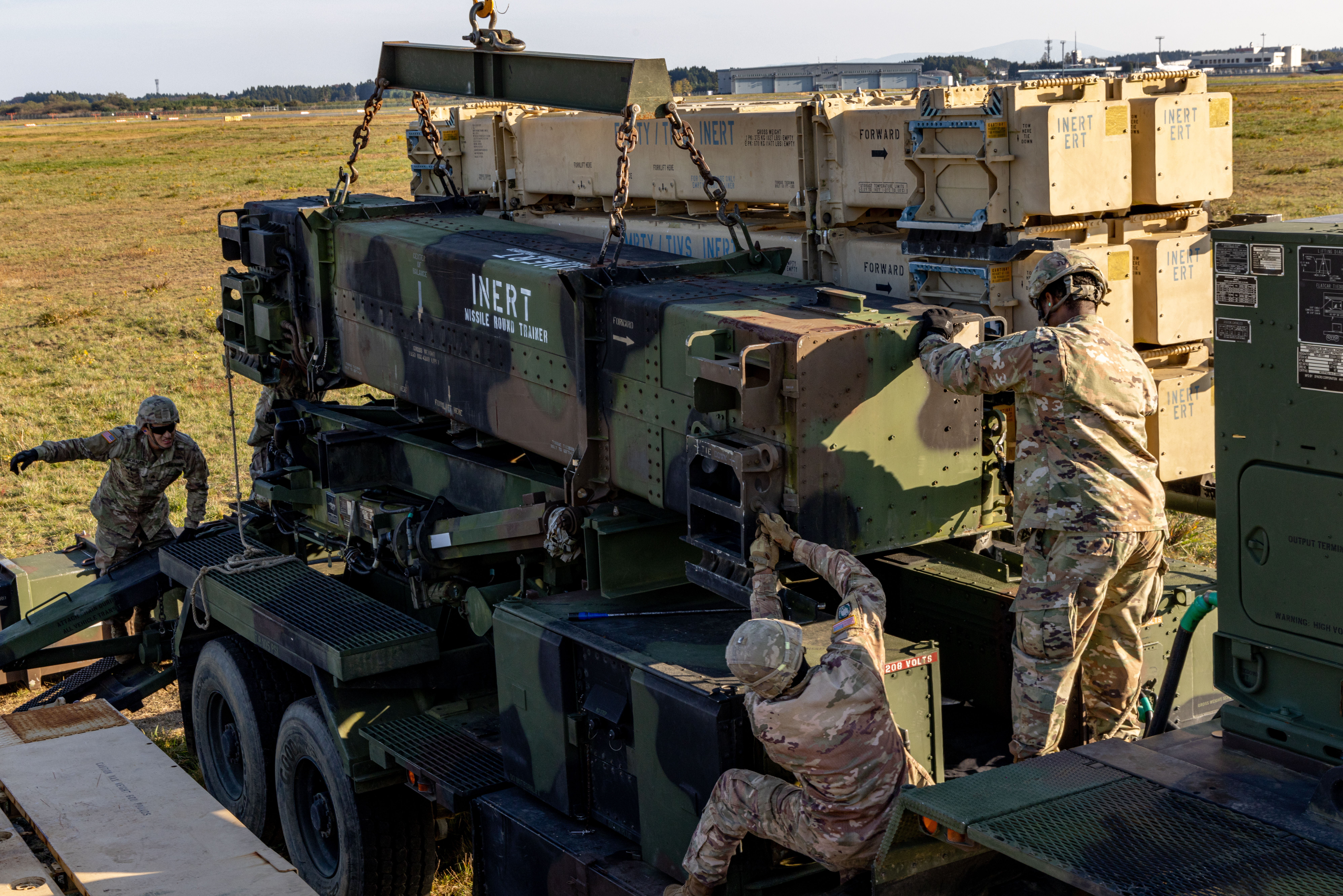
Events on Asia