Defense Priorities Defense Priorities
  • Policy Topics
    • US-Israel-Iran
    • Ukraine-Russia
    • Western Hemisphere
    • NATO
    • China
    • Syria
  • Analysis
    • Research
    • Q&A
  • Programs
    • Grand Strategy Program
    • Military Analysis Program
    • Asia Program
    • Middle East Program
  • Experts
  • Events
  • Media
  • About
    • Mission & Vision
    • People
    • Jobs
    • Contact
  • Donate
Select Page
Home / Syria / What the latest ceasefire and unification deal means for Syria
Syria, Middle East

February 9, 2026

What the latest ceasefire and unification deal means for Syria

By Alexander Langlois

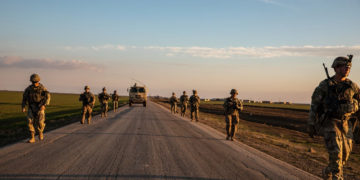
Fighting between the central government in Damascus and the previously U.S.-backed Syrian Democratic Forces (SDF) appears to have subsided after a tumultuous start in 2026, leaving many lingering questions. While the most significant exchange of territorial control since the Assad regime’s December 2024 collapse marks a decisive moment in the country’s transition, Washington’s imposed ceasefire that ended the fighting between the two major actors hardly resolves their differences in a way that assures long-term stability for Syria. Rather, it marks a potential turning point in efforts to unify the country while furthering the U.S. military withdrawal from it.

he hostilities that began in the northern neighborhoods of Syria’s second city of Aleppo and expanded eastward—eventually reaching the Kurdish-majority governorate of Hasakah—occurred with overt U.S. backing. From talks in Paris to repeated meetings between U.S. officials and Syrian actors on both sides of the fighting, Washington expressed increasing cynicism in the years-long negotiations between the parties, ultimately opting for the Turkish-Damascus position. Doing so fostered the central government’s offensive and the SDF’s capitulation on most of their points in the unification talks.

Syrian president Ahmed al-Shara seems to have overstepped, however, in aggressively advancing his forces deep into Syria’s northeast in mid-January after his government and the SDF reached a U.S.-brokered ceasefire to halt fighting along the banks of the Euphrates River. Washington attempted to step in more forcefully to prevent what it likely deemed a potential public relations disaster, highlighting real fears of ethnic cleansing and targeted violence against the Kurds by the Syrian army.

In this context, the Trump administration could not be seen as backing yet another ethnic massacre in the country, previously witnessed in the country’s northwest and south in 2025. Amid calls to renew sanctions against the central government, the Trump administration imposed a ceasefire between the parties.

Read at National Interest

Author

Alexander
Langlois

Contributing Fellow

Defense Priorities

More on Middle East

In the mediaUS‑Israel‑Iran, Iran, Middle East

CVA Hosted Panel: The Iran Conflict Explained

Featuring Jennifer Kavanagh

March 11, 2026

In the mediaUS‑Israel‑Iran, Iran, Middle East

IEA Announces Largest Ever Global Strategic Petroleum Reserves Release

Featuring Rosemary Kelanic

March 11, 2026

Op-edUS‑Israel‑Iran, Iran, Middle East

Is an Off-Ramp With Iran Possible?

By Daniel DePetris

March 10, 2026

Op-edUS‑Israel‑Iran, Iran, Middle East

Militarily, the Iran war is a success. But what are the U.S. goals?

By Daniel DePetris

March 10, 2026

Op-edUS‑Israel‑Iran, Iran, Middle East

Trump’s war against Iran is uniquely unpopular among U.S. military actions of the past century

By William Walldorf

March 10, 2026

In the mediaUS‑Israel‑Iran, Iran, Middle East

Iran warns it will block oil from Strait of Hormuz until U.S. strikes end

Featuring Rosemary Kelanic

March 10, 2026

Events on Syria

See All Events
virtualMiddle East, Basing and force posture, Diplomacy, Houthis, Iran, Iraq, Israel, Israel‑Hamas, Military analysis, Syria

Trump in the Middle East: Impacts, implications, and alternatives

May 16, 2025
virtualSyria, Balance of power, Basing and force posture, Counterterrorism, Middle East, Military analysis

Syria after Assad: Prospects for U.S. withdrawal

February 21, 2025
virtualMiddle East, Iran, Israel‑Hamas, Israel‑Iran, Syria, Yemen

Keeping the U.S. out of war in the Middle East

January 16, 2024

Receive expert foreign policy analysis

Join the hub of realism and restraint

Expert updates and analysis to enhance your understanding of vital U.S. national security issues

Defense Priority Mono Logo

Our mission is to inform citizens, thought leaders, and policymakers of the importance of a strong, dynamic military—used more judiciously to protect America’s narrowly defined national interests—and promote a realistic grand strategy prioritizing restraint, diplomacy, and free trade to ensure U.S. security.

  • Research
  • Experts
  • About
  • For Media
  • Jobs
  • Donate
  • Privacy Policy
  • Terms and Conditions
  • Contact
© 2026 Defense Priorities Foundation. All rights reserved.