Key points
- The precision revolution—the massive gains in the accuracy of airpower that made aircraft and missiles more efficient at destroying targets—was for decades essentially a U.S. phenomenon, but now it has proliferated to rivals like Iran.
- Guidance technology sufficient to achieve high accuracy is broadly available for ballistic and cruise missiles and drones. This has allowed developing countries and even non-state actors to attain accuracy, at least at short range.
- U.S. bases in the Persian Gulf region have thus become increasingly vulnerable to missile and drone strikes from Iran and, to a lesser extent, the non-state actors Iran supports.
- At the same time, increased accuracy means more targets can be destroyed by U.S. airstrikes conducted from greater distance, or from the sea, especially carriers, making tactical airpower from nearby airbases less useful.
- These developments support the case that the United States should close its Middle Eastern bases, conduct operations there from greater distance or from the sea (if they continue at all), and invest relatively more in the capability to do so.
For decades the United States, which pioneered precision targeting, did not have to worry about its military opponents having the capability to precisely target its overseas bases from a distance. After the Cold War, Russia and China increasingly developed more accurate missiles, but the countries the United States fought wars against did not. The bases were sanctuaries where missiles, aircraft, ships, and even invasions could be launched without being successfully targeted. What missiles U.S. adversaries possessed, like Iraqi Scuds in 1991, were not accurate enough to pose much threat.
But accuracy has since proliferated.1The author thanks Scott Strgacich for his substantial research support for this paper. Well before the 2026 Iran war began, it was evident that the Iranian military, and to a lesser extent its regional, non-state allies and proxies, had amassed large quantities of increasingly accurate short-range missiles and drones that could range U.S. bases near the Persian Gulf. The damage Iran has inflicted on U.S. bases during the war—with the most telling attacks targeting the suite of capabilities that enable tactical airpower—make this development plain.
True, Iran still cannot reliably hit precise targets beyond 1,000 kilometers or so, as their uneven results against Israel attest. Moreover, U.S. bases that took hits are still mostly operational, and adding more missile defenses, hardened silos, and other defenses can mitigate vulnerability. But Iran’s range of accurate missiles seems likely to grow, and defensive steps have limited utility and can be overcome by volume, which is far cheaper for Iran to increase than it is to defend against. U.S. bases are getting more vulnerable and costlier to defend.
These bases are also less useful to U.S. warmaking. Because strikes have become so much more accurate, sorties have become far more efficient and airpower that does not require local bases—bombers carrying air-to-ground missiles, ships firing Tomahawks, and especially aircraft taking off from carriers—increasingly can carry out airstrikes. This point should not be taken too far; even bombers that take off from the United States rely on tankers and other support that need local real estate. Stand-off missiles (meaning those fired from outside vulnerable range) are too pricey and limited in number to be used for heavy and sustained air campaigns. Moreover, as we see today in Iran, the ability to carry out accurate strikes should not be confused with success. Still, the trend is that bases have become less important to achieving tactical objectives and destroying targets.
The decreased utility of bases is part of a larger story about how smaller powers can increasingly contest U.S. military hegemony in growing swaths of the world.2What Barry Posen calls “contested zones,” in Barry R. Posen, “Command of the Commons: The Military Foundation of U.S. Hegemony,” International Security 28, no. 1 (Summer 2003): 5–46. This shift adds to the already overwhelming case for pulling back from the region—that the United States should close its garrisons in the Middle East and stop trying to police the region’s troubles.3Justin Logan, “The Case for Withdrawing from the Middle East,” Defense Priorities, September 30, 2020, https://www.defensepriorities.org/reports/the-case-for-withdrawing-from-the-middle-east/; David Blagden and Patrick Porter, “Desert Shield of the Republic? A Realist Case for Abandoning the Middle East,” Security Studies 30, no. 1 (2021): 5–48. But even those who retain an appetite for wars in the region should see these trends as reason to do so from greater distance.4Stephen Peter Rosen, “A Better Way to Defend America: Base More U.S. Forces in the Western Hemisphere—and Fewer in Asia and Europe,” Foreign Affairs, March 14, 2025, https://www.foreignaffairs.com/united-states/better-way-defend-america; Frank McKenzie, “U.S. Bases in the Middle East: Overcoming the Tyranny of Geography,” Jewish Institute for National Security of America, September 19, 2024, https://jinsa.org/u-s-bases-in-the-middle-east-overcoming-the-tyranny-of-geography/. Why give enemies hostages?
This paper first describes the technology of precision strikes. Second, it surveys the proliferation of this capability, especially to Iran and the forces it supports. Third, it discusses Iran’s strikes on U.S. bases, especially during the 2026 war. Fourth, it outlines how the U.S. used these bases to attack Iran and how it might have fought without them. The conclusion reviews different ways of responding to U.S. bases’ increased vulnerability and argues for complete withdrawal from the Middle East.
The precision revolution
The precision revolution—meaning the vast and even exponential improvements in the accuracy of missiles or bombs dropped from aircraft—is a product of various technological advances, most of them pioneered by the U.S. military, especially the Air Force, during the Cold War as it built up its strategic airpower capability. The term refers to the ability to win wars with airpower alone, including by the delivery of nuclear weapons.5Donald MacKenzie, Inventing Accuracy: A Historical Sociology of Nuclear Missile Guidance (Cambridge, MA: MIT Press, 1993); David R. Mets, The Long Search for a Surgical Strike: Precision Munitions and the Revolution in Military Affairs, CADRE Paper No. 12 (Maxwell Air Force Base, AL: Air University Press, 2001).
Advances in four major technological buckets allow for precision targeting.6A good overview is Barry Watts, “The Evolution of Precision Strike,” Center for Strategic and Budgetary Assessments, 2013, https://csbaonline.org/wp-content/uploads/2026/03/Evolution-of-Precision-Strike-final-v15.pdf. Microelectronics—the chips that allow modern computing—underlie almost all the links in the technological chain that allows for precision. Reconnaissance technology—photos, videos, radar, and other signals detected from satellites, drones, and aircraft—is vital to acquiring targets. Communications technology allows targeting information to be integrated and transmitted nearly instantly to strike platforms and to maintain control of munitions as they head toward targets. Navigation, whether inertial or provided by satellites, and terminal guidance, which can employ various seekers (electro-optical, infrared, radar, laser, anti-radiation, or image-matching systems) bring missiles to their targets.
Improved engineering of airframes and missiles, and particularly the advent of drones, is also an important part of the precision revolution. Drones take advantage of these other advances to be relatively cheap and expendable, though the overall cost of their operations may not be especially cheap.7John P. Abizaid and Rosa Brooks, “Recommendations and Report of the Stimson Task Force on U.S. Drone Policy,” Stimson Center, June 2014, https://www.stimson.org/2014/recommendations-and-report-stimson-task-force-us-drone-policy-0/. The ability to loiter also makes drones excellent as surveillance aircraft that provide targeting data to other weapons systems; some can strike targets themselves. If sufficiently cheap, drones can compensate for their vulnerability and unreliability with volume; with enough shots, some will find the target. They add mass to the proliferation of accuracy, making it more deadly.
For the United States, these advances have been revolutionary from a tactical perspective. The gains are measured in circular error probable (CEP), which refers to the radius of a target in which half of the projectiles that are fired at that target impact. The German V-1 missiles used to terrorize London in World War II, with CEPs of perhaps 10 kilometers, were only good for targeting a city, which meant they were essentially psychological weapons that tried to degrade British morale rather than something with direct military utility. U.S. intercontinental ballistic missiles (ICBMs) now reportedly have CEPs under 90 meters (and in truth probably half that), which is 41 times more accurate than the Atlas ballistic missiles first deployed in the early Cold War.8A ballistic missile is named for its ballistic trajectory: it is launched at a high angle to achieve a high altitude with the aim coming down more or less on top of its target. Engines are used in the initial “boost phase” with the “midcourse” and “terminal” phases relying on gravity. Cruise missiles are fully powered by airbreathing jet engines and sustain level flight through lift, much as an airplane does. Ballistic missiles offer greater range, and their warheads’ speed in the terminal phase helps avoid missile defense systems, but speed also historically limits accuracy. Cruise missiles’ low-altitude level flight gives them a chance to evade enemy radar detection. For ballistic missiles, short range is usually defined as under 1,000 kilometers (about 620 miles); medium range is 1,000–3,000 kilometers (620 to 1,860 miles); and intermediate range is between 3,000 and 5,500 kilometers (1,860–3,410 miles). Long-range missiles have intercontinental ranges—above 5,500 kilometers (3,410 miles) and also known as intercontinental or strategic ballistic missiles. “Fact Sheet: Ballistic vs. Cruise Missiles,” Center for Arms Control and Nonproliferation, April 2017, https://armscontrolcenter.org/wp-content/uploads/2017/04/Ballistic-vs.-Cruise-Missiles-Fact-Sheet.pdf. On the accuracy of modern Trident missiles being higher than officially reported, see “Trident D5,” Missile Threat Project, Center for Strategic and International Studies, last modified April 23, 2024, https://missilethreat.csis.org/missile/trident/. Because the ICBMs were nuclear, they compensated for low accuracy with higher yield. Tomahawk and other cruise missiles, with CEPs under 10 meters, are many times more accurate than early U.S. cruise missiles—roughly an order of magnitude improved over the later Regulus I and eightyfold over the less accurate Matador.9“Tomahawk,” Missile Threat Project, Center for Strategic and International Studies, last updated April 23, 2024, https://missilethreat.csis.org/missile/tomahawk/; “Missile, Surface-to-Surface, Regulus I, SSM-N-8a,” National Air and Space Museum, Smithsonian Institution, last accessed September 14, 2026, https://airandspace.si.edu/collection-objects/missile-surface-surface-regulus-i-ssm-n-8a/nasm_A1988004500; “Missile, Surface-to-Surface, Matador,” National Air and Space Museum, Smithsonian Institution, last accessed September 14, 2026, https://airandspace.si.edu/collection-objects/matador/nasm_A19630335000. Smart bombs—meaning gravity bombs guided by Joint Direct Attack Munition (JDAM) tail kits or laser guidance—now have CEPs reportedly below 10 meters, making them at least 10 times more accurate than the best dumb bombs.
This progress is realized not just in what targets can be selected but in how much effort goes into destroying them. Accuracy means each bomb, missile, or airframe has a far higher chance of striking the target. As a result, it takes far fewer sorties (flights of attack aircraft) or missiles to destroy a target. In addition, with precision, far smaller munitions (measured in yield, or explosive power) are needed. So now even hard targets, like silos for intercontinental ballistic missiles, are potentially threatened by conventional weapons, creating new threats to nuclear arsenals and arguably the stability of the nuclear balance.10Adam Mount, “Conventional Deterrence of Nuclear Use,” International Security 50, no. 2 (Fall 2025): 95–129, https://doi.org/10.1162/ISEC.a.13. These developments have yielded revolutionary gains in the efficiency of airpower. Still, it is important to remember that improved ability to destroy things is a distinct matter from achieving political results by destroying them.11Robert A. Pape, Bombing to Win: Air Power and Coercion in War (Ithaca, NY: Cornell University Press, 1996).
The proliferation of precision
The most important technical factor driving the proliferation of these technologies is probably how computing power radically reduced the cost of guidance and target acquisition, allowing precision targeting without satellite guidance.12Owen R. Cote, The Future of Naval Aviation (Cambridge, MA: Massachusetts Institute of Technology, 2006). These improvements have eased a long-standing tradeoff between speed and accuracy, allowing ballistic missiles to become far more accurate, albeit less accurate than cruise missiles or drones.13Douglas Barrie, “Trends in Missile Technologies,” International Institute for Strategic Studies, March 11, 2019, https://www.iiss.org/online-analysis/online-analysis/2019/03/trends-in-missile-technologies/. Even states that cannot afford air forces now can buy missile arsenals that are precise at short range.
Also important is the reduced cost of reconnaissance capabilities.14Maximilian K. Bremer and Kelly A. Grieco, “Iran’s Asymmetric Counterair Campaign: Attacking the U.S. Air Force’s Nests and Eggs,” War on the Rocks, April 9, 2026, https://warontherocks.com/irans-asymmetric-counterair-campaign-attacking-the-u-s-air-forces-nests-and-eggs/. Commercial satellites offering high-resolution imagers, synthetic aperture radar, ship and aircraft tracking data, and the open-source opportunities that social media provides allow states that lack their own reconnaissance satellites to find fixed targets like military bases, establish their coordinates, monitor them, and observe results after strikes.15Zachary Burdette, “Why the United States Should Not Fear a Space Pearl Harbor,” RAND, July 28, 2025, https://www.rand.org/pubs/commentary/2025/07/why-the-united-states-should-not-fear-a-space-pearl.html. Computing power helps integrate the results of various sensors into targeting data. This democratization of target acquisition applies far more to fixed targets than mobile ones, which are far harder to locate and track, let alone strike.16Watts, “The Evolution of Precision Strike,” 17–18.
Of course, demand, meaning politics, matters too. Weapons proliferation always follows geopolitical developments that drive states to improve arms.17Andrew Metrick, “A World Full of Missiles,” Foreign Affairs, March 28, 2024, https://www.foreignaffairs.com/north-korea/world-full-missiles. But it also depends on how the technology in question serves the mission of the state’s military organizations.18Michael Horowitz, The Diffusion of Military Power: Causes and Consequences for International Politics (Princeton, NJ: Princeton University Press, 2010).
To appreciate the U.S. loss of dominance in precision strikes, it is useful to consider the U.S. military’s experience in the Gulf War. In 1991, when U.S. forces bombed Iraq and ejected its forces from Kuwait, they dramatically displayed new “smart bombs” with precision strike capabilities developed to defeat the Soviet Union in Europe. This precision came from laser-guided bombs dropped from F-117s and F-111s and 288 Tomahawk missiles launched from ships and submarines.19“Operation Desert Storm: Evaluation of the Air Campaign,” GAO/NSIAD-97-134, U.S. General Accounting Office, June 1997, https://www.gao.gov/assets/nsiad-97-134.pdf. There were obvious limitations: the vast majority of the bombs dropped remained unguided, laser guidance was dependent on clear visibility, and the tactical effect of U.S. bombing was limited, with ground forces needed to expel Iraq’s military. But televised images of U.S. bombs severing bridges and going down ventilation shafts to destroy buildings suggested that U.S. forces were entering a new era of precision warfare.20Thomas G. Mahnken and Barry D. Watts, “What the Gulf War Can (and Cannot) Tell Us about the Future of Warfare,” International Security 22, no. 2 (Fall 1997): 151–162. On the limitations of airpower in the Gulf War, see Daryl G. Press, “The Myth of Air Power in the Persian Gulf War and the Future of Warfare,” International Security 26, no. 2 (Fall 2001): 5–44.
Iraq’s al-Husayn missiles (Scud derivatives), meanwhile, proved quite inaccurate, at least at the ranges at which they were used.21“Iraq Missile Overview,” Nuclear Threat Initiative, June 1, 2012, https://www.nti.org/analysis/articles/iraq-missile/. Iraq fired them mostly at cities in Israel and Saudi Arabia, using them essentially as terror weapons. The operations of U.S. bases in the region were largely unaffected, although a strike on an army barracks in Dhahran, Saudi Arabia killed 28 American soldiers in what seems to have been a probabilistically unlikely direct hit.22“Patriot Missile Defense: Software Problem Led to System Failure at Dhahran, Saudi Arabia,” U.S. General Accounting Office, GAO/IMTEC-92-26, February 1992, https://apps.dtic.mil/sti/tr/pdf/ADA344865.pdf.
China saw the improvements in U.S. airpower as something of an alarm bell.23David Shambaugh, Modernizing China’s Military: Progress, Problems, and Prospects (Berkeley: University of California Press, 2002). It pushed to ramp up accuracy in its cruise and ballistic missile arsenal, aided by its BeiDou satellite constellation, while improving its drone capability, over-the-horizon radars, data links, and command networks. These developments vastly improved China’s ability to find, track, and strike targets across much of the western Pacific—although its ability to strike moving targets, like ships, at long distances remains in question.
Russia has also made a major push toward accuracy in recent decades, especially with its post-2008 military reforms. It built up the GLONASS constellation for satellite navigation and has demonstrated the ability to precisely hit fixed targets in Syria and Ukraine, especially with its Iskander ballistic missiles.24Clint Reach et al., “Competing with Russia Militarily: Implications of Conventional and Nuclear Conflicts,” RAND, June 2021, https://www.rand.org/content/dam/rand/pubs/perspectives/PE300/PE330/RAND_PE330.pdf.
The United States remains superior in global intelligence coverage, joint-force integration, and the scale of precision-strike capability. But the ability to precisely deliver conventional munitions accurately is increasingly common, at least at ranges in the hundreds of kilometers. This is in spite of the Missile Technology Control Regime, an agreement in place since 1987, where the United States, Russia, Japan, South Korea, Turkey, and all of Western Europe have cooperated to block the export of technologies enabling missiles and drones to carry more than 500 kilograms more than 300 kilometers.25“Missile Technology Control Regime (MTCR) Frequently Asked Questions [Fact Sheet],” Bureau of International Security and Nonproliferation, U.S. Department of State, January 2025, https://www.state.gov/bureau-of-international-security-and-nonproliferation/releases/2025/01/missile-technology-control-regime-mtcr-frequently-asked-questions/. The agreement limits the ability of states like Iran to import technology for the development of missile guidance systems, engines, reentry bodies, warheads, integrated flight instrumentation, and other key inputs.26“Missile Technology Control Regime (MTCR) Annex Handbook 2017,” Missile Technology Control Regime, October 20, 2016, https://www.mtcr.info/en/mtcr-annex. While China is not a party, Beijing does not seem to have provided much missile development assistance to Iran beyond cruise missile technology decades ago.27Atul Kumar, “China’s Arms Transfers to Iran,” Observer Research Foundation, September 24, 2024, https://www.orfonline.org/research/china-s-arms-transfer-to-iran.
Today, precision capabilities have spread to many poorer countries, often with a large dose of outside help. Azerbaijan, for example, in its 2020 war on Armenia, demonstrated the ability to precisely hit military targets with Israeli-made LORA ballistic missiles, achieving a reported CEP of 10 meters at short range. 28Jack Watling and Sidharth Kaushal, “The Democratisation of Precision Strike in the Nagorno-Karabakh Conflict,” RUSI, October 22, 2020, https://www.rusi.org/explore-our-research/publications/commentary/democratisation-precision-strike-nagorno-karabakh-conflict. Turkish-made drones also provided precise fires as well as targeted information to enhance the accuracy of artillery and rocket systems.29Watling and Kaushal, “The Democratisation of Precision Strike.” Armenia, meanwhile, was stuck using missiles with CEPs of hundreds of meters, which is insufficient to hit discrete military targets.30Watling and Kaushal, “The Democratisation of Precision Strike.”
Both Russia and Ukraine employ drones in a similar fashion in their ongoing war, using them as reconnaissance feeds for accurate strikes from artillery, missiles, and other drones. Both sides now have large arsenals of loitering munitions, or kamikaze drones, which are quite small—usually not more than several feet in diameter—cheap, and mobile enough to maneuver to targets while undercutting radar through low-altitude level flight.31Peter Bergen, Melissa Salyk-Virk, and David Sterman, “World of Drones,” New America, July 30, 2020, https://www.newamerica.org/future-security/reports/world-drones/. Competition via jamming and spoofing have driven continual change in navigation systems, frequencies, and the adoption of fiber-optic drones that radio frequency jammers cannot disrupt.32“Chapter Three: The Uninhabited War in Ukraine,” in UAVs: ISR, Deterrence and War (London: International Institute for Strategic Studies, March 25, 2026), https://www.iiss.org/publications/strategic-dossiers/2026/uavs-isr-deterrence-and-war/the-uninhabited-war-in-ukraine.
Iran’s accuracy and that of its allies
Iran’s precision capability was a long time coming. After Iraq attacked in 1980, the war expanded into the mutual bombardment of cities with aircraft and missiles, the so-called War of the Cities.33Egle Murauskaite, “Saddam’s Use of Violence against Civilians during the Iran-Iraq War,” Middle East Journal 70, no. 1 (2016): 48, https://www.jstor.org/stable/43698619. Iraq had the clear advantage in this contest, with Soviet-made Scuds and other missiles.34Thomas L. McNaugher, “Ballistic Missiles and Chemical Weapons: The Legacy of the Iran-Iraq War,” International Security 15, no. 2 (1990): 9–11. Iran’s indigenous missile production took off. This experience, plus the threat from the United States and Israel, made ballistic missiles Iran’s key means of deterrence.35Assaf Orion, “Iran’s Missiles: Military Strategy,” The Iran Primer, United States Institute of Peace, February 17, 2021, https://iranprimer.usip.org/blog/2021/feb/17/iran%E2%80%99s-missiles-military-strategy. In some respects, Iran became the Middle East’s premier missile power, with an estimated inventory of 2,500 to 3,000 ballistic missiles prior to the 2026 war.36“Table of Iran’s Missile Arsenal,” Iran Watch, Wisconsin Project on Nuclear Arms Control, February 22, 2024, https://www.iranwatch.org/our-publications/weapon-program-background-report/table-irans-missile-arsenal; “Iran’s Missile Program: Past and Present,” Iran Watch, Wisconsin Project on Nuclear Arms Control, June 29, 2020, https://www.iranwatch.org/our-publications/weapon-program-background-report/history-irans-ballistic-missile-program#Overview; Dov Liber and Rory Jones, “How Big Is Iran’s Missile Arsenal?” Wall Street Journal, October 3, 2024, https://www.wsj.com/livecoverage/israel-iran-hezbollah-conflict/card/how-big-is-iran-s-missile-arsenal–earTfWyIeIJgWnm5UHor. To this end, Iran developed a substantial domestic defense-electronics sector that contributes guidance, navigation, and control technology to its missile programs, although it imports microelectronics and other components.37“Open-Source Analysis of Iran’s Missile and UAV Capabilities and Proliferation,” International Institute for Strategic Studies, April 2021, https://www.iiss.org/globalassets/media-library—content–migration/files/research-papers/open-source-analysis-of-irans-missile-and-uav-capabilities-and-proliferation.pdf.
Foreign countries have helped Iran in a limited way. China supplied Iran with several families of anti-ship cruise missiles in the 1980s and 1990s along with dual-use technologies key to missile development.38David Pierson, “How China’s Weapons Transfers to Iran Have Evolved Over Decades,” New York Times, April 15, 2026, https://www.nytimes.com/2026/04/15/world/asia/china-iran-weapons-sales.html. Iran acquired Soviet-designed Kh-55 cruise missiles from Ukraine in 2001, apparently via the black market. Those missiles provided the technological basis for Iran’s Soumar missiles.39“Kh-55 (AS-15),” Missile Threat Project, Center for Strategic and International Studies, August 10, 2016, https://missilethreat.csis.org/missile/kh-55/.
Range of Iran’s missiles and one-way attack drones
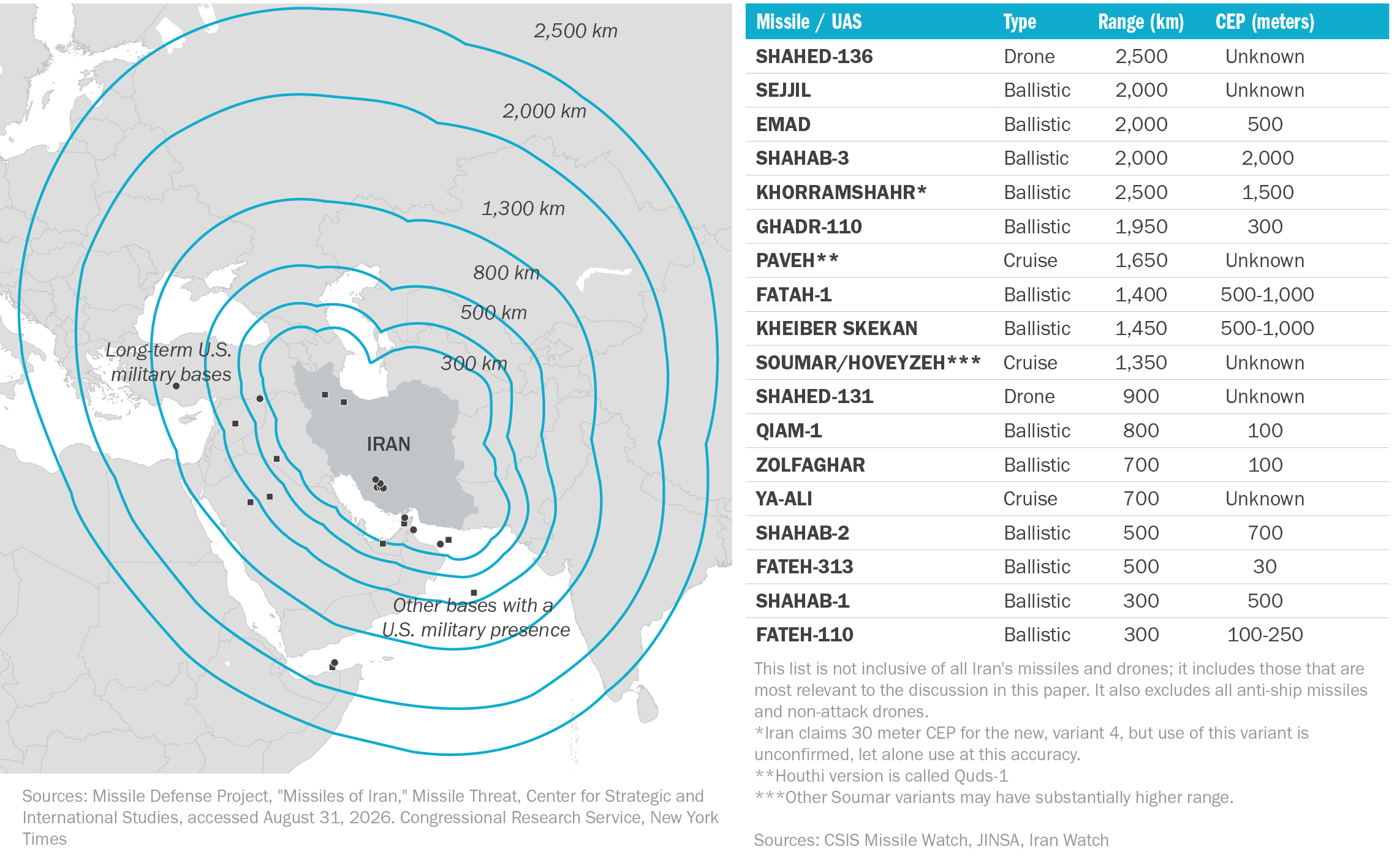
Iran’s Shahab family of liquid-fueled ballistic missiles, introduced between 1985 and 1998, are derivatives of Soviet Scud systems, with the short-range Shahab-1 and Shahab-2 having estimated CEPs of 500 and 700 meters respectively.40“Table of Iran’s Missile Arsenal.” The medium-range Shahab-3 system is even less accurate, with a CEP of nearly two kilometers.41“Shahab-3,” Missile Threat Project, Center for Strategic and International Studies, August 9, 2016, https://missilethreat.csis.org/missile/shahab-3/. The Ghadr and Emad medium-range missiles derived from the Shahab-3 and introduced in 2007 and 2015, respectively, offered some improvement, with reported CEPs of 300-500 meters and some reports claiming it is far more accurate than that.42“Emad, Ghadr (Shahab-3 Variants),” Missile Threat Project, Center for Strategic and International Studies, April 23, 2024, https://missilethreat.csis.org/missile/emad/. Iran says its newer, solid-fueled Kheibar Shekan and Fattah-1 missiles have CEPs of 10–25 meters, but these claims are dubious.43“Table of Iran’s Missile Arsenal.” The Khorramshahr family of medium-range ballistic missiles, which Iran has not yet widely deployed, supposedly boasts a CEP as low as 30 meters.44“Table of Iran’s Missile Arsenal”; “U.S. Strategic Command Warns Iran Now Holds Middle East’s Largest Ballistic Missile Arsenal,” Global Defense News Army Recognition Group, March 28, 2025, https://armyrecognition.com/news/army-news/2025/us-strategic-command-warns-iran-now-holds-middle-easts-largest-ballistic-missile-arsenal.
Whether or not Iran achieved these low-double-digit accuracy levels for its medium-range ballistic missiles in tests or simulations, the results in combat have not measured up. Notably, Iran’s October 2024 attack on several Israeli airbases and Mossad headquarters, involving 200 ballistic missiles, showed a dispersal of impacts that suggests a CEP closer to 1,000 meters.45Iran claims to have used Fattah-1s for the attack, though outside analysts say it likely used a range of missiles—Fattahs, Ghadrs, Emads, and perhaps Kheibar Shekans. Wes Rumbaugh, “Did the U.S. Defense of Israel from Missile Attacks Meaningfully Deplete Its Interceptor Inventory?,” Center for Strategic and International Studies, December 4, 2024, https://www.csis.org/analysis/did-us-defense-israel-missile-attacks-meaningfully-deplete-its-interceptor-inventory; Haley Ott, “What Iran Launched at Israel in Its Unprecedented Attack, and What Made It Through the Air Defenses,” CBS News, April 16, 2024, https://www.cbsnews.com/news/iran-israel-attack-what-weapons-launched-how-air-defenses-worked/. A ballistic missile that impacted about 500 meters from Israel’s Ministry of Defense in June 2025, while not a sufficient basis to judge CEP, is roughly supportive of these conclusions. Bar Peleg, “Iranian Missile Hit Near IDF’s Tel Aviv Headquarters at Start of Iran War,” Haaretz, June 29, 2025, https://www.haaretz.com/israel-news/2025-06-29/ty-article/.premium/iranian-missile-hit-near-idfs-tel-aviv-headquarters-at-start-of-iran-war/00000197-ba80-de01-a39f-ffbc1de40000. Though Iran has likely improved these missiles’ accuracy since 2024, it has not demonstrated the capability to precisely strike military targets like radars or even buildings at such range. It does have the accuracy to target bases, industrial complexes, ports, and other large targets.
By contrast, Iran clearly has precision strike capability at the short range that includes U.S. bases along the southwest coast of the Persian Gulf—in Kuwait, Bahrain, Qatar, the United Arab Emirates, much of Saudi Arabia, and even Jordan. The Fateh family of short-range ballistic missiles have evolved since their introduction in the early 2000s from essentially unguided artillery rockets to have CEPs of better than 30 meters in some variants.46“Open-Source Analysis of Iran’s Missile and UAV Capabilities and Proliferation.” The Qiam family introduced in 2010 has slightly more reach (perhaps 800 kilometers) and a CEP of maybe 100 meters or less in the newer variants.47“Open-Source Analysis of Iran’s Missile and UAV Capabilities and Proliferation.”
Ballistic missiles are Iran’s preferred means of attacking foreign targets on land. Cruise missiles and drones are far slower (two hours to Israel for a cruise missile versus under 15 minutes for a ballistic missile) and easier to intercept while carrying far smaller payloads. Still, Iran has a substantial land-attack cruise missile arsenal, though the size of that arsenal is comparatively cloudy. It began introducing these missiles in 2014 and has increased their range from about 700 kilometers to 1,650 kilometers with the Paveh, now the likely mainstay of Iran’s land-attack cruise missile arsenal.48A good overview of Iran’s cruise missile developments is Shahryar Pasandideh, “Under the Radar, Iran’s Cruise Missile Capabilities Advance,” War on the Rocks, September 25, 2019, https://warontherocks.com/under-the-radar-irans-cruise-missile-capabilities-advance/.
As part of its retaliatory strikes in the 2026 war, Iran used cruise missiles to complement ballistic missile strikes in attacks on bases and other facilities in nearby Gulf targets and perhaps on Israel.49The evidence is unclear on Israel strikes, but one-way drones seem to be Iran’s preferred adjunct weapon in these attacks. Farzin Nadimi, “Iran’s Drone Strategy (Part 1): Wartime Performance and Adaptations,” Policy Watch 4216, Washington Institute for Near East Policy, May 22, 2026, https://www.washingtoninstitute.org/policy-analysis/irans-drone-strategy-part-1-wartime-performance-and-adaptations; Mark F. Cancian and Chris H. Park, “Assessing the Air Campaign After Three Weeks: Iran War By the Numbers,” Center for Strategic and International Studies, March 25, 2026, https://www.csis.org/analysis/assessing-air-campaign-after-three-weeks-iran-war-numbers. Iran claims “pinpoint” accuracy for its cruise weapons at their advertised range.50Ali Topchi, “Iran’s Paveh Missile: A Threat to U.S. Military Bases in the Persian Gulf,” TRT World, March 1, 2023, https://www.trtworld.com/article/12796703. Combat evidence, especially Iran’s 2019 attack on Saudi oil facilities, which reportedly involved a mix of drones and cruise missiles, suggests somewhat less impressive capability.51“Letter dated 27 January 2020 from the Panel of Experts on Yemen addressed to the President of the Security Council,” United Nations Security Council, April 28, 2020, https://digitallibrary.un.org/record/3859381/files/S_2020_326-EN.pdf.
Iran also uses anti-ship cruise missiles extensively.52“Iran Military Power: Ensuring Regime Survival and Securing Regional Dominance,” Defense Intelligence Agency, 2019, https://www.dia.mil/portals/110/images/news/military_powers_publications/iran_military_power_lr.pdf. The missiles responsible for most of the attacks on shipping in the Strait of Hormuz, which Iran has used to considerable effect since being attacked by the United States and Israel in early 2026, are the Noor (a reverse engineered Chinese YJ-83), Qader, and Ghadir, with ranges of 120–300 kilometers.53Iran also has a much longer-range (1,000 kilometer) anti-ship cruise missile in the Abu Mahdi and various very short-range cruise missiles, designed to be fired from small boats or on shore at nearby ships. On Iran’s use and development of anti-ship cruise missiles, see Oral Toğa, “Iran’s Forward Defense Doctrine and the Evolution of Its ‘Long Arm’ Strategy,” Center for Iranian Studies, March 7, 2025, https://iramcenter.org/en/irans-forward-defense-doctrine-and-the-evolution-of-its-long-arm-strategy_en-2600; Farzin Nadimi, “The IRGC and the Persian Gulf Region in a Period of Contested Deterrence,” Middle East Institute, November 2021, https://mei.edu/wp-content/uploads/2021/11/The-IRGC-and-the-Persian-Gulf-Region-in-a-Period-of-Contested-Deterrence_1.pdf.
Iran is also a missile and drone proliferator. Iran shared Fateh-110-type ballistic missiles, with a reported CEP in the low hundreds, with Hezbollah and Shiite militias in Iraq.54“Open-Source Analysis of Iran’s Missile and UAV Capabilities and Proliferation,” International Institute for Strategic Studies, April 2021, 28–30, https://www.iiss.org/globalassets/media-library—content–migration/files/research-papers/open-source-analysis-of-irans-missile-and-uav-capabilities-and-proliferation.pdf. When the Houthis were battling Saudi Arabia and the forces it backed for control of Yemen, Iran helped them replace low-accuracy Scud variants with increasingly advanced Burkan ballistic missiles that have ranges of up to 1,400 kilometers.55Seth G. Jones et al. “The Iranian and Houthi War Against Saudi Arabia,” Center for Strategic and International Studies, December 21, 2021, https://www.csis.org/analysis/iranian-and-houthi-war-against-saudi-arabia. The Houthis developed the Quds series of cruise missiles with potential ranges above 1,000 kilometers, likely with Iranian help.56“Cruise Missiles in the Middle East,” Missile Dialogue Initiative, International Institute for Strategic Studies, September 2021, https://www.iiss.org/globalassets/media-library—content–migration/files/research-papers/cruise-missiles-in-the-middle-east.pdf. This leaves the Houthis with various missiles with CEP under 100 meters and perhaps lower at ranges below 500 kilometers.57“Missiles of Iran,” Missile Threat Project, Center for Strategic and International Studies, June 14, 2018, https://missilethreat.csis.org/country/iran.
Iran has transferred its one-way attack drones to Russia, Hezbollah, the Houthis, and militias in Iraq and Syria.58Molly Campbell, “Drone Proliferation Dataset,” Center for a New American Security, September 10, 2024, https://www.cnas.org/publications/reports/drone-proliferation-dataset. The Houthis imported the Iranian-made Shahed-131, which has an estimated range up to 900 kilometers, and developed a version of the Shahed-136, with a range that could be 2,500 kilometers.59Uzi Rubin, “Russia’s Iranian-Made UAVs: A Technical Profile,” Royal United Services Institute, January 13, 2023, https://www.rusi.org/explore-our-research/publications/commentary/russias-iranian-made-uavs-technical-profile/; “Iran Enabling Houthi Attacks Across the Middle East,” Defense Intelligence Agency, February 2024, 4, https://www.dia.mil/Portals/110/Documents/News/Military_Power_Publications/Iran_Houthi_Final2.pdf. They also developed the Samad family of loitering munitions with Iran’s help and employed them frequently against U.S. naval forces in the Red Sea.60“Iran Enabling Houthi Attacks Across the Middle East,” 5; “Sammad-2 (UAV-X) Yemeni Reconnaissance and Loitering Munition Unmanned Aerial Vehicle (UAV),” Operational Environment Data Integration Network, https://odin.tradoc.army.mil/WEG/Asset/Sammad-2_(UAV-X)_Yemeni_Reconnaissance_and_Loitering_Munition_Unmanned_Aerial_Vehicle_(UAV). Ethiopia, Sudan, and maybe Venezuela have imported Iranian surveillance drones. See “Missiles of Iran.” Houthi attacks on commercial and naval vessels during its attempt to shut down Red Sea shipping in response to Israel’s Gaza war demonstrated their growing capability to locate and attack ships, though their targeting capabilities remain uneven.61Fabian Hinz, “Houthi Anti-Ship Missile Systems: Getting Better All the Time,” International Institute for Strategic Studies, January 8, 2024, https://www.iiss.org/online-analysis/military-balance/2024/01/houthi-anti-ship-missile-systems-getting-better-all-the-time/.
The vulnerability of U.S. Middle East basing
Before going into greater detail about how the proliferation of accuracy to Iran and its local allies has endangered U.S. bases in the Middle East, it is useful to briefly describe the current U.S. basing infrastructure there.62This is not meant to be a complete survey of all U.S. facilities in the region. For that, see, Luke A. Nicastro and Andrew Tilghman, “U.S. Overseas Basing: Background and Issues for Congress,” CRS Report no. R48123, Congressional Research Service, July 10, 2024, https://www.everycrsreport.com/reports/R48123.html; Mariel Ferragamo et al. “U.S. Forces in the Middle East: Mapping the Military Presence,” Council on Foreign Relations, June 23, 2025, https://www.cfr.org/articles/us-forces-middle-east-mapping-military-presence. Unlike the U.S. military presence in East Asia and Europe, its basing in the Middle East is a largely post-Cold War phenomenon.63Mike Sweeney, “Considering the ‘Zero Option,'” Defense Priorities, March 3, 2020, https://www.defensepriorities.org/reports/considering-the-zero-option/. The U.S. has maintained upwards of 40,000 troops there in recent years, increased to 50,000 for the Iran war.64Note that these figures do not include thousands of Pentagon civilians and contractors. Few of these troops are considered “permanent” by the Pentagon, making official estimates more variable and harder to trust. Nicastro and Tilghman, “U.S. Overseas Basing: Background and Issues for Congress.” On the recent surge in troops, see Helene Cooper, “There Are Now Over 50,000 American Troops in the Mideast,” New York Times, March 29, 2026, https://www.nytimes.com/2026/03/29/us/politics/us-marines-middle-east-iran-war.html. U.S. forces also provide missile defenses for local countries, facilitate counterterrorism strikes, and allow for surges of troops in ground wars.65Jonathan Masters and Will Merrow, “U.S. Troops in the Middle East: Mapping the Military Presence,” Council on Foreign Relations, October 1, 2024, https://www.cfr.org/article/us-troops-middle-east-mapping-military-presence.
U.S. bases in the Middle East
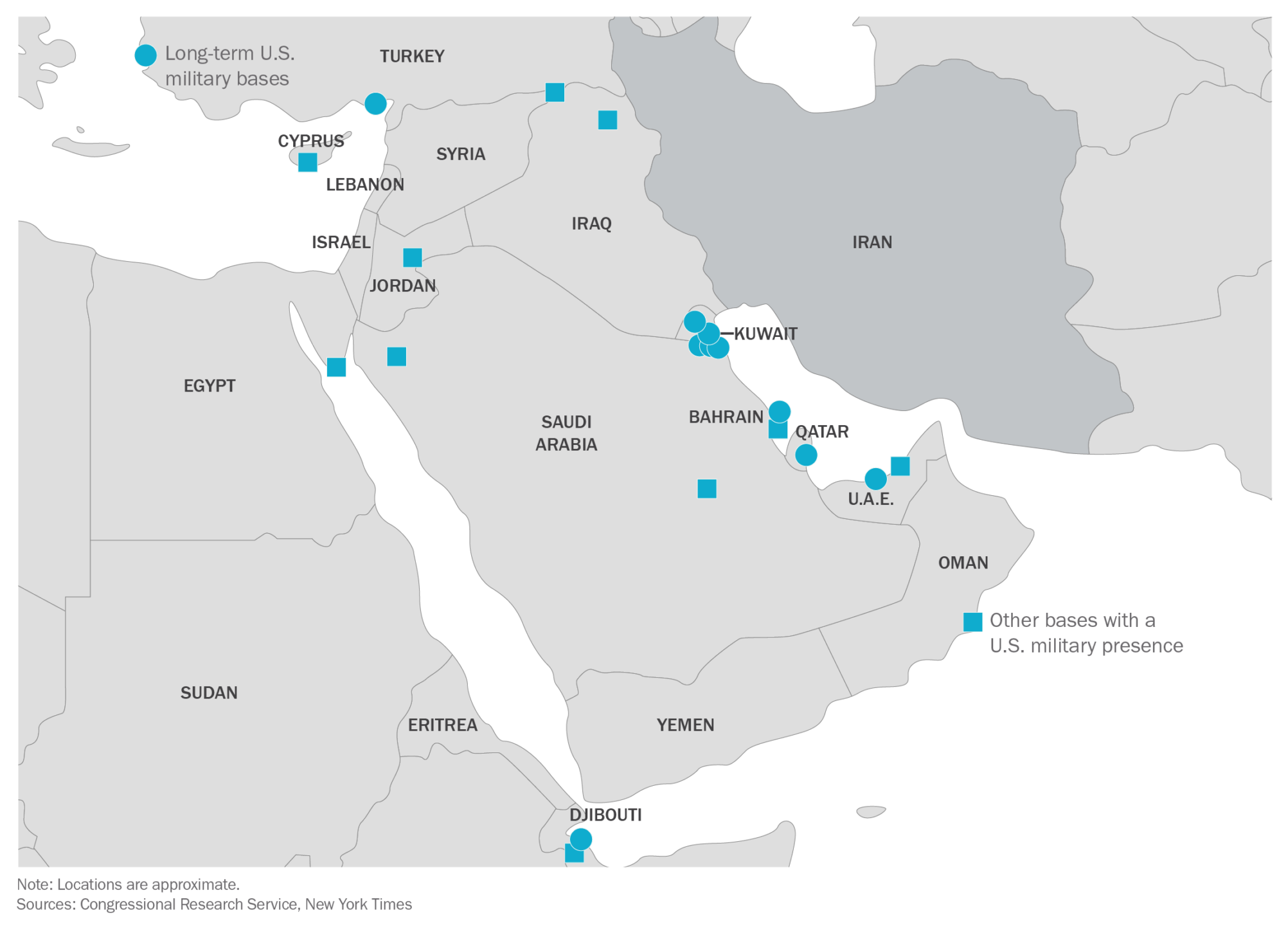
U.S. Middle Eastern bases are a legacy of old missions.
Al Udeid Air Base in Qatar is the largest U.S. facility, housing 10,000 U.S. personnel, serving as U.S. Central Command’s forward headquarters and the main regional hub for airpower, providing command and control, refueling tankers, and ISR aircraft.66“Where Are U.S. Military Facilities in the Middle East?” Reuters, February 28, 2026, https://www.reuters.com/world/middle-east/us-military-facilities-middle-east-2026-02-28/. Other major Air Force bases are Abu Dhabi in the United Arab Emirates, Ali Al Salem Air Base in Kuwait, Prince Sultan Air Base in Saudi Arabia, and Muwaffaq Salti Air Base in Jordan, which was established in 2016, originally to combat the Islamic State.67“Combined Air Operations Center (CAOC),” U.S. Air Forces Central, last modified July 2017, https://www.afcent.af.mil/About/Fact-Sheets/Display/Article/217803/combined-air-operations-center-caoc/. Incirlik in Turkey, long oriented to the European theater and a home for B-61 nuclear bombs, has in recent decades offered another important airbase for Middle East operations.
Kuwait is also home to two important Army facilities, Camp Arifjan and Camp Buehring.68“Welcome to Area Support Group—Kuwait,” U.S. Army, September 2023, https://www.usarcent.army.mil/Portals/1/Documents/01%20Welcome%20Packet%20New%20Sep%202023.pdf. Naval Support Activity (NSA) Bahrain, the headquarters of the U.S. Navy’s Fifth Fleet, supports naval operations and houses roughly 9,000 personnel.69“Naval Support Activity Bahrain: In-Depth Overview,” Military Installations, U.S. Department of Defense, last accessed September 14, 2026, https://installations.militaryonesource.mil/in-depth-overview/naval-support-activity-bahrain. Jebel Ali port in Dubai is also an important logistics stop for U.S. Navy ships. The major bases in the region function as hubs for smaller ones, which can be used for drones, raids, or missile defense elements.70In 2026, the U.S. pulled out of such smaller bases in Syria and planned to withdraw from those in Iraq, at least partly due to threat from Iranian missiles and attacks from militias it supports. Phil Stewart, Idrees Ali, and Tala Ramadan, “In Milestone, U.S. Pulls Out of Strategic Syria Base and Hands It over to Damascus,” Reuters, February 12, 2026, https://www.reuters.com/world/middle-east/syria-says-it-has-taken-control-al-tanf-base-vacated-by-us-troops-2026-02-12/; Abby Sewell and Qassim Abdul-Zahra, “As the Last US Troops Pack Up in Iraq, Militias Signal Their Weapons Will Stay,” Associated Press, September 15, 2026, https://apnews.com/article/iraq-us-withdrawal-militias-deadline-e13bf0d6b0389e76d74e8fda9577e734. All the U.S. bases in Kuwait, Bahrain, the UAE, and Qatar are easily within range of Iran’s most accurate missiles. Prince Sultan in Saudi Arabia, around 600 kilometers from Iran’s coast, is only slightly less vulnerable. Muwaffaq Salti in Jordan is about 1,000 kilometers from western Iran, but as noted below, recent strikes show this is close enough to be accurately targeted by Iran’s medium-range ballistic missiles.71David S. Cloud, Anat Peled, and Milàn Czerny, “Iran Shows Its Ballistic Missiles Are Still a Force to Reckon With,” Wall Street Journal, July 22, 2026, https://www.wsj.com/world/middle-east/iran-shows-its-ballistic-missiles-are-still-a-force-to-reckon-with-42b18204.
Growing danger
U.S. bases in the Middle East were never totally safe regardless of precision. There was always the possibility of terrorist attacks, like the 1983 bombing of the Marine barracks in Beirut that killed 241 Americans or the 1996 Khobar Towers truck bombings of a housing complex for U.S. Air Force personnel in Saudi Arabia, which killed 19.72Eric Weiner, “Remembering the 1983 Suicide Bombings in Beirut: The Tragic Events That Created the Diplomatic Security Service,” DipNote, U.S. Department of State, April 18, 2018, https://2017-2021.state.gov/remembering-the-1983-suicide-bombings-in-beirut-the-tragic-events-that-created-the-diplomatic-security-service/. Even inaccurate missiles can be deadly, as with the Gulf War strike on a U.S. barracks noted above.
In recent years, U.S. forces in the region have become increasingly vulnerable, even without the recent advent of precision, as the United States entangled itself in conflicts with hostile substate groups in Syria, Lebanon, Iraq, and Yemen, most of them linked to Iran. U.S. forces were spread out to less defended positions, putting more Americans in range of hostile fire, accurate or not.
For more than a decade before the recent war, U.S. bases in Iraq, and to a lesser extent Syria, took frequent rocket and occasional mortar fire from local militias, though few attacks caused casualties thanks to the inaccuracy of the weapons and the bases’ warning systems and shelters.73Mathias Hammer, “What to Know About the Attacks on U.S. Military Bases in the Middle East,” Time, October 25, 2023, https://time.com/6328458/military-base-attacks-middle-east-israel-iran/. Still, several attacks were deadly, including a rocket attack in late 2019 in Kirkuk that killed a U.S. contractor (part of the escalation that led to the U.S. killing of Qasem Soleimani), a barrage of rockets in 2020 that killed two U.S. and one British service members, and a 2021 rocket attack in Erbil that killed a foreign contractor.74Elizabeth McLaughlin, “Soleimani Approved Attack on Iraqi Military Base That Killed American: Top US General,” ABC News, January 3, 2020, https://abcnews.com/Politics/soleimani-approved-attack-iraqi-military-base-killed-american/story?id=68056126; Luis Martinez and Elizabeth McLaughlin, “2 Americans among 3 Service Members Killed in Rocket Attack on Base in Iraq: Officials,” ABC News, March 12, 2020, https://abcnews.com/Politics/americans-service-members-killed-rocket-attack-base-iraq/story?id=69541726; John Davidson and Ahmed Rasheed, “U.S. Forces in Iraq Hit by Rockets, Contractor Killed,” Reuters, February 15, 2021, https://www.reuters.com/world/us-forces-iraq-hit-by-rockets-contractor-killed-2021-02-15.
After Israel’s response to the October 7, 2023 Hamas attack, U.S. bases in Iraq, Syria, and bordering regions of Jordan increasingly took fire from rockets and drones, weathering a reported 180 attacks since then, most coming under the banner of the Islamic Resistance in Iraq, an umbrella group of local militias supported by Iran.75Hamdi Malik and Michael Knights, “Profile: The Islamic Resistance in Iraq,” Washington Institute for Near East Policy, October 21, 2023, https://www.washingtoninstitute.org/policy-analysis/profile-islamic-resistance-iraq. Many of these drone attacks were intercepted by short-range air defenses or jammed, while some missed their targets, and others likely impacted after early warning systems allowed base personnel to safely shelter.76Secrecy makes it hard to know how often these different outcomes occurred, especially given the frequency with which drones actually hit bases. “Iran-Backed Attacks on U.S. Troops in Middle East Since Oct. 7,” Reuters, January 28, 2024, https://www.reuters.com/world/middle-east/iran-backed-attacks-us-troops-middle-east-since-oct-7-2024-01-28; Jim Garamone, “DOD Continues Efforts to Support Israel, Limit Spread of War,” U.S. Department of Defense, October 30, 2023, https://www.defense.gov/News/News-Stories/Article/Article/3573065/dod-continues-efforts-to-support-israel-limit-spread-of-war/. A tragic exception was the January 28, 2024 attack on the Tower 22 outpost in northeastern Jordan, when Kataib Hezbollah hit a sleeping quarters on the base with a Shahed type drone, likely made in Iran, killing three U.S. soldiers.77Iason Athanasiadis, “What is the U.S. Doing in a Disputed Triangle on the Jordan/Syria/Iraq Border?,” Stimson Center, February 1, 2024, https://www.stimson.org/2024/tower-22-us-disputed-triangle-jordan-syria-iraq-border/. On the border with Syria and a few miles from Iraq, the base reportedly housed 350 Army and Air Force personnel, provided logistical support to U.S. operations in both countries, and likely also functioned to monitor weapons shipments from Iran to allied militias in Iraq, Syria, and Lebanon.78“What Is Tower 22, the Site of an Attack on U.S. Troops in Jordan?” Reuters, January 28, 2024, https://www.reuters.com/world/middle-east/what-is-tower-22-site-attack-us-troops-jordan-2024-01-28/; Jon Gambrell, “What is Tower 22, the Military Base That Was Attacked in Jordan Where 3 U.S. Troops Were Killed?,” Associated Press, January 29, 2024, https://apnews.com/article/us-jordan-drone-attack-iran-tower-22-israel-hamas-war-0265beed527e3009a966c0531c08838e/. Though it had bunkers and some anti-drone defenses, confusion and breakdowns in defenses let the drone get through without warning.79Alex Horton, “Army Cites Glaring Failures in Deadly Jordan Drone Attack,” Washington Post, April 6, 2025, https://www.washingtonpost.com/national-security/2025/04/06/jordan-drone-attack-tower-22/. On another occasion, in 2023, a drone hit a base in Erbil, Iraq, but failed to detonate.80Phil Stewart, Idrees Ali, and Ahmed Rasheed, “U.S. Forces Under Fire in Middle East as America Slides Towards Brink,” Reuters, November 9, 2023, https://www.reuters.com/world/middle-east/us-forces-under-fire-middle-east-america-slides-towards-brink-2023-11-09/.
The vulnerability of the United States’ Middle East bases thanks to increased missile and drone accuracy and hostilities with Iran should not have surprised anyone. Twenty years ago, in a report advocating that the United States move away from airbases in favor of carrier-based aviation, Owen Cote wrote:
Technological trends are making fixed targets more and more vulnerable to attack. In particular, when potential opponents follow the United States in marrying precision guidance technologies to cruise and ballistic missiles they will be able to hold fixed bases within a radius of up to 1,000 miles at risk of conventional attack by cruise and ballistic missiles against which defense is extremely difficult. …The trends in the vulnerability of fixed bases within a theater will be driven in particular by the marriage of cheap, widely available GPS/INS guidance technology and conventional sub-munition payloads with existing, mobile, tactical ballistic missiles (TBMs) and cruise missiles. Cruise missiles will likely be chosen if an opponent wishes to extend his reach beyond about 600 km. Such cruise missiles might actually have more in common with small aircraft than with current cruise missiles like Tomahawk, and might derive their survivability less from high speed and low radar cross section than from their ability to blend in with a noisy background and deny an opponent positive identification.81Cote, The Future of Naval Aviation, 19–21.
The future Cote predicted has arrived. One sign was the 2019 Aramco strike on Saudi Arabia, mentioned above, which demonstrated Iran’s ability to target static sites within 600 kilometers with fairly high accuracy, using drones and cruise missiles.82Low-flying cruise missiles and drones seem to have been used to avoid Saudi air defenses, which reportedly included an MIM-104 Patriot battery, optimized to intercept ballistic missiles. Michelle Nichols, “Exclusive: UN Investigators Find Yemen’s Houthis Did not Carry out Saudi Oil Attack,” Reuters, January 9, 2020, https://www.reuters.com/article/world/exclusive-un-investigators-find-yemens-houthis-did-not-carry-out-saudi-oil-a-idUSKBN1Z72VA/; Hammad I. Mohammad, “U.S. Blames Iran for Saudi Oil Attack,” Reuters, September 20, 2019, https://www.reuters.com/news/picture/us-blames-iran-for-saudi-oil-attack-idUSRTX736Q9/; Fabian Hinz, “Meet the Quds-1,” Arms Control Wonk, September 15, 2019, https://www.armscontrolwonk.com/archive/1208062/meet-the-quds-1/. The strike temporarily halted a substantial portion of global oil production (around 5 percent), imposing a large cost and showing the Saudis that they could be attacked without the United States responding.83On the effect on oil supply, see Christopher M. Blanchard, Heather L. Greenley, and Michael Ratner, “Attacks on Saudi Oil Facilities: Effects and Responses,” CRS no. IN11173, Congressional Research Service, October 1, 2019, https://www.congress.gov/crs-product/IN11173.
A bigger warning came on January 8, 2020, when Iran retaliated to the U.S. drone strike that killed Major General Qasem Soleimani, commander of the Islamic Revolutionary Guard Corps’ Quds Force. According to a U.S. assessment, Iran fired 16 ballistic missiles at Al Asad and Erbil airbases in Iraq, with 11 reportedly striking Al Asad, where nearly all the damage occurred, one hitting the Erbil area, and four apparently failing or falling short.84C. Todd Lopez, “Chairman: Defensive Measures Prevented Casualties in Iranian Attack,” Defense Department News, January 8, 2020, https://www.war.gov/News/Feature-Stories/Story/Article/2052919/chairman-defensive-measures-prevented-casualties-in-iranian-attack/; Phil Stewart, “Iran Intended to Kill U.S. Personnel in Missile Attack: U.S. General,” Reuters, January 8, 2020, https://www.reuters.com/article/world/iran-intended-to-kill-us-personnel-in-missile-attack-us-general-idUSKBN1Z72ZM/. The salvo reportedly included modified Qiam missiles and Fateh-family solid-fueled missiles, possibly including the Fateh-313.85“Open-Source Analysis” 11. Satellite imagery reviewed by Reuters showed seven buildings damaged or destroyed, including three apparent aircraft hangars.86“Iran Targets U.S. Forces,” Reuters, January 8, 2020, https://www.reuters.com/graphics/IRAQ-SECURITY/0100B4VR2Q5/index.html. Another source observed six direct hits out of 11 missiles. Victor Abramowicz, “The Impact of Accuracy,” Lowy Institute, January 16, 2020, https://www.lowyinstitute.org/the-interpreter/impact-accuracy. Over 100 U.S. personnel were diagnosed with brain injuries from the attack.87Lolita Baldor, “U.S. Awards 29 Purple Hearts for Brain Injuries in Iran Attack,” PBS, May 4, 2020, https://www.pbs.org/newshour/nation/u-s-awards-29-purple-hearts-for-brain-injuries-in-iran-attack.
The Al Asad attack surprised analysts by showing Iran could attack individual facilities rather than merely large area targets. Iran demonstrated accuracy below 50 meters CEP for some Fateh-family missiles, considerably better than many pre-2020 public estimates.88Ian Williams, “Uncomfortable Lessons: Reassessing Iran’s Missile Attack,” Center for Strategic and International Studies, February 6, 2020, https://www.csis.org/analysis/uncomfortable-lessons-reassessing-irans-missile-attack; Mike Sweeney, “A Plan for U.S. Withdrawal from the Middle East,” Defense Priorities, December 21, 2020, https://www.defensepriorities.org/wp-content/uploads/2024/03/DEFP_A_plan_for_US_withdrawal_from_the_Middle_East.pdf. Some assessments say the attacks demonstrated CEP below 20 meters, even approaching 10 meters.89Stéphane Delory, Agnès Levallois, and Vincent Tourret, “Iranian Operations Against el-Asad and Erbil Bases: What Can Be Learned from the Imagery?—Part One,” Fondation pour la Recherche Stratégique, February 12, 2020, https://www.frstrategie.org/en/publications/strategic-imagery/iranian-operations-against-el-asad-and-erbil-bases-what-can-be-learned-imagery-part-one-2020. New guidance kits were reportedly key to these improvements. “Iran’s Missile Program: Past and Present.” This revelation caused the United States to swiftly move bombers out of danger to its Diego Garcia base in the Indian Ocean.90Brian W. Everstine, “AFGSC’s New Plan to Deploy Bombers Across the Globe,” Air Force Magazine, April 29, 2020, https://www.airforcemag.com/afgscs-new-plan-to-deploy-bombers-across-the-globe/.
Iranian damage to U.S. bases during the war
Given these warnings, it is not surprising that Iran did so much damage to U.S. facilities during the recent war, but rather that so much U.S. capability remained exposed. Prior to the war, the Pentagon did move some army units, civilian personnel, aircraft, and ships out of the Gulf, while declining to station newly deployed aircraft there, moving them instead to Europe and Jordan.91Tara Copp and Alex Horton, “Survivors of Iranian Attack That Killed 6 U.S. Troops Say Generals Ignored Warnings,” Washington Post, July 12, 2026, https://www.washingtonpost.com/national-security/2026/07/12/survivors-iranian-attack-that-killed-6-us-troops-say-generals-ignored-warnings/; “Trump Says Iran Has Stopped Killings as U.S. Weighs Military Options,” Washington Post, January 14, 2026, https://www.washingtonpost.com/national-security/2026/01/14/us-iran-troops-withdraw-qatar/; Chris Gordon, “Iran Severely Damaged U.S. Air Ops Center in Qatar Soon After War Began,” Air & Space Forces Magazine, June 5, 2026, https://www.airandspaceforces.com/us-air-operations-center-qatar-severely-damaged-iran/; Meg Kelly and Imogen Piper, “Over 150 Aircraft Sweep into Europe, Middle East as U.S. Mulls Strikes,” Washington Post, February 24, 2026, https://www.washingtonpost.com/investigations/2026/02/24/united-states-iran-buildup/. More assets, especially aircraft, were dispersed to make them harder to locate once the war started. But overconfidence in the ability of U.S. and Israeli forces to suppress Iran’s missiles and launchers preemptively seems to have left the Trump administration complacent about the bases’ vulnerabilities when it joined Israel in attacking Iran.92Susannah George, “Iran’s Missiles Pose Deadly Threat, Gulf Allies Warn, as Trump Weighs Strikes,” Washington Post, February 1, 2026, https://www.washingtonpost.com/world/2026/02/01/iran-missiles-persian-gulf-trump-military-buildup/; Eric Schmitt, “Trump Says Top General Predicts Easy Victory Over Iran; He Says Otherwise in Private,” New York Times, February 23, 2026, https://www.nytimes.com/2026/02/23/us/politics/general-caine-iran-strikes-trump.html?smid=nytcore-ios-share; Jonathan Landay, Phil Stewart, and Erin Banco, “Trump Was Warned of Likely Iranian Retaliation on Gulf Allies, Sources Say,” Reuters, March 17, 2026, https://www.reuters.com/world/middle-east/trump-was-warned-likely-iranian-retaliation-gulf-allies-sources-say-2026-03-17/. Much capability was left vulnerable to a counterattack so predictable that Secretary of State Marco Rubio called it the reason for the war—we had to strike first to prevent the counterattack Israel’s attack would cause.93Chris Stein, “U.S. Strikes on Iran Triggered by Israel’s Plan to Launch Attack, Rubio Says,” The Guardian, March 2, 2026, https://www.theguardian.com/us-news/2026/mar/02/rubio-us-attack-israel-iran.
Secrecy makes the extent of the damage uncertain, but publicly available information shows that Iranian strikes have damaged at least 20 U.S. bases in the Middle East.94Evan Hill et al., “Iran Has Hit Far More U.S. Military Assets Than Reported, Satellite Images Show,” Washington Post, May 6, 2026, updated May 7, 2026, https://www.washingtonpost.com/investigations/2026/05/06/iran-us-bases-satellite-images/. This includes both standard U.S. bases and U.S.-used facilities controlled by other states, like Muwaffaq al-Salti in Jordan. As of July 20, the Pentagon recorded 18 U.S. service members dead and 447 injured during the conflict, while more recent Pentagon statements suggest that the injury total may now exceed 500—though not all of these casualties were caused by Iranian attacks. Sammy Westfall and Dylan Moriarty, “18 U.S. Service Members Have Been Killed During Iran War. Here’s Where,” Washington Post, July 20, 2026, https://www.washingtonpost.com/national-security/2026/07/20/17-us-service-members-have-been-killed-during-iran-war-heres-where. Hundreds of structures or pieces of equipment have sustained damage in these attacks: hangars, barracks, fuel storage facilities, satellite equipment, radars, air-defense systems, aircraft shelters, and various aircraft, accounting for tens of billions in damage.95Alia Chughtai, “U.S. Military Equipment Worth Billions of Dollars Destroyed in Iran War,” Al Jazeera, April 30, 2026, https://www.aljazeera.com/news/2026/4/30/us-military-equipment-worth-billions-of-dollars-destroyed-in-iran-war. CSIS later estimated the total incremental cost of the war at roughly $40 billion, noting that base damage accounts for a major piece of this. Mark F. Cancian and Chris H. Park, “The War May Be Ending. What Did Epic Fury Cost?,” Center for Strategic and International Studies, June 23, 2026, https://www.csis.org/analysis/war-may-be-ending-what-did-epic-fury-cost. The attacks appear to have relied mainly on ballistic missiles (Fateh-family solid-fuel missiles for most targets in Kuwait, Jordan, Bahrain, and Qatar) and one-way attack drones, likely Shahed variants, with some reported cruise missile use and one report of an Iranian F-5—which the U.S. supplied to Iran in the 1960s and 1970s, before the Islamic Revolution—bombing Camp Buehring in Kuwait in a surprising failure of U.S. air defenses.96For radar targeting, Iran likely relied on the Hormuz anti-radiation variant of Fateh. See “Fateh-110,” Missile Threat Project, Center for Strategic and International Studies, August 9, 2016, https://missilethreat.csis.org/missile/fateh-110/; Anika Arora Seth et al. “How Iran Devastated an American Naval Base—and Caused a U.S. Recalculation,” Wall Street Journal, June 26, 2026, https://www.wsj.com/world/middle-east/iran-us-naval-base-bahrain-e87bbca3. On the F-5, see “Telegram 219119,” U.S. Embassy in Iran, U.S. Department of State, December 4, 1972, in Foreign Relations of the United States, 1969–1976, vol. E-4, Documents on Iran and Iraq, 1969–1972, doc. 238, https://history.state.gov/historicaldocuments/frus1969-76ve04/d238. In the early weeks of the war, Iran seems to have targeted enabling capability for U.S. airstrikes—refueling tankers, command and control aircraft, and early warning radar used for missile defenses and fighter interceptions.97Michael Scanlon, “Iranian Strikes Target the Infrastructure Behind U.S. Airpower,” Military Times, April 1, 2026, https://www.militarytimes.com/global/mideast-africa/2026/04/01/iranian-strikes-target-the-infrastructure-behind-us-airpower; Maximilian K. Bremer and Kelly A. Grieco, “Iran’s Asymmetric Counterair Campaign: Attacking the U.S. Air Force’s Nests and Eggs,” War on the Rocks, April 9, 2026, https://warontherocks.com/irans-asymmetric-counterair-campaign-attacking-the-u-s-air-forces-nests-and-eggs/. Missile strikes on March 13 and March 27 reportedly damaged five KC-135 refuelers and an E-3 Sentry airborne warning and control aircraft.98Hill, et al., “Iran Has Hit Far More U.S. Military Assets Than Reported”; Scanlon, “Iranian Strikes Target the Infrastructure Behind U.S. Airpower.” These numbers shouldn’t be taken as gospel: the reporting is based on satellite imagery and government statements, but there are various discrepancies among sources. Iranian attacks apparently damaged radar and equipment for Terminal High Altitude Area Defense (THAAD) systems at Muwaffaq Salti Air Base in Jordan and at two sites in the UAE, and Patriot missile defense equipment in Bahrain and Kuwait.99Hill et al. “Iran Has Hit Far More U.S. Military Assets Than Reported.” According to the Washington Post’s review of satellite data, missiles hit satellite communication equipment in Bahrain and Ali Al Salem Air Base in Kuwait, a power plant at Camp Buehring in Kuwait, radomes (enclosures for radar and telecommunications antennas) at Naval Support Activity in Bahrain and Camp Arifjan and Ali Al Salem in Kuwait, and fuel storage sites at three bases.100Hill et al. “Iran Has Hit Far More U.S. Military Assets Than Reported.” Attacks on F-35 hangars and support infrastructure in Jordan seem to have been less successful.101“Iran Targets U.S. Bases in Jordan, Gulf After Trump Orders Strikes Near Hormuz,” Reuters, June 10, 2026, https://www.reuters.com/world/middle-east/iran-targets-us-bases-jordan-gulf-after-trump-orders-strikes-near-hormuz-2026-06-10/. Iran also attacked various other sites, including hotels and other buildings said to house U.S. personnel, U.S. embassies, airports, and energy infrastructure, often using Shahed drones.102“Iran: Unlawful Strikes Across Gulf Endanger Civilians,” Human Rights Watch, March 17, 2026, https://www.hrw.org/news/2026/03/17/iran-unlawful-strikes-across-gulf-endanger-civilians; “Joint Statement on Iran’s Missile and Drone Attacks in the Region,” Ministry of Foreign Affairs of the State of Qatar, March 2, 2026, https://mofa.gov.qa/en/latest-articles/statements/joint-statement-on-iran’s-missile-and-drone-attacks-in-the-region.
Since the July collapse of the ceasefire created by the Memorandum of Understanding, which had halted U.S. airstrikes and Iranian counterattacks for about three weeks, Iran has continued to launch missile and drone salvos against U.S. bases and claims to have struck U.S. facilities in Bahrain, radar systems in Oman and Kuwait, and command-and-control and drone sites in Jordan, among other locations.103Sarah Shamim, “New Iran Strikes on Gulf as U.S. Attacks Escalate: What We Know,” Al Jazeera, July 13, 2026, https://www.aljazeera.com/news/2026/7/13/new-iran-strikes-on-gulf-as-us-attacks-escalate-what-we-know; “Gulf States Come Under Iranian Fire as U.S. Strikes Intensify,” Al Jazeera, July 17, 2026, https://www.aljazeera.com/news/2026/7/17/gulf-states-come-under-iranian-fire-as-us-strikes-intensify. These claims are not verified, with the exception of the attack on the radar system in Kuwait which a New York Times review of satellite imagery confirmed. Alec Toler and Christoph Koetti, “What Visuals Show About Recent Damage to U.S. Military Sites in the Middle East,” New York Times, July 22, 2026, https://www.nytimes.com/2026/07/22/world/middleeast/iran-war-us-bases-images.html. On July 17, several missiles, likely Kheibar Shekans, struck Muwaffaq Salti in Jordan, damaging or destroying at least 20 buildings, including aircraft hangars, drone shelters, and troop housing, where three U.S. soldiers assigned to missile defense units were killed.104Jared Malsin and Robbie Gramer, “Iran Missile Struck Housing for U.S. Troops at Jordan Base,” Wall Street Journal, July 20, 2026, https://www.wsj.com/world/middle-east/iran-missile-struck-housing-for-u-s-troops-at-jordan-base-9f5b8120; Toler and Koetti, “What Visuals Show.” Iran also struck Tower 22 in Jordan, the same base that suffered a deadly drone attack in 2024, destroying at least one building.105Toler and Koetti, “What Visuals Show.” Iranian strikes also hit Erbil International Airport and King Hussein International Airport in Jordan, where the U.S. military reportedly maintains some presence, plus a radar system and hangars at other bases in Jordan.106Toler and Koetti, “What Visuals Show.”
Commercial satellite imagery makes it easy enough to locate U.S. bases and get precise images prior to the war, but Iran’s ability to get updated targeted information to hit things that can be moved, like aircraft, remains somewhat mysterious. They likely rely on data from additional commercial satellite sources, especially Chinese, their own Chinese-made reconnaissance satellite, plus open-source information, and some direct help from Russia, which seems to have provided satellite images to Iran.107Cate Cadell and Lyric Li, “Chinese Firms Market Iran War Intelligence ‘Exposing’ U.S. Forces,” Washington Post, April 4, 2026, https://www.washingtonpost.com/national-security/2026/04/04/china-ai-military-intelligence-iran-war/; “Iran Strikes on CIA Facilities Prompt Questions About Possible Russian Role,” Reuters, July 22, 2026, https://www.reuters.com/world/middle-east/iran-strikes-cia-facilities-prompt-questions-about-possible-russian-role-2026-07-22; “Iran Used Chinese Spy Satellite to Target U.S. Bases,” Financial Times, April 15, 2026, https://www.ft.com/content/1fddd2cd-1294-4e9c-a17d-5ea06b399355.
U.S. and partner air and missile defenses appear to have intercepted many, and probably most, Iranian missiles.108In the 12-Day War on Iran in 2025, the U.S. and Israel claimed a missile intercept rate of 85 percent. Ari Cicurel, “Shielded by Fire: Middle East Air Defense During the June 2025 Israel-Iran War,” Jewish Institute for National Security of America, August 2025, 4, https://jinsa.org/wp-content/uploads/2025/08/Shielded-by-Fire.pdf. In the more recent war, Gulf governments have been more open than the United States about intercept rates: in the opening days, the UAE reported intercepting 172 of 186 detected ballistic missiles, all eight cruise missiles, and 755 of 812 drones, while Qatar claimed 98 of 101 ballistic missiles and all three cruise missiles but only 24 of 39 drones. Gulf states collectively claim an intercept rate of 80 to 90 percent over the first three weeks. Avery Borens et al. “Iran Update Evening Special Report, March 3, 2026,” Critical Threats, March 3, 2026, https://www.criticalthreats.org/analysis/iran-update-evening-special-report-march-3-2026; Cancian and Park, “Assessing the Air Campaign After Three Weeks.” THAAD at high altitude and Patriots at the missiles’ terminal descent phase give multiple potential shots at incoming ballistic missiles, while Aegis-equipped ships firing SM-3 interceptors can contribute depending on the trajectory (these seem to have been used especially to defend Israel).109John Hudson, “U.S. Bears Brunt of Israel’s Missile Defense, Pentagon Assessments Show,” Washington Post, May 21, 2026, https://www.washingtonpost.com/national-security/2026/05/21/us-bears-brunt-israels-missile-defense-pentagon-assessments-show/. And while a panoply of platforms can intercept drones, including the Coyote system designed for that purpose, their penetration rate may be higher than that of missiles. That is due to how their low trajectory and small size makes detection harder and the fact that high-end missile defense systems prioritize ballistic missiles.110Greg Miller and Alex Horton, “Unprepared for Iranian Drones, U.S. and Partners Seek Ukraine’s Help,” Washington Post, March 6, 2026, https://www.washingtonpost.com/national-security/2026/03/06/us-unprepared-iran-drones-ukraine/; “Options to Counter Small Unmanned Aircraft Systems,” Congressional Budget Office, July 2026, https://www.cbo.gov/publication/62563; Cancian and Park, “Assessing the Air Campaign After Three Weeks.”
It is hard to assess exactly what effect Iran’s missile attacks had on U.S. operations, given the limits of public reporting. They have reportedly caused temporary operational halts, dispersals, airspace closures, and pauses at specific facilities, without shutting down operations.111Reuters reports that the U.S. moved some aircraft and ships away from vulnerable Middle East bases and limited access to Al Udeid; it also reports on ordered departures of non-emergency U.S. personnel and families from several regional posts, shelter-in-place alerts in Kuwait, the UAE, Iraq, Qatar, and Bahrain, and widespread Middle East airport and airspace closures. “U.S. Moves Some Military Assets in Middle East Vulnerable to Iranian Attack, Officials Say,” Reuters, June 18, 2025, https://www.reuters.com/business/aerospace-defense/us-moves-some-military-assets-middle-east-vulnerable-iranian-attack-officials-2025-06-18; Humeyra Pamuk, “U.S. Urges Americans to Leave Middle East Amid Air Travel Disruptions,” Reuters, March 3, 2026, https://www.reuters.com/world/middle-east/us-urges-americans-leave-middle-east-amid-air-travel-disruptions-2026-03-03/. Still, the attacks do not seem to have led to sustained closures and clearly did not make U.S. airstrikes impossible: strikes continued without much evident delay after repeated Iranian attacks.
The most obvious effect of Iran’s attacks was to drive up the costs of maintaining air operations. Reports suggest the U.S. expended about two-thirds of its Patriot inventory and upwards of 40 percent of its even more precious THAAD interceptors during the war, while substantially depleting SM-3 stocks.112Mark F. Cancian and Chris H. Park, “Renewed Iran War Would Test Diminished Interceptor Inventories,” Center for Strategic and International Studies, July 27, 2026, https://www.csis.org/analysis/renewed-iran-war-would-test-diminished-interceptor-inventories. With a PAC-3 (Patriot) running about $4 million to build, a THAAD $15 million, and an SM-3 even more, replacing this capability will cost $10–20 billion while leaving bases elsewhere more vulnerable in the interim.113“Program Acquisition Costs by Weapon System: Fiscal Year 2026 Budget Request,” Office of the Under Secretary of Defense (Comptroller), U.S. Department of War, July 2025, https://comptroller.war.gov/Portals/45/Documents/defbudget/FY2026/FY2026_Weapons.pdf. Though Iran’s production costs for missiles and drones are unknown, it is highly likely that the cost-exchange ratio favors them, especially if their Shahed drones, which likely cost $50,000 or less to build, can cause these sorts of interceptors to be expended.114Greg Miller and Alex Horton, “Unprepared for Iranian Drones, U.S. and Partners Seek Ukraine’s Help,” Washington Post, March 6, 2026, https://www.washingtonpost.com/national-security/2026/03/06/us-unprepared-iran-drones-ukraine/; Ari Cicurel, “Burn Rate: Missile and Interceptor Cost Estimates During the U.S.-Israel-Iran War,” Jewish Institute for National Security of America, July 21, 2025, https://jinsa.org/wp-content/uploads/2025/07/Cost-Estimates-During-the-U.S.-Israel-Iran-War-07-21-25.pdf.
In sum, while Iran did not shut down U.S. bases, its attacks disrupted U.S. operations, caused personnel evacuations, imposed substantial costs, and demonstrated the need for better base defenses and missile-defense depth, if bases are to remain in range of Iranian missiles. The attacks also suggest that Iran can keep producing missiles and drones at a lower cost than what the U.S. spends to deal with their threat.
The declining utility of airbases
The Iran war has made it obvious that U.S. bases are increasingly vulnerable. What is less evident is that they are also less necessary to launch air campaigns.115John Glaser, “The Case Against U.S. Overseas Military Bases: Why They Are No Longer a Strategic Asset,” Foreign Affairs, July 25, 2017, https://www.foreignaffairs.com/articles/2017-07-25/case-against-us-overseas-military-bases. While the U.S. attack on Iran does not clearly demonstrate this point, since it relied extensively on regional airbases, it is possible to see how it might have been conducted from greater distance and what investments might have made that sort of campaign even more effective. This section describes the war as it was fought and then sketches an alternative that would have avoided local airbases.
Partly in response to increased vulnerability, the Pentagon appears to have distributed operations against Iran across numerous bases and platforms—including land- and carrier-based fighters, long-range bombers, aircraft operating from amphibious assault ships, ship- and submarine-launched Tomahawk cruise missiles, and ground-launched Army missiles deployed in the region.116Dan Lamothe, Susannah George, and Júlia Ledur, “Trump Appears Ready to Attack Iran as U.S. Strike Force Takes Shape,” Washington Post, February 19, 2026, https://www.washingtonpost.com/national-security/2026/02/19/trump-iran-attack-military/?ref=vesaire.ghost.io; Mike Stone and Idrees Ali, “U.S. Uses Anthropic AI, B-2 Bombers and Suicide Drones in Iran Strikes,” Reuters, March 1, 2026, https://www.reuters.com/business/aerospace-defense/us-deploys-suicide-drones-tomahawk-missiles-iran-strikes-2026-03-01/; C. Todd Lopez, “Hegseth Says ‘Epic Fury’ Goals in Iran Are ‘Laser-Focused,’” U.S. Department of War, March 2, 2026, https://www.war.gov/News/News-Stories/Article/Article/4418826/hegseth-says-epic-fury-goals-in-iran-are-laser-focused/; Dan Lamothe, Tara Copp, and Noah Robertson, “U.S. Uses Hundreds of Tomahawk Missiles on Iran, Alarming Some at Pentagon,” Washington Post, March 27, 2026, https://www.washingtonpost.com/national-security/2026/03/27/iran-war-tomahawk-missiles/; Mikayla Easley, “Precision Strike Missile, Made Possible by Trump’s Treaty Withdrawal, Makes Combat Debut in Iran,” DefenseScoop, March 5, 2026, https://defensescoop.com/2026/03/05/prsm-precision-strike-missile-iran-operation-epic-fury/; Meredith Roaten, “Iran Conflict 2026: US Army ATACMS Sink Sub, Surface Vessels,” Janes, March 13, 2026, https://www.janes.com/defence-intelligence-insights/defence-news/defence/iran-conflict-2026-us-army-atacms-sink-sub-surface-vessels/. Aiding these strikes were refueling tankers (KC-135s, KC-46s, and KC-130s), electronic-warfare aircraft (EA-18Gs and EC-130Hs), and ISR aircraft and drones (U-2s, RC-135s, E-11As, E-2Ds, MQ-9s, and P-8s). The strikes targeted command-and-control centers, Islamic Revolutionary Guard Corps sites, air defenses, missile and drone manufacturing facilities, weapons depots, ballistic missiles and their launchers, anti-ship missiles, ships, and more.117“Operation Epic Fury Fact Sheet,” U.S. Central Command, April 1, 2026, https://media.defense.gov/2026/Apr/01/2003905658/-1/-1/1/OPERATION-EPIC-FURY-FACT-SHEET-APRIL-1-UPDATE.PDF.
Fighters—F-35As, F-22s, F-16s, and F-15Es—utilized regional airbases for strike missions. EC-130Hs, refuelers, and most ISR aircraft also need bases near targets. The same is true of the ground-based missiles used against Iran: Army Tactical Missile Systems, fired from the High Mobility Artillery Rocket System (HIMARS) or M270 launchers and Precision Strike Missiles (PrSM) fired by HIMARS.118Zita Ballinger Fletcher, “U.S. Launches Precision Strike Missiles in Iran War in First Combat Use,” Military Times, March 4, 2026, https://www.militarytimes.com/news/your-military/2026/03/04/us-launches-precision-strike-missiles-in-iran-war-in-first-combat-use/.
B-2 stealth bombers conducted round-trip missions from the United States, dropping 2,000-pound guided bombs on hardened ballistic sites and other tougher targets. B-1s and B-52s reportedly took off from Fairford airbase in the United Kingdom, outside the reach of even inaccurate Iranian missiles, and required refueling aircraft based nearer Iran.119Todd South, “B-1s and B-52s Pour into Europe for ‘More Bomber Pulses’ over Iran,” Air & Space Forces Magazine, March 9, 2026, https://www.airandspaceforces.com/b-1s-b-52s-bombers-europe-iran-epic-fury/. Diego Garcia was widely expected to be used for bomber strikes, and Iran even attempted to strike it because of its purported role in the campaign, but it is not clear that bomber strikes originated there during the war. Sam Tabahriti and Michael Holden, “UK Says Armed Forces Ready to Defend Country After Iran Warning Over U.S. Bombers,” Reuters, July 23, 2026, https://www.reuters.com/business/aerospace-defense/uk-says-armed-forces-ready-defend-country-after-iran-warning-over-us-bombers-2026-07-23/; Tyler Rogoway, “B-2 Spirits Heading to Iran Appear With Puzzling Features on Their Wings,” TWZ, March 24, 2026, https://www.twz.com/air/b-2-spirits-heading-to-iran-appear-with-puzzling-features-on-their-wings. B-1s and B-52s fired Joint Air to Surface Stand Off Missiles (JASSMs), with ranges of up to 1,000 miles, but mostly dropped gravity bombs. Dropping bombs on Iran requires flying directly over its airspace, which even at high altitude requires substantial support from aircraft with short-range: refueling tankers (a reported 75 were in the Central Command region during the war); fighter aircraft to police airspace and suppress air defenses (especially for the non-stealthy B-1s and B-52s); electronic warfare aircraft to disrupt enemy radar, communications, and navigation systems; AWACS aircraft for command and control; E-2Ds for early warning; a mix of MQ-9s, U-2s, RC-135s, and E-11As to provide targeting data and aid communications; plus rescue and recovery aircraft like the MH-60 helicopters and V-22 tilt-rotor Ospreys.
Strikes also came from F/A-18 and F-35C fighters on the USS Abraham Lincoln, USS Gerald R. Ford, and USS George H.W. Bush aircraft carriers (the Bush replaced the Ford), and F-35Bs on at least one amphibious assault ship.120Mallory Shelbourne, “USS Tripoli Operating in CENTCOM, USS Gerald R. Ford in Croatia,” USNI News, March 28, 2026, https://news.usni.org/2026/03/28/uss-tripoli-operating-in-centcom-uss-gerald-r-ford-in-croatia. Various destroyers fired Tomahawks, with a possible contribution from attack submarines.121Aaron-Matthew Lariosa, “Operation Epic Fury’s Tomahawk Fires: An Open-Source Counter,” Naval News, March 16, 2026, https://www.navalnews.com/naval-news/2026/03/operation-epic-furys-tomahawk-fires-an-open-source-counter/; “Operation Epic Fury: Tomahawk,” U.S. Central Command, last accessed September 15, 2026, https://www.centcom.mil/OPERATIONS-AND-EXERCISES/EPIC-FURY/dvpTag/Tomahawk/dvpmoduleid/41413/.
Air war without regional airbases
While the U.S. airstrikes on Iran were tied to local bases for support aircraft, logistics, and ground-missile launches, the Pentagon could have conducted the campaign another way to remove reliance on vulnerable facilities. It could have used a sea-based and long-range strike posture, meaning just naval assets and bombers firing missiles at stand-off distance, eschewing Air Force fighters needing regional airbases, along with short-range, ground-based rocket systems. Because carrier groups have organic support assets, they require far less support from nearby bases.122Carrier-based aircraft currently rely on “buddy-tanking” from F/A-18Fs, but specialized, unmanned refuelers, MQ-25A Stingrays, are being introduced to the fleet. “Unmanned Carrier Aviation,” Naval Air Systems Command, U.S. Navy, last accessed September 15, 2026, https://www.navair.navy.mil/product/Unmanned-Carrier-Aviation.
Given that the United States now has 11 carriers and nine amphibious assault ships, maintenance and training cycles mean that only three or four carriers and two or three big deck amphibious ships could be deployed immediately.123U.S. Congress, House, Committee on Armed Services, Subcommittee on Readiness, Optimized Fleet Response Plan (O-FRP): Statement of Rear Admiral Jeffrey A. Harley and Captain Thom Burke, 114th Cong., 1st sess., September 10, 2015, 5–6, https://docs.house.gov/meetings/AS/AS03/20150910/103881/HMTG-114-AS03-Wstate-BurkeT-20150910.pdf, explaining that maintenance, training, evaluations, and one seven-month deployment are normally fitted into a 36-month cycle; “Amphibious Warfare Fleet: Navy Needs to Complete Key Efforts to Better Ensure Ships Are Available for Marines,” GAO-25-106728, U.S. Government Accountability Office, December 2024, https://www.gao.gov/assets/gao-25-106728.pdf; “Amphibious Assault Ships – LHD/LHA(R),” United States Navy, last modified March 6, 2025, https://www.navy.mil/Resources/Fact-Files/Display-FactFiles/Article/2169814/amphibious-assault-ships-lhdlhar/. If the U.S. was willing to strip carriers and thus reduce readiness in other areas, deferring some maintenance and training, it could likely still generate a temporary surge force of five or perhaps even six carriers, which is the size of the carrier force used to bomb Iraq in 2003, a time when the U.S. had one more carrier.124Sam Cox, “H059.1 Desert Storm Part 2 (February 1991),” Naval Intelligence Professionals, February 19, 2021, https://www.navintpro.org/professional-articles/2021/02/19/h059.1-desert-storm-part-2-%28february-1991%29/; “US Navy Order of Battle – Operation Iraqi Freedom,” Navy Site, last accessed September 15, 2026, https://www.navysite.de/navy/iraqi-freedom.htm.
A force of four carriers would normally include 16 fighter squadrons each with 10 to 12 aircraft, for about 176 fighters total.125“Tactical Aircraft: DOD’s Ability to Meet Future Requirements Is Uncertain, with Key Analyses Needed to Inform Upcoming Investment Decisions,” GAO-10-789, U.S. Government Accountability Office, July 2010, https://www.gao.gov/products/gao-10-789; “ASNE Fleet Maintenance and Modernization Symposium,” U.S. Fleet Forces Command, September 17, 2020, https://www.usff.navy.mil/Press-Room/Speeches/Article/2353064/asne-fleet-maintenance-and-modernization-symposium. U.S. carrier operations in recent decades suggest that each carrier could generate 35 to 50 strike sorties per day—with some fighters used as fuel tankers (for now F/A-18E/F Super Hornets perform this role), fleet defense, and other non-strike missions.126The unmanned MQ-25 Stingray is intended to begin taking over the carrier’s organic tanking burden in 2029. Sam LaGrone, “Navy Pushes MQ-25A Stingray IOC Back to 2029 while Production Aircraft Takes First Flight,” USNI News, April 27, 2026, https://news.usni.org/2026/04/27/navy-pushes-mq-25a-stingray-ioc-back-to-2029-while-production-aircraft-takes-first-flight?utm_source=chatgpt.com. On the carrier-based strike sorties see:
Benjamin S. Lambeth, American Carrier Air Power at the Dawn of a New Century (Santa Monica, CA: RAND Corporation, 2005), 95–96; “CVN-78 Gerald R. Ford-Class Nuclear Aircraft Carrier,” FY 2012 Annual Report, U.S. Department of Defense, 2012, https://www.dote.osd.mil/Portals/97/pub/reports/FY2012/navy/2012cvn78.pdf; “Unprecedented: Dwight D. Eisenhower Carrier Strike Group Returns from Combat Deployment,” United States Navy, July 15, 2024, https://www.navy.mil/Press-Office/News-Stories/Article/3838261/unprecedented-dwight-d-eisenhower-carrier-strike-group-returns-from-combat-depl/. Assuming an average of 1.5 to two targets hit per strike sortie (a conservative estimate given modern fighter loads), this force of carriers could attack 200 to 300 targets a day.127“Joint Direct Attack Munitions GBU 31/32/38,” Minot Air Force Base, U.S. Air Force, last accessed September 15, 2026, https://www.minot.af.mil/About-Us/Fact-Sheets/Display/Article/264282/joint-direct-attack-munitions-gbu-313238/; “GBU-39B Small Diameter Bomb Weapon System,” U.S. Air Force, last accessed September 15, 2026, https://www.af.mil/About-Us/Fact-Sheets/Display/Article/104573/gbu-39b-small-diameter-bomb-weapon-system/. Forty F-35Bs on two amphibious ships in the new “lightning” configuration that maximizes striking power could strike another 40 to 50 targets.128Talbot Manvel, “The Lightning Carrier Isn’t Either,” Proceedings 149, no. 7 (July 2023), https://www.usni.org/magazines/proceedings/2023/july/lightning-carrier-isnt-either. A conservative estimate of daily sorties from long-range bombers firing JASSMs is five to 10. With B-1s carrying 24 JASSMs per sortie, and B-52s carrying 20, that could mean another 100 to 240 targets hit by bombers.129“B-1 Year in Review,” U.S. Air Force, February 17, 2012, https://www.acc.af.mil/News/Features/Display/Article/204081/b-1-year-in-review/; Joseph Raatz, “Barksdale Unit First to Train with Latest B-52 Upgrade,” U.S. Air Force, May 24, 2016, https://www.af.mil/News/Article-Display/Article/779747/barksdale-unit-first-to-train-with-latest-b-52-upgrade/. We can assume this force would use Tomahawks at roughly the rate the U.S. actually did—850 in four weeks, or another 30 strikes a day.130“U.S. Uses Hundreds of Tomahawk Missiles on Iran, Alarming Some at Pentagon,” Washington Post, March 27, 2026, https://www.washingtonpost.com/national-security/2026/03/27/iran-war-tomahawk-missiles/. This alternative force could then strike about 370 to 620 targets a day. That compares favorably to the initial rate of 355 strikes a day CENTCOM claims for Operation Epic Fury (the war on Iran): 13,500 strikes in 38 days.131“Statement from Adm. Brad Cooper Before the Senate Committee on Armed Services on the Posture of U.S. Central Command,” U.S. Central Command, 2026, https://www.centcom.mil/ABOUT-US/SASC-POSTURE-STATEMENT-2026/. And that is without a fuller surge of five carriers and three big-deck amphibious ships.
A major difference between this campaign and the real one would be its lesser sustainability. Limitations in Tomahawk and JASSM arsenals and carrier and amphibious ship maintenance schedules would make this force harder to maintain. It might be thought of as a surge force, whose more obviously limited duration might encourage the enemy to dig in and hold out until the surge ends. Of course, Iran has held out anyway, so this difference is academic. Much of the short-term tactical success could be achieved this way, albeit with the same likely strategic failure. It follows that a long-range approach is a viable option for future air wars in the Middle East, especially if the U.S. military shifts funds from tactical airpower to naval assets.132Cote, The Future of Naval Aviation.
It is true that U.S. surface ships, including carriers, are getting more vulnerable as more accurate, longer-range anti-ship missiles and the surveillance networks needed to employ them—especially over-the-horizon radar—have proliferated.133Metrick, “A World Full of Missiles”; Dennis M. Gormley, “Missile Contagion: Cruise Missile Proliferation and the Threat to International Security,” in Missile Control?, UNIDIR, 2012, https://unidir.org/wp-content/uploads/2023/09/missile-control-en-330.pdf, 69–77. Still, converting radar detections into sufficiently precise and timely targeting data to hit moving targets at range remains difficult. During the current conflict, Iran hit commercial vessels in the Strait of Hormuz with drones and cruise missiles but has not shown the ability to reliably hit commercial ships, let alone faster and better defended U.S. naval vessels, at greater ranges.134Enas Alashray et al. “Iran Escalates Attacks on U.S. Bases in Gulf States, Warns of More ‘Incidents’ in Strait,” Reuters, July 13, 2026, https://www.reuters.com/world/middle-east/iran-escalates-attacks-us-bases-gulf-states-warns-more-incidents-strait-2026-07-13. In the past several years, the Houthis hit several commercial ships in the Red Sea with Iranian-derived ballistic missiles, but they usually missed.135“Houthis Strike Commercial Vessel in Southern Red Sea,” U.S. Central Command, January 15, 2024, https://www.centcom.mil/MEDIA/PUBLIC-RELEASES/Article/3645588/houthis-strike-commercial-vessel-in-southern-red-sea/; “The Missile War in Yemen,” Missile Threat Project, Center for Strategic and International Studies, June 2020, 1, 12–18, https://missilethreat.csis.org/wp-content/uploads/2020/06/The-Missile-War-in-Yemen_June-2020.pdf. Moreover, fixed radar sites are vulnerable. U.S. strikes likely destroyed Iran’s network of long-range Ghadir over-the-horizon radars. For now, carriers and other U.S. ships remain fairly safe platforms to use against Iran, unless they are quite near its shores.136A conflict with China might be another story. Ronald O’Rourke, China Naval Modernization: Implications for U.S. Navy Capabilities—Background and Issues for Congress, CRS no. RL33153, Congressional Research Service, April 24, 2025; Stephen Biddle and Ivan Oelrich, “Future Warfare in the Western Pacific: Chinese Antiaccess/Area Denial, U.S. AirSea Battle, and Command of the Commons in East Asia,” International Security 41, no. 1 (2016): 7–48, https://doi.org/10.1162/isec_a_00249.
This long-range, Navy-first approach to air wars could reduce U.S. vulnerabilities while offering significant combat power. This alternative approach would be even more viable if resources are shifted within the defense budget to match it. That means more investment in JASSM missiles, carriers, their sustainability and defense, as well as carrier-based aircraft, refueling aircraft, including acceleration of the plan to replace the F/A-18s being used for tanking with the unmanned MQ-25.
That said, this is no panacea for several reasons. First, carriers are not entirely independent of land bases: their dependence on oilers, ammunition ships, and cargo vessels links them to land-based logistics, though at potentially greater remove than tactical airpower.137Cote, The Future of Naval Aviation. Second, they are limited by the range of their aircraft (2,200 kilometers for an F-35C, 2,350 kilometers for an F/A-18, with a combat radius half that) and the limited capacity of their refueling aircraft. Third, the limits of airpower that have been so evident in the war with Iran—the war’s failure to achieve its political aims—apply with equal force to longer-distance campaigns.
Accuracy and the end of the unipolar moment
The accuracy of U.S. missiles and aircraft makes bases in the Middle East less necessary. The proliferation of accuracy, meanwhile, makes them more vulnerable. Limiting base vulnerability is possible but expensive, and Iran and its partners can potentially overcome improved defenses by increasing missile and drone stockpiles at far lower cost. In the longer term, whatever happens with Iran, the region’s instability means that new adversaries with threatening missile arsenals may emerge. Regime change could turn today’s partners into adversaries who turn U.S.-made weapons on their maker, much the way an Iranian F-5 provided to the Shah’s Iran bombed a U.S. base this year. The Iranian attacks suffered by the Gulf states may make them and others charier of hosting U.S. bases.
Analysts broadly recognized this loss of sanctuary before the war on Iran, though Pentagon leadership did not sufficiently act on it. It is now obvious that the basing status quo is no longer viable. The most likely response, if the Pentagon has its way, is to muddle through by dispersing assets, hardening bases and hangars, continuing to improve missile defenses, and even making more strike aircraft and enabling capability unmanned and more expendable.138Bremer and Grieco, “Iran’s Asymmetric Counterair Campaign.” Another (not mutually exclusive) approach is to move bases west, out of range of current Iranian capabilities, to the more distant reaches of Saudi Arabia, Jordan, or Israel.139McKenzie, “U.S. Bases in the Middle East.”
The first approach is not a solution; it is an attempt to continue the status quo at increasing cost. The second approach is likely to be a short-term fix at best. The trend, evident even during the war, is for Iran’s missiles to become accurate at increasing range. That should soon include all of Jordan and Israel. Its leaders, even if they change, are likely to read the occurrence and results of the attacks they suffered in 2025 and 2026 as proof that deterring further attack requires doubling down: building up a bigger stock of missiles with greater capability to target nearby states, U.S. bases, and shipping in the Strait of Hormuz.140Rosemary Kelanic, “A Security Dilemma Made Worse: How War with Iran Backfired,” Defense Priorities, August 5, 2026, https://www.defensepriorities.org/explainers/a-security-dilemma-made-worse-how-war-with-iran-backfired/.
What these species of proposals do not take sufficient account of is the ability of the United States to conduct air wars using bombers and carriers with little or no local basing presence. This posture would limit the duration and perhaps the volume of airstrikes that can occur in a war, but it would be a sensible concession to the emerging reality that precision is working on both sides of the conflict to undermine the value of nearby airbases. Shifting Pentagon spending away from tactical airpower and their support elements to bombers and carrier air groups would make this approach even more effective and sustainable for a longer duration.
This shift would mean that wars in the region less automatically involve U.S. forces and thus that potential U.S. involvement would be slower and more deliberate. That should be seen as a benefit of such a posture, not a demerit.141Benjamin Denison, “Bases, Logistics, and the Problem of Temptation in the Middle East,” Defense Priorities, May 12, 2022, https://www.defensepriorities.org/explainers/bases-logistics-and-the-problem-of-temptation-in-the-middle-east/. Distant wars should be harder to start or join.142Benjamin H. Friedman, “Wars Should Be Hard to Start,” U.S. News & World Report, February 17, 2012, https://www.usnews.com/debate-club/should-special-operations-be-given-more-autonomy/wars-should-be-hard-to-start.
But it would be terribly inadequate to take the Iran war as a directive only to make future wars’ costs lower and thus ease the ability of the United States to try to militarily manage the Middle East—or even the world. The growing vulnerability of U.S. bases is one way the war demonstrates the limits of U.S. military dominance, another blow to the corpse of the unipolar moment.143Michael Mastanduno, “Preserving the Unipolar Moment: Realist Theories and U.S. Grand Strategy after the Cold War,” International Security 21, no. 4 (1997): 49–88, https://doi.org/10.1162/isec.21.4.49. More of the world is becoming a contested zone where the U.S. military cannot operate unmolested.144Posen, “Command of the Commons.” This does not mean that it is impossible to add defenses and maintain operations, but rather that the increased cost of doing more sharply calls into question the value of the whole endeavor. The Iran war is a problem not just because it was expensive but because the expense was pointless. Damage to bases, or the growing costs of protecting them, would be an acceptable price to pay if the war had a valid purpose.
The war’s blatant failure to achieve its goals is less a symptom of the decline of U.S. military dominance than of U.S. leaders’ inability to accept its long-standing limits. Airpower is rarely decisive alone, and precision has not meaningfully changed that. Its false promise regularly seduces leaders into wars with only remote connections to U.S. interests. Bombing Iran is an especially extreme example.
These conclusions about bases and airpower extend beyond the Middle East. While it is uncertain who the United States’ future enemies will be, it is increasingly likely they will have accurate drones and ballistic missiles that can precisely target U.S. bases in their vicinity. U.S. airbases in Asia are considerably more vulnerable to China than those in the Middle East are to Iran, though it might be argued that their value is higher due to the mission and the peril of carriers in a war with China. There is a growing need to reevaluate the value of the garrisons that undergird U.S. hegemony, whether they are replaced by long-range firepower or simply abandoned.
Another conclusion is in order. The proliferation of accurate missile capability may lead to more wars where states, even those that share no border, can hurt each other, even kill each other’s leaders, but not achieve decisive results. That is, they may be seduced by accuracy into entering conflicts they lack the ability to win. Already the exchanges over the past few years between Iran and Israel have this flavor. The United States might be losing not only its military dominance of much of the world but its monopoly on the ability to fight long-range wars for murky reasons.
Endnotes
- 1The author thanks Scott Strgacich for his substantial research support for this paper. ↩︎
- 2What Barry Posen calls “contested zones,” in Barry R. Posen, “Command of the Commons: The Military Foundation of U.S. Hegemony,” International Security 28, no. 1 (Summer 2003): 5–46. ↩︎
- 3Justin Logan, “The Case for Withdrawing from the Middle East,” Defense Priorities, September 30, 2020, https://www.defensepriorities.org/reports/the-case-for-withdrawing-from-the-middle-east/; David Blagden and Patrick Porter, “Desert Shield of the Republic? A Realist Case for Abandoning the Middle East,” Security Studies 30, no. 1 (2021): 5–48. ↩︎
- 4Stephen Peter Rosen, “A Better Way to Defend America: Base More U.S. Forces in the Western Hemisphere—and Fewer in Asia and Europe,” Foreign Affairs, March 14, 2025, https://www.foreignaffairs.com/united-states/better-way-defend-america; Frank McKenzie, “U.S. Bases in the Middle East: Overcoming the Tyranny of Geography,” Jewish Institute for National Security of America, September 19, 2024, https://jinsa.org/u-s-bases-in-the-middle-east-overcoming-the-tyranny-of-geography/. ↩︎
- 5Donald MacKenzie, Inventing Accuracy: A Historical Sociology of Nuclear Missile Guidance (Cambridge, MA: MIT Press, 1993); David R. Mets, The Long Search for a Surgical Strike: Precision Munitions and the Revolution in Military Affairs, CADRE Paper No. 12 (Maxwell Air Force Base, AL: Air University Press, 2001). ↩︎
- 6A good overview is Barry Watts, “The Evolution of Precision Strike,” Center for Strategic and Budgetary Assessments, 2013, https://csbaonline.org/wp-content/uploads/2026/03/Evolution-of-Precision-Strike-final-v15.pdf. ↩︎
- 7John P. Abizaid and Rosa Brooks, “Recommendations and Report of the Stimson Task Force on U.S. Drone Policy,” Stimson Center, June 2014, https://www.stimson.org/2014/recommendations-and-report-stimson-task-force-us-drone-policy-0/. ↩︎
- 8A ballistic missile is named for its ballistic trajectory: it is launched at a high angle to achieve a high altitude with the aim coming down more or less on top of its target. Engines are used in the initial “boost phase” with the “midcourse” and “terminal” phases relying on gravity. Cruise missiles are fully powered by airbreathing jet engines and sustain level flight through lift, much as an airplane does. Ballistic missiles offer greater range, and their warheads’ speed in the terminal phase helps avoid missile defense systems, but speed also historically limits accuracy. Cruise missiles’ low-altitude level flight gives them a chance to evade enemy radar detection. For ballistic missiles, short range is usually defined as under 1,000 kilometers (about 620 miles); medium range is 1,000–3,000 kilometers (620 to 1,860 miles); and intermediate range is between 3,000 and 5,500 kilometers (1,860–3,410 miles). Long-range missiles have intercontinental ranges—above 5,500 kilometers (3,410 miles) and also known as intercontinental or strategic ballistic missiles. “Fact Sheet: Ballistic vs. Cruise Missiles,” Center for Arms Control and Nonproliferation, April 2017, https://armscontrolcenter.org/wp-content/uploads/2017/04/Ballistic-vs.-Cruise-Missiles-Fact-Sheet.pdf. On the accuracy of modern Trident missiles being higher than officially reported, see “Trident D5,” Missile Threat Project, Center for Strategic and International Studies, last modified April 23, 2024, https://missilethreat.csis.org/missile/trident/. ↩︎
- 9“Tomahawk,” Missile Threat Project, Center for Strategic and International Studies, last updated April 23, 2024, https://missilethreat.csis.org/missile/tomahawk/; “Missile, Surface-to-Surface, Regulus I, SSM-N-8a,” National Air and Space Museum, Smithsonian Institution, last accessed September 14, 2026, https://airandspace.si.edu/collection-objects/missile-surface-surface-regulus-i-ssm-n-8a/nasm_A1988004500; “Missile, Surface-to-Surface, Matador,” National Air and Space Museum, Smithsonian Institution, last accessed September 14, 2026, https://airandspace.si.edu/collection-objects/matador/nasm_A19630335000. ↩︎
- 10Adam Mount, “Conventional Deterrence of Nuclear Use,” International Security 50, no. 2 (Fall 2025): 95–129, https://doi.org/10.1162/ISEC.a.13. ↩︎
- 11Robert A. Pape, Bombing to Win: Air Power and Coercion in War (Ithaca, NY: Cornell University Press, 1996). ↩︎
- 12Owen R. Cote, The Future of Naval Aviation (Cambridge, MA: Massachusetts Institute of Technology, 2006). ↩︎
- 13Douglas Barrie, “Trends in Missile Technologies,” International Institute for Strategic Studies, March 11, 2019, https://www.iiss.org/online-analysis/online-analysis/2019/03/trends-in-missile-technologies/. ↩︎
- 14Maximilian K. Bremer and Kelly A. Grieco, “Iran’s Asymmetric Counterair Campaign: Attacking the U.S. Air Force’s Nests and Eggs,” War on the Rocks, April 9, 2026, https://warontherocks.com/irans-asymmetric-counterair-campaign-attacking-the-u-s-air-forces-nests-and-eggs/. ↩︎
- 15Zachary Burdette, “Why the United States Should Not Fear a Space Pearl Harbor,” RAND, July 28, 2025, https://www.rand.org/pubs/commentary/2025/07/why-the-united-states-should-not-fear-a-space-pearl.html. ↩︎
- 16Watts, “The Evolution of Precision Strike,” 17–18. ↩︎
- 17Andrew Metrick, “A World Full of Missiles,” Foreign Affairs, March 28, 2024, https://www.foreignaffairs.com/north-korea/world-full-missiles. ↩︎
- 18Michael Horowitz, The Diffusion of Military Power: Causes and Consequences for International Politics (Princeton, NJ: Princeton University Press, 2010). ↩︎
- 19“Operation Desert Storm: Evaluation of the Air Campaign,” GAO/NSIAD-97-134, U.S. General Accounting Office, June 1997, https://www.gao.gov/assets/nsiad-97-134.pdf. ↩︎
- 20Thomas G. Mahnken and Barry D. Watts, “What the Gulf War Can (and Cannot) Tell Us about the Future of Warfare,” International Security 22, no. 2 (Fall 1997): 151–162. On the limitations of airpower in the Gulf War, see Daryl G. Press, “The Myth of Air Power in the Persian Gulf War and the Future of Warfare,” International Security 26, no. 2 (Fall 2001): 5–44. ↩︎
- 21“Iraq Missile Overview,” Nuclear Threat Initiative, June 1, 2012, https://www.nti.org/analysis/articles/iraq-missile/. ↩︎
- 22“Patriot Missile Defense: Software Problem Led to System Failure at Dhahran, Saudi Arabia,” U.S. General Accounting Office, GAO/IMTEC-92-26, February 1992, https://apps.dtic.mil/sti/tr/pdf/ADA344865.pdf. ↩︎
- 23David Shambaugh, Modernizing China’s Military: Progress, Problems, and Prospects (Berkeley: University of California Press, 2002). ↩︎
- 24Clint Reach et al., “Competing with Russia Militarily: Implications of Conventional and Nuclear Conflicts,” RAND, June 2021, https://www.rand.org/content/dam/rand/pubs/perspectives/PE300/PE330/RAND_PE330.pdf. ↩︎
- 25“Missile Technology Control Regime (MTCR) Frequently Asked Questions [Fact Sheet],” Bureau of International Security and Nonproliferation, U.S. Department of State, January 2025, https://www.state.gov/bureau-of-international-security-and-nonproliferation/releases/2025/01/missile-technology-control-regime-mtcr-frequently-asked-questions/. ↩︎
- 26“Missile Technology Control Regime (MTCR) Annex Handbook 2017,” Missile Technology Control Regime, October 20, 2016, https://www.mtcr.info/en/mtcr-annex. ↩︎
- 27Atul Kumar, “China’s Arms Transfers to Iran,” Observer Research Foundation, September 24, 2024, https://www.orfonline.org/research/china-s-arms-transfer-to-iran. ↩︎
- 28Jack Watling and Sidharth Kaushal, “The Democratisation of Precision Strike in the Nagorno-Karabakh Conflict,” RUSI, October 22, 2020, https://www.rusi.org/explore-our-research/publications/commentary/democratisation-precision-strike-nagorno-karabakh-conflict. ↩︎
- 29Watling and Kaushal, “The Democratisation of Precision Strike.” ↩︎
- 30Watling and Kaushal, “The Democratisation of Precision Strike.” ↩︎
- 31Peter Bergen, Melissa Salyk-Virk, and David Sterman, “World of Drones,” New America, July 30, 2020, https://www.newamerica.org/future-security/reports/world-drones/. ↩︎
- 32“Chapter Three: The Uninhabited War in Ukraine,” in UAVs: ISR, Deterrence and War (London: International Institute for Strategic Studies, March 25, 2026), https://www.iiss.org/publications/strategic-dossiers/2026/uavs-isr-deterrence-and-war/the-uninhabited-war-in-ukraine. ↩︎
- 33Egle Murauskaite, “Saddam’s Use of Violence against Civilians during the Iran-Iraq War,” Middle East Journal 70, no. 1 (2016): 48, https://www.jstor.org/stable/43698619. ↩︎
- 34Thomas L. McNaugher, “Ballistic Missiles and Chemical Weapons: The Legacy of the Iran-Iraq War,” International Security 15, no. 2 (1990): 9–11. ↩︎
- 35Assaf Orion, “Iran’s Missiles: Military Strategy,” The Iran Primer, United States Institute of Peace, February 17, 2021, https://iranprimer.usip.org/blog/2021/feb/17/iran%E2%80%99s-missiles-military-strategy. ↩︎
- 36“Table of Iran’s Missile Arsenal,” Iran Watch, Wisconsin Project on Nuclear Arms Control, February 22, 2024, https://www.iranwatch.org/our-publications/weapon-program-background-report/table-irans-missile-arsenal; “Iran’s Missile Program: Past and Present,” Iran Watch, Wisconsin Project on Nuclear Arms Control, June 29, 2020, https://www.iranwatch.org/our-publications/weapon-program-background-report/history-irans-ballistic-missile-program#Overview; Dov Liber and Rory Jones, “How Big Is Iran’s Missile Arsenal?” Wall Street Journal, October 3, 2024, https://www.wsj.com/livecoverage/israel-iran-hezbollah-conflict/card/how-big-is-iran-s-missile-arsenal–earTfWyIeIJgWnm5UHor. ↩︎
- 37“Open-Source Analysis of Iran’s Missile and UAV Capabilities and Proliferation,” International Institute for Strategic Studies, April 2021, https://www.iiss.org/globalassets/media-library—content–migration/files/research-papers/open-source-analysis-of-irans-missile-and-uav-capabilities-and-proliferation.pdf. ↩︎
- 38David Pierson, “How China’s Weapons Transfers to Iran Have Evolved Over Decades,” New York Times, April 15, 2026, https://www.nytimes.com/2026/04/15/world/asia/china-iran-weapons-sales.html. ↩︎
- 39“Kh-55 (AS-15),” Missile Threat Project, Center for Strategic and International Studies, August 10, 2016, https://missilethreat.csis.org/missile/kh-55/. ↩︎
- 40“Table of Iran’s Missile Arsenal.” ↩︎
- 41“Shahab-3,” Missile Threat Project, Center for Strategic and International Studies, August 9, 2016, https://missilethreat.csis.org/missile/shahab-3/. ↩︎
- 42“Emad, Ghadr (Shahab-3 Variants),” Missile Threat Project, Center for Strategic and International Studies, April 23, 2024, https://missilethreat.csis.org/missile/emad/. ↩︎
- 43“Table of Iran’s Missile Arsenal.” ↩︎
- 44“Table of Iran’s Missile Arsenal”; “U.S. Strategic Command Warns Iran Now Holds Middle East’s Largest Ballistic Missile Arsenal,” Global Defense News Army Recognition Group, March 28, 2025, https://armyrecognition.com/news/army-news/2025/us-strategic-command-warns-iran-now-holds-middle-easts-largest-ballistic-missile-arsenal. ↩︎
- 45Iran claims to have used Fattah-1s for the attack, though outside analysts say it likely used a range of missiles—Fattahs, Ghadrs, Emads, and perhaps Kheibar Shekans. Wes Rumbaugh, “Did the U.S. Defense of Israel from Missile Attacks Meaningfully Deplete Its Interceptor Inventory?,” Center for Strategic and International Studies, December 4, 2024, https://www.csis.org/analysis/did-us-defense-israel-missile-attacks-meaningfully-deplete-its-interceptor-inventory; Haley Ott, “What Iran Launched at Israel in Its Unprecedented Attack, and What Made It Through the Air Defenses,” CBS News, April 16, 2024, https://www.cbsnews.com/news/iran-israel-attack-what-weapons-launched-how-air-defenses-worked/. A ballistic missile that impacted about 500 meters from Israel’s Ministry of Defense in June 2025, while not a sufficient basis to judge CEP, is roughly supportive of these conclusions. Bar Peleg, “Iranian Missile Hit Near IDF’s Tel Aviv Headquarters at Start of Iran War,” Haaretz, June 29, 2025, https://www.haaretz.com/israel-news/2025-06-29/ty-article/.premium/iranian-missile-hit-near-idfs-tel-aviv-headquarters-at-start-of-iran-war/00000197-ba80-de01-a39f-ffbc1de40000. ↩︎
- 46“Open-Source Analysis of Iran’s Missile and UAV Capabilities and Proliferation.” ↩︎
- 47“Open-Source Analysis of Iran’s Missile and UAV Capabilities and Proliferation.” ↩︎
- 48A good overview of Iran’s cruise missile developments is Shahryar Pasandideh, “Under the Radar, Iran’s Cruise Missile Capabilities Advance,” War on the Rocks, September 25, 2019, https://warontherocks.com/under-the-radar-irans-cruise-missile-capabilities-advance/. ↩︎
- 49The evidence is unclear on Israel strikes, but one-way drones seem to be Iran’s preferred adjunct weapon in these attacks. Farzin Nadimi, “Iran’s Drone Strategy (Part 1): Wartime Performance and Adaptations,” Policy Watch 4216, Washington Institute for Near East Policy, May 22, 2026, https://www.washingtoninstitute.org/policy-analysis/irans-drone-strategy-part-1-wartime-performance-and-adaptations; Mark F. Cancian and Chris H. Park, “Assessing the Air Campaign After Three Weeks: Iran War By the Numbers,” Center for Strategic and International Studies, March 25, 2026, https://www.csis.org/analysis/assessing-air-campaign-after-three-weeks-iran-war-numbers. ↩︎
- 50Ali Topchi, “Iran’s Paveh Missile: A Threat to U.S. Military Bases in the Persian Gulf,” TRT World, March 1, 2023, https://www.trtworld.com/article/12796703. ↩︎
- 51“Letter dated 27 January 2020 from the Panel of Experts on Yemen addressed to the President of the Security Council,” United Nations Security Council, April 28, 2020, https://digitallibrary.un.org/record/3859381/files/S_2020_326-EN.pdf. ↩︎
- 52“Iran Military Power: Ensuring Regime Survival and Securing Regional Dominance,” Defense Intelligence Agency, 2019, https://www.dia.mil/portals/110/images/news/military_powers_publications/iran_military_power_lr.pdf. ↩︎
- 53Iran also has a much longer-range (1,000 kilometer) anti-ship cruise missile in the Abu Mahdi and various very short-range cruise missiles, designed to be fired from small boats or on shore at nearby ships. On Iran’s use and development of anti-ship cruise missiles, see Oral Toğa, “Iran’s Forward Defense Doctrine and the Evolution of Its ‘Long Arm’ Strategy,” Center for Iranian Studies, March 7, 2025, https://iramcenter.org/en/irans-forward-defense-doctrine-and-the-evolution-of-its-long-arm-strategy_en-2600; Farzin Nadimi, “The IRGC and the Persian Gulf Region in a Period of Contested Deterrence,” Middle East Institute, November 2021, https://mei.edu/wp-content/uploads/2021/11/The-IRGC-and-the-Persian-Gulf-Region-in-a-Period-of-Contested-Deterrence_1.pdf. ↩︎
- 54“Open-Source Analysis of Iran’s Missile and UAV Capabilities and Proliferation,” International Institute for Strategic Studies, April 2021, 28–30, https://www.iiss.org/globalassets/media-library—content–migration/files/research-papers/open-source-analysis-of-irans-missile-and-uav-capabilities-and-proliferation.pdf. ↩︎
- 55Seth G. Jones et al. “The Iranian and Houthi War Against Saudi Arabia,” Center for Strategic and International Studies, December 21, 2021, https://www.csis.org/analysis/iranian-and-houthi-war-against-saudi-arabia. ↩︎
- 56“Cruise Missiles in the Middle East,” Missile Dialogue Initiative, International Institute for Strategic Studies, September 2021, https://www.iiss.org/globalassets/media-library—content–migration/files/research-papers/cruise-missiles-in-the-middle-east.pdf. ↩︎
- 57“Missiles of Iran,” Missile Threat Project, Center for Strategic and International Studies, June 14, 2018, https://missilethreat.csis.org/country/iran. ↩︎
- 58Molly Campbell, “Drone Proliferation Dataset,” Center for a New American Security, September 10, 2024, https://www.cnas.org/publications/reports/drone-proliferation-dataset. ↩︎
- 59Uzi Rubin, “Russia’s Iranian-Made UAVs: A Technical Profile,” Royal United Services Institute, January 13, 2023, https://www.rusi.org/explore-our-research/publications/commentary/russias-iranian-made-uavs-technical-profile/; “Iran Enabling Houthi Attacks Across the Middle East,” Defense Intelligence Agency, February 2024, 4, https://www.dia.mil/Portals/110/Documents/News/Military_Power_Publications/Iran_Houthi_Final2.pdf. ↩︎
- 60“Iran Enabling Houthi Attacks Across the Middle East,” 5; “Sammad-2 (UAV-X) Yemeni Reconnaissance and Loitering Munition Unmanned Aerial Vehicle (UAV),” Operational Environment Data Integration Network, https://odin.tradoc.army.mil/WEG/Asset/Sammad-2_(UAV-X)_Yemeni_Reconnaissance_and_Loitering_Munition_Unmanned_Aerial_Vehicle_(UAV). Ethiopia, Sudan, and maybe Venezuela have imported Iranian surveillance drones. See “Missiles of Iran.” ↩︎
- 61Fabian Hinz, “Houthi Anti-Ship Missile Systems: Getting Better All the Time,” International Institute for Strategic Studies, January 8, 2024, https://www.iiss.org/online-analysis/military-balance/2024/01/houthi-anti-ship-missile-systems-getting-better-all-the-time/. ↩︎
- 62This is not meant to be a complete survey of all U.S. facilities in the region. For that, see, Luke A. Nicastro and Andrew Tilghman, “U.S. Overseas Basing: Background and Issues for Congress,” CRS Report no. R48123, Congressional Research Service, July 10, 2024, https://www.everycrsreport.com/reports/R48123.html; Mariel Ferragamo et al. “U.S. Forces in the Middle East: Mapping the Military Presence,” Council on Foreign Relations, June 23, 2025, https://www.cfr.org/articles/us-forces-middle-east-mapping-military-presence. ↩︎
- 63Mike Sweeney, “Considering the ‘Zero Option,'” Defense Priorities, March 3, 2020, https://www.defensepriorities.org/reports/considering-the-zero-option/. ↩︎
- 64Note that these figures do not include thousands of Pentagon civilians and contractors. Few of these troops are considered “permanent” by the Pentagon, making official estimates more variable and harder to trust. Nicastro and Tilghman, “U.S. Overseas Basing: Background and Issues for Congress.” On the recent surge in troops, see Helene Cooper, “There Are Now Over 50,000 American Troops in the Mideast,” New York Times, March 29, 2026, https://www.nytimes.com/2026/03/29/us/politics/us-marines-middle-east-iran-war.html. ↩︎
- 65Jonathan Masters and Will Merrow, “U.S. Troops in the Middle East: Mapping the Military Presence,” Council on Foreign Relations, October 1, 2024, https://www.cfr.org/article/us-troops-middle-east-mapping-military-presence. ↩︎
- 66“Where Are U.S. Military Facilities in the Middle East?” Reuters, February 28, 2026, https://www.reuters.com/world/middle-east/us-military-facilities-middle-east-2026-02-28/. ↩︎
- 67“Combined Air Operations Center (CAOC),” U.S. Air Forces Central, last modified July 2017, https://www.afcent.af.mil/About/Fact-Sheets/Display/Article/217803/combined-air-operations-center-caoc/. ↩︎
- 68“Welcome to Area Support Group—Kuwait,” U.S. Army, September 2023, https://www.usarcent.army.mil/Portals/1/Documents/01%20Welcome%20Packet%20New%20Sep%202023.pdf. ↩︎
- 69“Naval Support Activity Bahrain: In-Depth Overview,” Military Installations, U.S. Department of Defense, last accessed September 14, 2026, https://installations.militaryonesource.mil/in-depth-overview/naval-support-activity-bahrain. ↩︎
- 70In 2026, the U.S. pulled out of such smaller bases in Syria and planned to withdraw from those in Iraq, at least partly due to threat from Iranian missiles and attacks from militias it supports. Phil Stewart, Idrees Ali, and Tala Ramadan, “In Milestone, U.S. Pulls Out of Strategic Syria Base and Hands It over to Damascus,” Reuters, February 12, 2026, https://www.reuters.com/world/middle-east/syria-says-it-has-taken-control-al-tanf-base-vacated-by-us-troops-2026-02-12/; Abby Sewell and Qassim Abdul-Zahra, “As the Last US Troops Pack Up in Iraq, Militias Signal Their Weapons Will Stay,” Associated Press, September 15, 2026, https://apnews.com/article/iraq-us-withdrawal-militias-deadline-e13bf0d6b0389e76d74e8fda9577e734. ↩︎
- 71David S. Cloud, Anat Peled, and Milàn Czerny, “Iran Shows Its Ballistic Missiles Are Still a Force to Reckon With,” Wall Street Journal, July 22, 2026, https://www.wsj.com/world/middle-east/iran-shows-its-ballistic-missiles-are-still-a-force-to-reckon-with-42b18204. ↩︎
- 72Eric Weiner, “Remembering the 1983 Suicide Bombings in Beirut: The Tragic Events That Created the Diplomatic Security Service,” DipNote, U.S. Department of State, April 18, 2018, https://2017-2021.state.gov/remembering-the-1983-suicide-bombings-in-beirut-the-tragic-events-that-created-the-diplomatic-security-service/. ↩︎
- 73Mathias Hammer, “What to Know About the Attacks on U.S. Military Bases in the Middle East,” Time, October 25, 2023, https://time.com/6328458/military-base-attacks-middle-east-israel-iran/. ↩︎
- 74Elizabeth McLaughlin, “Soleimani Approved Attack on Iraqi Military Base That Killed American: Top US General,” ABC News, January 3, 2020, https://abcnews.com/Politics/soleimani-approved-attack-iraqi-military-base-killed-american/story?id=68056126; Luis Martinez and Elizabeth McLaughlin, “2 Americans among 3 Service Members Killed in Rocket Attack on Base in Iraq: Officials,” ABC News, March 12, 2020, https://abcnews.com/Politics/americans-service-members-killed-rocket-attack-base-iraq/story?id=69541726; John Davidson and Ahmed Rasheed, “U.S. Forces in Iraq Hit by Rockets, Contractor Killed,” Reuters, February 15, 2021, https://www.reuters.com/world/us-forces-iraq-hit-by-rockets-contractor-killed-2021-02-15. ↩︎
- 75Hamdi Malik and Michael Knights, “Profile: The Islamic Resistance in Iraq,” Washington Institute for Near East Policy, October 21, 2023, https://www.washingtoninstitute.org/policy-analysis/profile-islamic-resistance-iraq. ↩︎
- 76Secrecy makes it hard to know how often these different outcomes occurred, especially given the frequency with which drones actually hit bases. “Iran-Backed Attacks on U.S. Troops in Middle East Since Oct. 7,” Reuters, January 28, 2024, https://www.reuters.com/world/middle-east/iran-backed-attacks-us-troops-middle-east-since-oct-7-2024-01-28; Jim Garamone, “DOD Continues Efforts to Support Israel, Limit Spread of War,” U.S. Department of Defense, October 30, 2023, https://www.defense.gov/News/News-Stories/Article/Article/3573065/dod-continues-efforts-to-support-israel-limit-spread-of-war/. ↩︎
- 77Iason Athanasiadis, “What is the U.S. Doing in a Disputed Triangle on the Jordan/Syria/Iraq Border?,” Stimson Center, February 1, 2024, https://www.stimson.org/2024/tower-22-us-disputed-triangle-jordan-syria-iraq-border/. ↩︎
- 78“What Is Tower 22, the Site of an Attack on U.S. Troops in Jordan?” Reuters, January 28, 2024, https://www.reuters.com/world/middle-east/what-is-tower-22-site-attack-us-troops-jordan-2024-01-28/; Jon Gambrell, “What is Tower 22, the Military Base That Was Attacked in Jordan Where 3 U.S. Troops Were Killed?,” Associated Press, January 29, 2024, https://apnews.com/article/us-jordan-drone-attack-iran-tower-22-israel-hamas-war-0265beed527e3009a966c0531c08838e/. ↩︎
- 79Alex Horton, “Army Cites Glaring Failures in Deadly Jordan Drone Attack,” Washington Post, April 6, 2025, https://www.washingtonpost.com/national-security/2025/04/06/jordan-drone-attack-tower-22/. ↩︎
- 80Phil Stewart, Idrees Ali, and Ahmed Rasheed, “U.S. Forces Under Fire in Middle East as America Slides Towards Brink,” Reuters, November 9, 2023, https://www.reuters.com/world/middle-east/us-forces-under-fire-middle-east-america-slides-towards-brink-2023-11-09/. ↩︎
- 81Cote, The Future of Naval Aviation, 19–21. ↩︎
- 82Low-flying cruise missiles and drones seem to have been used to avoid Saudi air defenses, which reportedly included an MIM-104 Patriot battery, optimized to intercept ballistic missiles. Michelle Nichols, “Exclusive: UN Investigators Find Yemen’s Houthis Did not Carry out Saudi Oil Attack,” Reuters, January 9, 2020, https://www.reuters.com/article/world/exclusive-un-investigators-find-yemens-houthis-did-not-carry-out-saudi-oil-a-idUSKBN1Z72VA/; Hammad I. Mohammad, “U.S. Blames Iran for Saudi Oil Attack,” Reuters, September 20, 2019, https://www.reuters.com/news/picture/us-blames-iran-for-saudi-oil-attack-idUSRTX736Q9/; Fabian Hinz, “Meet the Quds-1,” Arms Control Wonk, September 15, 2019, https://www.armscontrolwonk.com/archive/1208062/meet-the-quds-1/. ↩︎
- 83On the effect on oil supply, see Christopher M. Blanchard, Heather L. Greenley, and Michael Ratner, “Attacks on Saudi Oil Facilities: Effects and Responses,” CRS no. IN11173, Congressional Research Service, October 1, 2019, https://www.congress.gov/crs-product/IN11173. ↩︎
- 84C. Todd Lopez, “Chairman: Defensive Measures Prevented Casualties in Iranian Attack,” Defense Department News, January 8, 2020, https://www.war.gov/News/Feature-Stories/Story/Article/2052919/chairman-defensive-measures-prevented-casualties-in-iranian-attack/; Phil Stewart, “Iran Intended to Kill U.S. Personnel in Missile Attack: U.S. General,” Reuters, January 8, 2020, https://www.reuters.com/article/world/iran-intended-to-kill-us-personnel-in-missile-attack-us-general-idUSKBN1Z72ZM/. ↩︎
- 85“Open-Source Analysis” 11. ↩︎
- 86“Iran Targets U.S. Forces,” Reuters, January 8, 2020, https://www.reuters.com/graphics/IRAQ-SECURITY/0100B4VR2Q5/index.html. Another source observed six direct hits out of 11 missiles. Victor Abramowicz, “The Impact of Accuracy,” Lowy Institute, January 16, 2020, https://www.lowyinstitute.org/the-interpreter/impact-accuracy. ↩︎
- 87Lolita Baldor, “U.S. Awards 29 Purple Hearts for Brain Injuries in Iran Attack,” PBS, May 4, 2020, https://www.pbs.org/newshour/nation/u-s-awards-29-purple-hearts-for-brain-injuries-in-iran-attack. ↩︎
- 88Ian Williams, “Uncomfortable Lessons: Reassessing Iran’s Missile Attack,” Center for Strategic and International Studies, February 6, 2020, https://www.csis.org/analysis/uncomfortable-lessons-reassessing-irans-missile-attack; Mike Sweeney, “A Plan for U.S. Withdrawal from the Middle East,” Defense Priorities, December 21, 2020, https://www.defensepriorities.org/wp-content/uploads/2024/03/DEFP_A_plan_for_US_withdrawal_from_the_Middle_East.pdf. ↩︎
- 89Stéphane Delory, Agnès Levallois, and Vincent Tourret, “Iranian Operations Against el-Asad and Erbil Bases: What Can Be Learned from the Imagery?—Part One,” Fondation pour la Recherche Stratégique, February 12, 2020, https://www.frstrategie.org/en/publications/strategic-imagery/iranian-operations-against-el-asad-and-erbil-bases-what-can-be-learned-imagery-part-one-2020. New guidance kits were reportedly key to these improvements. “Iran’s Missile Program: Past and Present.” ↩︎
- 90Brian W. Everstine, “AFGSC’s New Plan to Deploy Bombers Across the Globe,” Air Force Magazine, April 29, 2020, https://www.airforcemag.com/afgscs-new-plan-to-deploy-bombers-across-the-globe/. ↩︎
- 91Tara Copp and Alex Horton, “Survivors of Iranian Attack That Killed 6 U.S. Troops Say Generals Ignored Warnings,” Washington Post, July 12, 2026, https://www.washingtonpost.com/national-security/2026/07/12/survivors-iranian-attack-that-killed-6-us-troops-say-generals-ignored-warnings/; “Trump Says Iran Has Stopped Killings as U.S. Weighs Military Options,” Washington Post, January 14, 2026, https://www.washingtonpost.com/national-security/2026/01/14/us-iran-troops-withdraw-qatar/; Chris Gordon, “Iran Severely Damaged U.S. Air Ops Center in Qatar Soon After War Began,” Air & Space Forces Magazine, June 5, 2026, https://www.airandspaceforces.com/us-air-operations-center-qatar-severely-damaged-iran/; Meg Kelly and Imogen Piper, “Over 150 Aircraft Sweep into Europe, Middle East as U.S. Mulls Strikes,” Washington Post, February 24, 2026, https://www.washingtonpost.com/investigations/2026/02/24/united-states-iran-buildup/. ↩︎
- 92Susannah George, “Iran’s Missiles Pose Deadly Threat, Gulf Allies Warn, as Trump Weighs Strikes,” Washington Post, February 1, 2026, https://www.washingtonpost.com/world/2026/02/01/iran-missiles-persian-gulf-trump-military-buildup/; Eric Schmitt, “Trump Says Top General Predicts Easy Victory Over Iran; He Says Otherwise in Private,” New York Times, February 23, 2026, https://www.nytimes.com/2026/02/23/us/politics/general-caine-iran-strikes-trump.html?smid=nytcore-ios-share; Jonathan Landay, Phil Stewart, and Erin Banco, “Trump Was Warned of Likely Iranian Retaliation on Gulf Allies, Sources Say,” Reuters, March 17, 2026, https://www.reuters.com/world/middle-east/trump-was-warned-likely-iranian-retaliation-gulf-allies-sources-say-2026-03-17/. ↩︎
- 93Chris Stein, “U.S. Strikes on Iran Triggered by Israel’s Plan to Launch Attack, Rubio Says,” The Guardian, March 2, 2026, https://www.theguardian.com/us-news/2026/mar/02/rubio-us-attack-israel-iran. ↩︎
- 94Evan Hill et al., “Iran Has Hit Far More U.S. Military Assets Than Reported, Satellite Images Show,” Washington Post, May 6, 2026, updated May 7, 2026, https://www.washingtonpost.com/investigations/2026/05/06/iran-us-bases-satellite-images/. This includes both standard U.S. bases and U.S.-used facilities controlled by other states, like Muwaffaq al-Salti in Jordan. As of July 20, the Pentagon recorded 18 U.S. service members dead and 447 injured during the conflict, while more recent Pentagon statements suggest that the injury total may now exceed 500—though not all of these casualties were caused by Iranian attacks. Sammy Westfall and Dylan Moriarty, “18 U.S. Service Members Have Been Killed During Iran War. Here’s Where,” Washington Post, July 20, 2026, https://www.washingtonpost.com/national-security/2026/07/20/17-us-service-members-have-been-killed-during-iran-war-heres-where. ↩︎
- 95Alia Chughtai, “U.S. Military Equipment Worth Billions of Dollars Destroyed in Iran War,” Al Jazeera, April 30, 2026, https://www.aljazeera.com/news/2026/4/30/us-military-equipment-worth-billions-of-dollars-destroyed-in-iran-war. CSIS later estimated the total incremental cost of the war at roughly $40 billion, noting that base damage accounts for a major piece of this. Mark F. Cancian and Chris H. Park, “The War May Be Ending. What Did Epic Fury Cost?,” Center for Strategic and International Studies, June 23, 2026, https://www.csis.org/analysis/war-may-be-ending-what-did-epic-fury-cost. ↩︎
- 96For radar targeting, Iran likely relied on the Hormuz anti-radiation variant of Fateh. See “Fateh-110,” Missile Threat Project, Center for Strategic and International Studies, August 9, 2016, https://missilethreat.csis.org/missile/fateh-110/; Anika Arora Seth et al. “How Iran Devastated an American Naval Base—and Caused a U.S. Recalculation,” Wall Street Journal, June 26, 2026, https://www.wsj.com/world/middle-east/iran-us-naval-base-bahrain-e87bbca3. On the F-5, see “Telegram 219119,” U.S. Embassy in Iran, U.S. Department of State, December 4, 1972, in Foreign Relations of the United States, 1969–1976, vol. E-4, Documents on Iran and Iraq, 1969–1972, doc. 238, https://history.state.gov/historicaldocuments/frus1969-76ve04/d238. ↩︎
- 97Michael Scanlon, “Iranian Strikes Target the Infrastructure Behind U.S. Airpower,” Military Times, April 1, 2026, https://www.militarytimes.com/global/mideast-africa/2026/04/01/iranian-strikes-target-the-infrastructure-behind-us-airpower; Maximilian K. Bremer and Kelly A. Grieco, “Iran’s Asymmetric Counterair Campaign: Attacking the U.S. Air Force’s Nests and Eggs,” War on the Rocks, April 9, 2026, https://warontherocks.com/irans-asymmetric-counterair-campaign-attacking-the-u-s-air-forces-nests-and-eggs/. ↩︎
- 98Hill, et al., “Iran Has Hit Far More U.S. Military Assets Than Reported”; Scanlon, “Iranian Strikes Target the Infrastructure Behind U.S. Airpower.” These numbers shouldn’t be taken as gospel: the reporting is based on satellite imagery and government statements, but there are various discrepancies among sources. ↩︎
- 99Hill et al. “Iran Has Hit Far More U.S. Military Assets Than Reported.” ↩︎
- 100Hill et al. “Iran Has Hit Far More U.S. Military Assets Than Reported.” ↩︎
- 101“Iran Targets U.S. Bases in Jordan, Gulf After Trump Orders Strikes Near Hormuz,” Reuters, June 10, 2026, https://www.reuters.com/world/middle-east/iran-targets-us-bases-jordan-gulf-after-trump-orders-strikes-near-hormuz-2026-06-10/. ↩︎
- 102“Iran: Unlawful Strikes Across Gulf Endanger Civilians,” Human Rights Watch, March 17, 2026, https://www.hrw.org/news/2026/03/17/iran-unlawful-strikes-across-gulf-endanger-civilians; “Joint Statement on Iran’s Missile and Drone Attacks in the Region,” Ministry of Foreign Affairs of the State of Qatar, March 2, 2026, https://mofa.gov.qa/en/latest-articles/statements/joint-statement-on-iran’s-missile-and-drone-attacks-in-the-region. ↩︎
- 103Sarah Shamim, “New Iran Strikes on Gulf as U.S. Attacks Escalate: What We Know,” Al Jazeera, July 13, 2026, https://www.aljazeera.com/news/2026/7/13/new-iran-strikes-on-gulf-as-us-attacks-escalate-what-we-know; “Gulf States Come Under Iranian Fire as U.S. Strikes Intensify,” Al Jazeera, July 17, 2026, https://www.aljazeera.com/news/2026/7/17/gulf-states-come-under-iranian-fire-as-us-strikes-intensify. These claims are not verified, with the exception of the attack on the radar system in Kuwait which a New York Times review of satellite imagery confirmed. Alec Toler and Christoph Koetti, “What Visuals Show About Recent Damage to U.S. Military Sites in the Middle East,” New York Times, July 22, 2026, https://www.nytimes.com/2026/07/22/world/middleeast/iran-war-us-bases-images.html. ↩︎
- 104Jared Malsin and Robbie Gramer, “Iran Missile Struck Housing for U.S. Troops at Jordan Base,” Wall Street Journal, July 20, 2026, https://www.wsj.com/world/middle-east/iran-missile-struck-housing-for-u-s-troops-at-jordan-base-9f5b8120; Toler and Koetti, “What Visuals Show.” ↩︎
- 105Toler and Koetti, “What Visuals Show.” ↩︎
- 106Toler and Koetti, “What Visuals Show.” ↩︎
- 107Cate Cadell and Lyric Li, “Chinese Firms Market Iran War Intelligence ‘Exposing’ U.S. Forces,” Washington Post, April 4, 2026, https://www.washingtonpost.com/national-security/2026/04/04/china-ai-military-intelligence-iran-war/; “Iran Strikes on CIA Facilities Prompt Questions About Possible Russian Role,” Reuters, July 22, 2026, https://www.reuters.com/world/middle-east/iran-strikes-cia-facilities-prompt-questions-about-possible-russian-role-2026-07-22; “Iran Used Chinese Spy Satellite to Target U.S. Bases,” Financial Times, April 15, 2026, https://www.ft.com/content/1fddd2cd-1294-4e9c-a17d-5ea06b399355. ↩︎
- 108In the 12-Day War on Iran in 2025, the U.S. and Israel claimed a missile intercept rate of 85 percent. Ari Cicurel, “Shielded by Fire: Middle East Air Defense During the June 2025 Israel-Iran War,” Jewish Institute for National Security of America, August 2025, 4, https://jinsa.org/wp-content/uploads/2025/08/Shielded-by-Fire.pdf. In the more recent war, Gulf governments have been more open than the United States about intercept rates: in the opening days, the UAE reported intercepting 172 of 186 detected ballistic missiles, all eight cruise missiles, and 755 of 812 drones, while Qatar claimed 98 of 101 ballistic missiles and all three cruise missiles but only 24 of 39 drones. Gulf states collectively claim an intercept rate of 80 to 90 percent over the first three weeks. Avery Borens et al. “Iran Update Evening Special Report, March 3, 2026,” Critical Threats, March 3, 2026, https://www.criticalthreats.org/analysis/iran-update-evening-special-report-march-3-2026; Cancian and Park, “Assessing the Air Campaign After Three Weeks.” ↩︎
- 109John Hudson, “U.S. Bears Brunt of Israel’s Missile Defense, Pentagon Assessments Show,” Washington Post, May 21, 2026, https://www.washingtonpost.com/national-security/2026/05/21/us-bears-brunt-israels-missile-defense-pentagon-assessments-show/. ↩︎
- 110Greg Miller and Alex Horton, “Unprepared for Iranian Drones, U.S. and Partners Seek Ukraine’s Help,” Washington Post, March 6, 2026, https://www.washingtonpost.com/national-security/2026/03/06/us-unprepared-iran-drones-ukraine/; “Options to Counter Small Unmanned Aircraft Systems,” Congressional Budget Office, July 2026, https://www.cbo.gov/publication/62563; Cancian and Park, “Assessing the Air Campaign After Three Weeks.” ↩︎
- 111Reuters reports that the U.S. moved some aircraft and ships away from vulnerable Middle East bases and limited access to Al Udeid; it also reports on ordered departures of non-emergency U.S. personnel and families from several regional posts, shelter-in-place alerts in Kuwait, the UAE, Iraq, Qatar, and Bahrain, and widespread Middle East airport and airspace closures. “U.S. Moves Some Military Assets in Middle East Vulnerable to Iranian Attack, Officials Say,” Reuters, June 18, 2025, https://www.reuters.com/business/aerospace-defense/us-moves-some-military-assets-middle-east-vulnerable-iranian-attack-officials-2025-06-18; Humeyra Pamuk, “U.S. Urges Americans to Leave Middle East Amid Air Travel Disruptions,” Reuters, March 3, 2026, https://www.reuters.com/world/middle-east/us-urges-americans-leave-middle-east-amid-air-travel-disruptions-2026-03-03/. ↩︎
- 112Mark F. Cancian and Chris H. Park, “Renewed Iran War Would Test Diminished Interceptor Inventories,” Center for Strategic and International Studies, July 27, 2026, https://www.csis.org/analysis/renewed-iran-war-would-test-diminished-interceptor-inventories. ↩︎
- 113“Program Acquisition Costs by Weapon System: Fiscal Year 2026 Budget Request,” Office of the Under Secretary of Defense (Comptroller), U.S. Department of War, July 2025, https://comptroller.war.gov/Portals/45/Documents/defbudget/FY2026/FY2026_Weapons.pdf. ↩︎
- 114Greg Miller and Alex Horton, “Unprepared for Iranian Drones, U.S. and Partners Seek Ukraine’s Help,” Washington Post, March 6, 2026, https://www.washingtonpost.com/national-security/2026/03/06/us-unprepared-iran-drones-ukraine/; Ari Cicurel, “Burn Rate: Missile and Interceptor Cost Estimates During the U.S.-Israel-Iran War,” Jewish Institute for National Security of America, July 21, 2025, https://jinsa.org/wp-content/uploads/2025/07/Cost-Estimates-During-the-U.S.-Israel-Iran-War-07-21-25.pdf. ↩︎
- 115John Glaser, “The Case Against U.S. Overseas Military Bases: Why They Are No Longer a Strategic Asset,” Foreign Affairs, July 25, 2017, https://www.foreignaffairs.com/articles/2017-07-25/case-against-us-overseas-military-bases. ↩︎
- 116Dan Lamothe, Susannah George, and Júlia Ledur, “Trump Appears Ready to Attack Iran as U.S. Strike Force Takes Shape,” Washington Post, February 19, 2026, https://www.washingtonpost.com/national-security/2026/02/19/trump-iran-attack-military/?ref=vesaire.ghost.io; Mike Stone and Idrees Ali, “U.S. Uses Anthropic AI, B-2 Bombers and Suicide Drones in Iran Strikes,” Reuters, March 1, 2026, https://www.reuters.com/business/aerospace-defense/us-deploys-suicide-drones-tomahawk-missiles-iran-strikes-2026-03-01/; C. Todd Lopez, “Hegseth Says ‘Epic Fury’ Goals in Iran Are ‘Laser-Focused,’” U.S. Department of War, March 2, 2026, https://www.war.gov/News/News-Stories/Article/Article/4418826/hegseth-says-epic-fury-goals-in-iran-are-laser-focused/; Dan Lamothe, Tara Copp, and Noah Robertson, “U.S. Uses Hundreds of Tomahawk Missiles on Iran, Alarming Some at Pentagon,” Washington Post, March 27, 2026, https://www.washingtonpost.com/national-security/2026/03/27/iran-war-tomahawk-missiles/; Mikayla Easley, “Precision Strike Missile, Made Possible by Trump’s Treaty Withdrawal, Makes Combat Debut in Iran,” DefenseScoop, March 5, 2026, https://defensescoop.com/2026/03/05/prsm-precision-strike-missile-iran-operation-epic-fury/; Meredith Roaten, “Iran Conflict 2026: US Army ATACMS Sink Sub, Surface Vessels,” Janes, March 13, 2026, https://www.janes.com/defence-intelligence-insights/defence-news/defence/iran-conflict-2026-us-army-atacms-sink-sub-surface-vessels/. ↩︎
- 117“Operation Epic Fury Fact Sheet,” U.S. Central Command, April 1, 2026, https://media.defense.gov/2026/Apr/01/2003905658/-1/-1/1/OPERATION-EPIC-FURY-FACT-SHEET-APRIL-1-UPDATE.PDF. ↩︎
- 118Zita Ballinger Fletcher, “U.S. Launches Precision Strike Missiles in Iran War in First Combat Use,” Military Times, March 4, 2026, https://www.militarytimes.com/news/your-military/2026/03/04/us-launches-precision-strike-missiles-in-iran-war-in-first-combat-use/. ↩︎
- 119Todd South, “B-1s and B-52s Pour into Europe for ‘More Bomber Pulses’ over Iran,” Air & Space Forces Magazine, March 9, 2026, https://www.airandspaceforces.com/b-1s-b-52s-bombers-europe-iran-epic-fury/. Diego Garcia was widely expected to be used for bomber strikes, and Iran even attempted to strike it because of its purported role in the campaign, but it is not clear that bomber strikes originated there during the war. Sam Tabahriti and Michael Holden, “UK Says Armed Forces Ready to Defend Country After Iran Warning Over U.S. Bombers,” Reuters, July 23, 2026, https://www.reuters.com/business/aerospace-defense/uk-says-armed-forces-ready-defend-country-after-iran-warning-over-us-bombers-2026-07-23/; Tyler Rogoway, “B-2 Spirits Heading to Iran Appear With Puzzling Features on Their Wings,” TWZ, March 24, 2026, https://www.twz.com/air/b-2-spirits-heading-to-iran-appear-with-puzzling-features-on-their-wings. ↩︎
- 120Mallory Shelbourne, “USS Tripoli Operating in CENTCOM, USS Gerald R. Ford in Croatia,” USNI News, March 28, 2026, https://news.usni.org/2026/03/28/uss-tripoli-operating-in-centcom-uss-gerald-r-ford-in-croatia. ↩︎
- 121Aaron-Matthew Lariosa, “Operation Epic Fury’s Tomahawk Fires: An Open-Source Counter,” Naval News, March 16, 2026, https://www.navalnews.com/naval-news/2026/03/operation-epic-furys-tomahawk-fires-an-open-source-counter/; “Operation Epic Fury: Tomahawk,” U.S. Central Command, last accessed September 15, 2026, https://www.centcom.mil/OPERATIONS-AND-EXERCISES/EPIC-FURY/dvpTag/Tomahawk/dvpmoduleid/41413/. ↩︎
- 122Carrier-based aircraft currently rely on “buddy-tanking” from F/A-18Fs, but specialized, unmanned refuelers, MQ-25A Stingrays, are being introduced to the fleet. “Unmanned Carrier Aviation,” Naval Air Systems Command, U.S. Navy, last accessed September 15, 2026, https://www.navair.navy.mil/product/Unmanned-Carrier-Aviation. ↩︎
- 123U.S. Congress, House, Committee on Armed Services, Subcommittee on Readiness, Optimized Fleet Response Plan (O-FRP): Statement of Rear Admiral Jeffrey A. Harley and Captain Thom Burke, 114th Cong., 1st sess., September 10, 2015, 5–6, https://docs.house.gov/meetings/AS/AS03/20150910/103881/HMTG-114-AS03-Wstate-BurkeT-20150910.pdf, explaining that maintenance, training, evaluations, and one seven-month deployment are normally fitted into a 36-month cycle; “Amphibious Warfare Fleet: Navy Needs to Complete Key Efforts to Better Ensure Ships Are Available for Marines,” GAO-25-106728, U.S. Government Accountability Office, December 2024, https://www.gao.gov/assets/gao-25-106728.pdf; “Amphibious Assault Ships – LHD/LHA(R),” United States Navy, last modified March 6, 2025, https://www.navy.mil/Resources/Fact-Files/Display-FactFiles/Article/2169814/amphibious-assault-ships-lhdlhar/. ↩︎
- 124Sam Cox, “H059.1 Desert Storm Part 2 (February 1991),” Naval Intelligence Professionals, February 19, 2021, https://www.navintpro.org/professional-articles/2021/02/19/h059.1-desert-storm-part-2-%28february-1991%29/; “US Navy Order of Battle – Operation Iraqi Freedom,” Navy Site, last accessed September 15, 2026, https://www.navysite.de/navy/iraqi-freedom.htm. ↩︎
- 125“Tactical Aircraft: DOD’s Ability to Meet Future Requirements Is Uncertain, with Key Analyses Needed to Inform Upcoming Investment Decisions,” GAO-10-789, U.S. Government Accountability Office, July 2010, https://www.gao.gov/products/gao-10-789; “ASNE Fleet Maintenance and Modernization Symposium,” U.S. Fleet Forces Command, September 17, 2020, https://www.usff.navy.mil/Press-Room/Speeches/Article/2353064/asne-fleet-maintenance-and-modernization-symposium. ↩︎
- 126The unmanned MQ-25 Stingray is intended to begin taking over the carrier’s organic tanking burden in 2029. Sam LaGrone, “Navy Pushes MQ-25A Stingray IOC Back to 2029 while Production Aircraft Takes First Flight,” USNI News, April 27, 2026, https://news.usni.org/2026/04/27/navy-pushes-mq-25a-stingray-ioc-back-to-2029-while-production-aircraft-takes-first-flight?utm_source=chatgpt.com. On the carrier-based strike sorties see:
Benjamin S. Lambeth, American Carrier Air Power at the Dawn of a New Century (Santa Monica, CA: RAND Corporation, 2005), 95–96; “CVN-78 Gerald R. Ford-Class Nuclear Aircraft Carrier,” FY 2012 Annual Report, U.S. Department of Defense, 2012, https://www.dote.osd.mil/Portals/97/pub/reports/FY2012/navy/2012cvn78.pdf; “Unprecedented: Dwight D. Eisenhower Carrier Strike Group Returns from Combat Deployment,” United States Navy, July 15, 2024, https://www.navy.mil/Press-Office/News-Stories/Article/3838261/unprecedented-dwight-d-eisenhower-carrier-strike-group-returns-from-combat-depl/. ↩︎ - 127“Joint Direct Attack Munitions GBU 31/32/38,” Minot Air Force Base, U.S. Air Force, last accessed September 15, 2026, https://www.minot.af.mil/About-Us/Fact-Sheets/Display/Article/264282/joint-direct-attack-munitions-gbu-313238/; “GBU-39B Small Diameter Bomb Weapon System,” U.S. Air Force, last accessed September 15, 2026, https://www.af.mil/About-Us/Fact-Sheets/Display/Article/104573/gbu-39b-small-diameter-bomb-weapon-system/. ↩︎
- 128Talbot Manvel, “The Lightning Carrier Isn’t Either,” Proceedings 149, no. 7 (July 2023), https://www.usni.org/magazines/proceedings/2023/july/lightning-carrier-isnt-either. ↩︎
- 129“B-1 Year in Review,” U.S. Air Force, February 17, 2012, https://www.acc.af.mil/News/Features/Display/Article/204081/b-1-year-in-review/; Joseph Raatz, “Barksdale Unit First to Train with Latest B-52 Upgrade,” U.S. Air Force, May 24, 2016, https://www.af.mil/News/Article-Display/Article/779747/barksdale-unit-first-to-train-with-latest-b-52-upgrade/. ↩︎
- 130“U.S. Uses Hundreds of Tomahawk Missiles on Iran, Alarming Some at Pentagon,” Washington Post, March 27, 2026, https://www.washingtonpost.com/national-security/2026/03/27/iran-war-tomahawk-missiles/. ↩︎
- 131“Statement from Adm. Brad Cooper Before the Senate Committee on Armed Services on the Posture of U.S. Central Command,” U.S. Central Command, 2026, https://www.centcom.mil/ABOUT-US/SASC-POSTURE-STATEMENT-2026/. ↩︎
- 132Cote, The Future of Naval Aviation. ↩︎
- 133Metrick, “A World Full of Missiles”; Dennis M. Gormley, “Missile Contagion: Cruise Missile Proliferation and the Threat to International Security,” in Missile Control?, UNIDIR, 2012, https://unidir.org/wp-content/uploads/2023/09/missile-control-en-330.pdf, 69–77. ↩︎
- 134Enas Alashray et al. “Iran Escalates Attacks on U.S. Bases in Gulf States, Warns of More ‘Incidents’ in Strait,” Reuters, July 13, 2026, https://www.reuters.com/world/middle-east/iran-escalates-attacks-us-bases-gulf-states-warns-more-incidents-strait-2026-07-13. ↩︎
- 135“Houthis Strike Commercial Vessel in Southern Red Sea,” U.S. Central Command, January 15, 2024, https://www.centcom.mil/MEDIA/PUBLIC-RELEASES/Article/3645588/houthis-strike-commercial-vessel-in-southern-red-sea/; “The Missile War in Yemen,” Missile Threat Project, Center for Strategic and International Studies, June 2020, 1, 12–18, https://missilethreat.csis.org/wp-content/uploads/2020/06/The-Missile-War-in-Yemen_June-2020.pdf. ↩︎
- 136A conflict with China might be another story. Ronald O’Rourke, China Naval Modernization: Implications for U.S. Navy Capabilities—Background and Issues for Congress, CRS no. RL33153, Congressional Research Service, April 24, 2025; Stephen Biddle and Ivan Oelrich, “Future Warfare in the Western Pacific: Chinese Antiaccess/Area Denial, U.S. AirSea Battle, and Command of the Commons in East Asia,” International Security 41, no. 1 (2016): 7–48, https://doi.org/10.1162/isec_a_00249. ↩︎
- 137Cote, The Future of Naval Aviation. ↩︎
- 138Bremer and Grieco, “Iran’s Asymmetric Counterair Campaign.” ↩︎
- 139McKenzie, “U.S. Bases in the Middle East.” ↩︎
- 140Rosemary Kelanic, “A Security Dilemma Made Worse: How War with Iran Backfired,” Defense Priorities, August 5, 2026, https://www.defensepriorities.org/explainers/a-security-dilemma-made-worse-how-war-with-iran-backfired/. ↩︎
- 141Benjamin Denison, “Bases, Logistics, and the Problem of Temptation in the Middle East,” Defense Priorities, May 12, 2022, https://www.defensepriorities.org/explainers/bases-logistics-and-the-problem-of-temptation-in-the-middle-east/. ↩︎
- 142Benjamin H. Friedman, “Wars Should Be Hard to Start,” U.S. News & World Report, February 17, 2012, https://www.usnews.com/debate-club/should-special-operations-be-given-more-autonomy/wars-should-be-hard-to-start. ↩︎
- 143Michael Mastanduno, “Preserving the Unipolar Moment: Realist Theories and U.S. Grand Strategy after the Cold War,” International Security 21, no. 4 (1997): 49–88, https://doi.org/10.1162/isec.21.4.49. ↩︎
- 144Posen, “Command of the Commons.” ↩︎
Author



Events on Iran